• Skip to primary navigation
  • Skip to main content
  • Skip to primary sidebar
  • Skip to secondary sidebar

The Lincoln Squirrel – News, features and photos from Lincoln, Mass.

  • Home
  • About/Contact
  • Advertise
  • Legal Notices
    • Submitting legal notices
  • Lincoln Resources
    • Coming Up in Lincoln
    • Municipal Calendar
    • Lincoln Links
  • Merchandise
  • Subscription Info
    • My Account
    • Log In
    • Log Out
  • Lincoln Review
    • About the Lincoln Review
    • Previous Issues
    • Submit Your Work
    • Subscribe/Donate

land use

Third SOTT looks at electricity aggregation, road safety, South Lincoln

November 22, 2020

Residents heard updates on electricity aggregation, road safety measures, and planning for South Lincoln’s future at the third State of the Town meeting on November 19.

Electricity from renewable sources

Almost three years after voters authorized the Board of Selectmen to start developing the program, the Green Energy Committee is nearing the finish line for Lincoln Green Energy Choice, a program that will give residents the option of buying electricity from renewable sources. Eversource will continue to provide transmissions lines and billing, but the town will seek bids for renewable energy from the local grid. Committee chair C.J. Volpone explained that residents can opt in or out of the program at any time, though they will be automatically enrolled initially in a plan that will cost about the same as Eversource’s winter rates.

Eversource is currently required to draw 18% of its electricity from renewable sources. The new program will offer three options:

  • Budget, with 20% of the electricity from renewable sources
  • Basic Green, with 35-50% renewable (the default option that residents will be enrolled in unless they opt out)
  • Total Green, with 100% of the electricity from renewable sources. Volpone said this option would probably cost $20–$30 a month more than the current average bill, though the exact price won’t be known until buds are received and a contact is signed.

LGEC has posted a table showing preliminary estimates of additional costs depending on type and amount of electricity usage.

Benefits of the program include reducing greenhouse gas emissions, having a choice of electricity sources, and having long-term predictable rates for electricity, since LGEC contracts will be longer than the six-month contacts required of Eversource, Volpone said. Using electricity from renewable sources will become more important in the years to come as more and more people buy electric cars and use electric-power heat pumps for home heating, he added.

Homeowners will get a postcard in the mail informing them of the options and asking if they want to opt out before the program launches, which is expected to happen in March 2021, Volpone said. Resident Sara Mattes (one of 118 people who attended the online meeting) worried that there could be “blowback” because people will be automatically enrolled in the program, but Volpone said the impact on electric bills for the Basic Green option would be “minimal.”

Advisory shoulders

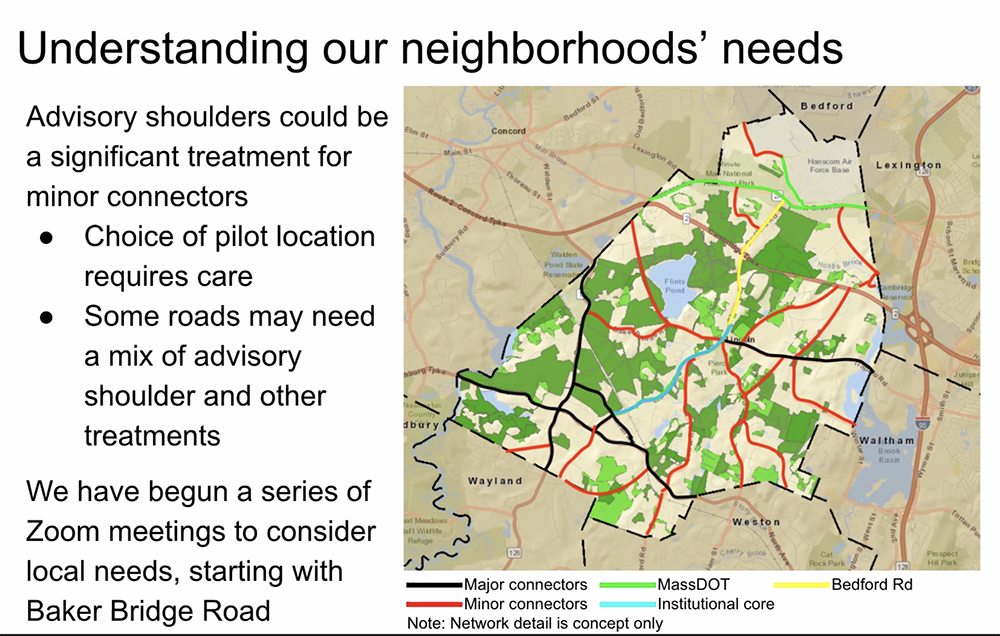
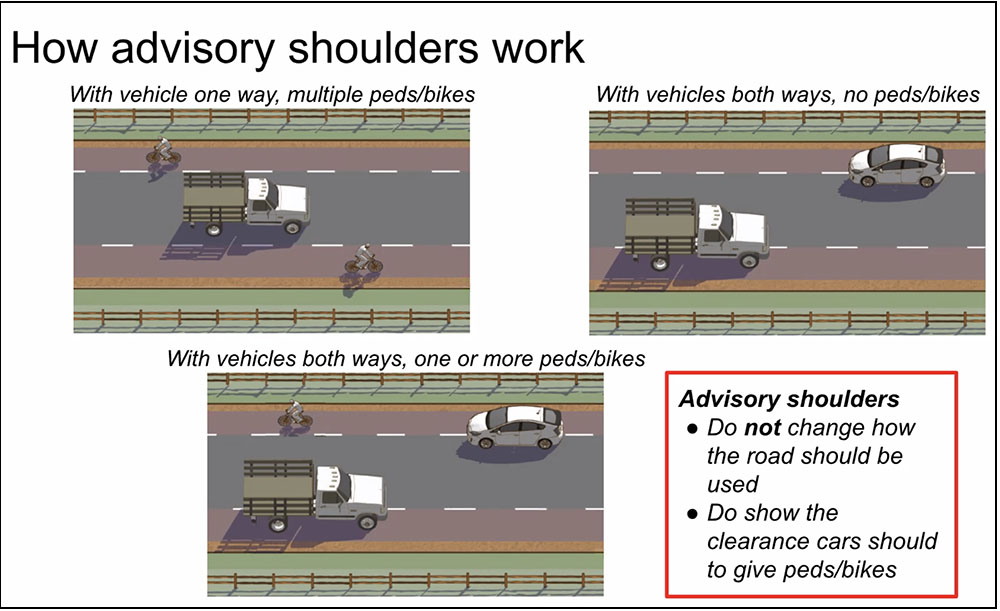
Bob Wolf and Ginger Reiner of the Bicycle and Pedestrian Advisory Committee (BPEC) outlined a method that could be used to make Lincoln’s roads safer for bikes and walkers. Advisory shoulders are lanes marked with white dashed lines on either side of a road to indicate where bikes and pedestrians have the right of way. Vehicles can cross the lines to avoid traffic coming from the opposite direction but must yield to oncoming traffic if there are “vulnerable users” (bicyclists, pedestrians, or any other non-vehicle) ahead or alongside.

The committee and its predecessor, the Cycling Safety Advisory Committee, came into being after two bicyclists were killed and a third was injured in three separate accidents on Lincoln roads in 2016. More than half of the residents who responded to a subsequent town-wide survey said they were not comfortable biking or walking on some of Lincoln’s roads.

As a road safety measure, advisory shoulders have the advantage that they are inexpensive and easy to create. “It doesn’t change how the road should be used, but it shows the clearance that vehicles should give vulnerable users,” Wolf said. In other towns such as Hanover, N.H., that have tried this approach, “drivers get used to this pretty quickly.”

The BPAC studied Baker Bridge Road as a possible first case where advisory shoulders could be installed. As one of several designated “minor connectors” in town, the road offers connections to schools and access to conservation trails. In a neighborhood Zoom meeting with the BPAC in October, there was “universal agreement” among Baker Bridge Road residents that the road is not safe for pedestrians and family cycling.

Wolf acknowledged that “it’s not one size fits all for all Lincoln roads” and invited residents of other neighborhoods to set up a Zoom meeting with the committee to discuss safety issues by emailing lincoln-bpac@googlegroups.com.

South Lincoln

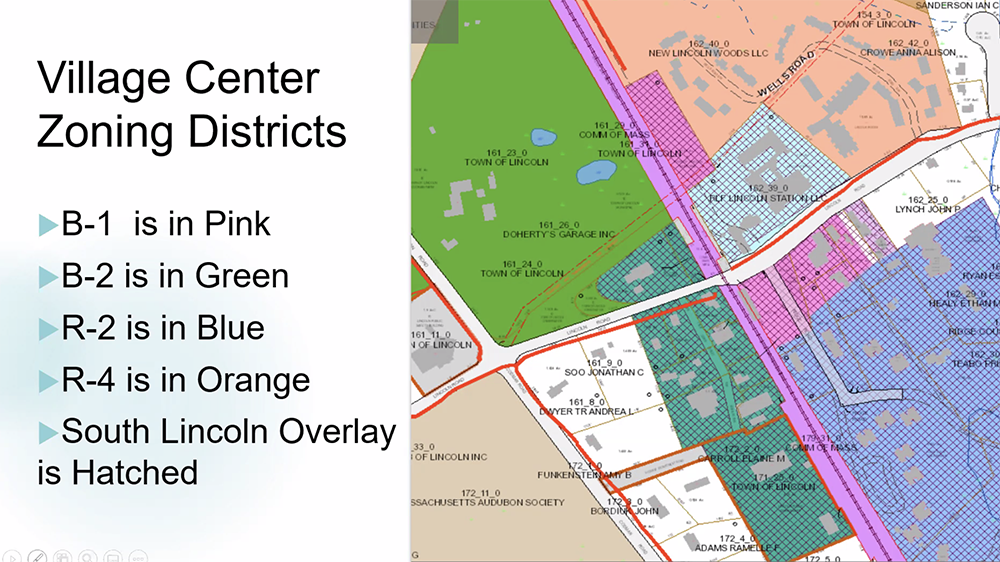
The South Lincoln Planning and Advisory Committee (SLPAC) has “restarted the process to evolve our village center” to make it more vibrant for residents and businesses, Planning Board chair Margaret Olson said. Businesses in the area have been struggling for some time, and a “confusing and costly” permitting process on top of a “hodgepodge” of five different zoning districts has made it very difficult for any sort of new development to win approval.

Revamping the zoning rules in South Lincoln would offer more flexibility in building uses, a more diversified housing stock, and a clearer permitting process while still imposing design guidelines to ensure new development is in keeping with Lincoln’s “look” and character, Olson said. SLPAC and the Planning Board will “build consensus… around an open and transparent process” with broad public participation and input. As part of that goal, the committee is inviting public comment any time and posting letters from residents on its website.

As part of the larger goal to limit climate change, the town hopes to encourage use of the commuter rail stop as well as energy-efficient buildings and more usage by bikes and pedestrians. The state also wants to encourage more use of mass transit. For example, Massachusetts House Bill 3931 would require multifamily zoning within one mile of train subway and bus stops.

While that particular bill may not pass, “there is pressure mounting in the system for something along these lines,” Olson said. “When regional problems get too big, the dam breaks, and 40B [the affordable housing mandate] is an example of that. We need to indicate how we want the town to change and adapt to the political and environmental changes headed our way in the next few decades.”

SLPAC’s predecessor tried to bring zoning changes to a town-wide vote last year but met with stiff opposition from residents who, among other things, were worried that residents in midrange housing such as the Ridge Road condominiums would be displaced. “SLPAC has heard that loud and clear,” Olson said, adding that near-term rezoning efforts will focus only on the south side of Lincoln Road.

The need for action is not hypothetical. The privately owned sewage treatment system used by Lincoln Woods and the mall is past its useful life, and the town plans to commission a study of options for upgrading and expanding it or else finding some other solution to allow more development.

Another reason for rethinking the South Lincoln commercial area: the mall itself will not be economically viable for much longer. Michelle Barnes, chair of the Rural Land Foundation (which owns the mall) reiterated her statement from last spring that changes in shopping habits are making it increasingly difficult for stores to succeed.

“I’m trying not to say anything about our current collection of enterprises, but I think it’s fair to say that over time, year after year, we have seen a decline in business at the mall,” Barnes said at the SOTT meeting. “Thinking about what’s going on economically elsewhere with local malls, they just have not been surviving, and certainly not thriving. The longer-term trends don’t look that great and we feel we have to be proactive in making sure it stays a vibrant place.”

The RLF operates the mall as a nonprofit, Barnes noted. “As economic forces on the mall continue to go in one direction, the fact that we don’t have much margin makes that endpoint collide eventually. That’s not tomorrow, but the long-term sustainability of the mall in its current state is not tenable.”

Category: businesses, government, land use, South Lincoln/HCA* 6 Comments

State of the Town updates to span three evenings

November 9, 2020

Lincoln’s annual State of the Town meeting will be split into three online meetings from 7­–9 p.m. on three consecutive days next week. Topics and dates will be as follows. Click here to register for any or all of the sessions.

Tuesday, Nov. 17

  • Public health update
    • Lincoln Covid-19 web page
  • Town Meeting preview
  • School building project update
    • School Building Committee website
  • Budget preview

Wednesday, Nov. 18

  • Diversity, equity, inclusion, and antiracism
    • Background and links to the videos and slide decks of the three Board of Selectmen’s roundtables

Thursday, Nov. 19

  • Electricity aggregation pricing update
    • Lincoln Green Energy Choice
  • South Lincoln Planning and Advisory Committee update
    • SLPAC web page
    • “South Lincoln panel is now a five-member SLPAC” (Lincoln Squirrel, June 10, 2020)
    • “Septic treatment becoming an issue for mall and South Lincoln” (Lincoln Squirrel, Oct. 12, 2020)
  • Bicycle and Pedestrian Advisory Committee update
    • “New bike/pedestrian group seeks members” (Lincoln Squirrel, Jan, 7, 2019)

Category: government, health and science, land use, news, schools Leave a Comment

Clarification

October 13, 2020

The October 12 story headlined “Septic treatment becoming an issue for mall and South Lincoln” may have implied that the four-member South Lincoln Planning Advisory Committee will not have any presence from the Finance Committee. While he will not be a voting member, FinCom member Tom Sander will act as liaison to SLPAC. The article also said that the FinCom was short by two members, but it is now back at full strength with the addition of new members Deb Wallace and Rich Rosenbaum.

Category: land use, news Leave a Comment

Septic treatment becoming an issue for mall and South Lincoln

October 12, 2020

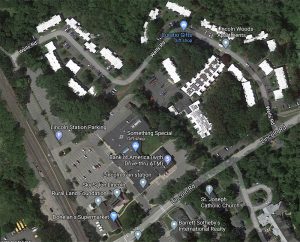
A aerial view from Google Maps of the Mall at Lincoln Station and Lincoln Woods (click to enlarge).

(Editor’s note: this article was updated on October 13.)

To remain economically viable, the Mall at Lincoln Station needs an upgrade to the septic treatment facility for the entire area, according to the Rural Land Foundation, which owns the mall.

Last winter, officials proposed rezoning parts of South Lincoln to create more incentives for businesses and moderate-income housing, but the idea met with opposition from residents and was shelved. However, it appears that even if the town did vote to loosen some restrictions on commercial and residential density in the area, the bigger infrastructure issue remains, even in the shorter term.

Michelle Barnes, chair of the RLF and Lincoln Land Conservation Trust, thanked town officials for this “unexpected and welcome opportunity to consider redevelopment” of the mall in a letter to the Board of Selectmen last spring. However, “in considering this opportunity, it has become apparent to us that there is no real feasible way to redevelop the Mall at Lincoln Station, nor the wider area beyond the mall, without first solving the problem of creating a viable septic solution supportive of such development.”

Barnes reiterated the message in a meeting with the Board of Selectmen on October 5 that was also attended by Planning Board members. Given the ongoing decline of smaller brick-and-mortar stores and malls as well as added financial stresses caused by the pandemic, “the belief that the RLF could preserve the mall in its current state is untenable,” she said.

Much of the South Lincoln area is in the same boat when it comes to expanding property use, Barnes added. “If every Lincoln Station landowner who wanted to develop their property in the future satisfied their sewage treatment needs on their own premises, there would be significant economic and operational challenges that would impede such development, and important economies of scale would be lost by trying to do it piecemeal.”

Community Builders (TCB), which owns the Lincoln Woods apartment complex, operates a septic treatment facility on land northwest of the mall adjacent to the train tracks and leases the use of some of its capacity to the RLF. Before it was built, the mall had its own septic system, “which too frequently failed,” Barnes said. A solution to the septic issue is “a crucial first step to any redevelopment.”

About a decade ago, the town commissioned a study by Camp, Dresser & McKee into the future viability and potential expansion of the plant, which has been operating since 1976. At the time of the consultant’s report, the plant was operating at about 50% capacity, processing 12,900 gallons per day (gpd) of wastewater. It was designed to receive an average of 30,000 gpd and was permitted for 26,000 gpd, the report said.

The report outlined three possible upgrade scenarios and cost estimates:

  • Make minor modifications and increase the plant’s usage to 17,300 gpd ($2.03 million)
  • Do a process upgrade to increase the average daily flow to 26,000 gpd ($2.49 million)
  • Replace the existing facility with a plant that could serve the entire South Lincoln Sewer District, including Lewis Street and the Lincoln School, treating 45,000 gpd ($5.8 million).

A more pressing issue is the current state of the facility. If its single-walled steel tank were to fail, the plant would be inoperable and it would cost TCB $14,000 a week to truck wastewater away for off-site treatment while repairs were being made, the 10-year0old report said. When the report was written, the tank had already exceeded its 20-year expected lifespan.

Selectmen and others at this month’s meeting acknowledged that any upgrade to allow more development would be very costly for TCB, so the town would have to provide “some sort of incentive or support for them,” said Planning Board member Gary Taylor. “TCB may not be amenable to going forward with this… we may have to look at other options.”

Among the options that could be explored are using some of the town’s conservation land in the area for additional wastewater treatment, which would require an equal amount of land elsewhere in town to be put into conservation status.

“It’s a very complicated problem, but it’s fundamental to any kind of development at the mall,” Taylor said.

“This septic question has to be addressed at the outset of any SLPAC work,” said Selectman James Craig. “If we don’t solve it, we’ll be constrained to something not very different from what we have right now.”

SLPAC is the South Lincoln Planning and Advisory Committee, a retooled version of the former 12-member SLPIC (where the “I” stood for “implementation”). SLPIC spearheaded several projects to revitalize South Lincoln, and the rezoning proposal came from one of its subcommittees. SLPAC was created in June and expected to have five members, but it’s now down to four because the Finance Committee will be represented by a liaison (Tom Sander) rather than a full voting member who would be expected to attend all meetings.

Town Administrator Tim Higgins suggested creating a group with members from the Planning Board, SLPAC, and the Board of Health as well as TCB to scope out a new town-funded study of septic treatment options. SLPAC has already been talking to Camp, Dresser & McKee about updating their study and researching grant funding for it.

Even before its first meeting, SLPAC was already generating controversy — this time about whether it should hold morning or evening meetings. At the Planning Board’s July 28 meeting, Bob Domnitz moved that it meet no earlier than 7 p.m., but after lengthy discussion, the motion failed by a 3–2 vote. However, a second vote to “encourage SLPAC to meet in the evening whenever possible” passed unanimously.

The Planning Board is scheduled to discuss the South Lincoln septic issues at its October 13 meeting. Selectmen will also discuss it further at their next meeting to “hammer out a path forward,” Craig said.

Category: businesses, land use, South Lincoln/HCA* 1 Comment

Property sales in September

October 11, 2020

3A South Commons — Rajesh K. Dasari to Brain Hurley for $479,000 (September 17)


22 Juniper Ridge Rd. — Walter Scott to Jinquan Liu for $50,000 (September 3)

30 Windingwood Lane — Leonard Notkin to Kavita S. Reddy for $574,000 (September 24)

4 Farrar Rd. — Jean-Pierre Carney to Igor and Robin Dobrusin for $1,375,000 (September 10)

352 Hemlock Circle — Christine Wanke to Helena Lau and Chris Chen for $513,500 (September 18)

19 Twin Pond Lane — Velma Frank to Gregory and Kate Geusic for $1,745,000 (September 28)


Category: land use Leave a Comment

Property sales in August 2020

September 27, 2020

8 Silver Hill Rd. — John Peters to Kathy and Andy Gabelman for $925,000 (August 31)

140 Lincoln Rd. — Leo W. Roache to James B. and Diane M. Callahan for $451,000 (August 31)

11 Hillside Rd. — William A. Nockles to Brooks and Patricia Mostue for $575,000 (August 28)

8 Ridge Rd. — Fredrick Pennachi to Amanda G, Papper for $45,000 (August 28)

203 Sandy Pond Rd. — Kevin Styles to Ma Fei and Shen Ping for $1,700,000 (August 25)

161 Tower Rd. — Dana L. Weigent to Robert Neidlinger and Emily Barry for $916,000 (August 21)

94 Mill St. — U.S. Bank and Trust (trustee) to Li Wei and Zhang Xiochun for 1,186,500 (August 14)

252 Lincoln Rd. — John J. O’Sullivan to Camille Petri and Michael Cameron for $1,052,000 (August 14)

67 Conant Rd. — Christopher White to Matthew Bio and Matina Madrick for $1,690,000 (August 14)

43 Birchwood Lane —Addison D. Cole to Barbara M. Pedulla for $547,500 (August 12)

263 Old C0ncord Rd. — Peter H. Guldberg to Fairhaven Bay Lincoln LLC for $3,125,000 (August 7)

131 Lincoln Rd. — Edward W. Schuller to Anna A. Crowe and Russell E. McConnell for $862,000 (August 6)

Category: land use, news Leave a Comment

Outdoor watering now limited to once a week

August 24, 2020

Residents on town water must now limit non-essential outdoor watering to one day a week because of this summer’s drought conditions, though agricultural watering is exempt from these restrictions.

After above-normal temperatures in July and early August and more than three months of below-normal rainfall, state Energy and Environmental Affairs Secretary Kathleen Theoharides declared a Level 2 – Significant Drought in all seven regions of the Commonwealth. Lincoln’s Water Commission subsequently voted to move to Stage 3 drought restrictions as specified in the town’s Drought Management Plan.

Lincoln water customers may water established lawns and landscaping on their assigned day using in-ground irrigation systems or hose-mounted sprinklers between 7 p.m. and 7 a.m. Those with even-numbered street addresses may water on Saturdays and odd-numbered addresses on Sundays. Hand-watering using a hose is allowed any day of the week between 6 p.m. and 9 a.m.

Exceptions for new lawns are allowed only during June and September and will be limited to watering during the first 20 days after installation. In addition, swimming pools may be filled no more than three inches per month, and car washing is prohibited.

People with home gardens must follow the residential restrictions for non-essential watering, since hand-watering should be sufficient. Those who officially qualify as farmers, however, are allowed to water as needed. This includes customers who have been approved for agricultural water rates and those whose property meets the definition of “farm” as outlined in the town’s agricultural zoning bylaws.

The Water Department will issue warnings and potentially fines to customers who violate the watering restrictions.

Category: agriculture and flora, conservation, government, land use, Water Dept.* Leave a Comment

Property sales in June

July 26, 2020

148 Lincoln Rd. — Jessica Packineau to Ethan and Bridget Healy for $890,000 (June 30)

37 Laurel Drive — Terrence Warzecha to Carlota Vinals y de Basols for $1,505,000 (June 29)

9 Rockwood Lane — Ruth D. Williams Trust to Rosaline Salifu and Andy Alhassan for $605,000 (June 29)

4 Garland Rd. — Sonja Wolfsberg to Kimberly and Gregory Goldmacher for $1,837,500 (June 29)

104 Codman Rd. — Arthur Cotoni to Carl Angiolillo and Shira Horowitz for $1,155,000 (June 26)

11 Linway Rd. — Donald H. Wilson Trust to Jacob Lehrhoff and Philana Gnatowski for $900,000 (June 25)

82 Virginia Rd. #402 — Susan Isbell to Maureen Onigman for $174,505 (June 16)

98 Codman Rd. — Maureen Onigman to David Onigman for $700,000 (June 15)

42 Silver Hill Rd. — Liam Spaeth to Craig Bloem for $1,955,000 (June 12)

23 Conant Rd. — Alexander MacLean to Benjamin Armstrong and Gabrielle Emanuel for $1,319,000 (June 5)

80 Birchwood Lane — Guilbert Winchell to Clark Winchell and Katherine Brustowicz for $1,000,000 (June 1)

16 Pine Ridge Rd. — Lawrence Paige Pagliarani to Robert and Morgan Lyon for $825,000 (June 1)

Category: land use Leave a Comment

Property sales in May 2020

July 6, 2020

40 Huckleberry Hill Rd. — Susan E. Conway to Alexandra Chomut and Christopher E. Brook for $1,800,000 (May 29)

41 Greenridge Lane — Patrick Greene to Christopher McCarty and Nataly Dvash for $550,000 (May 27)

59 Winter St. — Richard Wiggin to Marcus and Nicole Ruopp for $1,420,000 (May 18)

3 Smith Hill Road — Piyush Srinivastava to Brendon and Rachel Reiff for $1,150,000 (May 8)

21 Birchwood Lane — Alan J. Shapiro to Anthony M. Dubon and Kary K. Lee-Dubon for $598,320 (May 8)

54 Conant Rd. — Mary Q. Pope to Meghan K. Lytton for $1,090,000 (May 6)

Sandy Pond Rd. — Joseph Kasputys to [name withheld at editor’s discretion] for $1,078,000 (May 2)

Category: land use, news Leave a Comment

Property sales in March and April 2020

June 23, 2020

10 Stratford Way — Zovag Guldalian to Hong Tan and Shuihuang Hua for $2,550,000 (April 17)

242 Aspen Circle — Jean P. Gosselin to Laura Sher for $535,000 (April 17)

9 Oakdale Lane — Scott Lovering to Adam Jaskievic and Andrew Morton for $1,340,000 (April 10)

72 Winter St. — Edward Babrich to Harrison R. and Emma S. Shulman for $1,455,000 (April 2)

78 Codman Rd. — James Fleming to Amy B. Finkelstein and John Nolan for $1,320,000 (March 31)

144 Trapelo Rd. — Leonard Darling to Amy B. Naughton Trust for $1,949,000 (March 25)

136 Weston Rd. — Robert H. Mason to Jude T. and Francine McColgan for $1,925,000 (March 25)

38 Old Winter St. — David L. Forbes to Justin and Kristin Hopson for $1,638,000 (March 5)

19 Bedford Rd. — Laura Pontin to Eric and Joseph Webster for $1,787,500 (March 3)

Category: land use Leave a Comment

  • « Go to Previous Page
  • Page 1
  • Interim pages omitted …
  • Page 14
  • Page 15
  • Page 16
  • Page 17
  • Page 18
  • Interim pages omitted …
  • Page 38
  • Go to Next Page »

Primary Sidebar

Recent Posts

  • Legal notice: Historical Commission – Aug. 4 hearing (5 Hawk Hill) July 21, 2026
  • Legal notice: Conservation Commission – July 29 hearing (219 Concord) July 21, 2026
  • News acorns July 20, 2026
  • Revised version of the Lincoln Review July 16, 2026
  • Lincoln resident to walk the Cape for immigrant justice July 15, 2026

Squirrel Archives

Categories

Secondary Sidebar

Search the Squirrel:

Advanced search

Privacy policy

© Copyright 2026 The Lincoln Squirrel · All Rights Reserved.