• Skip to primary navigation
  • Skip to main content
  • Skip to primary sidebar
  • Skip to secondary sidebar

The Lincoln Squirrel – News, features and photos from Lincoln, Mass.

  • Home
  • About/Contact
  • Advertise
  • Legal Notices
    • Submitting legal notices
  • Lincoln Resources
    • Coming Up in Lincoln
    • Municipal Calendar
    • Lincoln Links
  • Merchandise
  • Subscription Info
    • My Account
    • Log In
    • Log Out
  • Lincoln Review
    • About the Lincoln Review
    • Previous Issues
    • Submit Your Work
    • Subscribe/Donate

government

Cuetos wins Trustees of Bemis seat as write-in candidate

March 31, 2026

(Editor’s note: This article previously stated that there were no contested races, but it has been corrected to not that there include the previously overlooked contest for the Parks and Recreation Commission race.)

In a town election where there was only one contested race, David Cuetos — who did not appear anywhere on the actual ballot — managed to garner votes for three different positions and was in fact elected as a Bemis trustee.

No one filed to run for the Trustees of Bemis opening in the March 30 election, but Cuetos won as a write-in candidate with three votes. Eight other residents  — Chris Bursaw, Montana Bray, Christopher Burns, Donald Collins, Ephraim Flint, Patrick Lawler, Sue Parker, and Dilla Tingley — won two votes apiece, and many other residents received single votes, according to Town Clerk Valerie Fox.

“This was a complete surprise to me. I learned about it this afternoon when I received an email from the town clerk,” Cuetos told the Lincoln Squirrel on Tuesday evening. “Apparently I was written in by some voters to many different offices across the ballot.”

Asked if he planned to serve in the Bemis role, he said, “I don’t know yet what I’d do. My goal is to join the Finance Committee and by our bylaws, that post requires exclusivity. I have expressed my continued interest in that position to the chair of FinCom and the new town moderator. If the moderator doesn’t appoint me, I think I’d honor the support of those voters who deposited their confidence in me.”

If Cuetos declines the Bemis position, a candidate will be appointed by the current Bemis trustees and the Select Board. That person will hold the seat until the next election, when two seats will be up for election (one person for the remaining two years of this seat and another for the normally expiring three-year term).

FinCom has two three-year terms currently expiring. New members must be appointed by the moderator within 30 days of Town Meeting. “I don’t know whether Merrill Berkery or Rich Rosenbaum have expressed interest in another term, but in my view incumbency alone should not guarantee reappointment,” Cuetos said.

In the only contested race, newcomer Hilary Dionne beat out David Onigman for a seat on the Parks and Recreation Commission by a vote of 365–246. Onigman had been serving as an appointed member to fill a vacancy.

Andrew Payne, the sole candidate on the ballot for Town Moderator, garnered 612 votes, but Cuetos also got 51 write-in votes (40 in Precinct 1 and 11 in Precinct 2). Three other residents (Susan Mygatt, Richard Ohlsten, and Peter Sugar) each got a single write-in vote.

Margaret Olson regained the seat on the Planning Board that she lost in last year’s election. She will succeed Craig Nicholson, who did not run for reelection. Four voters wrote in Cuetos for that race as well, and Sarah Postlethwait got five votes.

Offices & CandidatesPrec. 1Prec. 2Total
SELECT BOARD
Kimberly A. Bodnar429216645
Write-in/blank712596
Total500241741
BOARD OF ASSESSORS
Ellen Bassett Meadors426219645
Write-in/blank752296
Total500241741
BOARD OF HEALTH
Frederick Lawton Mansfield423216639
Write-in/blank7725102
Total500241741
CEMETERY COMMISSIONER
Manley B. Boyce432212644
Write-in/blank682997
Total500241741
COMMISSIONER OF TRUST FUNDS
Derek Paul Fitzgerald413208621
Write-in/blank8733120
Total500241741
LS REGIONAL SCHOOL DISTRICT COMMITTEE (2 seats)
Ravi Simon365178543
Jason David Mclure382200582
Write-in/blank253104357
Total10004821482
MODERATOR
Andrew Clinton Payne407205612
Write-in/blank9336129
Total500241741
PARKS AND RECREATION COMMITTEE
Hilary Dionne242123365
David Henry Onigman16878246
Write-in/blank9040130
Total500241741
PLANNING BOARD (2 seats)
Lynn E. Delisi380186566
Setha Margaret Olson363182545
Write-In/Blank13215
Blank244112356
Total10004821482
SCHOOL COMMITTEE (2 seats for 3 years)
Matina Madrick385189574
Thomas Nickerson363174537
Write-in/blank253119372
Total10004821482
SCHOOL COMMITTEE (1 year)
Jessica Burke Callow408203611
Blank9238130
Total500241741
TRUSTEES OF BEMIS FUND
Write-in7833111
Blank422208630
Total500241741
WATER COMMISSIONER
Matthew Michael Bio420208628
Write-in/blank8033113
Total500241741

Category: government Leave a Comment

Town Meeting features two different takes on ‘bright light’

March 29, 2026

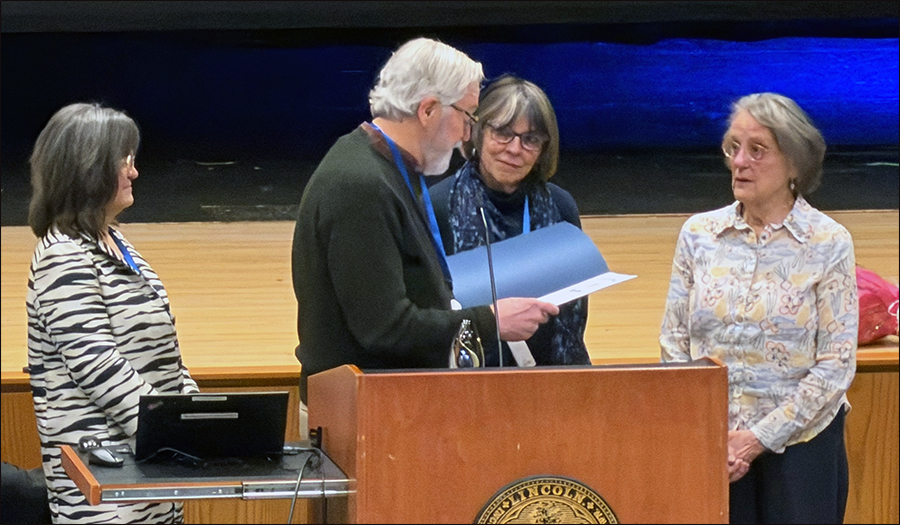
Former Selectman Gary Taylor reads the Bright Light Award citation to Sarah Cannon Holden (right) as fellow former Selectman Sara Mattes (center) and current Select Board member Jennifer Glass (left) look on. (Click image to enlarge)

Lincoln residents gathered on March 28 for an Annual Town Meeting that included both a reflection on decades of civic service and a forward-looking debate on how to preserve the town’s character in a changing world. 

Bright Light Award

The highlight of the morning was the presentation of the Bright Light Award to Town Moderator Sarah Cannon Holden, who was presiding over her final Town Meeting after 15 years in the role. Select Board member Jennifer Glass delivered an emotional tribute, noting Holden’s 36 years of elected and appointed service that included stints on the Finance Committee, School Committee, and Select Board. Before the award was presented, a slide show displayed some of Holden’s Lincoln history as well as short video tributes to “Rahrah” from her grandchildren and others.

Holden, who is an attorney and professional mediator, “mentored countless fellow volunteers and taught the next generation to find their voice and positively impact the community,” Glass said. Quoting Holden about a contentious meeting in the past, she added, “It was fun, it was inspiring, it was messy at times, it was democracy.”

In her 36-year career as a Lincoln volunteer, “I learned about different perspectives on issues and human resistance to change,” Holden said. “The greatest gift is the unique opportunity when serving as moderator and on other boards is to learn from people” of all types and from everywhere in town, she said. “It is what we celebrate this year [America’s 250th anniversary], it is what we must protect vigilantly… [our duty is] to be informed, to volunteer, to be at Town Meeting, and to vote.”

Holden’s two former Selectmen, Sara Mattes and Gary Taylor, helped present the award, with Mattes (who recently published an appreciation of Holden in the Lincoln Squirrel and on LincolnTalk) noting that the trio were known then as “Sara, Sarah, and Not-Sarah.”  Holden received a standing ovation and a citation from the President of the Massachusetts Senate for her service.

Article 32 cast a look farther back in Lincoln history in asking for a town vote on the same question that was put before voters in 1776: whether or not to support the forthcoming Declaration of Independence by the Continental Congress. Two Lincoln historians, Rick Wiggin and Don Hafner, read speeches that were given in town on May 20, 1776 for and against declaring independence.

“Imagine the choice the colonists faced: king or no king,” Holden said before Wiggin presented the pro-independence argument with some lines that carried new relevance in 2026.

“America today is at a crossroad” in deciding whether “a king who is greatest enemy of this country shall continue to tell us, ‘there shall be no laws but such as I like’,” Wiggin said. Ironically, Lincoln was one of only two towns in Massachusetts that voted against the measure in 1776.

Modernizing Town Meeting

Kenny Mitchell, chair of the Town Meeting Study Committee, presented the group’s report with recommendations on how to improve the efficiency and accessibility of the centuries-old tradition. Kenny Mitchell noted that while the current process works well for typical meetings, “high-interest items” can double or triple attendance, straining the system.

The committee outlined five key themes for improvement:

  • Preserving traditions
  • Reducing meeting length
  • Ensuring fair and balanced motions
  • Improving access and voting technology
  • Reducing confusion and discomfort

Several of the recommendations have or will soon implemented, such as clickers for instant vote-counting, scheduling high-interest items first, and a two-minute time limits for comments from the floor with a countdown clock shown on screen. Other ideas that were popular among earlier survey respondents but would require town bylaw amendments are scheduling specific voting times for high-interest issues and remote voting, which would also require approval from the state legislature. Lincoln officials will monitor the progress of a home rule petition by Wayland that asks the legislature to allow this, “but I think this is a ways off,” Mitchell said.

The clickers, which officially debuted a year ago, were a hit. In a brief post-meeting poll (also done by clicker), 85% of participants rated the three-hour meeting length as “just right.”

Budget and capital projects

Finance Committee Chair Paul Blanchfield presented a $52.5 million budget for FY27 (pages 43-48 in the Financial Section & Warrant) representing a 1.3% decrease from this year. The budget includes the use of $2.3 million in excess reserves to provide tax relief, resulting in a flat tax bill for the median household. Lincoln’s average tax bill has grown by about 5% in recent years, which is higher than the inflation rate but somewhat lower than the increases in neighboring towns, he said.

Key capital approvals included:

  • $1.28 million for Community Preservation Act projects (pages 3-7 in the list of motions)
  • $822,916 in Capital Planning Committee projects plus $1.05 million for a new fire engine to replace a 1999 model (pages 8-12 in the list of motions)
  • $457,350 for the Water Department, including the third year of a smart meter rollout, a generator for the Tower Road well, and building repairs.

As expected, votes to fund the library HVAC project were passed over after independent energy advisors found that previous tax credit assumptions were “overly optimistic” by roughly $500,000. An environmentally friendly ground-source heat pump system was expected to cost the town about $2.5 million after rebates and incentives, which will still be available alter this year, Blanchfield said. Meanwhile, the town is getting a second round of estimates for both heat pump and conventional boiler options

“It does not delay the need for replacement, but allows us to make a better-informed decision,” he said. A refined funding plan is expected for a Special Town Meeting in the fall.

Dark Skies

The most robust debate centered on Article 35, an amendment to the town’s “dark skies” zoning bylaw. Sherry Haydock of the Planing Board’s Dark Skies subcommittee argued that the changes are essential to minimize the effects of light pollution on birds, fireflies and other wildlife, particularly harms to circadian rhythms and bird migration, which mostly happens at night, she said. The Planning Board voted last week 3-1 to endorse the amendment.

The new regulations will only apply to properties with new construction, substantial renovations, or change of use, as well as any newly installed fixtures on existing buildings. They require:

  • Shielding to direct all light toward the ground
  • A maximum light color temperature of 2700K (down from the current 3000K)
  • Limits on brightness (900 lumens)
  • New rules on hours of operation for lighting not associated with active use

There is a waiver application process, Haydock said in response to a question from resident Karen Seo, who keeps sheep and uses nighttime lighting to keep away coyotes. Resident Andrew Pang also said the new rules were “overly burdensome” because fixtures that comply with Lincoln’s new rules (some of which are more stringent than guidelines from DarkSky) were difficult to find in the course of a recent renovation at his home.

“The amount of time and energy that we spent was extraordinary and onerous,” Pang said, adding that “the market right now does not support” easy identification of Lincoln-compliant fixtures. However, resident Don Halsted, who also did a recent renovation, urged people to use Google Gemini in the search. “Have patience, use AI, and get fixtures with screw-in lightbulbs,” he said.

Another thorny issue is Christmas lights. “There are people who like to celebrate holidays for an extended period of time,” resident Jennifer Morris remarked to knowing laughter from the audience.

“Would one of the committee members like to talk to my neighbor so as not to cause discord? I hope my neighbor isn’t here today,” quipped another resident.

The Planning Board sought legal advice about whether or how to limit holiday lights or specify the length of time they can be displayed, but these issues could be construed as limiting religious expression, “and town counsel said, ‘Don’t touch it, it’s a hot potato’,” board member Susan Hall Mygatt said.

Resident Diana Beaudoin urged passage of the “deeply important” amendment. “I think this bylaw, more than anything I’ve seen in my 35 years in Lincoln, expresses the real values of Lincoln and why so many people choose to move here,” she said. The article passed with a 195-48 vote, clearing the required two-thirds majority hurdle.

Voters also overwhelmingly supported a citizens’ petition to file a home rule petition to ban anticoagulant rodenticides. Residents and local veterinarians spoke passionately about the secondary poisoning of owls, hawks, and foxes that eat poisoned rodents.

Category: government Leave a Comment

Town Meeting 2026 preview

March 25, 2026

Here is some information and links to previous Lincoln Squirrel stories about some of the warrant articles that will be voted on at the Annual Town Meeting on Saturday, March 28. See the town web page above for the article list, warrant, and motions.

Town Meeting Study Committee (Article 3)

The TMSC will report on its recommendations for making Annual Town Meeting more efficient and transparent.

  • Group makes recommendations for improving Town Meeting (February 10, 2026)

Community center update (Article 4)

  • Happy faces and shiny shovels at community center ground-breaking (October 8, 2025)
  • All Lincoln Squirrel stories on the community center

Town budget and other allocations (Article 5 and others)

  • Library HVAC project postponed; 0% tax increase in FY27 (March 13, 2026)
  • Three spending meetings on the horizon (March 1, 2026)
  • See also:
    • Article 6 (Community Preservation Act projects) — $1.4 million total
    • Article 9 (Capital Spending Committee projects) and Article 10 (fire truck) — $1.9 million total
    • Article 14 (Water Department capital projects) — $457,000

Lincoln-Sudbury Regional Agreement update (Article 33)

A vote to approve updates to the agreement (last updated in 1988) submitted by an inter-town group that bring the language into alignment with current state law and how the district operates today.

Dark Skies zoning bylaw amendment (Article 35)

The proposal would update Section 13 of the zoning bylaw to place more controls on the types and usage of outdoor lighting on new and substantially renovated buildings.

  • Planning Board votes 3–1 to endorse Dark Skies measure (March 25, 2026)
  • Dark Skies group finalizes zoning amendment proposal (March 12, 2026)

Request to ban on anticoagulant rodenticides (Article 26)

  • Citizens’ petition seeks to ban certain rodenticides (February 16, 2026)

Category: government Leave a Comment

Officials defend actions relating to the Hanscom misallocation issue

March 24, 2026

At two recent meetings, town officials sought to offer more detail about the Hanscom misallocation and pushed back against the idea that there had been actual mistakes by anyone.
 
In 2024, an outside consultant found that — under terms of the contract between Lincoln and the Department of Defense Educational Activities (DoDEA) then in effect — not enough money was allocated to the town from that contract for some expenses. The issue was raised by resident David Cuetos and eventually resulted in a review of the contract and a report by the Collins Center, which found that “some expenses, typically paid by the town on behalf of the Hanscom contract, were being funded by outdated methodologies,” School Committee Chair Matina Madrick said at the group’s March 19 meeting.
 
Since then, a revised allocation approach was adopted and about $560,000 has been returned to the town’s general fund for Hanscom pension liabilities in FY 2024 and FY2025, but resident David Cuetos and others have been trying to get the town to recover a further $1.5 million they say it is owed from the Hanscom reserve fund.
 
Cuetos et al maintain that the town should also get reimbursed for misallocations for several earlier years, but the Collins Center report did not address that specifically.

“The amount paid for these years is the difference between what was already paid and the amount if the new methodology had been applied to these contract years. These are the only past years for which actuarial determined contributions are available,” Madrick said.
 
The report — which was issued about a year before the current contact with DoDEA was signed — updated the methodologies for determining pension payments and indirect cost payments to the town. It made numerous recommendations for improving town and Lincoln Public Schools policies and procedures as well as financial and accounting operations concerning Hanscom. The report also recommended seeking special legislation to establish the Hanscom contract as an “enterprise account operation.”
 
Some have expressed unfounded fears that town funds have gone directly to Hanscom when they shouldn’t have, but Madrick vigorously disputed that notion.
 
“At no time has the Lincoln School Committee taken money from the town general fund to pay for Hanscom expenses. The School Committee does not have the authority to move money from the town’s general fund,” she said. “The Hanscom reserve is entirely made up of DoDEA funds from the contract. There is no Lincoln tax levy that goes into the Hanscom reserve.”

As a result of the new methodologies, the annual payment for pension benefits has gone from roughly $200,000 to over $400,000 per year, and the indirect costs (the administrative costs the town incurs to run benefits and other administrative costs for the contract) have gone from $71,000 to close to $200,000, she said.

Madrick added that the Hanscom reserve “should be used primarily to protect the town from increased expenses at Hanscom due to a loss or change in the contract.” In that case, Lincoln would probably be solely responsible for educating the children who live on the base, and the increased expenses would include unemployment benefits for laid-off workers as well as pension and retiree benefits in addition to operating expenses for the Hanscom School.
 
“Additionally, the School Committee was cautious to commit too much money out of the reserve because of the new financial structure of the new DoDEA contract” that began on July 1, 2025, whose “revenue structure differs from the previous contract significantly.”
 
However, Cuetos said at the School Committee meeting that “several of the explanations offered for refusing [additional] reimbursement are not supported by the record” and said that Hanscom has been running an annual budget deficit for several years. He also argued that the School Committee does not have control of those funds by right (a notion that has been refuted by town counsel and others). He and others added that the town should “take a much more active role” in overseeing Hanscom funds.
 
The Select Board agreed at their March 23 meeting with the sentiment that other town officials should have some oversight over Hanscom finances. Board member Jennifer Glass went even further in advocating for consistency across other town departments.
 
“I agree a hundred percent,” board member Jim Hutchinson said. “If we do this for the School Committee, it better be the same for the Water Department, the library, or any other department that does any kind of budgeting or allocation of shared costs.” 
 
But Hutchinson also said he was “troubled” about the tone of some residents when discussing the issue. 
 
“I disagree with using the words ‘error’ and ‘mistake.’ I feel like that’s when you type in a wrong number to an Excel spreadsheet. I don’t think a stale or inaccurate estimate is an error or mistake. You make estimates all over the place when you make budgets every year,” he said. “I respectfully ask residents to think about the language they use when they talk about this topic.”
 
Nonetheless, there are still “significant misunderstandings and misstatements,” said resident Sarah Postlethwait. “I know it may look bad for the town to have a misallocation pointed out, but don’t try to put lipstick on a pig.” 

When Cuetos first raised the issue in 2022, he was “dismissed and denied,” she added. “Frankly, residents are being generous in describing it merely as a mistake.”
 
“I personally am sorry it took us so long to figure out what to do about that,” Hutchinson said earlier in the meeting.

Category: government Leave a Comment

Correction

March 18, 2026

Several town and school officials commented on the March 16 Lincoln Squirrel article headlined “Residents demand more oversight of Hanscom funding,” specifically:

  • Questioning the use of “judgmental” words such as “error” and “mistakenly” to describe the allocation process involved, rather than using more neutral language.
  • Noting that the Collins Center report was a comprehensive review of the Hanscom contract, not an audit.
  • Noting that the School Committee has no power to spend money from the town’s general fund, only from the Hanscom fund.

The article has been updated to reflect these changes. A more detailed response from one or more of those officials will be published as a “My Turn” piece in a day or two.

Category: government 2 Comments

Residents demand more oversight of Hanscom funding

March 16, 2026

(Editor’s note: This article has been updated after conversations with several town and school officials on March 17. Changes are indicated with strikethrough and red text. A more detailed response in the form of a “My Turn” piece from one or more of those officials will be forthcoming in a day or two.)

Dozens of residents speaking by Zoom at the March 11 Finance Committee meeting demanded greater oversight of education spending after about $2 million was mistakenly allocated from Lincoln town funds for Hanscom School benefits and pensions from FY2021–2025.

The error inaccurate allocation was first brought to light in 2022 by resident David Cuetos. The School Committee performed an audit in 2024; also that year, a working group including Cuetos was formed. aided by a consultant. Since then, a revised allocation approach was adopted and about $560,000 has been returned, but he and others have been trying to get the town to recover the other $1.5 million.

Cuetos published his detailed report on the matter in a March 3 “My Turn” piece in the Lincoln Squirrel. FinCom chair Paul Blanchfield posted his own piece on the issue on March 9.

“Can you explain why it was OK for residents to lose control of that money? We didn’t get to vote on it or a say about what it goes towards,” Sarah Postlethwait said. “Hanscom needs to reduce their costs so they can save up for these [unfunded] liabilities. Why is this considered acceptable?”

Blanchfield said that the School Committee and not the FinCom has sole responsibility about how education funding in Lincoln is spent or saved. “In the vast majority of cases in town, I would say we have a direct democracy, but this is a little more representative. We elect School Committee members every year,” he said.

“We didn’t vote on their having the $2 million in their pocket,” Postlethwait said. 

“I’m not going to disagree with the sentiment of what you’re saying,” Blanchfield replied.

“It’s a gray area,” said FinCom member Greg Haines. “Technically [the School Committee’s]  prerogative, but the Finance Committee could make a recommendation.” 

“It’s a mistake to transfer money from the general fund to pay for Hanscom expenses,” said resident Sarah Liepert. “They should return it to where it’s supposed to be. I can’t understand any other answer than that.”

However, Committee Chair Matina Madrick later made it clear in a conversation with the Lincoln Squirrel that the School Committee does not have any authority to spend from the town’s general fund and never has (only from the Lincoln and Hanscom school funds), so it’s solely a question of what allocation of costs should be made to the Hanscom contract.

The FinCom said they would recommend that the School Committee institute a formal reserve policy. The Hanscom issue will be discussed at the latter committee’s March 19 meeting.

“I actually think the School Committee does not have the prerogative to use that money,” Cuetos said, adding that he would consult town counsel about the question. He suggested that there should be a vote on the issue at Town Meeting rather than the School Committee.

“We need as a town to reevaluate how Hanscom funds are handled,” said resident Karla Gravis, suggesting a multi-board approach rather than the School Committee having sole oversight.

“This is really complicated,” Blanchfield said, adding that Lincoln is one of only three school districts in the country that contracts with the Department of Defense to educate children of active service members living in town.

Category: government 3 Comments

Library HVAC project postponed; 0% tax increase in FY27

March 13, 2026

Officials have decided to pass over the Town Meeting agenda items on funding a new HVAC system for the library after learning that the projected tax incentives were too optimistic.

Warrant articles 7 and 8 would have asked voters to approve a $5.4 million project to install for a ground-source heat pump system or, failing that, $330,000 for a conventional boiler for the library to replace the library’s aging gas-fired boiler and air conditioning system. After a $1 million grant and $1.93 million in tax incentives, the cost to the town was pegged at about $2.47 million. This would not have resulted in a tax increase; the amount was to be bonded with the debt paid from future Community Preservation Act funds.

In summer 2025, the Green Energy Committee was awarded a three-year MassSave Energy Manager Grant, which was used to hire Power Options, Inc. as the town energy manager. The firm targeted the library decarbonization study as the most immediate need and brought in Energy Systems Group (ESG) to perform a more detailed study of library decarbonization strategies and develop 2-year life-cycle cost estimates, according to a Jan. 8 memo.

But ESG found that the expected tax credits were “best case scenario… it changed the dynamic. $1.9 million was not the number we felt comfortable with,” Assistant Town Administrator Dan Pereira told the Finance Committee on March 11. The group working on the project “made a recommendation to pause and allow us more time to work on the tax incentive side and get a better second opinion on costs.”

The group expects to present a revised spending proposal to voters at a Special Town Meeting in the fall. In the meantime, tax consulting firms feel that the incentives now on the table are “stable” and will still be available later this year.

Potential capital projects for Lincoln (click image to enlarge).

The FinCom discussed what to do with the unexpected drop in expected spending for FY27. Several members suggest “giving back” some or all of the money in tax relief to residents. In February, the FinCom had recommended a tax increase of 3.5% for the median household in FY27, inclusive of the library HVAC program. The committee is now recommending using an additional $1.3 million ($2.3 million total) to offset debt service to result in a recommendation of a 0.0% increase in FY27 taxes for the median household, FinCom Chair Paul Blanchfield said.

Aside from the library, major capital costs expected in the new few years include $5.32 million in FY28 (the largest being $2 million for Ballfield Road restoration) and about $2 million in FY2029–30, with the next big expenditure coming in FY31 for a comprehensive road project currently estimated at $12 million. Farther in the future: a rebuild of the DPW site on Lewis Street, and land acquisition to expand the Lincoln Cemetery.

Category: government Leave a Comment

Three spending meetings on the horizon

March 1, 2026

Meetings about proposed town spending topics in FY2027 — the town operating budget, water rates, and replacement of the Lincoln Public Library’s HVAC system — are coming up in advance of the Annual Town Meeting on March 29.

Water Commission

First up is the Water Commissioners public hearing on proposed water rates on Tuesday, March 3 at 7:00pm (agenda and Zoom link here). That hearing is technically the continuation of a Feb. 18 meeting, which drew no attendees. “We have scheduled this second session on March 3rd to ensure full community outreach, as the previous February 18th meeting was only posted on the Water Department’s website and not advertised in the local news outlets,” said Water Department Superintendent Rick Nolli.

The Water Department is proposing a 13% rate increased for its customers, matching last year’s increase (10% in March 2025 and another 3% in September 2025). The department warned residents last year to expect rate increases of 10% in each of the three following years to pay for capital projects, particularly the Lincoln Road water main replacement project. In March 2025, voters approved $6.79 million in capital spending in fiscal 2026, most of which was funded by bonding.

Library HVAC

The replacement of the Lincoln Public Library’s HVAC system will be the topic on Monday, March 9, when the Select Board will hold an information session and answer questions during its meeting on Monday, March 9 at 7:00pm (project overview here; agenda and Zoom link will be posted here).

Articles 7 and 8 of the Town Meeting warrant ask whether the town should replace the 35-year-old gas-fired boiler and air conditioning system with a ground-source heat pump solution for $5.40 million (or about $2.5 million net cost to the town after grant funding), or pursue a more conventional system replacement. The Community Preservation Committee recommends bonding the $2.5 million and paying the debt service for that bonding from Community Preservation Act funds.

If approved by voters, “the project will not cause any tax bill increase to residents, although it will incrementally crowd out other CPA-eligible projects in the future,” the Select Board said in its January 2026 newsletter.

FinCom budget session

The Finance Committee will host a virtual budget Q&A session on Wednesday, March 11 at 7:30pm (Zoom link here; password: fincom). The session, which will be recorded and posted, will not include a presentation of the budget itself; for that, residents are encouraged to watch the February 12 FinCom meeting (the budget discussion starts at 14:50) and review the financial report and warrant.

The FinCom is proposing a budget of $54.54 million, an increase of 2.5% over last year.

“All residents have the right to deliberate at town meetings, and we will certainly do our best to respond to comments and questions. But, to keep our in-person Town Meeting as short and focused as possible, we hope to address comments and questions in this virtual Q&A session before we meet in person,” FinCom Chair Paul Blanchfield wrote in a Feb. 24 message on LincolnTalk.

Category: government Leave a Comment

Simon runs for House seat of Gentile, who’s not running for reelection

February 11, 2026

Ravi Simon

Ravi Simon of Sudbury, longtime aide to Democratic State Rep. Carmine Gentile and chair of the Lincoln-Sudbury School Committee, announced that he is running for State Representative in the 13th Middlesex District, following Gentile’s decision not to seek re-election in 2026. Gentile has endorsed Simon as his successor for the 13th Middlesex, which covers southwest Lincoln (Precinct 1), all of Sudbury, and parts of Concord, Wayland, and Marlborough.

“No one is better prepared than Ravi to take on the responsibilities of this office,” Gentile said. “He has an unmatched understanding of the district, a deep knowledge of the legislative process, and a strong grasp of policy. In Ravi, the district has the opportunity to elect a thoughtful, energetic leader who will be ready on day one.”

“For the last 11 years, Rep. Gentile has been the model of responsive, principled public service. I am grateful for the opportunity to have worked closely with him for five of those years,” said Simon. “In that time, I have had the privilege of getting to know each of the communities in the 13th Middlesex District better. I’m running for State Representative to continue our work fighting for both the progressive values and needs of my home district.”

During his tenure with Gentile, Simon assisted constituents with issues ranging from housing and healthcare to unemployment and public benefits, according to a press release from Simon. He drafted and helped advance legislation and amendments including Gentile’s bills to establish a $20/hour minimum wage, allow same-day voter registration, make public higher education debt-free, and restrict unlawful deployments of the Massachusetts National Guard. 

Simon also helped secure millions of dollars in state funding for local projects across the district, including rail trails, the redevelopment of MCI-Concord, and the development of a new food pantry on the Sudbury-Wayland border, his release said. 

In addition to his State House experience, Simon has served for three years on the Lincoln-Sudbury School Committee, including two years as chair, and he is running for reelection unopposed. During his tenure, the committee successfully onboarded a new superintendent, negotiated a teachers’ contract that increased educator pay without a Proposition 2½ override, and banned cellphones in classrooms. He also serves as co-chair of the Sudbury Democratic Town Committee and as a member of the Democratic State Committee.

Previously, Simon worked as public policy and communications associate for Providers’ Council, advocating on behalf of community-based nonprofits that serve seniors, children with disabilities, and people experiencing homelessness.

Simon’s story is rooted in the immigrant experience. His father’s family fled Russia in the early 20th century while his mother immigrated from Sri Lanka and become an American citizen. His parents chose Sudbury to raise their family, and Ravi is a 2015 L-S graduate (he has a 2019 bachelor’s degree from Brandeis University in political science and government). If elected, he would be the first person of South Asian descent to serve in the Massachusetts legislature.

“My generation will live with the consequences of the choices we make right now,” Simon said. “I’m running because I don’t want us to look back and wish that we had done more to defend our democracy, make Massachusetts affordable, or save our climate and environment. Over the coming months, I look forward to listening closely to residents across the district about their own hopes and dreams for the future.”

For more information about Simon and his campaign, visit www.ravisimon.com.

Category: government Leave a Comment

Group makes recommendations for improving Town Meeting

February 10, 2026

Donaldson Auditorium, the site of Town Meetings for decades.

Presenting motions in a more balanced manner and improving voting access were among the recommendations for improving Town Meeting outlined by a study committee at the Feb. 9 Select Board meeting.

The Town Meeting Study Committee was formed in October 2024 after the Annual Town Meeting earlier that year, where an unexpected amendment to the hotly debated proposed Housing Choice Act was made on the floor. Controversy swirled about who was allowed to speak, when, and from where. Shortly before the TMSC was formed, residents offered initial feedback and ideas at a kickoff session in September 2024.

One of the group’s goals was to preserve and enhance Town Meeting traditions including resident questions, discussion and deliberation, as well as greater use of the consent calendar for noncontroversial items, and gathering data on meeting metrics and overall satisfaction with the process.

“The biggest issue is the length of Town Meeting,” TMSC Chair Kenny Mitchell said. Also, presentations on warrant articles are often seen as “very one-sided [in favor of]  the proponent and the town board or committee pushing it,” he added.

Respondents to a survey in fall 2025 showed that a large majority of residents wanted to see written “pro and con” summaries of warrant articles before voting. Among the recommendations to address these issues:

  • Have sponsors of “high-interest” measures hold public forums with two-way discussion and feedback before Town Meeting
  • Allow differing viewpoints to be presented via written pro-vs.con handouts and/or slide presentations as well as designating the two floor microphones for supporters and opponents.

The survey confirmed that the length and scheduling of Town Meeting are major barriers to participation, especially for those with young children. The TMSC therefore recommends:

  • Continuing to use clickers for voting
  • Enforcing the two-minute limit on speakers from the floor, and encourage article presenters to limit the number of speaking slots for other boards and commissioners who support a measure
  • Considering imposing a time limit on podium speakers
  • Considering scheduling high-interest items at the start of the meeting

Another idea that would require a town bylaw change is to schedule specific times for votes on specific warrant articles. The change that many people really want — the ability to participate and vote at Town Meeting remotely — would require state legislation as well as a local bylaw.

Since the pandemic, the state allowed towns to conduct other types of meetings remotely, an innovation that has been largely successful. The legislature has extended that allowance until March 2027 and there are discussions about making it permanent, but it doesn’t apply to Town Meetings.

To reduce overall confusion at Town Meeting, the TMSC recommends doing systematic educational outreach work, especially to new voters, and creating educational informational material in multiple modalities to reach a broad audience in town.

Mitchell said the next steps will be issuing a written report and scheduling public forums in person and via Zoom before the Annual Town Meeting on March 28 to review the recommendations and answer questions.

Category: government 1 Comment

  • Page 1
  • Page 2
  • Page 3
  • Interim pages omitted …
  • Page 94
  • Go to Next Page »

Primary Sidebar

Upcoming Events

Apr 22 Wed
10:00 am - 12:00 pm

Earth Day at deCordova

Apr 22 Wed
7:00 pm - 8:30 pm

How Trees Help Fight Climate Change

Apr 26 Sun
2:00 pm - 4:00 pm

Earth Day walk to Walden Pond

Apr 29 Wed
2:45 pm - 4:30 pm

Speed painter Rob Surette

Apr 29 Wed
6:30 pm - 7:30 pm

Unmasking Women in Crisis

View Calendar

Recent Posts

  • Service in June for Tim Barclay April 21, 2026
  • Legal notice: Conservation Commisson public hearing (29 Lincoln) April 21, 2026
  • News acorns April 19, 2026
  • Police log for April 3–15, 2026 April 19, 2026
  • Two different ideas floated for former Stonegate Gardens property April 16, 2026

Squirrel Archives

Categories

Secondary Sidebar

Search the Squirrel:

Advanced search

Privacy policy

© Copyright 2026 The Lincoln Squirrel · All Rights Reserved.