• Skip to primary navigation
  • Skip to main content
  • Skip to primary sidebar
  • Skip to secondary sidebar

The Lincoln Squirrel – News, features and photos from Lincoln, Mass.

  • Home
  • About/Contact
  • Advertise
  • Legal Notices
    • Submitting legal notices
  • Lincoln Resources
    • Coming Up in Lincoln
    • Municipal Calendar
    • Lincoln Links
  • Merchandise
  • Subscription Info
    • My Account
    • Log In
    • Log Out
  • Lincoln Review
    • About the Lincoln Review
    • Previous Issues
    • Submit Your Work
    • Subscribe/Donate

land use

New state law imposes more zoning changes

August 12, 2026

(Image by Magnific)

The Planning Board this week heard a summary of sweeping statewide changes to zoning laws signed into law on July 9 aimed at easing the housing crisis. And because the amendments were contained in the FY2027 budget bill that contained an emergency preamble, the changes take effect immediately, overriding any conflicting local community zoning rules.

At the board’s Aug. 11 meeting, KP Law attorney Amy Kwesell outlined changes that will substantially loosen restrictions in Lincoln’s zoning. 

Extension or alteration of preexisting nonconforming structure or residential uses

Such structures may now be altered as of right (i.e., without a special permit) as long as they conform to height, setback, and story regulations. This also means owners of such properties can build accessory dwelling units (ADUs), provided the new ADU construction itself complies with current setback, height, and story requirements.

Variances

Variances may now be issued if failure to do so would cause “practical difficulty” to the property owner, a lower standard than the former “substantial hardship” requirement.

“This sort of puts the [Zoning Board of Appeals] in a corner,” board chair Lynn DeLisi remarked.

“Most definitely,” Zwesell replied.

To determine what constitutes “practical difficulty,” the ZBA must weigh the benefits to the petitioner and the public interest, “including the interest in supporting the production of housing,” according to the amendment, against the potential detriment to the public health, safety and welfare of the neighborhood.

“This is going to be very difficult for ZBAs,” Kwesell said, noting that those boards are trained not to grant variances except in “very unusual circumstances.” ZBAs will need to evaluate the facts of each case and it will probably take some time to get more clarity as the courts interpret this language through variance appeals, she added.

Expansion of lot merger zoning protection

Under the old rules, if someone owned two 1.5-acre adjacent lots in Lincoln (less than Lincoln’s two0acre minimum for building a home), the lots were protected from being “merged” into a single lot for zoning purposes and the owner could therefore still build a single-family house on each adjacent lot. However, if the owner wanted to build small multi-family housing on each lot, the anti-merger protection did not apply; the town could treat them as one parcel to bring the land closer to current dimensional requirements, limiting the developer to only one structure instead of two separate projects.

Because anti-merger protection now covers all residential uses, the two lots maintain their separate “grandfathered” status regardless of whether the proposed homes are single-family, two-family, triplexes, or multi-family townhomes. So a buyer who acquires two adjacent non-conforming lots can now build multifamily housing or townhomes on each lot (assuming they each met septic and other requirements) without the town forcing them to collapse the lot lines into a single, less dense parcel.

“This is a huge change,” Kwesell said.

Earlier zoning freezes and construction windows

Projects are protected from subsequent zoning amendments starting from the moment when a property owner files their application for a building permit or special permit, rather than from when the permit is actually issued. (Also, building permits also now allow owners 24 months to start construction rather than 12 months.) 

Electronic notices

Cities and towns may now use electronic mailing of notices for public hearings for zoning amendments, special permits, and variances.

Abandonment

Towns cannot declare a nonconforming structure abandoned unless it has sat unused for four years (increased from two).

Although the new rules take effect immediately, Lincoln will still have to update its zoning bylaw to conform — probably at Annual Town Meeting in March 2027. This affects sections 4.1(a), (c), (d) and (e)(iii) having to do with nonconforming uses, section 14.4.2 (ADUs), and sections 20(d) and (e) concerning powers of the ZBA over variances.

This is the second major state-mandated zoning change intended to make it easier to build more housing. The 2020 Housing Choice Act encouraging development of multifamily housing near public transportation stations led to months of wrangling and a contentious Town Meeting in 2024 where Lincoln made the required amendments before a state deadline. There’s no deadline for changing local zoning bylaw this time, because the changes immediately override them.

And more changes are coming. Under terms of a pending economic development bill:

  • Duplexes and accessory dwelling units would be allowed in all zoning districts
  • Conversion of commercial uses or structures to multifamily residential uses would be encouraged. Under current law, if a developer wants to convert an underutilized office building, strip mall, or factory into housing, they must apply for local rezoning, a variance, or a special permit. Instead of forcing developers to fight for one-off zoning variances for a single parcel, a municipality can pre-designate entire commercial zones where adaptive reuse into housing or mixed-use development is permitted via streamlined local approvals.
  • Religious institutions could build multifamily housing on their property if it’s already in a residential zone. Under the Dover Amendment, they are currently exempt from certain local zoning laws, but only for strictly religious or educational purposes. 
  • Site plan review procedures would be standardized statewide to provide developers with predictable timelines and objective criteria.

The House and Senate have passed different versions of the bill that must be reconciled before it can be signed and enacted.

“I’m sorry I don’t have better news for you,” Kwesell said.

Category: land use 2 Comments

Property sales in June 2026

July 27, 2026

50 Todd Pond Road — Susan D. Keller to Thomas Barrasso and Tina Kambil for $595,000 (June 30)

70 Todd Pond Road — Thomas A. Risser Trust to Aaron Aguirre and Viviani R. Taqueti for $4,065,000 (June 29)

45 Weston Road — Neil B. Middleton to Layne and Kimberly Ainsworth for $2,311,000 (June 26)

123 Lincoln Road — Christopher W. Stamos to Debra L. Gettelman and Robert E. Koelzer for $2,460,000 (June 25)

15 Mackintosh Lane — Nicholas Covino Jr. Trust to Zachary M. Ruff and Magdalena Kuenkel for $2,020,000 (June 17)

53 Stonehedge — Dennis Hong Trust to Nelson De Castro and Sarah Straus for $2,980,000 (June 16)

152 Chestnut Circle — Donald B. Milan to Robert Levine for $725,000 (June 11)


Category: land use Leave a Comment

Property sales in May 2026

July 8, 2026

37 Lincoln Road — Laura Olson Trust to Ethan Krause and Ruth E. McBain for $1,195,000 (May 28)

138 Lexington Road — Lexington Properties LLC to Leon Home LLC for $700,000 (May 22)

36D Indian Camp Lane — Matthew Berkowitz to Scott Kaiser for $610,000 (May 21)

142 Tower Road — Jason Felsch to Geoffrey B. Keating and Sarah Baldessari for $1,266,260 (May 18)

130 Tower Road — Campobasso Trust to Mark E. and Sandra H. Pepin for $885,000 (May 4)

Category: land use Leave a Comment

Property sales in April 2026

June 18, 2026

109 Trapelo Road — Parish of Christ Church to S.A. Boylston LLC for $1,300,000 (April 7)

167 Lexington Road — Joseph Sullivan to Xiangyu and Rochen Wang for $1,290,000 (April 16)

123 Bedford Road — Mark F. Fielding, trustee, to Linda Dorian Revocable Trust for $1,130,000 (April 17)

5D South Commons — Jeffrey Miller, trustee, to Thomas J. and Lisa A. Bryant for $595,000 (April 27)

260 Lincoln Road — Carolyn R. Snelling, trustee, to Daniel Valderrama and Olivia Bogucki for $1,132,500 (April 29)


Category: land use Leave a Comment

Board OKs trail easement; hears about Air Force Base study, more on trees

June 17, 2026

The Select Board earlier this month accepted a new trail easement near the transfer station and heard about a plan to study alternative uses for some of the Hanscom Air Force Base property, as well as more information on how and why the list of trees to be removed by Eversource was compiled.

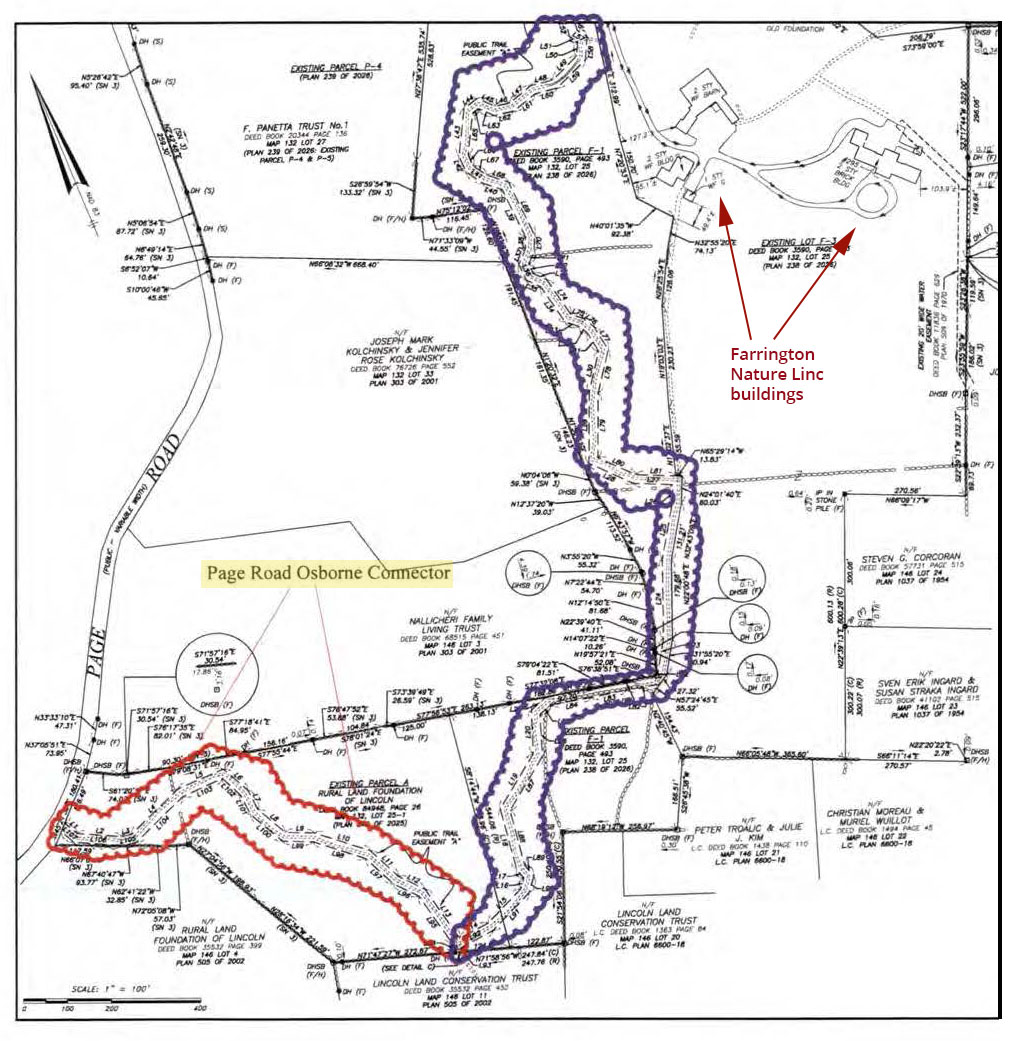
A map showing the new trail easement east of Page Road (click image to enlarge).

Trail easement

The Select Board voted on June 8 to accept the trail easement plan proposed by the Rural Land Foundation and the Conservation Commission for the Farrington Memorial property. This plan grants two conservation restrictions and two trail easements to the town on land currently owned by Farrington Memorial Inc., which will be temporarily conveyed to Rural Land Foundation and then permanently deeded to City of Cambridge for water supply purposes. 

The easements (which are costing the town $850,000) and conservation restrictions will prevent future development on the land, including by a religious or educational organization. The measure was approved at a Special Town Meeting in June 2025 as part of Civico’s Farrington Nature Link project to build housing on land owned by the Panetta family just south of Route 2 and east of Page Road.

The trail will be open to hikers, and dogs may be walked on leash from September through June, as reported in the Select Board’s June SelectConnect e-newsletter.

Hanscom Air Force Base

The Secretary of the Air Force and the Gov. Maura Healey’s office are partnering to evaluate opportunities to save money by repurposing some of Hanscom Air Force Base’s for other uses that would benefit the surrounding community and the state. The Strategic Real Estate Opportunity (SREO) pilot study will “examine the ideal operational footprint for Hanscom AFB and explore opportunities to reduce recurring costs for the Air Force and unlock economic development opportunities for the Commonwealth,” according to an Air Force release.

Base housing, the Hanscom schools, MIT Lincoln Labs, and current military construction projects are not being reviewed as part of the scope of the study. 

“We’re looking at efficiencies… and the art of the possible,” Adam Freudberg, Executive Director of MassDevelopment’s Massachusetts Military Asset & Security Strategy Task Force, told the Select Board. For example, the federal government transferred ownership of Joint Base Cape Cod’s water and wastewater system to a private company in 2024, potentially making some of its capacity available to surrounding towns.

Hanscom is one of six military installations in the state and the only active-duty Air Force Base. There are no plans to close the base right now, according to Town Administrator Tim Higgins. “The stronger the mission is at the base and the better regarded it is within the military community, the better it can sustain a critical review,” he said.

Tree removal

DPW Superintendent Steve Olson and Eversource arborist Matt Mitchell explained the impetus and process by which they and Lincoln Tree Warden Ken Bassett settled on the final list of trees to be removed or pruned by the utility.

“By far this is the largest list we’ve proposed for Lincoln,” Mitchell acknowledged. The extensive list was drawn up because of Department of Public Utilities mandates for residential electricity reliability. Since 2023, one of two Eversource circuits in Lincoln has been “consistently performing poorly” in terms of how long power outages last, and tree damage is responsible for 83% of outages on that circuit, he said. 

The circuit covers almost half of Lincoln geographically around Trapelo Road, Lexington Road, Lincoln Road, South Great Road and nearby smaller roads. The average length of outages due to trees on that circuit is about 6.5 hours, compared to the Eversource state average of 3.5 hours, Mitchell said.

Faced with public protest over plans to remove some of the 271 trees on the original list, Bassett and a second arborist looked at every tree and eventually reduced the number of removals to 152, as well as 18 trees targeted for pruning. The work will take place over the summer.

Category: conservation, Farrington/Nature Link project*, land use Leave a Comment

ZBA approves wellness center, speciality vet clinic

June 16, 2026

Two new businesses, a veterinary speciality clinic and a wellness center, have been approved by the Zoning Board of Appeals.

Bodhi Healing won permission to occupy the former Stonegate Gardens property on South Great Road. Owner Alison Zook had to go to the ZBA because the property is in a residential zone and the zoning bylaw allows nurseries and a few other specific commercial uses but not yoga/wellness centers. However, the ZBA determined that Stonegate Gardens was a preexisting nonconforming use, and a different nonconforming use would be allowed to operate there as long as it wasn’t “substantially more detrimental to the neighborhood” than the prior use.

At the June 4 ZBA meeting, Zook said her business would be less impactful than the nursery, since there would no longer be truck deliveries of plants and other gardening materials, outdoor storage of merchandise, and odors from mulch and fertilizer, as well as fewer customers per day. It would start the day a bit earlier (6:00am vs. the nursery’s 7:00am) and usually operate until 8:00pm.

The board also denied an appeal of an approval by the building inspector to have a veterinary clinic operate in a building on Minuteman High School’s Mill Street property. Ally Specialty Veterinary Center was initially given the OK because they claimed the business constituted an educational use, which is permitted under the state’s Dover Amendment, because although Ally is a for-profit business, it will also serve as a hands-on clinical training site for Minuteman students studying veterinary sciences.

But residents including  Bob Domnitz appealed Metivier’s decision to the ZBA, saying the educational use wasn’t the “the primary or dominant purpose” of the clinic. However, at the June 4 meeting, Domnitz asked to withdraw the appeal after successful negotiations with Custead’s attorney, but the board was advised by town counsel Robin Stein to deny it while stating the reason for doing so. 

“The sworn statement from Dr Custead is what changed our minds,” Domnitz said.

In that statement, Custead explained that the Ally Vet/Minuteman partnership “creates a uniquely strong educational environment by allowing students to follow clinical cases across multiple stages of care rather than isolated appointments alone. Students engage with clinical workflows, diagnostic reasoning, and interdisciplinary collaboration in a manner that aligns with competency-based veterinary education. Ally’s operational model is intentionally designed to integrate structured clinical education, workforce preparation, supervised mentorship, and competency-based learning into the daily operation of the facility.” The statement also said that the partnership is “foundational” to the “success and integrity” of Minuteman’s Veterinary Science Program.

Category: land use Leave a Comment

Property sales in March 2026

May 25, 2026

192 Concord Road — Richard K. Lahnstein Trust to Sevgi Umur for $640,000 (March 2)

141 Chestnut Circle — Hopeton K. Kimball Trust to Timothy A. Taylor for $905,000 (March 19)

29D South Commons — Alan Goodrich to Melissa W. Liska for $610,000 (March 20)

45 Winter St. — Joshua Lamstein to Bouwien Smits and Cary Elliott for $2,705,000 (March 24)

Category: land use Leave a Comment

ZBA to consider Bodhi Healing, vet clinic in June

May 21, 2026

Proposals for a “healing center” on Route 117 and a veterinary clinic associated with Minuteman High School are expected to come before the Zoning Board of Appeals on June 4 after both matters were continued from the board’s May 7 meeting.

Alison Zook is looking for permission to change the former Stonegate Gardens property from a nursery to Bodhi Healing, “a space for the mind, body and nervous system” without any exterior building modifications. The property is in a residential zone, which normally does not allow any commercial use, but zoning bylaw section 6.1 (page 6 in the bylaw) includes exceptions for commercial greenhouses as well as various other uses such as museums, libraries, and livestock farms excluding pigs. Also acceptable, but only as secondary accessory uses to those allowed in Section 6.1, are things like professional offices, studios, laboratories, and workshops under certain conditions, according to Section 6.1(h).

Under Section 6.2, the ZBA may grant a special permit for certain other uses such as hospitals, sanitariums, nursing homes, charitable institutions, community clubs or country clubs, raising dogs or pigs, private radio and television towers, and “any occupation which otherwise meets the requirements of Section 6.1(h) but which requires the parking of more than four motor vehicles on a regular basis or with respect to which more than one person other than the residents of the premises is engaged in the conduct of such occupation.”

However, at least some of the members of the ZBA, including chair David Summer, were initially unaware at the May 7 meeting that the Stonegate property is in a residential zone and thus subject to the various limits listed above. “‘I’m frankly shocked this is an R1 zone,” he said. “I don’t think those conditions [for a special permit] can be met.” 

Though ZBA members were generally in favor of the Bodhi Center idea, they postponed a decision until they could consult with town counsel. “We need to do a little bit of research to see if there’s a path for this,” member David Stifter said.

Mill Street veterinary clinic

Ally Specialty Veterinary Center was initially given the OK by Building Inspector M. Jon Metivier to operate in a building on Minuteman High School’s Mill Street property as an educational use allowed under the Dover Amendment. Business owner Michelle Custead has said that, although Ally is a for-profit business, it will also serve as an educational, hands-on clinical training site needed by Minuteman students studying veterinary sciences.

In April, Mill Street residents including Bob Domnitz, a former Planning Board member, appealed Metivier’s decision to the ZBA. In proposed Dover Amendment exceptions like this, the owner must show that the educational goal is “the primary or dominant purpose” of the proposed use, and this is not the case, according to the appeal.

Category: businesses, land use Leave a Comment

Property sales in February 2026

May 4, 2026

28 Blueberry Lane — Joel S. Greenberger to Raz and Shani Davidyan for $1,885,000 (February 2)

88 Winter St. — Jeffrey S. Bennett to Dirk Gevers and Geraldine Paulus for $2,350,000 (February 5)

2 Tracey’s Corner — 2 Tracey’s Corner LLC to Michael and Luana McLagan for $732,000 (February 13)


Category: land use Leave a Comment

Neighbors appeal decision to allow vet clinic on Minuteman land

April 15, 2026

(Editor’s note: this story was updated on April 16 to include the ZBA hearing date.)

Mill Street neighborhood residents have appealed a decision that allowed a veterinary clinic to open on the Minuteman High School property based on its planned educational use.

Ally Specialty Veterinary Center, now located on Bear Hill Road in Waltham, is leasing an unoccupied home at 16 Mill Street from Minuteman. The plan is to have the schools’ veterinary science students do clinical observation and training in the for-profit clinic. The Dover Amendment exempts religious and educational uses from some zoning requirements, including educational uses in a residential zone such as the one occupied by the high school and the intended clinic building.

Planning Board members asked pointed questions about how the property will be used at hearings on March 24 and April 14. Ally owner Michelle Custead assured them that her lawyers had OK’d the use and that Minuteman was eager to use her clinic to help educate its students rather than busing them to other locations off campus. Building Inspector M. Jon Metivier approved the use on March 18 with the proviso that the “educational component is maintained.”

But on April 10, Mill Street residents including Bob Domnitz, a former Planning Board member, appealed Metivier’s decision to the Zoning Board of Appeals. They cited the court case Regis College v. Town of Weston saying that projects allowed under the Dover Amendment must have a “bona fide goal” that is “educationally significant” and must also show that the educational goal is “the primary or dominant purpose” of the proposed use.

“To our knowledge, there is no documented agreement or contract between Ally and Minuteman that describes the parameters of their educational relationship,” the appeal says.

“Our onsite partnership with Ally Veterinary Specialty Center is not supplemental; it is foundational,” Minuteman Superintendent Heather Driscoll wrote in an April 6 letter to Metivier, outlining the clinical skills that students would need for future including certified veterinary assistants (CVAs).

“What makes this model uniquely effective is the daily integration of learning and application. Students are not limited to occasional clinical exposure; they are immersed in it every day,” Driscoll wrote. “Without consistent, onsite clinical access, students encounter significant gaps in both required CVA hours and demonstrated proficiency.”

The ZBA will hold a public hearing on the matter on Thursday, May 7 at 7:00pm.

Even if the ZBA decides that the business is permitted under the Dover Amendment, Ally should still have to abide by the town zoning bylaw’s parking regulations and submit plans showing how they will do so, the appeal argues.

The Dover Amendment was also at the core of a battle in Lincoln over whether a McLean Hospital facility should be allowed in a residential zone on Bypass Road. The hospital planned to house boys aged 15–21 in a large former private home to give them classroom training in dialectical behavior therapy, teaching them social and emotional skills including mindfulness, emotional regulation, distress tolerance, and behavioral flexibility.

The use was originally permitted but then overturned by the ZBA. McLean sued the town, lost in land court but eventually prevailed in the Supreme Judicial Court in 2019, but the hospital never went ahead with its plans. In 2021, it found another location for the intended services and put its two Bypass Road properties on the market.

Category: businesses, land use Leave a Comment

  • Page 1
  • Page 2
  • Page 3
  • Interim pages omitted …
  • Page 39
  • Go to Next Page »

Primary Sidebar

Upcoming Events

Sep 1 Tue
7:00 am - 8:00 pm

Primary election day

Sep 3 Thu
7:00 pm - 8:30 pm

Outdoor movie night: “The Lorax”

Sep 4 Fri
7:00 pm - 10:00 pm

LOMA with Craig Sonnenfeld

Sep 9 Wed
5:00 pm - 7:00 pm

Summer tomato galette workshop

Sep 12 Sat
11:00 am - 12:00 pm

“Do Bees Pee?” story and scavenger hunt

View Calendar

Recent Posts

  • Police log for Aug. 12–22, 2026 August 27, 2026
  • Legal notice: Property Tax Classification Hearing August 27, 2026
  • Resident at The Commons honored with a rose from her caregiver August 26, 2026
  • Tickets on sake for TEDx Walden Pond August 25, 2026
  • Groups continue pressure on ICE activities, private jet expansion at Hanscom Field August 25, 2026

Squirrel Archives

Categories

Secondary Sidebar

Search the Squirrel:

Advanced search

Privacy policy

© Copyright 2026 The Lincoln Squirrel · All Rights Reserved.