• Skip to primary navigation
  • Skip to main content
  • Skip to primary sidebar
  • Skip to secondary sidebar

The Lincoln Squirrel – News, features and photos from Lincoln, Mass.

  • Home
  • About/Contact
  • Advertise
  • Legal Notices
    • Submitting legal notices
  • Lincoln Resources
    • Coming Up in Lincoln
    • Municipal Calendar
    • Lincoln Links
  • Merchandise
  • Subscription Info
    • My Account
    • Log In
    • Log Out
  • Lincoln Review
    • About the Lincoln Review
    • Previous Issues
    • Submit Your Work
    • Subscribe/Donate

agriculture and flora

Public hearing for tree cutting and removal scheduled

April 9, 2026

Editor’s notes:

  • Based on new information from the DPW on April 16, plans to cut undergrowth trees on Lexington Road, Trapelo Road, South Great Road, and Tower Road as described in the penultimate paragraph below have been shelved.
  • This article was updated with more relevant tree hazard descriptions from Eversource on April 10.

On Wednesday, April 22 at 7:00pm at the Town Hall, a public hearing will be held to consider the removal of three sets of trees in the public right of way. 

Eversource Energy wants to cut and/or remove the trees listed here that are dead, in decline, or otherwise posing a hazard to the safe and reliable operation of the electrical system and the roadway. Eversource focuses on pruning within specific clearances (8–10 feet to the side, 10 feet below, and 15 feet above lines), but they will remove entire trees that are deemed to be severe hazards. They are listed on that page by size category (DBH, or diameter at breast height) and hazard rating. Those ratings are based on a detailed inspection International Society of Arboriculture tree risk assessment form used by Eversource arborists, with 1–3 ratings corresponding to low, medium and high risk.

As described by Eversource arborist Matthew Miller, “generally the 1’s are smaller diameter ‘wrong tree, wrong place’ situations where they are growing over the wires with proximity and a lean but don’t necessarily have defects. While I gave these trees the ‘low’ risk rating, that is with respect to risk within the tree list. If a tree in my opinion posed no risk to the wires or roadway they wouldn’t be included in the list. 2’s generally have more obvious potential health issues. They may not die in the immediate future but they could start dropping limbs or be stressed enough for a windstorm to get them. 3’s have the largest rot cavities, are dead outright or are infected ash, or they are touching the primary wires.”

Miller also offered a comprehensive explanation of the company’s tree removal practices as of 2024 in this Lincoln Squirrel article.

A second set of trees listed here is being considered for removal by the Town of Lincoln (at Eversource’s expense) because they are dead, in decline, or otherwise posing a hazard to the safe and reliable operation of the roadway.

Eversource also wants to cut and remove undergrowth trees on Lexington Road, Trapelo Road, South Great Road, and Tower Road. With abutter approval, all trees 10” or less in diameter under the wires that are growing up into the wires will be cut to the stump.

For more information, contact the Lincoln DPW, see this Eversource Tree-Trimming FAQs page, or call 800-592-2000.

Category: agriculture and flora, news Leave a Comment

My Turn: McMackin highlights species interconnectedness in gardening talk

April 9, 2026

By Robin Wilkerson and Steve Atlas

Rebecca McMackin, a rising star in the world of ecological horticulture, made the case for a different approach to gardening to a rapt crowd of Lincolnites at the Donaldson Auditorium on April 7.

McMackin, whose TED Talk has generated 1.3 million plays, was for 10 years the head horticulturist at the Brooklyn Bridge Park in New York. The park was built on four abandoned piers in the Hudson River and is now a resplendent garden of native plants that attracts bees, butterflies, and birds as well as millions of human visitors. McMackin’s presentation repeatedly emphasized the interconnectedness of all species, including people.

She shared many of the lessons learned in Brooklyn that can easily be applied to our own gardens in order to achieve biologically diverse habitats that are also beautiful. Practices like leaving the leaves contributes enormously to the health of our gardens. Leaves feed the soil the way nature intended. They also provide a habitat for a rich array of insects, amphibians, and birds. 

A skirt of leaves around the base of a tree provides soft landings for hatched caterpillars to complete their life cycles and turn into butterflies, moths, and fireflies. Leaves are nature’s own fertilizer and soil conditioner.

McMackin also spoke about alternative ways to “clean up” our gardens in the spring that protect and nurture insect life — a crucial and undervalued component of the natural world. Cutting dead stalks of perennials to a foot provides habitat for insects and can also provide structure to support new growth. 

For those fortunate enough to be in attendance, the evening was eye-opening — an opportunity to see how the myriad living elements of the natural world need each other if all are to thrive. Rather than admonishing gardeners, McMackin sees storytelling as a way to educate (and in this case, also entertain) an audience.

The talk was presented by the Lincoln Garden Club. The co-sponsors were the Lincoln Land Conservation Trust, the Bemis Free Lecture series, the Walden Woods Project, Monarch Meadows and EcoGardens, and Anne Sobol.


“My Turn” is a forum for readers to offer their letters to the editor or views on any subject of interest to other Lincolnians. Submissions must be signed with the writer’s name and street address and sent via email to lincolnsquirrelnews@gmail.com. Items will be edited for punctuation, spelling, style, etc., and will be published at the discretion of the editor. Submissions containing personal attacks, errors of fact, or other inappropriate material will not be published.

Category: agriculture and flora, My Turn, nature 1 Comment

Crusading for a tree’s comeback

April 2, 2026

Editor’s note: This article originally appeared in the Lincoln Agricultural Committee newsletter and is republished here with permission.

By Heather Anderson

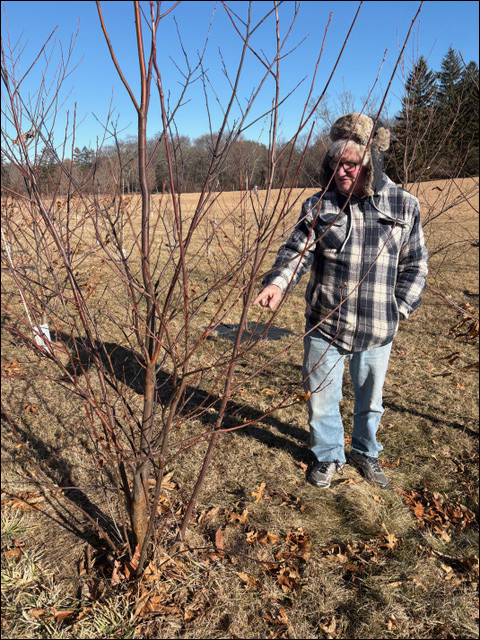
On a wintry, sun-dappled day in Flint Field, a man wearing a trapper’s hat with ear flaps braves the cold to check on a young chestnut orchard. He has just left the warmth of a senior citizen luncheon at Lincoln’s Parish House where—with all the fervor of a southern tent revivalist—he preaches salvation every Friday.

He’s not a Bible thumper, mind you. Nor is he bent on saving our collective soul. Instead, Mark Meehl — known about town as the Chestnut Man — is on a passionate (some might say evangelical) mission to save the beloved American chestnut tree from the brink of extinction.

“The native tree is largely absent from our forest, and we want it back. So, we’re working on it,” says Meehl, a 73-year-old retiree from North Reading. He adds, “Why wouldn’t you want something back that belongs here? It was man’s fault for its demise.”

By tinkering with Mother Nature, Meehl and a cohort of self-described “chestnutters” are part of a national movement to develop a blight-resistant American chestnut tree. Led by The American Chestnut Foundation (TACF), it’s a decades-old pursuit. Meehl has been a TACF member since 2014. The goal? Restore the tree to its native forests from Maine to Alabama.

So far, the results have been underwhelming. But a new, genetically engineered, blight-resistant American chestnut tree called Darling 54 could save the day. Developed in an academic lab, Darling 54 is on the cusp of federal regulatory approval. In fact, 2026 could be a pivotal year for the American chestnut tree. “Because of modern genetic engineering, the future looks bright,” says Meehl.

This is a story about hope. And, quite possibly, rebirth.

Short history lesson

Once called the “redwoods of the east” for their height (up to 150 feet) and girth, the once mighty American chestnut tree was wiped out by an airborne fungal disease called blight, likely imported on trade ships from Asia in the late 1800s. The blight raged through America’s forests, killing about 4 billion trees by 1950, according to TACF.

Wildlife that depended on chestnuts as their winter food source starved. And an economy that relied on lumber — for cradles, coffins and everything in between — tanked. Historians consider it one of the worst ecological disasters in American history.

As for those chestnuts roasting on an open fire at Christmastime? A different species likely imported from Italy or China, Meehl explains. And those shiny, brown orbs used as ammunition in childhood chestnut fights? An invasive, non-edible (as in toxic) species called horse chestnuts.

Oh My Darling 54

Researchers at the State University of New York College of Environmental Science and Forestry developed Darling 54, claiming it could better resist chestnut blight. The U.S. Department of Agriculture issued a preliminary positive review last June, finding that the tree is “unlikely to pose a plant pest risk,” according to SUNY’s website.

But Darling 54 still awaits federal approval from the Food and Drug Administration (as chestnuts are a food) and the Environmental Protection Agency. All three prongs of government must declare it safe to humans and to the environment before pollen from these transgenic trees can be introduced to Lincoln’s orchard.

Mark Meehl checks on the American chestnut orchard at Flint Field. Meehl is the orchard manager in Lincoln as well as in several other towns statewide.

On a two-acre patch of town-owned conservation land in Flint Field, the young orchard was planted specifically in anticipation of breeding its trees with genetically engineered, blight-resistant pollen, Meehl explains. Started in 2021, the Flint Field Germplasm Conservation Orchard — GCO for short — is basically playing host to a national science project about transgenics.

Speckled with bluebird boxes, this fast-growing orchard is home to 400 wild American chestnut trees from diverse regional climates: 110 exclusively from Massachusetts; 230 from throughout New England, New Jersey and Maryland; and 60 from southern states such as South Carolina and Georgia. All trees are numbered, monitored, and catalogued in a TACF database managed by Meehl.

The reason for diversity? To see which region’s trees adapt best to the local environment in the face of climate change. The idea is to produce the hardiest trees, Meehl explains, and to capture their DNA.

If all goes well, he anticipates a high-volume, nut-producing orchard and, quite possibly, a controlled pollination with Darling 54 this summer.

But government deregulation isn’t the only hurdle. Those opposed to GMOs (Genetically Modified Organisms) are readying for a fight.

“Anti-GMO people are poised and ready to attack deregulation of Darling 54 even though no harm to the environment or to food safety has been shown,” says Meehl, adding that the food fight between GMO and anti-GMO people has been going on for decades. “The same blight-tolerant gene is found in strawberries and bananas, available (for human consumption) every day.”

Louise Bergeron, a scientist and past chair of Lincoln’s Agricultural Commission, also highly anticipates transgenic deregulation. She belongs to a niche group of chestnut enthusiasts who host orchards on private land.

Unlike many GMOs, the blight-tolerant gene in Darling 54 is not a pesticide, explains Bergeron, who recently moved from Lincoln to Petersham where she plays host to a 110-tree germplasm orchard. The blight-tolerant gene “is naturally present in native plants and grains such as wheat.”

Ideologically, The American Chestnut Foundation is not against GMO technology, either. But the nonprofit foundation has reservations about Darling 54’s effectiveness and recently pulled its support. By contrast, Meehl—project manager for the chestnut foundation’s Massachusetts/Rhode Island chapter—is keeping the faith.

Who is Mark Meehl?

“I call him ‘Chestnut Man’ and everyone knows who I’m talking about,” says Lincoln’s Carol DiGianni, oftentimes his tablemate at Fridays’ senior center luncheon. “I planted two of his trees in hopes they’d marry” but they’ve yet to pollinate. “They’re growing surprisingly fast.”

(Botany 101: A plant’s mission in life is to produce a seed. Because chestnut trees do not self-pollinate, they need at least one nearby tree to exchange pollen and produce fertile nuts.)

Meehl, who holds a degree in zoology, is strictly a volunteer. He travels across the state—sometimes by motorcycle—spreading his enthusiasm. He lectures, educates, and gives away American chestnuts and saplings at churches, schools, libraries, and senior centers.

Thanks to Meehl, students at Birches School, a nature-based K-8 private school on Bedford Road, are likewise crusading for an American chestnut tree comeback. He enlisted them, along with Auxiliary Program Director Ken Clarkson, to help care for the trees in Flint Field.

“It’s a good educational tool for us,” says Clarkson in a phone call, adding that old town maps show chestnut fields existed right where the school stands now. “Every March, we check in with Mark to coordinate seed planting. We propagate them right here.”

By taking a hands-on role, says Clarkson, “it helps give kids hope in bringing back this ‘mighty giant’ that was one of the most important trees in the ecosystem.”

When he’s not proselytizing, Meehl maintains chestnut orchards in other “host” towns including Weston, Littleton and Westborough; as well as a second orchard in Lincoln. It sits on the former Umbrello family farmstead, located just beyond the railroad tracks that cross Route 117.

Started 23 years ago by violin teacher John Emery, it’s a much older breeding experiment and involves 100 hybrid trees. The hybrids are a cross between American and blight-resistant Chinese chestnut trees. It’s part of TACF’s Backcross Breeding Program intended to create “a variety as American as possible” while retaining the Asian blight-resistant trait, explains Meehl.

Some early-generation survivors of backcross breeding still stand in the Route 117 orchard and produce nuts. But several “ghost trees”—trees that have died and their trunks turned white—haunt the orchard. Meehl, who inherited the orchard, has replaced several dead trees with more hybrids.

But the effort seems more like holding vigil.

The Backcross Breeding Program is all but defunct. “It’s a shame,” says Meehl. “A lot of work, all for naught. …I think the transgenic approach is much better at moving the mission forward.”

But first, the trees in Flint Field must survive New England weather and wildlife.

Standing amongst the scrappy trees, Meehl points to deer damage caused by bucks rubbing antlers against the trunks. On another trunk, he notices a wart-like wound—called a canker—caused by blight.

But a prickly burr that once contained three coveted chestnuts clings to its branches. And the dying tree has sent up new root shoots from the soil.

In other words, the tree has done its job.

“Trees are smart enough to know they’re in trouble,” says Meehl, who believes trees talk to one another through their root systems. “This tree is putting up a good fight.”

Looking out over the orchard, Meehl smiles wide like a proud dad. Overall, he is pleased with what he sees. The trees “are coming along just fine,” he says. “They’re really healthy.”

He’s envisioning a fireworks display of chestnut flowers this summer. Late bloomers, American chestnut trees reach full bloom by July 4, but typically not before they’re five years old. This orchard is approaching its sixth year. About 15 trees blossomed last season. Meehl expects four times as many trees to flower this summer.

Meehl ducks into a car for warmth after a tour of the orchard. He offers up a brown, prickly burr. A souvenir. Asked why he has devoted his retirement to crusading for a tree’s comeback, Chestnut Man is quick to answer.

“Most people want to leave the world a little better, to do something good for Mother Nature,” he replies, adding, “It’s just a wonderful tree. It won’t grow back on its own without man’s help.”


“My Turn” is a forum for readers to offer their letters to the editor or views on any subject of interest to other Lincolnians. Submissions must be signed with the writer’s name and street address and sent via email to lincolnsquirrelnews@gmail.com. Items will be edited for punctuation, spelling, style, etc., and will be published at the discretion of the editor. Submissions containing personal attacks, errors of fact, or other inappropriate material will not be published.

Category: agriculture and flora, conservation Leave a Comment

Farm folk tap into the sweetness of spring

March 31, 2026

From the March 22, 2026 Codman Community Farms member newsletter, republished with permission.

For the past many weeks, it’s been maple sugaring season in New England. While Codman Farm doesn’t run a commercial sugaring operation, we do participate in this seasonal celebration with an incredible group of dedicated volunteers leading the effort. The maple sugaring season comes on quickly and usually ends just as swiftly — so our volunteers need to be at the ready to tap the trees and begin the labor intensive process of hauling all the maple sap back to the farm for boiling down to syrup.

Our guest contributor this week is Stephen Hoenig, longtime Lincoln resident, former Codman Farm board member, and yes, Sap Head in Chief. Steve has been leading our sapping effort for many, many years and we are eternally grateful for his hard work, passion for sugaring, and his absolutely infectious positivity and good cheer. Here is his tale:

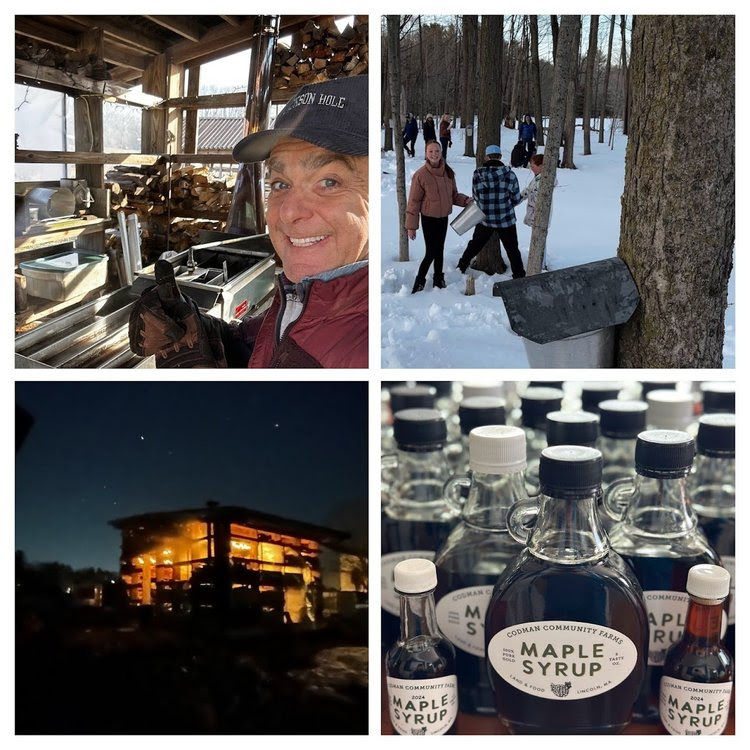
Exactly one month ago this afternoon (as of a few days go), I gathered our loyal “Sap Heads.” Together, we marched to our maple tree haven at Baker Bridge Road with spiles, buckets, lids, drills, and hammers in hand—to tap our sacred trees. Our mission: collect sap from the Sugar Maple trees and begin the transformation into maple syrup.

We knew that the rhythm of frigid nights and warm days changes the inner workings of a tree’s plumbing. A simple 2-inch hole drilled into a tree can yield 1–3 gallons of sap per day. So, on February 18th, about 20 of us — mostly children, along with a few adults — got to work. One strong 13-year-old Lincolnite powered a drill with a 5/16-inch bit into a tree while a classmate set the spile and tapped it firmly into place. Her younger siblings hung the bucket, another added the lid, and then they moved on together repeating the process across 39 more trees. The sap began to drip immediately. Many children (and adults) eagerly caught drops of the faintly sweet liquid in their mouths, as if it were falling from the heavens.

Our work had begun.

Each day, our team returned to the grove to gather sap and haul it to larger barrels. Even as two major snowstorms dropped 3–4 feet of snow, we pressed on — snowshoeing, skiing, and trudging through drifts, rarely missing a day. The cold, the early darkness, and the wind did not slow us down. Three dedicated women transported up to 100 gallons of sap at a time in the red Codman Farm pickup truck, hauling heavy barrels with laughter and determination — never a complaint, always a smile.

In total, we boiled 410 gallons of sap. Volunteers had previously chopped and stacked hardwood along the walls of the sugar shack, ready to fuel the fire. Another team kept the fire going and fed sap into the evaporator, concentrating it as clouds of steam filled the air. A Solo Stove helped keep us warm — along with a little wine, whiskey, and barbecued Codman sausage!

Because education is at the heart of Codman Farm, we welcomed about 40 students — young and old — during the final weekend. They visited the grove and the sugar shack and enjoyed pancakes topped with Codman maple syrup and homegrown bacon. We then capped it all off with pizza in the pavilion.

The boiling is now complete. Our hard-earned sap has been transformed into gallons of Codman “Liquid Gold,” carefully filtered and poured into 2-, 8-, and 24-ounce bottles. Soon, they will be available in our store or shared with the many hands who made this possible. Some will even find their way into creations from the Codman kitchen.

Wherever these bottles go, they carry the spirit of our community with them.

Thank you to our Sap Heads, who drilled, hung, collected, hauled, boiled, and smiled their way through the past month. Our syrup is the finest of the fine — and may your pancakes never be without it.


Category: agriculture and flora Leave a Comment

Codman farm plans to relocate and enlarge retail store

October 20, 2025

A sketch showing the current and future locations of the Codman store (click to enlarge).

In its last of its planned major capital projects, Codman Community Farms will relocated its farm store to a much larger space in an adjacent barn.

The store once occupied a corner of C barn and expanded to more of the barn during the pandemic, since it offered an open-air space with no cashiers. It will move to the front of B barn to the north. That space was used mainly for hay storage in past years, but is now used for general storage and operations for the farm store since the farm no longer offers retail sales of hay, said Caroline Fiore, CCF president. This will open up the main C barn again for community use.

“The improved Farm Store space will be designed in a way that honors the character of the historic barn while providing critical infrastructure updates,” Fiore said. One of the primary goals is providing an insulated, cli ate-controlled space for the store staff and customers as well as back-end operations and a multi-purpose work area for all Codman employees Farm store staff work in two different locations: B barn for storage and prep, and C barn for the retail space.

“Neither of these areas are conditioned, so staff are subject to the harshness of winter and the heat of summer. Our currently uninsulated space also creates issues for food storage, as extreme temperatures and conditions within the barn can impact food quality and increase spoilage,” Fiore said.

The farm is refining design plans for the project and working with local builders to obtain accurate cost estimates, she said. It will be funded by the farm using money raised for that purpose during its 50th anniversary capital campaign in 2023, as well as a recent $600,000 state grant. The hope is to begin construction in early 2026.

“The Farm Store relocation is the last remaining major capital project that’s part of our vision for multiyear infrastructure improvements,” Fiore said. Completed projects include new roof on the barns and solar power installation, a new septic system, a new commercial kitchen, farm house insulation, conversion to solar hot water systems, generator installation, driveway renovation and community courtyard, education pavilion, and renovation of restrooms.

Installation of a new sprinkler system, which has to be in place before work on the store can begin, is nearly complete. That project was funded with $400,000 from the town’s Community Preservation Act fund and $100,000 from CCF fundraising. For the store, the farm expects it will have to raise at least another $400,000 to supplement the state grant. The work may trigger the need for structural repairs and improvements and CCF may seek additional money from the town at some point, CCF board member Craig Nicholson told the Select Board earlier this month.

Category: agriculture and flora 1 Comment

Library offers seeds of knowledge — and now real seeds as well

April 3, 2025

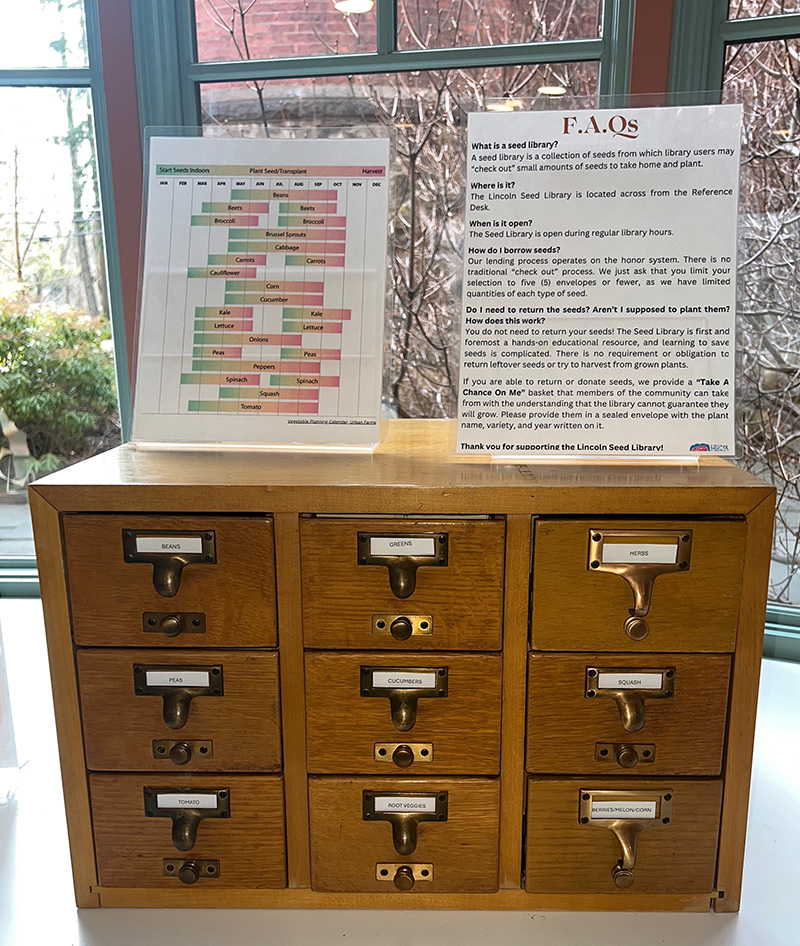
The Lincoln Public Library’s seed library (click image to enlarge).

The Lincoln Public Library lands all sorts of things in addition to books and music, but now it’s giving something away: seeds.

The “seed library” on the ground floor offers packets of seeks stored in old wooden card catalogue boxes, as well as a notebook with instructions from the original seed packets on planting each type (visitors can jot them down or take a picture with their phone of the pages of interest).

The seeds were donated by Weston Nurseries of Lincoln and Russell’s Garden Center in Wayland. The selection focuses on easier-growing garden plants, “which is why there is more of a focus on fruits and vegetables rather than flowers, as they can be a bit finicky,” said librarian Alison Armstrong, who organized the project after hearing interest from some patrons and noting the idea’s success at other libraries.

Even though libraries are usually in the business of offering things to use in the building, or lending things with an expectation that they’ll be returned, the seed library squares with the institution’s mission. “Above all, the work of the library is providing access to resources and information that patrons may not otherwise have been able to utilize,” Armstrong said. “By connecting with our community partners to establish the seed library, we’re able to facilitate access to people who may have always been interested in building their own garden, but were unable to do so for whatever reason.”

The most important piece, Armstrong continued, “is being able to provide the Lincoln community with a hands-on educational resource, which is at the core of our mission to focus on life-long learning and sharing new knowledge and ideas.”

Category: agriculture and flora Leave a Comment

LLCT installs new pollinator garden signs

July 4, 2024

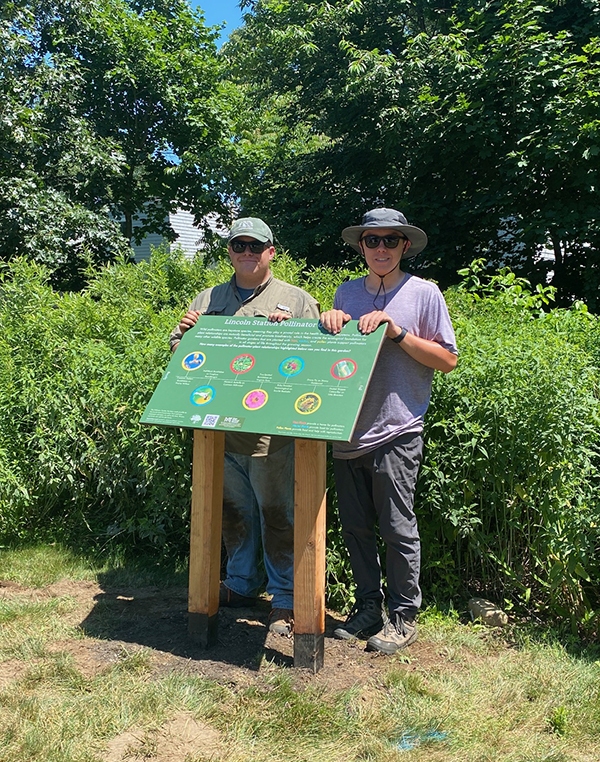
The Lincoln Land Conservation Trust has installed five new signs at pocket pollinator gardens throughout town.

The signs (see photos below) were designed in 2023 by Amy Dorfman, a volunteer who worked with LLCT staff to create a template for permanent signage at LLCT’s pollinator sites. Dorfman had just finished a graduate certificate in environmental policy and international development from the Harvard Extension School and is now continuing with her master’s in environment and sustainability management at Georgetown University.

After visiting the pollinator sites in Lincoln, Amy created two sign templates that introduce passersby to the gardens and emphasize the importance of native plants, biodiversity, and connected habitat. She used photos to show different plant-insect interactions throughout the growing season and highlight nectar and pollen producing plants, as well as plants that serve as “hosts” for different insect species.

Once the signs were printed, Jane Layton, LLCT’s former stewardship coordinator, designed the sign posts and assisted LLCT seasonal interns Robert Killam and Joe Pariser with the installation process.

Although LLCT’s pollinator pathway lawn signs have served the gardens well and will continue to be used throughout Lincoln, they began to fade after a few years in the sun and don’t have any information on them about what the purpose of the gardens are. The new signs will be a permanent and informative way to welcome visitors to the gardens.

The project was funded in part with a grant from the Lincoln Cultural Council, a local agency which is supported by the Massachusetts Cultural Council, a state agency. The grant funds will help cover more than half of the printing costs of the signs, and LLCT is grateful for the council’s generosity.

The new signs are at:

  • Lincoln Station near the Twisted Tree and Bank of America
  • Codman Community Gardens
  • Codman Road/Route 126 traffic island
  • Stony Brook trailhead on Route 117 at the Lincoln/Weston town line
  • LLCT Pollinator Meadow near the Smith School parking lot
rob-and-joe-sign1
IMG_9979
sign4

Category: agriculture and flora Leave a Comment

Eversource arborist explains roadside tree removal

May 5, 2024

One of several trees on Sandy Pond Road that’s been marked for removal.

Residents may have noticed temporary signs attached to numerous roadside trees in town that are being targeted for removal by Eversource. The town is required to hold a public hearing to invite comments or objections to removal of specific trees; it will take place on Wednesday, May 22 at 7 p.m. at the DPW office (30 Lewis St.). Anyone who can’t attend may email or call DPW Superintendent Chris Bibbo at bibboc@lincolntown.org or 781-259-8999 (he will read aloud the emailed comments at the hearing).

The Lincoln Squirrel asked Eversource Arborist Matthew Mitchell some questions about this process; here are his answers.

Why has Eversource not done this in Lincoln in several years?

A few aspects to this question. Our tree program is two-pronged; we have a trimming program and a removal program. The trimming program maintains space around the primary wires at the top of the electric poles, usually as close to 10 feet to the sides and bottom and 15 feet above as we can while following safety regulations and proper pruning practices. This program prunes each circuit every four to five years. There are several circuits in Lincoln that get pruned in different years, with a large Lincoln circuit having been pruned just last year. So we are around town regularly, even if the trimming work isn’t as dramatic as outright tree removal.

Our removal program is not cyclical and is a little more subjective. Circuits with recently poor outage rates are targeted, but we also try to do removal work on circuits that aren’t getting outages yet but in my opinion have a strong potential to see a spike in the future. We want to be removing potentially hazardous trees before they cause outages or cause a danger to general public safety. If I do my job correctly, nobody will have known there was a possible issue at all.

It has been a while since we have removed public trees in Lincoln, but last year we were fairly active in town removing hazard trees on private property. The motivation for this project happening now is that I think the Lincoln forest is aging out of a young forest into a more middle-aged one, and part of that process involves trees accumulating injuries or poor structure that make overall failure more likely. Tree injury, mortality, or failure is a natural part of the forest life cycle, and it is all well and good when it happens in the middle of the woods, but when these trees are situated next to power lines, sidewalks, and homes then human action is needed to intervene and prevent them from interrupting the power we depend on or causing property or bodily injury.

A specific issue in the Lincoln forest is that in the last few years, Lincoln has lost the majority of its ashes to emerald ash borer (EAB). This bug is an invasive species from eastern Asia and because our native ashes did not evolve alongside it, they do not have the evolutionary adaptations of Asian ashes. The beetle causes a near 100% fatality rate in native ash in any locality it has been introduced, and it is why when you go camping you will often see signage asking campers to not bring off-site wood for campfires as this is the beetle’s main avenue of spreading. Other than expensive pesticide treatments on individual large and significant trees, the only cure for EAB is preventing it from arriving. Ashes with EAB make up the single most common species on our Lincoln removal list.

What are the criteria for selecting trees to remove?

Circuits are profiled by our certified arborists to assess trees along the power lines for removal and then reviewed and edited by myself. Obviously, dead standing trees are immediately added. When the tree is still alive, it is visually assessed from root to shoot for signs of stress, poor stem structure that makes failure more likely, open or hidden rot cavities that could be a breakage point, the presence of tree pests that pose significant risk to the tree’s survival such as EAB (but there are others that affect more than just ashes), and overall form and vigor. The majority of non-undergrowth, larger diameter trees on the list are on there because I believe they are likely to fail in the short to mid term future and I would like to get them removed before they do.

I specified size in that last point because a lot of the trees on this list are small undergrowth trees. They are healthy in and of themselves, but they have been selected for removal because they are of a species that have characteristics that make them unsuitable to be located under the wires. Cherries and elms are the two most common. These species grow faster than average, sprout aggressively when they are pruned, and usually do not take to being pruned to grow out and around the wires but stubbornly keep trying to grow straight upwards. These trees are difficult for our pruning program to control and even when pruned to arboriculturally correct and healthy standards are frankly an eyesore. It is more effective to have them removed outright as well as improving the aesthetic of the roadway.

There is a small handful of healthy, moderately sized trees on the list that do not have significant biological or structural defects. They are on there because they are actively touching our primary lines which carry thousands of volts. If/when friction wears away the wire coating, these trees will cause an outage by catching fire themselves and potentially (although very unlikely) acting as an electrical conductor for anyone who happens to be touching the tree.

What’s the timeframe for removal?

It depends on the contractor’s workload from other areas Eversource services, but I expect work to begin a few weeks after the tree hearing

What happens to all the wood?

The logs will usually linger for a week or two as the log crew is a separate crew to the removal crew. Because the trees we are targeting are often unhealthy to begin with, there is not much value in their lumber. Usually they are given to facilities that process them into chips for resale or industrial use, sometimes the town wants the wood themselves for whatever reason. It depends on each of our contractor’s individual system and geographical location, and it is not a part of the process I am much involved in.

If any abutters to trees being removed would like to keep the logs themselves or if they want chips for organic mulch, that is also an option if they let us know. Chips are measured by the truckload or so, if anyone wants them they usually need to have a full-sized garden or several yard trees.

Category: agriculture and flora, news 2 Comments

My Turn: A new dog in town

February 13, 2024

The following was included by Codman Community Farms farmer Pete Lowy in the February 2, 2024 e-newsletter to CCF members and is reprinted here with permission.

By Pete Lowy

This week we welcome our newest livestock guardian dog puppy to the farm! Introducing… POPPY the pup!

Why do we have a new puppy? I’m sure the next question is can folks pet it (no), and where is it (it’s a secret). Aww, that’s mean. It’s not meant to be! Our dogs are not pets, but rather working animals, so we try and give them the respect (and space) the need and deserve. But we do like folks to know the latest happenings on the farm so…read on!

We have a new pup, because our dearest, sweetest, most beautiful Sophie will soon be moving to South Carolina with Alyssa, our farm store manager. Yes, Alyssa will soon be leaving us too (her official goodbye letter will be coming soon), and yes she is adopting Sophie, much to her (and our) delight. They are best buds and while we are so happy for both of them — we are also simultaneously deeply saddened in our heart of hearts to see them leave us.

Poppy the puppy and Pete Lowy’s son Abe.

The short backstory on why we are saying goodbye to Sophie is that last year she developed a naughty habit. While always a great, and very sweet (if not a bit jumpy) livestock guardian dog, Sophie developed a habit of sneaking under the chicken fences and sometimes chasing down innocent dog walkers as they passed by the chickens on Codman South Field. This scared the bejesus out of many folks who were not expecting Sophie to dash through (or under) the fence line at full stride, while also barking like a raving lunatic at them. Now, Sophie is a sweetie and she never ever was aggressive in the biting sort of way and I’m sure she just felt she was doing her job – but these momentary outbursts of energy weren’t that fun for anyone to experience. We tried again and again to tighten up the fences and to train her to stop the antics but we were ultimately unsuccessful. The only way we found to keep her contained was by adding a single strand of very electrified fencing at the inside base of the fences. This works most of the time, but it’s much too time-consuming for us to manage daily and was only a stop-gap solution. In the end, we decided replacing Sophie was the best solution.

At the same time Sophie was displaying this maddening behavior, Alyssa also was starting to bond with her. Alyssa is an animal lover through and through and would often visit Sophie in the field — and they developed a strong love for one another. Alyssa was there for Sophie when she needed a little extra TLC for the occasional bug bite or other minor ailments from living outdoors, and Sophie learned to trust Alyssa deeply during these visits.

So, in the end, this is as good a resolution as one can find in this kind of circumstance. Livestock Co-Managers Aimee and Abby get to train a new livestock guardian dog – and Alyssa gets a new best friend to keep her company as she settles into her new farming life in South Carolina. And we couldn’t be happier that Sophie and Alyssa will have each other during their transition and that we also get to spread a little bit of our best peeps from Codman Farm down south. We will miss them so much!


“My Turn” is a forum for readers to offer their letters to the editor or views on any subject of interest to other Lincolnites. Submissions must be signed with the writer’s name and street address and sent via email to lincolnsquirrelnews@gmail.com. Items will be edited for punctuation, spelling, style, etc., and will be published at the discretion of the editor. Submissions containing personal attacks, errors of fact, or other inappropriate material will not be published.

Category: agriculture and flora, My Turn 2 Comments

Farm store thief busted after being caught on camera — twice

December 17, 2023

Security camera images of the thief on his November 28 visit to the farm store (click image to enlarge).

A brazen thief who was twice caught on camera stealing food from the Codman Community Farms store — once when farmer Pete Lowy was in the room with him — was caught by police and banned from the store for life.

A security camera first recorded the unidentified man gathering various items and leaving without paying on November 28. The farm store does not have checkout staff and operates on an honor system whereby customers scan and pay for their items using a credit or debit card or put cash in an envelope through a slot. Lowy wrote about the first incident in a December 2 email to CCF members asking them to be on the lookout for the thief, and then breathlessly related the whole story in a December 15 e-newsletter to CCF members, along with some subtle plugs for the merchandise (scroll down for the latest):

It’s been a couple of weeks since we shared the news of the theft in the farm store. Many, many folks emailed us offering both support and a bit of concern about the way we handled this latest intrigue at the farm. It is never fun to share these complicated matters with the public, but we find it’s important to provide this information when the situation merits. In this case, it did, and as confident as I was about the intention of the theft at the time, some in the public were less inclined. Many offered their theories which were kinder and based on the supposition that we are all good people and no doubt this was an innocent mistake. Alas… I have most unfortunate news for those who thought this kind fellow was experiencing a mere lapse of judgment or perhaps some other more serious medical issue. In the end, we were right and this whole ordeal is about honesty and trust and well, it’s just another interesting Codman farm-life story.

And if you are reading this, you are also part of this story. Because you are part of our community. We are grateful to you all for your interest and your continued support and kindness.

Oh yes, and it’s still all about a dude stealing because he can — and our journey toward making things right. Read on for the conclusion of this winding tale… Kick back and enjoy. Cancel that morning meeting. Refill that cup of hot joe. I have a story for you…

OK, so here goes. As we all know, the original theft occurred on November 28th at 8:40 p.m. We have the camera footage and massive amounts of video showing that our friend did not pay for the items he took from the store. He walked confidently out of the store without any attempt to pay. We were unable to locate him or track his car and license plate so we turned to you, Joe Public, to assist us with finding him. We received lots of feedback and a tip of sorts that someone had indeed seen him in the store another time — but this person did not know him so, the lead was a dead end.

Until one day — December 6 at 1:01 p.m., to be exact — I, me, mwah (Farmer Pete) was just returning to the farm from a three-hour trip bringing some pigs into freezer camp. I was a bit tired from the long drive and was walking home to refill my coffee and sit down for a few minutes to relax. But as I was walking through the parking lot towards the house, I noticed a car pulling into the parking lot. I did a double-take and thought to myself, “Hey, that car kinda looks familiar — it looks like the car that guy was driving that fateful night.” The car had the same profile, brake lights, wheel rims, and so on. As I maintained my gaze at the car and watched the driver’s door slowly open, out came our gray-haired friend in his same blue puffy jacket!

I nearly dropped my empty coffee cup. My stomach turned in knots. Wait, what!? This could not be — I just happened to get back to the farm and happened to be walking in the same direction as the guy whom I had been searching for, and he happened to be getting out of his car right as I was walking by? No way. The gods of petty larceny were shining brightly on me that day! Without a hint of hesitation, I approached him as he walked towards the store. “Excuse me,” I said. He looked down at me (I’m not very tall). I said, “I believe you were here last week and didn’t pay for your items.” (It never pays to be a total jerk; I like the kinder approach to accusing someone of being a thief.) He said, “Oh, really? No problem, I’m happy to pay for the items now.” I also said, “We can also call the police if you like.” And he replied, “Oh no, no need for that.” I then did the smartest thing of all — I said, “OK, before we head into the store, I want to take a photo of your license plate.” And I did.

OK, people, now is not the time to think “See, I told you, it was an honest mistake, Pete… he did mean to pay, he just forgot. You are such a mean guy for thinking he was dishonest!”

My reply would be, “Don’t be naïve — what else would someone who intentionally stole say? Come on! Do you think he would blurt out, ‘Oh dang, busted! I did steal that stuff, and I was gonna steal again just now, but I guess I won’t because you caught me.’” No, what he said is exactly what I would expect him to say. He acted slightly surprised but with a bit of contrition. I asked him to follow me into the store so he could pay for the items, and he did.

Once in the store, I quickly gathered my thoughts and went into the farm kitchen to grab the piece of paper where I previously made the list of all the items he stole. I saw Tillie and said, “He’s here! The guy who stole, he’s here!” She was like, “Wait, what, he’s here?!” The drama, I tell you! Dripping with drama!

I gathered my list [of the items stolen in November] which included the boneless breast (pasture-raised), steak (grass-fed), Side Hill yogurt (whole milk), SAP seltzer (made with local maple syrup), bacon (OMG tasty), and a few other items totaling around $80. While I was running around, our friend decided to do a bit more shopping — he grabbed an empty Side Hill farm yogurt box and moseyed around the store grabbing apples (from Apex orchard), random bulk produce (organic), Brewers Crackers (up-cycled from brewers’ grains), and he even went into the inner farm store to grab a half- gallon of very fresh High-Lawn milk — before coming back out to where I was gathering my info. As I got my sh*t together so he could pay for his last non-purchase, he decided to self-check out for the new items he had gathered into his box. Oh wow, he appeared to know how to use the scanner and system. Shocked, I tell you! I saw him scan the items one by one, then eventually press the button to “pay by check or cash using envelope” — which means you actually are paying by cash or check, and then, most importantly, you deposit the money/envelope into the pay box. That is kinda the point, right? You actually then pay for the items? OK, just checking you understand the system.

Next chapter…

After I saw him get a receipt, he went and found an envelope and I even saw him put the receipt (around $19) and a $20 bill in the envelope. I was relieved that he planned to pay for these items. He then followed me into the inner store so I could scan in all the items from last time and then he would use his credit card to pay. He was kind enough and followed me. I then scanned all the items while he stood patiently behind me with his box of items sitting on the butcher block table. Once all the items were scanned in, he then came up and inserted his credit card into the terminal and completed the transaction. Easy peasy! I reminded him that we operate an honor store so he needs to pay for all his items from now on; he agreed and then grabbed his box of goodies and swiftly left. Whew, I thought. I caught the guy, he paid, and I warned him not to do it again. No way he would do that again, right? All is good in the world! Let the sun shine! Case closed. Time for a drink!

Oh, well, um, not so fast…

What happens next is truly the stunner. The cherry on top. The icing on the cake. The pièce de résistance (say this last bit with your best French accent).

I walked away from the whole transaction feeling good, but in the back of my head, I had a little kernel of doubt. I could not quite pinpoint this feeling so I just let it pass. Until, until… just the other day, when I went to collect the envelopes from the previous week. We usually do this once a week or so since most folks pay using credit these days and so we have relatively few envelopes to collect. So I went and collected the envelopes from both payboxes and started to tally up the sales, and I noticed something odd. I could not find the envelope that I knew should be there. The $19 from our friend. For sure I saw him put the receipt and money into the envelope. Where could it be? I checked the boxes again, the pile of envelopes… nope, nothing. Not there. What the…?

So what did I do? I went back to the security cameras, and there, voila. I found it. In the video footage, I found myself running around like a nut case getting my list together, his shopping, me talking to him, him self-checking out and putting the money into the envelope. I knew I wasn’t crazy, I did see him pay and put the money in the envelope. But I still didn’t know where that darn envelope went. But then, I did see what happened. I could not believe what I was seeing. As I was scanning items into the system for him to pay, he was waiting behind me… still holding the envelope. Okay, I thought, that’s curious, why is he still holding the envelope? Why didn’t he already put it in the pay box? And then it hit me. He never intended to pay. And then, boom, there it was…

He coyly looked at the cameras, then down, then at the cameras again, and then, slowly, then quickly and smoothly, the envelope moved from one hand to the other. And then? And then? Is your heart sinking? Are you ready for this? Seriously? What did he do? He quickly folded the envelope in half… and stuffed it into his puffy jacket pocket. Yes! You heard me right! Just as he was about to be asked to pay for the items he stole last time… he stole again right behind my back! OMG. Are you freaking out? I was! I still am. When I saw the footage my heart truly sank. I could not believe it. It was — and it is shocking.

This is where I must tell you, and I don’t take pride in saying this: I told you. I was right. I knew it all along. He stole intentionally. And here he is, he stole again. He’s not honest. It was not a mistake. All is not always good in the world. Some people do bad things. But hey, I’m sure he is otherwise a really nice dude. But to us, in this situation, he did something wrong. That’s the fact, Jack.

After feeling totally despondent and informing some other staff at the farm, who were equally shocked and dismayed, I contacted the Lincoln police. It was time to get the police involved and stop this from ever happening again. And God love our Lincoln police officers —especially my go-to police officer, who knows who he is. Love him! He quickly came to the farm and took care of things. He went to our friend’s house in Weston, and long story short, our gray-haired, blue-puffy-jacketed friend will not be visiting the farm again, ever. We hope. He and his family know he was caught in the act, he has paid up, and he has been warned to not visit the farm again. Case closed! (until next time…)

* Epilogue *

What a story, right? Crazy.

We share all of this because it’s true. It’s the life we live here at Codman Farm. We share what we live, the good the bad, and the ugly. It’s exactly these tales that make life on the farm so interesting, each and every day. We work hard, we care about each other, and we care about you and the community. We value deeply the land we manage, the animals in our care, the soils beneath our feet that feed us. And we care about your interactions with us. We trust you, and we hope you trust us. For we are a community farm after all and we need to rely on each other so we can achieve our greatest goals together — eating well, living a healthy life, and sharing good times and bad. We understand sometimes people do dumb things. Folks make mistakes. We get that. We forgive and forget. But honesty is truly the best policy. We hope you agree.

We remain grateful to you, to each other, to our community. I hope you all have a wonderful holiday! Onwards!

Click here to watch the video of the second theft. The sequence where he pockets his cash envelope without paying starts at the 1:40 mark. 

Police Chief Kevin Kennedy said on December 15 that when confronted by police, the man paid for all of the stolen items and was not arrested. “He ended up making full restitution and I believe the farmer did not want to pursue it. They were made whole,” he said. If the thief is seen again at the store despite the ban, “we could probably charge him with trespassing,” he added.

The thief (a Weston resident who drives an Acura, according to Lowy) appeared to be unfazed by being caught red-handed. “I told him we had cameras. And he saw me take a photo of his license plate and I told him I was doing so — right in front of him,” Lowy told the Lincoln Squirrel on December 15. “I can’t say why he didn’t pay the second time — probably thought he was smarter than me, I guess. I don’t know why people do this other than they think they can get away with it.  Obviously not a very honest guy.”

Category: agriculture and flora, police & fire 4 Comments

  • Page 1
  • Page 2
  • Page 3
  • Interim pages omitted …
  • Page 14
  • Go to Next Page »

Primary Sidebar

Upcoming Events

Apr 22 Wed
10:00 am - 12:00 pm

Earth Day at deCordova

Apr 22 Wed
7:00 pm - 8:30 pm

How Trees Help Fight Climate Change

Apr 26 Sun
2:00 pm - 4:00 pm

Earth Day walk to Walden Pond

Apr 29 Wed
2:45 pm - 4:30 pm

Speed painter Rob Surette

Apr 29 Wed
6:30 pm - 7:30 pm

Unmasking Women in Crisis

View Calendar

Recent Posts

  • Service in June for Tim Barclay April 21, 2026
  • Legal notice: Conservation Commisson public hearing (29 Lincoln) April 21, 2026
  • News acorns April 19, 2026
  • Police log for April 3–15, 2026 April 19, 2026
  • Two different ideas floated for former Stonegate Gardens property April 16, 2026

Squirrel Archives

Categories

Secondary Sidebar

Search the Squirrel:

Advanced search

Privacy policy

© Copyright 2026 The Lincoln Squirrel · All Rights Reserved.