• Skip to primary navigation
  • Skip to main content
  • Skip to primary sidebar
  • Skip to secondary sidebar

The Lincoln Squirrel – News, features and photos from Lincoln, Mass.

  • Home
  • About/Contact
  • Advertise
  • Legal Notices
    • Submitting legal notices
  • Lincoln Resources
    • Coming Up in Lincoln
    • Municipal Calendar
    • Lincoln Links
  • Merchandise
  • Subscription Info
    • My Account
    • Log In
    • Log Out
  • Lincoln Review
    • About the Lincoln Review
    • Previous Issues
    • Submit Your Work
    • Subscribe/Donate

agriculture and flora

My Turn: Where do the Codman Farm footprints lead?

January 11, 2021

By Pete Lowy

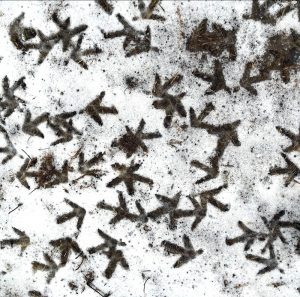
I captured this image the other day as I was wandering around the laying hen pasture. What do you see? Chicken feet, arrows, maybe something else? Well, we are on a farm, so I guess the most obvious answer is that they are chicken footprints — but in the same instance I noticed the patterns — it also immediately dawned on me that they looked like arrows pointing in different directions. When I showed the photo to Jen, she blurted out “chicken feet.” It’s funny how a shift in perspective can yield a totally different image. And the “chicken arrows” pointing in every different direction made me think of the current state of affairs in our country and also of life on the farm. How different ideologies can alter your perspective and thus perception of events and result in different actions being taken.

As a farmer, the image made me think how each and every day we have an endless amount of things to do, all sometimes pointing in different directions. The daily tasks on a farm are endless and it’s my job to make sense of the chaos and chart a clear path forward. The farms and businesses that find success tend to be the ones that are best able to stay pointed in one direction, stay true to their core principles, and be disciplined to achieve their goals.
At Codman, we are currently on such a path. With the sudden increase in visibility due to the pandemic, Codman Farm has become more of a resource to our community than ever. This has made us take measure of where we are, and consider more carefully where we are headed as a non-profit farm in the community of Lincoln. Why are we here, what is our purpose, how can we best care for our land and for the community in which we live. These are some of the many questions we are asking ourselves both now, and in the weeks to come.

I invite you to share what Codman means to you, how YOU see our role as a nonprofit in the community and HOW we can best carry out our core mission of keeping the lands of Lincoln open, in production agriculture, and educating others about farming and the impact it has in our society in so many different ways. Email me at pete@codmanfarm.org.

Pete Lowy is the farmer at Codman Community Farms. This piece appeared as part of the farm’s monthly blog/e-newsletter to members. Click here to see past issues of the blog.


”My Turn” is a forum for readers to offer their views on any subject of interest to other Lincolnites. Submissions must be signed with the writer’s name and street address and sent via email to lincolnsquirrelnews@gmail.com. Items will be edited for punctuation, spelling, style, etc., and will be published at the discretion of the editor. Submissions containing personal attacks, errors of fact, or other inappropriate material will not be published.

Category: agriculture and flora, My Turn Leave a Comment

Lincoln’s catalpa tree gets some preventive maintenance

December 20, 2020

By Cathy Moritz

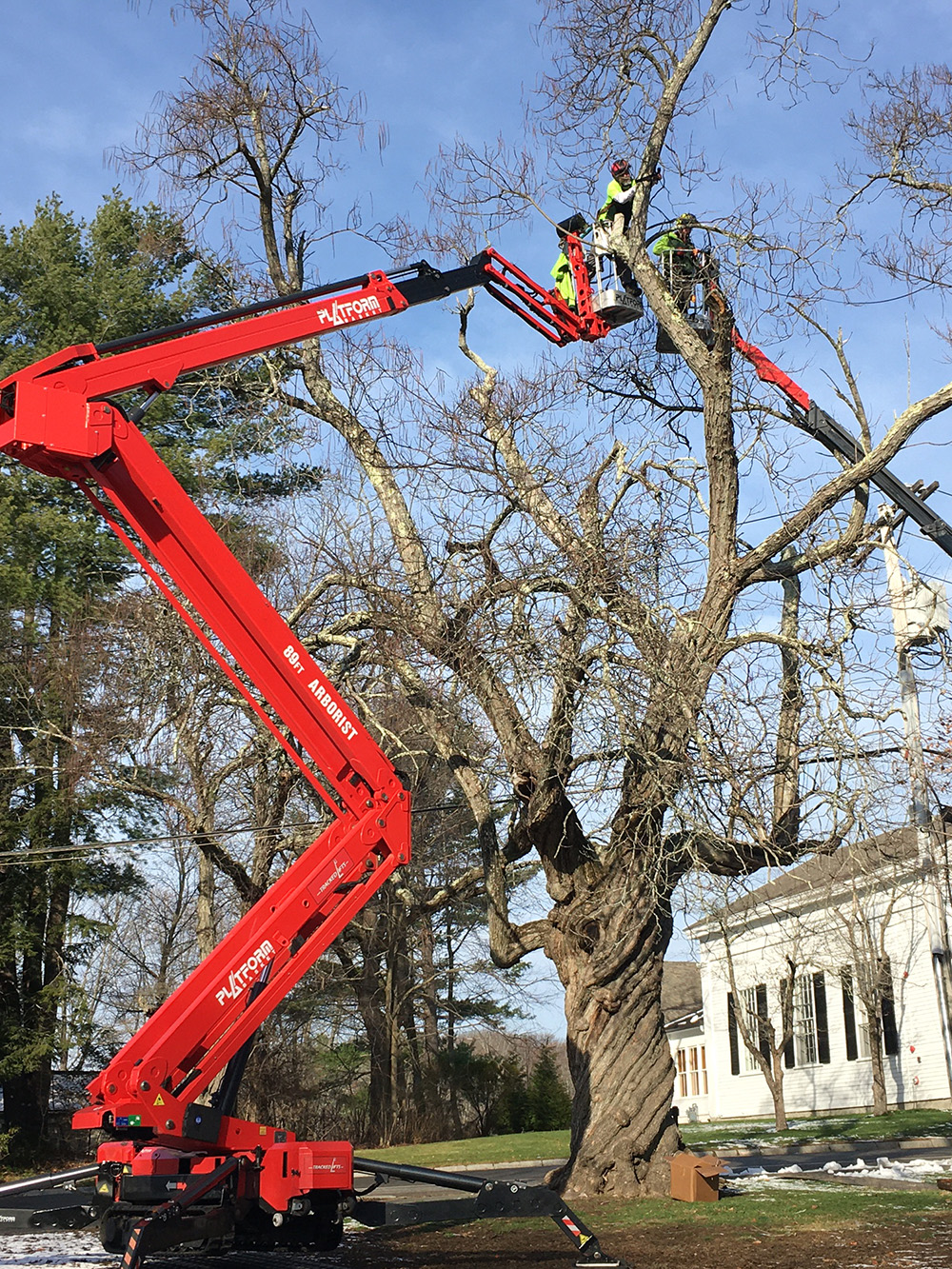
Workers attach cabling to branches of Lincoln’s twisted catalpa tree to help protect them from breakage.

The beloved twisted tree in front of the Lincoln Public Library is estimated to be 110 to 120 years old — at least 50 years older than a typical Northern Catalpa. In a joint project, the Friends of the Lincoln Library (FOLL) and the Lincoln Garden Club (LGC) have funded a preservation project that could extend the life of the tree another 20 to 30 years.

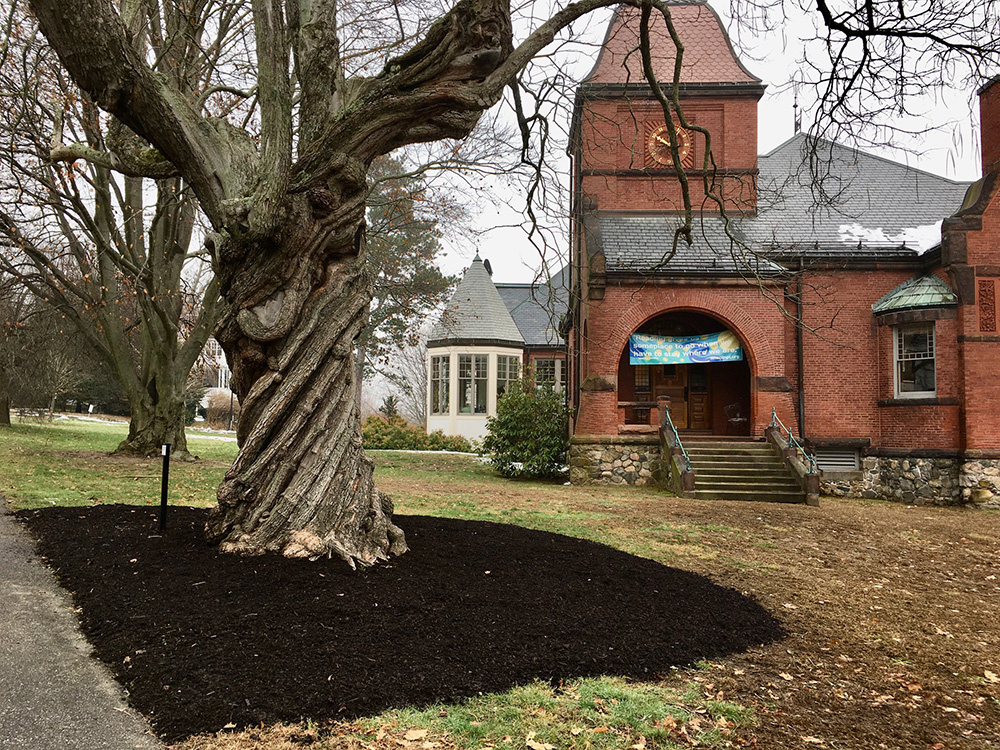
With the expert advice of the Arnold Arboretum’s Sean Halloran and professional arborist Jonathan Bransfield, along with the approval of library trustees and town officials, the Lincoln Catalpa Committee planned an extensive preservation project. On December 11, a crew from Bransfield Tree Co. spent over four hours in two tall bucket trucks to perform the preservation work, which included cabling the upper limbs to help them withstand wind and snow, pruning unstable or dead wood from the canopy, and fertilizing and installing a protective mulch ring around the trunk. A videographer filmed the project and interviewed the crew, and Bransfield promised that a finished video will eventually be available to all.

A fresh layer of mulch covers the ground beneath the tree.

The Committee was organized last spring to promote the preservation of the tree and coordinate a project to propagate clones of it. Members hope that at least one of the clones will twist as dramatically as the parent tree so that the tradition of a twisted tree at the library can continue. The committee includes Cathy Moritz, FOLL and LGC board member; Peter Sugar, library trustee; Bobbie Myles, library director; LGC members Cynthia Ferris and Eileen McCrory, and past FOLL president and LGC board member Daniela Caride. Questions about the group’s work can be directed to coordinator Cathy Moritz at cathymoritz@gmail.com.

In a public presentation sponsored by the LGC, Halloran, head of woody plant propagation at the Arnold Arboretum, gave a talk on the twisted tree, the cloning project, twisting trees in general, and tree planting tips. Interested Lincolnites who missed the presentation on November 1 can view it here.

Category: agriculture and flora, charity/volunteer Leave a Comment

My Turn: Drumlin Farm pitches in with produce during pandemic

December 3, 2020

By Renata Pomponi

Editor’s note: this piece originally appeared in EdibleBoston.com and is reprinted with permission. The last two paragraphs were added on December 15.

It all started with a half-ton of carrots.

In late March, with the world closing down around us from a global pandemic and all of our staff except farmers working from home, it soon became clear that Mass Audubon’s Drumlin Farm Wildlife Sanctuary in Lincoln had more vegetables than customers. News stories from other parts of the country spoke of farmers plowing under their spring crops in response to the near standstill in sales due to shuttered restaurants, schools gone virtual and closed farmers markets.

At the same time, the Greater Boston Food Bank was beginning to report what would end up being more than twice the demand of their normal operations. With a root cellar stocked with a bumper crop of carrots, and a new hoop house in the crops field starting to produce fresh greens that needed to be harvested, we knew that we needed to get our food out to where it was needed most.

Drumlin Farm has long called our approach to agriculture “Community Based Farming,” and we felt strongly that our ties to the community should drive our food distribution strategy, particularly at this time when food insecurity was rising in our region.

With the practical reality that there are only so many deliveries we could make in a week, it also felt important to continue working within the communities in which we already had relationships in order to maximize our impact. When we learned that the Cambridge-based nonprofit Food for Free had taken on grocery delivery and daily school meal preparations for families in their city, it immediately felt like a natural fit; in ordinary times, we would have already been making weekly deliveries to the Cambridge Public School’s farm-to-school program.

A few emails and phone calls later and we were connected with a weekly drop-off to Food for Free’s refrigerated lockers, getting those carrots (along with fresh eggs and greens) out to many of the same children who would have been eating Drumlin Farm food in the salad bars of the Cambridge elementary, middle and high school cafeterias.

Similar ties drew us to a partnership with the Lincoln Food Pantry, in our home community of Lincoln, where their board felt strongly about including fresh produce from local farms in their bi-monthly distributions. One of our regular restaurant customers decided to do a Meal Day for health care workers; that became another easy fit for a donation that strengthened our ties with the people who understood and valued our approach to sustainable agriculture. Through these and other meaningful local partnerships, we quickly got to a point where we were donating about a quarter of what we produced each week in April and May.

While the root cellar supply dwindled, the costs of running our farm of course did not. The demand for local food definitely increased enrollment in our CSA program, but our major distribution channels—restaurants and farmers markets—remained at minimal levels compared to our target annual budget. We wanted to keep donating whatever we couldn’t sell, but we also faced the same harsh realities of every small business during these challenging times.

Enter the community.

Our entire food donation program would not be possible without the incredible generosity of a growing group of individuals who see the value in investing in their local farms while simultaneously doing good in their community. By supporting Drumlin Farm with their charitable donations, these donors are keeping our farm going and helping ensure the food they know and love out gets to the families and individuals who need it the most. The response to this outreach has been steady and inspiring, allowing us to continue meeting Drumlin Farm’s commitment to local partners while keeping our farmers employed. Some donors have made major gifts, while some have chosen to add $5 or $10 onto their weekly CSA orders. One has even made an extraordinary offer to match every donation, doubling the impact, up to a total of $25,000. Each and every person has made a difference.

The root cellar is empty now and some of our regular sales channels have rebounded. But as the bounty of our fields grows each week during the summer and fall, we will continue to donate a significant portion in order to help alleviate hunger in our region. The pandemic crisis has led us to closely examine how our model of sustainable community farming can do even more to sustain our neighbors facing food insecurity, and we hope to be able to continue this program even after the pandemic has subsided for good.

Addendum, December 15, 2020:

Over the course of the 2020 growing season, Drumlin Farm has distributed over 17,000 pounds of veggies and 600 dozen eggs to people in need around eastern Massachusetts. We are grateful to the Lincoln Agricultural Commission for provided funding this summer to allow Drumlin Farm to begin making twice-a-month contributions of produce and eggs to the Lincoln food pantry. The Ogden Codman Trust then stepped forward with a generous grant to allow us to continue the program through the winter, with eggs from our chickens and greens coming soon from our hoop house.

Our hunger relief work in Lincoln has been a true community partnership, and we are honored to be part of making the connections from farm and farmer to those who truly need our food.

Renata Pomponi is the Wildlife Sanctuary Director at Drumlin Farm in Lincoln. To learn more about the Drumlin Farm hunger relief project, including a matching challenge that will double the impact of your donation, please visit the Drumlin Farm Food Donation Program.


”My Turn” is a forum for readers to offer their views on any subject of interest to other Lincolnites. Submissions must be signed with the writer’s name and street address and sent via email to lincolnsquirrelnews@gmail.com. Items will be edited for punctuation, spelling, style, etc., and will be published at the discretion of the editor. Submissions containing personal attacks, errors of fact, or other inappropriate material will not be published.

Category: agriculture and flora, charity/volunteer, food Leave a Comment

Storm wreaked havoc at Codman Community Farms

October 18, 2020

The unexpected derecho that swept through the area on October 7 damaged hundreds of trees, closed many roads and caused widespread power outages (about half the town at one point). A similar but stronger event in August destroyed millions of acres of crops and buildings in Iowa and northern Illinois, but the storm here caused damage and even livestock deaths on Lincoln’s own town farm. Below is the account of farmer Pete Lowy of Codman Community Farms. He sent this account to subscribers of the farm’s email newsletter; it’s reprinted here with his permission.


Last Wednesday was yet another memorable night on the farm. The evening starting out pretty much business as usual for a chicken catching night. As we do every chicken catching night we loaded the trailer with empty chicken crates, recruited some volunteers, and planned to gather out in the field to catch and crate birds about one hour before sunset. A bit of rain and thunderstorms did pop up in the forecast which had not been predicted, but it didn’t seem like a big storm.

Of course, the rain itself was due to arrive right around 6 pm, just when we planned to meet up with volunteers at Mt. Misery field, but otherwise, all seemed fine. Jared and I decided to get a jump on the weather as we first had to catch the last 40 turkeys at Van Leer field, then head over to Mt. Misery. We successfully caught all the turkeys as planned and loaded them in the back of the pickup truck. Toby the guardian dog looked on lazily as we caught the birds, no doubt happy to be done working for the season, then Jared loaded Toby in his truck and we both headed back to the farm to hook up the big trailer with the empty crates and to drop off Toby.

I was eager to get going as I’m always a bit excited and hopeful that chicken catching goes well – so I headed over to Mt. Misery first — Jared would soon follow. Just as I arrived in the field where the coops were located, some raindrops started falling. I got out of the truck to open the electric fence gate and as soon as I opened the truck door I felt a strong gust of brisk wind and some big pelting raindrops smack me on my bald pate — never a nice feeling! I jumped back into the truck and pulled into the field about 200 yards from where the coops were located.

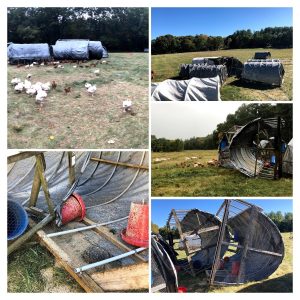
Driving slowly towards the coops, the weather closed in, uncertain how much rain would fall, I stopped the truck. The raindrops were unusually large — but the rain was not falling heavily. But then a strange wind quickly descended from the tree line. The tall trees surrounding the field swayed in the strong wind. Before I knew it, the 8’x12′ open-floored, tarp-covered chicken coops, each containing 65 chickens, started lifting off of the ground. One popped off the ground and descended again, like a kite trying to take off, then was suddenly picked up and flung through the air, tumbling and twirling side over side until it lay resting at the tree line about 200 feet from where it started. Then just as quickly another coop — and another — and another lifted off the ground and flipped over.

I honestly could not believe this was happening. We have used these types of coops for over 10 years and never, ever has this happened before. But this storm, later to be officially classified as a derecho (defined on Wikipedia as a widespread, long-lived, straight-line wind storm that is associated with fast-moving windstorms, potentially rivaling hurricane and tornado force minds), was like nothing I have ever seen. As the coops tossed and turned and danced in the air, I could only imagine how many chickens were being injured.

As quickly as the storm arrived, it departed. I called Jared, who had yet to arrive, and shouted out to him about the disaster I just witnessed — he was on his way. I was afraid to get out of the truck for fear of another wave of wind, but thankfully it never arrived. Once Jared arrived, we cautiously walked out to the coops to survey the damage. The chickens were scattered around, newly exposed to the open sky, and disoriented from the sudden change in their housing situation! Many chickens were walking around aimlessly in circles, wondering where their feeders and waterers went. Some were huddled together in small groups trying to stay warm, and yet other birds took advantage of their newfound freedom and started foraging, searching for tasty bugs and grass bits.

As Jared and I walked in circles surveying the damage, we began developing a plan as to how to unravel this mess. Volunteers starting arriving and we all pitched in to catch and crate the birds that were ready for harvest. We then had to relocate the homeless birds back into shelters for the evening. It was the best we could do as nighttime quickly descended. We would sort it all out in the morning. And just as we were finishing up and moving the last of the homeless birds back into shelters, an opportunistic hawk swept down and grabbed a free chicken dinner! And to our amazement, that was the only chicken that we lost due to the storm.

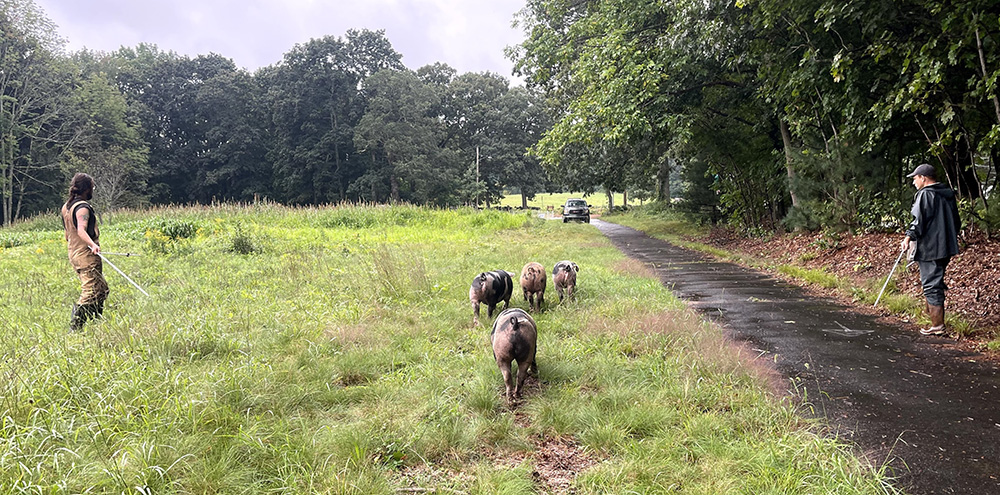
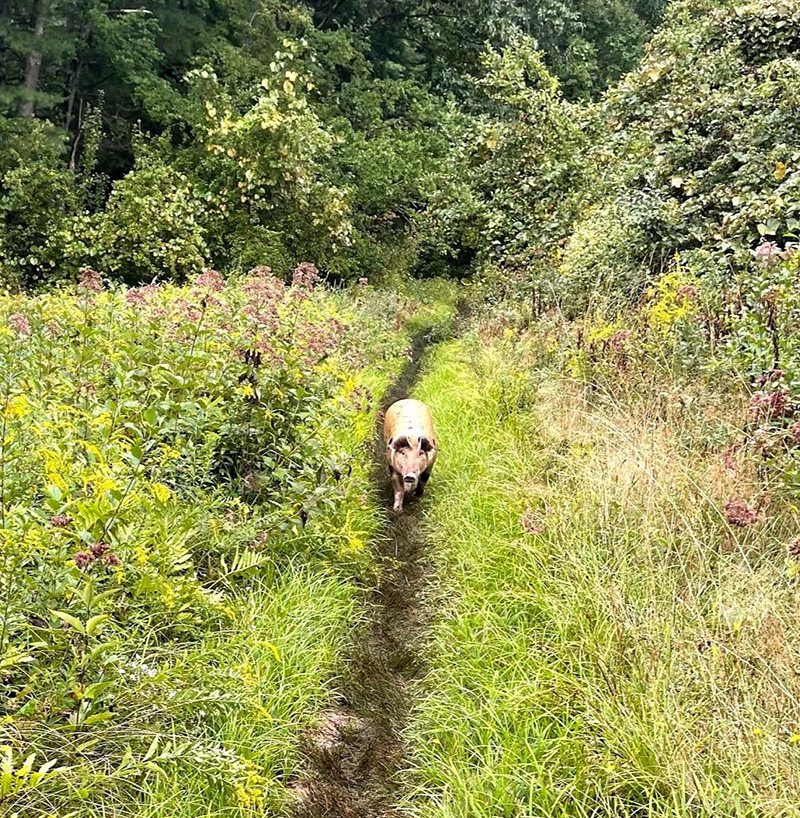
Unfortunately, the story does not quite end here. While we were dealing with the chickens, our pigs over at Minuteman National Park were also impacted that evening. Minuteman National Park along 2A was devastated by the storm with a tremendous amount of fallen trees. A large branch fell in our pig field, knocking down our pig fencing and injuring some of the more than 60 full-grown pigs who live on the field. Several days after the storm, three pigs died from internal injuries suffered from the fallen branch. They were beautiful full-grown Old Spot pigs that we had been growing since the spring. Tremendously sad accident. So far the rest of the pigs seem strong and healthy and we are keeping a close eye on them. Never a dull moment….

These events that happen all too often are just part of the many physical and economic challenges farms like ours face every day. We feel it’s important to share these stories to provide a deeper understanding of our work and what it take s to run a small diversified farm in today’s world. As always, we appreciate any and all feedback and are grateful for your support! Onward!

Photos of some of the damage caused by the derecho (click to enlarge).

Category: agriculture and flora, news 1 Comment

Outdoor watering now limited to once a week

August 24, 2020

Residents on town water must now limit non-essential outdoor watering to one day a week because of this summer’s drought conditions, though agricultural watering is exempt from these restrictions.

After above-normal temperatures in July and early August and more than three months of below-normal rainfall, state Energy and Environmental Affairs Secretary Kathleen Theoharides declared a Level 2 – Significant Drought in all seven regions of the Commonwealth. Lincoln’s Water Commission subsequently voted to move to Stage 3 drought restrictions as specified in the town’s Drought Management Plan.

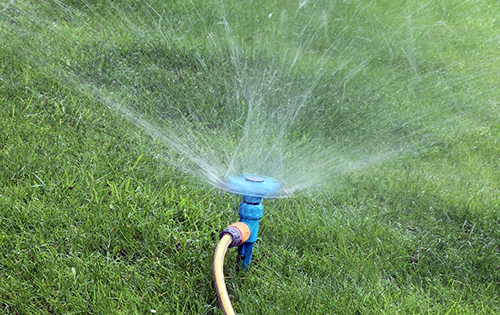
Lincoln water customers may water established lawns and landscaping on their assigned day using in-ground irrigation systems or hose-mounted sprinklers between 7 p.m. and 7 a.m. Those with even-numbered street addresses may water on Saturdays and odd-numbered addresses on Sundays. Hand-watering using a hose is allowed any day of the week between 6 p.m. and 9 a.m.

Exceptions for new lawns are allowed only during June and September and will be limited to watering during the first 20 days after installation. In addition, swimming pools may be filled no more than three inches per month, and car washing is prohibited.

People with home gardens must follow the residential restrictions for non-essential watering, since hand-watering should be sufficient. Those who officially qualify as farmers, however, are allowed to water as needed. This includes customers who have been approved for agricultural water rates and those whose property meets the definition of “farm” as outlined in the town’s agricultural zoning bylaws.

The Water Department will issue warnings and potentially fines to customers who violate the watering restrictions.

Category: agriculture and flora, conservation, government, land use, Water Dept.* Leave a Comment

My Turn: The Food Project needs your help

July 12, 2020

By Peter von Mertens

The Food Project, which farms 31 acres of Lincoln conservation land, is hard-pressed during this Covid crisis to carry out their mission. Normally teams of volunteers from corporations, law firms, banks, schools, and other nonprofits would be planting and weeding the carrots, lettuce, tomatoes, and other crops. During the summer months, teams of high school youth would carry on that work as well as picking, washing, sorting, and helping distribute over 250,000 pounds of fresh, organic produce to inner-city hunger relief organizations and farmers’ markets. 

Not so this year. The 110 youth — some from cities and some from suburbs — cannot come together due to Covid, and the entire farm work has fallen on a core crew of eight farmers and some of the Food Project office staff. 

The Food Project is a powerful anti-racism program as it brings together youth from different racial and ethnic as well as socioeconomic backgrounds, and the youth and staff spend time discussing their biases, experiences and ways to understand and resolve conflicts. Of all the years to miss this kind of learning!

The Food Project has been hard hit financially this year. They were fortunate to have received a Payroll Protection Grant to help them keep key staff employed, but the future is very uncertain. Please consider making a donation at thefoodproject.org. It’s local. It provides high-quality produce to residents of Dorchester, Roxbury, and other areas in greater Boston. And it’s important to keep alive and well through this crisis.


”My Turn” is a forum for Lincoln residents to offer their views on any subject of interest to other Lincolnites. Submissions must be signed with the writer’s name and street address and sent via email to lincolnsquirrelnews@gmail.com. Items will be edited for punctuation, spelling, style, etc., and will be published at the discretion of the editor. Submissions containing personal attacks, errors of fact, or other inappropriate material will not be published.

Category: agriculture and flora, charity/volunteer, My Turn, news 1 Comment

Today’s Covid-19 updates for Lincoln

March 18, 2020

Donelan’s

Because a number of items are in short supply, Donelan’s has temporarily suspended its online shopping and delivery service. Lincoln store manager Jason Deveau told the Squirrel on Wednesday that the five-store grocery chain is considering offering early-morning hours exclusively for seniors to minimize their risk of public exposure, but stores would follow whatever policy the company is decided and can’t act individually.

As far as general restocking goes, the store is not always getting everything it orders, but deliveries continue. “Right now we’re doing the best we can ordering stuff, but I just don’t know what time or day things will come in,” Deveau said.

Other options for food and medication home delivery can be found here.

Transfer station

In an effort to minimize crowding at the transfer station, the Department of Public Works will has added Monday hours to the customary Wednesday and Saturday schedule. Effective Monday, March 23, the facility will be open Monday, Wednesday and Saturday from 7:30 a.m. until 3:30 p.m. As announced earlier, the swap table program has been indefinitely halted.

Real

Real is now offering takeout brought to your car three evenings a week. Please place your order before 5 p.m. with 30 minutes’ notice, or schedule ahead for later in the week. Pickup times are available from 5–6:45 p.m. on Wednesdays, Fridays, and Sundays. At your chosen pick-up time, park in the back of the restaurant and call the restaurant at (781) 259-9464. Ruth-Anne or Tom will bring your order out to your car.

Drumlin Farm

Although Drumlin Farm is closed to the public, farming operations continue, and Drumlin is partnering with Codman Community Farms and Family Dinner to distribute produce. Residents can buy Drumlin Farm produce at the CCF farm store, which is open 24/7, and Family Dinner will deliver boxes of local produce right to your door. This week, Drumlin Farm is harvesting spinach, arugula, pea shoots, bok choy, and tatsoi for these partners, and is optimistic that they’ll be able to provide another season of CSA shares starting in May. If you haven’t already registered for one of its seasonal programs, shares are still available.

Educational offerings

Dozens of past presentations, including Lincoln Academy and other Council on Aging events, Bemis Lectures, and events hosted by the Lincoln Historical Society, Lincoln Public Library, Lincoln Land Conservation Trust and more are all available for watching on your computer. Find videotaped events by going to lincolntv.viebit.com/ and clicking on an organization or topic from the vertical list of folders on the left.

For those interested in learning a new language or improving their skills,  the library offers Mango, which immerses you in real, everyday conversations in a wide variety of languages. It also features ESL instruction in English, tailored for speakers of more than a dozen languages. Transparent Languages offers courses and supplemental resources for learners of all levels looking to build their listening, speaking, reading, and writing skills in more than 100 languages. Click here to see links for these programs, as  well as free access to the New York Times online. You’ll need your library card number to log in.

Category: agriculture and flora, Covid-19*, educational, food Leave a Comment

Winter at the farm (Lincoln Through the Lens)

January 26, 2020

The white barns of Codman Community Farms match their snowy surroundings earlier this winter. See this CCF blog post for a description of what goes on during the quieter winter months.


Readers may submit photos for consideration for Lincoln Through the Lens by emailing them to lincolnsquirrelnews@gmail.com. If your photo is published, you’ll receive credit in the Squirrel. Photos must be taken in Lincoln and include the date, location, and names of any people who are identifiable in the photo. Previously published photos can be viewed on the Lincoln Through the Lens page of the Lincoln Squirrel.

Category: agriculture and flora, Lincoln through the Lens Leave a Comment

Farmers protest sudden end to lower water rates

January 9, 2020

By Alice Waugh

The Water Department recently stopped allowing rate caps for agricultural users of town water, but after farmers were taken by surprise and objected, officials decided this week to study the matter further.

The issue of water rates is a sore subject for the town. To help pay for an array of capital projects and new equipment, residents voted to approve bonding totaling about $2 million at Town Meetings in March and November 2019, and the department has been in a financial and staffing crisis for some time.

Because of the expenditures, water bills went up by 25% last year, and another significant increase is expected when next year’s rates are set. The Water Commission plans to propose the new rates on January 21 and hold a public hearing on February 4.

Everyone who uses town-supplied water must pay according to how much water they use each quarter. There are three usage tiers: 0–20,000 gallons, 20,001–40,000 gallons, and 40,001 gallons or more. As an incentive to conserve water, the fee climbs steeply from one tier to the next: $5.08 per 1,000 gallons for users in tier 1, rising to $10.71 for tier 2 and $25.03 for tier 3. Local farms can use more than 100,000 gallons per quarter in the growing season.

In keeping with Lincoln’s agricultural character, former Water Department Superintendent Greg Woods (who left about two years ago) capped the rate at Tier 1 for some farming operations in Lincoln. The policy was on an informal case-by case basis; Lincoln does not have a written policy regarding rates for agricultural water use.

Water Department Superintendent MaryBeth Wiser drafted a proposal with suggested criteria for an agricultural rate last year, but in June 2019, the commission voted not to adopt it and to discontinue the water rate caps for farms. Water customers were notified in their July bills that farms would no longer receive special treatment and would be charged according to water usage the same as everyone else starting October 1, 2019. Since farms use a lot of water, the change could mean added costs amounting to tens of thousands of dollars a year. The only alternative is to pay for digging a private well, which can cost upwards of $20,000.

Although the notice went out in July, some farmers didn’t realize a change had been made until they got their water bills in November, as there was no outreach or publicity from the Water Department aside from the notice in the summer bill.

“Agricultural water rates are important to the viability of farms in Lincoln,” Agricultural Commission co-chair Ari Kurtz said at the Water Commission’s January 7 meeting. “Farmers use town water to wash vegetables, maintain community gardens, and water crops when wells are not available or treated water is required. Building wells is a significant expense that many small farmers cannot absorb and would discourage small startup agricultural operations… If water conservation or the need for increased revenue for the Water Department were significant drivers of the decision to rescind agricultural water rates, we would like to have the chance to examine alternatives that are less damaging to the farming community.”

Kurtz was reading from a letter that he and Agricultural Committee co-chair Louise Bergeron wrote to the commission.

“These will be crippling rates for many people,” said Steven Kanner, who owns Kanner Family Orchard on Bypass Road, which supplies fresh fruit to customers including the Lincoln schools and Codman Community Farms (CCF).

“For us, the situation is critical,” said Pete Lowy, manager of CCF. “We would have to double or triple rates for garden plots.” CCF leases more than 100 community gardening plots to residents.

The Water Commission approved an interim agricultural rate structure in 2017, though it’s unclear who now qualifies for that rate. After extending an exemption for Brian Turnbaugh of 153 Lexington Rd., the commission approved an interim fee structure whereby Tier 2 would encompass 20,001–100,000 gallons per quarter. This was proposed as an “interim measure” by commission member Packy Lawler, who advocated a rate structure for agricultural use that encourages water conservation, according to meeting minutes.

“We’ve had agricultural water rates on our agenda or list of things to do for about five years,” commission member Ruth Ann Hendrickson said at this week’s meeting.

Wiser’s June agricultural proposal wasn’t useful for Lincoln, Hendrickson said. “It was sort of a generic proposal that MaryBeth had picked up from various sources on the Internet. It was really more appropriate to a place like the Midwest,” with its massive amounts of livestock and farming acres. “It was more complicated than we needed.”

As the commission was discussing the issue this week, it was apparent that they did not have current data on the number of farms in town, how a farm is defined, how much water they use, and which have separate water meters for agricultural uses such as watering animals and irrigating crops as opposed to regular indoor use. This stems in part from difficulties some officials have had in using Munis, the town’s financial data system.

 “What we really need is some data,” Hendrickson said. “How much water are we talking about? It’s a balancing act between supporting the town in its desire to have farms vs. asking to what extent do our customers want to subsidize the farmers. That’s the question we’re going to have to wrestle with… Every year we already overdraw our [state DEP] permit. We’re between a rock and a hard place.”

The commission decided to appoint a subcommittee to study the issue of agricultural water rates, chaired by member Michelle Barnes and including Agricultural Commission members. But they’re under a tight deadline, with the public hearing on new rates set for February 4.

Category: agriculture and flora, government, news, Water Dept.* 1 Comment

Arnold Arboretum begins project to reproduce Lincoln’s catalpa tree

October 16, 2019

By Cathy Moritz

Sean Halloran, head of woody plant propagation for Arnold Arboretum, takes a cutting of Lincoln’s catalpa tree.

Sean Halloran, head of woody plant propagation at the Arnold Arboretum of Harvard University, has generously agreed to attempt to reproduce a twisting offspring of the town’s beloved Northern Catalpa tree in front of the Lincoln Public Library. Halloran’s work is at the joint request of the Lincoln Garden Club and the Friends of the Lincoln Library.

The catalpa has graced the grounds of the Lincoln Library and sparked conversations in Lincoln since the early 20th century, but it’s well beyond the typical catalpa lifespan of 60 years and won’t live forever. The hope is to grow a genetically identical twisting “daughter tree” to plant nearby on the library grounds so future generations can enjoy the same beautiful tree we have. 

Arboretum staff are using several reproduction techniques. On July 22, Halloran and an intern took many cuttings of new growth up in the upper branches, and 115 of them are now planted in an Arboretum greenhouse under the best conditions. This fall, they will gather seeds from the tree before they fall to the ground where they can pick up disease.

Halloran has not located another catalpa in the immediate area. He believes that the tree is self-pollinating, so that its seeds are probably genetically identical to the parent tree. Next winter, one or more small limbs will be taken and grafted onto catalpa stumps, employing the same technique used to grow apple cultivars. Root cuttings, which can be dangerous to the tree, are under consideration but will not be used without further discussion and permission from the library trustees.

This project will take several years, and it may not be immediately apparent that any of the tree’s offspring will have the twisting characteristic. Halloran explained that tree genetics are even more complicated than human genetics and their expression is affected by the environment just as human genes are, so that there is no guarantee that any offspring will twist. But he assures us that the Arboretum staff will take whatever time is needed to complete the project. They are using it as a learning experience for their interns. Meanwhile, they’re also advising us on how to preserve the existing tree.

Coordinating the effort is the Lincoln Garden Club, with assistance from the Friends of the Lincoln Library; Barbara Myles, the library’s director; and the library trustees. Myles reported that town residents are very concerned about the tree and contact her frequently in the spring, when the month of May often goes by with nary a leaf appearing. In early June, the catalpa’s bare branches leaf out very rapidly. Halloran noted with interest that for unknown reasons, Lincoln’s catalpa blooms three to four weeks after the catalpas at the arboretum and is, quite literally, a “late bloomer.”

Category: agriculture and flora 2 Comments

  • « Go to Previous Page
  • Page 1
  • Page 2
  • Page 3
  • Page 4
  • Page 5
  • Interim pages omitted …
  • Page 14
  • Go to Next Page »

Primary Sidebar

Recent Posts

  • Service in June for Tim Barclay April 21, 2026
  • Legal notice: Conservation Commisson public hearing (29 Lincoln) April 21, 2026
  • News acorns April 19, 2026
  • Police log for April 3–15, 2026 April 19, 2026
  • Two different ideas floated for former Stonegate Gardens property April 16, 2026

Squirrel Archives

Categories

Secondary Sidebar

Search the Squirrel:

Advanced search

Privacy policy

© Copyright 2026 The Lincoln Squirrel · All Rights Reserved.