• Skip to primary navigation
  • Skip to main content
  • Skip to primary sidebar
  • Skip to secondary sidebar

The Lincoln Squirrel – News, features and photos from Lincoln, Mass.

  • Home
  • About/Contact
  • Advertise
  • Legal Notices
    • Submitting legal notices
  • Lincoln Resources
    • Coming Up in Lincoln
    • Municipal Calendar
    • Lincoln Links
  • Merchandise
  • Subscription Info
    • My Account
    • Log In
    • Log Out
  • Lincoln Review
    • About the Lincoln Review
    • Previous Issues
    • Submit Your Work
    • Subscribe/Donate

health and science

My Turn: Eighth-graders raise awareness of teen mental health

June 3, 2026

By Klaudia Teksten and Veronika Sedlak

Our names are Klaudia Teksten and Veronika Sedlak and we are local eighth-graders from Lincoln Public Schools. We are working on our civics action project researching teen suicide prevention. Teen mental health is something that affects more people than we often realize, yet it is not always talked about openly. The suicide rate has increased by 30% in the past two decades and as of now is the third-leading cause of death among those ages 15-29 years old. As students working within this topic, our goal is to help raise awareness and make it easier for teens to get support before their struggles become more serious. 

The leading cause of teen suicide has proven to be depression and anxiety. Many young people experience overwhelming stress, pressure, loneliness, or feelings of hopelessness which can build up over time. These issues can occur from negative self-esteem, having been the victim or witness or violence, having a learning disability, as well as abusive use of alcohol, nicotine, and/or drugs. According to Johns Hopkins Medicine, women experience depression and anxiety about twice as much as men due to factors like hormones and pregnancy. Helping teens feel heard and supported can make a meaningful difference in preventing a crisis.

One of the most important things we have learned is that many teens who are struggling do not always ask for help directly. Because of this, it is important for friends, families, teachers, and community members to recognize signs.

Some common signs that a teen may be struggling include noticeable changes in mood or behavior. This could look like becoming more withdrawn, losing interest in activities they once enjoyed, isolating themselves from families and friends, writing good-bye letters, and/or if an individual is talking about suicide. Other signs might include changes in sleep patterns or changes in eating habits. Increased irritability, difficulty focusing, or a sudden drop in school performance can also be warning signs. 

It is also important to pay attention to what people say. Even small comments about feeling hopeless or overwhelmed can be meaningful. While not every sign means something serious is happening, patterns or multiple changes at once are worth noticing. 

Through our project, we have been working to better understand how teens can access support. We spoke with our school counselor to learn about the resources available in our school and how students can get connected to additional help when needed. We also learned about the William James College INTERFACE Referral Service, which provides support outside of school and can be an important step for many students. 

These conversations helped us realize that support systems do exist, but not everyone knows about them or feels comfortable using them. That is why awareness is so important. If more people know what to look out for and how to respond, it becomes easier for teens to get help early on.

So what can you do if you think someone might be struggling?

First, check in with them. This does not have to be a big formal conversation. Simply asking “Are you okay?” can make a huge difference. Listening without judgement is one of the most important things you can do.

Second, encourage them to talk to a trusted adult. This could be a parent, teacher, school counselor, or another trusted adult they feel comfortable with. You do not need to get all the answers; helping them connect to someone who can support them is what matters.

Finally, take concerns seriously. If something feels off, it’s always better to speak up than to stay silent. Looking out for one another is an important part of building a supportive community. 

Our project is not just about learning; it is about making change. By sharing this information, we hope to help our school and Lincoln community become more aware, more supportive, and more prepared to help teens who may be struggling. Everyone has a role to play. Sometimes, noticing small changes and reaching out can make a bigger difference than we realize.


“My Turn” is a forum for readers to offer their letters to the editor or views on any subject of interest to other Lincolnians. Submissions must be signed with the writer’s name and street address and sent via email to lincolnsquirrelnews@gmail.com. Items will be edited for punctuation, spelling, style, etc., and will be published at the discretion of the editor. Submissions containing personal attacks, errors of fact, or other inappropriate material will not be published.
Category: health and science, My Turn, Uncategorized 1 Comment

Town seeks input on how to spend opioid settlement money

November 16, 2025

Residents of Lincoln and six other towns are being asked to take surveys that will shape how the towns will spend their shares of the legal settlements with opioid companies and Johnson & Johnson.
Massachusetts is receiving more than $900 million from the 2021 settlements, all of which is intended for substance use prevention and treatment efforts. Local municipalities are receiving 40% of the funds, or about $360 million. Annual payments vary and are determine by the state, and Lincoln averages about $20,000–$25,000 annually, according to Assistant Town Administrator Dan Pereira.

Lincoln is part of the Great Meadows Regional Public Health Collaborative with Wayland, Sudbury, Weston, Concord, Bedford, and Carlisle. Within that group, the SAFE Initiative (Substance Awareness for Everyone) intends to look at regional responses to the opioid problem. Surveys are being conducted in all of the towns and the data will be used to develop both regional and local programs.

The anonymous survey for Lincoln, which takes about 10 minutes to complete, will help the town understand community priorities for spending opioid settlement funds. Public Health Nurse Tricia McGean, the Health Department, and Pereira represent Lincoln on the collaborative and will work with other Lincoln officials and SAFE to guide investments in prevention, treatment, recovery, and related services.

The SAFE team expects to close the survey before the end of 2025 and will publish results sometime in 2026 once they’ve had time to analyze the data.

Category: health and science Leave a Comment

West Nile Virus found in Lincoln

August 18, 2025

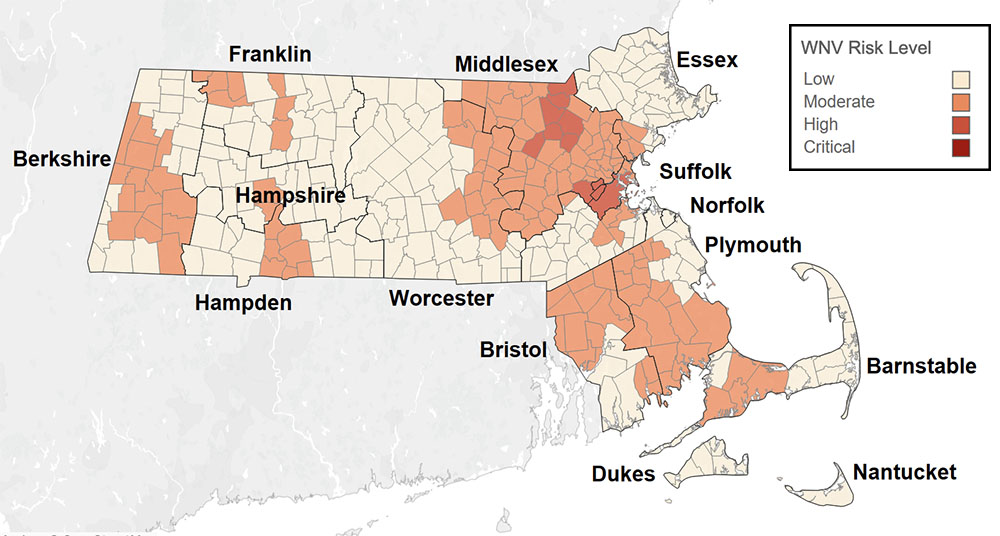
A map showing towns with low, moderate, and high risk of West Nile virus (click to enlarge). Source: Mass.gov.

The Massachusetts Department of Public Health announced that West Nile virus (WNV) has been detected in Culex pipiens/restuans mosquitoes collected in Lincoln on August 5, 2025. This raises the risk level in Lincoln to moderate.

Due to ongoing evidence of mosquito samples carrying the virus, the risk level for WNV is classified as high in Acton, Bedford, Billerica, Boston, Brookline, Carlisle, Chelmsford, Dracut, Lowell, and Newton. 

“WNV findings in mosquitoes have accelerated rapidly over the last several weeks,” said State Epidemiologist Catherine M. Brown. “We are now in the peak time for transmission of mosquito-borne disease to people, and it is important for people to know that so they can take steps to protect themselves.”

The state Public Health Laboratory confirmed this year’s first WNV-positive mosquitoes in Massachusetts on June 17. Since then, there have been 168 WNV-positive mosquito samples detected from 12 counties including Middlesex. No human cases of WNV have been confirmed in Massachusetts so far this year.

Although serious illness caused by WNV is uncommon, there have been 142 cases of WNV in Massachusetts between 2015 and 2024. There were nineteen human cases of WNV in 2024, six human cases in 2023, and eight human cases of WNV in 2022. In addition, there have been seven mosquito samples that have tested positive for EEE (eastern equine encephalitis) this year, but no confirmed human or animal cases so far.

“Both West Nile virus and EEE pose risk to the people in Massachusetts,” Public Health Commissioner Robbie Goldstein said in an August 12 press release. “The weather remains warm and somewhat humid, which increases mosquito activity. I encourage everyone to take measures to protect themselves: use mosquito repellent when outdoors, wear long sleeves and pants, and be aware of peak mosquito hours.”

More information on both viruses as well as protection and control measures can be found on this Mass. Department of Health web page. 

According to Lincoln public health nurse Tricia McGean, East Middlesex Mosquito Control collects mosquitoes by setting out mosquito traps. Once back at the lab, mosquitoes from each individual trap are sorted by species, and certain species are submitted to the Department of Public Health to be tested for both WNV and EEE. Each sample submitted consists of 5-50 mosquitoes, all of the same species. Each sample is tested as one unit, so if one “pool” of 25 mosquitoes is submitted and tests positive, that would count as one WNV+ sample.

The specific locations that yielded positive samples are not disclosed, she said.

Category: health and science Leave a Comment

My Turn: Kanner touts experience on Board of Health

March 27, 2025

By Dr. Steven Kanner

Although I run unopposed for the Lincoln Board of Health this year, some policy and personal information may still be of interest to voters.

I have been privileged to serve on our Board of Health since 2013. My work, along with that of my colleagues Dr. Fred Mansfield and Trish Miller, is to keep Lincoln residents safe as possible from infectious diseases, environmental dangers, and other health hazards, as well as to provide informed, science-based counsel around any health issues of community relevance.

Originally, I was asked to join the board after engaging in public discussion about the public health importance and safety of using low levels of water fluoridation in the runup to the resounding vote of support at Town Meeting for community water fluoridation that year.

During the early Covid-19 pandemic, just five years ago this month, we faced a rapidly spreading severe disease for which we had no tests, no treatment, and no prevention, while the initial Massachusetts death rates from Covid were an astonishing 5%. This was a scary and very fraught time.

More recently:

  • I worked with other board members to simplify septic approvals, saving time and money for homeowners.
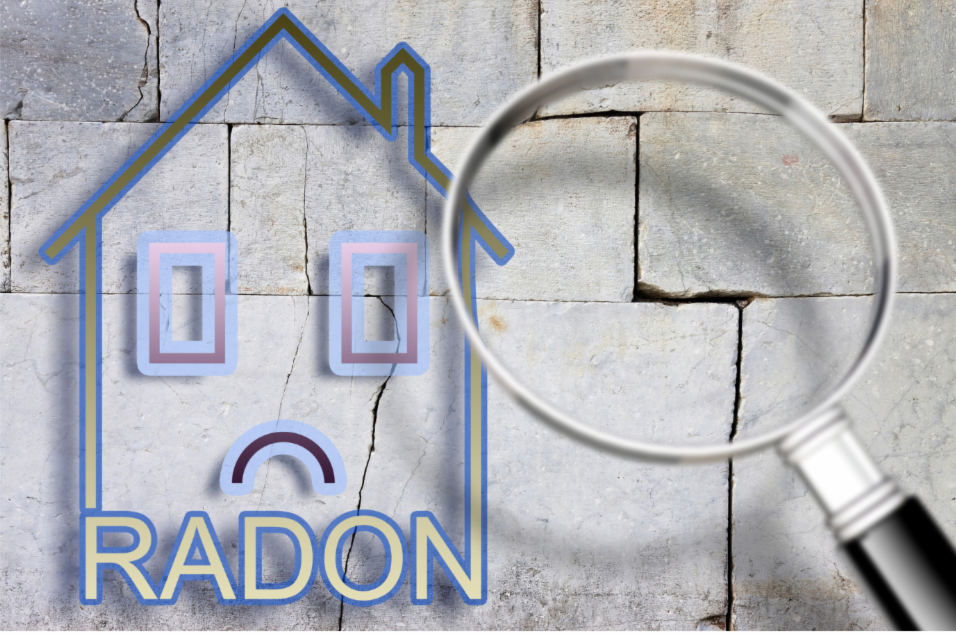
  • I took the lead to arrange for radon meters to be available free for home testing (with the major aid of another Lincoln resident) and wrote educational materials about our significant radon risk in Lincoln.
  • I wrote science-based informational materials on disease and vaccination relative risks for the Board of Health website (“Influenza and Covid-19 Vaccine Risk and Benefit in 2024 – On Health and Health Care” in left-hand column).

Going forward, I plan to work with my other board members to widen our public health information initiatives to include home sanitation topics such as kitchen cleanliness and proper maintenance of septic systems, while maintaining our primary focus on community infectious diseases and environmental risks.

My qualifications for this public health role include education at Harvard College (A.B.) and Harvard Medical School (M.D.), an MBA from the MIT Sloan School of Management, several years work in the U.S. Public Health Service and in Massachusetts state government improving mental health medical systems, and 50 years of primary care medical practice. I have happily lived in Lincoln with my wife, Linda, since 1996, where we developed the Kanner Family Orchard to grow apples and peaches. We provide these to the Lincoln food pantry and Codman farm among other nearby nonprofit food organizations.


“My Turn” is a forum for readers to offer their letters to the editor or views on any subject of interest to other Lincolnites. Submissions must be signed with the writer’s name and street address and sent via email to lincolnsquirrelnews@gmail.com. Items will be edited for punctuation, spelling, style, etc., and will be published at the discretion of the editor. Submissions containing personal attacks, errors of fact, or other inappropriate material will not be published.

Category: elections, health and science, My Turn Leave a Comment

News acorns

January 12, 2023

Lincoln historian speaks on her latest book

Megan Kate Nelson

Civil War historian and Lincoln resident Megan Kate Nelson will give a talk about her new book, Saving Yellowstone: Exploration and Preservation in Reconstruction America (Scribner, 2022) at the Concord Museum on Tuesday, Jan. 24 at 7 p.m. at the Concord Museum. It tells the vivid story of how, 150 years ago, Yellowstone became the world’s first national park amid the nationwide turmoil and racial violence of the Reconstruction era. A narrative of adventure and exploration, the creation of Yellowstone is also a story of Indigenous resistance and the struggles of Black southerners during a turning point in the nation’s history. Nelson was a finalist for a Pulitzer Prize in 2020 for The Three-Cornered War: The Union, the Confederacy, and Native Peoples in the Fight for the West (read this Lincoln Squirrel profile of her). Click here to register.

Session on radon risks and testing

January is National Radon Action Month, Michael Feeney, director of the Indoor Air Quality Program at the Massachusetts Department of Public Health, will give a presentation on radon health risks, testing, and mitigation on Thursday, Jan. 26 at 6:30 p.m. in the Lincoln Public Library’s Tarbell Room. His talk will address residents’ health regarding exposure to radon that may accumulate in their homes and provide radon health and exposure reduction information to interested residents. Feeney has conducted over 1,800 indoor air quality investigations in schools, office buildings, libraries, courthouses, town halls, firehouses, police stations and homes throughout Massachusetts. Anyone may attend in person, but those who want to attend via Zoom must preregister; click here to register.

 Flu and Covid-19 vaccine clinic 

Lincoln residents ages 6 months and up may get free flu and Covid-19 vaccinations at a clinic on Friday, Jan. 27 from 4–7 p.m. in the Reed Gym. Advance registration required.

Category: health and science, history Leave a Comment

Road salt in Lincoln: How much is enough?

January 17, 2022

Road salt has been a hot topic of discussion on LincolnTalk recently. How is it used to treat Lincoln’s roads? How much salt is in town water? Is it harmful for the environment?

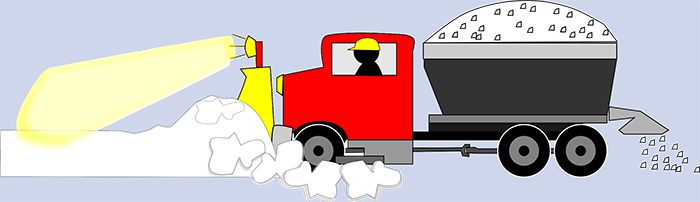
Lincoln’s Department of Public Works, like that in most other U.S. cities and towns where it snows, have been spreading salt crystals on roads for decades. Road salt (sodium chloride, the same chemical as table salt) lowers the freezing point of water, so ice and snow containing dissolved salt will melt at colder temperatures, resulting in roads that are wet rather than slippery and thus improving safety for vehicles.

About four or five years ago, Lincoln began applying a thin coating of salt water (brine) on roads before an anticipated storm, which appears as thin white stripes. This prevents ice and snow from immediately adhering to the roadway and “breaks that bond,” DPW Superintendent Chris Bibbo said. Pre-treating roads with brine means that less road salt is needed during and after the storm.

In recent weeks, several residents have shared photos on LincolnTalk of what appeared to be heavy coatings of rock salt on some town roads. Around the same time, The New York Times and The Washington Post published stories about a study in the scientific journal Frontiers in the Ecology and Environment titled “Road salts, human safety, and the rising salinity of our fresh waters.” Road salt can damage plant life when it drains or plows push it to the side of the road, and too much sodium in drinking water over a period of years can be harmful to human health.

In the 1980s, there was enough concern over road salt that the amounts used in Lincoln were reduced, and signs appeared at the town line on some roads noting that “minimum salt is used in Lincoln” as a warning to drivers that the road they were on might suddenly get more slippery. But problems arising from under-salted roads caused the pendulum to swing back the other way.

“Some roads were just rutted ice in a particularly bad winter,” Water Commissioner Ruth Ann Hendrickson said. There have been at least two deaths in recent years after car accidents involving icy roads. George Elder died after his car skidded on Sandy Pond Road, according to the Boston Globe article published on March 4, 1984. There was  another accident on icy Moccasin Hill where the driver was badly hurt, “and it really triggered people to say we need to have more” salt, she added.

How much salt does the DPW use? That depends on the weather and road conditions. “We try and use the least amount of material possible during winter storm events while doing our best to provide a safe transportation network,” Bibbo said. “Most winter storm events provide different sets of challenges and therefore require different treatment options. For example, a fast-moving snowstorm typically requires a different strategy than a rain-to-freeze event. Storms that produce mostly snow typically require more of a plowing technique than treatment. The weather conditions that we had in mid- and late December were challenging, with rain and mist repeatedly freezing on the roads.”

On Christmas Day, there was light snow and rain while the temperature hovered around freezing, and police reported several car accidents that morning. On January 5, while Lincoln didn’t see particularly hazardous conditions, a flash freeze caused numerous accidents in central and western Massachusetts despite road treatments. “I’ll tell you that I can speak for all our snow and ice managers that I’d rather get a foot of snow,” state Highway Administrator Jonathan Gulliver was quoted as saying.

Another variable is the ratio of sand to salt used on a given day. The DPW has piles of both (though the salt is covered, as required by the DEP), and the department decides what mixture to use for each weather event, Bibbo said. A higher proportion of salt is needed for icy conditions, whereas snow calls for less salt but more sand to aid in traction.

Occasionally there’s an accidental release of a large amount of the salt/sand mixture in one spot, “but we obviously try to avoid that at all costs,” Bibbo said. The DPW is looking into purchasing calibration equipment to more precisely control the rate at which the material is released as trucks drive over roads. The rate is now manually controlled by DPW crews based on their experience and road conditions, he added.

Asked about the use of road salt in environmentally sensitive areas, Bibbo said, “We don’t do anything different on roads near wetlands.” Roads are treated differently only according to traffic volume and speed, so main roads like Route 117 and Route 136 will get more total sand and salt. “The more minor roads typically may not be treated at the same frequency as the major roads, but all roads typically get treated,” he said.

Sodium in town water

The Lincoln Water Department tests untreated water from Flint’s Pond and the well on Tower Road (which provides about 30% of town water) once a year. The most recent water quality report shows that sodium levels ranged from 14.1 to 54.5 milligrams per liter or parts per million (ppm) in 2020. Unlike with some other chemicals and bacteria, there are no regulatory limits on sodium in drinking water, but the state DEP’s Office of Research and Standards guideline (ORSG) is 20 ppm.

The U.S. Environmental Protection Agency also has nonenforceable guidelines for secondary maximum contaminant levels (SMCLs) for various contaminants; exceeding those levels can cause cosmetic or aesthetic effects in drinking water. The SMCL for sodium is 250 ppm.

Interestingly, Lincoln’s higher 54.5 ppm sodium concentration is in water from the well, not Flint’s Pond, which abuts a portion of Sandy Pond Road, according to Darin LaFalam, Water Department superintendent. This could be due to mineral deposits in the Tower Road groundwater, he said.

“Detected levels of sodium are well within recommended limits. Nonetheless, people restricted to sodium intake of 500 mg/day due to health issues such as high blood pressure, heart disease, or kidney failure should discuss with their doctors whether to drink Lincoln water,” the town’s 2020 report notes.

For healthy Americans, the Centers for Disease Control and Prevention recommends consuming no more than 2,300 mg per day of sodium. In comparison, a liter of water from the Lincoln well contained a maximum of 54.5 mg in 2020. More than 70% of dietary sodium comes from processed and restaurant food, with 14% from naturally occurring sources and 11% from salt added during cooking or at the table.

Water from the well and pond water is not tested at different times of year, so it’s impossible to know whether sodium levels vary by season (for example, whether there’s more in the winter from road runoff into the pond). It was not immediately clear whether sodium levels in Lincoln’s drinking water have been steady, rising, or falling over the years.

“We will put this on the next Water Commission agenda to discuss whether there’s anything useful we can do. We need to take our time to understand the whole area of salt in groundwater,” Hendrickson said.

Category: health and science, Water Dept.* 4 Comments

News acorns

November 17, 2021

Covid-19 vaccination clinic for kids

There are still spots available at the Covid-19 vaccination clinic for kids aged 5-11 on Saturday, Nov. 20 from 10 a.m. – 3 p.m. in the Reed gym. Click here to register for an appointment  (select “Nov. 20” only). The clinic will be well staffed to ensure the process goes smoothly and our young children feel safe and well cared for from start to finish. Additional clinics are being planned for first and second doses — information coming soon.

Register for adult classes at Minuteman Voc-Tech

Minuteman Technical Institute (MTI), part of Minuteman Regional Vocation Technical High School in Lincoln and Lexington,  is now accepting student applications for adult workforce development programs that begin in January for the programs in Metal Fabrication and Joining, CNC Machine Operation, Carpentry Pre-Apprentice, and Plumbing Code. In addition, MTI will accept applications beginning in January for 10-month programs that start in August 2022 for the 2022-23 school year. MTI will hold 10-month programs in Automotive Technology, Cosmetology, and Electricity. For more information, visit minutemanti.org. Classes are held on weekday evenings.

MTI’s January programs are tuition-free for qualified applicants as part of Gov. Charlie Baker’s Career Technical Initiative. Students who complete the programs will receive industry-recognized credentials and hours toward licensure in their respective fields. The programs are held in collaboration with Commonwealth Corp., MassHire Career Centers, and the United Brotherhood of Carpenters and Joiners of America. Prospective students must meet eligibility requirements to access these tuition-free opportunities.

Join the Reading for Racial and Social Justice group

The Lincoln Public Library’s Reading for Racial Justice program is now Reading for Racial and Social Justice. While continuing to read books focused on racism and racial justice, they will also be incorporating fiction and nonfiction titles related to other social justice issues. All sessions will be conducted via Zoom. To receive a Zoom invitation or to obtain more information, email rrapoport@minlib.net. Copies of the books in various formats are available. The upcoming schedule:

  • Monday, Dec. 13 at 7 p.m. — The Turner House by Angela Flournoy. Available in hardcover, Hoopla e-book, and digital audiobook.
  • Monday, Jan. 10 at 7 p.m. — Evicted: Poverty and Profit in the American City by Matthew Desmond. Available in hardcover, Overdrive e-book and Overdrive digital audiobook.
  • Wednesday, Feb. 23 at 7 p.m. — Invisible Child: Poverty, Survival & Hope in an American City by Andrea Elliott. Available in hardcover, Overdrive e-Book, and Overdrive digital audiobook.

Category: arts, health and science, kids Leave a Comment

News acorns

May 21, 2021

George Floyd commemoration on Tuesday

Lincoln School fifth-grader Olin Teksten is organizing a “Layers of Love” commemoration of the one-year anniversary of the death of George Floyd on Tuesday, May 25 from 4:30–5:30 p.m. in Pierce Park. Students, families and the community will form a big heart holding cards that will be handed out. The formation will be captured via aerial photo with the help of the Lincoln Fire and Police Departments. There will also be a brief vigil with speakers including children, and nine minutes and 30 seconds of silence to reflect. Anyone who would like to volunteer or has more ideas may email layersoflovelincoln@gmail.com.

Farmer’s market seeks vendors

The Lincoln farmer’s market operated for 30 years by Lindentree Farm will now take place on Saturdays from 9 a.m.–1 p.m. at Lincoln Station (the grassy area in front of the restaurant) starting Saturday, June 5. Bill Huss and Tom Flint of the Lincoln Lands Farmer’s Market hope to open up the event to more people to get people outdoors after a challenging year and are recruiting vendors. They will help set up your stand at no charge and welcome vendors selling food but also antiques, arts and crafts, books, clothing, or anything creative. Earnings can be kept or given to a local charity, as many opt to do. For more information, email Huss at billhuss53@gmail.com or Flint at the_flint@hotmail.com.

Session on PFAS and drinking water

On Thursday, June 3 at 7 p.m., MetroWest Climate Solutions will host a discussion on PFAS, a class of toxic chemicals found in everyday products and drinking water. For more information and to register for the webinar, visit metrowestclimatesolutions.org.

Speakers will include Dr. Laurel Schaider, senior scientist at the Silent Spring Institute, and Laura Spark, senior policy advocate for Clean Water Action. The session will be moderated by Elizabeth Saunders, Massachusetts State Director at Clean Water. They will discuss the health problems that PFAS can cause, the products they are typically used in, how they get into drinking water, and how people in MetroWest can try to reduce their exposure. The session will also explore legislation pending in Massachusetts to eliminate PFAS from consumer products such as food packaging.

MetroWest Climate Solutions is a partnership between First Parish in Wayland, First Parish Church in Weston, First Parish in Lincoln, the Congregational Church of Weston, and other communities and individuals. Its mission is to share strategies for moving towards a low- and no-carbon-based society and economy and to suggest activities that enable individuals to help bring about solutions.

Category: educational, health and science Leave a Comment

My Turn: All those eligible should get the Covid-19 vaccination

May 3, 2021

By Chris Eliot

While many Americans have now been vaccinated against Covid-19, it is critical to vaccinate everyone who is medically eligible. Most estimates indicate 60-70% of the population must be vaccinated to reach herd immunity. Historically, approximately 10-15% of the population cannot take a vaccine for medical reasons. There is no approved vaccine for children, which are about 20% of the population. Adding up these numbers leaves no room for anyone to choose not to get the vaccine.

I am in favor of making the vaccine mandatory, but there are many prior steps that can be taken. We should create a shared incentive to get vaccinated by connecting relaxation of social distancing restrictions directly to vaccination rates. Currently, there is a highly opaque political process for deciding when to open up theaters, restaurants, and other areas, and this strange system does little to really encourage public acceptance of vaccination.

Instead, there should be specific advertised policy changes tied numerically to local vaccination rates. For example, when 50% of the medically eligible population in a community is vaccinated, there should be no requirement to wear masks outside. When 60% of the medically eligible population in a community is vaccinated, more businesses should be open at higher levels. The restrictions should be lifted in increments as 70%, 80%, 90%, and 95% of the medically eligible population of a community are vaccinated. This process would directly connect everyone’s contribution to public health measures to a tangible set of rewards. People would have a chance to take specific actions to achieve the common goals, empowering the population.

I believe this kind of measure is necessary for us to reach full vaccination and end the Covid pandemic.

Eliot is a computer scientist with a background in medical teaching software and chair of the Hanscom Field Advisory Commission.


“My Turn” is a forum for readers to offer their views on any subject of interest to other Lincolnites. Submissions must be signed with the writer’s name and street address and sent via email to lincolnsquirrelnews@gmail.com. Items will be edited for punctuation, spelling, style, etc., and will be published at the discretion of the editor. Submissions containing personal attacks, errors of fact, or other inappropriate material will not be published.

Category: Covid-19*, health and science, My Turn Leave a Comment

This may be a bad year for Lyme disease

April 27, 2021

By Rhea Karty

(Editor’s note: Karty, a Lincoln resident, is a senior at Lincoln-Sudbury who has always been interested in biology, particularly diseases and ecology. “After taking biology and AP biology, I wanted to continue to broaden my understanding and look into some practical applications,” she said. “Lyme disease was really meaningful to me because many of my friends and coaches from cross-country and school have had scary experiences with it. So I worked with my former biology teacher (Ms. Shopiro) to develop an independent study curriculum where I studied the ecology, immune response, treatments, and microbiology of Lyme, and I interviewed some doctors and community members. Now I’m doing some projects to spread awareness.”

Acorns and mice and ticks — oh my!

With the onset of spring comes the bane of New England: Lyme disease. Amidst the Covid-19 pandemic, other diseases may have slipped off our radar, but Mother Nature is not so quick to give us a break. In fact, there may be a significant uptick in Lyme disease cases this year due to a bumper crop of acorns.

Oak trees operate in cycles: they naturally have years where they produce blankets of acorns and others where they have very few. As you may have noticed, 2019 was a particularly plentiful year for acorns in suburban New England, called a mast crop These blankets of acorns are great for wildlife and rodents, but also provide a building block for Lyme disease.

Lyme disease is caused by bacteria and is transmitted to humans through the bite of black-legged tick (Ixodes scapularis), sometimes known as deer ticks. The ticks pick it up from mice and other small rodents that are already infected with the bacteria.

Ticks feed three times in their life. In their larval stage just after they hatch from eggs, they bite and drink the blood of mice and small rodents. This is when they potentially become infected with Lyme disease. (Surprisingly, even though they are called deer ticks, they don’t actually get Lyme disease from deer.) Once a tick picks up Lyme disease, it will carry it for the rest of its life and is able to transmit it to humans.

In the next two years of a tick’s life, it will bite once or twice more. This is when humans can get the disease.

Our ecosystem operates in harmony, where changes in one section cascade to other areas. The plethora of acorns from the mast year provides plenty of food for the rodent population, which will then cause a higher population of infected ticks for the next one to two years, so, the acorn mast year in 2019 will be felt this year with increased ticks.

An illustration of how Lyme disease is transmitted between species (click to enlarge). Image courtesy Centers for Disease Control and Prevention

With indoor restrictions on gatherings still in place, we’re all hoping for an active outdoor spring. However, as kids go outside to play and families begin to start biking and walking in the woods, we should be aware that Lyme disease will be particularly bad this year and must keep an eye out for the symptoms. Here are a few things you can do to stay protected:

Dress — wear light-colored clothes, long pants, high socks, and bug spray, especially when venturing off trail.

Environment — Consider spraying for ticks or other remedies like tick tubes, essential oils, chickens, keeping deer out of your yard, maintaining a well-kept yard, and staying away from the edge of the woods.

Awareness — check for ticks after going outside. If a tick is pulled out within a short period of time, Lyme disease may be avoided. Make sure you have all the parts of the tick, including the eight legs and head.

If Lyme disease is caught and treated early, the worst effects can be prevented with antibiotics, so keep an eye out and be prepared. For more information about Lyme disease and symptoms, visit www.cdc.gov/lyme or www.mass.gov/service-details/lyme-disease.


“My Turn” is a forum for readers to offer their views on any subject of interest to other Lincolnites. Submissions must be signed with the writer’s name and street address and sent via email to lincolnsquirrelnews@gmail.com. Items will be edited for punctuation, spelling, style, etc., and will be published at the discretion of the editor. Submissions containing personal attacks, errors of fact, or other inappropriate material will not be published.

Category: educational, health and science, My Turn Leave a Comment

  • Page 1
  • Page 2
  • Page 3
  • Interim pages omitted …
  • Page 19
  • Go to Next Page »

Primary Sidebar

Upcoming Events

Jun 13 Sat
1:30 pm - 2:30 pm

Microadventures in Massachusetts

Jun 13 Sat
2:00 pm - 4:00 pm

“Storytelling Across the Cultures”

Jun 13 Sat
June 13 @ 4:30 pm - June 14 @ 10:00 am

Codman Campout

Jun 17 Wed
6:30 pm - 7:30 pm

“Fixing the Unfixable”

Jun 20 Sat
7:30 pm - 9:00 pm

“Fiving the Unfixable”

View Calendar

Recent Posts

  • News acorns June 11, 2026
  • Service on June 30 for Lewis Lloyd, 1938–2026 June 11, 2026
  • Police log for May 27 – June 7, 2026 June 9, 2026
  • News acorns June 8, 2026
  • Monday morning service for Sharon L. King, 1952–2026 June 7, 2026

Squirrel Archives

Categories

Secondary Sidebar

Search the Squirrel:

Advanced search

Privacy policy

© Copyright 2026 The Lincoln Squirrel · All Rights Reserved.