 The November 26 article headlined “Updates to outdoor lighting rules mulled” incorectly said that “color temperature refers to the color of the light— the higher the number, the more orange it appears, whereas cooler temperatures are bluer.” In fact, it’s the other way around (more info on this Wikipedia page). The article has been updated.
conservation
Town hopes to become a Climate Leader Community
 Now that Lincoln has approved a Climate Action Plan, the next step seen by the Green Energy Committee is for the town to become a state-certified Climate Leader Community (CLC),
The Select Board decided earlier this month to formally apply for technical assistance from the Mass. Department of Energy Resources by November 29 to help prepare an application for the CLC designation that’s due by next summer.
If Lincoln becomes a CLC, it will be eligible for grants to help implement its Climate Action Plan that the town approved in 2023. The CLC program expands on the Green Communities program (of which Lincoln is already a part) by encouraging movement not only towards energy efficiency, but also greenhouse gas reduction.
There are six eligibility requirements for CLCs, three of which Lincoln has already met: having a Green Energy Committee, being already designated as a Green Community, and adopting an opt-in specialized energy code. Before next summer, the town must also:
- Commit to ending onsite use of fossil fuels by 2050
- Adopt a Zero Emissions First policy
- Create a Municipal Decarbonization Roadmap
The consultant will help town officials and the Green Energy Committee (GEC) to draft the Municipal Decarbonization Roadmap, which identifies specific “green” projects in town that would be eligible for future grant applications. A Zero Emissions First policy affects procurement future decisions when purchasing town vehicles for first responders and the DPW.
This last requirement might be the toughest for Lincoln. “We’re getting pushback from departments on eclectic vehicles,” such as issues with back-ordered police cars and concerns about whether EVs would have enough power for things like snow plowing, Town Administrator Tim Higgins said at the board’s November 4 meeting.
This will make us take a hard look at all that stuff,” Select Board member Jim Hutchinson said. “It’s really a question of how hard we can push.”
The GEC is also hoping the town will hire a professional climate coordinator or sustainability manager to oversee and coordinate Lincoln’s various sustainability efforts. However, several other departments are also seeking additional staff.
“I think we would be hard-pressed to make room for this position in the fiscal year 2026 budget, but I could see prioritizing it in the coming years,” Higgins said.
My Turn: U.S. is falling behind in the renewable energy race
By Emma Loren

By the year 2050, it is estimated that 90% of the world’s energy can and should be supplied by renewables. Countries like Iceland are above this curve, as almost 100% of their energy comes from geothermal energy, a renewable source. With countries like Iceland, China, and Norway in the lead, it’s hard not to notice that the United States continues to lag. While the U.S. has made noticeable strides in renewable energy, it is falling behind in the transition compared to other major global economies.
Currently, the United States gets only 20.3% of its energy from renewable sources, which is behind the global average of 30%, despite having the resources and potential to be a leader. Meanwhile, China firmly establishes itself as a dominant force in the renewable energy sector, particularly in solar panel manufacturing. In an impressive show of growth, China increased its renewable energy generation capacity by 301 gigawatts (GW) in 2023, which includes solar, wind, and hydro. This increase followed a addition of approximately 168 GW in 2022, a 79% increase from 2021. Notably, this accounted for about 59% of the total global additions to renewable capacity in 2023. In comparison, the United States added just 33.8 GW of new clean energy projects in 2023, allowing for a 12.5% increase from the previous year.

This map (click to enlarge), created with data from the World Bank, shows how countries around the globe are progressing in renewable energy consumption. As the urgency of climate change intensifies, this map serves as a reminder of where we stand and how far we still have to go.
The United States’ slow transition to clean energy sources can be blamed on policy inconsistencies, infrastructure, and historic dependence on fossil fuels. Unlike countries such as Germany and Denmark that have established long-term energy policies, the U.S. lacks a bipartisan unified approach, resulting in stagnant progress. Political shifts in leadership often lead to changes in energy dynamics, causing uncertainty for renewable energy implementation and gaining the interest of investors.
Infrastructure challenges further hamper progress. The U.S. power grid, much of which was built in the mid-20th century, is not designed to handle the variability of renewable sources like wind and solar. Unlike fossil fuel plants that produce a steady flow of electricity, renewables generate power intermittently; solar panels only work when the sun is shining, and wind turbines need a wind in order to spin. This inconsistency requires a more flexible, modernized grid that balances supply and demand in real time. However, the challenge of modernizing the grid is complex due to America’s historic support for the fossil fuel industry.
The continued support for the fossil fuel industry is one of the main reasons why the U.S. is lagging in the global clean energy transition. Many benefits given to fossil fuel companies were established over a century ago and continue to give them an unfair advantage today. Despite evidence of the urgency to shift to renewables, U.S. policies still lean to favor oil and coal through subsidies and loopholes that ultimately give then an advantage. For example, the Percentage Depletion Allowance lets oil and gas companies reduce their taxes by deducting a set percentage of their income — often more than what they spend. Other industries lost this tax break long ago, but fossil fuel companies continue to see benefits. Additionally, another benefit known as Intangible Drilling Costs, allows these companies to deduct most of their drilling expenses, thus gaining more profits. These oil, gas, and coal companies can even lease federal lands for extraction at bargain rates.
These incentives make it harder for renewables to compete on a level playing field. In 2020 alone, the U.S. provided $649 billion in fossil fuel subsidies, according to the International Monetary Fund. If we want to tackle climate change seriously, we need to stop these subsidies and give renewables a fair chance to grow. The U.S. has made progress in renewables, and wind energy alone has increased, contributing to nearly 10% of the nation’s electricity generation, which is projected to reach 20% by 2030. The Inflation Reduction Act and Bipartisan Infrastructure Law highlighted some positive progress regarding climate investments. But with a change in administration, these two pieces of legislation can go away. Therefore, to catch up in the global clean energy race, we need lasting investments and a complete redesign of the outdated power grid.
Lincoln resident Emma Loren is earning a master’s degree at Georgetown University studying environment and international affairs, focusing on energy policy and science.
“My Turn” is a forum for readers to offer their letters to the editor or views on any subject of interest to other Lincolnites. Submissions must be signed with the writer’s name and street address and sent via email to lincolnsquirrelnews@gmail.com. Items will be edited for punctuation, spelling, style, etc., and will be published at the discretion of the editor. Submissions containing personal attacks, errors of fact, or other inappropriate material will not be published.
School composting program brings together kids and volunteers
This spring, the Lincoln School launched a school-wide food composting program. The Lincoln School Foundation sponsored the pilot program, working with second-grade teacher Nicole McDonagh, Principal Sarah Collmer, and many others to create a greener future for the school and the town.
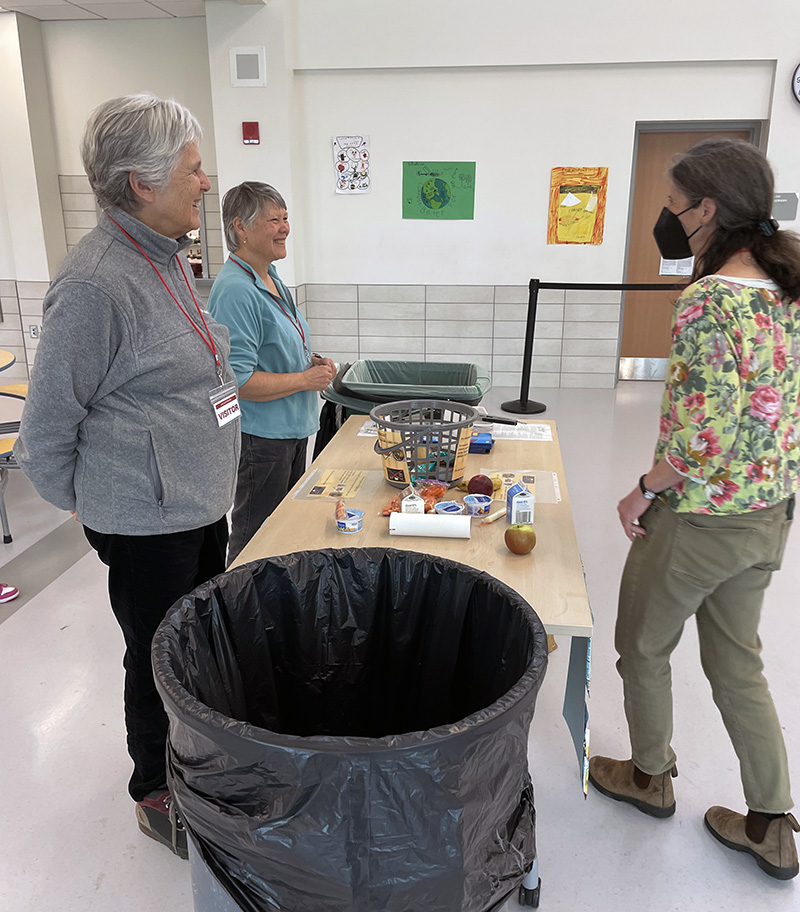
Diana Smith, Belinda Gingrich, and Emily Haslett were among the volunteers who helped launch the Lincoln School composting program.
Over a period of four weeks, volunteers in a total of 72 slots (two adults per lunch hour) went to work. After participating in an informational session and reviewing an instructional slide deck, they guided students as they dumped organic matter, trays, and other items into either compost or trash. Unopened, non-refrigerated food items that meet the official guidelines for food sharing are donated to the local food pantry. Students and staff move the compost binds to a holding location, where Black Earth Composting picks them up weekly.
The school will receive some composted soil that will be used in raised beds that the Lincoln Garden Club is funding. The club’s Diana Rice-Sheahan will be responsible for planting and maintaining the beds for two years, after which Lincoln Common Ground and other volunteer groups will continue.
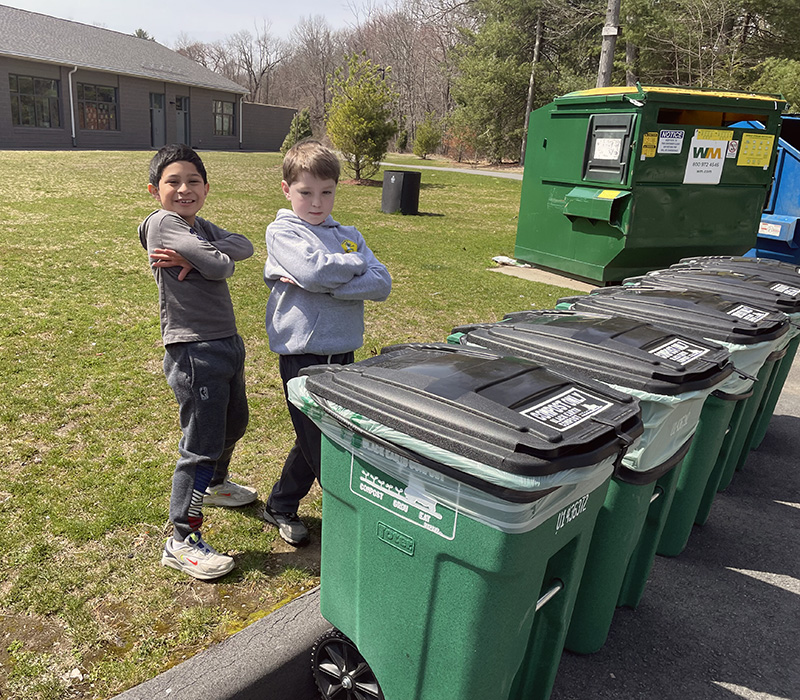
Daniel Ravanales and Gordon Allen stand proudly with the schools compost containers.
The composting program also has the benefit of showing what students are consuming, which can inform menu choices and help minimize food waste and spending. Studies have shown that American school cafeterias waste more food (especially fruits and vegetables) than those in other developed countries.
One of the volunteers who helped with the program’s rollout was Select Board Chair Kim Bodnar. “The lessons it shares with students around environmental sustainability and waste reduction are important, and it’s something that brings the Lincoln School community together with the broader community.”
In addition to the LSF, Garden Club, and Select Board, members of the School Committee, PTO core team, METCO Coordinating Committee, First Parish Church, Friends of Modern Architecture, Friends of Lincoln Public Library, the Council on Aging & Human Services pitched in to make the composting program possible.
Minute Man park cited as endangered by historic preservation group
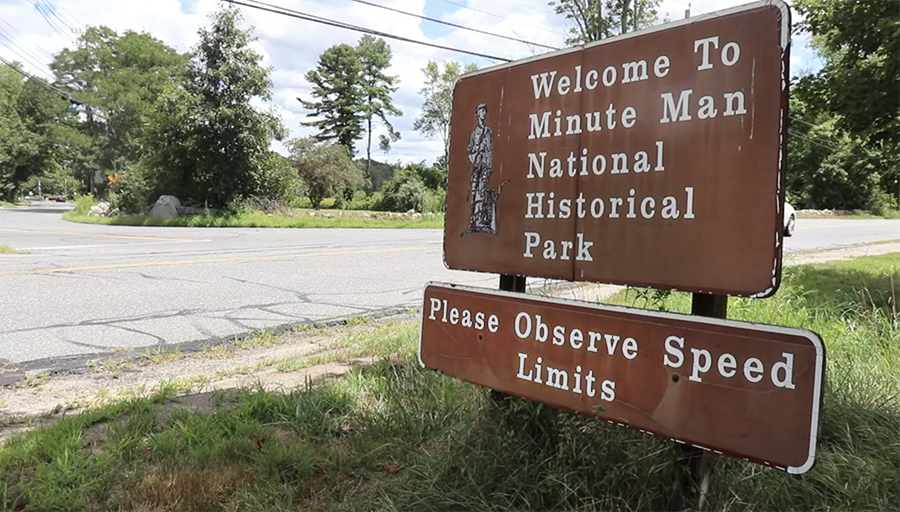 Minute Man National Historical Park and nearby landmarks have been designated as one of America’s 11 most endangered historic places by the National Trust for Historic Preservation.
The Trust chose MMHNP due to threat of private jet hangar expansion at nearby Hanscom Field, which would significantly increase the number of private jet flights along with noise and greenhouse gas emissions. The jets would use the runway that directly overflies Minute Man Park, Walden, Great Meadows National Wildlife Refuge, and historic homes in Concord, Lexington, Lincoln, and Bedford. Hanscom is the only airport in the country that abuts a national historic park and a national wildlife refuge.
The park and surrounding area designated by the Trust includes the site of the first battle of the American Revolution on April 19, 1775; the homesteads of the authors Thoreau, Emerson, Hawthorne, and Alcott; Walden Pond and Walden Woods, and properties connected with the Underground Railroad and Brister Freeman and Caesar Robbins, two enslaved men who were emancipated after their service in the Revolutionary War.
“Against the dire backdrop of our warming climate and the climate disasters that result, causing so much suffering for millions, it is utterly appalling to consider a massive development for luxury private jets in the midst of the landscape that inspired the founding of our democracy and the American environmental movement,” actor and activist Ashley Judd said at the May 1 announcement ceremony in Concord. “We must take responsibility for protecting both our historic sites and our planet by firmly opposing this completely senseless development.”
“Today’s announcement reminds us of the enduring responsibilities we bear: to preserve our national treasurers like Walden Pond and Walden Woods through vigilant advocacy and devoted stewardship. Without both, we face the very real possibility that these national treasures could be lost for future generations. Critical choices lie ahead. We must choose wisely by prioritizing what is essential for the preservation of the special places that inspire us, embody our history, reflect our values and define us as Americans,” said Don Henley, musician and board chair of the Walden Woods Project.
The Trust encourages residents to sign their petition urging Gov. Healey and U.S. Secretary of Transportation Pete Buttigieg them to stop expansion of Hanscom Field.
The project’s draft environmental impact report and other documents can be found here. The public comment portal is here (project 16654, login/registration required). The deadline for comments on the DEIR has been extended to June 14, 2024.
Correction
The February 20 article headlined “My Turn: 100 seconds to a better planet” did not contain links in two places saying “click here.” The article has been updated, and the paragraphs explaining how to check which green energy plan you’re on(and how to upgrade to 100% Green) are reprinted below:
First, make sure you have your Eversource bill at hand. Then click here, fill out the form, and press “Submit.” Or call LGEC customer support at 844-651-8919 and tell them you want 100% Green. They will make the change for you. (It may take several billing cycles before the change takes effect.)
If you’re uncertain which option you’re in now, click here to see where the rate and supplier information is noted on your Eversource bill. Then find your February 2024 or a later bill to compare.
My Turn: 100 seconds to a better planet
By Michael Moodie and Belinda Gingrich
(Editor’s note: The following is one in a series of “Climate Minutes” posted on the Lincoln Green Energy Committee website.)
The Lincoln Green Energy Choice (LGEC) program offers residents three options for electricity from renewable (primarily wind and solar) sources:
- Basic — 26% renewable, 14.631 cents per kWh
- Standard Green — 62% renewable, 16.093 cents per kWh
- 100% Green — 100% renewable, 17.348 cents per kWh
When the program started three years ago, unless an enrolling household specifically selected Basic or 100% Green, it was placed in the Standard Green program by default. The great majority of those enrolled in the program ended up with Standard. With busy lives and automatic bill payments, probably few of us have given much thought to our electricity supplier since.
About 13% of Lincoln households have chosen the 100% option, while 80% have Standard and 7% Basic. The CFREE team hopes that more households would move to 100% if they knew how easy it is to do and how minimal the extra cost would be. The 100% option is just over a penny per kilowatt-hour more than Standard. For an average home that uses 10,000kWh per year, that’s about 35 cents a day. This is one of the simplest and lowest-cost steps we can take to get at least the electricity part of our fossil fuel use out of our lives.
We’ve timed it. If you can spare 100 seconds, you can do this! First, make sure you have your Eversource bill at hand. Then click here, fill out the form, and press “Submit.” Or call LGEC customer support at 844-651-8919 and tell them you want 100% Green. They will make the change for you. (It may take several billing cycles before the change takes effect.)
If you’re uncertain which option you’re in now, click here to see where the rate and supplier information is noted on your Eversource bill. Then find your February 2024 or a later bill to compare.
Tech support will be provided free of charge in the Tarbell Room of the Lincoln Public Library on Friday, March 1 from 1–2 p.m. Volunteers will have computers set up to help anyone who’d like to make the change to 100% (or any other change). Bring your Eversource bill. We’ll also do a Q&A and provide tech support to help users make changes on Thursday, March 21 from 2–3 p.m. at Bemis Hall.
Moodie and Gingrich are writing on behalf of CFREE (Carbon-Free Residential, Everything Electric), a working group of the Lincoln Green Energy Committee.
“My Turn” is a forum for readers to offer their letters to the editor or views on any subject of interest to other Lincolnites. Submissions must be signed with the writer’s name and street address and sent via email to lincolnsquirrelnews@gmail.com. Items will be edited for punctuation, spelling, style, etc., and will be published at the discretion of the editor. Submissions containing personal attacks, errors of fact, or other inappropriate material will not be published.
My Turn: Updates on the town’s two solar energy projects
By Jim Hutchinson, Select Board
A number of folks have expressed interest in the status of the solar projects in progress at the transfer station and Lincoln School, so I thought I’d post an update. I am the Select overseeing the transfer station project and I was also a member of the PPA [power purchase agreement] subcommittee that advised the School Committee on the Lincoln School solar project. For this update I also got input from Buck Creel, the Lincoln School staff member overseeing the Lincoln School solar project.
What solar project is Lincoln doing at the transfer station?
After years of effort, careful negotiations with the National Park Service, discussions with neighbors on Mill Street, and a successful competitive bidding process, Lincoln is now finalizing final details of a Power Purchase Agreement (“PPA”) with the New Jersey-based firm HESP to construct and operate a 1.4MW solar PV system for our benefit on top of the capped landfill next to the transfer station, which we expect to generate enough green electricity to cover the amount of municipal electricity that has historically been used by the town net of the Lincoln School. As an added benefit to the town, while we are doing this construction work, with the input of the Conservation Commission and the Bicycle and Pedestrian Advisory Committee, we will also construct a bikeable and walkable path connecting Mill Street to the transfer station access road.
What is the expected schedule for the transfer station solar project?
We are currently working our way through the local, state, and utility permitting processes. We received Conservation Commission approval for the project in November 2023 and hope to get Planning Board approval this March. We hope to get approval from the MassDEP by June, and from Eversource by the end of the summer. HESP will then order the equipment and begin installation, hopefully in the Fall of 2024, or Spring of 2025 at the latest. Construction is expected to take four months, and equipment startup one additional month. We hope to be generating electricity by the Fall of 2025.
What is the solar project at Lincoln School?
The School Committee signed a PPA Agreement with TotalEnergies (previously SunPower) back in 2022 to install 1.2MW of rooftop and parking lot canopy solar PV as well as 562KW of battery storage. We expect this system to generate enough electricity to cover the expected usage at Lincoln School and thereby make the school “net zero” overall. In addition, the battery system should help us minimize the dreaded “demand charges” from Eversource that occur if our generation plus battery supply doesn’t meet our spot demand and we have to draw power from the grid at peak times. The technical approach taken in this project was somewhat novel for municipal projects in that it is “behind the meter,” meaning that a good chunk of the solar power generated by the panels is used directly by the School and is not shipped out to Eversource, and thus we do not have to pay distribution charges on that amount.
I see the solar panels have been installed at Lincoln School rooftops and carport canopies. Are they live?
No. TotalEnergies has encountered a number of setbacks that have delayed the completion of this project, including supply chain issues, issues with Eversource needing to adopt new policies and procedures for our novel “behind the meter” situation, and most recently, an equipment compatibility issue between the inverters and rapid shutdown safety devices used on the project, which is the current holdup on energizing the system. None of these delays have been the fault of the Town of Lincoln, although we have done what we can to help resolve the issues quickly while protecting Lincoln’s interests.
When do we currently expect Lincoln School solar to be live?
We are working with TotalEnergies now to finalize the plan for them to replace the incompatible equipment, which will be done solely at their expense. They need snow and ice-free conditions to do this work, so the schedule is weather dependent, but we currently expect the work to be completed and the system to go live in May, and possibly sooner. TotalEnergies does not collect any revenue from Lincoln for this project until they go live, so they are just as eager as we are to do so.
Aren’t we paying more for electricity from Eversource while we wait for the Lincoln School solar PV system to go live?
Yes, although note that the cost to Lincoln for delays is not the full ~$500,000 per year we spend on electricity when sourcing solely from Eversource; it is the roughly $60,000–$100,000 per year we hope to save when we replace much of the Eversource usage with PPA usage. The exact savings we might have enjoyed are not possible to calculate since we do not know exactly how much power the panels would have produced over the period.
Can we recover that extra cost due to delays from TotalEnergies?
Possibly, for some amount related to the guaranteed production of the system, since we don’t have any actual production. We did negotiate for and got language in the PPA agreement that addresses costs associated with some delays in getting the system live. With town counsel’s help, we are reviewing the town’s rights, the expected dollar amount that might be recoverable, the likelihood such events will be judged to be force majeure and thus not be eligible for recovery, and the impact pursuing a recovery could have on what is the beginning of a 25-year relationship with this developer. Subsequently we will advise the School Committee, who will make the ultimate determination on whether the town pursues a recovery.
Once these two solar projects are live, will Lincoln be “net zero” regarding municipal electricity use?
Yes, these projects are expected to generate enough green electricity to cover our municipal electricity usage, although note that in the case of Lincoln School the sizing was done based on expected usage, and in the non-school case we are sizing while considering historical usage. Periodic reassessment of our “green coverage” will be needed. Also, new uses to the town, such as a possible community center or increased adoption of electric vehicles by the town, may require additional solar power in the future to keep the town “net zero.”
“My Turn” is a forum for readers to offer their letters to the editor or views on any subject of interest to other Lincolnites. Submissions must be signed with the writer’s name and street address and sent via email to lincolnsquirrelnews@gmail.com. Items will be edited for punctuation, spelling, style, etc., and will be published at the discretion of the editor. Submissions containing personal attacks, errors of fact, or other inappropriate material will not be published.
Lincoln Green Energy Choice prices to decrease in January
The Mass. Department of Public Utilities requires the town to publicize an announcement about the new prices for Lincoln Green Energy Choice. Following is the text of the announcement.
Beginning in January, prices for Lincoln Green Energy Choice, Lincoln’s electricity aggregation program, will decrease by more than 6 cents/kWh for all program participants. The new prices will take effect as the current electricity supply contract with First Point Power ends and a new, 24-month contract with First Point Power takes effect. Most participants will also receive more electricity from renewable sources and a price that is lower than Eversource’s winter residential Basic Service price, though future savings compared with Eversource cannot be guaranteed.
The new prices and associated renewable content for each option are as follows:
Lincoln Standard Green – Lowering to 16.093 cents/kWh. Participants in Standard Green already receive an additional 32% of their electricity from renewable sources, “additional” meaning above the minimum required by state law. With the new contract, that additional amount will increase to 38% in 2024 and 44% in 2025. Most participants are enrolled in Lincoln Standard Green.
Lincoln 100% Green – Lowering to 17.348 cents/kWh. This option will continue to provide 100% of participants’ electricity from renewable sources.
Lincoln Basic – Lowering to 14.631 cents/kWh. This option will continue to provide an additional 2% of participants’ electricity from renewable sources.
Lincoln prioritizes helping to build demand for new renewable energy projects on the New England grid. As a result, the additional renewable energy that is purchased for each program option, over and above the minimum amount required by state law, is from new renewable projects in the New England region (MA Class I RECs).
The new prices are designed to provide long-term stability and are fixed for 24 months, from January 2024 to January 2026. In addition, the Lincoln Green Energy Choice Standard Green and Lincoln Green Energy Choice Basic prices are below Eversource’s January 1 residential Basic Service price of 17.25 cents/kWh. However, Eversource’s Basic Service prices change and future prices are unknown. As a result, future savings compared with Eversource cannot be guaranteed.
Lincoln Green Energy Choice has a track record of providing measurable value to participants, including providing price protection during last winter’s volatile electricity market. Lincoln Green Energy Choice has saved participants more than $1.4 million since the program’s 2021 launch through September 2023. In addition, because all program participants buy more electricity generated from renewable sources than is required by law, Lincoln Green Energy Choice has helped the community to avoid more than 12 million pounds of CO2 emissions. This is equivalent to the emissions associated with more than 1,211 gasoline-powered passenger vehicles for a year.
No action is required for current Lincoln Green Energy Choice participants. All active program participants will automatically be enrolled into the new First Point Power contract with their January 2024 meter read. The new program price will first appear on February 2024 Eversource electric bills, and the electricity supplier will be listed as “Lincoln Green Energy Choice.”
Participants will be enrolled in the same program option they have in the current First Point Power contract. However, participants may choose a different program option or leave the program before the new First Point Power contract takes effect, and at any time in the future, with no penalty or fee.
To enroll, make changes to enrollment, or get more information, please visit the program website at LincolnGreenEnergyChoice.com or contact customer support with Lincoln’s program consultants at 1-844-651-8919. Large commercial accounts are subject to special terms and conditions.
Mass Audubon gets $25 million from MathWorks
 Lincoln-based Mass Audubon has received a $25 million gift spanning seven years from mathematical computing software MathWorks to help protect and restore the Commonwealth’s valuable natural lands.
The gift of $7 million in year one and $3 million in each of the six subsequent years is the largest programmatic gift in Mass Audubon’s 127-year history and will be used to acquire, restore, and preserve properties to their natural state, particularly in coastal areas. One example of such work already going on is the “rewilding” of retired cranberry bogs at Tidmarsh Wildlife Sanctuary in Plymouth.
“This extraordinary commitment to protecting the nature of Massachusetts is nothing short of transformative, and we are forever grateful for MathWorks’ overwhelming generosity,” said David O’Neill, president of Mass Audubon. “It’s so heartening to see a world-renowned company like MathWorks prioritize the natural world, and we are honored they are entrusting us to carry out such important work.”
Since the gift spans several years, “there’s not a lot of specifics right now” on how the funds might impact Drumlin Farm or other wildlife sanctuaries overseen by Mass Audubon, said Aaron Gouveia, the organization’s director of public relations.
“The opportunity for nature to play a role in fighting climate change is more vital than ever,” said Jeanne O’Keefe, SVP and CFO of MathWorks, said in a press release. “Between Mass Audubon’s 127-year history of conservation and MathWorks’ commitment to its local communities and green initiatives, we’re confident this kind of partnership will inspire even more corporate social responsibility and lead to the protection of outdoor spaces that benefit people and wildlife across the state.”
In fiscal 2022, Mass Audubon received $8.87 million in gifts, grants, and government contracts, according to its annual report for that year. Its operating budget in 2022 was $32.53 million. In 2019 (the most recent data readily available), MathWorks more than $9.7 million for educational programs, which included research grants, university fellowships, curriculum development, and museum partnerships with 15 organizations in four countries including Mass Audubon.
Locally, the Carroll School on Old Sudbury Road gave Mass Audubon 85 acres of land straddling the Lincoln/Wayland border (part of 103 acres from an anonymous donor) in 2020. That parcel is now part of the Drumlin Farm Wildlife Sanctuary.