• Skip to primary navigation
  • Skip to main content
  • Skip to primary sidebar
  • Skip to secondary sidebar

The Lincoln Squirrel – News, features and photos from Lincoln, Mass.

  • Home
  • About/Contact
  • Advertise
  • Legal Notices
    • Submitting legal notices
  • Lincoln Resources
    • Coming Up in Lincoln
    • Municipal Calendar
    • Lincoln Links
  • Merchandise
  • Subscription Info
    • My Account
    • Log In
    • Log Out
  • Lincoln Review
    • About the Lincoln Review
    • Previous Issues
    • Submit Your Work
    • Subscribe/Donate

conservation

State of the Town meetings look to the future

October 13, 2022

There will be a two-night State of the Town meeting via Zoom in mid-November with an overarching theme: “What should Lincoln be like in 2050?”

“Lincoln’s boards and committees are focused on work that will have long-term implications for and impacts on our town. There are conversations about housing, education, human services, multi-modal transportation, diversity and equity, land use, and climate change (to name but a few),” the Select Board said in their most recent newsletter. “Many topics are interrelated and require us to think about our values, envision the future, and weigh (sometimes difficult) tradeoffs. We need your ideas, insights, questions, and dreams to guide our work as we draft the plans, policy proposals, and budgets that you will vote on at subsequent Town Meetings.”

Residents are invited to read and respond to a “Letter to Our Grandchildren” by the 1971 Planning Board excerpted in the Select Board newsletter that outlined issues of the day including zoning, housing prices, roadside paths, and even trash (“We wonder whether you will have solved the problem of solid waste? Maybe our best hope is that you will be wise enough to produce less of it…”).

Discussion questions for today include:

  • How would you describe Lincoln in 2022? (housing, transportation, human services, education, diversity & equity, town governance, land use practices, energy consumption, etc.)
  • What is your vision for 2050?
  • What would you include in a new “letter to our grandchildren”? What actions do we need to take to fulfill your vision? What are your top priorities?

Send a few words, a few paragraphs, photos, poetry or whatever conveys your ideas using this form. The deadline is Tuesday, Nov. 1.

The State of the Town schedule and topics of discussion are listed below. The links can also be found on the town’s SOTT web page.

Monday, Nov. 14 at 7 p.m. — Night 1 (Zoom event — register here)

  • Community Center Building Committee
  • Council on Aging & Human Services
  • Inclusion, Diversity, Equity, & Anti-Racism (IDEA) Committee

Tuesday, Nov. 15 at 7 p.m. — Night 2 (Zoom event — register here)

  • Planning Board
  • Conservation, Rural Land Foundation/Lincoln Land Conservation Trust
  • Green Energy/Climate Action
  • Bicycle & Pedestrian Advisory Committee

Category: community center*, conservation, government, land use, seniors Leave a Comment

News acorns

October 3, 2022

Public forums scheduled on Bicycle & Pedestrian Master Plan

The Bicycle & Pedestrian Advisory Committee is hosting four virtual public forums to review the Bicycle & Pedestrian Master Plan draft and collect feedback to improve the plan. There will also be a short presentation about the master plan at the State of the Town meeting in November.

The master plan, which was drafted by BPAC in consultation with the Planning Department, the Metropolitan Area Planning Council, and other town committees and departments, aims to make Lincoln to be more safe, green and accessible for residents and visitors traveling by foot and bike.

The public forums each focus on one region of Lincoln, but the BPAC will review the overall plan at each forum and are happy to discuss any region of town at any meeting if participants desire.

  • Thursday, Oct. 13 at 7:30 p.m. — North Lincoln (Route 2 and north). Zoom link.
  • Thursday, Oct. 20 at 7:30 p.m. — South Lincoln (Route117 and south). Zoom link.
  • Wednesday, Oct. 26 at 7:30 p.m. — East Lincoln (east of Lincoln Road/Bedford Road, south of Route 2 and north of Route117.) Zoom link.
  • Wednesday, Nov. 2 at 7:30 p.m. — West Lincoln (west of Lincoln Road/Bedford Road, south of Route 2 and north of Route117.) Zoom link.

More information:

  • Long-term plan aims to make Lincoln roads safer for walkers and cyclists (May 4, 2022)

Watering restrictions still in effect

With the continued Stage 3 drought, the state requires maintaining water use restrictions. To comply, the Lincoln Water Commission voted unanimously to extend water use restrictions in Lincoln beyond the traditional stop date of September 30. When drought restrictions are ended, a posting will be made on the town website and via other means. Don’t hesitate to contact the Lincoln Water Department if you have any questions (781-259-2669 or lafalamd@lincolntown.org).

During Stage 2 and above, Water Department staff monitors all sprinkler use in town and will stop to remind residents of the restriction policy. A first offence will result in a $100 fine, and subsequent violations will result in a $200 fine. For more information, see this Restrictions, Conservation & Water Use page and the Executive Office of Energy and Environmental Affairs’ drought page.

Film screening: “After Life”

The Lincoln Library Film Society will screen “After Life” (1998) directed by Hirokazu Kore-eda on Thursday, Oct. 20 at 6 p.m. If you could choose only one memory to hold on to for eternity, what would it be? In Japanese with English subtitles. Free and open to all.

Walk to benefit SVdP food pantry

Join a walk to benefit the Society of St. Vincent de Paul of Lincoln and Weston, which operates the food pantry for the two towns, on Saturday, Oct. 22 at St. Julia Church (374 Boston Post Rd., Weston) along Weston’s rail trail (approximately 2.2 miles). Check-in/same-day registration begins at 9 a.m. and the walk at 9:30 a.m., with an ice cream social at 10:30 a.m. Pre-register by October 15 to receive an SVdP gift. Suggested donation: $10 per person/ or $25 per family. Click here to register and/or donate. For more information, email svdplincolnweston@gmail.com.

“Opera for Everyone” series returns

The Friends of the Lincoln Library present their annual “Opera for Everyone” series on three Sundays from 2–3:30 p.m. at the library. Opera lecturer Erika Reitshamer returns to enlighten, inspire and entertain while passing along her vast knowledge of opera and opera lore to Boston’s educational institutions. Her last offering for Lincoln Library was a lecture on “It Takes Two to Duet,” just in time for Valentine’s Day on February 12, 2022.

  • October 23 —Donizetti’s “The Elixir of Love”
  • October 30 —  Rossini’s “The Barber of Seville”
  • November 6 — Rossini’s “The Italian Girl in Algiers”

Click here for plot details.

Family Halloween activities at deCordova

The deCordova Sculpture Park and Museum offers moonlit sculpture-building activities with deCordova faculty, self-guided mysteries to solve with friends and family, and a sweet treat or two along the way on Friday, Oct. 21 and Friday, Oct. 28 at 5:30 p.m. Cost is $35 per family ($28 for member families); click here to select date and buy tickets. For more information, call 781-259-3647.

Pumpkin Palooza for kids at library

The Lincoln Public Library will host Pumpkin Palooza on Saturday, Oct. 29 from 10:30 a.m.–noon. Wear your costume and join us on the library lawn for Halloween fun: pumpkin painting, activities, crafts, and more. Drop-in; best for ages 6 and under.

Purple lights highlight domestic violence awareness

Why are those buildings purple? Purple, it is said, is the color of courage, survival, honor, and hope. It is also the color recognizing Domestic Violence Awareness Month each October. For the past several years, the Sudbury-Wayland-Lincoln Domestic Violence Roundtable, in collaboration with the Lauren Dunne-Astley Memorial Fund and First Parish in Wayland, has chosen to light the towns of Sudbury and Wayland in purple. They have lit numerous faith and public buildings in Sudbury and Wayland and have posted banners and signs in all three communities. The Roundtable invites local businesses and homeowners to join in by adding their own purple lights. Inexpensive 4.5 watt Feit purple LED Electric bulbs are available at Ace Hardware in Wayland and Aubuchon Hardware in Sudbury.

Category: arts, charity/volunteer, conservation, kids, sports & recreation, Water Dept.* Leave a Comment

Solar array at landfill could be built starting next summer

September 15, 2022

The town has cleared a major hurdle in its years-long effort to create a solar photovoltaic array atop the capped landfill next to the transfer station.

The National Park Service owns the land along Route 2A and up the beginning of Mill Street, over which the town must create utility access to the site. The federal government was “vigorously protecting their rights” but recently came to an agreement with the town for an access permit, Town Administrator Tm Higgins reported at the September 12 Select Board meeting.

There will be an informational meeting via Zoom (passcode: 335408) on Wednesday, Sept. 21 at 7 p.m. to explain the project background and impacts to abutters and others. According to an FAQ document that’s been distributed to abutters, the only noise from the installation once it’s operable will be a low hum from the inverter when the sun is shining and HVAC equipment inside the energy storage system as a volume that will be “negligible” at the nearby transfer station.

The solar array is expected to generate about 1 megawatt of electricity, which will feed into Eversource’s distribution system via the utility poles and power lines along Mill Street and be used to power town-owned buildings. The town will receive financial credits from Eversource for the energy produced, as well as annual property tax payments.

In 2017, residents approved a “land swap” arrangement whereby some of the landfill property was taken out of conservation status in exchange for putting the same amount of land elsewhere into conservation. That land is part of the Wang property on Bedford Road that the town purchased, now the site of an athletic field as well as nine acres of conservation land.

The town hopes to issue a request for proposals in October 2022 and receive competitive bids from solar companies by mid-November. Construction lasting 4-6 months could begin in summer 2023.

It may also be possible to create a trail link during the process of creating access to the site, Higgins said.

Category: conservation, news Leave a Comment

Town gets grant to create Climate Action Plan

September 1, 2022

Lincoln will have its own Climate Action Plan next year, thanks to a recent $100,000 grant from the Baker-Polito administration that will fund a consultant to create the plan.

The municipal climate resilience grants administrated by the Municipal Vulnerability Preparedness (MVP) program support cities and towns in identifying climate hazards, developing strategies to improve resilience, and implementing priority actions to adapt to climate change impacts including sea level rise, inland flooding, storms, and extreme temperatures.

Lincoln is one of 73 projects to have received action grant funding in the latest round of applications. With this year’s awards, 97% of Massachusetts cities and towns, or 341 municipalities, are enrolled.

“This grant application was a monumental group effort, thanks in large part to the 27 letters of support we received from citizen groups, individual residents, and town officials and departments,” the Planning Department said in a statement.

Climate Action Lincoln, a subcommittee of the town’s Green Energy Committee, has been advocating for the development of a Climate Action Plan for several years. In 2021, Climate Action Lincoln conducted extensive outreach to 12 town boards and committees and presented at the State of the Town Meeting in November 2021 and at the 2022 Annual Town Meeting on the urgency to plan and prepare for climate impacts and mitigate carbon emissions. Lincoln residents responded by unanimously voting to embark on a process to develop a Climate Action Plan for the town.

The plan will build on the town’s 2019 MVP Community Resilience Building Workshop, which identified seniors, low-income residents, and people living alone as more susceptible to extreme heat and other climate risks. The workshop and corresponding data analysis also identified flooding, severe storms, and droughts as top hazards. The planning process will center on inclusive and equitable community engagement to identify priorities, goals, and strategies for the town to rapidly build community resilience, adapt to these climate impacts, and develop actionable strategies to mitigate greenhouse gas emissions.

Anyone who has questions or would like to be included in the project’s mailing list may email ClimateAction@lincolntown.org.

Category: conservation, news 1 Comment

“Where does it all go?” Part 5: The 5 R’s, and some numbers

August 11, 2022

By Alice Waugh

Editor’s note: A huge thank-you to Susan Donaldson, DPW office manager, for her prompt and helpful answers and explanations as the Lincoln Squirrel was researching and writing these articles.


Also in this series:

  • Part 4: Beyond the transfer station
  • Part 3: Recycling beyond single-stream
  • Part 2: Trash
  • Part 1: Single-stream recycling

Lincoln’s recycling rate (the proportion of recyclables diverted from the trash) since 2012 has averaged about 40%, which is slightly better than the statewide average of 33% but well below the national leaders, San Francisco and Los Angeles, which divert about 80 percent of their waste from landfills. So there’s definitely room for improvement in both how much Lincolnites recycle, and how correctly they recycle by putting items in the correct bin at the transfer station. 

One method that some towns are using to encourage more recycling is “pay as you throw” (PAYT), where residents pay for trash disposal per unit of waste discarded rather than solely through a fixed townwide fee or tax. “It’s equivalent to putting a price tag on each container of trash that’s placed at the curb or taken to the landfill or transfer station for disposal,” notes a DEP implementation guide for starting PAYT programs. As of 2021, more than 150 cities and towns in Massachusetts had some type of PAYT program in place.

The Holy Grail of recycling and trash management is “zero waste,” where almost nothing goes in the trash and everything we use is subject to the five R’s: Refuse, Reduce, Reuse, Recycle, and Rot. “Refuse” at the top of the pyramid means the first step is to say no to disposable single-use plastic, coffee cups, utensils, straws, shopping bags, food packaging, and anything else you could replace with a reusable or compostable option.

Meanwhile, at the transfer station, it’s often hard to know whether something is recyclable or not, so the DPW encourages residents to ask a staff member where things should go rather than just guess or “wishcycle.” “It makes you have to think,” noted Susan Donaldson, DPW office manager. 

The department will hold education days at the transfer station starting in September, and a short version of the new rules is being included with new transfer station stickers that residents get in the mail (they’re required as of September 1).

“We want to encourage people to read the rules and regulations because that tells you everything,” Donaldson said.


Resources

  • Lincoln DPW Transfer Station
    • Rules and Regulations
    • 2022-24 stickers
  • How and Where to Recycle (MassDEP)
  • Recyclopedia (MassDEP)
  • Beyond the Bin Recycling Directory 
  • Moving Toward a Zero Waste Massachusetts (Keep Massachusetts Beautiful)
  • Zero Waste Living, the 80/20 Way: The Busy Person’s Guide to a Lighter Footprint (book)
  • How to Go (Almost) Zero Waste: Over 150 Steps to More Sustainable Living at Home, School, Work, and Beyond (book)

Lincoln’s costs to haul and process materials (January – June 2022)

MaterialCost
Trash$48,918
Single-stream recyclables$6,102
Glass$5,301
Metal$1,588
TVs$880
Black Earth Compost$4,524
Recycling rebate+$4,725
Textiles rebate+$1,321
Total costs (Jan-Jun)$61,267

Costs are fee per ton, less the value of materials.


Tons of material hauled in Lincoln (2012 – June 2022)

(Source for table and chart: Susan Donaldson, Lincoln DPW, and 2019 DPW presentation)

Notes:

  • Starting in July 2016, paper and cardboard were included in single-stream recycling.
  • In 2021, there were also 8 tons of mattresses recycled.

Category: conservation 1 Comment

“Where does it all go?” Part 4: Beyond the transfer station

August 9, 2022

By Alice Waugh

Not everything you’re done using can be recycled, of course, but here are some destinations for recycling or repurposing items that the Lincoln transfer station doesn’t handle, as well as additional places for things it does accept. The DPW’s transfer station website also has links on the left-hand side of the page with more information about where things can be recycled inside and outside the transfer station.


Also in this series:

  • Part 5: The 5 R’s, and some numbers
  • Part 3: Recycling beyond single-stream
  • Part 2: Trash
  • Part 1: Single-stream recycling

Plastic bags and wraps

These should never be put in the single-stream recycling bin because they are not recyclable with other plastics and they get tangled up in the sorting machinery, but you can recycle them in the large white cylindrical bins at most grocery stores or simply throw them in the trash.

Recycled plastic bags and wraps (soft and flexible that you can stretch) are sold to companies that make composite “lumber” for decks, benches, playground sets, etc. The bags can also be reprocessed into small pellets, which can be made into new bags, pallets, containers, crates, and pipe. Items in this category that are recyclable include:

  • Single-use grocery bags
  • Product wrap around cases of water/soda bottles as well as single-use towels, napkins, plates, toilet paper, diapers, etc.
  • Food bags from bread, potatoes, produce, etc. (must be clean and dry)
  • Plastic box liners (but not if they tear like paper)
  • Dry-cleaning and newspaper bags
  • Plastic mailing envelopes (must have paper labels removed)
  • Zip-top food storage bags
  • Air pillows that protect items in mailed cardboard boxes
  • Plastic that’s wrapped around new electronics and other consumer items
  • Bubble wrap
  • Any film packaging or bag that has the How2Recycle Label

Plastic bags that are not recyclable include (ironically enough) compostable bags and those containing pre-washed salad mix, frozen food, and candy bars/chips/snacks. Learn more about what happens to plastic bags, where you can recycle them, and what’s recyclable in that category. 

Construction debris and building materials

Click here for a short list of companies that will take construction debris as well as appliances and household trash. C. Carney Environmental in Raynham also accepts some types of demolition debris for recycling.

Several charities and nonprofit organizations accept donations of old cabinets, counters, doors, windows, and other discarded building materials that can still be used.

Hazardous waste

Latex paint cans, button batteries, and alkaline batteries can be tossed in the regular trash. Oil-based paints, solvents, chemicals, medical waste, pesticides, and explosives are some of the items that can be brought to the Minuteman Hazardous Products Facility at 60 Hartwell Ave. in Lexington, which holds collection days for several area towns several times a year. The next collection days will be September 18, October 15, and November 5. Residents must preregister to be able to drop off items on those days. Click here for more information or call the Board of Health at 781-259-2613.

Books and media

The transfer station has a mini-swap shed for books and other media as well as a bin where residents can drop books off for resale to benefit the Friends of the Lincoln Library (see “Where does it all go?” Part 3: Recycling beyond single-stream”). Another local beneficiary of donated books is More Than Words, a Waltham program that trains and employs at-risk youth in its $4 million book-selling business. They accept donations of books, DVDs, video games and gently used clothing at their headquarters at 56 Felton St. in Waltham or one of their donation bins in the greater Boston area. Not accepted: textbooks over 10 years old, encyclopedias, VHS tapes, audio cassettes, or magazines. They will also do pickup for donors with eight or more boxes of books and/or clothing.

Bookscouter.com has suggestions for where to resell or donate used textbooks.

Housewares and furniture

Household Goods in Acton accepts items to furnish homes for those who are recently homeless, veterans, survivors of domestic violence, low income, immigrants, victims of disaster, or are coping with illness or disability. They accept items in good condition including:

  • Dressers, tables, chairs, and other furniture
  • Mattresses and bed frames
  • Dishes, flatware, and kitchen items
  • Sheets, towels, and other bed linens

Among the items they don’t accept: toys, sports equipment, office furniture, etc. Click here for a detailed list of what you can and can’t donate. Donations can be dropped off at their headquarters at 530 Main St. in Acton (978-635-1710) on Tuesdays, Thursdays  and Saturdays from 9 a.m.–noon without an appointment. 

ReStore (part of Habitat for Humanity) in West Roxbury and Ashland also accepts donations of home and office furniture, appliances, building materials, exercise equipment, and more.

Clothing

In addition to the Red Cross and Bay State Textiles bins at the transfer station (see “Where does it all go?” Part 3: Recycling beyond single-stream”), residents can drop off donated clothing and shoes in the nonprofit Planet Aid bin at Tracey’s Service Station on Bedford Road and Route 2. Other options:

  • Dress for Success (Boston)
  • Global Thrift (Waltham)
  • On the Rise (Cambridge)
  • Goodwill (multiple locations)
  • Salvation Army (multiple locations)
Used stuffed animals and toys

Many organizations only accept new stuffed animals , but Stuffed Animals for Emergencies, Donation Town, Ronald McDonald House, homeless shelters, the Salvation Army, Goodwill, Habitat for Humanity, and some hospitals will accept used items that adhere to cleanliness guidelines that vary from you to group. For more information, click here or here. 

Yard waste

Brush, leaves, grass clippings, Christmas trees, etc., can be brought to the DPW yard at 30 Lewis St. during normal business hours and on the first Saturday of each month between 7:30 a.m. and 3:30 p.m. Brush and yard waste is limited to material generated by normal residential activity; waste from larger-scale land clearing, etc., is not accepted. Use of the DPW yard is limited to residents with a transfer station sticker. Due to space limitations, residents are limited to three trips per month. Click here for more information.

The DPW yard also offers some materials back to the community for free, including compost, wood chips, and firewood at the DPW (call 781-259-8999 to check on availability). The department also has a small sand shed where residents can shovel a sand/salt mixture into buckets to take home to spread on outdoor walks and steps.

Tires

Tires are not accepted as either trash or recycling and should not appear at the transfer station at all. Old tires are usually replaced at a commercial garage or repair shop, which charges the customer a small fee to dispose of them. If you have tires at home that you need to get rid of, call Doherty’s or another service station.

Category: conservation 2 Comments

Corrections

August 8, 2022

There are several corrections and additions to the “Where does it all go?” series, and the articles have now been updated.

“Part 2: Trash”

  • The new trash compactor on order is not replacing the so-called commercial hopper, which will remain in operation for bulky items that are appropriate for the regular trash (though residents will have to ask a DPW attendant to unlock the container gate). A third trash compactor will be installed in a new location.

“Part 3: Recycling beyond single-stream”

  • Soiled regular pizza boxes are not accepted in the compost, though compostable pizza boxes are.
  • The cost to buy a home composting bin from the DPW is $25, not $60.
  • Bay State textiles has one bin at the transfer station, not two.
  • A section on batteries, deposit bottles, and lightbulbs has been added.

Coming soon: “Part 4: Beyond the transfer station.” 

Category: conservation Leave a Comment

“Where does it all go?” Part 3: Recycling beyond single-stream

August 7, 2022

By Alice Waugh

Previous articles in this series looked at what happens to Lincoln’s trash and single-stream recycling. The DPW recently published a guide that lists everything accepted at the transfer station and where residents should put things (see Section 6 in the regulations). But what then happens to all that stuff?


Also in this series:

  • Part 5: The 5 R’s, and some numbers
  • Part 4: Recycling beyond the transfer station
  • Part 2: Trash
  • Part 1: Single-stream recycling

Compost

DPW officials have been pleasantly surprised at the amount of compostables they’ve been collecting at the transfer station, saving tons of material from being incinerated along with the town’s trash.

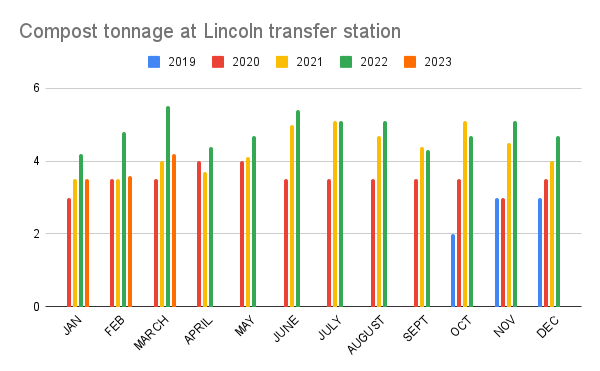
Black Earth Compost began collecting compostables at the transfer station in October 2019. Since the program began with four barrels (two more were added in early 2021), residents have dropped off an average of 3.76 tons per month. The company turns what it collects into compost and sells back to the public, as well as to area farms (including Codman Community Farms and The Food Project) at a reduced rate.

(Source: Lincoln Department of Public Works)

What can you compost? Black Earth has a list here. It’s not just food scraps (including meat and dairy items) — it’s also napkins and paper towels, wine corks, coffee grounds and filters, toothpicks, popsicle sticks, compostable pizza boxes, and even pet waste and bedding from any animals except dogs and cats. Dishes, utensils, etc. that are specifically labeled as “home-compostable” are also accepted.

Residents may also sign up for curbside pickup of compostables for $15.99 a month (plus purchase of an animal-proof 13-gallon bin for $38 or a 4-gallon bin for $16). The starter kit includes compostable liners for a small countertop bin and the curbside bin. For those who have outdoor space for home composting, the DPW sells backyard containers at its Lewis Street headquarters for $25 and countertop containers for $10 (click here to order). Massachusetts residents may no longer throw away clothing and textiles with their trash starting on November 1. Fortunately, the transfer station has several receptacles for this stuff.

Textiles

Bay State Textiles, a for-profit company that has a bin at the transfer station and at the Lincoln School, collects clean and dry clothing and textiles in any condition including shoes, purses, linens and towels, bedding, etc. Every American throws out about 81 pounds of post-consumer textiles each year, but only about 15% of the total is reclaimed with the other 85% going into the municipal solid waste (trash), according to Paul Curry, the company’s president.

What happens to the stuff depends on what category it falls into: reusable, repurposable, or recyclable. Reusable clothing is sold to firms in developing countries that sell or give away the items to local residents. One of Bay State’s customers in the Dominican Republic employees several hundred people to sort and categorize the items by condition and quality as they’re prepared for sale, Curry said.

Repurposed items come from textiles that are torn up, made into wipes, and sold to factories and service industries all over the world, where they’re used for cleaning equipment, staining furniture, cleaning cars, etc. Some items are also targeted for fiber conversion — they’re shredded and recycled for use in carpet padding, insulation, furniture stuffing, among other things. Techniques and markets for turning cotton-rich and polyester-rich textiles into new fibers are also advancing. Only about 4-5% of the materials it collects can’t be used for anything, Curry said.

The nonprofit American Red Cross picks up clothing from one of the bins and sells it through a vendor, with a portion of the proceeds benefiting its Disaster Relief Fund. Donors are eligible for tax deductions. 

Groups that accept new or gently used clothing and distribute items to people in need at little or no cost include:

  • The St. Vincent DePaul Society
  • Cradles to Crayons (newborn to age 12)
  • Circle of Hope (Needham), which distributes items free of charge to 25 area shelters and low-income programs in Boston
  • Solutions at Work Cambridge (clothing for children and homeless people a the Green Street Shelter, and business attire for job seekers)
  • ThreadEd — a Newton charity that provides donated professional clothes to low-income college students
  • thredUP — they mail you a free Donation Clean Out Kit with a pre-paid shipping label, and you get a tax receipt for $5 per bag.

More information:

  • Textile recovery (MassDEP)
  • FAQs about textile recycling (Secondary Materials and Recycled Textiles Association)

Books

The transfer station has a mini-swap shed for books and other media, as well as a bin where residents can drop books off for resale to benefit the Friends of the Lincoln Library (FOLL). Before the advent of Covid-19, the FOLL accepted donations in the Bemis Hall foyer and sold them at monthly book sales. Nowadays the materials are picked up by the Bay State Book Company, which sells them online and returns a portion of the proceeds to FOLL. There are also FOLL bins in the Donelan’s parking lot, Tracey’s Service Station (at the intersection of Bedford Road and Route 2, and Lincoln Gas and Auto Service at 170 South Great Rd.

The book shed is a place where residents can leave and also take home used books, puzzles and similar items. Volunteers take items that have hung around too long to More Than Words, a Waltham program that trains and employs at-risk youth in its $4 million book-selling business.

Mattresses and box springs

These may not be put in the regular trash after November 1, but there’s an area at the transfer staton to leave them, where they’re picked up by Raw Material Recovery. Massachusetts residents and businesses discard about 600,000 mattresses and box springs annually — but once disassembled, more than 75 percent of mattress components can be recycled, according to the Massachusetts DEP.

Electronics

Items you can leave in the electronics area include computers, monitors, printers, VCRs, stereo equipment, refrigerators, microwaves, etc. — “basically anything with a cord,” said Susan Donaldson, the DPW’s office manager. They are picked up by East Coast Electronics Recycling, which declined to comment on what it does with the materials it receives.

Batteries, fluorescent bulbs, deposit bottles

The old swap shed is the place to drop off these items.

Rechargeable lithium batteries and fluorescent lightbulbs (rod-shape and U-shaped) are processed by Veolia to remove harmful metals and chemicals. Ordinary alkaline batteries and button batteries no longer contain these substances and can be thrown into the regular trash. Incandescent lightbulbs are also fine to put in the trash. Car batteries should be taken to a service station for disposal.

Waverley Redemption Center in Waltham takes deposit bottles and pays the town a portion of the 5-cent deposit on each bottle, which goes into the DPW’s recycling budget. 

Scrap metal

Schnitzer Steel in Everett picks up metals bin near the transfer station entrance. Items accepted in that bin include washers, dryers, metal pipes, fencing, cookware, baseball bats, outdoor grills, metal sinks, outdoor furniture, etc. (here’s a more detailed list of materials they buy from scrap dealers and contractors).

Schnitzer shreds the items into fist-sized pieces and sorts it with magnets to separate ferrous and nonferrous metals (steel vs. copper, aluminum, nickel, etc.), explained Eric Potashner, the company’s chief public affairs and communications officer. Most of the ferrous material from New England is shipped to steel mills overseas, where it’s smelted for making into new steel products such as rebar, sheet metal and car parts. The nonferrous metals are sent to another facility in Georgia for further processing to remove nonmetal components and then sold to domestic manufacturers to make into new products. Copper, a highly conductive metal, is much in demand these days since it’s a key component of electric vehicles.

(Editor’s note: this story was updated on August 8.)

Category: conservation 2 Comments

“Where does it all go?” Part 2: Trash

August 4, 2022

(Editor’s note: this story was updated on August 8, 2022.)

By Alice Waugh

Before there was a transfer station and before most people had heard of recycling, Lincolnites either burned their garbage in their back yard or brought it to the landfill, a.k.a. the town dump. The grassy hill with white gas vent pipes on your right as you enter the transfer station is all you can see of Lincoln’s landfill since it was closed in 1986 and capped in 1990. 


Also in this series:

  • Part 5: The 5 R’s, and some numbers
  • Part 4: Recycling beyond the transfer station
  • Part 3: Recycling beyond single-stream
  • Part 1: Single-stream recycling

The Massachusetts Department of Environmental Protection (MassDEP) introduced its first bans on landfilling and combustion of easy-to-recycle and toxic materials in 1990. More waste bans have been added over time, so there’s now a growing list of things that aren’t allowed in municipal solid waste (MSW), otherwise known as trash.

Lincoln’s transfer station has two trash dropoff containers: the compactor next to the singe-stream recycling bin, and the one across from the new swap shed where you can toss larger items directly from your vehicle. That container used to be called the “commercial hopper,” DPW Office Manager Susan Donaldson said. The town no longer accepts commercial or construction waste; now everything in there goes to the same place as the regular trash.

There are some changes on the horizon for trash at the transfer station. The DPW is awaiting delivery of the new compactor and hopes to have it installed by the end of the summer. 

Also, the so-called commercial hopper will be locked all the time, so residents will have to ask an attendant to open it when they want to drop items inside. “You’re not going to be able to back up and throw anything and everything into it any more,” Donaldson said. That move is an attempt to reduce trash “contamination” — meaning prohibited items that were thrown into the trash and should be recycled or disposed of in some other manner instead. 

This is actually a bigger problem than the reverse (too many nonrecyclable items contaminating the recycling bins). The town has been getting warnings from WM (Waste Management), which picks up the transfer station’s trash and takes it to a waste-to-energy (WTE) facility operated by Wheelabrator in North Andover, one of seven in the state. Companies can refuse to accept MSW loads that contain more than 30% contaminants — meaning not food or chemicals, but rather items that aren’t allowed in the trash any more. 

Because the trash from Lincoln’s two current containers are brought in separately, it’s been easy to see that most of Lincoln’s trash contamination is coming from the gated container rather than the trash compactor next to the single-stream recycling bin. Lincoln was also fined about a year ago after someone threw tires in that bin. Tires are not accepted any place at the transfer station and must be recycled by a service station.

So what happens to the trash?

When the trash is burned in Wheelabrator’s WTE facility, it yields electricity and heat but also some air pollution in the form of toxic chemicals. The federal government requires advanced pollution control equipment such as scrubber systems that reduce but not eliminate emissions. Each WTE facility in Massachusetts has to submit an emissions control plan as well as a report on the composition of the trash it takes in (click here for the facility’s latest report).

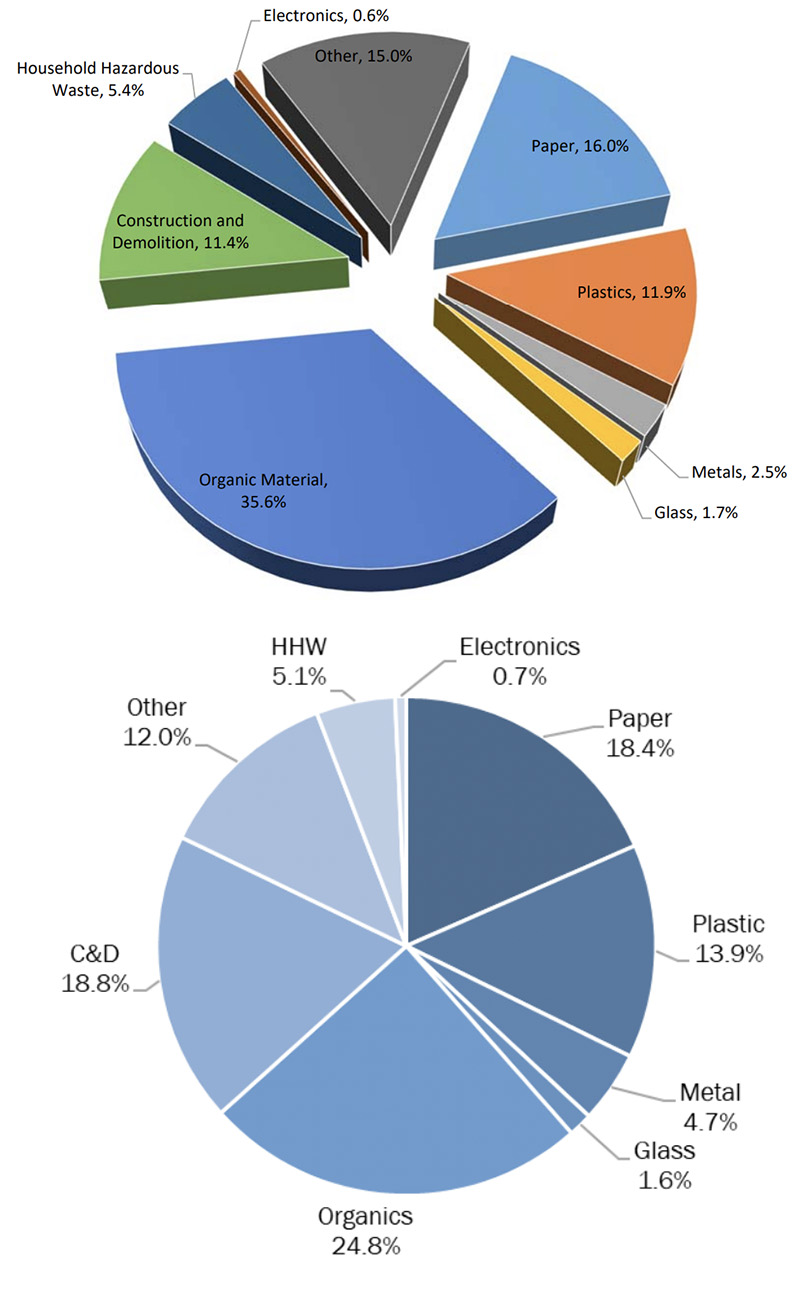
Residential waste by category that was processed by Wheelabrator in North Andover in 2019. (Source: “Wheelabrator North Andover, Inc. 2019 Waste Characterization Study Report in Support of Class II Recycling Program,” page 17.)

In 2019 (the last year for which a report is available), the largest category of trash at Wheelabrator in North Andover was organic material, which includes food waste, branches, stumps, smaller yard waste, and manure. Because of its relatively high moisture content, food waste takes more energy to burn than it yields, and it’s also one of the heavier components of household waste, which is a financial issue since the town pays by the ton for trash hauling. However, the transfer station has accepted compostable material since 2019.

Anywhere from 10-25% of incinerated trash winds up as solid bottom ash. Wheelabrator takes it to the Peabody Monofill Associates Ash Landfill, which accepts ash from several waste-to-energy facilities in the northeast United States. (Researchers are also investigating ways of extracting metals and minerals from bottom ash, or using it in making concrete or as a road base.)

As of 2020, Peabody was one of only 19 landfills still in operation in Massachusetts; another 942 MSW landfills and dumping grounds have been closed over the years, and most are or will be capped, or covered to minimize the percolation of stormwater through the buried trash and into groundwater and wetlands. 

Though there are a lot fewer landfills nationwide than there once were, they still emit carbon dioxide and methane, a potent greenhouse gas. Landfills accounted for about 15% of methane emissions in the U.S. in 2020, according to the Environmental Protection Agency, which notes that methane emissions from landfills that year were roughly equivalent to the greenhouse gas emissions from about 20.3 million passenger vehicles driven for one year. As of 2022, there were 13 landfills in the state that are current or potential candidates for the EPA’s Landfill Methane Outreach Program that aims to harvest landfill gas for energy, but Lincoln’s is not one of them.

Not allowed in Massachusetts trash:
  • Asphalt pavement, brick and concrete
  • Cathode ray tubes
  • Clean gypsum wallboard
  • Commercial food material (lower threshold effective November 1, 2022)
  • Ferrous and non-ferrous metals
  • Glass and metal containers
  • Lead acid batteries
  • Leaves and yard waste
  • Mattresses (effective November 1, 2022)
  • Recyclable paper, cardboard, and paperboard
  • Single-resin narrow-necked plastic containers (click here to see what becomes of Lincoln’s recycled plastics)
  • Textiles (effective November 1, 2022)
  • Treated and untreated wood and wood waste (banned from landfills only)
  • White goods (large appliances)
  • Whole tires (banned from landfills only; shredded tires acceptable)

Coming soon: Articles about what happens to these other recyclables — and what to do about stuff that the transfer station doesn’t accept.

Category: conservation 3 Comments

“Where does it all go?” Part 1: Single-stream recycling

August 3, 2022

By Alice Waugh

Lincolnites are pretty conscientious about trying to recycle, but contamination is a problem here and everywhere else. Through carelessness or misunderstanding, people sometimes throw things that ought to be recycled into the trash, and throw trash into their recycling bin. In this series of articles, the Lincoln Squirrel will look at what happens to everything that gets dropped off at the transfer station as well as some tips on how to recycle more effectively.


Also in this series:

  • Part 2: Trash
  • Part 3: Recycling beyond single-stream
  • Part 4: Recycling beyond the transfer station
  • Part 5: The 5 R’s, and some numbers

Like many towns, Lincoln’s transfer station accepts single-stream recycling in a bin where people can toss paper and junk mail, cardboard, metal cans, plastic bottles, clean aluminum foil, and some plastic food and beverage containers. 

But then what happens to all that stuff after it leaves town? Waste Management (WM) picks up the roll-off containers of recyclables and takes them to its materials recovery facility (MRF) in Billerica, where everything is dumped onto a tipping floor. The commingled items are then loaded into an elaborate multi-step sorting machine that plucks out different materials at various points. As the items go by on a conveyor belt, human operators also pick out as much nonrecyclable material as they can. See videos of MRFs in action here and here.

Mixed paper and cardboard are easily recyclable and can be made into new cardboard, paper, paper napkins, etc. WM sells most of these materials to Pratt Industries and Westrock, according to Chris Lucarelle, Waste Management’s Area Director for Recycling Operations. Glass gets crushed and made into new glass products as well as fiberglass insulation. Metal cans meet a similar fate.

The biggest issue, of course, is plastic. Before 2018, MRFs sold much of America’s recyclables to China, which used them as raw materials for its growing industrial base but which also led to pollution in that country. But in 2018, China stopped accepting most so-called recyclables from North American and Europe as part of Operation National Sword because the loads were contaminated with too much nonrecyclable material.

As a result, a lot of plastic that was supposedly recycled by Americans goes into landfills and incinerators in the U.S. or is shipped to developing countries without the capacity to properly process it, which in turn results in more pollution of land, sea, and air worldwide (see “Reckoning with the U.S. Role in Global Ocean Plastic Waste,” a 2022 report by the National Academies of Sciences, Engineering, and Medicine). 

Recycling plastic is especially problematic because there are so many variations in chemical composition, color, and transparency and many of these items can’t be mixed even after they’re separated from glass, metal, paper, etc. And it’s often too expensive to sort all these types of plastic, especially since it’s usually cheaper to make new plastic rather than use recycled plastic. Also, many well-intentioned residents engage in “wishcycling” — putting nonrecyclable items in their recycling bin and thus contaminating the load, as noted in this 2019 WBUR piece.

There’s a lot of understandable confusion when people try to figure out what plastics can and can’t be recycled. For example, single-use plastic cold drink cups can be recycled, but not their lids or straws. Black plastic takeout containers can’t be recycled, but their clear lids can. And many plastic items actually contain two or more types of plastic, so they’re also not recyclable. The days are gone when you could look at the number inside the triangle on the bottom of a container and immediately tell if it’s recyclable. 

Plastic items are labeled with a resin identification number inside a triangular recycling logo that indicates how the plastic was made. However, the recycling logo is deceptive. Just because a package or bottle has a number or recycling symbol doesn’t mean it’s recyclable. Instead, it indicates the molecular structure of the plastic, which is used to categorize what can and can’t be recycled. Plastics labeled #3, #4, #6 and #7 are not recyclable, according to the Conservation Law Foundation (see chart).

Click for larger image. (Source: Conservation Law Foundation)

Some argue that recycling plastic is almost hopeless because of this sorting issue and because disposable plastic is relatively cheap to make as well as sturdy and sanitary. By extending the shelf life of food, plastic packaging actually reduces food waste, which comprises a large portion of household trash (see the “Saving Food” chart in “The Cost of Plastic Packaging”). Composting goes a long way toward reducing the amount of trash that has to be incinerated.

New uses for recycled plastic

However, the market for recycled plastics is slowly growing, due in part to increasing pressure for manufacturers to use more post-consumer resin (PCR) in their products. WM has some of its recycled plastic made into residential bins for its own use (EcoCarts).

None of the plastics from Lincoln that wind up in WM’s Billerica facility are sold overseas, according to Lucarelle. “National Sword proved to be a good thing for U.S. recyclers and we have seen a lot of growth in the domestic market,” he said.

Many plastic bottles are made of polyethylene terephthalate (PET), which is often marked with the #1 symbol. One of the largest purchasers of WM’s PET is Unifi, which uses the plastic to create a textile fiber to make new products such as shoes, clothing and bags. Work clothing made from this fiber is now available to WM employees. WM also sells some of its HDPE and PP (high-density polyethylene and polypropylene, often marked as #2 and #5) to KW Plastics in Troy, Ala., which claims to be the world’s largest plastics recycler and resin supplier for those materials. 

State governments are also working to encourage more plastic conservation and recycling by industry. California now requires certain food service facilities to serve customers with packaging that is either reusable, recyclable, or compostable. Last year, Maine became the first state to require producers of packaged goods sold in the state to pay for maintaining and expanding municipal recycling programs — a so-called extended producer responsibility (EPR) law.

Burn, baby, burn

Other ways to dispose of plastic are traditional waste-to-energy incineration and pyrolysis, where mixed plastic is heated in a low-oxygen environment so it breaks into shorter-chain hydrocarbons that can then be used to make fuels and chemical feedstocks that can be fashioned back into polymers, creating a closed loop, according to Chemical and Engineering News (“Should plastics be a source of energy?”). However, as the article notes, waste-to-energy plants can produce only the amount of energy per day that they were designed to. Plastics have a higher energy content than most trash, so if the facility processes more plastics, it has to take in less waste overall.

Many multinational companies are partnering with cement manufacturers to burn unrecycled plastic waste in cement kilns, which operate at a very high temperature. Cement factories have traditionally burned coal, which is a major greenhouse gas producer. Plastic and trash are far cheaper fuel source, but the factories still cause a lot of air pollution, especially in countries where emissions regulations are inadequate or not enforced.

And the bigger problem remains. Less than 10% of all the plastic ever made has been recycled, mostly because it’s too costly to collect and sort. Plastic production, meanwhile, is projected to double within 20 years, according to Reuters. 

What you can and can’t recycle in Lincoln

Back here in Lincoln, how does an environmentally conscious resident know what’s recyclable? Recycle Smart MA (a program funded by the Massachusetts DEP) has an excellent Recyclopedia where you can quickly look up hundreds of different items. Waste Management also has a Recycling 101 website. A general rule of thumb: if it isn’t a container — or if you’re in doubt at all — put it in the trash.

Here are a few of the things that many people “wishcycle” that should not go into the single-stream container:

  • Single-use plastic drink lids, cutlery, straws
  • Polystyrene “to go” containers
  • Waxed cardboard milk/juice containers with plastic screw caps
  • Frozen food boxes (they also contain wax)
  • Paper cold drink cups with a wax coating
  • Paper coffee cups and their lids
  • Colored plastic cold cups (clear ones are OK)
  • Plastic food envelopes for snacks, drink pouches, etc.
  • Cardboard food canisters with metal rims containing nuts, chips, etc.
  • Black plastic takeout containers (though their clear lids are OK). Why? MRFs sort plastics by bouncing a beam of light off them. Since black plastic absorbs light, it can’t be sorted and goes straight to the incinerator.
  • Any kind of plastic bag, wrap or film
  • Padded paper mailing envelopes
  • Coat hangers, wires, tubing, etc. (these items, along with plastic bags, can tangle the sorting machinery)
  • Screws, nuts, bolts, tools, etc.
  • Larger metal or plastic objects such as toys, appliances, etc.
  • Styrofoam molded package insulation or packing peanuts
  • Rigid plastic form-molded packaging (sometimes glued to a cardboard backing)
  • Prescription medicine bottles
  • Anything contaminated with food

Category: conservation 9 Comments

  • « Go to Previous Page
  • Page 1
  • Interim pages omitted …
  • Page 3
  • Page 4
  • Page 5
  • Page 6
  • Page 7
  • Interim pages omitted …
  • Page 30
  • Go to Next Page »

Primary Sidebar

Recent Posts

  • Fate of trees to be announced on June 8 May 18, 2026
  • Police log for May 5–13, 2026 May 17, 2026
  • Board accepts $1.35 million in donations for community center May 14, 2026
  • News acorns May 13, 2026
  • Police log for April 16 – May 5, 2026 May 13, 2026

Squirrel Archives

Categories

Secondary Sidebar

Search the Squirrel:

Advanced search

Privacy policy

© Copyright 2026 The Lincoln Squirrel · All Rights Reserved.