• Skip to primary navigation
  • Skip to main content
  • Skip to primary sidebar
  • Skip to secondary sidebar

The Lincoln Squirrel – News, features and photos from Lincoln, Mass.

  • Home
  • About/Contact
  • Advertise
  • Legal Notices
    • Submitting legal notices
  • Lincoln Resources
    • Coming Up in Lincoln
    • Municipal Calendar
    • Lincoln Links
  • Merchandise
  • Subscriptions
    • My Account
    • Log In
    • Log Out
  • Lincoln Review
    • About the Lincoln Review
    • Issues
    • Submit your work

land use

Oriole Landing approved at Town Meeting

March 26, 2018

Residents approved a zoning change and preliminary plan for the Oriole Landing mixed-income housing project, despite impassioned pleas not to subject the neighborhood to yet another major construction project that will increase traffic.

Town officials urged passage of the measure so Lincoln can avoid a much larger 40B affordable housing project. Developers can circumvent town zoning restrictions for a project of that type if less than 10 percent of the town’s housing stock is affordable according to the 2020 census, and Lincoln was projected to be about nine units short. Lincoln Woods, which has both affordable and market-rate units, has a waiting list of 60 families, according to housing consultant Pamela Gallup.

“This provides the diversity of housing that Lincoln currently lacks” for young professionals or retirees looking to downsize but stay in town, Selectman James Craig said.

Residents including Cathy O’Brien of 3 Mary’s Way objected to the development before the Planning Board earlier this month, saying it was too large and would create traffic and road safety issues. At Town Meeting, she also repeated her earlier claim that the project was being rushed through.

“Public meetings on this started in January. What has ever happened in this town of this magnitude in a matter of three months? Nothing,” O’Brien said. “This process has been steamrolled through with no commitment or thought process about the impact on the neighborhood.”

“We don’t get a chance to pick the properties. This one came up very fast, and the accelerated pace is not due to anything other than a need to react to market conditions when things become available,” Selectman Jonathan Dwyer responded.

The property was on the market for some time and the town looked into purchasing it, but the price was “well out of reach,” Craig said. Several developers inquired about putting a project on the site with anywhere from 125 to 250 units, “but we were able to turn them away,” Gallup said.

The Planning Board and Board of Selectmen endorsed the project last week with several conditions. Among them: a left-turn-only restriction out of the Oriole Landing driveway onto Mary’s Way on weekday mornings and a $25,000 contribution by Civico to the town’s Complete Streets program earmarked for a roadside path on Mary’s Way. The company will also offer a shuttle bus service for Oriole Landing residents to Alewife and South Lincoln.

Neighbors not satisfied

But neighbors on Saturday said these steps were not enough. “A no-right-turn sign without a policeman standing there every day is virtually useless,” said Andrew Cole of Sandy Pond Road, adding that a similar restriction on his road is “routinely flouted.” The promised $25,000 is also inadequate, he added.

“Who is going to fund the rest of what needs to be done? These answers need to be in writing before we change the zoning,” O’Brien said.

Other area towns including Sudbury and Wayland are grappling with looming 40B projects, but O’Brien rejected the comparison. “They’re trying to convince you through fear. We need nine units in next two years. We have brilliant people in this community who can find a solution for nine units,” she said.

But a Concord Road resident disagreed. “To think you’re going to have someone come in with nine units in the next year and a half is unrealistic,” he said. “If we miss this opportunity, a 40B [developer] can slam down anything they want. If you’re worried about the impact on schools or traffic now.”

Residents including David Levington argued that the town is unfairly isolating affordable housing in North Lincoln, which is not within walking distance to public transportation for Oriole Landing residents who might not own a car. Others expressed concern about the roadways and lack of sidewalks in the area.

“That’s life in Lincoln — we have narrow roads,” resident Sharon Antia said. She also alluded to earlier fears about the location of Lincoln Woods, then the town’s first affordable housing development. “There were major objections being that close to the train station that they might get a lot of undesirable people from Boston,” she said.

Levington moved to postpone the decision until the special Town Meeting in June, but Andrew Consigli of Civico Development said that would not be financially feasible for him. “There’s a certain amount of money we pay a month to hold the land. We don’t have the ability to do that past this time of year,” he said. “We won’t be here in June, and I mean that with all due respect.”

This possibility caused outgoing Finance Committee member Eric Harris to say he was “experiencing post-traumatic stress disorder from 2012,” when the town voted down a school project that would have been partially paid for by a $20 million state grant (the state subsequently denied repeated reapplications).

“For $29 million [the town’s share in 2012], we could have had a school. Now we’re talking about maybe $120 million. Sometimes the ‘Lincoln way’ way isn’t the best way,” Harris said..

Civico has “bent over backwards like no developer I’ve ever seen,” said resident Noah Eckhouse. “Change is tough, but Lincoln is changing, and either we change it or somebody else does. We’re going to be paying for this one way or another. We have got to vote for this.”.

After the motion to postpone the vote was soundly defeated, the standing-room-only crowd approved the measure in a voice vote by the required two-thirds majority. Civico must come back to the Planning Board within two years to obtain a special permit and site plan review.

This is the sixth overlay-district development that the town has approved since 1986. The others are Lincoln Woods, Battle Road Farm, Lincoln North, the Minuteman Inn (which was never built), Minuteman Commons, and The Commons.


Category: government, land use, news 1 Comment

Letter to the editor: Taylor urges “yes” vote on Oriole Landing

March 22, 2018

To the editor:

I write to urge Lincoln citizens to attend Town Meeting and vote for the zoning changes required for the Oriole Landing housing development.

In the interest of full disclosure, I am a member of the Planning Board, which has recommended passage of the proposed zoning amendments, but this is a personal plea from me simply as a private citizen who has been deeply involved in housing matters in Lincoln. In 2000 I joined the Housing Commission and since then have had a hand in most if not all of the affordable housing units added to Lincoln’s inventory. I chaired the Affordable Housing Trust and helped draft the town’s first Housing Development Plan and our Inclusionary Zoning bylaw. When Lincoln’s affordable housing stock briefly fell below 10 percent, I assisted in a challenge at the state level that thankfully deflected a 40B application for a 30-unit development on a one-acre lot on Route 117.

My experience gives me some perspective on the merits of the Oriole Landing proposal, and on the merits, I hope it will be approved. There are many reasons why, but there are a few key points.

First, the project offers housing in a range sorely missing in Lincoln. This isn’t just the units that qualify as affordable, but also the market-rate units that open opportunities for seniors to downsize and young people to live in Lincoln.

Second, 40B development is a real threat. Without additions to our affordable housing, Lincoln will fall below the 10 percent requirement in 2020, and with our high real estate values, developing units that qualify for the Subsidized Housing Inventory (SHI) is very difficult. Critics of the Civico proposal have argued that we should pursue other options, but other available options have been pursued vigorously without success. The housing groups in Lincoln have not been sitting idly by while the clock ticks.

Finally, collaborative developers like Civico are rare. Other developers that checked out the six-acre parcel where Oriole Landing would be located were contemplating 150 or more units. In response to citizen concerns, Civico reduced the number of proposed units from 72 to 60, increased the share of affordable units from 15 to 25 percent (thus qualifying all 60 units for the SHI), committed to preserving the historic farmhouse located on the property, and agreed to measures to mitigate community impacts. If the parcel goes back on the market, there is nothing to prevent its falling into the hands of someone far less accommodating.

Having mentioned community impacts, it must be noted that projects that serve the greater public good often have differential effects, and that is the case here. Consequently, care must be taken to understand such impacts and to mitigate them to the degree possible. The Selectmen (who control roadways and traffic regulation) and Planning Board (which must consider abutter impacts in site plan review) are charged with and committed to doing so.

And to those who suggest that by “checking the 40B box” pursuit of housing diversity in Lincoln will wane, let me assure you that is not the case. The South Lincoln Planning and Implementation Committee (a subcommittee of the Planning Board) has been and will continue to investigate and pursue increased housing diversity as an element in revitalizing the Lincoln Station area. More to come on that in future Town Meetings!

Sincerely,

Gary Taylor
2 Beaver Pond Rd.


Letters to the editor must be signed with the writer’s name and street address and sent via email to lincolnsquirrelnews@gmail.com. Letters will be edited for punctuation, spelling, style, etc., and will be published at the discretion of the editor. Letters containing personal attacks, errors of fact or other inappropriate material will not be published.

Category: land use, letters to the editor Leave a Comment

Letter to the editor: Why the Oriole Landing project is important for Lincoln

March 22, 2018

To the editor:

The Lincoln Housing Commission and Affordable Housing Trust are co-sponsoring the Oriole Landing Project at Town Meeting on Saturday, March 24.

The project, located at 1 Mary’s Way and presented in Warrant Article 30, is the result of a truly collaborative effort over the past six months involving multiple town boards and committees, Civico Development, and extensive public input. Because of these efforts, we believe Oriole Landing will benefit the residents of Lincoln in the following ways:

  • It will significantly increase the town’s inventory of affordable rental housing. As 15 (25 percent) of Oriole Landing’s units will be set aside as affordable, the state Department of Housing and Community Development will count all of the project’s 60 units towards Lincoln’s subsidized housing inventory (SHI). This will fulfill Lincoln’s Chapter 40B requirements for the next several decades while also meeting Lincoln’s high standards for responsible development and protecting our town’s rural character.
  • It will provide a diversity of housing opportunities our town currently lacks: moderately priced one- and two-bedroom apartments to appeal to young professionals and “empty nesters” looking to downsize and stay in Lincoln.
  • The 15 “affordable” units will be for households earning up to 80 percent of the area median income. Of these units, 10 will be reserved as “local preference” for Lincoln residents, employees of the town or local businesses, and families with children in the Lincoln Public Schools.
  • Oriole Landing will enable the town to fulfill one of the long-term goals identified in the Housing Commission’s 2014 Housing Plan: expanding our housing stock to serve a broader spectrum of Lincoln residents.

Lincoln’s SHI is anticipated to fall below 10 percent in 2020, making the town vulnerable to 40B high-density housing developmens similar to projects under consideration and/or construction in Weston, Wayland, and Sudbury today. In fact, at least four prior developers made inquiries with the town about the six-acre Mary’s Way property since it was listed for sale, discussing developments ranging in size from 125–250 units.

To arrive at where we are today, many town boards and committees, through multiple public forums, hearings, and informational sessions, have worked diligently to identify and address the many concerns and issues raised about this project, including: 

  • Traffic — The town conducted an independent peer review of the traffic study performed by Civico and as a result, a condition of the project will include a “no right turn” restriction during peak commuting hours to help mitigate the potential traffic impact to the neighborhood. Additionally, neighborhood feedback has made it clear that there are already existing roadway and pedestrian safety issues which the Board of Selectman have committed to prioritize in addressing. Civico has also pledged $25,000 to the town’s Complete Streets program to be targeted for this neighborhood.
  • School enrollment — Civico estimated nine to 16 new school age children while the town’s own independent peer review of the fiscal impact and project finances estimated seven7. Our school administrators state that enrollment constantly fluctuates for a wide variety of reasons. They are confident that Oriole Landing’s contribution to the student population will be well within what the school system already experiences annually, and which it has both the expertise and resources to respond to.
  • Financial contribution — The Affordable Housing Trust will support this project with a $1 million loan to secure a permanent deed restriction that ensures that all 60 units at Oriole Landing will remain on Lincoln’s subsidized housing inventory in perpetuity. Lincoln’s peer review consultant has reviewed the project finances and determined that this sum is important to the project’s overall financially viability.
  • Historical Commission — Civico and the Historical Commission have agreed that the historic home on the property (Dexter C. Harris House, c. 1870) will be relocated and restored for use as a garden house.
  • No variation from submittal — If approved, the project cannot be substantially changed in the future without requiring another Town Meeting vote (which needs a two-thirds approval), ensuring the property must be developed in accordance with the will of the town.

The Housing Commission’s 2014 Housing Plan’s goals included providing housing for young couples, empty nesters seeking to downsize, those who work in town, and those connected to Lincoln in other ways. Oriole Landing will enable the town to create moderately priced local housing opportunities in a cost-efficient manner, rather than pursuing the inefficient and expensive task of incrementally increasing Lincoln’s subsidized housing stock to keep pace with new home construction.

If approved, the Housing Commission and Affordable Housing Trust will be able to turn their focus toward other important housing initiatives, such as working with the South Lincoln Planning and Implementation Committee to explore housing opportunities in the Lincoln Station area.

You have an important role in determining the shape and direction of Lincoln’s future. Please join us this Saturday at Town Meeting, participate in the discussion, and vote. Lincoln’s Board of Selectmen, Housing Commission, Affordable Housing Trust, and Planning Board have all endorsed this project. We ask that you support it too, by voting “yes” in favor of Warrant Article 30. See the websites below for more information.

  • Lincoln Planning Department site on Oriole Landing offers the town’s point of view.
  • The Housing Commission’s web page detailing the town’s affordable housing history, goals, and challenges, and how the Oriole Landing project addresses them.
  • Civico Development’s Oriole Landing project website highlights communications with the community.

Sincerely,

James Craig and George Georges
Co-chairs, Lincoln Affordable Housing Trust

Allen Vander Meulen
Chair, Lincoln Housing Commission

Pamela Gallup
Lincoln housing consultant


Letters to the editor must be signed with the writer’s name and street address and sent via email to lincolnsquirrelnews@gmail.com. Letters will be edited for punctuation, spelling, style, etc., and will be published at the discretion of the editor. Letters containing personal attacks, errors of fact or other inappropriate material will not be published.

Category: government, land use, letters to the editor Leave a Comment

Upcoming public hearings

March 22, 2018

The Planning Board will hold a public hearing on Tuesday, March 27 at 7:30 p.m. to review an application for Site Plan Review. The applicant, Joachim Fruebis of 58 Weston Rd., proposes to construct a new home on an undeveloped lot.

The Historical Commission will hold a public hearing on Tuesday, April 3 at 7:30 p.m. to consider the application of Hytho Pantazelos for a request to extend the 12-month delay to demolish the structure at 12 Woodcock Lane.

The Zoning Board of the Appeals will hold a public hearing on Thursday, April 5 at 7:30 p.m. to hear and to act on a petition by Mary Kostman, 131 Tower Rd., for a special permit for an addition of an art studio, open air deck and screened porch.


Category: land use Leave a Comment

Planning Board, Selectmen endorse Oriole Landing

March 21, 2018

The Planning Board voted unanimously this week to recommend passage at Town Meeting of a measure that would give preliminary approval to the Oriole Landing mixed-income housing project.

In its recommendation, the board included several conditions that will be reflected in conditions for any future approval of the developer’s formal application. If the Town Meeting measure (which would create a development district within the North Lincoln Overlay zoning district and also approve a preliminary land use plan) passes by a two-thirds majority, Civico Development must then come back to the Planning Board within two years to obtain a special permit and site plan review.

In the first portion of the board’s public hearing on March 6, neighbors protested the 60-unit proposal on a number of fronts, saying the project is too large, will cost the town money due to increased school enrollment from tenants, will significantly increase traffic in the neighborhood, and will allow the town to dispense with any future efforts at increasing affordable housing in town.

At the hearing continuation on March 20, Andrew Consigli of Civico detailed changes in the proposal that resulted from community input at various meetings and open houses. The original proposal called for a four-story building of rental units (15 percent of them affordable) plus a condo building. The plan now calls for no condos and two 30-unit rental buildings of two and a half to three stories, with 25 percent of the units deeded as affordable. Consigli noted that this adjustment was made possible by the promise of a no-interest loan of $1 million from the Lincoln Housing Commission. The sum does not need to be repaid to the town unless the affordability deed restrictions are terminated for any reason in the future.

Rather than tearing down the 1870s Dexter C. Harris house on the property, Civico has pledged to spend up to $100,000 to relocate the house between the two rental buildings and repurpose it as an open three-season indoor space for gatherings or studio use.

In response to traffic concerns, Civico agreed to a left-turn-only restriction out of the Oriole Landing driveway onto Mary’s Way from 6:30-9:30 a.m. on weekdays. The company also agree to donate $25,000 to Lincoln’s Complete Streets program to improve street safety and accessibility for drivers, bicyclists, and pedestrians. (Last fall, the town received a $400,000 state grant for 10 projects that must be completed by September 2018.)

In their March 19 vote to endorse the Oriole Landing project, the Board of Selectmen specified that the $25,000 should be used if possible to create a roadside path along Old Concord Turnpike near the development. The Department of Public Works is also planning to paint a center line on Mary’s Way. In addition, Consigli said he was looking into the idea of offering a fee-based shuttle service between the development and the Alewife MBTA station.

“It’s a better plan from when we first came in with,” he said.

The town hired Lynne Sweet of Newton-based LDS Consulting in Newton to look at Civico’s fiscal impact statement. Her report estimated a net positive fiscal impact to the town of about $114,000 annually—just under the $115,000 predicted in the analysis commissioned by Civico.

“The margins are very slim for this project,” Sweet said of the development’s projected finances. Because of the reduced density from the original plan and things like the LEED certification, “the numbers are really tight; there’s not a lot of wiggle room to add more costs,” she said in concluding that the $1 million loan is in fact necessary to make the project financially feasible.

“For me, this was a difficult decision,” said Planning Board member Lynn DeLisi after the vote.  “I was very impressed with Civico and how they interacted with the community, but on the other hand, I have great sympathy for the neighborhood. Cathy O’Brien made some very good points.”

O’Brien, who lives on Cambridge Turnpike and whose mother Mary’s house abuts the development site, raised numerous objections at the earlier public hearing. On March 21, she confirmed on LincolnTalk that she was the source of a town-side mailing that reiterated those objections and urged residents to vote “no” vote at Town Meeting.

“Neighborhoods are personal—it’s where we live,” Selectman Jonathan Dwyer said earlier this week when Selectmen unanimously voted to endorse the project. If voters approve it, “we need to help the neighborhood get that it needs to help them live with it.”

Selectmen James Craig and Jennifer Glass also expressed sympathy for the neighbors, who have had to live alongside two construction projects at The Commons as well as the Route 2 project in recent years. However, they couldn’t pass up an opportunity to guarantee the town’s state-mandated affordable housing minimum for years and thus avoid a much larger 40B housing project that could bypass local zoning restrictions. Weston and Wayland are both facing the real prospect of “unwanted large-scale developments that are really going to change the fabric and essence of those communities,” Craig said.

Category: government, land use, news 2 Comments

Letter to the editor: Civico expresses appreciation to community

March 21, 2018

To the editor:

In advance of Town Meeting being held this weekend, we would like to take this opportunity to extend our thanks to the Lincoln community. Since October 2017, Civico Development has been out in the community discussing the merits of our proposed Oriole Landing project. Throughout this time, we have learned about what the community refers to as “the Lincoln way” through hard questions, meaningful debates and fruitful discussions. Whether at a public meeting in the Donaldson Room, a community open house at the town library, or a conversation at the transfer station, the passion and pride of the townspeople were clearly evident.

Through a collaborative approach working with the HOW Group, Planning Board, Housing Commission, Housing Trust, Historic Commission and all of the various town departments, the process has been a positive experience for our team. We appreciate the organized and “attention to detail” manner in which the town officials led meetings and conducted the public process.

We have heard the concerns regarding density and height, historic preservation, school impacts, fiscal benefits, traffic concerns, and neighborhood impacts, and have responded. We hope our responses have clarified and resolved your questions in a meaningful way.

Throughout the process, we have gained the support and endorsement of the Planning Board, Housing Commission, Historic Commission, and the Board of Selectmen. This Saturday we hope to gain the support of the community through approval of a bylaw amendment to establish a North Lincoln Planning Development Overlay District and a Preliminary Development and Land Use Plan. If you have any remaining questions before Town Meeting, we will also be holding a community open house this Thursday from 4:30–8:30 p.m. at Bemis Hall. Please come by and enjoy some snacks and refreshments.

We hope to see you on Saturday at Town Meeting, and if approved, we look forward to working with the community through the site plan permit process.

Sincerely,

Andrew Consigli
Civico Development


Letters to the editor must be signed with the writer’s name and street address and sent via email to lincolnsquirrelnews@gmail.com. Letters will be edited for punctuation, spelling, style, etc., and will be published at the discretion of the editor. Letters containing personal attacks, errors of fact or other inappropriate material will not be published.

Category: land use, letters to the editor Leave a Comment

Some background on the Historic District proposal

March 18, 2018

(Editor’s note: This article originally appeared in the Lincoln Review and is reprinted with permission.)

What if a species of tree appeared to be threatened with disease, let us say, on your property. Should you be worried? How would you assess the situation? What could be done? How would you measure the loss? If we alter the scenario and describe the pending loss as not of trees but as part of Lincoln’s history, architecturally and culturally, we can see the ideas behind a forthcoming town initiative.

At Town Meeting on March 24, the town will be asked to consider an initiative: the addition of 18 Modern houses located throughout town to Lincoln’s existing Historic District, and the creation of a new Historic District with 11 houses in the Modern neighborhood of Brown’s Wood. For several years, the Historic District Commission (HDC) and the Friends of Modern Architecture (FoMA) have been working on this initiative with owners of Modern houses who are voluntarily participating. Its purpose is to help preserve and protect the defining characteristics of Modern buildings, structures, and neighborhoods, and in doing so, to sustain the treasured look and feel of the town. According to the Massachusetts Historical Commission, “the strongest form of protection is a local historic district created through a local bylaw or ordinance.” The Massachusetts Historic District Act provides for the addition of noncontiguous houses to a local district.

A little background: the HDC is an official Lincoln board. It came into being with establishment of Lincoln’s Historic District by vote of the town in 1981. Its members are appointed and have oversight over the Historic District, which currently consists of 73 properties in four areas: Lincoln Center, Woods End, Codman Farm, and Cory-Brown-Hunt on Conant Road.

According to Lincoln’s bylaw, the HDC is “intended to preserve and protect as a permanent legacy the significant historical areas and distinctive architectural characteristics of the town of Lincoln in their settings.” This is achieved through guidelines in the bylaw for buildings and structures within the district. HDC members are responsible for approving requests for permanent exterior alterations above grade and visible from a public way, and new construction and demolitions; and for determining the appropriateness of a requested change in relation to the historical and architectural significance of the building or structure and its site.

The HDC can issue a certificate of nonapplicability for ordinary maintenance and a certificate of hardship in certain instances when refusal of a request would create a hardship for the applicant. Certain alterations and additions, itemized in the bylaw, are excluded from consideration. This bylaw would govern the Modern house being added to the Historic District; the new Brown’s Wood Historic District would have several additional provisions developed in consultation with the members of that district.

FoMA, a local nonprofit organization, was founded in 2005 to promote greater awareness and appreciation of Modernism’s contribution to Lincoln’s architectural and cultural history. FoMA encourages efforts to preserve this legacy for the town and for future generations of homeowners.

Modernism in Lincoln

Modernism refers not to a specific style but an international idea. Dating from and reflective of the post-World War I period, Modern architecture uses mass-produced materials and scientific and engineering innovations in an effort to improve living and working conditions by providing fresh air and light in efficient, affordable designs. Modernism values honesty of structure and purpose expressed through simplicity of form, direct use of materials, open floor plan, large glass windows which foster connection between interior and exterior, and design specific to site.

In Lincoln, Modernism has a long and distinguished history. Lincoln became an important incubator for Modern residential design beginning in the late 1930s. The first Modern residence in town was completed in 1937. During the 1940s and especially post-World War II, Lincoln grew rapidly. The town’s proximity to Cambridge and Boston, and the educational and cultural opportunities those cities offered, attracted a population drawn to and interested in participating in Modern ideas and ideals. Many architects were attracted to Lincoln and found residential commissions. Some architects also joined with local residents to work with innovative town planning, including the development of several Modern house neighborhoods in town.

Woods End Road, the town’s first Modern neighborhood, became part of the town’s Historic District in 1981. Other Modern neighborhoods dating from the 1940s to 1960s include Old Concord Road, Brown’s Wood, Twin Pond Lane, Tabor Hill, Woodcock Lane, Rockwood Lane, Stonehedge Road, and Hiddenwood Path.

Although other towns possess important Modern houses or neighborhoods, Lincoln has an inventory of considerable breadth and influence. From 1937 to 1969, over 300 Modern residences as well as civic, cultural, and commercial buildings were constructed in Lincoln. This collection of Modern houses uniquely includes 14 pre-World War II houses, some of which were designed by architects for their families.

Following World War II, academics and professionals moving into town as well as local residents commissioned Modern houses, and, as before, architects also designed for their own families. The local, nationally and internationally recognized architects who have practiced in Lincoln include J. Quincy Adams, Lawrence Anderson, Walter Bogner, Marcel Breuer, Earl Flansburgh, Walter Gropius, Henry Hoover, Carl Koch, Thomas McNulty, Cyrus Murphy, G. Holmes Perkins, Walter Pierce, Constantin Pertzoff, Frances Quarton, Lucy Rapperport, Mary Otis Stevens, and Hugh Stubbins. Through their academic work and teaching, architectural firms, publications, and extent of commissions, their influence frequently extended well beyond Lincoln.

Certain houses in Lincoln already have a measure of protection, a basis on which the HDC would like to build through this initiative. For instance, the 1937 home of Henry Hoover and the 1963 home of Earl Flansburgh are under the Preservation Easement Program of Historic New England (HNE). In addition, HNE owns the property of Walter Gropius and maintains the residence as a house museum. The Gropius House is also on the National Register of Historic Places, as well as a designated National Historic Landmark, and is within the Woods End area of the Historic District. The residence of Marcel Breuer likewise is within the Woods End area of the Historic District. Three Modern houses are within the Lincoln Center area of the Historic District, and two more Modern houses are protected by a Lincoln Rural Land Foundation conservation easement governing the buildings’ envelope.

The HDC and FoMA believe that more examples of Modern architecture in Lincoln warrant the attention and protection the Town’s Historic District bylaw can provide. They therefore ask for town support of the proposal outlined above, believing it can provide the town and interested homeowners a significant mechanism by which examples of the important architectural and cultural period of Modernism in Lincoln’s history can be protected for the future.

—Andrew C. Glass and Lucretia H. Giese, for the HDC and FoMA

Category: government, history, land use 2 Comments

Neighbors protest Oriole Landing plans

March 12, 2018

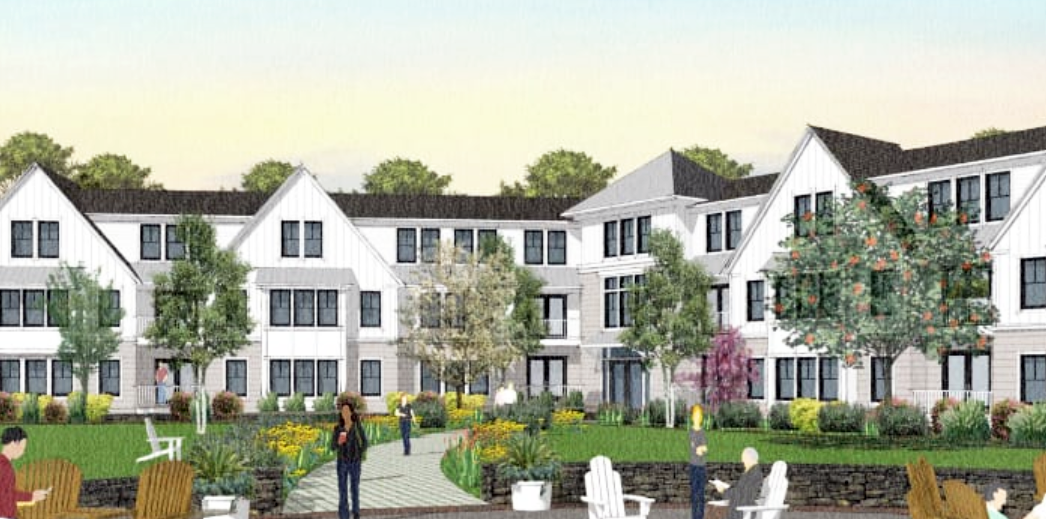
Civico Development’s landscaping plan for Oriole Landing (click to enlarge).

Neighbors of the proposed Oriole Landing mixed-income housing development offered impassioned protests over the plan at a March 6 Planning Board public hearing that continues on Tuesday, March 20 at 7 p.m. in Town Hall.

If approved, the project would guarantee that Lincoln will have well more than the minimum 10 percent affordable housing units required to block a 40B housing development, which would be allowed to bypass many town zoning regulations. The first steps are “yes” votes at Town Meeting on March 24, one to approve the preliminary site plan and the other to make a zoning change to allow the development. The developer would the have to return for Planning Board approval of a final site plan incorporating traffic, parking, landscaping, drainage and septic, etc.

The existing 1870s Dexter C. Harris house on the property will be relocated to stand between two 30-unit residential buildings and serve as a garden house with a large unfinished space inside for gatherings or possible studio use, said Andrew Consigli of Civico Development.

Current plans call for 60 one- and two-bedroom units (25 percent of them affordable) ranging from 644 sure feet to 1,142 square feet in two three-story buildings. The company originally hoped to include 12 condominiums as well, but backed off due to community concerns, Consigli said.

The Garland Road/Deerhaven Road neighborhood stands to see significantly increased traffic during the morning rush hour, according to traffic engineers, who suggested that to minimize this impact, the town might prohibit a right turn from the development onto Mary’s Way in the morning, or make Mary’s Way one way westbound.

Seeking to allay fears that the development would cause a surge in school-age children, Lincoln Public Schools Administrator for Business and Finance Buck Creel explained that changes in class size happen every year when kindergarteners enter school or new families move into town. “We’re used to this phenomenon, these bulges moving through the boa constrictor,” he said. The development will not have any units larger than two bedrooms.

Creel also disputed the notion that mixed-income housing would be more likely to attract families with special-needs children whose more expensive education the town must pay for. The proportion of children from Lincoln Woods who require special education is the same as that for the rest of the town, and none are on out-of-district special-ed placements, he said.

Neighbors unhappy

Nonetheless, the development would mean more noise, heavy equipment and loss of open space in a part of town that has already seen construction of The Commons and its recent extension, as well as the Route 2 project. “All of these projects have impacted us on a daily basis for past 10 years,” said Cathy O’Brien of 3 Mary’s Way. “How would you feel if another developer came to your neighborhood knocking on your door and saying ‘Here’s another two years’?”

O’Brien also questioned why the town was “trying to steamroll this” in a quick time frame. “The town must be trying to exploit some sort of a loophole… there’s some shenanigans or someone is in somebody’s pocketbook,” she said.

In addition, the development is far larger than what’s needed to meet the affordable housing minimum, and the narrow roads and lack of roadside paths are not conducive to more housing in that area, O’Brien said. However, she strongly argued against making Mary’s Way one-way or a cul de sac.

The recently completed Route 2 project “granted us a gift” that resulted in residents on the south side of Route 2 finally being able to turn right or left onto the Mary’s Way access road rather than directly onto the highway. “You’ve given us a neighborhood,” she said. “For you today to take that away is absolutely ludicrous and unfair.”

Orchard Lane resident noted that the area between Crosby’s Corner and Bedford Road is about to get more traffic when the Birches School opens. “It just feel like one section of town for the past 50-plus years has been burdened,” she said.

The Housing Options Working Group was formed a year ago to try to find new affordable housing opportunities in Lincoln, but “it seems the town stopped looking once they saw Civico,” said Commons resident David Levington. “If something seems too good to be true, it probably is… it seems to me we’re acting too quickly.”

But BJ Sheff, a Housing Commission trustee, disputed that notion. “We have looked at every single parcel as it has come up [for sale] in town. This is not new, not coming out of left field,” she said. When the Oriole Landing property came on the market, “instantly we had developers saying they could do a 40B and get 160 or 200 units on it. This was something we had to run with when we finally saw it.” The town had in fact tried to buy the property itself but “couldn’t get anywhere,” she added.

Resident Sara Mattes also warned that “the town needs to indemnify itself against these projections” with the developer if the number of school-age children moving is is significantly higher than expected. “We don’t want to go into Town Meeting with these things unanswered.”

In addition to the continued public hearing, Civico will host three more public forums on Thursday, March 15 from 6:30–8:30 p.m. in the Lincoln Public Library; Friday, March 16 with the Council on Aging at 1 p.m. in Bemis Hall; and Thursday, March 22 from 4:30–8 p.m. in Bemis Hall.

Category: land use, news 4 Comments

Selectmen split on water bottle ban but reject legal-fee petition

March 4, 2018

The Board of Selectmen voted 2-1 to endorse a plastic water bottle measure that will be up for a Town Meeting vote on March 24. They also voted unanimously to remove a citizens’ petition seeking reimbursement for legal costs incurred by a group of residents fighting the McLean Hospital proposal on Bypass Road.

In November 2016, the Zoning Board of Appeals denied McLean’s request to use a single-family house for an outpatient facility, saying it did not meet the criteria for an educational use, which would have been permitted under the state’s Dover amendment. McLean filed suit in state land court against the town and the ZBA, and a group of residents represented by attorney Michael Fee petitioned to intervene as co-defendants. Some of those residents recently submitted a Town Meeting citizen’s petition asking the town to reimburse them for $112,000 in legal fees incurred in the court battle.

The residents originally intervened because they felt the town would not adequately represent their interests, which were more specific than those of the town—thwarting McLean Hospital’s plans for a specific property, as opposed to merely upholding the authority of the ZBA and town town’s zoning bylaws in general. They argued at last week’s Board of Selectmen meeting that the residents’ and town’s interests were identical once the trial had begun, but selectmen and special counsel Jason Talerman disagreed.

Talerman also told the board that the state’s anti-aid amendment prohibits public funding for private individuals and organizations that are not working under town control. If a town hires a private contractor for something like snow plowing, “you as community have to be able to control those services,” he said. In the McLean case, the town can’t be responsible for covering the cost of an attorney who reports only to private residents and not the town, he added.

Although the town has received some “incidental benefit” from the work of the residents’ attorney, the funding issue is “fairly clear because of the lack of [town] control,” Selectman James Craig said. “I feel the neighborhood is going to crucify me for this, but it’s more the duty I feel to the town as a whole.”

Selectman Jennifer Glass worried about setting a precedent if the funding request were allowed to go forward. Selectman James Dwyer agreed, saying, “I just think our hands are tied.”

Plastic bags and bottles

Selectmen voted unanimously to endorse a citizen’s petition to ban retail distribution of thin-film plastic grocery bags but were divided over sales of single-serving plastic water bottles.

There are actually two Town Meeting articles relating to the bottles—one submitted by the Lincoln-Sudbury Environmental Club and the second by resident Jim White, co-owner of Lincoln Kitchen and the recently closed Trail’s End Cafe. White’s measure is more far-reaching as it would prohibit use of the disposable bottles anywhere on town property in addition to banning their sale.

Although he was “fully supportive” of restricting bottle sales in general, “I was struck by the overwhelming sense of a fair playing field for our businesses,” especially Donelan’s, “our most critical [Lincoln mall] anchor tenant operating on such thin margins,” Craig said.

Glass and Dwyer supported the measure, however. “I hope this will spread geographically and give retailers cover,” eliminating the advantage of driving to a neighboring town to buy disposal water bottles, Dwyer said. He acknowledged that Donelan’s is “a huge benefactor to this town,” especially with contributions to the July Fourth celebration, “and I’m hoping this is not going to adversely affect them.”

Selectmen voiced doubts about how White’s measure would be enforced if approved. After voting 2-1 to endorse the students’ proposal, White asked the board not to take a formal position on his alternative measure.

Category: conservation, land use, news 2 Comments

Correction

March 1, 2018

In the February 22 articles headlined “Property sales in January,” an incorrect sales price was given for three parcels on Huckleberry Hill sold to Ramana Lagemann. The total price was $2.1 million. The article has been updated to reflect this correction.

Category: land use Leave a Comment

  • « Go to Previous Page
  • Page 1
  • Interim pages omitted …
  • Page 22
  • Page 23
  • Page 24
  • Page 25
  • Page 26
  • Interim pages omitted …
  • Page 37
  • Go to Next Page »

Primary Sidebar

Recent Posts

  • Water bills to go up by 13% March 5, 2026
  • News acorns March 5, 2026
  • Property sales in January 2026 March 4, 2026
  • My Turn: Unraveling the Hanscom misallocation March 3, 2026
  • Police log for Feb. 19–25, 2026 March 3, 2026

Squirrel Archives

Categories

Secondary Sidebar

Search the Squirrel:

Privacy policy

© Copyright 2026 The Lincoln Squirrel · All Rights Reserved.