• Skip to primary navigation
  • Skip to main content
  • Skip to primary sidebar
  • Skip to secondary sidebar

The Lincoln Squirrel – News, features and photos from Lincoln, Mass.

  • Home
  • About/Contact
  • Advertise
  • Legal Notices
    • Submitting legal notices
  • Lincoln Resources
    • Coming Up in Lincoln
    • Municipal Calendar
    • Lincoln Links
  • Merchandise
  • Subscriptions
    • My Account
    • Log In
    • Log Out
  • Lincoln Review
    • About the Lincoln Review
    • Issues
    • Submit your work

land use

Clark Gallery moving from mall to Lewis Street

April 22, 2021

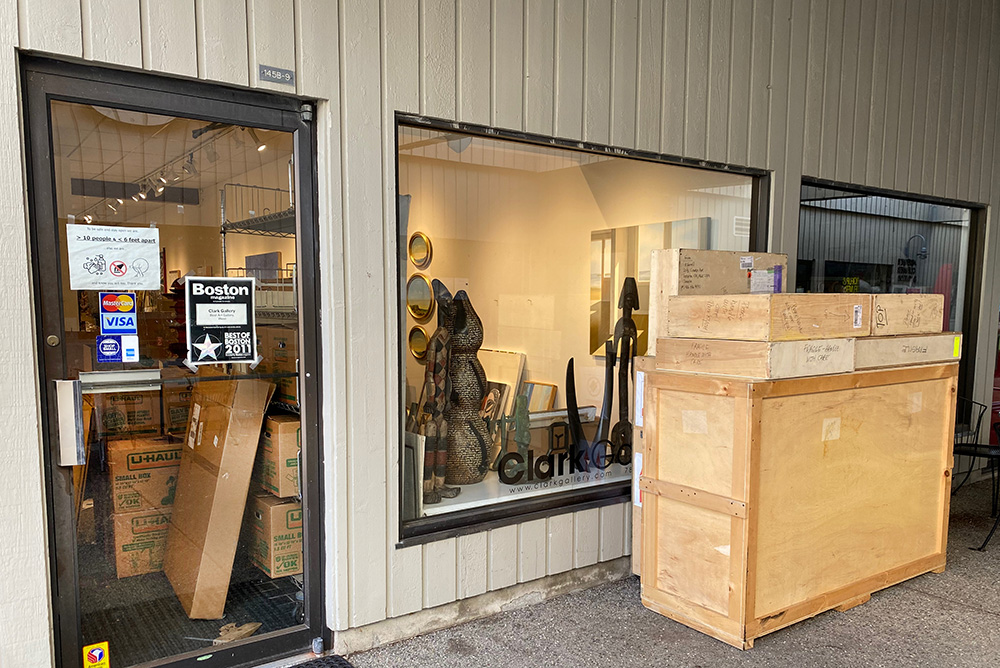
The Clark Gallery was packing up on Thursday.

(Editor’s note: this story was updated on April 23 to include a comment from Christina Van Vleck.)

The Clark Gallery in the Mall at Lincoln Station is moving across Lincoln Road to the recently refurbished commercial space on the ground floor of 2 Lewis St. and may open in their new location as early as next week.

Geoff McGean, executive director of the Rural Land Foundation, which owns the mall, confirmed the move. The gallery was a tenant at will in its 1,400-square-foot space and will not be liable for any future lease payments.

The 2,300-square-foot space that the gallery will occupy includes a kitchenette and ADA-compliant bathrooms, according to the property’s website.

Van Vleck and her husband began renovating the upper floors of the distinctive Lewis Street property (also known as the 1870 Wyman Cook House) in late 2016 with the plan that their family would live there. Last year, they started renovating the retail space on the building’s east side adjacent to the railroad tracks after the MassDOT field office, travel agency, and barber shop left, and Lincoln Cleaners moved to 10 Lewis St. with an entrance abutting the tracks.

Clark Gallery owner Dana Salvo said he was in talks with the Lewis Street owners from very early in the renovation planning and wouldn’t have signed the 10-year lease unless he could occupy both units on the ground floor. “I don’t think they imagined one tenant” at the outset, “but it was good timing — when they knew they were going to have just one tenant, it really opened up what they could do with the space upstairs,” he said. “They’ve done such a good job with that building. They have a really good eye and a good vision.”

“We received a great deal of interest in the space,” Van Vleck said. “Given that septic constraints currently preclude any food service establishments, the gallery feels like a wonderful opportunity to welcome the community in to experience the newly renovated space and enjoy the beautiful artwork featured in the gallery’s collection.

The 1,375-square-foot commercial space on the second floor is occupied by a tech start-up run by a local Lincoln business owner, she said.
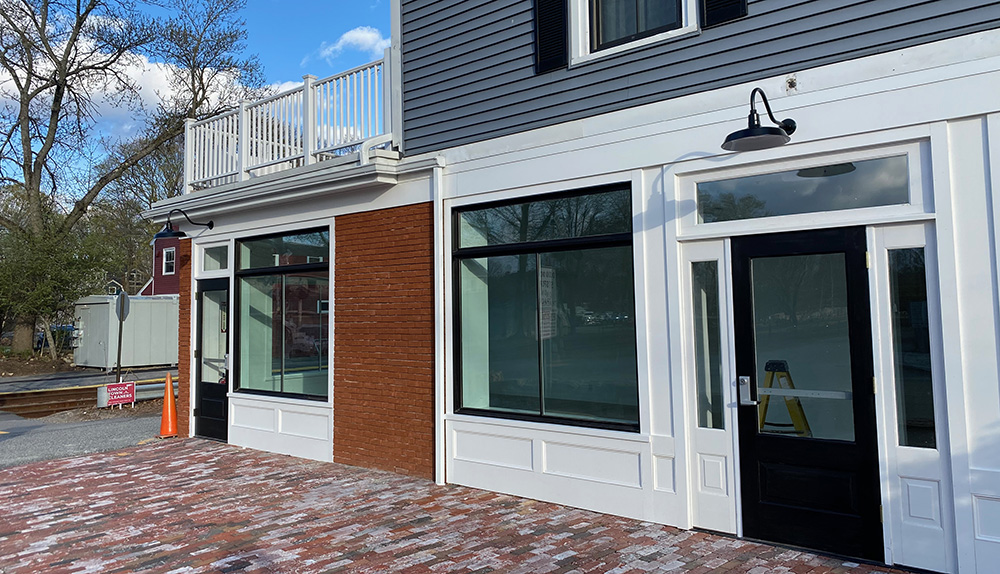
A Lincoln Road view of the renovated space.

The goal for the new Clark Gallery space is not necessarily to attract a higher volume of visitors, “but it just allows us to program a bit differently,” Salvo said. “Contemporary art is a really small niche — I don’t get a lot of foot traffic. People that come are intentional.”

One of the things he didn’t have before is the brick patio along Lincoln Road, which might accommodate outdoor seating and one or more Clark sculptures. Three of its sculptures are now on the lawn in front of the restaurant, he noted.

“I like being in Lincoln in a destination space and that’s not really changing. It’s not like I’m moving” out of town, said Salvo, noting that the gallery has been in the mall for about 30 years.

The RLF is looking for a new tenant for the Clark Gallery’s former mall space and “we’ll be focused initially on trying to find a retail tenant,” McGean said. “We continue to look at all options for improving the vibrancy of Lincoln Station.”


Category: businesses, land use, news Leave a Comment

Clarification

March 21, 2021

The March 18 story headlined “Uncertainties surround new state multifamily housing law” stated that a new state law requires Lincoln and certain other towns to allow multifamily housing by right near MBTA stations. Towns that do not change their zoning bylaw are not subject to a penalty but they stand to lose access to certain state grants, which may or may not be fiscally feasible for the towns. The wording at the start of the article was thus changed to read “effectively requires.”

Category: land use Leave a Comment

Uncertainties surround new state multifamily housing law

March 18, 2021

A new state law effectively requires Lincoln and other MBTA communities to allow denser housing around their train stations, but it will be many months before the state clarifies the law and explains exactly what’s required, Town Counsel Joel Bard said at a March 17 Planning Board/SLPAC meeting on the topic.

State zoning law as revised by the Housing Choice Act says MBTA communities must have a least one district of “reasonable size” within a half-mile of the MBTA stop that permits multifamily housing by right. “Multifamily housing” is defined as a minimum of 15 units per acre, “subject to any further limitations” imposed by the Wetlands Protection Act and Title V, which outlines requirements around septic systems.

For the time being, all communities are considered to be in compliance with the Act, Bard said. Eventually, MBTA communities that do not comply will not be eligible for grant funding from the Housing Choice Initiative, the Local Capital Projects Fund, or the MassWorks infrastructure program. Town officials will gather information about how much funding Lincoln has received from these programs in recent years.

In its preliminary guidance about the new law, the state Department of Housing and Community Development (DHCD) does not define terms such as “reasonable size” of the zoning district, or whether development proposals can be denied if they don’t also meet every wetlands and septic requirement. “There will be a discussion of what is a zone of ‘reasonable size’ in a very small town” that’s more rural than Somerville but more densely populated than Deerfield, for example, said Bard, whose law firm published this update on the legislation last month.

Lincoln Woods has 125 units on 17 acres of land for a density of about 7.5 units per acre. Oriole Landing has about 10 units per acre.

“Lincoln should get credit for allowing density near [the train station] over the years — so ‘reasonable size’ might be smaller for Lincoln than other communities that have done very little,” Bard said.

The existence of Lincoln Woods wouldn’t let Lincoln off the hook in any case. The town would still have to change its zoning to allow future developments of that type by right, rather than by special permit and Town Meeting approval.

Well before the Housing Choice Act was passed, the Planning Board and its South Lincoln Planning and Advisory Committee (SLPAC) were working on rezoning proposals that would encourage more housing and mixed-use development in South Lincoln with the goal of creating a more vibrant village center for residents and businesses. Board chair Margaret Olson wondered how that work could proceed with the new uncertainties.

“I wouldn’t let this slow down your process,” Bard said, adding that it would be several months at least before state authorities give clearer guidance in implementing the new law. He suggested that when the Planning Board was ready, it could send a draft of its proposal to the DHCD for an advisory opinion.

Another unresolved question involves mixed-use development in which a single structure contains both housing and commercial space. “If the residential component is by right, but the commercial component is not, what prevents the town from effectively preventing the development based on aspects of the commercial development?” asked Michelle Barnes, chair of the RLF/Lincoln Land Conservation Trust, which hopes to redevelop the mall.

“Good question,” Bard replied.

Until further state guidance is forthcoming, all communities are considered to be in compliance with the Act, Bard said. Eventually, MBTA communities that do not comply will not be eligible for grant funding from the Housing Choice Initiative, the Local Capital Projects Fund, or the MassWorks infrastructure program. Town officials will gather information about how much funding Lincoln has received from these programs in recent years.

In 2018, the state allocated $500,000 for designing improvements to Lincoln’s MBTA station but never released the money. The fate of that funding is now more uncertain than ever. Meanwhile, the MBTA is cutting service everywhere after taking a financial hit from the Covid-19 pandemic, and it’s unclear what the long-term future holds for Lincoln’s train service.

Because many people may continue to work from home even after the pandemic is over, “use of the commuter rail may change dramatically… this whole notion of being an ‘MBTA community’ is kind of up in the air,” observed resident Sara Mattes.

Category: government, land use, South Lincoln/HCA* 1 Comment

Property sales in January 2021

March 15, 2021

4 Oak Meadow Rd. — Petter Brumme to Michael and Victoria Landers for $1,200,000 (January 29)

14 Moccasin Hill — Christoph Kaufmann to Nancy and Gregory Fincke for $1,220,000 (January 25)

83 Page Road — Michael Kolowich to Jennifer and Joseph Kolchinsky for $3,250,000 (January 19)

134 Chestnut Circle — Zackary Barron to Deborah Page for $535,000 (January 20)

15 Greenridge Lane — Johnny Pho to Lisa Marcaurelle Patterson for $539,000 (January 15)

25 Oak Meadow Road — Joseph Uretsky to Farhana and Javed Riaz for $1,149,000 (January 14)


Category: land use, news Leave a Comment

Planning Board sets hearings on zoning bylaw amendments

March 1, 2021

Amendments to the town’s accessory apartment regulations and new zoning language for stormwater management will be the subject of Planning Board public hearings on Monday, March 9 starting at 7:15 p.m. 

If approved, the zoning bylaw would add a cap on the number of accessory apartments allowed, equal to 5% of all residential units in Lincoln. The board also proposes to remove limitations on the age of structures that are eligible to add accessory apartments, and to require a minimum rental term of 30 days where the accessory apartment or principal dwelling is occupied as a rental unit.

The town approved the Affordable Accessory Apartment program four years ago, but it was only recently that the state officially OK’d it, so the local rules needed some tweaks before the program launches.

A separate hearing at 7:30 p.m. will seek comment on the proposed addition of a new zoning bylaw section titled “Illicit Discharge Control and Stormwater Management Bylaw,” the purpose of which is to protect water quality and comply with federal requirements. If approved by the Planning Board, both sets of changes will go before residents at the Annual Town Meting in May.

Also at the board’s March 9 meeting, the Historic District Commission will make presentations on the proposed addition of 11 Moccasin Hill Rd. to the Brown’s Wood Historic District, and 126 Old Concord Rd. to the Lincoln Historic District.

For more information, see the agenda and the Zoom link for the meeting.

Category: land use, news Leave a Comment

New state law requires towns to allow multifamily zoning near train stations

February 18, 2021

Editor’s note: This story was originally published on or about February 13 but was lost after a website malfunction and later recovered.

A new state law will require rezoning part of the South Lincoln area to encourage multifamily housing around the commuter rail station — something the Planning Board has been wrestling with for years but has not been able to accomplish.

The Act Enabling Partnerships for Growth, signed into law by Gov. Baker on January 14, is intended to encourage multifamily development close to transportation stops to promote greater use of public transportation. It imposes new multifamily zoning requirements for “MBTA communities” that are within a half-mile of commuter rail stops and other transit locations in eastern Massachusetts. Those communities must now have at least one zoning district in which multifamily housing is allowed by right with no age restrictions, and that district must allow at least 15 units per acre.

The law also reduces the voting approval threshold for approving certain zoning bylaw amendments and special permits from a two-thirds majority to a simple majority. These amendments include those that allow (by right or by special permit) multifamily or mixed-use developments at “eligible locations” (which would include the South Lincoln area), accessory dwelling units, and open space residential developments.

The new law is a “comprehensive economic relief and stimulus bill that will affect a multitude of industries across the Commonwealth” and includes “provisions intended to spur housing development and economic growth,” according to this analysis by JD Supra, a company that provides commentary and analysis from lawyers and law firms.

Affected towns that do not amend their zoning bylaw as required will face penalties including loss of access to state grants.

In 2019, a subset of the South Lincoln Planning and Advisory Committee (SLPAC) presented a rezoning proposal that would have created a new South Lincoln Village District with subdistricts (commercial or mixed use, and residential), with buildings up to three and a half stories allowed if they were farther back from Lincoln Road. The measure would have also given the Planning Board the authority to approve special permits for some developments rather than requiring Town Meeting approval.

The goal was to create a more vibrant “village center” with housing options that would allow for housing that’s smaller and more affordable than single-family homes for smaller households and older residents who are downsizing but want to stay in Lincoln. However, the proposal was tabled after objections from residents who worried that the apartments and condos on Ridge Road could be squeezed out and were also uncomfortable with ceding too much authority to the Planning Board.

Lincoln officials are organizing a public multiboard meeting hosted by the town’s legal counsel, KP Law, to review the new legislation and its implications for Lincoln. “After that, the Planning Board will map the way forward with directions to SLPAC as to objectives and public process,” said Director of Planning and Land Use Paula Vaughn-MacKenzie.

Category: government, land use, South Lincoln/HCA* Leave a Comment

Lincoln’s affordable accessory apartment program OK’d by state

February 18, 2021

(Editor’s note: This story was originally published on or about Feb. 13, 2021 but was lost after a website outage and later recovered. The paragraph on loan terms was updated on March 1, 2021.)

Lincoln’s plan to offer tax rebates and loans to residents who create affordable accessory apartments on their property has finally won approval from the state, though the local Housing Commission must now review details of the program, which was formulated four years ago.

Residents voted to approve the Affordable Accessory Apartment program (AAA) in 2017 pending eventual state authorization. The legislature passed H.2645 in January and Gov. Baker signed it into law shortly thereafter. At the time, the goal of the program was threefold:

  • To ensure Lincoln’s SHI (subsidized housing inventory) remained above the state-required ratio of 10% of the town’s entire housing stock so as to avoid a 40B housing development
  • To encourage the development of scattered affordable housing units throughout the town, as opposed to concentrating them in one or two large projects
  • To provide a way for those with unused living space in their homes to earn income from that space, and to reduce their property tax burden

The recent opening of Oriole Landing has obviated the first need, “but the other two are still relevant, and are of even greater importance now than when the program was first developed,” Housing Commission Chair Allen Vander Meulen said. The state’s official SHI for Lincoln is 14% since the opening of Oriole Landing and is expected to be about 12.5% once the 2020 census figures and other variables are factored in, he added.

As approved in 2017, the AAA program also offers an unrestricted “loan” of $25,000 from the town. Ten percent of the original balance is forgiven each year, resulting in a zero balance after 10 years. The loan would be secured by a lien on the property but would not be contingent on the homeowner’s income. Any unpaid balance would have to be repaid if and when a homeowner stops participating in the AAA program.

To qualify, each affordable accessory apartment must have a separate entrance and off-street parking, and must not exceed 1,200 square feet or 35 percent of the home’s square footage. After receiving a special permit from the Zoning Board of Appeals, landlords would have to select tenants from a waiting list of those who applied to the town and have certain income limits.

“Given the four-year gap in time since the town approved it, we need to determine what if anything needs to change for the program to conform to the legal and economic situation we as a town are in today, and to ensure that the program is implemented in a way that is sensitive to the concerns and challenges of those of us who live here in Lincoln,” Vander Meulen said.

“I imagine getting the AAA program up and running will require coordination and perhaps approval from several town governing bodies and offices, so it will likely take some time to ‘get there’.

“I would like to extend our gratitude to State Rep. Tom Stanley, who has diligently worked for years to get this rebate past the various legislative roadblocks it faced until it was finally approved, and to Pam Gallup, who did the lion’s share of the work needed to develop the program and then get it approved at Town Meeting,” he added.

Category: land use, news Leave a Comment

Third SOTT looks at electricity aggregation, road safety, South Lincoln

November 22, 2020

Residents heard updates on electricity aggregation, road safety measures, and planning for South Lincoln’s future at the third State of the Town meeting on November 19.

Electricity from renewable sources

Almost three years after voters authorized the Board of Selectmen to start developing the program, the Green Energy Committee is nearing the finish line for Lincoln Green Energy Choice, a program that will give residents the option of buying electricity from renewable sources. Eversource will continue to provide transmissions lines and billing, but the town will seek bids for renewable energy from the local grid. Committee chair C.J. Volpone explained that residents can opt in or out of the program at any time, though they will be automatically enrolled initially in a plan that will cost about the same as Eversource’s winter rates.

Eversource is currently required to draw 18% of its electricity from renewable sources. The new program will offer three options:

  • Budget, with 20% of the electricity from renewable sources
  • Basic Green, with 35-50% renewable (the default option that residents will be enrolled in unless they opt out)
  • Total Green, with 100% of the electricity from renewable sources. Volpone said this option would probably cost $20–$30 a month more than the current average bill, though the exact price won’t be known until buds are received and a contact is signed.

LGEC has posted a table showing preliminary estimates of additional costs depending on type and amount of electricity usage.

Benefits of the program include reducing greenhouse gas emissions, having a choice of electricity sources, and having long-term predictable rates for electricity, since LGEC contracts will be longer than the six-month contacts required of Eversource, Volpone said. Using electricity from renewable sources will become more important in the years to come as more and more people buy electric cars and use electric-power heat pumps for home heating, he added.

Homeowners will get a postcard in the mail informing them of the options and asking if they want to opt out before the program launches, which is expected to happen in March 2021, Volpone said. Resident Sara Mattes (one of 118 people who attended the online meeting) worried that there could be “blowback” because people will be automatically enrolled in the program, but Volpone said the impact on electric bills for the Basic Green option would be “minimal.”

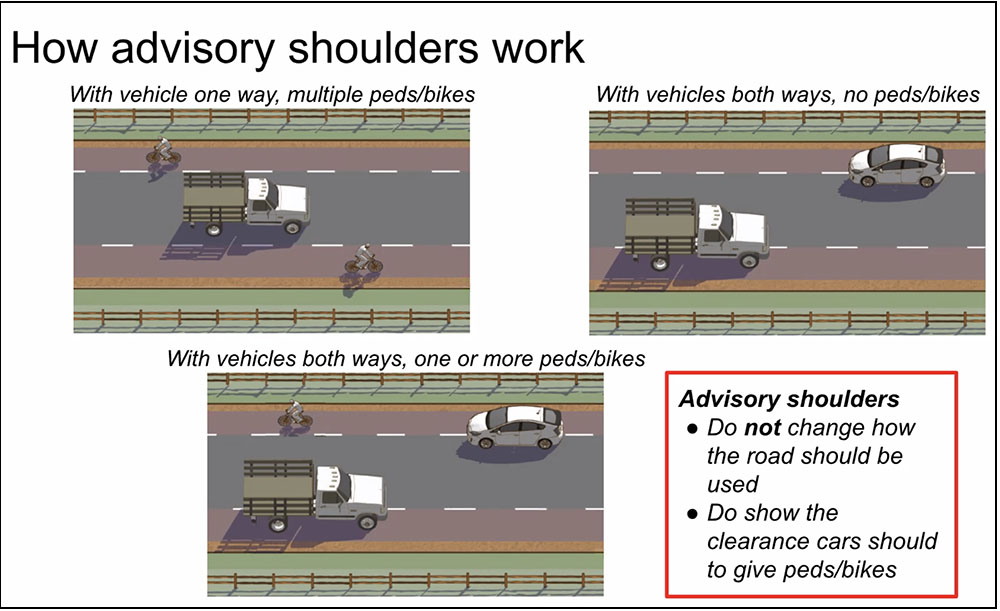
Advisory shoulders

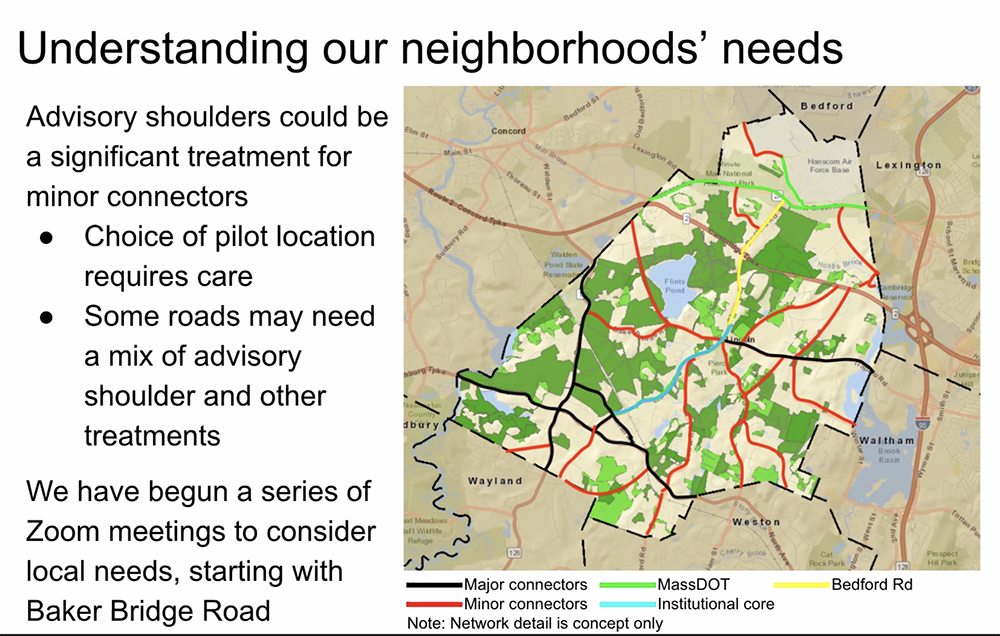
Bob Wolf and Ginger Reiner of the Bicycle and Pedestrian Advisory Committee (BPEC) outlined a method that could be used to make Lincoln’s roads safer for bikes and walkers. Advisory shoulders are lanes marked with white dashed lines on either side of a road to indicate where bikes and pedestrians have the right of way. Vehicles can cross the lines to avoid traffic coming from the opposite direction but must yield to oncoming traffic if there are “vulnerable users” (bicyclists, pedestrians, or any other non-vehicle) ahead or alongside.

The committee and its predecessor, the Cycling Safety Advisory Committee, came into being after two bicyclists were killed and a third was injured in three separate accidents on Lincoln roads in 2016. More than half of the residents who responded to a subsequent town-wide survey said they were not comfortable biking or walking on some of Lincoln’s roads.

As a road safety measure, advisory shoulders have the advantage that they are inexpensive and easy to create. “It doesn’t change how the road should be used, but it shows the clearance that vehicles should give vulnerable users,” Wolf said. In other towns such as Hanover, N.H., that have tried this approach, “drivers get used to this pretty quickly.”

The BPAC studied Baker Bridge Road as a possible first case where advisory shoulders could be installed. As one of several designated “minor connectors” in town, the road offers connections to schools and access to conservation trails. In a neighborhood Zoom meeting with the BPAC in October, there was “universal agreement” among Baker Bridge Road residents that the road is not safe for pedestrians and family cycling.

Wolf acknowledged that “it’s not one size fits all for all Lincoln roads” and invited residents of other neighborhoods to set up a Zoom meeting with the committee to discuss safety issues by emailing lincoln-bpac@googlegroups.com.

South Lincoln

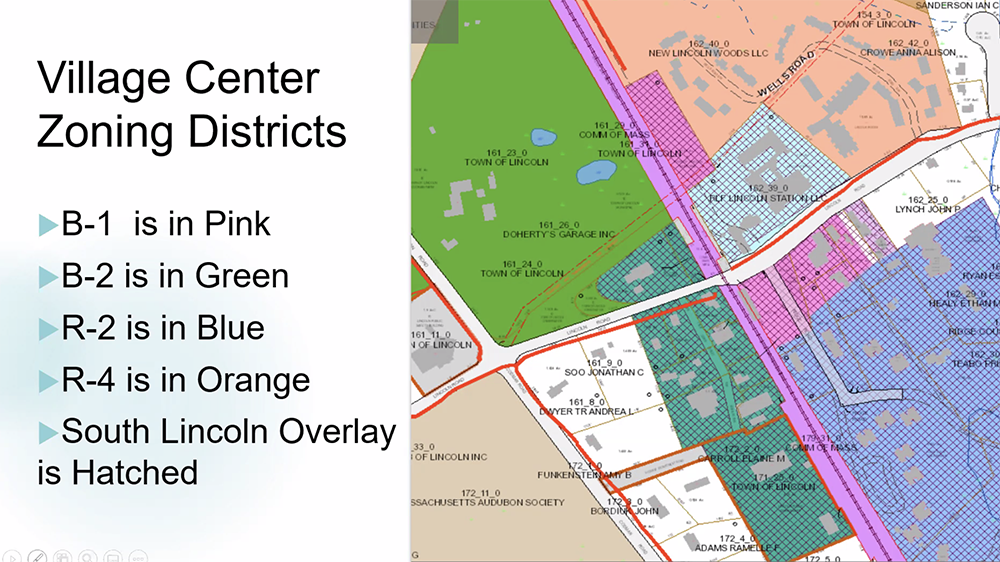
The South Lincoln Planning and Advisory Committee (SLPAC) has “restarted the process to evolve our village center” to make it more vibrant for residents and businesses, Planning Board chair Margaret Olson said. Businesses in the area have been struggling for some time, and a “confusing and costly” permitting process on top of a “hodgepodge” of five different zoning districts has made it very difficult for any sort of new development to win approval.

Revamping the zoning rules in South Lincoln would offer more flexibility in building uses, a more diversified housing stock, and a clearer permitting process while still imposing design guidelines to ensure new development is in keeping with Lincoln’s “look” and character, Olson said. SLPAC and the Planning Board will “build consensus… around an open and transparent process” with broad public participation and input. As part of that goal, the committee is inviting public comment any time and posting letters from residents on its website.

As part of the larger goal to limit climate change, the town hopes to encourage use of the commuter rail stop as well as energy-efficient buildings and more usage by bikes and pedestrians. The state also wants to encourage more use of mass transit. For example, Massachusetts House Bill 3931 would require multifamily zoning within one mile of train subway and bus stops.

While that particular bill may not pass, “there is pressure mounting in the system for something along these lines,” Olson said. “When regional problems get too big, the dam breaks, and 40B [the affordable housing mandate] is an example of that. We need to indicate how we want the town to change and adapt to the political and environmental changes headed our way in the next few decades.”

SLPAC’s predecessor tried to bring zoning changes to a town-wide vote last year but met with stiff opposition from residents who, among other things, were worried that residents in midrange housing such as the Ridge Road condominiums would be displaced. “SLPAC has heard that loud and clear,” Olson said, adding that near-term rezoning efforts will focus only on the south side of Lincoln Road.

The need for action is not hypothetical. The privately owned sewage treatment system used by Lincoln Woods and the mall is past its useful life, and the town plans to commission a study of options for upgrading and expanding it or else finding some other solution to allow more development.

Another reason for rethinking the South Lincoln commercial area: the mall itself will not be economically viable for much longer. Michelle Barnes, chair of the Rural Land Foundation (which owns the mall) reiterated her statement from last spring that changes in shopping habits are making it increasingly difficult for stores to succeed.

“I’m trying not to say anything about our current collection of enterprises, but I think it’s fair to say that over time, year after year, we have seen a decline in business at the mall,” Barnes said at the SOTT meeting. “Thinking about what’s going on economically elsewhere with local malls, they just have not been surviving, and certainly not thriving. The longer-term trends don’t look that great and we feel we have to be proactive in making sure it stays a vibrant place.”

The RLF operates the mall as a nonprofit, Barnes noted. “As economic forces on the mall continue to go in one direction, the fact that we don’t have much margin makes that endpoint collide eventually. That’s not tomorrow, but the long-term sustainability of the mall in its current state is not tenable.”

Category: businesses, government, land use, South Lincoln/HCA* 6 Comments

State of the Town updates to span three evenings

November 9, 2020

Lincoln’s annual State of the Town meeting will be split into three online meetings from 7­–9 p.m. on three consecutive days next week. Topics and dates will be as follows. Click here to register for any or all of the sessions.

Tuesday, Nov. 17

  • Public health update
    • Lincoln Covid-19 web page
  • Town Meeting preview
  • School building project update
    • School Building Committee website
  • Budget preview

Wednesday, Nov. 18

  • Diversity, equity, inclusion, and antiracism
    • Background and links to the videos and slide decks of the three Board of Selectmen’s roundtables

Thursday, Nov. 19

  • Electricity aggregation pricing update
    • Lincoln Green Energy Choice
  • South Lincoln Planning and Advisory Committee update
    • SLPAC web page
    • “South Lincoln panel is now a five-member SLPAC” (Lincoln Squirrel, June 10, 2020)
    • “Septic treatment becoming an issue for mall and South Lincoln” (Lincoln Squirrel, Oct. 12, 2020)
  • Bicycle and Pedestrian Advisory Committee update
    • “New bike/pedestrian group seeks members” (Lincoln Squirrel, Jan, 7, 2019)

Category: government, health and science, land use, news, schools Leave a Comment

Clarification

October 13, 2020

The October 12 story headlined “Septic treatment becoming an issue for mall and South Lincoln” may have implied that the four-member South Lincoln Planning Advisory Committee will not have any presence from the Finance Committee. While he will not be a voting member, FinCom member Tom Sander will act as liaison to SLPAC. The article also said that the FinCom was short by two members, but it is now back at full strength with the addition of new members Deb Wallace and Rich Rosenbaum.

Category: land use, news Leave a Comment

  • « Go to Previous Page
  • Page 1
  • Interim pages omitted …
  • Page 12
  • Page 13
  • Page 14
  • Page 15
  • Page 16
  • Interim pages omitted …
  • Page 37
  • Go to Next Page »

Primary Sidebar

Recent Posts

  • Water bills to go up by 13% March 5, 2026
  • News acorns March 5, 2026
  • Property sales in January 2026 March 4, 2026
  • My Turn: Unraveling the Hanscom misallocation March 3, 2026
  • Police log for Feb. 19–25, 2026 March 3, 2026

Squirrel Archives

Categories

Secondary Sidebar

Search the Squirrel:

Privacy policy

© Copyright 2026 The Lincoln Squirrel · All Rights Reserved.