• Skip to primary navigation
  • Skip to main content
  • Skip to primary sidebar
  • Skip to secondary sidebar

The Lincoln Squirrel – News, features and photos from Lincoln, Mass.

  • Home
  • About/Contact
  • Advertise
  • Legal Notices
    • Submitting legal notices
  • Lincoln Resources
    • Coming Up in Lincoln
    • Municipal Calendar
    • Lincoln Links
  • Merchandise
  • Subscription Info
    • My Account
    • Log In
    • Log Out
  • Lincoln Review
    • About the Lincoln Review
    • Previous Issues
    • Submit Your Work
    • Subscribe/Donate

land use

Property sales in December

January 31, 2022

42 Bypass Rd. — Hanhphuong Vo to Bal Mukund Dhar and Jasmine Dhar for $1,005,000 (December 23)

51 Greenridge Lane — David Cancian to David Cancian for $520,000 (December 9)

104 Lincoln Rd. — Diana Barnes Blood Trust to Juan Pablo Ugarte and Lisette Silva-Sanchez for $1,050,000 (December 6)

31 Conant Rd. — Charles E. Morneau Trust to Vijay Somandepalli and Carly Park for $2,050,000 (December 2)

108 Concord Rd. — Maureen Masterson to Thomas E. and Alison B. Masterson for $930,000 (December 2)

47 Birchwood Lane — Paul A. Mangini to Lawrence I. Ecjler and Carol L. Domblewski for $850,000 (December 1)

6 Reiling Pond Rd. — She Ling Wang to Sajal Swaroop and Arpita Akhouri Swaroop for $1,790,001 (December 1)

Category: land use Leave a Comment

Property sales in November 2021

January 20, 2022

26 Morningside Lane — Alexander J. Nichols to Lauren Miller and Michael Brundage for $1,005,000 (November 30)

148 South Great Rd. — Stephen A. Fairfax to Jun Wang and He Qiong for $730,000 (November 23)

225 Aspen Circle — James J. Faran Jr. to Kathleen and John R. Edmondston for $850,000 (November 17)

324 Hemlock Circle — Patricia Lewis Trust to Arthur J. Gleiner Trust for $346,000 (family sale) (November 15)

9 Wheeler Rd. — Peter J. Watkinson to Alexander J. Nichols and Ann Feng Cheung for $1,950,000 (November 12)

354 Hemlock Circle — Susan M. Burt Trust to Sandra N. Bradlee Trust and Henry G. Bradlee III Trust for $705,000 (November 10)

51 Todd Pond Rd. — Howard M. Wiles to Janet and Steve Niemi for $560,000 (November 5)

64 Baker Bridge Rd. — Jonathan B. Ammen to Meghan K. Lytton for $2,050,000 (November 5)

115 Trapelo Rd. plus adjoining lot — Brian A. Byrne to Jesse A. Lefkowitz and Rachel A. Neurath for $1,760,000 (November 3)

34 Round Hill Rd. — Melissa M. Brooks to Clara A. and William R. Broughton for $2,000,000 (November 3)

Category: land use, news Leave a Comment

State officials explain draft guidelines for multifamily housing

January 12, 2022

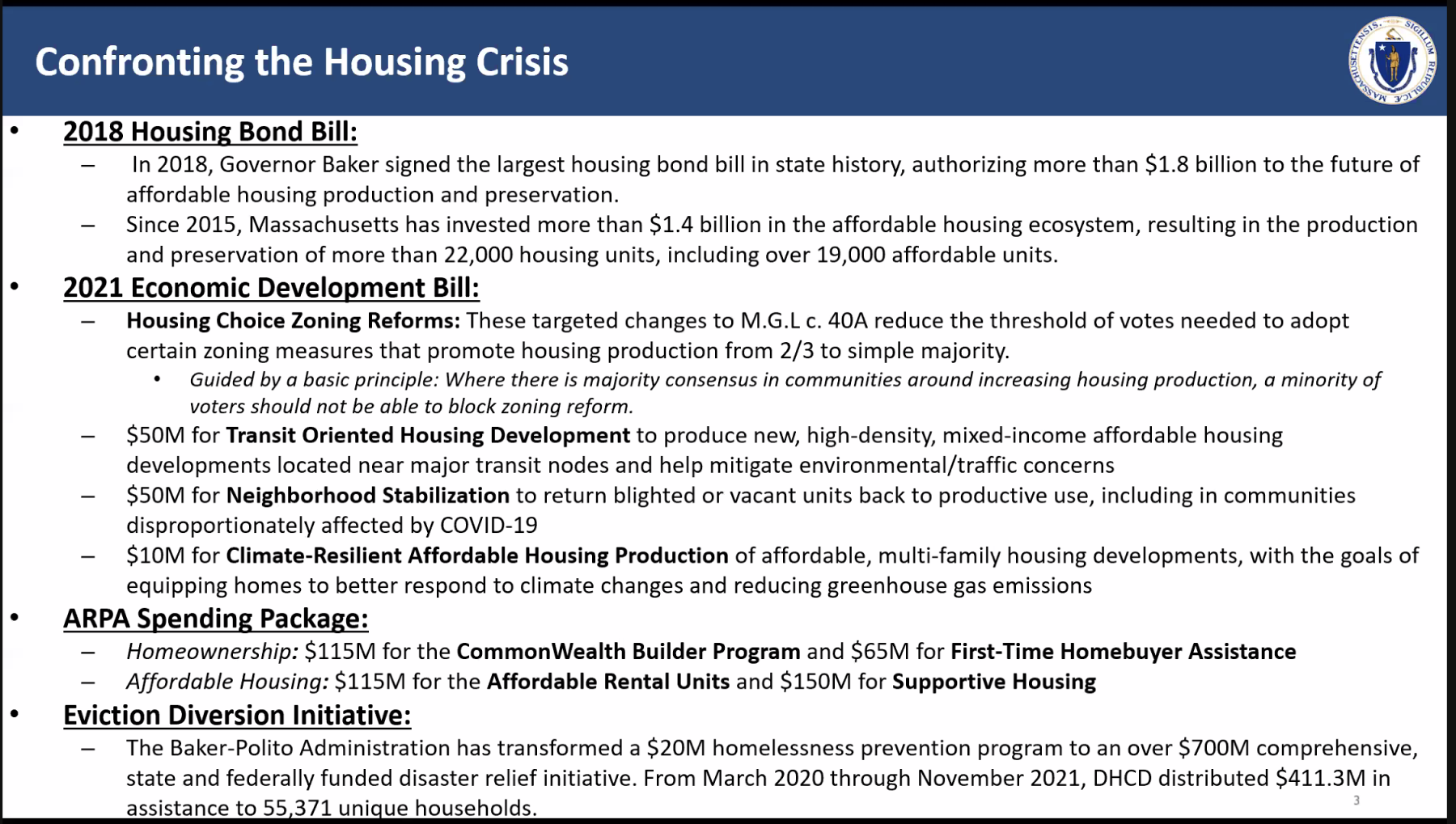
State housing officials made the case for multifamily zoning in MBTA communities and explained the draft compliance guidelines during a January 12 webinar.

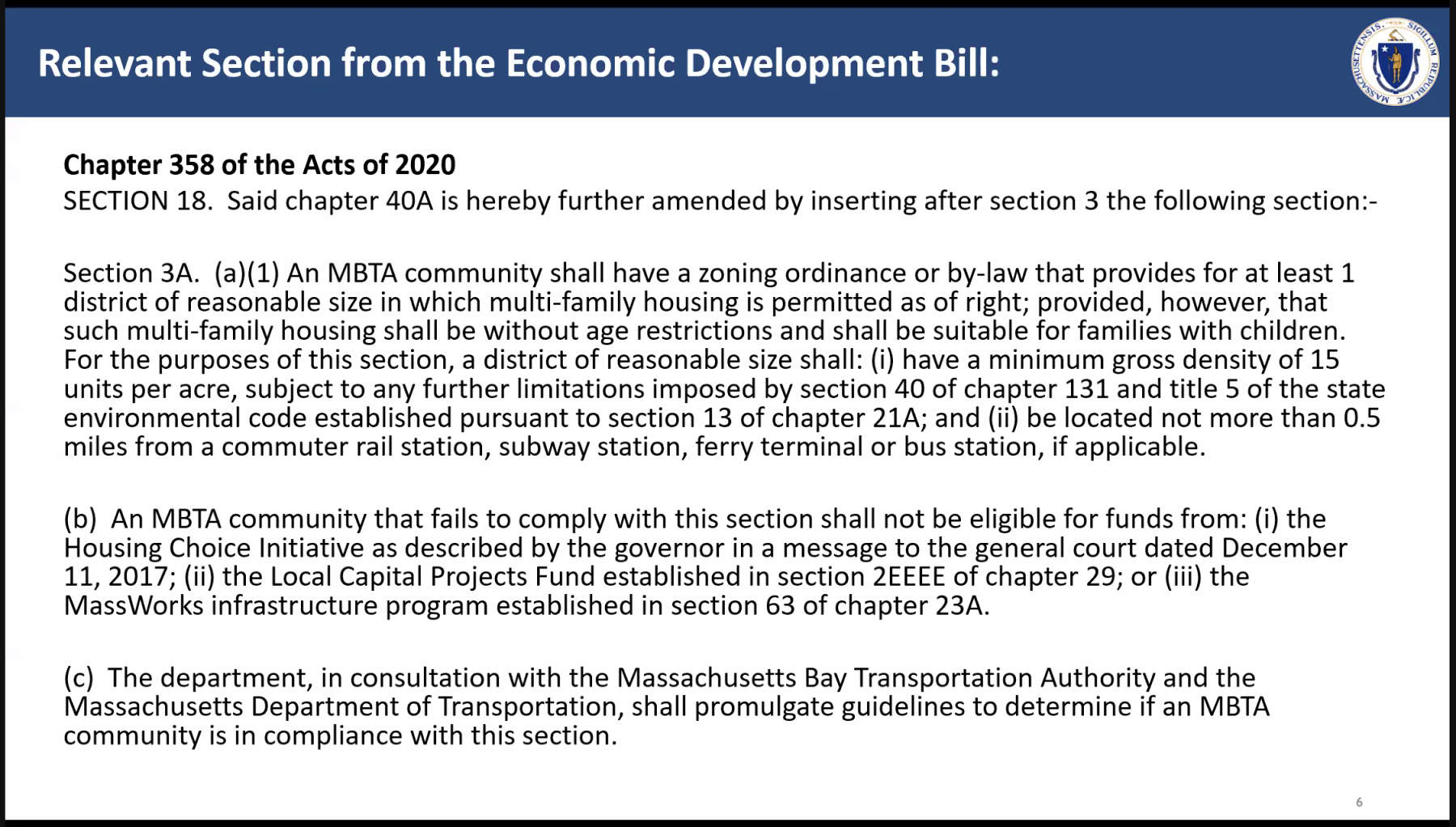
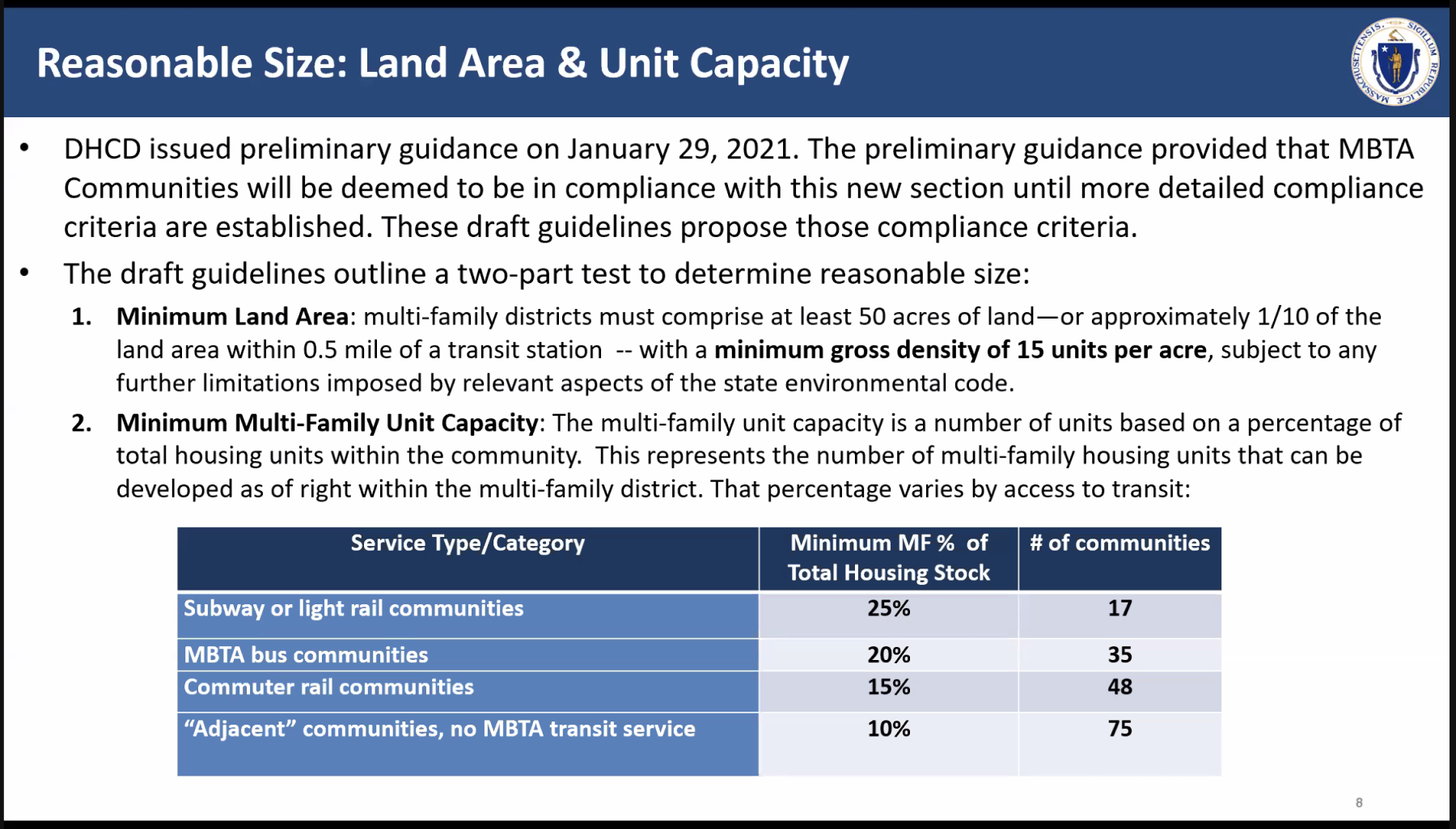
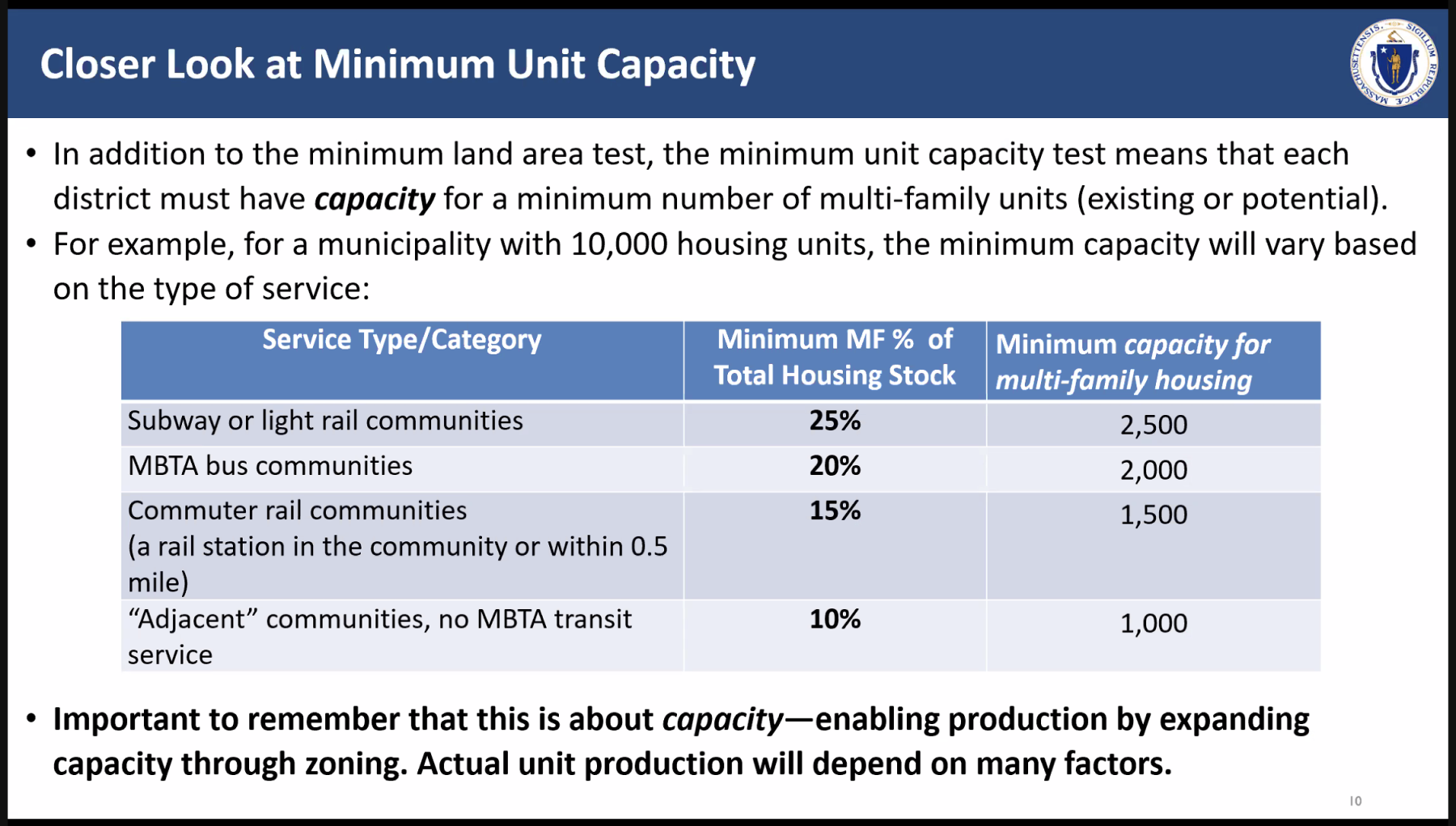
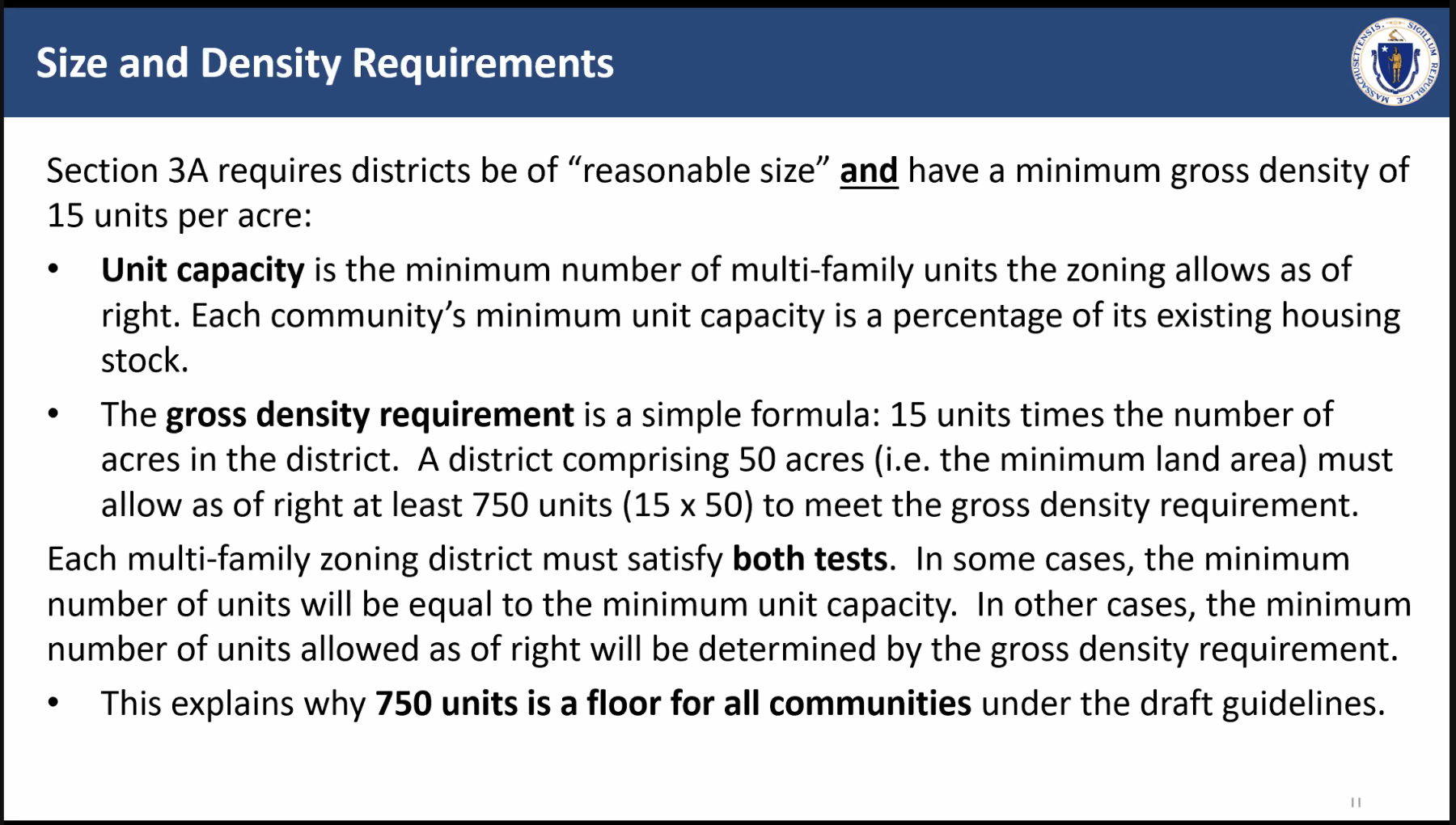
New zoning rules require MBTA communities to allow multifamily housing of a given density in an area within half a mile of an MBTA station or bus stop, or face loss of eligibility for some state grants. For Lincoln, the requirement would be 750 multifamily units (the minimum number for all MBTA communities). The changes are part of a $262 million economic development bond bill passed in January 2021. 

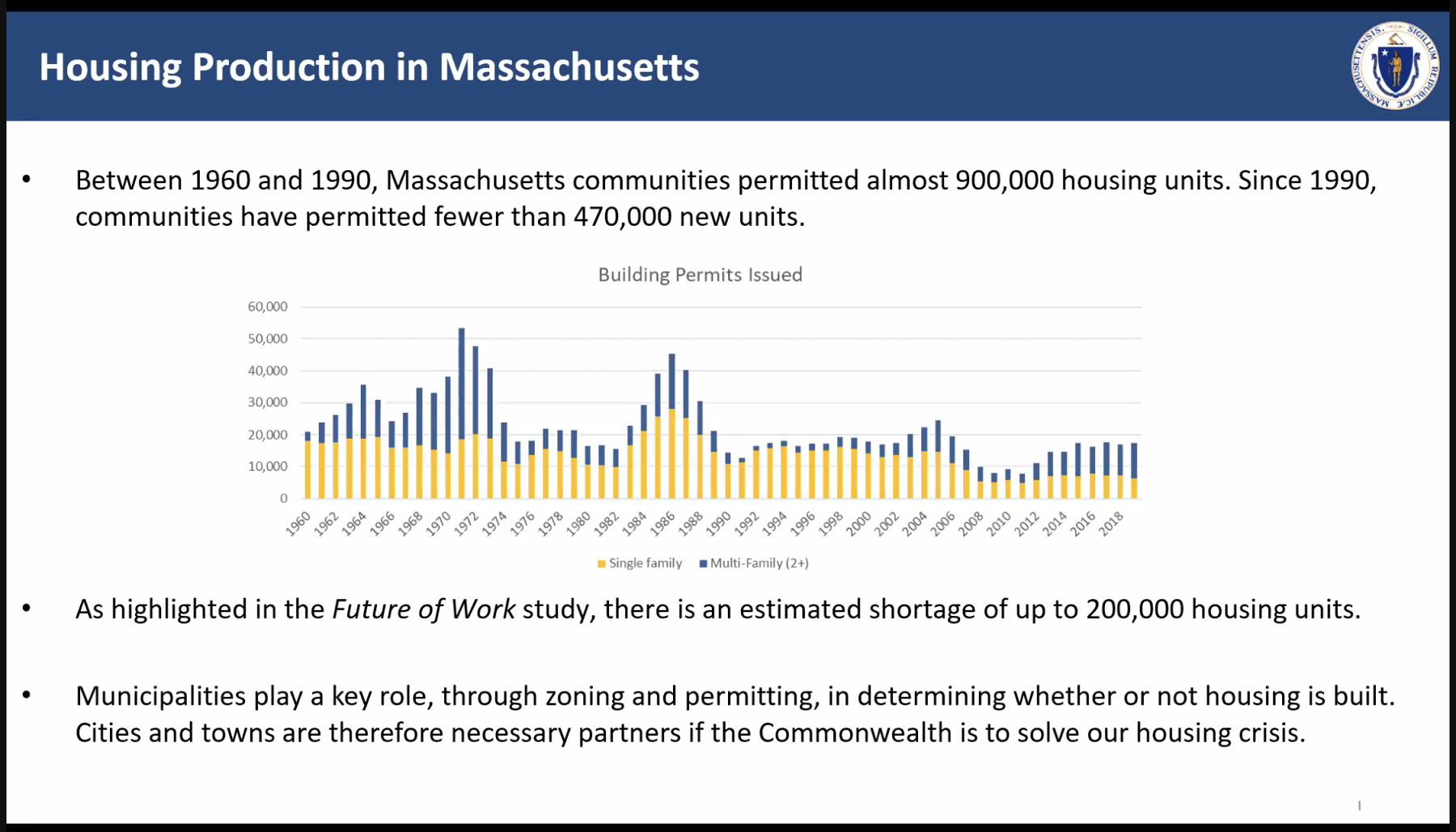
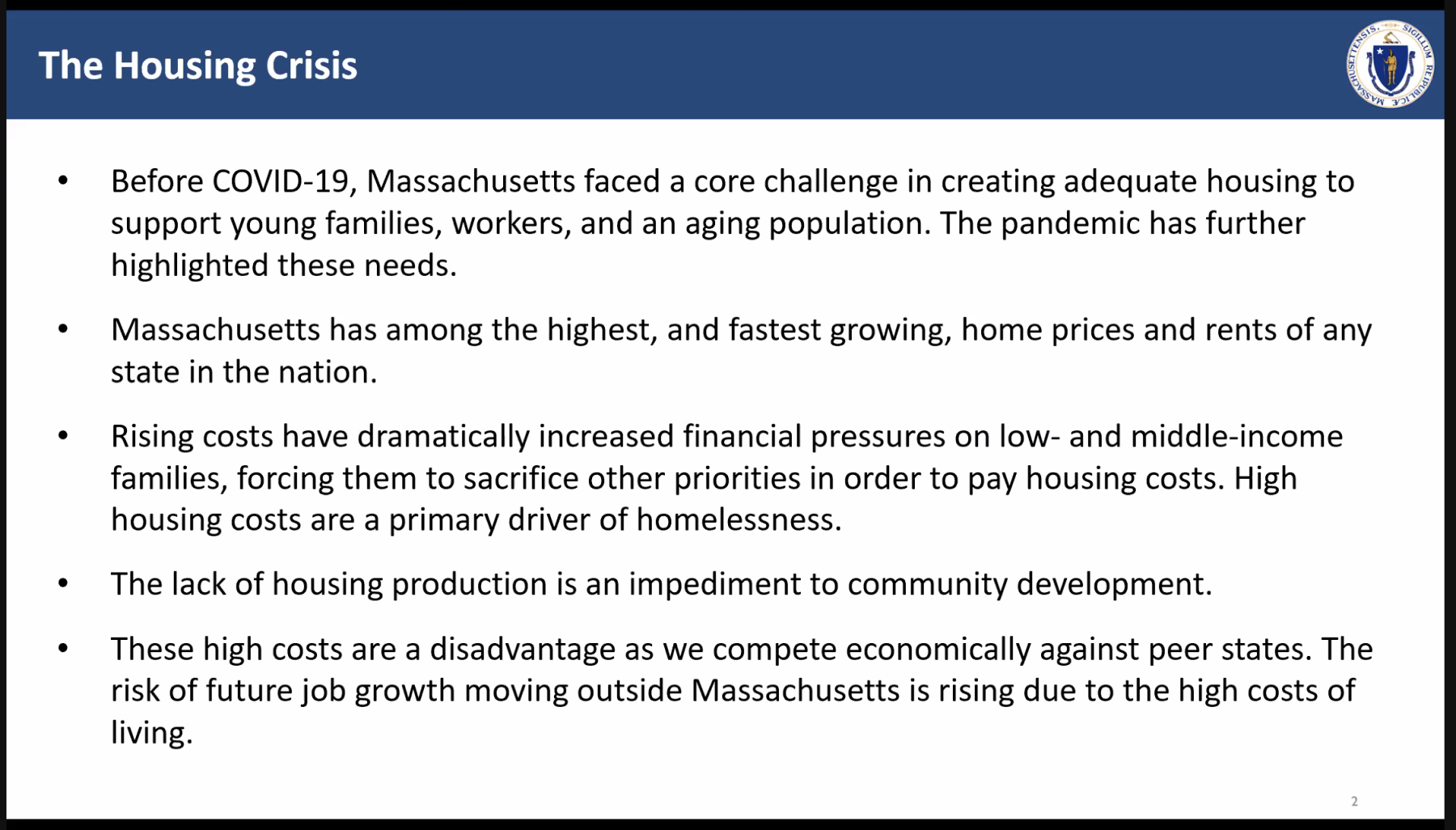
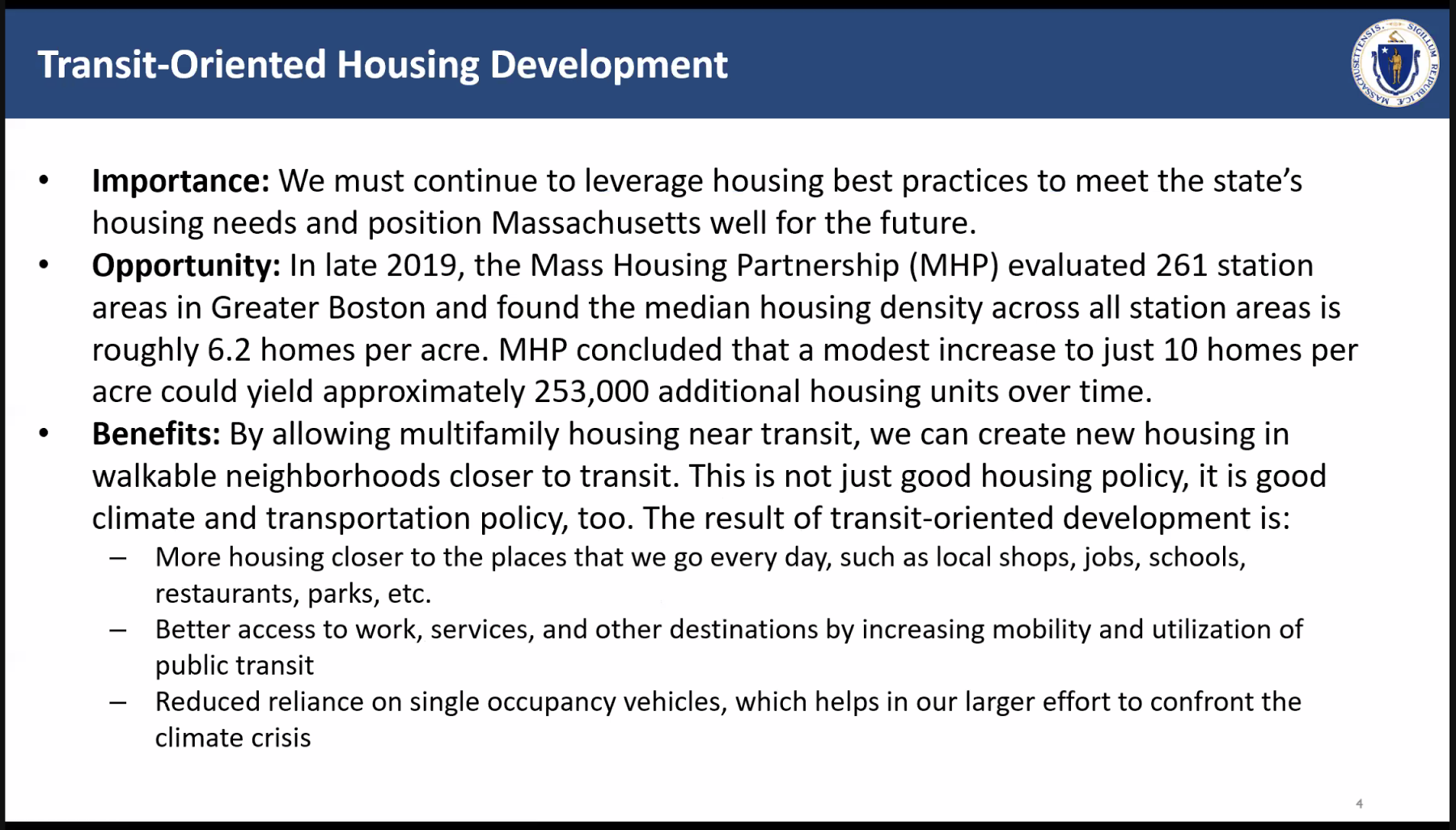
That bill has several other provisions and funding allocations that aim to alleviate the housing shortage in Massachusetts, which has among the highest and fastest-growing housing costs in the nation, said Michael Kennealy, Housing and Economic Development Secretary. Although the population has risen steadily, only half the building permits statewide were issued from 1990 to 2020 as in the preceding 30-year period, he noted.

“This has placed an incredible burden on our households and families all over the state” and is making Massachusetts less competitive with other “innovation economy” states, Kennealy said. The new law “is simply good climate policy, good transit policy, good housing policy, and good local economic development policy.”

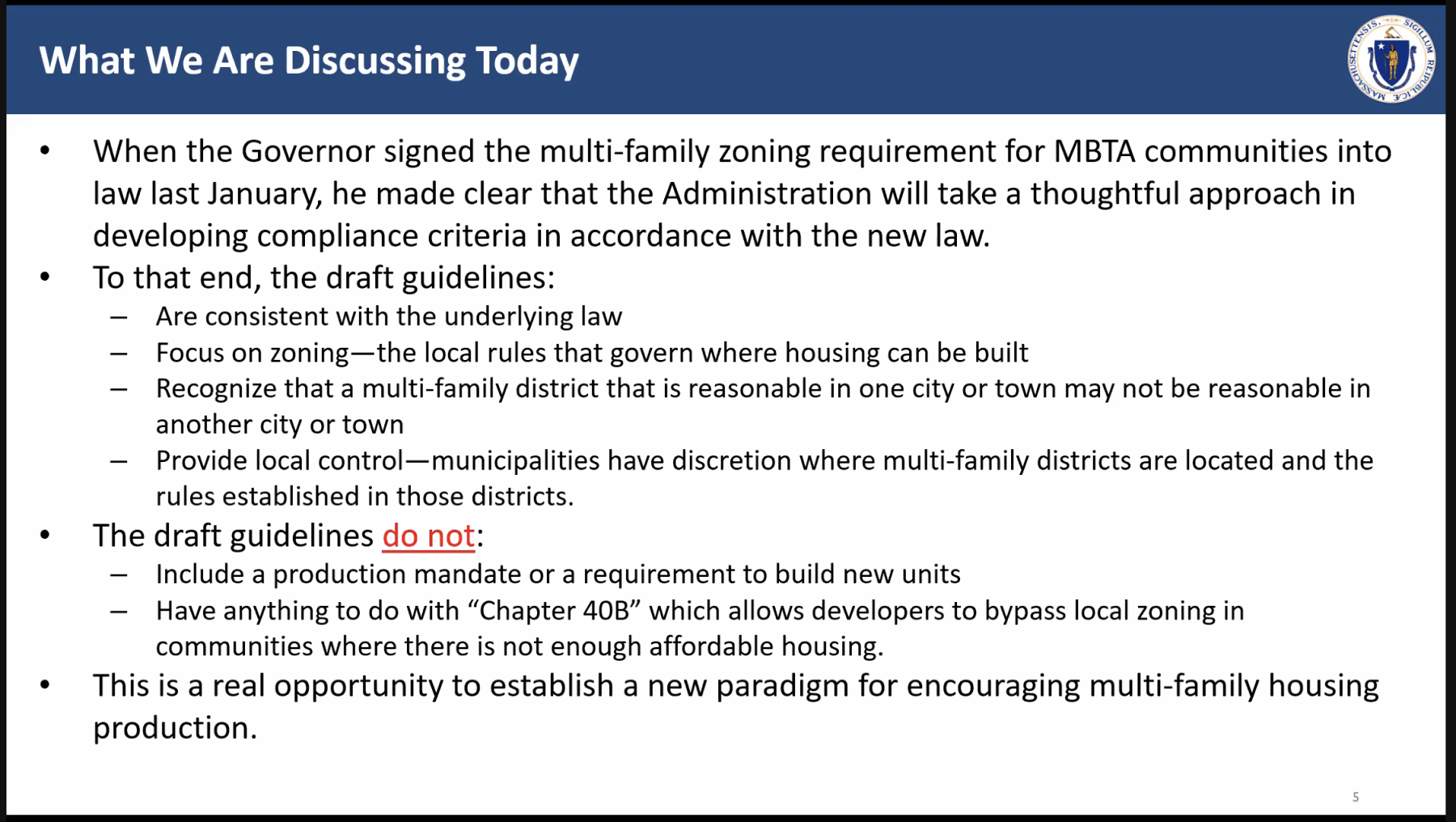
Gov. Baker has said his administration will take a “thoughtful approach in developing compliance criteria” and that those criteria will “recognize that a multifamily district that is reasonable in one city or town may not be reasonable in another,” said Chris Kluchman, Deputy Director of the Community Services Division of the state Department of Housing and Community Development.

The officials emphasized that the law is unrelated to Chapter 40B, which allows developers to bypass local zoning in communities that do not meet the state minimum for affordable housing stock. It is also not a production mandate; “the actual unit production will depend on many factors,” Kluchman said.

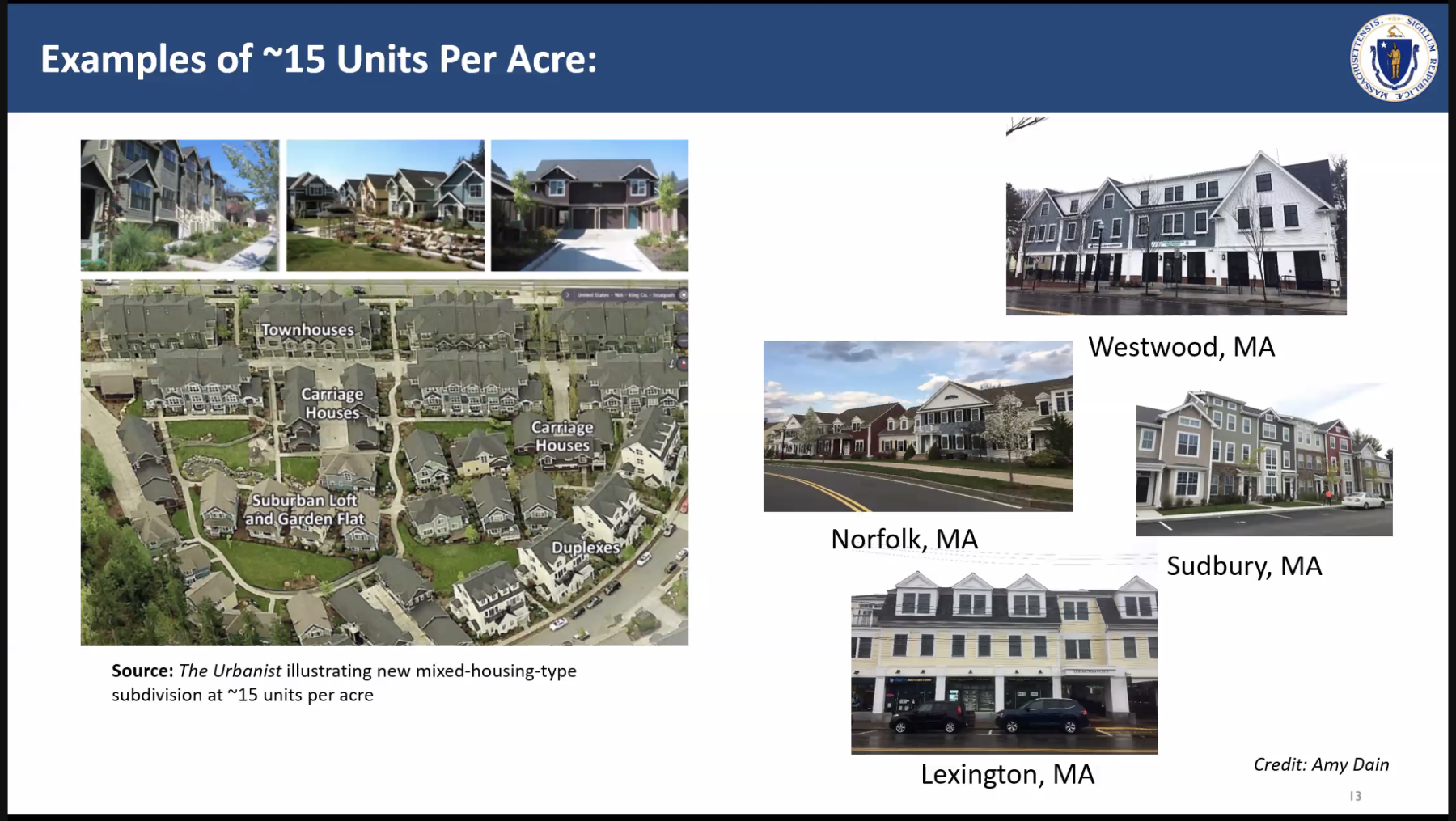
Clark Ziegler, Executive Director at the Massachusetts Housing Partnership, showed a slide with photos of “real-world examples of attractive multifamily housing,” including developments in Sudbury and Lexington (see slide deck below). “We need to show local residents that multifamily is not what they often fear, and that it can be knit into the fabric of any community to create vibrant neighborhoods,” he said.

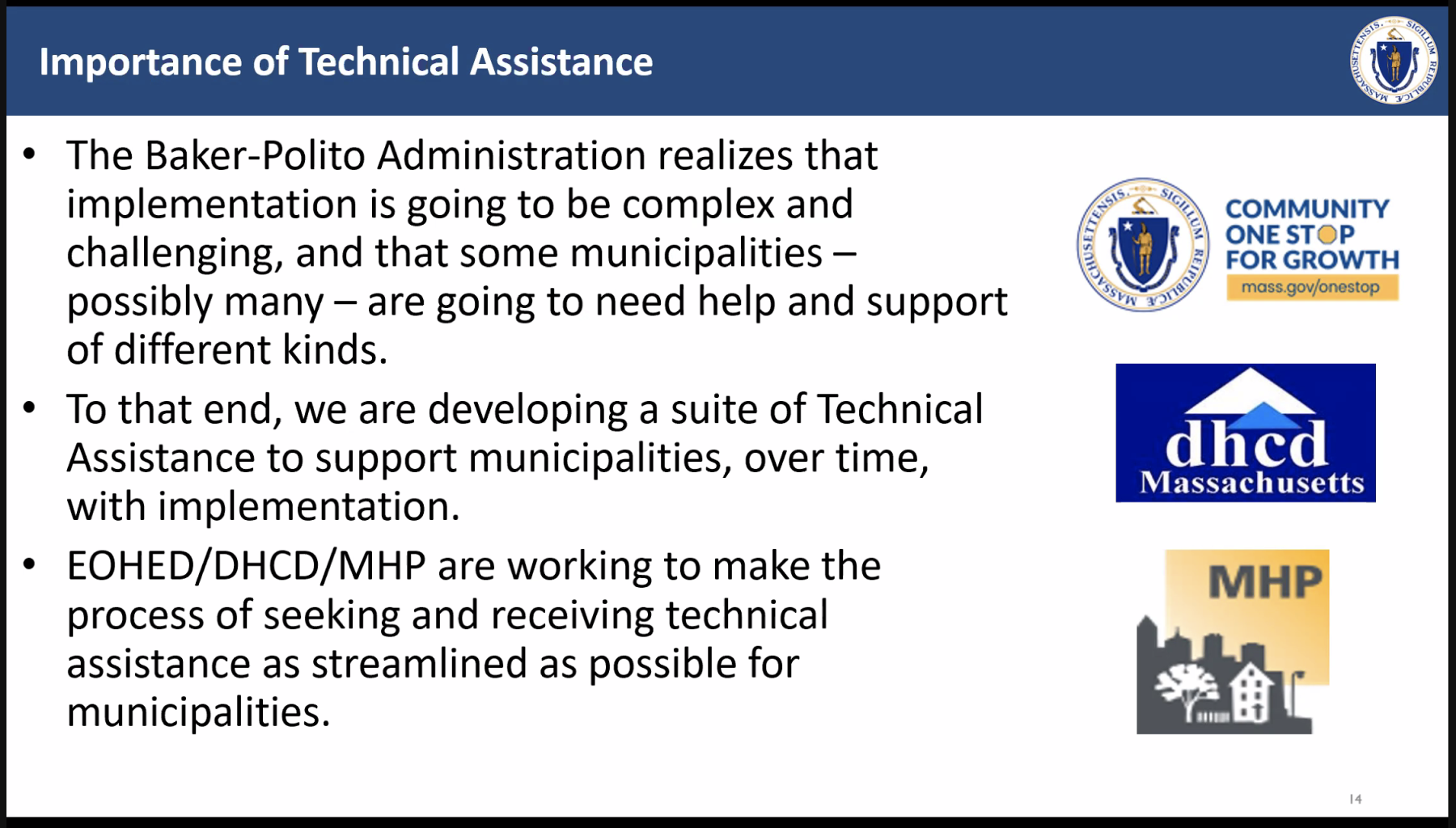
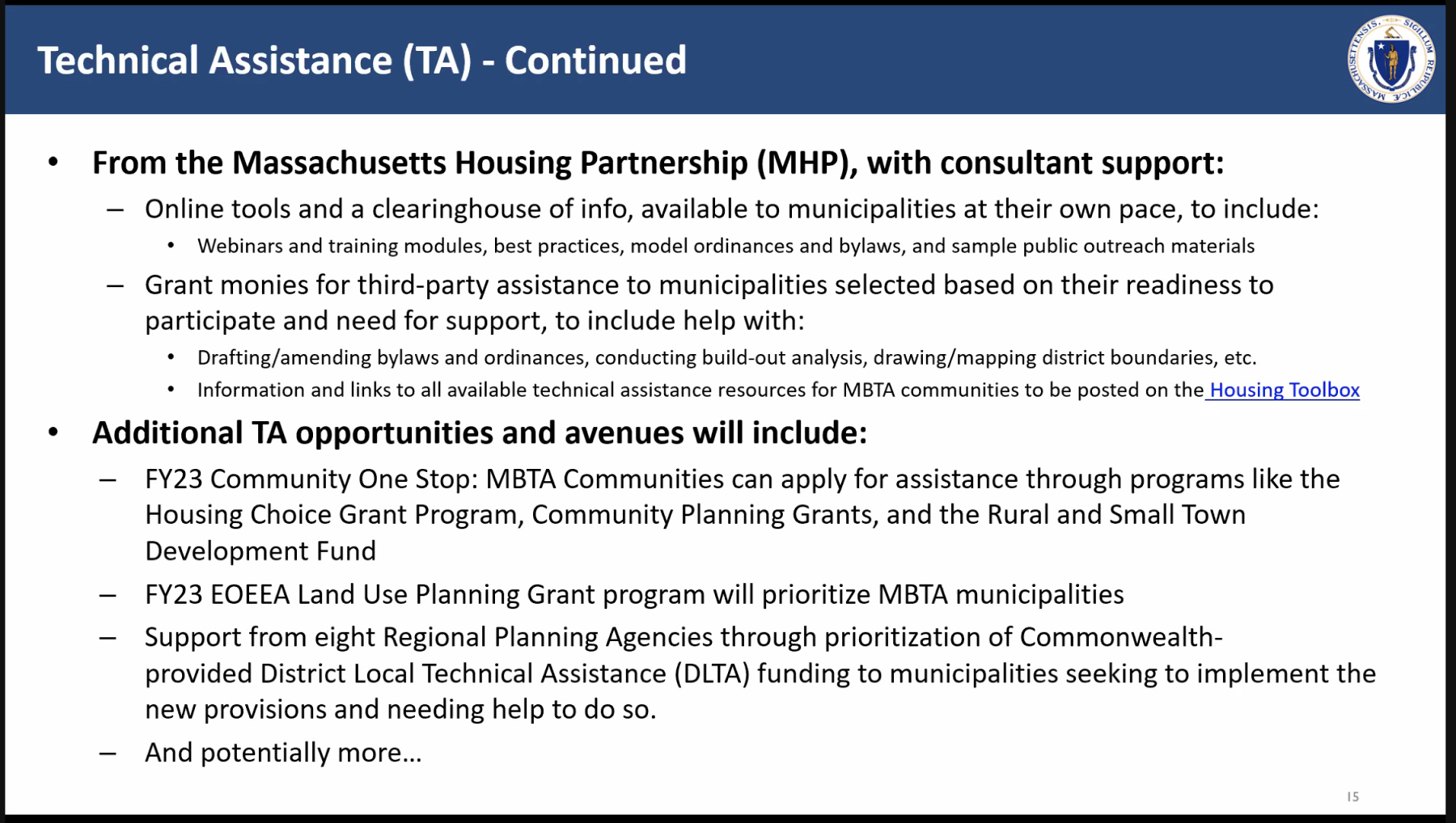
Lincoln and other towns currently require a two-thirds majority at Town Meeting to approve changes to their zoning rules. The economic development bill reduces the voting approval threshold for approving certain zoning bylaw amendments (including creation of the multifamily district) and special permits to a simple majority. Nonetheless, the state realizes that “that can be a big lift,” so officials are offering technical assistance as well as grant programs for low- and moderate-income housing near public transit to help communities comply,” Ziegler said.

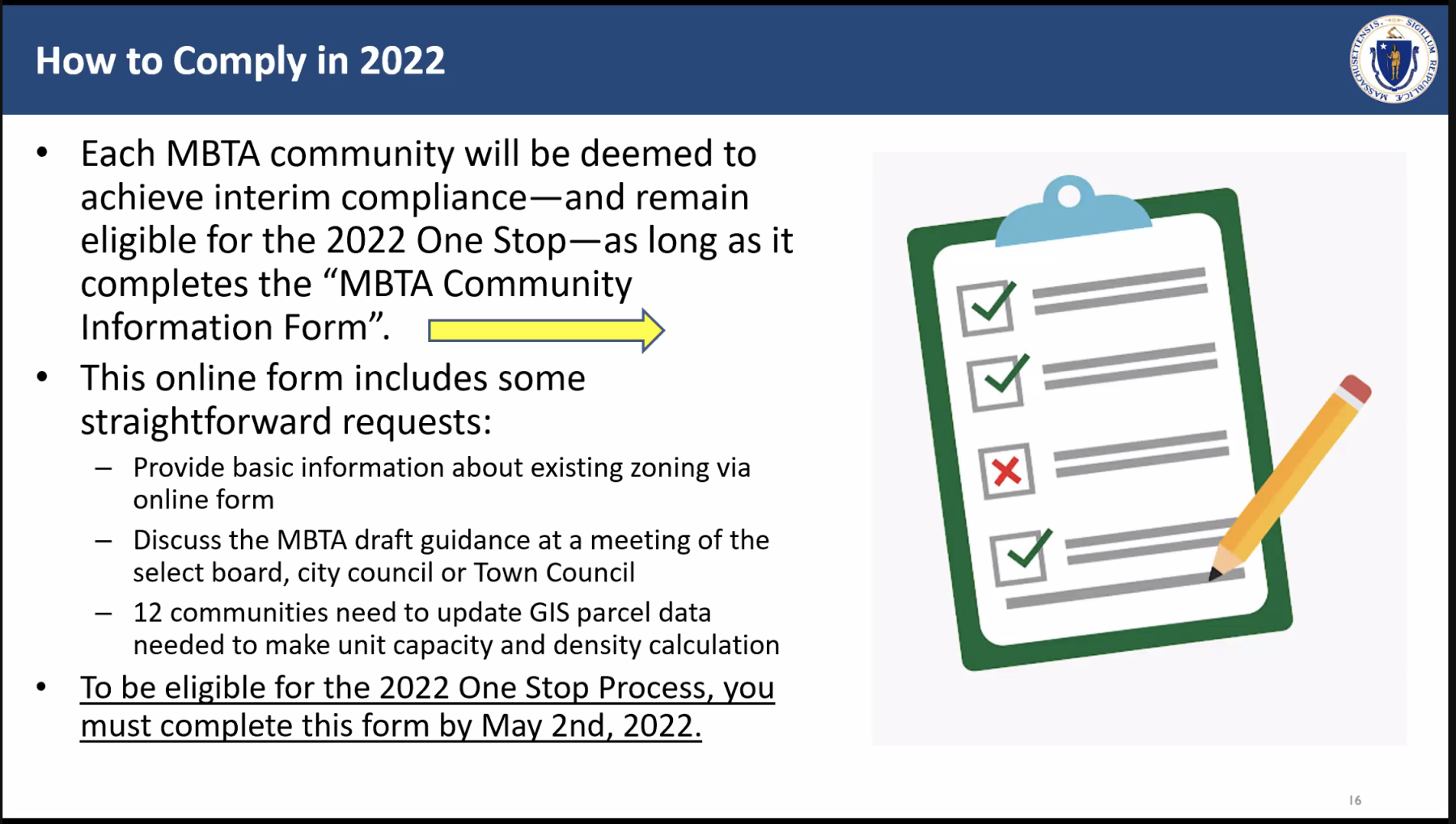
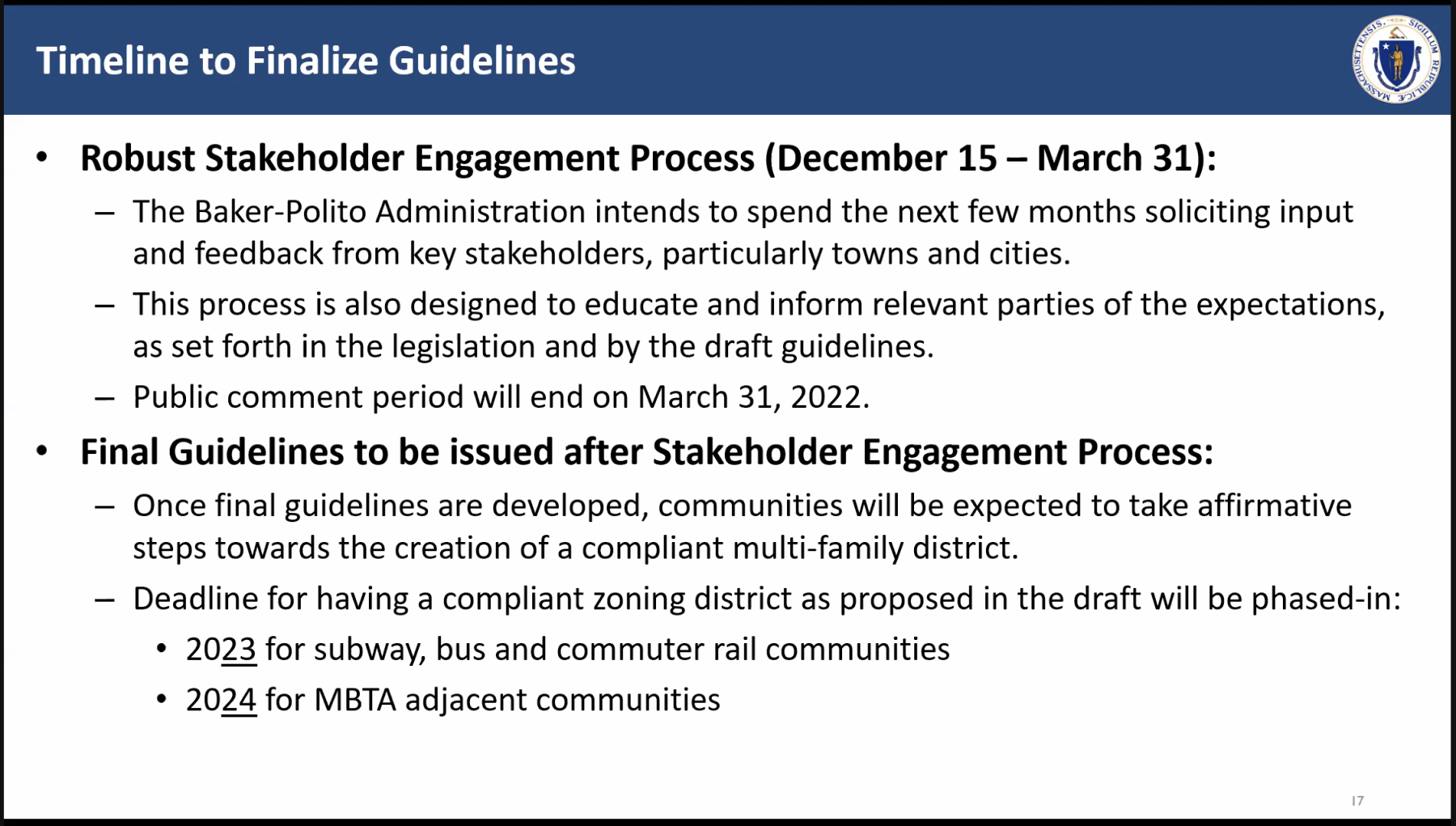
To be eligible for this year’s round of grants, towns must submit an online form by May 2. The public comment period for the draft guidelines closes on March 31. Once the final guidelines are established, MBTA communities must establish a compliant zoning district by 2023 or become ineligible for grants from the Housing Choice Initiative, the Local Capital Projects Fund, or the MassWorks infrastructure program.

The 750-unit mandate for Lincoln is “infeasible” and “jaw-dropping,” Planning Board Chair Margaret Olson said last week. After the webinar, she commented, “The most interesting part of that webinar is that the emphasis is on the zoning, not on what is feasible nor on housing production. That has some interesting implications that we will have to think about.”

Here are some of the slides from the January 2 webinar hosted by the Executive Office of Housing and Economic Development (click on a slide to see larger versions and forward/back buttons):

MBTAcomms1 MBTAcomms2 MBTAcomms3 MBTAcomms4 MBTAcomms5 MBTAcomms6 MBTAcomms7 MBTAcomms8 MBTAcomms9 MBTAcomms10 MBTAcomms11 MBTAcomms12 MBTAcomms13 MBTAcomms14

Category: land use, South Lincoln/HCA* 4 Comments

New rules ask town to permit 750 housing units in South Lincoln

January 9, 2022

(Editor’s note: when this story was originally published, the accompanying map misidentified the amount of land that would be subject to multifamily zoning under the new state rules. The map has been updated.)

To comply with new state housing guidelines, Lincoln would have to allow 750 units in South Lincoln or become ineligible for various state grants.

Because it has a commuter rail station, Lincoln is designated as an “MBTA community” and is therefore required to amend its zoning to allow multifamily housing with half a mile of the station or face loss of eligibility for some state grants. The rules call for a minimum of 15 units per acre suitable for families and children and with no age restrictions. This translates to 750 units for Lincoln.

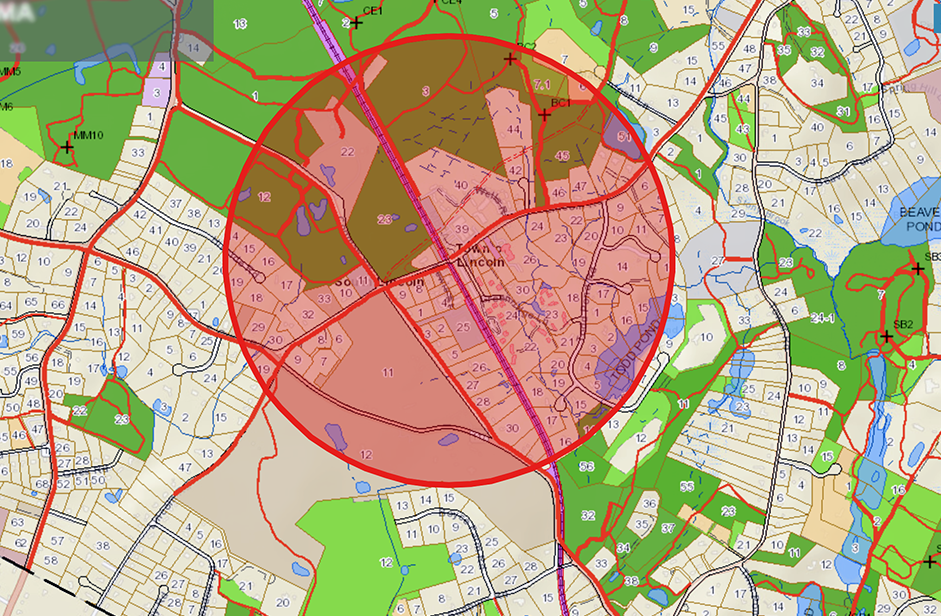
The red circle shows land within a half-mile radius of the Lincoln commuter rail station. Wetlands and buffers are indicated in shades of blue, conservation land is in green, and the beige area in the southwest quadrant is the Mass Audubon Society. The town would have to allow 750 units of multifamily housing within that area to comply with the Housing Choice Act. NOTE: this map was incorrect when initially published and was updated on Jan. 19, 2022. (Map courtesy Margaret Olson)

The initiative was announced in early 2021 but the initial outline of the law left many unanswered questions.

“We verified this [750-unit requirement] jaw-dropper with the state,” Planning Board Chair Margaret Olson, who made an illustration of “just how infeasible this is.” At least half of the acreage within that zone is wetlands, wetlands buffer, or conservation land, she noted.

It’s unclear how the existing multifamily units in South Lincoln would be counted as part of Lincoln’s requirement. Condos and apartments with half a mile of the station include 125 units in Lincoln Woods and a total of 65 units in three developments on Ridge Road and Greenridge Lane.

There will be a webinar hosted by the state Executive Office of Housing and Economic Development to explain the requirements outlined in a 2021 bill on Wednesday, Jan. 12 at 1 p.m. Click here to register. 

If Lincoln does not comply by changing its zoning, it would no longer be eligible for grants from the Housing Choice Initiative, the Local Capital Projects Fund, or the MassWorks infrastructure program. It’s unclear how much money Lincoln has received from these funds in the past.

Category: government, land use, South Lincoln/HCA* 8 Comments

Property sales in October 2021

December 2, 2021

52 Todd Pond Rd. — Juliet M. Rago McNamara Trust to Andriy and Inna Kochura for $525,000 (October 29)

192 Weston Rd. — Bojan Rip to Michael Olsen for $1,200,000 (October 29)

8 Huntley Lane — Thomas A. Cappucci to Yukiko Bloomenthal Trust and 8 Huntley Lane Nominee Trust for $1,340,000 (October 29)

21A South Commons — Jeffrey Arena to Nicholas Bliamptis for $505,000 (October 25)

14 Stratford Way — Gustav Beerel to Brian Hoertdoerfer and Emily Marcus-Hoertdoerfer for $2,210,000 (October 6)

49 Round Hill Rd. — Christopher Awtrey to [redacted, 2025] for $2,000,000 (October 4)

11 Stratford Way — Walter McCarty to Jacob Housman and Catherine Buzney for $2,300,00 (October 4)

22 Deerhaven Rd. — Diane Marangoly to Ramesh Natarajan and Aruna Ramesh for $1,390,000 (October 1)

Category: land use Leave a Comment

Town gets $400,000 for South Lincoln septic plant design work

November 16, 2021

The town has received a $400,000 state grant to design and engineer an upgrade to the wastewater treatment plant in South Lincoln, which owners of the mall have been advocating as a requirement for redeveloping that commercial area.

Lincoln Planning officials have been considering ways to rezone South Lincoln to encourage denser housing and mixed-use development in the larger area encompassing the mall, the MBTA station and adjacent businesses, Ridge Road, Doherty’s Garage, and Lewis Street. Among the ideas is redeveloping the mall (which is in tenuous condition financially) by adding a second story for housing. But the Rural Land Foundation, which owns the mall, has said that the wastewater treatment plant that serves both the mall and Lincoln Woods will need an upgrade for any redevelopment to be feasible. 

As a result, the town applied for a $400,000 grant even as it awaited the results of an engineering study by Wright-Pierce to evaluate the condition of the plant and see if it could handle additional septic capacity. Phase 1 of the study was completed in October and showed that the 35-year-old plant, though “a little long in the tooth” and needing some work, is operating at about 50% of its 26,000 gallon-per-day capacity and could handle some additional residents and businesses.

The town applied for the grant before knowing any of the study’s results because “you always have to plan the next step and the next step” in advance, said Paula Vaughn-MacKenzie, director of planning and land use.

“As that [study] was going on, we knew that if we could get a grant to cover [upgrading the treatment plant], that would benefit both the town and Community Builders,” which owns the 125-unit Lincoln Woods and the plant, Vaughn-MacKenzie said. “Everybody knew it was working but everyone also knew it was old… this entire evaluation is in response to the feedback we’ve been getting from the public asking about the infrastructure, and we know we can’t have redevelopment without the infrastructure” to support it.

The mall originally had a separate wastewater treatment facility that failed, and the RLF has been contracting with Community Builders to use the Lincoln Woods system for some years.

Wright-Pierce said earlier that Phase 2 of the study, which should be complete by the end of the year, will look at whether the existing plant can handle flow above 26,000 gallons per day for which it’s permitted, alternative treatment methods with a life-cycle cost analysis, and a recommendation on how to proceed, both with flows and treatment type. It’s unclear if that remaining work will be affected by news of the grant.

The grant money isn’t targeted at a specific project, “but it will provide a framework for going forward,” Vaughn-MacKenzie said. After Phase 2 is complete, “we’ll look at options and discuss with the community and Community Builders what the capacity and various costs will be” to upgrade the plant.

Vaughn-MacKenzie said she had asked Wright-Pierce and two other engineering firms for a ballpark estimate for upgrading or replacing the plant and was told it would be around $400,000, so that’s the figure she used in the grant request.

The town had been under a public announcement embargo while a formal announcement ceremony was being organized. Mike Kennealy, Secretary of Housing and Economic Development, will appear at the event at Town Hall on Wednesday, Nov. 17 at 3:30 p.m. 

Category: land use, news, South Lincoln/HCA* Leave a Comment

SOTT #2: South Lincoln, climate action, and diversity and inclusion

November 4, 2021

Planning officials will keep working on revising the zoning bylaw to encourage business and mixed-use development in South Lincoln, in keeping with the town’s comprehensive plan and vision statement as well as pressure from the state to allow denser development near MBTA stops.

Planning Board Margaret Olson summarized the past and current work in this area at the second State of the Town meeting on November 2. The meeting also featured discussions surrounding two new organizations, the Climate Action Planning Committee and the Inclusion, Diversity, Equity and Antiracism Initiative (see below).

About four years ago, the board created the South Lincoln Planning Advisory Committee (SLPAC) to map out easy to “create a compact, vital, walkable village center in the Lincoln Station area that provides more housing choices near public transportation, goods and services for residents and opportunities for social interaction” as per Lincoln’s 2009 Comprehensive Plan. In May 2018, SLPAC unveiled proposed zoning changes that met with strong opposition from residents worried about changing the town’s character and shifting too much power for approving development projects from Town Meeting to the Planning Board.

More recently, the reorganized SLPAC published a town-wide survey on South Lincoln. The results revealed, among other things, that a large majority of respondents want to retain a village center with commercial businesses and support the economic viability of those businesses. 

“We believe we need to do something down by South Lincoln in order to achieve this,” Olson said. “The commercial viability [in that area] is marginal.”

Olson explained that the board is not aiming to increase the amount of space devoted to commercial uses. “What we’re really talking about is, if the mall is redeveloped, allowing housing on a second story and permitting mixed-use” developments, she said. “We’re not going to attempt to build some sort of giant mall — we want to promote a sense of place and community.”

Olson summarized the hodgepodge of zoning districts in South Lincoln and the difficulty faced by potential developers in proposing projects that can ultimately win approval — especially when an up-or-down vote is required at Town Meeting where it’s not possible in practice for residents to propose amendments to plans. 

  • See the South Lincoln zoning slides shown at the State of the Town

Another issue is that most businesses are required to secure a time-limited special permit that can’t be later transferred to a new owner. “This is kind of a scary thing — you need a special permit and then it expires and then what do you do? This is a big deterrent,” she said. “We believe a new zoning bylaw will get us better projects.”

Even if the town relaxes some limitations in the bylaw, “there’s nothing that prevents us from being extremely specific about what we do and do not want” in terms of a building’s overall appearance, materials used, etc., as well as requiring traffic and fiscal studies, green buildings, community spaces, and/or affordable housing, she said. “It provides parameters for developers… they know what they need to do and we know what we’re going to get.” 

Another source of pressure for change is the Housing Choice and MBTA Community legislation passed by the state legislature earlier this year. Though it’s not yet being enforced, the legislation requires a multifamily housing zone near MBTA stops such as Lincoln’s commuter rail station. If a town doesn’t comply by allowing such development, it stands to lose what could be a considerable amount of money in state grants.

“The town really does have a decision to make about how much we care… We don’t actually have to do this,” Olson said. It’s also unclear what exactly will satisfy the state requirements. “It says the district has to be of ‘reasonable size’ but we don’t know what that means,” she added.

In a Q&A session, several residents reiterated their criticism of the survey, but Olson was clear that “we do not intend to redo the survey. We understand what people’s frustrations were and it was very helpful to hear those viewpoints,” but the survey “is just one small piece of information among many.”

Sara Mattes argued against the proposed changes. “It’s not clear what problem we’re really trying to solve,” she said. If the mall’s financial struggles are the primary concern, “the driver is for us to sit down with RLF and Community Builders [owners of Lincoln Woods and the South Lincoln wastewater treatment plant] and work on a solution directly.” She also noted that there are numerous apartment and condominium complexes in town where downsizing residents can move.

But Sasha Golden, a resident of Farrar Pond Village, pushed back, noting that vacancies occur only when a unit’s owner dies. “To make a sweeping assumption that we have all these different sites is really missing the actual day-to-day issue of vacancy and affordability.”

“I disagree with Sara. I would love to see market forces deciding what housing and development should come to Lincoln for once,” said Jim Hutchinson, describing himself as an “unrepentant capitalist.” Saying that the economic environment in South Lincoln is “not good,” he decried those who “don’t want any change without 15 committees to approve it first… I think it’s good for some experimentation to be allowed in this town. 

Terry Perlmutter, a realtor, argued that the town needs more affordable housing. Developments such as those mentioned by Mattes may be perceived as affordable, “but affordable to whom? They are just the ‘more affordable’ housing in an expensive community.”

Climate Action Planning Committee

A new town group urged residents to follow the example of many neighboring towns and fund a sustainability manager position while also developing a climate action plan

The Climate Action Planning Committee (CAPC, a subgroup of the Green Energy Committee) made its pitch at the second State of the Town meeting on November 2.

The Commonwealth recently passed a climate roadmap calling for net zero greenhouse gas emissions by 2050, “and state goals cannot be met unless cities and towns do their part,” CAPC member Sue Klem said. 

A Zoom poll during the State of the Town meeting asked attendees what fuel types they use to heat their home and power their cars (click to enlarge).

A climate action looks at reducing carbon emissions from things like buildings, transportation, electrical generation and land use, she explained. Examples of specific town-wide actions might include energy retrofits on buildings, changes in the building code, electrifying town vehicle fleets and tools, and installing electric vehicle charging stations.

  • See the Climate Action Planning Committee slides shown at the State of the Town

Lincoln, like several other towns in the region, has produced a greenhouse gas emissions report (which will be updated soon) and offered community choice for electricity. Before the Green Energy Choice program began, only 16% of electricity consumed in town was from wind and solar, but that figure is now up to 45%, she noted. However, it has not yet followed the area’s lead in establishing a climate action plan, which will provide “the structure and guidance we will need to address the climate crisis.”

The town should also hire a sustainability manager to help plan and promote green policies, Klem said. The cost for that position could be mostly or entirely offset by grants, she added.

The CAPC is in the process of talking to town boards and committees and will host a public frum in the next few weeks to hear questions and comments in preparation for submitting a warrant article for the ATM this spring.

IDEA Initiative

A group of residents was recruited earlier this year to make recommendations on establishing a new committee that would investigate unconscious bias and actively promote an antiracist community. 

In September, the Select Board formally allowed the IDEA Initiative to pivot from designing a committee and simply become that committee. They plan to research efforts by other towns (some of whom have hired diversity coordinators), partnering with the Welcome, Inclusion, Diversity, Equity group and the schools, and securing funding and hiring a consultant on equity measures “to keep Lincoln’s vision of fostering and supporting diversity at the center,” IDEA member Jen James said. Among the possibilities: a town-wide 21-day group challenge to discuss and reflect on readings, videos, and podcasts.

Among the questions IDEA is wrestling with: “What does racism look like in Lincoln? Where does classism exist? What is Lincoln willing or unwilling to change to become a truly antiracist town? We want to be taking action, not just making recommendations,” she said.

Category: conservation, land use, South Lincoln/HCA* Leave a Comment

Property sales for September 2021

October 31, 2021

15C South Commons — Christine Lundblad to Anne Lovell for $549,000 (September 28)

16 Bypass Road — McLean Hospital Corp. to Scott Rodman for $850,000 (September 2)

23 Bypass Rd. — McLean Hospital Corp. to Yu Liu and Lujia Zou for $2,178,000 ( September 3)

5 Mary’s Way — Mary O’Brien Trust to Cheryl O’Brien and James Durkin for $570,000 (September 1)

12 Acorn Lane — Marcus Lincoln to Christopher Coke and Tania Abedian for $1,285,000 (September 30)

123 Chestnut Circle — William A. Galup Jr. to Robten Realty Corp. for $400,000 (September 8)


Category: land use Leave a Comment

South Lincoln treatment plant has capacity for more development

October 11, 2021

The first phase of an engineering study of the wastewater treatment plant near the mall shows that it’s working well and has additional capacity to handle some commercial or residential development in the area.

The plant in the field about 1,500 feet north of the apartments was built in 1975 to serve the Lincoln Woods apartments and the businesses in the mall. It’s now owned and operated by TCB (The Community Builders), which is paying part of the cost of the Wright-Pierce study. The town needs to know the status of the plant to make informed decisions about rezoning South Lincoln to allow for more types of development.

The plant is “a little long in the tooth” and the building used mainly for records and water testing is in bad shape and needs to be replaced soon, said Kevin Olson, senior project manager at Wright-Pierce, as he presented Phase 1 of the study to the Planning Board meeting on October 5. However, after visiting the plant and looking at maintenance records, the plant is “performing well and is not overloaded,” said his Wright-Pierce colleague Adam Higgins.

The plant’s state permit allows it to handle up to 26,000 gallons per day of wastewater, though its average annual flow is less than half that. “There’s still available treatment capacity and flow capacity,” Higgins said.

Assuming the plant is maintained but not substantially upgraded or replaced, it will cost about $311,000 for work that should be done within the next five years and another $121,000 (in 2021 dollars) for work done in five to 15 years, according to the study.

Phase 2 of the study will look at whether the plant can handle flow above 26,000 gallons per day (gpd) for which it’s permitted, alternative treatment methods with a life-cycle cost analysis, and a recommendation on how to proceed, both with flows and treatment type.

“The increase in flow will likely be cut off at 40,000 gpd, but we’re waiting for input from the Planning Board and SLPAC [the board’s South Lincoln Planning and Advisory Committee] if more is desired based on wanting additional commercial/residential development,” Higgins said in an email. 

The Phase 2 report is due in early December, with a report to the Planning Board expected shortly before Christmas.

Neither the board nor SLPAC has voted on how the cost will be divided between the town and TCB if plant upgrades are desired, “but my expectation is that whoever does the development will pay for any required treatment plant work or expansion,” board Chair Margaret Olson said. “That being said, the town does need to know what can be done and what it would cost before investing large amounts of staff and volunteer time into proposing changes that would require wastewater treatment.”

Category: government, land use, South Lincoln/HCA* Leave a Comment

Residents slam South Lincoln survey at forum

September 30, 2021

Current zoning in South Lincoln (left) and the changes that were proposed in 2020 (click image for larger version).

Residents at a September 28 public forum to discuss the results of a survey on the future of South Lincoln criticized the study as being biased toward development and asked for another survey done by an objective professional.

The survey was open from May 14 to June 30, and data and comments from the 790 responses were released in August. Results indicated that residents have mixed feelings about South Lincoln. There was no consensus on whether the village center should change, and respondents wanted both a viable commercial center and perhaps some moderately priced housing but also wanted to maintain the town’s rural character.

“People want more benefits but not the things that could lead to those benefits,” observed resident Jen Morris.

“Welcome to our world,” quipped Planning Board Chair Margaret Olson.

Potential drivers for change include a new state law that will require areas near MBTA train stations to allow denser housing, though the specific details and any penalties for noncompliance are still unclear. The state aims to encourage more housing construction along with public transportation use, but since most of the daily commuting by train to Boston ended due to the pandemic, the viability of South Lincoln as a commuter point is also unclear, with or without new housing nearby.

Another factor: although Lincoln is generally wary of growing its population, enrollment at the Lincoln School has been declining over the past several years. “We have plenty of capacity in the Lincoln School to accept many additional students and would welcome more students,” Superintendent of School Becky McFall wrote in an email to Olson, who shared it at the forum attended by more than 50 residents via Zoom.

McFall is expected to send a more detailed memo regarding school enrollment in October.

In the survey, 46% of respondents said they supported more affordable or moderately priced housing in South Lincoln, but one-third either did not support it at all, or supported it in a location other than the South Lincoln village center.

“I support activity such as a playground, dog park and community gathering/meeting point, etc., [but] as I have said many times, there is a lot we could do to have a viable town center without adding new rental units,” Planning Board member Lynn DeLisi wrote in the chat area of the Zoom forum.

Also affecting possible development in South Lincoln is the limited capacity of the septic system that currently serves the mall and Lincoln Woods. A study is currently underway by engineers who will make a preliminary report at the Planning Board’s October 5 meeting. And even if the mall were to be redeveloped, there isn’t agreement about what sort of businesses can achieve long-term success there, given the proliferation of online shopping and nearby stores such as Market Basket and Costco, forum attendees noted.

Both the mixed-use zoning that was proposed in early 2020 by the Planning Board and the notion of “if you build it they will come” are “flawed models,” said Richard Ohlsten, adding that many storefronts in the Wayland Center development are still vacant years after completion. “I’m not opposed to development but let’s just do something smart and unique. If we get this wrong, there’s no going back.”

Many brick-and-mortar stores in Lincoln and elsewhere are struggling, “and I don’t know that we can build our way out of it,” resident Sara Mattes said. She suggested looking into subsidizing the types of  businesses that Lincoln wants, or even using Community Preservation Act funds to buy smaller houses and “put into permanent affordability… it’s the kind of crazy forward thinking that Lincoln used to do with land acquisition and preservation,” she said.

Many residents at the forum said the survey questions were skewed and urged the Planning Board to commission another survey, this time using an outside firm. “The survey wasn’t designed to hear from those of us who are opposed to development,” said Barbara Peskin.

Mattes suggested framing questions in terms of what tradeoffs people are willing to make to achieve certain objectives. “The information generated in the survey has been questioned, and to use it to guide or direct any potential change, some of us feel, is not appropriate,” she said.

Category: land use, South Lincoln/HCA* Leave a Comment

  • « Go to Previous Page
  • Page 1
  • Interim pages omitted …
  • Page 11
  • Page 12
  • Page 13
  • Page 14
  • Page 15
  • Interim pages omitted …
  • Page 38
  • Go to Next Page »

Primary Sidebar

Recent Posts

  • Five graduate after 13 years together as Girl Scouts June 25, 2026
  • Legal notice: Historical Commission (58 Codman) June 25, 2026
  • Legal notice: ZBA (July 9, 2026 hearing) June 25, 2026
  • News acorns June 23, 2026
  • Police log for June 8–21, 2026 June 23, 2026

Squirrel Archives

Categories

Secondary Sidebar

Search the Squirrel:

Advanced search

Privacy policy

© Copyright 2026 The Lincoln Squirrel · All Rights Reserved.