• Skip to primary navigation
  • Skip to main content
  • Skip to primary sidebar
  • Skip to secondary sidebar

The Lincoln Squirrel – News, features and photos from Lincoln, Mass.

  • Home
  • About/Contact
  • Advertise
  • Legal Notices
    • Submitting legal notices
  • Lincoln Resources
    • Coming Up in Lincoln
    • Municipal Calendar
    • Lincoln Links
  • Merchandise
  • Subscription Info
    • My Account
    • Log In
    • Log Out
  • Lincoln Review
    • About the Lincoln Review
    • Previous Issues
    • Submit Your Work
    • Subscribe/Donate

land use

ConCom approves new rules for town’s conservation trails

July 18, 2022

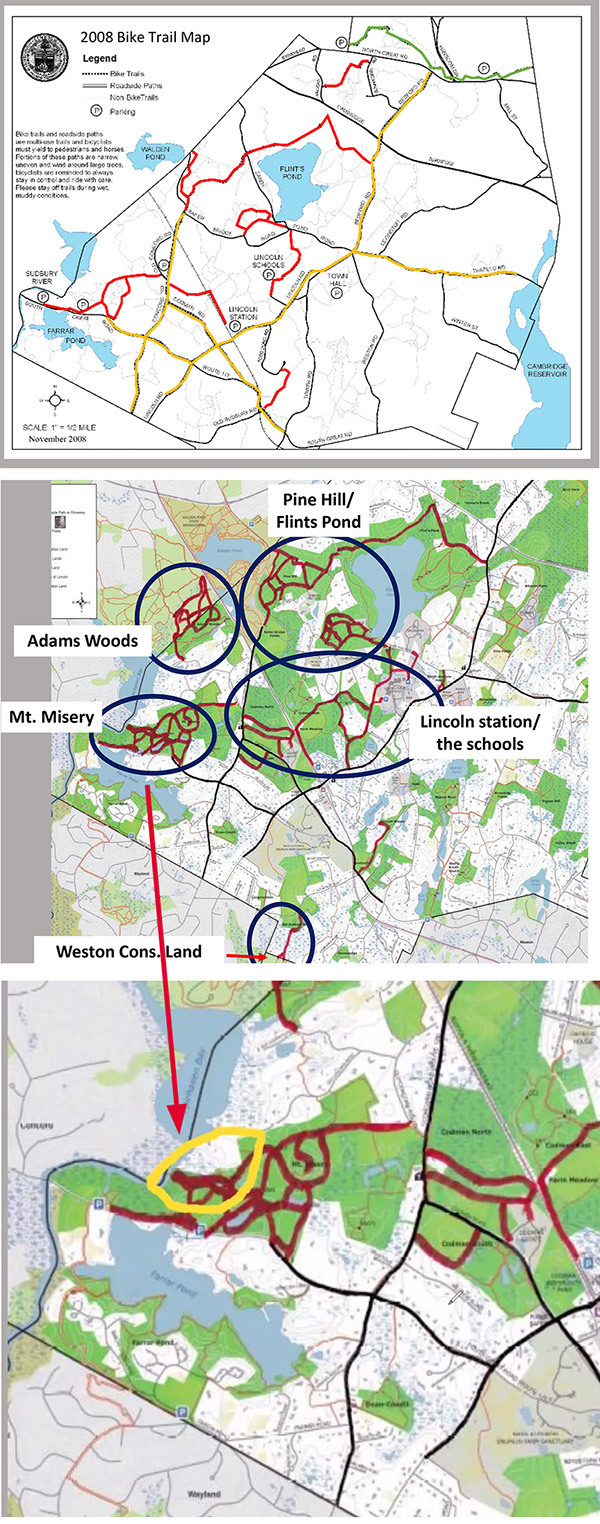
Maps showing the trails currently open to bikes, the proposed expansion, and the compromise presented on June 1 (the area outlined in yellow would not be open to bikes). Click to enlarge.

After months of debate and hundreds of comments and opinions shared by residents, the Conservation Commission unanimously approved new trail use regulations last week, meaning more trails — about 24% of the total or roughly double what’s currently allowed — will be open to bikes.

The new set of regulations (available in both abbreviated and detailed formats) are almost identical to the amended set proposed by the ConCom in June. The only differences: 

  • Some trails that are actually in Concord (though on land managed by Lincoln) will stay closed to bikes until Concord officials approve.
  • When approaching other trail users, dog owners must leash their dog or hold it by the collar, vs. the last iteration which required only “voice control” of the dog

(The rules linked to above do not reflect these two updates.)

Another new requirement that was the topic of much discussion is that dogs must be leashed on the entirety of Flint’s Pond conservation area to protect the town’s water supply. In addition, groups of five or more bikers must get a permit in advance to bike the trails together.

After getting public pushback in the spring, the commission cut back on the number of trails on Mt. Misery that it had proposed opening to bikes, but the approved regulations still opens substantially more trails in the popular conservation area than were permitted before. This change has been the subject of voluminous and heartfelt debate in LincolnTalk emails and several ConCom public hearings each attended by dozens of residents on Zoom.

“There are very strong opinions, pro and con” about bikes, horses and dogs on Lincoln’s trails,” and “I know we’re not going to make all of your happy tonight,” ConCom chair Susan Hall Mygatt said at the start of the July 13 meeting where the panel finally approved the changes. The approval was made final when the Lincoln Land Conservation Trust’s gave its parallel OK on July 15.

Conservation Department staff will make quarterly assessments of trail conditions and gather user feedback over the next year and report to the ConCom, which can make further changes at any time.

“If we see something dramatic happen, we’re not going to wait a year” to seek more adjustments to the rules, Conservation Director Michelle Grzenda said. Staff work year-round to monitor and maintain the trails, and they can close tails with signs and yellow caution tape when necessary, she noted.

Temporarily withheld from the array of trails newly open to bikes are those in the Adams Woods area straddling the Lincoln/Concord town line just west of the railroad tracks. An 87-acre parcel was transferred in the 1980s from Lincoln to Concord as conservation land, but Lincoln retained sole land management responsibility. Nonetheless, Concord conservation officials want a chance to weigh in.

Several residents who’ve been involved in offering feedback to the ConCom were not pleased with the outcome last week. 

“By opening up half the trails at Mt. Misery to biking officially, I think you’re going to get groups of people on bikes without a permit,” Barbara Peskin said. “The [parking] lot is already maxed out… I just think this is such a wrong thing to do, especially at Mt. Misery.” 

“I think you’re pushing boundaries. The strength and number of pushback [comments] you’re getting on this should be a signal to all of us that the town needs a lot more conversation about this issue of changing policies, and it needs to take place in a variety of arenas,” said Diana Beaudoin. Among her suggestions: studying policies in neighboring towns and allowing the Bicycle and Pedestrian Advisory committee to “broaden its work” on road safety before changing trail regulations.

Conservation Department staff will put up new signs over the summer, and town rangers will also be on hand to explain and enforce the rules. The department recently hired full-time Land Steward/Ranger William Leona, who will work some weekend hours, and he and Land Manager Ryan Brown will install the signs and help trail visitors understand trail expectations and rules.

“Although William and Ryan will be monitoring all of Lincoln’s conservation lands, specific emphasis and greater ranger presence will be focused on Flint’s Pond and Mt. Misery,” Grzenda said. In addition, the LLCT has funded a part-time seasonal ranger for the first time.

“I am excited that we are now going to be able to articulate our expectations of how we can enjoy these trails together,” Mygatt said after the vote. “And I am confident that we will be very satisfied by how this works out — not perfectly satisfied, but very satisfied.”

Category: conservation, land use Leave a Comment

Property sales in May 2022

July 18, 2022

8 Reiling Pond Rd. — Ruben J. Azocar to Gautam and Kanupriya Goel for $1,625,000 (May 26)

64 Baker Bridge Rd.— Meghan Lytton to Ehren and Angel Nogueira for $1,850,000 (May 4)

25 Huckleberry Hill — Daniel Doyle to Jessica  Ching Ko and Aaron Q. Beck for $3,150,000 (May 5)

231 Aspen Circle — Harold S. Smith Trust to Margaret McNair and Nicholas Bridges for $785,000 (May 6)

12 Browning Lane — John B. French Trust to Deena Berton and Stephen Odio for $1,788,000 (May 10)

69 Todd Pond Rd. — Margaret M. Stathos Trust to Stephanie Stathos and Stephen Smith for $1,250,000 (May 12)

8D North Commons — Mary Ellen Barbiasz to Anthony and Susan Soldi for $490,000 (May 19)

18 Juniper Ridge Rd. — David J. Cancian Trust to Benjamin and Aminah Herzig for $1,630,000 (May 20)

0 Twin Pond Pane — Susan Allen to City of Cambridge for $200,000 (May 25)

136 Chestnut Circle — Nancy McDonald to H. Arlene Morgan for $582,000 (May 31)


Category: land use Leave a Comment

Property sales in April 2022

May 19, 2022

31 Old Concord Rd. — James Dwyer to 31 Old Concord Rd. LLC for $675,000 (April 15).

16 Todd Pond Rd. — Gabriela Traynor to the Jeannie T. Lee Trust and the 16 Todd Pond Road Realty Trust for $2,875,000 (April 22).

Category: land use Leave a Comment

Property sales in March 2022

April 18, 2022

144 Lincoln Rd. — Lincoln Rd. Realty LLC to L.A.M.B. Trust for $735,000 (March 1)

82 Virginia Rd. #203 — Rose Ishii to the Herbert Haltiwanger Trust and K. Fischer Trust for $435,000 (March 8)

247 Old Concord Rd. — Wallace Boquist to James and Anne Hutchinson for $1,000,000 (March 14)

41 South Great Rd. — James LaPlante to 41 South Great Road Trust for $2,850,000 (March 17)

22 Silver Hill Rd. — Cothbo Limited Partnership to David Winston for $600,000 (March 24)

140 Lincoln Rd. — Ryan Estate #11 LLC  for Catherine Dyl for $475,000 (March 31)

123 Chestnut Circle #3 — Robten Realty to Pamela Banks for $880,000 (March 31)

Category: land use Leave a Comment

Property sales in February 2022

April 5, 2022

21B South Commons — Alison Siemiatkaska to Jared Laliberte for $244,720 (February 9)

82 Virgina Rd. #406 — Janet A. Branch Trust to John and Elizabeth Maciolek for $196,500 (February 1)

Mary’s Way — Civico Oriole Lincoln LLC to ND Lincoln LLC for $32,375,000 (February 1)

Category: land use Leave a Comment

Property sales in January 2022

March 20, 2022

1 Harvest Circle — BSL/BN Groves CCRC LLC of Lincoln to NELP-Commons LLC of Topsfield for $70,852,153 (January 6)

14 Todd Pond Rd. — Rodger Weismann Jr. to Eric and Sarah Ward for $3,215,000 (January 6)

146B Lincoln Rd. — Stephen Smith to Janet and Meagan Maloney for $515,000 (January 10)

263 Lincoln Rd. — Gail J. Matot Trust to Fan Ye and Xueyuan Wu for $1,500,000 (January 11)

19 Oak Meadow Rd. — Robert Valleau to Arjun and Anupam Mathur for $1,520,000 (January 19)

8 Boyce Farm Rd. — Anson James to Seth and Tracy Grandeau for $1,180,000 (January 26)

6 Short Hill Rd. — Mildred Cooper to Burton Hanley for $995,000 (January 28)


Category: land use Leave a Comment

Town restarting project to install solar array at landfill

March 10, 2022

The plan to install a solar array atop the old town landfill has lain fallow for a while, but it will “go near the top of our priority list to restart that process” once the Annual Town Meeting is over, said Town Administrator Tim Higgins.

Almost five years ago, voters approved a land swap in conjunction with the Wang property purchase that allowed the town to move several acres of the landfill parcel out of conservation so a solar array could be installed there. The area was deemed the best spot out of 25 potential sites for a municipal solar array that were studied earlier by a consultant hired by the now-defunct Solar PV Working group. Higgins said this week that the site could generate 1 MW of electricity, or enough to power all of the town-owned buildings except the school, which will have its own solar array.

But the project stalled due to factors including the pandemic and the complexity of the process. Minute Man National Historical Park owns the right of way on either side of Route 2A, so the town would need their approval to install power lines from the landfill out to the road. It’s unclear whether who would need to grant that approval — the park superintendent, a regional director or someone at the federal level.

Also yet to be determined is where that line will go (alongside or under the transfer station driveway, or via Mill Street), and whether it will be above ground or underground. If Mill Street is seen as the better option, town officials will discuss the matter with residents there, although Higgins said the line would not have to cross any private property. Any underground work will probably also require an archeological survey, he said. 

Finally, the town will have to identify a solar developer and get estimates for up-front costs for that company and the town. The goal is to “generate income for the community or [have it be] a break-even proposition at least,” Higgins said. He and other officials are working with Beth Greenblatt of Beacon Integrated Solutions, the firm that was involved in creating the power purchase agreement for the school’s solar installation. He estimated that all the planning and permitting could be completed by the end of 2022.

Category: conservation, land use Leave a Comment

My Turn: Article headline was “misleading”

March 6, 2022

To the editor:

Although the body of the article is accurate, the headline of the Lincoln Squirrel article “Town officials marshal arguments against housing rules” (posted March 3, 2022) is somewhat misleading.

It is important to emphasize that Lincoln is not against the Housing Choice Act, nor is it opposing the Department of Housing and Community Development’s (DHCD’s) draft guidelines, which are the focus of this article. The concern is that the DHCD’s proposed rules, as currently written, do not accomplish their intent of providing support and usable guidance on conforming to the Housing Choice Act for smaller towns (like Lincoln). They would have the opposite effect.

Lincoln has a long history of being proactive and diligent in the development and support of affordable housing and still is, as the ongoing support and leadership in this regard from the Planning Board, Board of Selects, SLPAC, COA&HS, Housing Commission, Housing Trust, and many other town bodies and departments demonstrate.

The goal of the town’s response is to encourage the state (and DHCD) to work with Lincoln and other smaller towns to craft a more effective, and comprehensive, approach in support of the Housing Choice Act. We must avoid creating a set of rules that will discourage smaller towns from participating in the effort to address our state’s severe shortage of affordable housing with viable public transit options.

Sincerely,

Allen Vander Meulen
Chair, Lincoln Housing Commission


“My Turn” is a forum for readers to offer their letters to the editor or views on any subject of interest to other Lincolnites. Submissions must be signed with the writer’s name and street address and sent via email to lincolnsquirrelnews@gmail.com. Items will be edited for punctuation, spelling, style, etc., and will be published at the discretion of the editor. Submissions containing personal attacks, errors of fact, or other inappropriate material will not be published.

Category: land use, My Turn Leave a Comment

Town officials marshal arguments against housing rules

March 3, 2022

In a response to the state’s new multifamily housing guidelines now being drafted, town officials will argue that the requirements are draconian and impracticable for Lincoln.

Lincoln was one of 42 Massachusetts towns designated by the ​​Housing Choice Act (HCA) as “MBTA communities” that will be required to allow 750 units of multifamily housing within half a mile of an MBTA stop (15 units per acre over 50 acres). Towns have until March 31 to give feedback to the state Department of Housing and Community Development. Those that don’t eventually comply risk losing millions in state grants.

Planning Board and SLPAC members met with the Select Board on February 28 to outline their objections to some of the law’s provisions. The most clear-cut issue is that Lincoln was designated as a “bus” rather than a “commuter rail” town. This wouldn’t change the number of multifamily units required, but towns that fall into the commuter rail category have one more year to implement zoning changes, with a deadline of December 31, 2024 rather than 2023.

The housing density required by the HCA would also have a huge impact. Adding 750 units would increase the town’s total number of housing units (excluding those on Hanscom Air Force Base) by 30%, which is “extremely burdensome” for Lincoln and other small towns when considering the effect on schools, public safety, water usage, and infrastructure, said Paula Vaughn-MacKenzie, Director of Planning and Land Use.

Officials from Lincoln and other towns would like to see more flexibility in the zoning requirements. They suggested that the state let Lincoln split the multifamily zones between two areas (those in proximity to the commuter rail station and the MBTA bus stop near Hanscom Field, for example), or rezone a larger piece of land at a lower density, such as 93 acres with eight units per acre. Basing the number of required units on a percentage rather than units per acre would make more sense, they said.

“No one wants to see a 10-story building in Lincoln center. It’s not a project that would fit within the aesthetics and methods of our town, and we are not alone in that belief,” Vaughn-MacKenzie said.

Meanwhile, the train station itself is not ADA-accessible and does not have a platform, shelters or seating, and the schedule and ticket prices do not encourage commuter use. “We have been asking for upgrades for years,” she said. “If you want all of these towns to build more housing near commuter rail stops, then you have to make the MBTA schedule and fares better serve the users.”

Another problem for Lincoln is that much of the land within the half-mile radius of the commuter rail stop is wetlands or land belonging to the Codman Estate and Mass Audubon, while most of the rest is already zoned for some level of commercial and multifamily housing.

The response letter will be signed by the chairs of the Select Board, the Planning Board, SLPAC and the Housing Commission. Many other towns feel the same way as Lincoln does about the new rules and may collaborate in responding to the DCHD. “I think there will be broad statewide support for advocating something different,” Town Manager Tim Higgins said.

Category: land use, news, South Lincoln/HCA* 1 Comment

Questions and pushback aired on multifamily housing guidelines

February 2, 2022

One thing is clear after a pair of informational sessions this week: by order of the state, some type of multifamily housing will be permitted by right in South Lincoln some day. Still to be determined is how dense that housing might be — and what will happen if it fails to comply with the new state rules.

The Housing Choice Act will “have a significant impact on the town, whether we choose to comply or not,” Planning Board Chair Margaret Olson said at a joint meeting with the Select Board on January 31. 

The Housing Choice Act asks that Lincoln and other designated MBTA communities amend their zoning to allow 750 units of multifamily units within half a mile of an MBTA stop or lose eligibility for three categories of state grants. Lincoln has not received grants from any of those programs (though other area towns have received millions from one of them in recent years), but a state official on Wednesday indicated that noncomplying towns would have lower priority for other state grants as well.

“All [state grant programs] are discretionary and oversubscribed,” said Mike Kennealy, Secretary of Housing and Economic Development, during a February 1 Zoom session with dozens of officials and residents from eastern Massachusetts towns. “We may want to fund more for communities that are trying to get housing done. There’s a lot of discretion about what gets funded and what doesn’t.”

  • Slides from the January 12 and February 1 state webinars
  • Slides from the January 31 Select Board/Planning Board/SLPAC meeting downloadable from this page 

Kennealy and two other state officials began the hourlong session by recapping their presentation at a January 12 webinar. They explained that the final rules will have more flexibility than the draft guidelines that were issued in early January.

For example, the 50 acres in the multifamily zone needn’t be contiguous, said Chris Kluchman, Deputy Director of the Community Services Division in the state Department of Housing and Community Development (DHCD). There will also be some flexibility for towns that don’t have 50 acres of buildable land within the prescribed radius because of wetlands, obstructing physical features, or issues with water supply or Title V septic regulations, though a future developer could be required to provide wastewater treatment facilities if necessary, she said.

One of the attendees at the February 1 session noted that more than 40 MBTA stations are not currently ADA-compliant and asked how that situation would be rectified for communities that are subject to the Housing Choice Act zoning rules. That event was co-hosted by MAGIC (Minuteman Advisory Group on Interlocal Coordination) and the MetroWest Regional Collaborative.

“We are working closely with the MBTA and MassDOT,” Kluchman said. “I’ll take that as a comment.”

Lincoln attendees raised another issue: the documents issued by the state show Lincoln as a bus community by virtue of having an MBTA bus stop at Hanscom Field. However, Lincoln obviously has an MBTA train station in South Lincoln as well, and the timelines for the two types of communities are different. Bus towns must submit a proposed action plan and timelines for studies by March 31, 2022 and have new zoning rules adopted by Dec. 31, 2023, whereas the deadlines are July 1, 2022 and Dec. 31, 2024 for commuter rail towns.

The state guidelines assign MBTA communities to one of four service categories from highest to lowest: subway or light rail, bus, commuter rail, and “adjacent” (meaning the town has no MBTA service but there’s a stop in a neighboring community within half a mile of the town border).

“If you’re within a half mile of the highest service category, that’s what category you’re in,” said Clark Ziegler, Executive Director of the Massachusetts Housing Partnership, said at the MAGIC/MetroWest session.

“This is where our designation as a bus service community is a problem,” Olson said. With a Planning Department staff of two, “this is actually a very tight deadline for the town to come to an informed conclusion.”

Olson and the state officials reminded everyone that the new guidelines do not require actual housing construction. “It does not force anybody to do anything at all. It simply says that property owners have the right” to build multifamily housing without needing a special permit,” she said. “For actual housing, someone has to sell, someone has to buy, and someone has to build.”

Multifamily housing will take years if not decades to appear in the affected towns. “Zoning is a long-term play; it’s not like flipping a switch,” Kluchman said.

Even so, given the burden that hundreds more residents will eventually place on schools, the town water supply and other services, “it might be cheaper to pay for stuff ourselves” and forego state grants in order to avoid state-mandated housing densities, resident Sara Mattes mused.

“We need to organize with other small towns to speak with a single voice about the inequity of how this legislation is drafted for small towns,” said Gary Taylor, chair of the South Lincoln Planning and Advisory Committee, said at the Select Board/Planning Board meeting.

“As a town, we have to figure out what our strongest message is,” Select Board member Jennifer Glass said. But given the fact that Lincoln has already been exploring how to allow more commercial and residential development in South Lincoln, “it’s also an opportunity for us to really stretch our thinking about what does this mean and how can we do some thoughtful planning. Sometimes the best thinking is when you’re kind of pushed to have to do it.”

When all is said and done, “it might not be 750 [units], but there will be a number that the state expects and a number we should probably expect of ourselves,” said Select Board member J.D. Dwyer.

Officials from MBTA communities are required to submit an online form by May 2 that asks for town information and verifies that the draft guidelines have been presented to their Select Board. Other stakeholders and residents may also offer feedback via this comment form by March 31

Category: land use, news, South Lincoln/HCA* Leave a Comment

  • « Go to Previous Page
  • Page 1
  • Interim pages omitted …
  • Page 10
  • Page 11
  • Page 12
  • Page 13
  • Page 14
  • Interim pages omitted …
  • Page 38
  • Go to Next Page »

Primary Sidebar

Recent Posts

  • Five graduate after 13 years together as Girl Scouts June 25, 2026
  • Legal notice: Historical Commission (58 Codman) June 25, 2026
  • Legal notice: ZBA (July 9, 2026 hearing) June 25, 2026
  • News acorns June 23, 2026
  • Police log for June 8–21, 2026 June 23, 2026

Squirrel Archives

Categories

Secondary Sidebar

Search the Squirrel:

Advanced search

Privacy policy

© Copyright 2026 The Lincoln Squirrel · All Rights Reserved.