 The Planning Board endorsed the proposed Dark Skies zoning amendment by a 3–1 vote on March 24, with board member Gary Taylor casting the only “nay” vote.
The proposal would tighten controls on exterior lighting for new construction and substantially renovated buildings while not affecting current structures… mostly. While all existing lighting is grandfathered, meaning residents with noncomplying lights would not be forced to replace them, one section of the amendment language (section 13.5.2a) stipulates that “installation or replacement of exterior luminaires” (fixtures) must comply with the new bylaw.
This means that while a lightbulb of an existing fixture may be replaced with a new bulb of the same type (as long as it’s not brighter or bluer than before), any new fixture on an existing home must comply with the new rules on shielding, brightness, color temperature, “light trespass” (excessive light shining onto a neighbor’s property) and hours of operation (lights must be turned off at 10:00pm in most cases, or activate only with motion detectors).
This was the sticking point for Taylor “I’ve got serious concerns about this,” he said. “Anyone who replaces a light fixture anywhere in town [and having] to make it Dark Skies compliant raises all sorts of issues.”
Taylor also raise the issue of enforcement. “The building inspector doesn’t even work evenings so how is he going to be able to observe” an alleged violation?” he said. “That leaves it to someone ratting on their neighbor.”
If a homeowner replaces an outside lightbulb, “you’re not even going to know it’s the wrong one unless you go over and unscrew it,” board member Susan Hall Mygatt said, adding that encouraging compliance is more a matter of “neighbors talking to neighbors” than town officials.
Dark Skies Subcommittee Co-chair Sherry Haydock noted that there’s already a process in place: residents can submit a Request for Enforcement form, but “realistically, how many people are going to rat on their neighbor if you replace a light on your doorstep?”
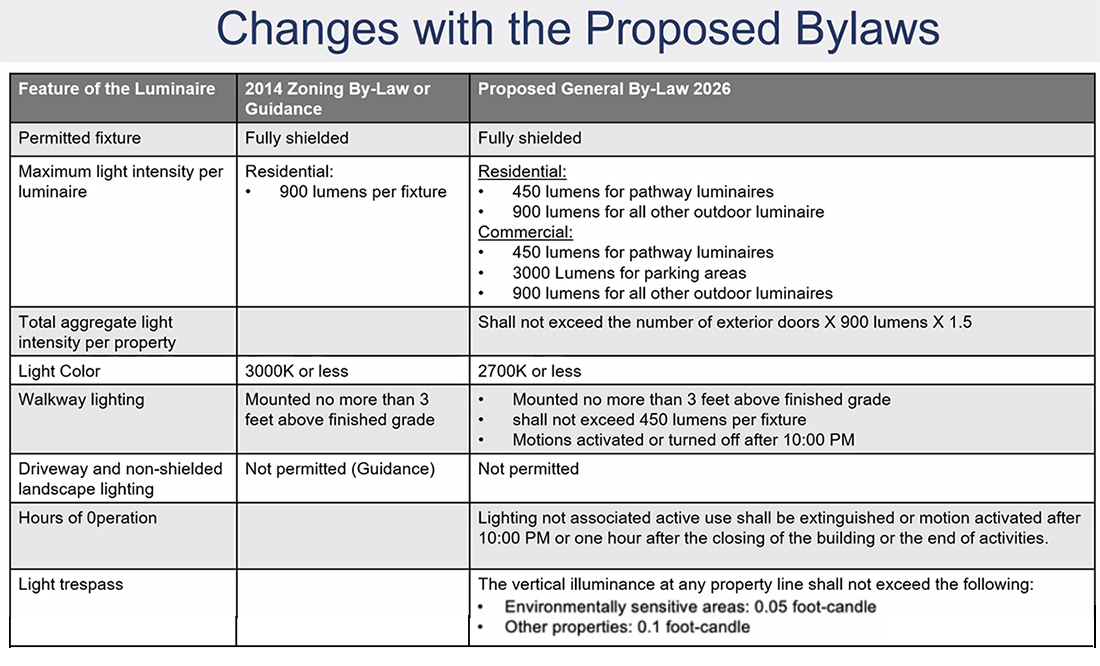
The Dark Skies proposal (click image to enlarge).
The aim is more to educate homeowners while concentrating enforcement efforts with the biggest offenders in terms of night lighting — large public and private buildings such as The Commons in Lincoln and the Department of Public Works, Haydock said. New multifamily housing is now permitted in some parts of town, “and if apartments come in, if we don’t pass this bylaw, they can leave their lights on all night long. As there’s more construction in town, we don’t want to see that.”
Resident Margaret Olson also objected to the proposal on two grounds. Rather than changing the zoning bylaw, the board should instead codify the rules into the site plan review process.
Secondly, sh said, “I don’t like the idea of having two classes of citizens — building vs. behavior. If 10:00 is important, it should apply to everyone… it does not feel right to me and does not feel like what Lincoln should be.”
Olson, the former chair of the Planning Board, lost her seat on the board in last year’s town election but is set to regain it next week because she is running unopposed for the seat of Craig Nicholson, who is not running for reelection.
Earlier this year, the subcommittee considered proposing a change to the town’s general bylaw rather than the zoning bylaw so the rules could be applied to existing buildings as well as new construction. But the Planning and Select Boards discouraged them from that approach, and Haydock admitted that there probably wasn’t enough voter support for such a move right now.
Approving the amendment would be “an opportunity to implement technology that makes the 10:00 [turn-off time] easy to achieve” with motion detectors and timers that won’t require future homeowners to actively turn off the lights each night,” board member Craig Nicholson said. “I don’t see it as a huge behavioral change.”
Over the course of the year, brand-new fixtures are not often installed in town, and Haydock reminded the board that existing noncompliant lightbulbs can be replaced with the same type. “This may apply to three buildings a year; this is not something that’s going to affect a lot of people,” she said.
Mygatt also disagreed with Olson’s site plan review idea since people who have already built their homes probably aren’t even aware of its stipulations. A bylaw change and the resulting efforts to spread the word means people “will be educated in a way they never will be by site plan review.”
At its March 23 meeting, the Select Board decided not to vote on whether to endorse the measure until the Planning Board acted the following night, though they scheduled a quick meeting right before the start of Town Meeting on Saturday to do so. The amendment has been endorsed by the Conservation Commission, Agricultural Commission, Historical Commission, Lincoln Land Conservation Trust, and Save Lincoln Wildlife.
Planning Board member Rob Ahlert as well as Mygatt and Nichlson voted to endorse the measure. Chair Lynn DeLisi was not at the meeting.