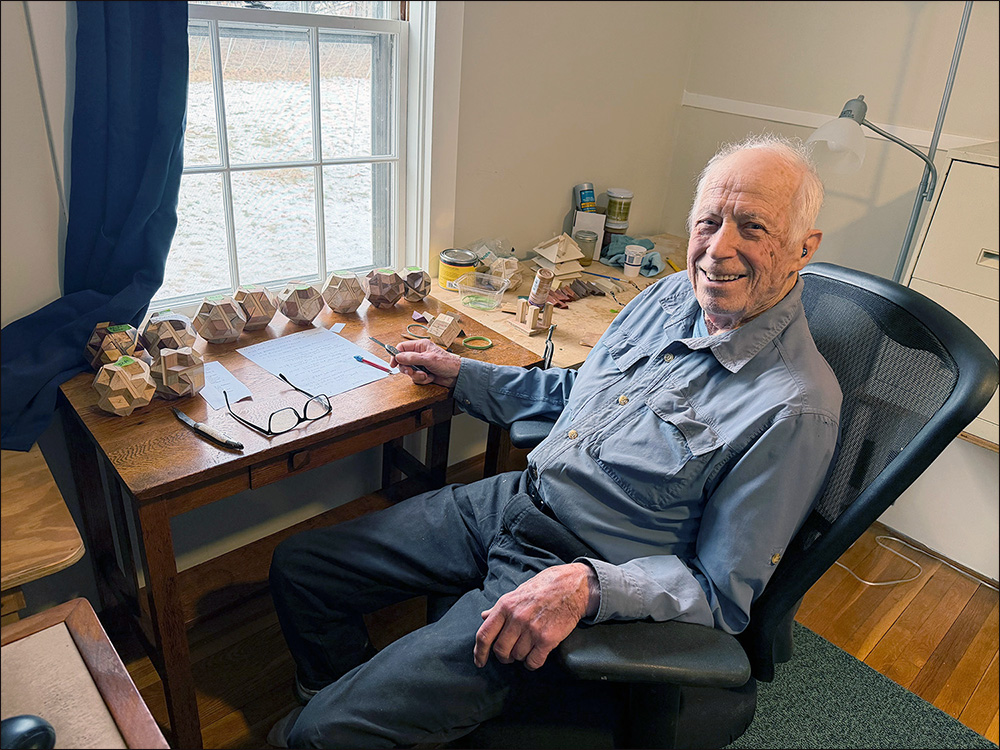
Stewart Coffin at home with some of his 3-D puzzles.
Editor’s note: This article originally appeared in the Spring 2026 issue of the Lincoln Review.
Stewart Coffin is a maker. In his 95 years, he’s become world-famous for the three-dimensional puzzles he designs and builds. In his varied career, he’s also been an electrical engineer, a boat builder, a writer, and even a nursery owner.
Coffin’s creations are legendary in the puzzle world. He’s designed hundreds of interlocking 3-D puzzles including striking polyhedral sculptures, ingenious tray-packing challenges, and pioneering examples of interlocking cube puzzles, according to puzzlehub.org. He’s written several books on the topic as well, including Geometric Puzzle Design and AP-ART: A Compendium of Geometric Puzzles (the start of the title is a nod to “the art that comes apart”). He still makes a few puzzles and sometimes sells them to individuals and at events such as the Lincoln Art & Farmer’s Market in December 2025 (and he’ll be back there on April 3).
Puzzle craft led to another item on Coffin’s resume: public speaker. He’s appeared at numerous puzzle conventions and was on an American Association for the Advancement of Science panel of puzzle experts. “His polyhedral puzzles, they’re beautiful three-dimensional sculptures, basically. To create the structure from these bits and pieces of three-dimensional sticks is creating an object of art. You’re not designing it, but you’re creating this art by putting it together,” Jerry Slocum, founder of the International Puzzle Party, told the Andover Eagle-Tribune in 2007.
Coffin came to puzzle-making after starting out building computers for the defense industry at MIT Lincoln Laboratory in the 1950s but grew disenchanted with that line of work. After he left the corporate world, he began to make a living with hands (and pen) as a woodworker, designer and maker of canoes and paddles, and writer.
He was also a somewhat reluctant businessman in his first Lincoln sojourn, which began in 1964 when he and his wife were looking for a house that could accommodate their young family as well as a workshop. A property on Old Sudbury Road came on the market that included several acres of land and a greenhouse used in the previous owner’s nursery business. They bought the property — but it turned out that the business was in bankruptcy, and some customers who had paid for plants that were never delivered came calling.
“I was trained as an electrical engineer and here I was a nursery man, and I knew nothing about it,” he said. “People said, ‘you can’t let it die; we’ll help you,’ so they helped me and it worked out beautifully.” It also turned out that if they made $500 a year selling plants they could classify their property as a farm, which resulted in a helpful reduction in their property taxes.
Coffin eventually won patents for two of his puzzle designs, including one called Hectix, and he caught the attention of 3M. But the design was so complex that factory workers were unable to assemble them, so the parts were shipped to his Lincoln residence where he, his daughters and neighborhood children all put them together, reportedly making 20,000 puzzles in two weeks.
Lincoln was a good fit for someone who grew up hiking and camping in the Pioneer Valley and always enjoyed the outdoors. He made many friends in town who were fellow members of the Appalachian Mountain Club and was also part of the farming community — he and his wife raised poultry and grew produce that they sold at a stand outside their house, which was close to Boyce Farm, the Van Leer farm, and Ellen Raja’s sheep farm, which is still in operation. “It was fun and it made everybody happy, so I wrote a book about it,” he said
Tipcart Tales is a sequel to a volume about his early life called Tall Trees and Wild Bees: Memories of Childhood That Never Really Ended. He’s also written poetry, fiction, essays, natural history (Good Earth’s Bounty, illustrated with photographs taken by his father, R.L. Coffin, and Black Spruce Journals, about canoe tripping in the Canadian wilderness) — and most recently, Reflections (2025), which he describes as “looking pensively back and critically ahead.” That title and his other books that are out of print are available as free PDFs on his website (stewartcoffin.com).
After his wife died in 1991, Coffin moved around in eastern Massachusetts. His son in law and daughter, Chris Brown and Margie Coffin Brown (a landscape architect for the National Park Service who’s based at Minute Man National Historical Park), bought the house from him after he donated several acres of the property to the town.
Speaking of history, Coffin has another story: his grandfather lied about his age to join the army and fight in the Civil War. Coffin’s father was the youngest of seven children and had Stewart at age 40. “Add it all together and I may be the last person alive whose grandfather was in the Civil War. I would not be a bit surprised,” he said.
As of September 2025, he’s living in a newly renovated part of the house that gained an addition since he first lived there in the 1960s. In 2003, the state took the Pillar House, an 1845 Green Revival building in Newton, by eminent domain and offered it for $1 to anyone who would move it. Coffin’s daughter and son-in-law plunked down the dollar, moved it to Lincoln piece by piece, and attached it to the Old Sudbury Road house.
The greenhouse, which he used as a utility building and chicken coop back in the day, is now his workshop, but it’s unheated, so in the winter he can only use it on sunny afternoons, “and even then it’s tough because the glue that I use does not set when it’s cold,” he said. Fortunately, he has some indoor space to work in with a picture window where he can watch the voracious birds (he has to fill the feeders twice a day, he said). He’s still writing, and his latest book on woodworking is about to be published.
“In recent years, puzzlecraft has just been one of my many pastimes, which have included control of invasive plants and collecting food donations for the needy. But much of my effort now goes into trying to improve my website, stewartcoffin.com, especially the final chapter, Reflections,” Coffin said. “It is my feeble attempt at trying to help solve some of the many puzzles now facing our country and the world.”
Leave a Reply