• Skip to primary navigation
  • Skip to main content
  • Skip to primary sidebar
  • Skip to secondary sidebar

The Lincoln Squirrel – News, features and photos from Lincoln, Mass.

  • Home
  • About/Contact
  • Advertise
  • Legal Notices
    • Submitting legal notices
  • Lincoln Resources
    • Coming Up in Lincoln
    • Municipal Calendar
    • Lincoln Links
  • Merchandise
  • Subscriptions
    • My Account
    • Log In
    • Log Out
  • Lincoln Review
    • About the Lincoln Review
    • Issues
    • Submit your work

land use

Survey shows mixed feelings about boosting development in South Lincoln

August 8, 2021

(Image by upklyak – freepik.com)

Lincoln residents want to keep the post office, restaurants, and some retail offerings in South Lincoln, but they also want to retain the town’s rural character, according to results of a survey released last week.

The Planning Board, which launched the survey in May, will host a discussion of the results on Tuesday, Sept. 28 at 7 p.m. The agenda and Zoom information will be available on the town calendar and the board’s web page prior to the meeting.

For the last two-plus years, the Planning Board has been considering changes to the zoning in the area around the Mall at Lincoln Station and the commuter rail station. The goal is to encourage more diversity in housing in that area as well as commercial activity, services, and amenities in and around the mall.

One of the drivers is a measure passed by the state in 2020 that, among other things, requires towns with a commuter rail station or other public transit (“MBTA communities”) to allow multifamily housing by right within half a mile of the station or lose access to various state grants. The specific implications for Lincoln are unclear because details still being worked out at the state level, but all towns are considered to be in compliance for now.

Among the survey data points:

  • 47% of respondents wanted to see changes in South Lincoln, while 17% did not and 36% weren’t sure.
  • The most important goals for respondents were retaining a village center with commercial businesses (80%) and supporting their economic viability (76%), followed by maintaining the town’s rural character (72%), minimizing environmental impact (70%), and ensuring accessibility for all ages and abilities (68%).
  • The features that garnered the most support were a post office (91%), retail offerings such as a grocery store (88%), and restaurants and entertainment (76%). The only feature that had more opponents than supporters was additional parking (29% to 19%, with 51% neutral).
  • 24% wanted no additional housing in the village center, while 27% preferred 50-100 units and 26% weren’t sure.
  • In a post-pandemic environment, 47% said they planned to use the commuter rail one to five times a year, while 7% said they would take the train three to five times a week and 31% said they never would.
  • The biggest factors influencing the responses were concerns about the environment and an increased focus on climate change and sustainability, followed by the increased cost of housing in the region.

The number of people who filled out the survey isn’t clear, but 91% said they own their own home, and about the same proportion are in their 40s to 70s.

Many respondents included long and thoughtful comments with their responses (the compilation is more than 80 pages long). Those comments skewed heavily toward not wanting additional development and wanting to maintain the town’s rural character. Some accused the survey writers of being pro-development and not recognizing the quality of commercial and pedestrian/bike-friendly amenities already in place. Several also called for a restaurant with a more family-friendly atmosphere and menu.

A sampling of comments:

  • “I am not sure higher-density housing near commuter rail will support persons with modest incomes to live in Lincoln as commuter rail schedules/fees are not aligned with all needs/income levels of workers.”
  • “I don’t shop at Donelan’s: limited variety, low quality, high price. Retail is struggling everywhere as people have shifted to shop on line. Only personal services (P.O., salon, dry cleaner) and fresh items will draw shoppers.”
  • “Need a family-friendly moderately-priced restaurant that serves lunch and dinner and is long term!”
  • “Don’t spend any taxpayer money on changing the town center. Leave it alone. We just spent $93 million on schools.”
  • “I want to discourage further growth in Lincoln. I’m perfectly happy to travel to other towns to keep Lincoln small and rural. If I wanted a town with more development, I would move to one.”
  • “Changing the town, in which homeowners have chosen to buy property based on the rural, undeveloped character, in order to promote the political goals of a few, is problematic.”
  • “It is essential that Lincoln broaden its population by including affordable one- or two-bedroom apartments in a dense and sustainably constructed housing development that is within walking distance of the MBTA and the mall. The DPW should move to the current site of the transfer station.”
  • “Turn the village into community/town use.”
  • “Really am not sure why a small group of development-minded people keep pushing for these changes… as with so much planning in Lincoln, it seems completely ill advised and a project that the next generation will regret for years to come.”
  • “One of my worries is that increased density will require municipal sewer and/or force us to join the MWRA for water. Lincoln’s rural character is maintained in part by the need for sufficient acreage per dwelling so that the land can support the burden we put on it. Municipal sewers would make out current zoning no longer justifiable and could threaten the rural. character of the town.”
  • “If we don’t change something, we will keep losing businesses and the town center will be a shell of itself.”
  • “The Town of Lincoln must develop a larger commercial base for the town. The taxes charged for residential homes are becoming unsustainable.”
  • “I’m strongly in favor of changes to the center to increase housing density and shopping options even if it means more vehicle traffic — and I live on Lincoln Rd.”
  • “It is not clear that residents in any new housing near Lincoln Station would drive less than other residents. It seems reasonable to assume that increased density will come with an increase in cars, especially in a town like Lincoln that simply cannot provide enough resources within walking distance to anyone.”
  • “We need to fill the vacant properties we have in South Lincoln before we begin to expand commercial/multi-use development. In expanding available housing units, is there a proven, commensurate uptick in local commercial patronization? ”
  • “I want the rural town I bought into. Just because someone got their MS in town planning doesn’t mean we have to change out the town to stroke their edifice complex. Biased questions — should have a column for ‘leave what we bought into alone’.”
  • “Lincoln is long overdue to add business and cultural opportunities and help reduce the tax burden on its residents. Soon only the ultra-rich will be able to afford living in Lincoln.”
  • “Too many apartments and condos already.”

Category: businesses, land use, South Lincoln/HCA* Leave a Comment

Property sales in June 2021

July 27, 2021

54 Baker Bridge Rd. — Carroll School to David Mauch for $1,721,000 (June 30)

10 Silver Birch Lane — Benjamin Whittaker to Ryan and Elizabeth Bouldin for $1,400,000 (June 21)

0 Twin Pond Lane (parcel 118-10-0) — Jeffrey C. Birchby Trust to Susan Allen and Michelle Barnes for $625,000 (June 18)

0 Twin Pond Lane (parcel 118-13-0) — Jena Salon-Birchby to Susan Allen and Michelle Barnes for $175,000 (June 18)

11 Huckleberry Hill — Shih Ying Lee to Philip Eliopoulos Trust for $997,300 (June 22)

32B Indian Camp Lane unit B — Patrick McCusker to Oleksandr Dziuba and Yulia Zozulia for $449,000 (June 15)

38 Longmeadow Rd. — John Donahue to Arvind Grover and Carolyn Crandall for $1,695,000 (June 15)

26 Old Winter St. — Aire Maija Schwann Trust to Matt and Jon Anderson-Miller for $1,000,000 (June 9)

207 Tower Rd. — Lincoln LLC to Gabriel Palaez for $1,288,000 (June 4)

2 Giles Rd. — Leslie Kaufmann to Nicole Bensen and Galen Missig for $1,450,000 (June 1)

Category: land use, news Leave a Comment

Plans moving ahead for bike and pedestrian-friendly improvements

July 8, 2021

Plans for safety improvements to Farrar Road and Route 2A are advancing, and a third project to benefit pedestrians in South Lincoln is out to bid.

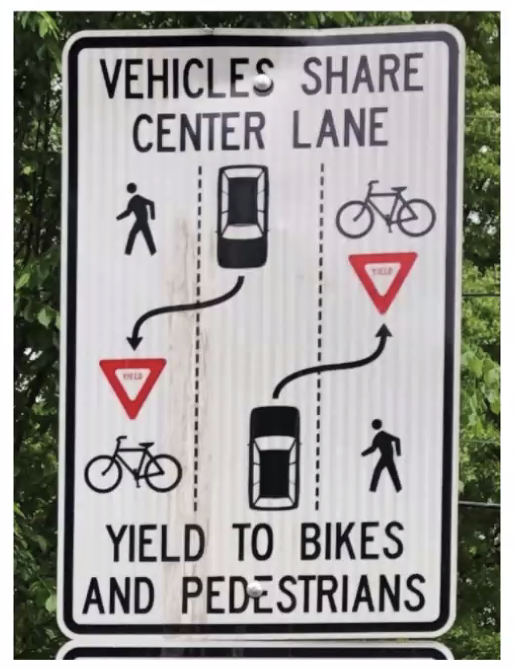
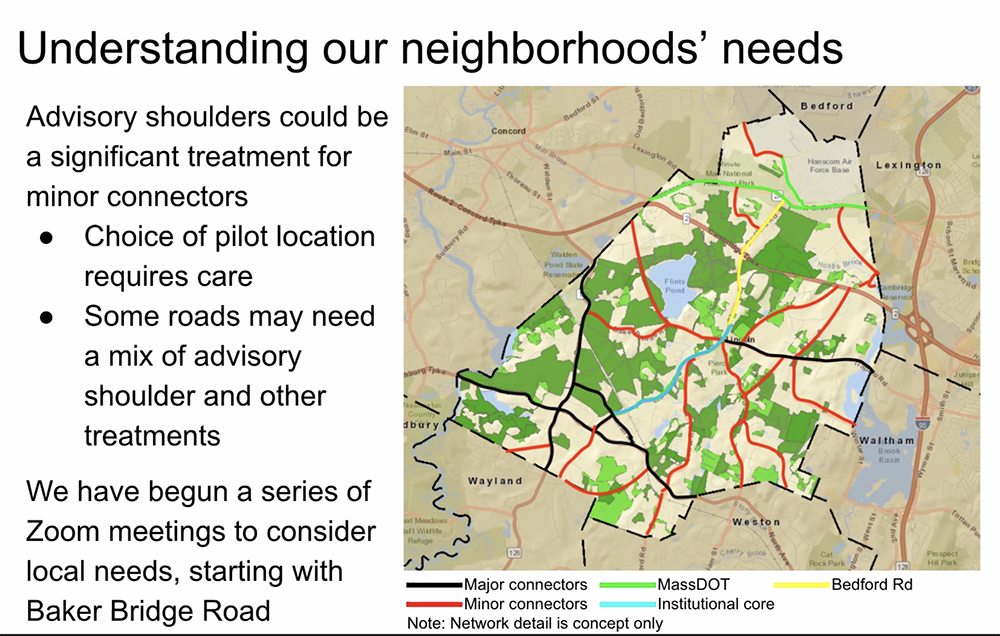
The Farrar Road project will create “advisory shoulders” on Farrar Road, which involves painting dashed lines to indicate shoulders. Vehicles can cross the lines to avoid traffic coming from the opposite direction but must yield to oncoming traffic if there are “vulnerable users” (bicyclists, pedestrians, or any other non-vehicle) ahead or alongside.

An example of a sign about advisory shoulders.

Farrar Road was chosen as a pilot by the  Bicycle and Pedestrian Advisory Committee (BPEC) in service of its broader goal to make Lincoln’s roads safer for all. If the measure turns out to be successful, other “minor connectors” in town might get the same treatment. There are 17 miles of  minor connectors that offer routes to schools and access to conservation trails but are not major roads.

The lines will advise all road users of the legal rights of way and safe passing distance. “It doesn’t change the way folks should use the road — it’s not like a stop sign or speed limit. It just advises about what’s safe,” BPEC member Bob Wolf told the Select Board at its June 21 meeting. The committee has been working with police, the Roadway and Traffic Committee, the DPW, the Planning Board, and representatives of candidate neighborhoods. Wolf and fellow BPEC member Ginger Reiner presented the idea to residents at one of last November’s State of the Town meetings.

The town has submitted an “application to experiment” to the Federal Highway Administration for the advisory shoulders, which are a relatively recent invention in this country. If all goes well, the painting could take place as soon as September, Wolf said.

Route 2A improvements

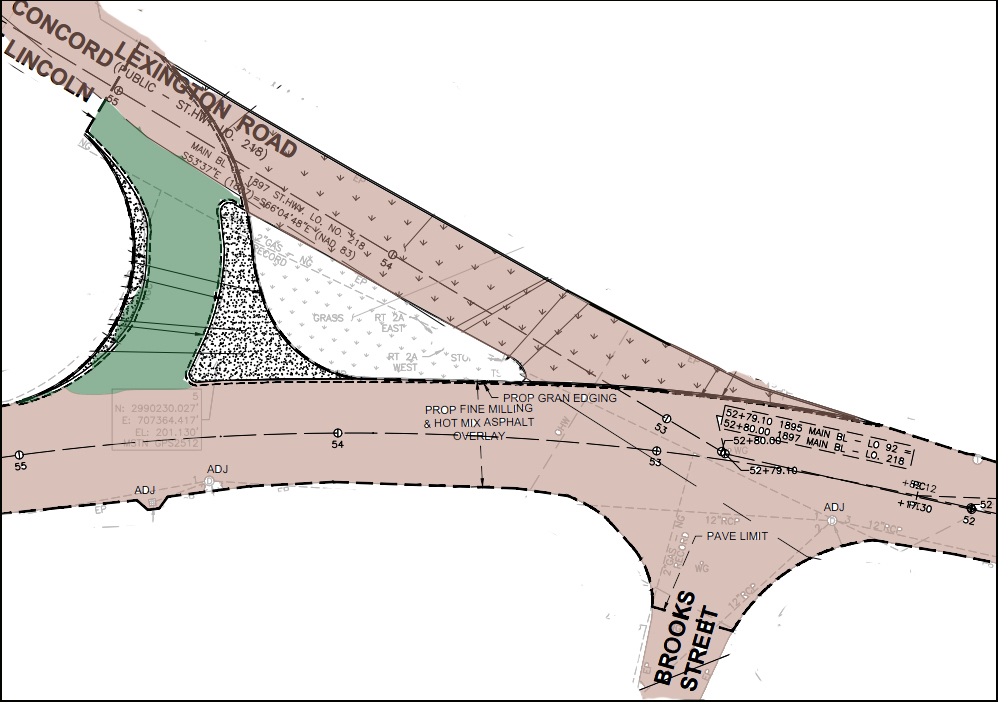
Another project in the planning stages is repaving and adding safety features to Route 2A. The current plans (which are at the 75% complete stage) call for traffic islands at intersections, and reconfiguring the Route 2A/Lexington Rd, intersection to make it safe for those approaching on Brooks Road.

MassDOT plans to move the Route 2A/Lexington Rad intersection slightly to the west. The green area is the new roadway.

Town officials recently offered feedback on the latest round of plans by MassDOT and expects to hear their response in several weeks. Among their requests:

  • Add pedestrian-activated flashing lights at all intersections
  • Add a crosswalk at Brooks Road
  • Add pedestrian islands at certain intersections
  • Make the road shoulders 4 feet wide where practicable

Select Board member Jonathan Dwyer said the town should hear the next response from MassDOT in four to six weeks. The agency has been “accommodating and respectful” to previous requests, he added.

Path in South Lincoln field

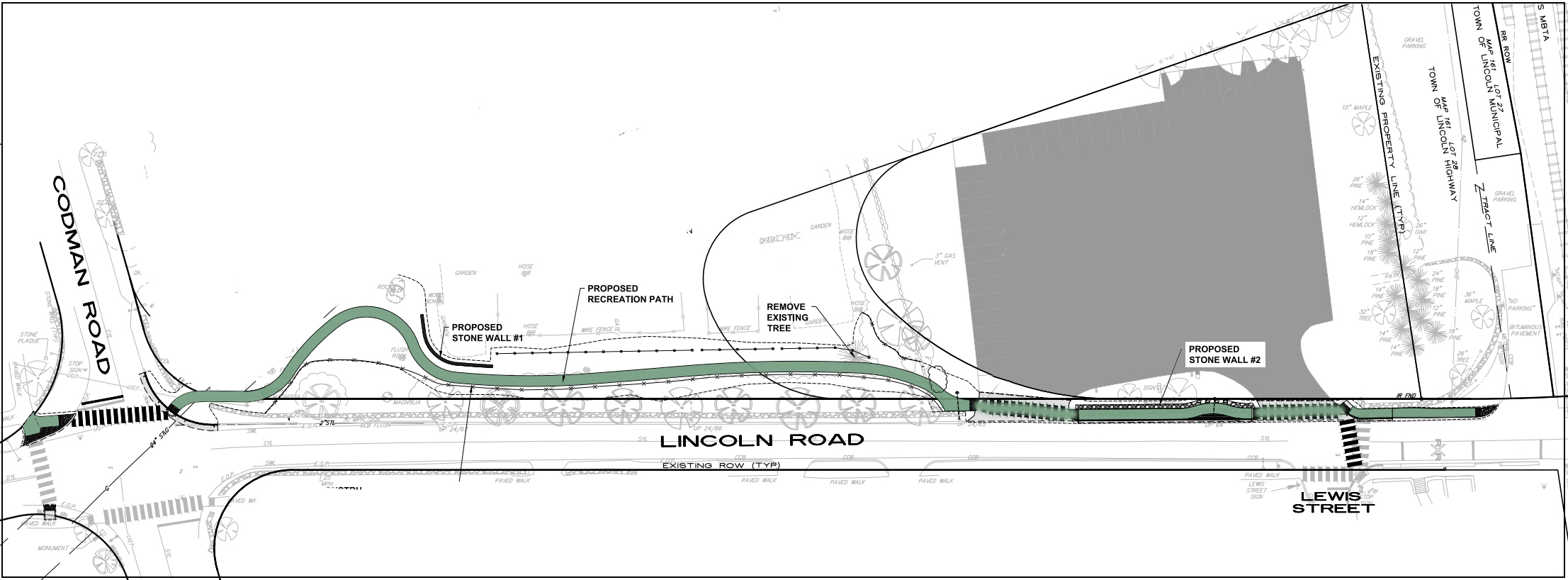
A third pedestrian-friendly project that’s currently out to bid is a pathway alongside Lincoln Road from the railroad tracks to the intersection with Codman Road. The paved path would be on the grass north of the stone wall and row of flowering trees and would skirt the community gardens.

The proposed path alongside Lincoln Road in green. The Doherty’s gas station property is in gray.

The project will be funded by a previously awarded grant from a state program to encourage safe travel and connectivity to mass transit for pedestrians and bicycles. The original deadline for completing the work was June 30, 2021, but the town was unable to award the contract through the initial bidding process, so the new deadline for bids is July 30. MassDOT gave the town an extension until November 30 to complete the work, said Director of Planning and Land Use Paula Vaughn-MacKenzie.

Some residents have expressed concern that the path would cut through the community gardens or is intended to promote access to the Codman Community Farm store. But CCF Board President Nancy Fleming wrote in LincolnTalk in May that the path has nothing to do with the store. She also explained and defended driveway work and other changes at the farm.

“For the first time in decades, we are financially stable, our animals are extremely well cared for, and we are plowing resources back into the aging infrastructure of the farm in ways that were impossible just five years ago,” she wrote.

Category: government, land use, news, South Lincoln/HCA* Leave a Comment

Property sales in May 2021

June 27, 2021

82 Virginia Rd. #204 — James Brennan Jr. to Christopher J. Voce Irrevocable Trust for $438,000 (May 28)

148 Weston Rd. — Keith McDonald to Robert and Christie Waitt for $1,375,000 (May 26)

38 Round Hill Road — Vaja Koumantzelis to Maureen and Enda Quigley for $1,789,000 (May 19)

52 Greenridge Lane #15A — Elisa Sartori to Amy Sanders for $425,000 (May 14)

14 Greenridge Lane #8 — Jeffrey Childs to Christopher City for $530,000 (May 4)


Category: land use Leave a Comment

McLean Hospital abandons Bypass Road plans

June 20, 2021

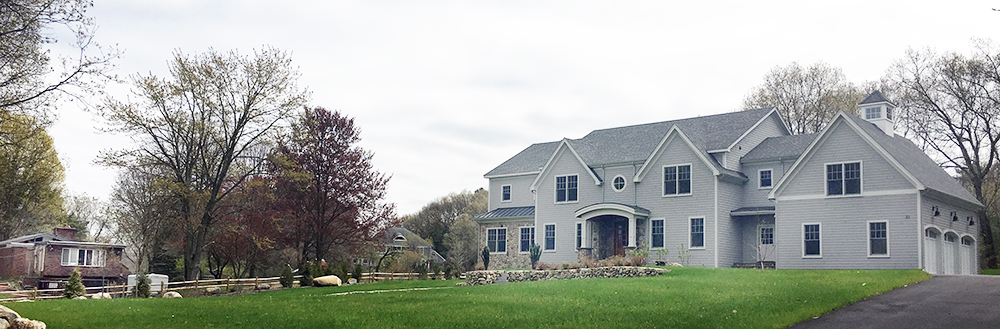
The house at 22 Bypass Rd. (2016 photo) where McLean Hospital had hoped to house boys and men aged 15-21. The adjacent house at 16 Bypass Rd. can be seen at far left.

After years of litigation culminating in a go-ahead from the Supreme Judicial Court for a McLean Hospital facility in Lincoln, the hospital found another location for the services and has put the two Bypass Road properties on the market.

McLean, a psychiatric hospital in Belmont with several satellite locations, purchased two adjacent properties at 16 and 2 Bypass Road in 2016. The facility was intended as a locked residential site for teenage boys and young men being treated for borderline personality disorder using dialectical behavioral therapy to teach mindfulness, interpersonal effectiveness, emotion regulation, and distress tolerance.

McLean initially got a building permit from the town under the Dover Amendment, which exempts educational and religious facilities from many local zoning restrictions. Neighbors argued that the intended use was medical and not educational. After several appeals, the Supreme Judicial Court ruled in 2019 that the McLean facility did in fact qualify as an educational facility.

But McLean has moved on since then. “For the program we planned to put in there, we found a much better site closer to the hospital, so that turned out to be a good move for us,” said Dr. Philip Levendusky, senior vice president for business development and communications, and director of McLean’s Psychology Department. The Arlington location, which is now in operation, “is a very attractive site and much larger than what we were looking at in Lincoln.”

The new Arlington location is a “free-standing piece of real estate” recently purchased by McLean and is not part of the hospital’s existing 3East campus in Arlington, Levendusky said.

In June 2016, McLean bought 16 Bypass Rd. for $1,024,500 and the larger home at 22 Bypass Rd. for $1,700,000, according to town land records. The hospital subsequently did an $83,000 kitchen renovation at 16 Bypass Rd. but never pulled any building permits for the other parcel. The properties are now listed for sale at $900,000 and $2.26 million, respectively.

Category: land use Leave a Comment

Property sales in April 2021

May 31, 2021

195 Lincoln Rd. — Mitchell D. Schultz to Michael Share and Benjamin Mizell for $1,825,000 (April 8)

140 Lincoln Rd. — Colin Nissan to Salvatore S. Privitera Trust and Doris S. Privitera Trust for $432,000 (April 8)

9 Meadowbrook Rd. — Brian Rogers to Jonathan and Victoria Paly for $1,431,000 (April 15)

34 Farrar Rd. — Brenda Lee Molloy Trust to Michael Leip for $705,000 (April 16)

223 Sandy Pond Rd. — Charles Hadlock to Abjijit Sarkar and Debarati Bhattacharya for $1,200,000 (April 12)

19 Wheeler Rd. — John Dickinson to Christopher and Eileen Pattinson for $2,465,000 (April 28)

72 Birchwood Lane — Elinor White to Ann Odessey and Mark Sandman for $615,000 (April 28)

184 Bedford Rd. — Marcella E. Saunders trust to Benjamin Ivanchenko for $650,000 (April 30)

Category: land use, news Leave a Comment

Property sales in February and March 2021

May 23, 2021

41B Indian Camp Lane — Ersan Seric to Alicia Googine for $325,298 (March 25)

3 Page Farm Rd. — Steven Wilcox to Monica Grewal and Jeffrey Ruberti for $1,798,000 (March 10)

22 Lincoln Rd. — Ronald McDougald to Lanping Yiu for $1,100,000 (March 5)

46 Todd Pond Rd. — Patricia Warner to Robert and Jill Hanna for $475,000 (March 4)

10 Hawk Hill Rd. — Jane Denholm to Jonathan Bock and Erin Rist for $1,100,000 (March 4)

80 Winter St. — Richard Tatlock to Kecin Worthington for $1,225,000 (March 2)

Two parcels including 145 Weston Rd. — Kevin Mundt Trust to Ruano Cuetos and Karla Gravis for $6,000,000 (February 8)

Category: land use Leave a Comment

DeCordova hopes to add tent for special events

May 20, 2021

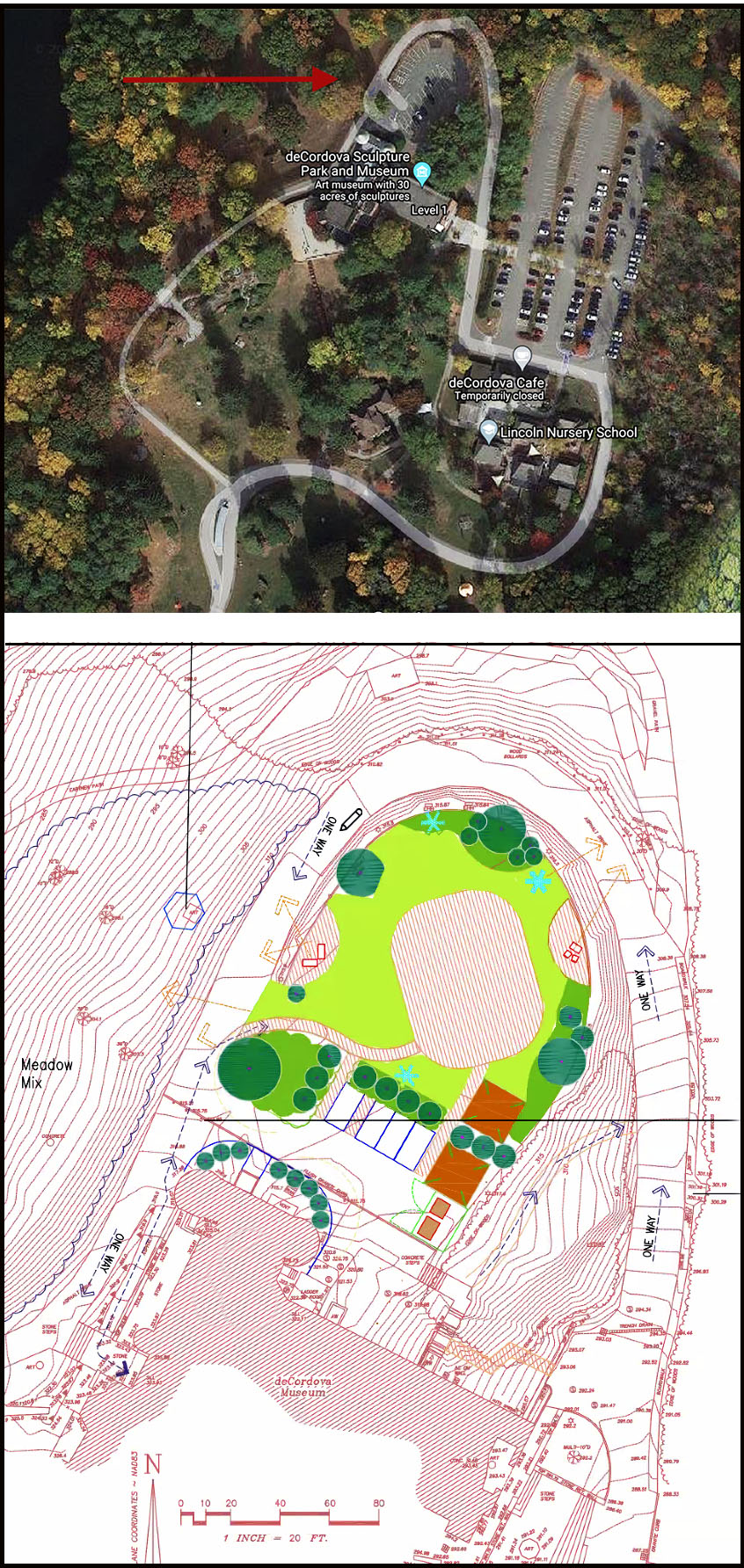
An aerial view of the current employee parking area (red arrow in top image) and a drawing of how the deCordova plans to reconfigure the area (click image to enlarge).

The deCordova Sculpture Park and Museum is proposing to reconfigure part of its parking area and walkway to create a new open space for special events.

What is now a two-way driveway between the lower visitor parking lot and the horseshoe-shaped upper employee parking area will become a one-way vehicle-only roadway to be used mainly for deliveries, said Kord Jablonski, the deCordova’s business director. The existing boardwalk will be replaced by a sidewalk and a handicapped-accessible ramp.

Staff will park in the visitors lot and the current staff lot will be “reimagined and reconceived” as an area with crushed stone or pavers in the  idle to accommodate a tent for special events in warm weather, Jablonski told the Select Board at their May 10 meeting. There will also be two new seating areas to take in views of Flint’s Pond. Those views have been enhanced by removal of some of the brush, in cooperation with the Conservation and Water Commissions, he noted.

Depending on the outcome of grant applications and town approvals, the work should begin in late September or early October, Jablonski said.

As with similar public-facing organizations, visitation dropped significantly as a result of the pandemic but has bounced back more recently, he told the board. Using timed ticketing, capacity limits and Covid-19 protocols, the sculpture park grounds reopened last May after a fairly brief shutdown, and the indoor museum galleries reopened in October. 

In the 12 months ending March 31, 2021, admissions were up by 86% over the previous year. The rise was even more striking for younger visitors; children’s admissions rose by 237% to 28,163, compared to 76,121 for adults (a 60% increase).

The integration of the deCordova with The Trustees of Reservations was completed in November 2019.

Category: arts, land use Leave a Comment

New survey seeks input on the future of South Lincoln

May 18, 2021

The current zoning in South Lincoln (left) and the changes that were proposed in 2019. Click image for larger version.

Residents are invited to fill out a new survey asking for thoughts on development at Lincoln Station.

For the last two years, the Planning Board has been considering changes to the zoning in South Lincoln in the area around the Mall at Lincoln Station and the commuter rail station. The goal is to encourage more diversity in housing in that area (especially with the advent of the Housing Choice Act) as well as commercial activity, services, and amenities in and around the mall. Some residents have expressed concern about the size of the area proposed for rezoning, the density and scale of permitted buildings, and the impact of development on traffic and Lincoln’s finances.

To give officials a clearer sense of public sentiment on these topics, please take the survey at tinyurl.com/villagecentersurvey. To request a paper survey, call 781-259-2610. The deadline to participate is June 30.

Background in the Lincoln Squirrel:

  • Uncertainties surround new state multifamily housing law (March 18, 2021)
  • Septic treatment becoming an issue for mall and South Lincoln (October 12, 2020)
  • South Lincoln panel is now a five-member “SLPAC” (June 10, 2020)
  • Residents argue pros and cons of South Lincoln rezoning (February 10, 2020)
  • Group unveils proposals to boost South Lincoln development (May 15, 2019)

Category: land use, South Lincoln/HCA* Leave a Comment

Accessory apartment issue results in razor-thin votes

May 16, 2021

For the second year in a row, Lincoln’s Annual Town Meeting in the Covid-19 era went off without a hitch under a tent in the Hartwell school parking lot. However, though as in any town meeting, there was some controversy — at one point resulting in 87-86 vote.

The subject of not one but two razor-thin votes was the town’s accessory apartment rules. The Planning Board asked residents on Saturday to approve several changes to the bylaw, which they outlined in video and Powerpoint presentations on April 27:

  1. Delete a section that requires the dwelling to be at least 10 years old, and remove the requirement that accessory apartments can increase the floor area of the original dwelling by no more than 10%.
  2. Add a cap on the number of accessory apartments equal to 5% of all residential units in town. This cap would not apply to affordable units, including those participating in the town’s Affordable Accessory Apartment program.
  3. Require accessory apartments leases to be for at least 30 days.

The Planning Board recommended the first change so that modestly sized homes could add a livable accessory apartment comprising more than 10% of the original floor area. The second change was intended to act as “insurance” to limit the impact on town services should the program prove highly popular. Board chair Margaret Olson noted that this can easily be revisited in the future.

But it was the third amendment that provoked the most discussion. The goal of the proposed 30-day rental minimum was to discourage homeowners from building accessory apartments for the sole purpose of renting them out to short-term tenants via Airbnb or similar services. Olson said she wasn’t aware of any cases in Lincoln that suggested the limit but “it has been an issue in other communities.”

Town Counsel Joel Bard pointed out that the 30-day rental minimum would apply only to accessory apartments and their associated principal dwellings, not to all rental units in Lincoln.

Sara Mattes proposed an amendment that would remove that proposed 30-day minimum. In the discussion that followed, John Carr said that fear of short-term rentals ”destroying the community” was moot. “This parade of one-day guests is the status quo… [the community] has already been destroyed and we didn’t notice.”

Eric Harris said the effective ban on Airbnb rentals was unfair to those who already hold permits for accessory apartments and favors those with single-family homes. Tom Sander also opposed the amendment, suggesting instead that the town limit the number of rentals per year for each accessory apartment owner.

The voice vote on the Mattes amendment was too close to call, and a standing vote resulted in a tally of 87 “no” votes vs. 86 “yes” votes. But the drama wasn’t over yet. Christoper Boit offered another amendment that would reduce the minimum rental period from 30 days to seven, which he said would allow more flexibility for short-term caregivers to come and go.

Speaking as a private citizen, Finance Committee chair Andy Payne noted that neither limit would apply to short-term accessory apartment occupants who are not paying rent. Additionally, “short-term rentals do give a number of our fellow residents an option to make Lincoln more affordable for them than it would be otherwise.”

Again, a voice vote was too close to call. In the standing vote, the Boit amendment was approved by a 89-82 margin.

Tim Christenfeld then proposed yet another amendment: removing the 5% cap on the number of accessory apartments. “This seems to run against a lot of what we’re trying to accomplish” in terms of encouraging economic diversity in town, he said. A cap signifies that “we support moderate-income families in Lincoln, but not too many.”

The current proportion of accessory apartments in town (64) is about 2–2.5% of the total number of units, Olson said. New ones are being created at the rate of two to three per year, meaning Lincoln would reach the 5% cap in about 20 years.

Christenfeld’s amendment was defeated in a voice vote where roughly two-thirds of residents voted no.

Eric Harris argued that “policy should not be based on one vote” (the margin for the first amendment) and the matter should be brought back at a future Town Meeting, but the vote on the original motion (as amended to reduce the rental period minimum from 30 days to seven) passed with only a handful of residents voting no, easily clearing the required two-thirds majority.

Category: government, land use Leave a Comment

  • « Go to Previous Page
  • Page 1
  • Interim pages omitted …
  • Page 11
  • Page 12
  • Page 13
  • Page 14
  • Page 15
  • Interim pages omitted …
  • Page 37
  • Go to Next Page »

Primary Sidebar

Recent Posts

  • Water bills to go up by 13% March 5, 2026
  • News acorns March 5, 2026
  • Property sales in January 2026 March 4, 2026
  • My Turn: Unraveling the Hanscom misallocation March 3, 2026
  • Police log for Feb. 19–25, 2026 March 3, 2026

Squirrel Archives

Categories

Secondary Sidebar

Search the Squirrel:

Privacy policy

© Copyright 2026 The Lincoln Squirrel · All Rights Reserved.