• Skip to primary navigation
  • Skip to main content
  • Skip to primary sidebar
  • Skip to secondary sidebar

The Lincoln Squirrel – News, features and photos from Lincoln, Mass.

  • Home
  • About/Contact
  • Advertise
  • Legal Notices
    • Submitting legal notices
  • Lincoln Resources
    • Coming Up in Lincoln
    • Municipal Calendar
    • Lincoln Links
  • Merchandise
  • Subscriptions
    • My Account
    • Log In
    • Log Out
  • Lincoln Review
    • About the Lincoln Review
    • Issues
    • Submit your work

government

Officials offer school recommendations, borrowing estimates

February 1, 2017

Saying “we believe it’s time to act on our own,” School Committee Chair Jennifer Glass outlined next steps for a town-funded school project at a multi-board meeting earlier this week.

Glass told the Board of Selectmen last month that her group recommended not applying again for state funding, but start the planning process for a school project that the town would pay for by itself. At the multiboard meeting, she explained the committee’s reasoning, while Finance Committee Vice Chair Jim Hutchinson outlined some funding and property tax scenarios.

There will be two warrant articles at Town Meeting next month—one on whether to spend a previously approved $750,000 on a town-funded school feasibility study, and another on whether to reapply for state funding—but “we see that as a fork in the road, an either/or choice,” Glass said. The increased competition for state grants and the immediate needs of the Lincoln School from both facilities and educational standpoints mean that waiting any longer is not the best option, she said.

Previous meetings and votes indicate that there is community consensus on four points:

  • The education value of a school project is a top priority
  • Residents understand that the town will have to spend a minimum of $30 million for a “responsible project”
  • There is “strong support” for a project that would cost $45 million to $60 million even without state funding
  • There is interest in planning collaboration for a school project and community center

The cost estimates were provided by Dore and Whitter in their report in late 2014. At that time, they outlined three groups of renovation and construction options and price ranges:

  • Option 1 – facilities needs only: $12–$29 million
  • Option 2 – facilities needs plus “a la carte” educational enhancements: $29–$47 million
  • Option 3 – facilities needs plus comprehensive educational enhancements: $54–$66 million

The new feasibility study process would again outline the school’s needs, the town’s educational and community vision and building options, as well as an eventual a decision on one option to put forward for a town vote. The Dore & Whittier report did some of this but did not include faculty input, nor did it address the overall site plan in terms of roadways, athletic fields, etc., Glass noted.

Borrowing costs

Although construction costs have climbed since 2014, interest rates have remained steady, Hutchinson said. The Finance Committee has consulted with bond advisors and concluded that the town can borrow up to $80 million without losing its AAA bond rating, which affects future borrowing costs. That level of borrowing would drive the town’s debt-to-operating ration from the 3-4% range up to 12-13%, he said.

To soften the tax impact, the Finance Committee recommends additional steps such as repaying the bonds over 30 years rather than 20. Also advisable is a “level debt” whereby annual payments would remain the same, though they would effectively decline as a percentage of revenue over time due to inflation, Hutchinson said. Although the town has a debt stabilization fund, spending all of it is not a good idea, because “there are always unanticipated things that happen to towns and we need to have some kind of buffer,” he added.

Another way to spread out the repayments would be to borrow for a community center and a school project separately “and put it in two lumps rather than one big lump,” Hutchinson said.

Voters at Town Meeting will be asked for a $150,000 appropriation for a feasibility study by a community center building committee that would work alongside the new school building committee. The Board of Selectmen would “mandate cooperation between the two,” Selectman Peter Braun said.

One advantage of not involving the MSBA is it frees the town from having to clearly separate design and planning for a school project and a community center, Glass noted.

Property tax impact

What does this mean for Lincoln taxpayers? Hutchinson did not have final estimates this week (the committee will present them at another multi-board meeting on March 8), but an earlier analysis that assumed a 4.6% interest rate and a more aggressive repayment schedule showed that tax bills would rise by $367 per year on a median-value home for every $10 million that the town borrowed. The median home value is $883,000, so someone with a home of that value would pay an additional $1,101 per year if the town borrowed $30 million, for example.

However, Hutchinson noted that interest rates are actually lower than the projected figure (about 3.4% right now), so the repayment cost would be lower than the example—more like $300 per $10 million borrowed, he said.

Even if the town decided on a “repair-only” direction, it would not be eligible for Massachusetts School Building Authority funding, Glass said. The MSBA has two grant programs: the core program and the “accelerated repair” program, which funds individual repair projects such as roofs and boilers. However, schools who get the second type of funding have no other major facilities or educational flaws aside from the isolated issue, and Lincoln does not meet that standard.

Other area towns have done town-funded school projects in recent years, including a new elementary school in Brookline and a replacement for the Zervas School in Newton. Lexington has done several projects, some with MSBA funding and some without. Wellesley has been turned down by the MSBA several times for a project that would consolidate three elementary schools into two and is also contemplating going it alone, Glass said.

One focus of debate is sure to be which major project to do first. The Council on Aging and the Parks and Recreation Department are advocating for a community center and have suggested that if it were built first, some of its space would be used by the school while staged school construction work was taking place.

But resident Ken Hurd disagreed. “My preference would be if the focus is really the school because this is what we need the most. We’re going to attract more people if we have the school situation resolved. A community center is nice is nice and we need it, but it’s not going to bring people to Lincoln,” he said.

“Town leadership should take a position on what the priorities should be,” said Steve Perlmutter, a member of the 2014 School Building Advisory Committee.


 

Category: community center*, government, school project*, schools Leave a Comment

Public hearings coming up

February 1, 2017

The Zoning Board of the Appeals of the Town of Lincoln will hold a public hearing on Thursday, Feb. 2 at 7:30 p.m. in the Town Office Building to hear and to act on the following petitions under the Zoning Bylaws:

  • Nunzio Domilici, 22 Deer Run Road, for transfer and renewal of an accessory apartment special permit.
  • Holly Hedlund, 21 Morningside Lane, for extension of time on original approved special permit.

The Lincoln Historical Commission will hold a public hearing at 7:30 p.m. on Tuesday, Feb. 7 in the Town Office Building to consider the application of Massachusetts Audubon Society to demolish the existing structure known as the “Education Building” at 208 South Great Rd.

A complete list of public notices for the town of Lincoln can be found here.

Category: government, land use, news Leave a Comment

Letter to the editor: support updated open-space plan

February 1, 2017

letter

(Editor’s note: See this Lincoln Squirrel article from July 2016 for more background.)

To the editor:

Lincoln’s update to the Open Space and Recreation Plan (OSRP) is nearly complete (the previous update was published in 2008). The OSRP Committee has worked diligently over the last eight months to get to this point. There were two community forums and an OSRP survey to obtain feedback from residents. Now it is ready to bring before the Selectmen for final approval. Please join us at their February 6 meeting and show your support for this guidance document.

An OSRP is a tool that helps a municipality maintain and improve the benefits of open space and recreation facilities that contribute to the character of the community and protect its “green infrastructure.” Planning for this “green infrastructure” of water, land, farms, wildlife habitat, parks, recreation areas, trails and greenways is as important to the economic future of a community as planning for schools, roads and public safety. With a current plan approved by the Massachusetts Executive Office of Energy and Environmental Affairs, Lincoln will be eligible for state grants to help fund open space and recreation projects and programs. OSRP highlights include:

  • an inventory of Lincoln’s open spaces and recreation facilities
  • a 7-year action plan
  • descriptions of key scenic resources
  • background on our community’s natural resources and conservation history
  • an evaluation of how our OSRP facilities serve people with disabilities
  • accompanying maps

The Board of Selectmen will discuss the OSRP on Monday, Feb. 6 at 7:30 p.m. in the Donaldson Room of the Town Office Building.

Sincerely,

Angela Kearney
Conservation Planner, Lincoln Conservation Dept.


Letters to the editor must be signed with the writer’s name and street address and sent via email to lincolnsquirrelnews@gmail.com. Letters will be edited for punctuation, spelling, style, etc., and will be published at the discretion of the editor. Letters containing personal attacks, errors of fact or other inappropriate material will not be published.

Category: conservation, government, news Leave a Comment

News acorns

January 31, 2017

Candidates still needed for two town posts

There’s still time to run for office in the upcoming Town Election of March 27. Currently there are no candidates for the Housing Commission (a three-year seat) or Bemis Board of Trustees (a one-year seat). The deadline to take out nomination papers from the Town Clerk’s office is Friday, Feb. 3. Papers must be returned for certification by 5 p.m. on Tuesday, Feb. 7.  Candidates must collect 28 registered voter signatures to appear on the ballot.

Selectman candidate’s forum on Feb. 12

The Northside News will host a session for candidates for the Board of Selectmen—Jonathan Dwyer, Jennifer Glass and Allen Vander Meulen—in a discussion of issues facing the town on Sunday, Feb. 12 from 12:30-2:30 p.m. at the Lincoln North Office Building (55 Old Bedford Road). Residents will have a chance to hear from each candidate, pose questions and discuss issues. (Editor’s note: the Lincoln Squirrel will publish interviews with Glass and Vander Meulen before this event.)

Donated toiletries sought

Women and children who are in shelters remaking their lives after experiencing domestic violence need toiletries like shampoo, soap, toothpaste, hand and body lotions, and more. If you have unopened toiletries from hotels or stores that you can’t use, please bring them to Bemis Hall by Friday, Feb. 6. A volunteer will take them to local domestic violence organizations for Valentine’s Day distribution.

“Lincoln marchers” start email list

Some of the “Lincoln marchers” who went to the Boston Women’s March for America (or those who went to the Washington March) on January 21 are organizing an email network to facilitate follow-up action on behalf of the march objectives of peace and justice. The group is starting with the “10 actions 100 days” agenda that can be found on the website of the Women’s March for America (www.womensmarch.com/100). If you would like to add your name to the Lincoln email list, whether or not you actually marched on that date, please contact Barbara Slayter at bslayter@comcast.net.

LOMA features Greg Klyma

Greg Klyma will be the featured performer at the next LOMA (Lincoln Open-Mike Acoustic) night on Monday, Feb. 13 from 7-10 p.m. at the Lincoln Public Library. Admission is free and refreshments are provided. Klyma will perform a half-hour set starting around 8:30. His articulate and amusing stories and populist ideals make him a rare young artist in the mold of Woody and Ramblin’ Jack. A nationally touring performer, he has seven albums to his credit; his latest, Another Man’s Treasure, features the song Livin’ the Life.

LOMA is a monthly event. Performers can sign up at the event or email Rich Eilbert at loma3re@gmail.com for a slot. There is a sound system with mikes and instrumental pickups suitable for individuals or small groups.

Category: arts, charity/volunteer, elections, government Leave a Comment

School Committee recommends Lincoln-only school project; multiboard meeting Monday night

January 29, 2017

The School Committee has voted unanimously to recommend that the town move forward with a Lincoln-funded school project and not reapply for state funding.

There will be a multi-board meeting on Monday, Jan. 30 at 7 p.m. in the Brooks gym to discuss the school project. In an earlier announcement about that meeting, the committee said it would sponsor two Town Meeting warrant articles: one asking whether the town should go ahead and spend $750,000 that was appropriated in 2015 on a feasibility study for a town-funded school project, and whether to apply again to the Massachusetts State Building Authority (MSBA) for a grant.

“We view these two articles as either/or,” School Committee Chair Jennifer Glass told the Board of Selectman at its January 25 meeting. “We’re saying we’ve reached a point where there are two directions and we’re asking the town which way we should go, and our recommendation is to go the first way.”

The physical condition of the Lincoln School and the need for educational improvements means that continuing to hope for uncertain MSBA funding is no longer a good option, according to Glass. “Each year we delay in this process, we risk failure of some major system such as a roof or boiler,” she said, adding that construction costs have “gone up pretty dramatically” over the past several years.

As the School Committee has learned more about the workings of the MSBA, it’s also become less confident that it will be invited into the funding pipeline again anytime soon, Glass said. Meetings with MSBA officials after the 2016 and 2016 rejections have shown “just how competitive a process it is… and have given us a pretty clear-eyed vision of where we are in terms of those [MSBA funding] criteria,” she said.

There is also some level of community agreement that a town-funded school is the best option at this point, Glass added. “We’ve built a lot of excitement and consensus that it’s time to address this. It feels like there’s this moment of opportunity,” she said. Furthermore, those hoping for construction of a community center “will have clearer path when we figure out what’s going on with the school.”

Applying to the MSBA while also pursuing a Lincoln-funded project “would send a mixed message to the state” and would also risk wasting its $750,000 outlay, because if Lincoln eventually got invited into the MSBA funding pipeline, it would have to do a completely new feasibility study, Glass said. Similarly, the School Committee is unwilling to waste the effort of another School Building Committee in the event state money ever appeared.

“It is incredibly intense to be on a School Building Committee,” she said. “I’m not comfortable asking our fellow townspeople to make that kind of investment and then say ‘Whoops, sorry, we’re putting that aside and were going to start again and hire a new architect and a new OPM [owner’s project manager]… it feels like we just need to decide.”

Glass concluded by saying her panel will seek support for its position from as many town government bodies as possible, including the Board of Selectmen.

“I commend the School Committee for putting a stake in the ground on this,” Selectman Peter Braun said.

Faced with the need to borrow a substantial sum of money, selectmen said they hoped the Finance Committee would be receptive to increasing the town’s debt stabilization fund, which currently stands at about $3.7 million. “As a town, we need to start examining what strategies we can take for a large-scale [funding] process,” Selectman James Craig said.

Category: government, school project*, schools Leave a Comment

Lincoln on the march

January 24, 2017

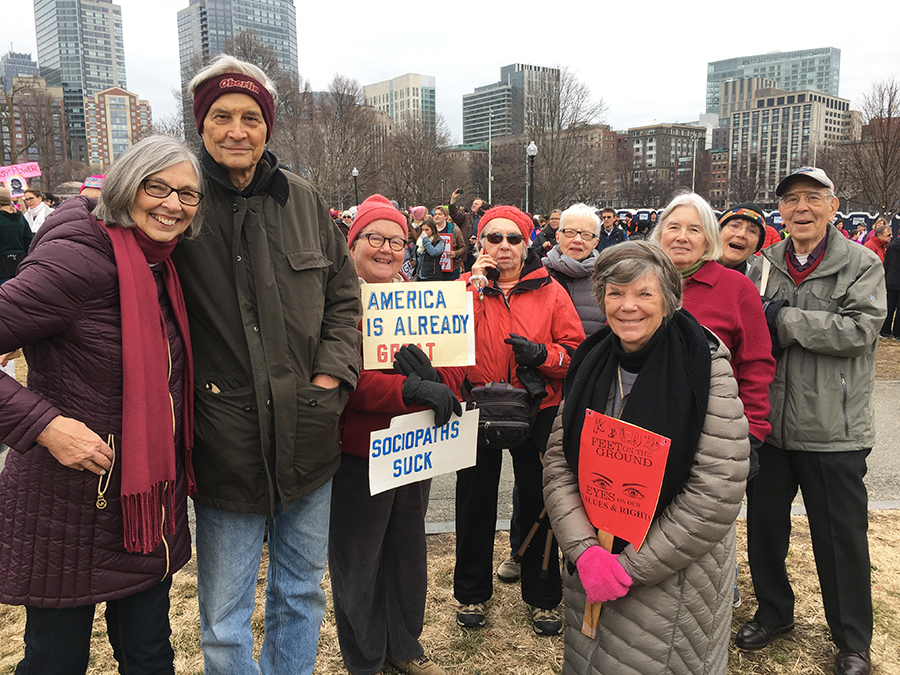
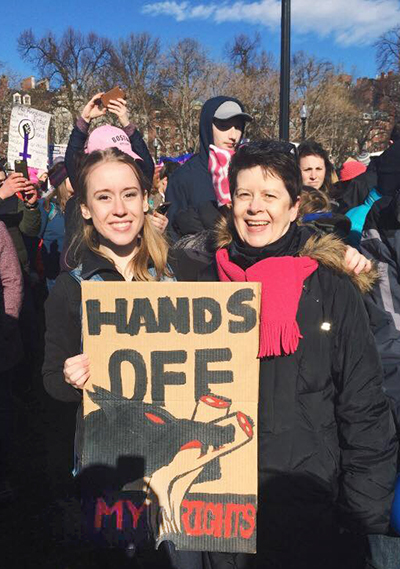
For the Women’s March on January 21, the Lincoln Democratic Town Committee organized a bus to Boston Common for 50 participants under the group title of “Lincoln Marchers,” while many other residents made the trek to the nation’s capital. Marches in Washington and other U. S cities drew at least 1 million people in total, and thousands more participated in similar events around the world.

“The Washington Women’s March for America was amazing from start to finish,” said Barbara Slayter, one of the Lincoln DTC riders. “The crowd included people of all ages and races—men as well as women, Muslims, and even, I observed, a gentleman wearing a Sikh turban. There were children in strollers and baby carriages as well as on foot, and there were disabled or elderly people in wheelchairs. The mood was upbeat and even jubilant.

“These exuberant good spirits were accompanied by a huge array of largely homemade signs ranging from humorous to mocking to lighthearted, angry, compelling or uplifting [see the end of this gallery]. As we marched—very slowly—we frequently sang or chanted or contributed to great shouts rolling like waves through the crowd. Chants included ‘We want a leader, not a creepy tweeter,’ ‘Education, not deportation,’ ‘Women’s rights are human rights,’ and ‘Hands too small! Can’t build the wall!’

“Sometimes we sang songs such as This Land is Your Land or old union songs. One group knew songs from the musical Hamilton and entertained us for a bit along the way, as did several different drummers. And one cluster of some 30 or 40 marchers even sang a rousing Happy Birthday—to me—tipped off by my daughter, much to my surprise.”

The crowd were so large that Slayter’s group never got close enough to the podium  hear the speakers address the crowd, or even to the official march route. Instead, they made their way alongside the mall down Madison Avenue along with throngs of other marchers. “From 9 a.m. to 5:30 p.m. we were ‘on the move’ and it proved to be a thrilling day. Now we are trying to reflect on how we can build on the momentum the march has given us,” she said.

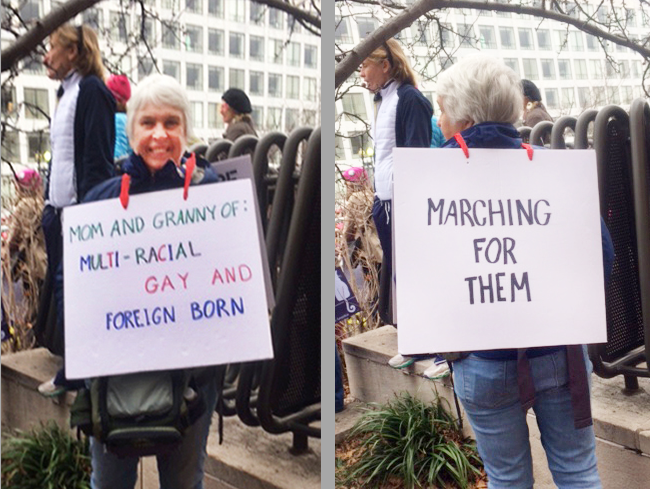
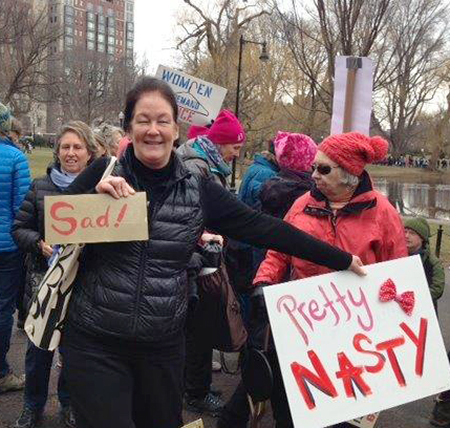
Here are pictures and words from other Lincoln marchers.

Janet Boynton, Larry Buell, Dilla Tingley, Marie Roberts, Lucretia Giese, Kim Buell, Elizabeth Cherniack, Julie Hibben and Al Schmertzler on Boston Common.

Rosamond DeLori marches in Boston.

Dilla Tingley and her friend Marie Roberts of Lexington. “The march restored my sense of humor and some hopefulness—there was lot of camaraderie and solidarity. We will need it,” Tingley said.

Jessica Tunick and her husband Trevor Berens went to the Washington event. “The feeling of the march was one of diversity, solidarity, love and determination,” Berens said.

Three generations march in Boston: Lincoln residents Natalie McNerney (front right) and her daughter Mary McNerney (front center) with her son Tim McNerney (back left) and 14-year-old granddaughter Sofia McNerney of Shutesbury.

Gwyn Loud and Rosamond DeLori on Boston Common.

Carolyn Montie and her daughter Eve in Boston.

Barbara Slayter (left) just happened to bump into Superintendent of Schools Becky McFall at the march in Washington. “Can you imagine a chance encounter of two Lincolnites in a sea of 500,000+ people and an extraordinary number of pink hats? It was an astonishing moment!” she said.

Jennifer Morris (right), her niece Norah Deluhery (left) and her sister Andrea Morris. Jannie and Andrea stayed in Washington with Norah, who was an Obama administration appointee in the Department of Agriculture for eight years.

Virginia Rundell (right) and her daughter Elisabeth, a senior at Drexel University. “As a mom, you never know if the values you try to instill in your children will stick—but this demonstration, and the conversations it prompted, proved to me that she’s been listening with her heart all along!”

Al Schmertzler, Julie Hibben and Lucretia Giese in Boston. “The crowds and their enthusiasm were tremendous. The trick will be to use that enthusiasm to effect change in the House and Senate,” Schmertzler said. “The attendees must make their goals painfully clear so that particularly Republicans know that if they do not change their positions, they will be voted out of office immediately just as the Democrats were in this recent election. 2018 will be the first test.”

Current and former Lincoln residents Houwa Ibrahim, Suzanne Karl, Rayna Caplan, Susan Taylor and Paula Waterman. “We packed into the Red Line car at Alewife—so tightly packed I couldn’t turn around,” Taylor said. “In the middle of the car, held up only by the press of other passengers, was a young mother with purple dyed braids and a still-toothless baby in a front pack dressed as SuperGirl. The ride was slow and the car began to get hot and stuffy. SuperGirl began to cry. Two young women who were squeezed up against the mother began to sing to SuperGirl: ‘Raindrops on roses and whiskers on kittens…’ Concentric ripples of passengers began to join in the song until, when everyone reached the verse ‘I simply remember my favorite things,’ the entire car of at least 100 people shouted out ‘And then I don’t feel so bad!’ little SuperGirl had stopped crying, and everyone in the car was laughing. Solidarity, sisterhood, femininity at its best, and joy of common purpose.”

Sharon Antia and her granddaughter Armani Sims on the bus in Boston. Antia borrowed Armani’s pink Hello Kitty hat for her pussy hat.

The Washington march was “an amazing experience,” said Nancy Bergen. “There was a wonderful sense of unity and support for the democratic values that most of us want in our country. It was just incredible to look out at a sea of united people, many holding signs expressing why they were there. I wish there had been a place to put all the signs as they were so beautiful and creative. I experienced a great feeling of community, kindness and camaraderie among everyone there. Being at the march gave me hope that change can happen even in times like these, and that speaking up matters.”

Susan Pease brought a pair of signs to Boston.

Former Lincoln resident Isabel Peterson.

Various signs photographed by Barbara Slayter.

Category: charity/volunteer, government, news Leave a Comment

Early voting will probably cost the town starting in 2018

January 19, 2017

Lincoln had a very successful early voting turnout in 2016—so successful that there will have to be some voting adjustments and probably expenditures made before the next biennial election in 2018.

At almost 41 percent, Lincoln had the fifth-highest early voting turnout in Massachusetts in 2016, the first year in which early voting became available here. Municipalities are required to offer early voting during elections in even-numbered years for at least two weeks before Election Day. The measure is intended to maximize overall voter turnout and minimize crowd at polling places on the day, but Lincoln experienced some unintended consequences in November, as Town Clerk Susan Brooks explained to the Board of Selectmen on January 9.

Early voting was conducted in a conference room in the Town Office Building that proved barely adequate to the task. Handicapped regulations require a clearance of at least 36 inches from the AutoMARK handicapped-accessible voting machine, “and we had an inch to spare,” Brooks said.

Then, on the last day of early voting, monitors from the General Accounting Office appeared, “and we had to squeeze sideways down the hall” to get past a line of voters—right around the time a busload of senior citizens from The Commons arrived to vote. “There was a lot of traffic,” Brooks said.

Ideally, the location for early voting would be a lockable room large enough to accommodate the voting equipment so it doesn’t have to be wheeled back into secure storage at the end of each day, and it should also be centrally located and handicapped-accessible. The obvious choice, Brooks said, is the Donaldson Room. Since town government meetings are often held there at night, those meetings would probably have to take place in the Hartwell multipurpose room during the early-voting period, she said.

Another problem that arose during the November election was the strain on the staff of the Town Clerk’s office, Brooks said. Early voting “really makes your election a 16- or 17-day event, and whether we can continue to do it with an all-volunteer workforce [at the polls on Election Day] is a hard choice we need to be looking at… There’s a lot of enthusiasm for being election workers, but there’s a difference between volunteers and people who are paid to understand and administer election law.”

On Election Day, volunteers check voters in and out while the Town Clerk’s staff is on hand to deal with more complicated issues such as researching inactive voters, providing provisional ballots and having affidavits signed. “We were averaging one voter interaction every three minutes for all 100 hours that office was open,” with the result that the office’s other work got backed up, Brooks said. 

Lincoln is unusual in having election workers who are unpaid, so beginning with the 2018 election, the town will probably have to hire trained poll for the early voting period “who can be held accountable more intensively than our volunteer staff,” Brooks said. How much this will cost is anyone’s guess at this point, but she said her office will begin researching the issue.

State funding almost certainly will not available to offset some of this expense. The legislation was “artfully crafted” to avoid having the extra costs of early voting appear in the town’s expenses, since the Town Clerk’s staff is salaried and thus not eligible for overtime pay, Brooks said.

A third issue with early voting is electioneering policy. Current law prohibits displaying political signs or “attempts at political persuasion” within 150 feet of a polling place, but the Town Office Building is not considered a polling place. Also, the building is tricker to police than the Smith gym because it is a multi-floor building with two entrances as well as stairwells, conference rooms and other locations.

Selectmen disagreed about electioneering rules for the Town Office Building. Brooks proposed a policy that would prohibit electioneering within 16 feet of the outside entrances as well as in various foyers and hallways but that did not explicitly cover the entire interior of the building. Selectman Peter Braun proposed simplifying the language to prohibit electioneering anywhere inside the building as well as within 16 feet of the entrances.

But Selectman Renel Fredriksen objected to the amendment. “My concern is it could limit a couple of employees on the second floor from having a [political] conversation,” she said. “I basically object to doing more than we need to.”

The amended policy passed by a 2-1 vote, with Fredriksen voting against it.

Category: government, news Leave a Comment

Town to grapple once again with future of school project

January 16, 2017

At Town Meeting in March, residents will have yet another chance to chart a course for a multimillion-dollar school project—going it alone, or seeking partial state funding for the fifth time. But barring a major crisis at the Lincoln School, state funding is looking increasingly unlikely as the competition for grants gets fiercer by the year.

Lincoln won a $21 million grant from the Massachusetts School Building Authority in 2009, contingent on a two-thirds majority approval from residents at Town Meeting—but that eventual 2012 vote fell short. The town has reapplied three times since then and been turned down each time. Just before Christmas, officials learned that the town was again denied entry into the state school funding pipeline.

As Lincoln officials are now realizing, the 2009 MSBA approval was at least partly a matter of luck because the MSBA as a funding entity had been created only the year before, and Lincoln was ready to pounce because it had recently done a facilities study and thus happened to have its “ducks in a row” more than many competing towns, School Committee Chair Jennifer Glass said at the January 9 Board of Selectmen meeting.

Glass and other Lincoln officials learned through recent conversations with the MSBA that nowadays, there is a “very high bar” for getting state funding approval. Most schools that were invited into the funding pipeline last year have a major structural deficiency to the extent that the building is uninhabitable (for example, a collapsed roof or flooding in the entire building), severe overcrowding, or a threatened loss of accreditation. This is something that usually happens only to high schools, Glass noted, and it was a significant factor in Minuteman High School getting its $44 million state pledge last year.

Each year, the MSBA evaluates a new set of applications; there is no waiting list or preference for schools like Lincoln’s that have previously won approval. “It’s a clean slate every year,” Glass said. “Our applications are very through and they understand our needs… we haven’t done anything wrong since [2009].”

Glass asked the selectmen to hold spots for two Town Meeting warrant questions: whether to reapply for MSBA funding, and whether to begin pursuing a town-funded project by spending $750,000 appropriated by voters in 2015 on a feasibility study. Theoretically, the town could do both; “we’re welcome to spend $750,000 of our own money and reapply [to the MSBA, but] if we were invited in, that feasibility study would be put on the shelf and we would start again,” since the state would require a newer one, Glass said.

Performing the feasibility study “does not commit us to any certain project or dollar amount,” Glass said. The final study would have to focus on one design for the school, but this time, there could be the “missing step [where we] narrow the choice down with a lot of public input,” Selectmen Peter Braun said. One reason cited for the 2012 defeat is that residents did not have enough say about the proposed project’s building and campus design, and many objected to the proposal for compromising the circular central ballfield.

“We need to put all the choices out there and let the people tell us,” Brain said.

Beginning with a multi-board meeting on Monday, Jan. 30, there will be a series of public conversations to consider the town’s options and to understand the choices in the context of Lincoln’s priorities and finances. These conversations will be ongoing; everyone’s input and questions are needed, and residents are encouraged to attend as many sessions as possible.

The schedule is as follows:

  • January 30 — Multi-board meeting, 7 p.m., Brooks Gym. This will be a joint meeting of the School Committee, Board of Selectmen, Finance Committee and Capital Planning Committee.
  • February 10 — Council on Aging public forum, , 12:30 p.m., Bemis Hall. Superintendent Becky McFall and School Committee Chair Jennifer Glass will discuss the Town Meeting warrant articles related to a building project, and give an overview of the FY18 school operating budget. In addition, Town Administrator Tim Higgins will give an overview of the FY18 town budget.
  • March 8 — Multi-board public forum, 7 p.m., location TBD — Hosted by the School Committee, Board of Selectmen, Finance Committee and Capital Planning Committee.
  • March 17 — Council on Aging public forum, 12:30 p.m., Bemis Hall. Superintendent Becky McFall and School Committee Chair Jennifer Glass will discuss the Town Meeting warrant articles related to a building project.

Category: government, news, school project*, schools Leave a Comment

News acorns

January 12, 2017

Talk on winter and gypsy moths

Gypsy moth

The outbreaks of gypsy moths in Massachusetts have been building for several years, and 2016 saw the largest in 35 years. Hear about the progress being made with biological controls and get an update on the spread of these insects in New England from Joe Elkinton, professor of entomology in the Department of Environmental Conservation at UMass-Amherst, on Wednesday, Jan. 18 at 7:30 p.m. in Bemis Hall. Elkinton’s lab researces population dynamics and biological control of invasive forest insects, with a current focus on biological control and population dynamics of the winter moth, hemlock woolly adelgid and black oak gall wasp. Anyone with questions may contact Jane at llct@lincolnconservation.org or 781-259-9251. The event is free and open to all.

Bus ride offered to Boston Women’s March

The Lincoln Democratic Town Committee is organizing a bus to take marchers to and from the Boston Women’s March for America on Saturday, Jan. 21. The march lasts from 11 a.m. to 3 p.m. and involves a one-mile walk, speakers and a program. A map and more information are available here. The bus will leave the Smith School parking lot for Boston Common promptly at 10 a.m. on Saturday morning and return by 4 p.m. Seats cost $15 and are available on a first-come, first-served basis. There is space for 30, and several seats are already taken, so if you want to reserve a seat, email Barbara Slayter at bslayter@comcast.net as soon as possible. Checks may made out to the Lincoln Democratic Town Committee and mailed to Barbara Slayter, P. O. Box 6337, Lincoln MA 01773.

Extended library hours for L-S students

The Lincoln Public Library will be open for extended study hours for Lincoln-Sudbury High School students on Thursday, Jan. 19 and Monday, Jan. 23. The library will be open until 10 p.m. and will provide snacks and a safe supervised place to study, but will be closed for all other services.

Category: educational, government, news Leave a Comment

Letter to the editor: Stanley is against proposed MassHealth changes

January 12, 2017

letter

(Editor’s note: The Boston Globe ran a story about this issue on January 3, 2016.)

To the editor:

Recently proposed changes to MassHealth eligibility requirements would make it harder for residents older than 65 to establish special-needs trust accounts and still qualify for nursing home care and other health services from state and federal government agencies. The changes would force disabled seniors to spend down their personal financial resources, including held money in a trust, before qualifying for MassHealth benefits. Special-needs trusts allow seniors to pay for extra benefits, such as dental work or a home health aide that are not covered by MassHealth. They have traditionally been exempt from MassHealth income calculations, allowing disabled seniors and families to plan for long-term care and provide them with small comforts that improve their quality of life.

According to MassHealth officials, the changes are being pursued in order to comply with 2008 federal Medicaid guidelines which advised states that disabled individuals over 65 wouldn’t be able to transfer money into a pooled trust without a penalty. However, since MassHealth proposed the special-needs trust revisions, officials from the Centers for Medicare and Medicaid Services (CMS) have pointed out that there are other factors that determine Medicaid eligibility when it comes to trusts and transfers, such as how much money is in a trust and why it was deposited. CMS officials also point out that they don’t necessarily exempt one from becoming eligible for Medicaid if an individual has a special-needs trust.

Long-term care costs make up a large percentage of the MassHealth budget as the median annual cost for a shared room at a nursing home in Massachusetts is $135,000. While it is important for MassHealth to rein in costs to ensure a sustainable future for the agency, any changes to the eligibility requirements in regards to special-needs trusts should be looked at with strict scrutiny. I am very much opposed to these changes and will work with my colleagues in the legislature on measures to reverse them should MassHealth move forward.

Sincerely,

Mass. Rep. Thomas M. Stanley (D-9th Middlesex)


Letters to the editor must be signed with the writer’s name and street address and sent via email to lincolnsquirrelnews@gmail.com. Letters will be edited for punctuation, spelling, style, etc., and will be published at the discretion of the editor. Letters containing personal attacks, errors of fact or other inappropriate material will not be published.

Category: government, health and science, seniors Leave a Comment

  • « Go to Previous Page
  • Page 1
  • Interim pages omitted …
  • Page 45
  • Page 46
  • Page 47
  • Page 48
  • Page 49
  • Interim pages omitted …
  • Page 93
  • Go to Next Page »

Primary Sidebar

Recent Posts

  • Dark Skies group tries again for limits on new outdoor lighting March 8, 2026
  • News acorns March 8, 2026
  • Water bills to go up by 13% March 5, 2026
  • News acorns March 5, 2026
  • Property sales in January 2026 March 4, 2026

Squirrel Archives

Categories

Secondary Sidebar

Search the Squirrel:

Privacy policy

© Copyright 2026 The Lincoln Squirrel · All Rights Reserved.