• Skip to primary navigation
  • Skip to main content
  • Skip to primary sidebar
  • Skip to secondary sidebar

The Lincoln Squirrel – News, features and photos from Lincoln, Mass.

  • Home
  • About/Contact
  • Advertise
  • Legal Notices
    • Submitting legal notices
  • Lincoln Resources
    • Coming Up in Lincoln
    • Municipal Calendar
    • Lincoln Links
  • Merchandise
  • Subscriptions
    • My Account
    • Log In
    • Log Out
  • Lincoln Review
    • About the Lincoln Review
    • Issues
    • Submit your work

features

First Day social gathering draws Lincoln celebrants

January 2, 2018

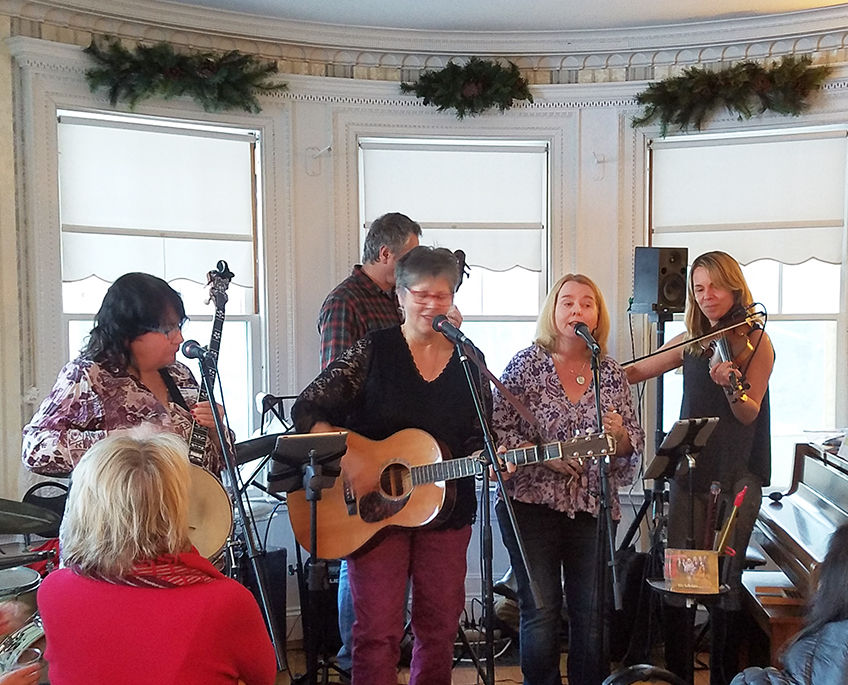
The Kelly Sisters perform.

Mr. Twister creates balloon animals for appreciative kids and their parents. (Photos by Nancy Beach)
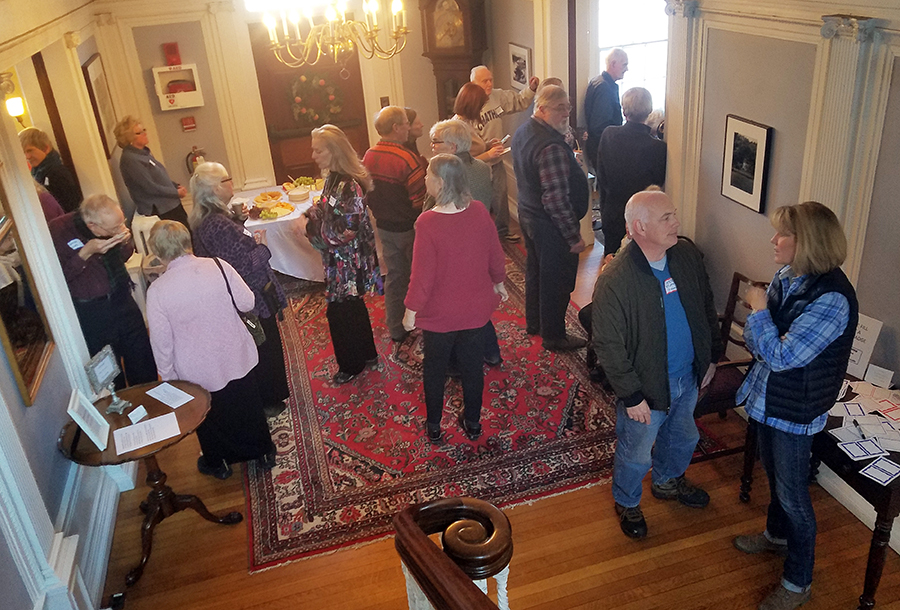
The First Day gathering as seen from the stairwell.

First Day at the Pierce House attracted dozens of Lincolnites of all ages on January 1, overcoming an earlier danger of cancellation.

Residents stepped up to help out and town organizations made donations to pull off the event, which was threatened by a shortage of funds due to renovation expenses. The Celebrations Committee, Rural Land Foundation, Police & Fire Association, Lincoln Family Association, private donors and town officials chipped in time and funding.

“It was heartwarming to see all who turned out to volunteer,” Pierce House Event Manager Nancy Beach wrote in a post on LincolnTalk. “I can’t thank you enough for all your hard work during all phases of the event. I made some new friends and enjoyed working side by side with you as we prepared for the party.

A variety of music was provided by the Ancient Mariners (Dixieland), the Kelly Sisters (Irish tunes) and clarinetist Craig Ball (swing), and kids got a kick out of balloon animals created by “Mr. Twister.” The day ended with the traditional singing of Auld Lang Syne.

The Pierce House Committee will assemble a group in the spring to start planning the 2019 First Day event. Anyone interested in helping should email Beach at nancy@piercehouse.com.
Category: features, news Leave a Comment

Kids get a taste of Election Day in Lincoln

November 14, 2017

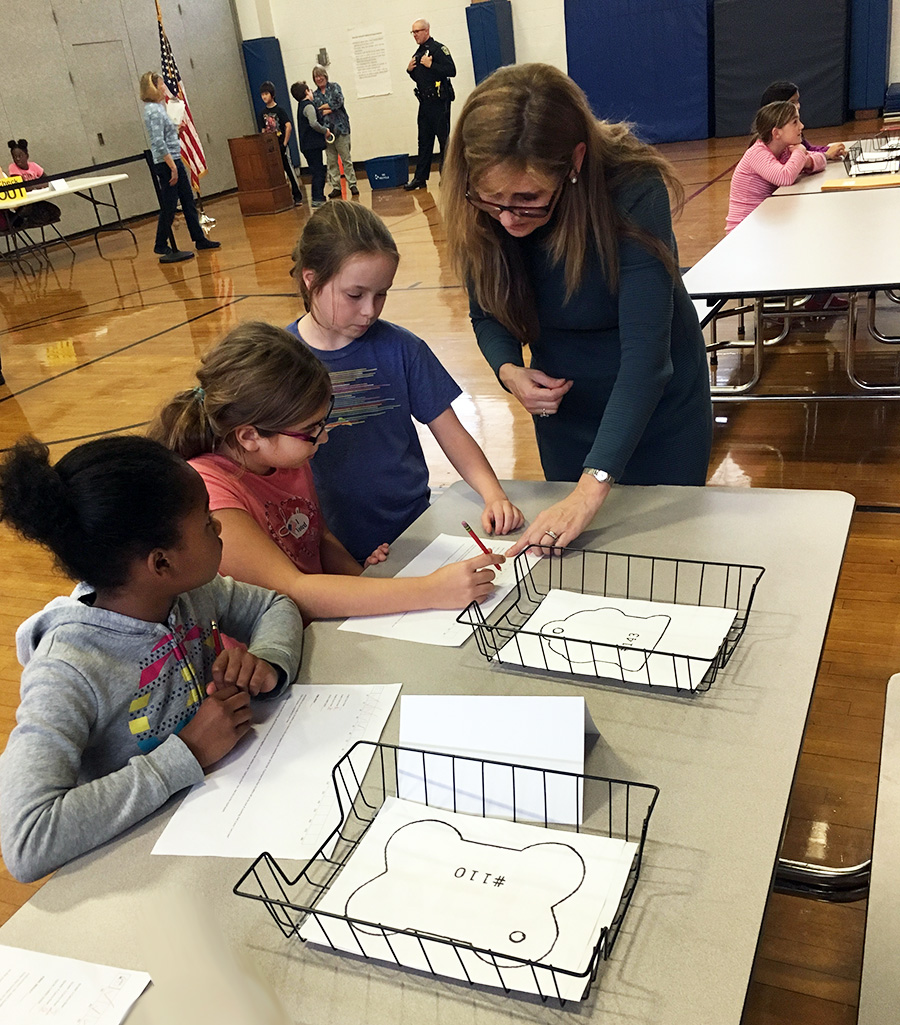
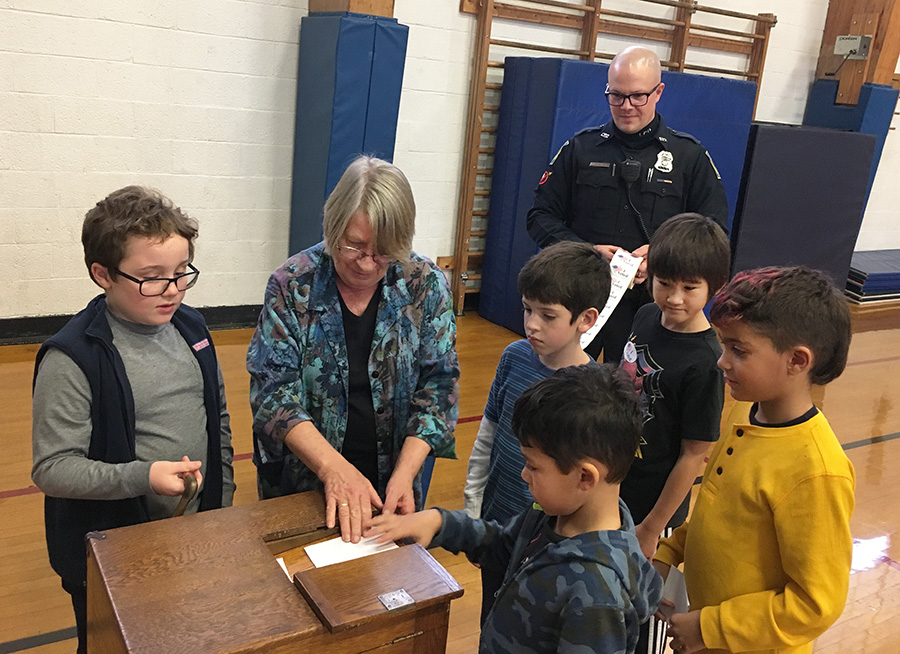
James Finbar Light (left) turns the crank of the Lincoln’s 100-year-old voting machine while Margaret Flint helps a student insert his ballot and Lincoln Police Det. Ian Spencer looks on. (Photos by Alice Waugh)

Dozens of voters filed into the Smith gym last week to cast their ballots on an important Lincoln issue—and even though none of the voters were officially registered, the results will still count.

The ballot question asked the “voters” (Lincoln School students in grades K-3) what shape they preferred for town dog licenses next year: a dog bone, a fireplug, or a dog house. Running the election and tallying the results were fourth-graders under the direction of Town Clerk Susan Brooks and other adult helpers to teach the kids about the voting process.

“I’d had this idea for a while, and it’s thrilling to see the kids, teachers and principals really embracing it,” Brooks said. “It’s a nice introduction to the kids of how the wheels of government turn, and it shows how in a town our size, a few people can make a difference.”

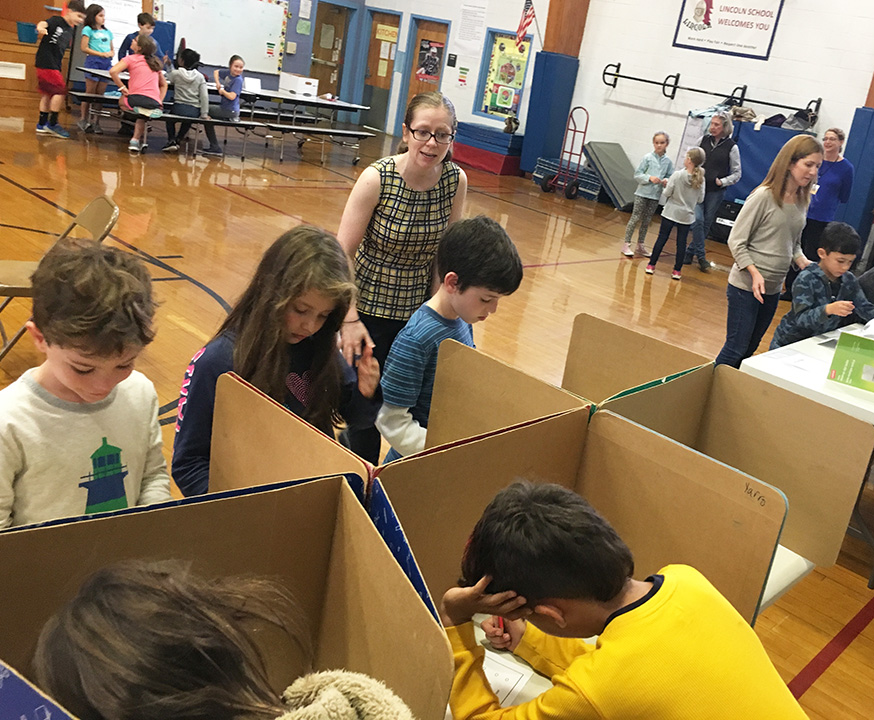
The “election” had all the features of the real thing: a check-in table where “registered voters” were matched against class rosters, voting booths (albeit cardboard), and a tally table where students recorded the results on a large chart as they came in.

The centerpiece of the operation was a 100-year-old Lincoln ballot box that was recently restored. When a voter inserted a ballot, the poll worker turned a handle, the ballot disappeared inside, a bell rang, and a mechanical tally number changed. In the old days, a small round ink pad inside also printed the word “Lincoln” on each ballot as it was processed through the rollers.

Lincoln School students mark their ballots for dog license shape as Assistant Town Clerk Susan Francis looks on.

The wooden ballot box has one part that doesn’t look quite genuine; the crank handle made of copper tubing doesn’t match but was clearly installed as a replacement at some point. One of the volunteers that day was Margaret Flint of the long-time Lincoln Flint family. As it turns out, her father-in-law, Warren Flint Sr., fashioned the replacement handle many years ago.

After the ballots were processed, each student got an “I Voted” sticker. Watching over the process was Lincoln Police Det. Ian Spencer, the town’s youth officer, making sure there wasn’t any Russian meddling.

“Outreach is a big part of what we do,” Brooks said. “The town clerk’s office, at bottom, is making government more accessible to people, and my role is to be more affirmative and proactive about it.”

Deputy Town Clerk Valerie Fox helps fourth-grade poll workers Donovan Everett (left), Alkmene Armoundas, and Brooke Mitchell.

While some of the kids have accompanied their parents into the polls on Election Day, this was their first chance to participate in a close facsimile of town voting, “and some fo them seem to be genuinely thrilled to be close to the action,” Brooks said.

Samantha Bodnar was one of those who was pleased to have her opinion count, at least on the issue of dig license shape. “It’s cool that the kids are voting on it and not the adults,” she said.

And the winner for next year’s dog license? “It will be a blue bone—in a landslide!” Brooks said.

Category: features, kids Leave a Comment

Codman Community Farms grows by adopting modern practices

November 2, 2017

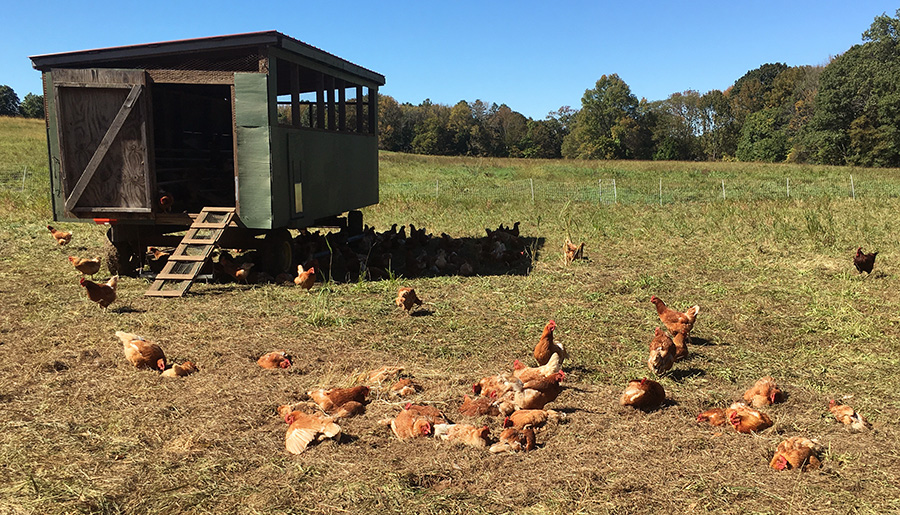
Codman chickens stroll and roost in their dust-bath holes. See more photos in gallery below. (Photo by Alice Waugh)

By Alice Waugh

Lots of fresh air, lying around in the warm sun or cool shade, munching on fresh grass in a spacious field, a change of scenery every few days—what more could an animal ask for?

Horizons have expanded for Codman Community Farms livestock since Pete Lowy took over as farm manager in early 2016. Human visitors have also noticed some changes, including a major expansion of the farm store and—ironically—fewer animals to be seen in and around the familiar white barns.

When visitors see the mostly empty coops and pens, “they say, ‘Oh, you’re not farming anymore?'” Lowy said. “Everyone hates the term ‘petting zoo,’ but it was sort of like that before—there were a few animals here and there, but it wasn’t really a working farm. Our challenge is conveying how this is better for the quality of the land and the livestock.”

Making the farm a going concern

By using new equipment such as a large moveable cattle shade and lightweight electric fencing, he’s been able to go beyond CCF’s 18 acres and utilize a total of about 80 acres for grazing livestock in various locations around town. Now, instead of a henhouse with a few dozen chickens, this summer there were more than 1,000 laying hens and 600 meat chickens puttering around off Codman Road and Old Concord Road, 125 turkeys on the north side of Codman Road, 80 pigs (mostly in the Van Leer field on Old Sudbury Road), and 26 Red Devon beef cattle in three different meadows—one of which includes a habitat for bobolinks.

The lower barn was converted earlier to an enlarged and modernized facility for washing and packing the 70 dozen eggs that those 1,000 hens lay each day. Just this week, workers began framing and insulating part of the space so it can be used for this year-round. Other recent additions to the farm include an energy-efficient walk-in freezer and several fruit orchards and plots for rhubarb, raspberries, tomatoes, kale and chard.

Some of these improvements are being funded by grants from the Massachusetts Department of Agricultural Resources and Lincoln’s Ogden Codman Trust as well as private donations. In the past year, $100,000 has been invested in infrastructure including the portable fencing, new water lines, a greenhouse for the chickens in the winter, tractors and other equipment. However, CCF’s operations are not subsidized by the town, which is responsible only for the upkeep on the buildings. Money to lease conservation land, buy and feed livestock, maintain the land, and pay Lowy and assistant farm manager Jared Martin has to come largely from sales of meat, eggs and produce.

While many of these items are sold in the CCF store, local restaurants including Lincoln Kitchen/Trail’s End and 80 Thoreau in Concord now buy eggs, while Moody’s in Waltham buys stewing hens to make chicken stock and other products. The store itself has new glass-front refrigerators as well as a high-tech self-service checkout. Customers scan bar codes corresponding to what they’re buying and then use a touchscreen to pay via credit card or ApplePay—though leaving cash in a paper envelope is still an option.

[Best_Wordpress_Gallery id=”81″ gal_title=”Codman Community Farms 2017″]


The first stop on a tour via electric golf cart and pickup truck was the vegetable garden and high-density apple orchard between the barns and the Codman Estate. In modern practice, fruit trees are planted very close together, clipped to trellises, and pruned aggressively to yield more fruit per acre than a traditional orchard.

This fall’s yield also included pumpkins, winter squash and a few potatoes; Lowy hopes to plant more spuds next spring. None of the produce is sold to outside buyers, however’ “it’s just to round out the products we have here,” he said. “One of the keys to successful farming is being diversified.”

A herd of cows grazes on a field next to the solar and septic facilities for Lincoln Woods. Like most of the other livestock, the cows are moved en masse every few days to a new section when the farmers pick up and relocate areas of flexible electric fencing (some of it solar-powered) within the meadow. Moving the animals frequently means that they always have fresh grass, and the field can recover in stages while also getting fertilized evenly over time, thanks to their four-legged guests.

Although it’s better for the land and animals, this technique is more labor-intensive than keeping livestock in larger fixed fields. Lowy and Martin have to move the fencing and animals themselves, and they also need to keep the section edges trimmed, because wet grass touching the electric fence above will cause a short circuit. It also requires mental work, since each spot has unique amounts of rocks, slope, and wetness.

“You have to keep it all in your head and know what you have to do each time, and what fields are best for what,” Lowy said.

Fowl play in the fields

Chickens populate the field on the south side of Codman Road near Route 126. Inside their fenced area are feeders, a moveable water tank, and a coop on wheels where they can take shelter and lay their eggs. Despite the fencing, the birds and their eggs would be easy prey for coyotes, fisher cats, and raccoons, but they have protection in the form of Toby. He’s an Anatolian shepherd, a type of dog specifically bred to guard flocks of poultry, and he’s unperturbed by the dozens of clucking birds trotting around his legs.

Although the chickens don’t tear up the grass as much as cows or pigs, they have another habit that can pose a hazard for the farmers if they don’t keep their eyes on the ground while feeding the birds and collecting their eggs every day—the field is pitted with shallow holes that the chickens scratch out to give themselves a dust bath and then nestle in to rest. But with plenty of room for their excavations, the chickens are more spread out, so they don’t peck each other or spread illnesses as quickly.

Across Codman Road is a field with similar enclosure for turkeys guarded by Andy, another Anatolian shepherd, while a field near Mount Misery is home to the stewing chickens. The dogs live in the enclosures with the birds 24/7, sharing their water and eating raw meat provided by the farmers. Like the birds, they take advantage of the shade provided by the mobile coops to doze on hot summer days.

The dogs aren’t expected to kill predators—they just keep them away by barking and marking boundaries in the way dogs generally do. However, living with the dogs does put some limits on where the birds can be located—if they’re too close to houses, their canine guards will keep the homeowners awake at night with their barking.

Perhaps the most contented livestock this summer were the pigs, who live in the field on the south side of Old Sudbury Road. They spent their time rooting for plants, socializing, and enjoying the muddy spots (“that’s the air-conditioned section,” Lowy joked). “That’s why our animals taste good—they eat great food, get a lot of fresh air, and run around.”

Winter plans

Now that the cold weather is coming, the chickens and Toby will soon be moved to the greenhouse, which will offer shelter and light at least 12 hours a day (so the hens keep laying eggs) but is also open to the outdoors. The turkeys, alas, will not survive the winter—mainly because they’re all spoken for, with Thanksgiving coming up.

As fall deepens into winter, the farmers will bring the pigs back to the main farm to live in a barn and fenced area. The sows will be slaughtered after having their first litter of piglets and the meat brought to smokehouses in Connecticut and Vermont for eventual purchase by New England Charcuterie in Waltham as well as CCF store customers.

The cows will stay outside during the winter in a field closer to the barn. Lowy is installing an insulated frost-free drinker that uses water from the new piping, and they’ll eat the hay that was harvested over the summer. But the best is yet to come for three young cows—Lowy plans to rent a bull to breed the lucky heifers in the front pasture (hopefully at a moment when no children are visiting).

Meanwhile, the store is still expanding its selection with yogurt from Sidehill Farm in Hawley, Mass. (also a supplier for Whole Foods), and bread, baguettes, and bagels from Bread Obsession in Waltham available on Fridays and Saturdays. These products are sold alongside eggs and chicken with the Pete and Jen’s Backyard Birds label, which dates from when Lowy and his wife raised chickens while he was assistant farm manager at Verrill Farm in Concord.

Once winter is here, Lowy and Martin will be freed of their fence- and animal-moving duties and will spend more time doing repairs and maintenance around the farm, cleaning and painting the chicken coops, and other tasks in addition to caring for the livestock. Lowy and the CCF board will also be thinking about how they can illustrate for visitors the operations of a farm that, at first glance, doesn’t seem to have many animals.

The hard work in the fields starts again in the spring, when Lowy has lots of ideas for further reinvigorating Codman Community Farms: more haying and vegetable gardening, more field acreage, more turkeys—and some sheep to join the other livestock. He also hopes to find a part-time coordinator for volunteers, who play a big role in haying, mowing, gardening and other tasks. Once the weather warms, up, “we can always find things for folks to do,” he said.


Category: agriculture and flora, conservation, features, land use Leave a Comment

Lincolnites join forces with crowd at climate rally

May 1, 2017

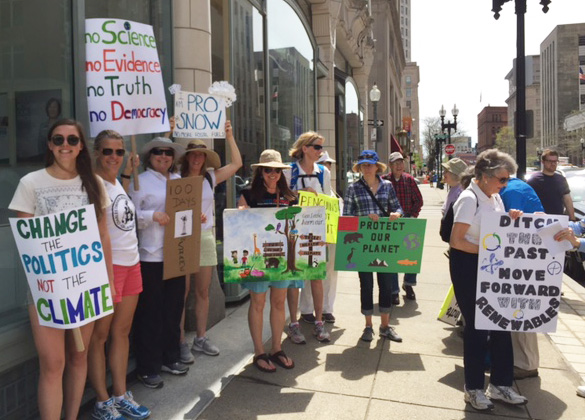
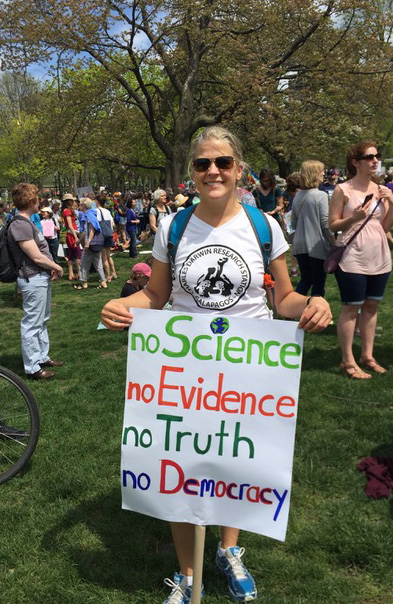
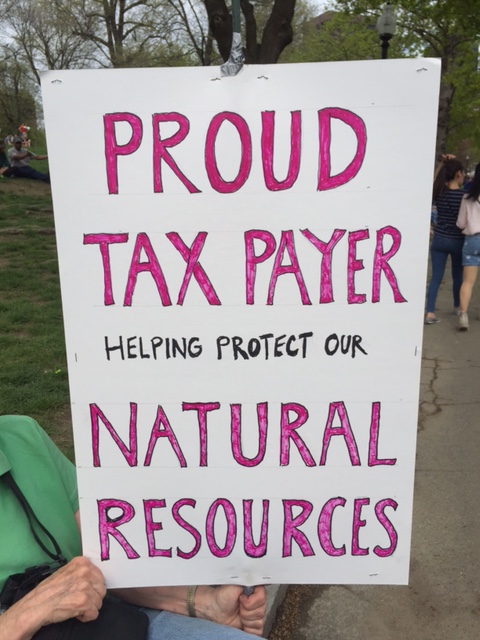
Eighteen Lincolnites armed with posters, good spirits, hats, and sunscreen participated in the Boston People’s Climate Mobilization on Boston Common on Saturday, April 29. A Doherty’s bus, organized by the Lincoln Democratic Town Committee, conveyed the group to and from the rally.

Sponsored by a wide array of environmental organizations, the rally offered workshops, teach-ins, music, and speakers focusing on jobs, economic and environmental justice, and ideas for promoting job growth and diminishing the ill effects of climate change.

“The activities were informative and often inspiring and the mood was buoyant, as it was a perfectly beautiful spring day in Boston with participants, along with their children and their dogs, enjoying the warm sunshine and the flowering trees, shrubs and tulips in the Public Garden,” said participant Barbara Slayter, who provided the photos below (click any image to enlarge).

Gwyn Loud, Nancy Soulette, and Elizabaeth Cherniack on the bus to Boston Common.

Barbara Slayter behind her Maura Healy sign.

The Lincolnites get themselves organized before heading onto Boston Common.


Jillian Darling displays her poster.

Kate Dahmen and Staci Montori, whose sign calls attention to unrepaired natural gas leaks.

Leslie Hallowell and Sherry Haydock.

Lia Darling.


Nancy Soulette’s sign.

Category: conservation, features Leave a Comment

Beach hopes to bring more events to Pierce House

April 27, 2017

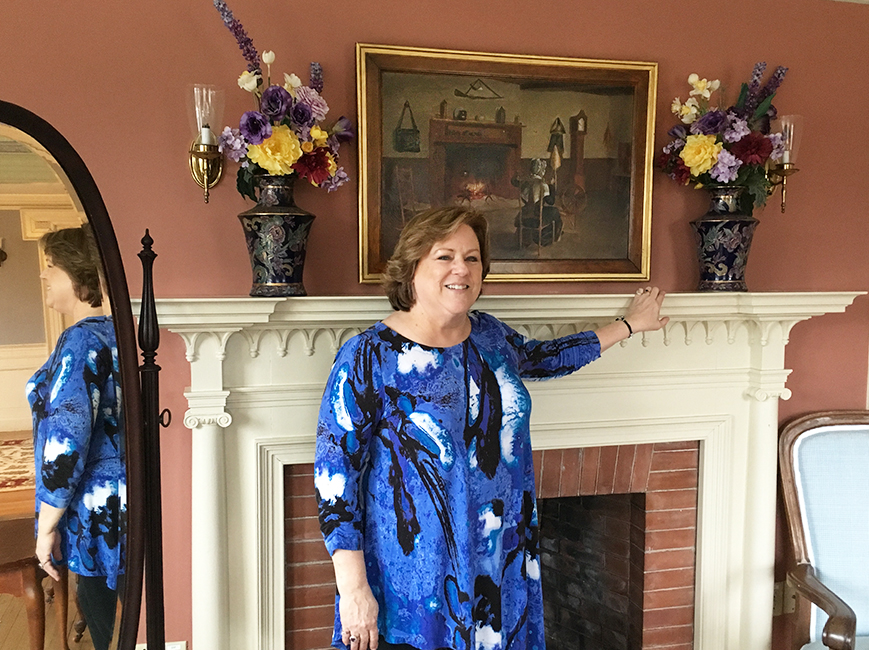
Nancy Beach reflects on her new role as Pierce house events manager.

The new live-in event manager of the Pierce House hopes to expand the historic building’s beyond summer weddings to widen its appeal and help pay for more improvements.

Nancy Beach was hired in January after managers Richard and Susan Silver retired after 22 years. She’s taken over the job of booking rentals, managing contracts and overseeing upkeep of the house along with town facilities staff. “We’re here to guide her and support her, but she’s in charge,” said Virginia Rundell, chair of the Pierce House Committee, which proposes the annual budget and general oversight.

Much of that budget comes from fees paid for use of the house by those who rent it for weddings and other events. Summer Saturdays are fully booked for that purpose, but Beach plans to market the house for other uses such as weekday corporate retreats and meetings as well as wintertime events. The Pierce House played host to a wedding reception on a snowy evening in January, and “they had a lovely time—it was so beautiful with all four fireplaces going,” Beach said.

Beach, who grew up in Concord, started her career as a wedding planner in the 1980s and was later in charge of worldwide training and customer entertainment events at Hewlett-Packard. Four days after moving into the refurbished manager’s apartment in January, she organized a separate bridal show in another town and got dozens of leads for future bookings.

More income could help Beach pay for better period decor and other interior upgrades. “If I can bring in enough money to put back into house, then we can improve it,” she said.

Additional events for Lincoln residents are also a goal. “The committee did some soul-searching last year and talked about our mission, and we’d like to do more events that bring Lincolnites into the house,” Rundell said. Past shindigs have included the Downton Abbey viewing party in 2014 and a welcome event for new Lincoln residents; organizations such as the Lincoln Family Association and the Council on Aging periodically make use of the house, and Beach envisions other local social groups and families coming in as well (Lincoln residents and groups get discounts on the rental fees, Rundell noted).

“It’s a little corny, but I think of the Pierce House being a part of Lincolnites’ lives” for everything from baby showers to weddings and post-funeral gatherings, Rundell said. “It’s so iconic.”

Category: features Leave a Comment

Minuteman’s Bouquillon fires up the grill near and far

April 19, 2017

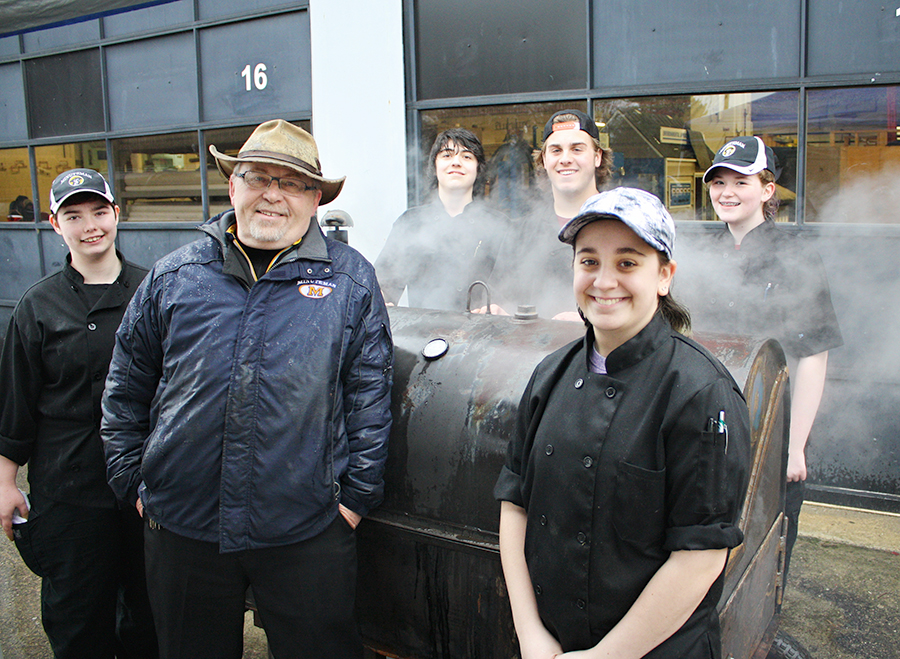
Superintendent Edward A. Bouquillon stands in front of his BBQ smoker, flanked by Culinary Arts students Natalia Gorman of Belmont (left) and Allison Sanzio of Stow (right). Behind them are Chris LeBlanc of Watertown, Christian Ciaramaglia of Everett, and Taryn O’Connor of Bolton. 

By Steven C. Sharek
Director of Outreach and Development, Minuteman High School

On weekdays, he serves as the top administrator at an award-winning regional high school. On weekends, he puts on an apron and hat and becomes an award-winning barbecue chef.

It’s probably safe to say that Dr. Edward A. Bouquillon, superintendent of Minuteman High School, is unique among the ranks of area school superintendents, sharing passions for both vocational-technical education and barbecue cooking.  Several times a year, those passions overlap.

That’s when you can smell smoked beef brisket in the air at Minuteman High School and on the superintendent’s clothes. That’s when Dr. Bouquillon—known simply as “Dr. B” to the students at Minuteman—teaches meat cutting, authentic barbecue preparation, and the use of barbecue sauce, brines, injects, and rubs to students in the Culinary Arts program at Minuteman.

Welcome to what’s known as “Dr. B’s BBQ Institute.”

“I like to share what a BBQ judge would look for,” he says, wearing a barbecue chef’s jacket and trademark hat.

Dr. B. knows what judges look for because he’s cooked at BBQ competitions and has been a judge himself. He’s gone to BBQ competitions all over the country and has won trophies, ribbons, and certificates. He’s a member of the Northeast Barbecue Society (which runs BBQ grilling classes at the Maynard Rod and Gun Club), the Kansas City Barbecue Society, and the Memphis Barbecue Network.

During the first week in April, Bouquillon led a team of Minuteman Culinary Arts students in preparing nearly 300 pounds of beef brisket and 15 racks of ribs for an authentic barbecue buffet to be served in the school’s student-run restaurant. Under his direction, they added specific amounts of honey, rub, and spices to the ribs and pork butts. During the cook, they sprayed the meat with apple juice. The ribs would be on the smoker for four hours and the pork butt for eight, Bouquillon estimated.

Beef brisket prepared the day before was slow-cooked for 16 hours on Bouquillon’s personal smoker, a black, barrel-shaped, six-foot-long metal tank fueled by apple wood and lump charcoal. The smoker operates at surprisingly low heat—220 degrees for most meats. “It’s authentic,” he says. “No electricity, no propane. It’s real and it takes time, attention, and skills I want my kids to learn.”

In addition to this special annual event—probably the seventh or eighth, he guesses—the superintendent also oversees “Dr. B.’s BBQ Break” once every semester. The event recognizes the class with the highest attendance rate of the quarter and rewards the students with a free barbecue meal cooked by Culinary Arts students under his supervision.

How did Bouquillon acquire this flair for barbecue? He explains it this way: 35 years ago when he was a student and friends had an event, he was always asked to help with the food, so he started roasting pigs in cinder block pits. After earning a B.S. in animal sciences and a master’s in animal industries, he taught in an agricultural high school and then became a school administrator. About 10 years ago, he started entering barbecue competitions at Minuteman, and appreciates the family atmosphere prevalent in the BBQ culture.

Bouquillon hopes to break ground on a new high school building by early this summer. But before that happens, he’ll be off to his first barbecue festival of the season in Ridgefield, Conn., on May 6-7 and the Memphis in May International Festival on May 17-20 for the World Championship Barbecue Cooking Contest. He’ll be competing as a member of the Bare Bones BBQ Team in Memphis.

Bouquillon also has his own team, with its own logo, its own T-shirts, and barbecue sauces and base rub. His team is called Big Head Ed BBQ, a self-effacing name he coined to describe his own cranium. He’s proud of the growing popularity of barbecue and efforts to create BBQ cooking competitions just for youngsters, known in the field as “kids’ Q”. He hopes to have his grandchildren competing with the team this summer.

Category: features, food, schools Leave a Comment

Ms. G gets ready to strut her stuff

January 19, 2017

The incomparable Ms. G.

Mass Audubon’s Drumlin Farm Wildlife Sanctuary is set to host their annual Groundhog Day event on Thursday, Feb. 2. Watch Ms. G, the Official State Groundhog of the Commonwealth of Massachusetts, deliver her 10th prognostication.

The live groundhog forecast starts at 10 a.m., followed by winter activities such as meeting Drumlin Farm’s resident wildlife, exploring its trails, and learning how to identify animal tracks in the snow. Hot cocoa will be provided.

Featured Programs:

  • Learn the forecast for spring’s arrival from our woodchuck weather expert
  • Visit our resident wildlife and farm animals
  • Meet Don McCasland of Blue Hill Observatory Science Center
  • Learn about winter tracking
  • Make winter crafts to take home
  • Purchase produce grown right at Drumlin Farm

Admission is $9 for adults, and $6 for children ages 2–12 and seniors (free for Mass Audubon members). Activities are free with admission.

Category: features, kids, nature, news Leave a Comment

The year in review (part 2)

December 30, 2016

Site of the former Aka Bistro, soon to be Lincoln Kitchen.

December

  • State says no to Lincoln school funding for the third time
  • ConsComm OKs approves ‘land swap’ for solar installation
  • Letter to the editor: Vander Meulen throws hat in ring for selectman
  • Letter to the editor: Fredriksen to resign from Board of Selectmen
  • Letter to the editor: Glass running for Fredriksen’s seat
  • Dwyer hopes to modernize town government’s outreach methods
  • Braun reflects on his two terms on Board of Selectman

November

  • McLean Hospital sues Lincoln over Bypass Road decision
  • Sale closes on Wang property; town will be asked for $850,000+
  • Benefits and hurdles for solar array at landfill discussed
  • Small-scale agriculture expansion discussed at SOTT
  • Traffic remedies discussed at State of the Town
  • Final election results show Lincoln voted ‘yes’ On Question 2
  • ZBA says no to McLean Hospital
  • Officials discuss ways to tweak Town Meeting
  • ZBA expected to vote on McLean proposal this week

October

  • Groups proposed for economic development, south Lincoln
  • Students apply engineering skills to solving school problems
  • Car accident sends two to hospital
  • Land purchase aims to help town and Birches School
  • A pair of ground-breaking occasions
  • Trails’s End Cafe opens its doors in Lincoln

September

  • Drought playing havoc with plants and wildlife, speakers say
  • Bouquillon looking forward to new chapter for Minuteman
  • Minuteman school measure passes in district-wide vote
  • McLean Hospital proposal goes to the ZBA
  • Carroll School gets Wayland’s OK for Old Sudbury Rd. project
  • State grant will help town look at options for street safety
  • Images capture drought in Lincoln
  • Agriculture Day blooms in Lincoln
  • Winter Street hospice construction underway

August

  • Trail’s End to open cafe, restaurant in two Lincoln Station locations
  • Causes of bicycle fatalities still under investigation
  • ‘Ghost bike’ removal stirs debate
  • Outdoor water ban now in effect as drought drags on
  • Four-legged wildflife caught on cameras
  • McLean psychologist downplays risks of Bypass Road facility

July

  • Police chief talks about progress and challenges
  • Trail’s End vies with Blazes for Aka Bistro space
  • Whistle Stop closes abruptly, leaving mall without a restaurant
  • Minuteman project going to district-wide vote

Category: businesses, features, government, kids, land use, news, seniors, sports & recreation Leave a Comment

2016: the year in review (part 1)

December 29, 2016

Kids enjoyed ice cream and other diversions at Lincoln’s “40 Years of Community” fair in April 2016.

June

  • Bemis Hall unveils new space
  • New co-ed softball league is fielding teams
  • Flint’s Pond fire yields unique research opportunity
  • Event marks completion of new Hanscom Middle School

May

  • Residents turn out in force against McLean proposal
  • Lincoln resident bilked out of more than $1.4 million
  • Minuteman school building project hits another snag
  • McLean Hospital plans teen residential facility on Bypass Road
  • Residents moving into new areas at the Commons
  • AKA Bistro to close Sunday; Blazes may take its place
  • Hundreds of Lincolnites flock to the fair

April

  • Lincoln group working to create a new pollinator meadow
  • Fair celebrates 40 years of three town institutions
  • Carroll School buying property on Lincoln/Wayland line

March

  • School steps up security in wake of graffiti incident
  • Three concrete towers planned along railroad tracks in Lincoln
  • Olson, Gladstone win Planning Board seats
  • Gun safety, fossil fuel measures passed
  • Residents vote to try for school funding again
  • Voters OK buying land for possible solar swap
  • Budget approved; property taxes to drop by 0.5%
  • Mangini family thrilled with Mark’s Oscar for “Mad Max: Fury Road”
  • Lincoln goes for Kasich, Clinton in presidential primary

February

  • Minuteman school district down to 10 towns
  • Lincoln withdraws from Minuteman school district
  • Town Meeting warrant includes modest budget hike
  • First Parish marks installation of new minister on March 6
  • Cambridge Trust Co. closings its doors
  • Campus study group presents final report

January

  • Burney dives into Lincoln planning and land use
  • New road name leads to clash among residents
  • MBTA proposes revised commuter rail schedules
  • Codman Farm has new farming family
  • New Hanscom Middle School proceeding on schedule

Category: agriculture and flora, arts, features, government, history, kids, Lincoln through the Lens, news, schools, seniors, sports & recreation Leave a Comment

Police chief talks about progress and challenges

July 28, 2016

Lincoln Police Chief A. Kevin Kennedy.

Lincoln Police Chief A. Kevin Kennedy.

A new “Coffee with a Cop” program, video recording of police encounters, the opioid crisis and the possible legalization of marijuana in Massachusetts are just some of the topics Chief of Police A. Kevin Kennedy  touched on in a wide-ranging interview with the Lincoln Squirrel.

Staring on September 15, Kennedy will host the Lincoln Police Department’s inaugural Coffee with a Cop program in which police will meet with residents on the third Thursday of every month at Bemis Hall from 1-2 p.m. A different officer will be on hand each month to answer questions in either  small groups or one on one.

“There’s no agenda. People can come in and talk about whatever questions or concerns they have,” Kennedy said. “It’s just a way for us to be more involved with the community and answer question residents may have, when they’re maybe not as comfortable coming into the station.”

Questions and issues that may arise range from traffic concerns, handling disputes with neighbors, difficulties with a child, or concerns about driving by an older adult, said Kennedy, adding that he was open to holding an evening session in there was enough interest.

“We mediate and arbitrate things all the time. We’re more of a community-oriented police department offering social services—how can we help people in crisis? How can we point them [victims, suspects and family members] in the right direction?”

Jail diversion coordinator

Calls involving people with mental health issues are fairly common in police work, and Lincoln has another tool to help in those situations. Eight Middlesex County towns including Lincoln got a three-year grant to fund a clinical coordinator for the Regional Jail Diversion Program.

“We know that assaults, larcenies and property crimes are often committed by those with mental health or substance abuse issues,” Acton Police Chief Francis Widmayer said in a statement when clinical coordinator Alia Toran-Burrell was hired in December. “Our goal when we began this coalition was to put residents into treatment instead of behind bars. With the assistance of our clinical coordinator, who will train officers in all our communities on how best to respond to mental health or substance abuse related incidents, we can reduce crimes and change lives.”

The opioid crisis

While Lincoln is not a hub of drug-dealing activity, some criminal activity such as house break-ins can be traced to the opioid epidemic, Kennedy said. Lincoln fire and police personnel carry Narcan, a drug that can quickly reverse an opioid overdose at the scene; the Fire Department has used Narcan on at least one call in Lincoln, though police have not, he said.

“It’s here, it’s everywhere, and no community is immune from it,” Kennedy said.

Video recording of police encounters

Millions of people in recent months have seen the videos of police shootings recorded on bystanders’ cell phones. It’s perfectly legal to film a police encounter as long as it doesn’t interfere with officers’ work, and since cell phones are everywhere, “police are always under the assumption that they’re being filmed,” Kennedy said. At the police station, interrogations and bookings in police stations are also recorded on audio and video.

Some have suggested that police wear body cameras to record encounters, something that could protect both police and civilians when a situation turns violent or the facts are in dispute. But there are legal and privacy concerns as well as possible reluctance on the part of victims and others to speak candidly to police if they know they’re being filmed, Kennedy said. Still, “it’s something we’re definitely looking into… There’s a balance there somewhere, and law enforcement is trying to work out that balance now.”

In the end, police training and preparation are the biggest factors in keeping situations from getting out of control. “You never know who you’re going to be in contact with, or their prior experiences with law enforcement, or whether they have a mental health issue, so officers rely on their training,” Kennedy said. “I can’t emphasize enough the amount of training we’ve done.”

Asked about his take on some of the recent well-publicized shootings involving police officers, Kennedy, replied, “Being on the sidelines without knowing about everything is not fair to make a comment on. Only grand juries hear all the evidence; not everything is released to the public. The public wants [a judgment] immediately, but they have to maintain the integrity of the investigation.

“It all reverts back to officer training, their involvement in the community, and officers treating people with respect and dignity no matter who they are, whether they’re victims of a crime or a suspect,” Kennedy continued.

RESIST training

RESIST, Lincoln’s self-defense class for women, has been very successful since its inception in 2013. The program, which is coordinated by Lincoln resident Jena Salon, was developed by Lincoln police officers who have undergone the more comprehensive 40-hour RAD (Rape Aggression Defense) program, and one of the officers is also a former defensive tactics police instructor. The program teaches situational awareness, confidence-building and escape from attackers rather than fighting back.

RESIST has been so successful that the Domestic Violence Services Network (DVSN) has applied for a grant to offer it, and Lincoln police have trained officers in other communities how to teach it as well. “We’ve had nothing but tremendous feedback,” Kennedy said.

Marijuana

Massachusetts is one of five states that will have a ballot question in November asking voters whether to legalize recreational marijuana (the Commonwealth has allowed medical use of the drug since 2012). But marijuana laws have been evolving for years, Kennedy noted. The drug was decriminalized in 2008, meaning that possession of less than one ounce does not result in arrest but incurs only a civil fine of $100.

“Case law has really dictated over the last couple of years what cops can or can’t do when they come in contact” with the drug, either visually or by smelling burnt or raw marijuana, Kennedy said. Odor alone does not entitle police to perform a search, and if an officer sees the drug, “it has to be immediately apparent to you that’s a criminal amount of marijuana” with an intent to distribute before they can take action, he said.

Police concerns over legalization of recreational marijuana revolve around possible increases in use by juveniles and traffic accidents resulting from driving while impaired, Kennedy said. Right now there is no legal limit for the amount of THC (marijuana’s active ingredient) in the bloodstream for driving and no quick test anyway, so officers have to rely on drug recognition training. If an officer believes a driver is impaired by a drug but is not driving to endanger, they can take the keys away but can’t make an arrest or issue a ticket, Kennedy said.

Security is already an issue for medical dispensaries because marijuana distribution is “a cash-and-carry business,” Kennedy noted. Because marijuana is still illegal at the federal level where interstate financial transactions occur, dispensaries can’t accept credit cards or checks.

“It’s very challenging for law enforcement… but we’ll enforce the law whatever it is, and whatever changes in our policies and procedures are needed, we will cert comply and get trained.”

Category: features, news Leave a Comment

  • « Go to Previous Page
  • Page 1
  • Interim pages omitted …
  • Page 3
  • Page 4
  • Page 5
  • Page 6
  • Page 7
  • Interim pages omitted …
  • Page 11
  • Go to Next Page »

Primary Sidebar

Recent Posts

  • Water bills to go up by 13% March 5, 2026
  • News acorns March 5, 2026
  • Property sales in January 2026 March 4, 2026
  • My Turn: Unraveling the Hanscom misallocation March 3, 2026
  • Police log for Feb. 19–25, 2026 March 3, 2026

Squirrel Archives

Categories

Secondary Sidebar

Search the Squirrel:

Privacy policy

© Copyright 2026 The Lincoln Squirrel · All Rights Reserved.