 Officials from several town boards, a consulting engineer, and dozens of residents convened at a multiboard meeting on Sept. 28 to share the latest proposals and try to answer questions from the public about the library HVAC system.
Not in question is the need to replace the 37-year-old gas-fired boiler before it fails. At issue is whether voters at the Oct. 24 Special Town Meeting will opt for a high-efficiency gas-fired boiler costing about $330,000 plus future significant expenditures to upgrade other pieces of the HVAC system, or a comprehensive geothermal ground-source heat pump system (GSHP) plus HVAC upgrades that would run on electricity rather than fossil fuels and thereby cut carbon emissions in keeping with Lincoln’s goal of eventually having town buildings be 100% green.
The GSHP-based system would cost an estimated $6.25 million, though the net cost to the town would be about $3.7 million after grants and tax incentives are factored in. Consultants have said that replacing the entire system with one based on a gas boiler would cost a total of about $3.32 million.
Community Preservation Committee Chair Eric Zimmerman confirmed this week that his group has agreed to finance up to $2.47 million of the total cost, which would push its debt service from 30% to about 46% of its expected annual revenue. The Finance Committee has recommended borrowing another $1.2 million through a 20-year bond that would be funded under the regular budget tax levy limit rather than a debt exclusion. In the short term, the stabilization fund would have to be tapped for another $1.55 million “until confirmation of expected incentives,” FinCom Chair Paul Blanchfield said. Neither the CPC nor the FinCom took a vote on recommending either option.
If voters reject the GSHP system and opt for a new gas-fired boiler, the questions then become: (1) should the rest of the HVAC system be replaced in a single comprehensive project, done in planned steps, or only when components fail, and (2) how much will that system cost in total, especially when considering inflation over the years.
“You can do it piecemeal, but you’ll definitely have to upgrade [the rest of the] system because the technologies have all become obsolete” in terms of building and safety codes, said Brandon Kelly, the town’s facilities director. On the other hand, although the rest of the system could certainly be replaced in a single project sooner, the cost is unknown at this point since it hasn’t been designed, Assistant Town Manager Dan Pereira said.
“If voters reject the heat pump [option], I’m going to hear a clear signal that they’re worried about the cost of the project,” Select Board member Jim Hutchinson said. “We’d look for ways to reduce the project cost, which probably means reducing the scope of the conventional project.”
As with an aging car, residents must decide next month whether “it’s worth fixing the transmission knowing you’re going to have to keep putting in money, or invest now when you have [green energy] incentives,” Blanchfield said. “More to the point is where the town wants to spend the dollars and how much value they put in having a more green solution that’s 9% more expensive than a full traditional system.”
Also unknown is how much inflation and future savings due to improved technology or other factors will affect the cost of a traditional system, either step-wise or all at once, he added.
If voters opt for the conventional boiler next month, the town could draw up a budget for design and construction (or perhaps just design) for the rest of a new conventional system in time for a vote at Annual Town Meeting in March 2027, Town Administrator Tim Higgins said. According to a spreadsheet linked from a Sept. 11 memo by Pereira, an in-kind conventional system would cost $3.28 million and would save the town about $3,800 in energy costs, compared to about $2,200 for the GSHP system.
“Town officials need to be careful about saying that the heat pump option is only 10% more expensive,” resident David Cuetos said. He questioned several items in the budget, such as $1.71 million for overhead and other project-related costs, and $430,000 for American with Disabilities Act improvements — something that may not be required if the project doesn’t cross the threshold of having at least 30% of the building renovated or replaced and thus trigger state-mandated ADA upgrades, he said.
Cuetos also said that the gas boiler for Bemis Hall, which had to be replaced on an emergency basis last year, cost only about $41,000. Although the library has about 40% more floor space, “how can that [conventional] boiler be almost 10 times as expensive?”
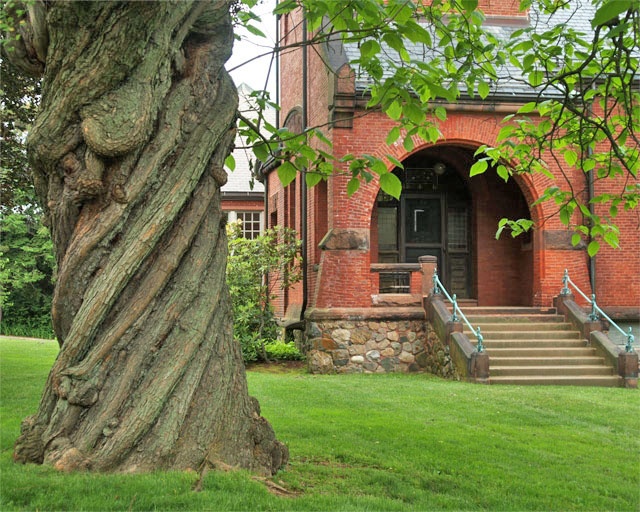
Other residents at the meeting asked about the impact of the work on the rest of the library interior as well as its surrounding landscape and masonry foundation, which some worried could be damaged by vibrations from nearby well-drilling. The topic has also been the subject of discussion and debate online (LincolnTalk login required).
Bill Garbati with consulting engineering firm Energy Systems Group said the drilling will not cause any damage since the wells will be about 75 feet from the building and far enough away from the trees and irrigation lines to keep them intact. The interior mechanical spaces will not be enlarged, the interior ductwork and registers will be reused, and the rooftop air-conditioning condensers will be removed, he said.
Officials are updating an FAQ document (a draft of which was available at the multi-board meeting) to address some of the questions that will be posted on the Special Town Meeting web page. Future information sessions on the topic will be hosted by the Select Board (Monday, Oct. 5 at 6:30pm) and the Green Energy Committee (Tuesday, Oct. 13 at 8:00 a.m.), and at the State of the Town meeting on Oct. 24 at 9:45am before the Special Town Meeting at 10:30am.