• Skip to primary navigation
  • Skip to main content
  • Skip to primary sidebar
  • Skip to secondary sidebar

The Lincoln Squirrel – News, features and photos from Lincoln, Mass.

  • Home
  • About/Contact
  • Advertise
  • Legal Notices
    • Submitting legal notices
  • Lincoln Resources
    • Coming Up in Lincoln
    • Municipal Calendar
    • Lincoln Links
  • Merchandise
  • Subscriptions
    • My Account
    • Log In
    • Log Out
  • Lincoln Review
    • About the Lincoln Review
    • Issues
    • Submit your work

schools

Letter to the editor: time to move forward with a school project

March 6, 2017

letter

(Editor’s note: There will be a multi-board meeting and forum on Wednesday, March 8 at 7 p.m. in the Brooks Gym. This is the second such meeting in recent weeks about the school project; click here for coverage of the first multiboard meeting on January 30.)

To the editor:

Last April, Lincoln again applied for state funding for a school building project from the Massachusetts School Building Authority (MSBA). In December, the town learned that we were not invited into the 2016 funding pipeline. After careful consideration, we, the members of the Lincoln School Committee (LSC), have voted unanimously to recommend that the town move forward independently and begin planning a Lincoln-funded school building project. This is an opinion that we have shared openly with other boards and that we introduced to the public at the January 30 multi-board meeting. It has since been endorsed by multiple town boards and committees.

The purpose of the January 30 meeting was to launch a community process that we hope will bring the town to consensus on a Lincoln School building project. The first decision will be made at the March 25th Annual Town Meeting. The LSC is bringing forth for the town’s consideration two warrant articles that represent two different pathways:

  • Article 33: Using the money we already set aside in 2015, will the Town permit the School Committee to begin planning a Lincoln-funded project? OR
  • Article 34: Should the Town continue to re-apply to the MSBA?

The LSC views these articles as an either/or choice representing two distinct pathways and timetables. The School Committee recommends voting “yes” on Article 33 and passing over Article 34.

Article 33

As stewards of the school, we believe the time has come to act independently for the following reasons:

  • The Lincoln School’s building systems are at increasing risk of failure, and the fiscally responsible approach is to address the deficiencies with a thoughtfully planned single project.
  • We are committed to creating a learning environment that supports the town’s educational vision.
  • There has been considerable community engagement over the past five years, and a growing consensus that a school project is one of the town’s top priorities.

Certain systems in the school, such as the roof and boilers, are on borrowed time. With immediate action, the earliest completion date for a renovation project is late 2021. Waiting to act lengthens the timeline and increases the risk of a costly infrastructure failure that would force us to reactively spend millions of dollars.

Since 2002 when the Capital Planning Committee first recommended a comprehensive approach to addressing the school’s capital needs, the town has conducted five studies of the facility. Each study has confirmed the idea that it is fiscally prudent to thoughtfully plan a project that holistically addresses the school’s infrastructure needs.

For the past several years, because we sought to maximize the impact of the town’s investment, the LSC asked for town support to seek MSBA funding. Yet, since we applied last April, we have learned more about the current competitiveness of the MSBA process. The MSBA uses weighted criteria to evaluate proposals, including:

  1. Is the building structurally sound?
  2. Is there severe overcrowding?
  3. Is there a threatened loss of accreditation?
  4. Does the district foresee future overcrowding?
  5. Are the major systems obsolete?
  6. Will there be short-term enrollment growth?
  7. Are the educational spaces outdated?

The Lincoln School, like many around the Commonwealth, falls firmly into categories #5 and #7. Many districts around us, however, are also facing severe overcrowding, and there are some facilities around the Commonwealth that are considered unusable. The MSBA is using its limited resources to fund projects around the state that fall squarely within categories #1 and/or #2. We believe that with the current focus on these top two criteria, we are unlikely to receive state support in the foreseeable future, and that given the condition of the building, the responsible financial choice is to move ahead on our own.

Supporting high-quality public education is one of Lincoln’s core values. This goes beyond academic rigor, encompassing a vision of education that is innovative, engaging and inspiring. To realize that vision, we know we need highly effective educators in an environment that supports teaching and learning. Lincoln consistently supports the educational program, and now it is time to invest in our infrastructure. Our goal is a school facility that fosters collaboration and communication, is flexible and sustainable enough to meet educational needs for decades to come, and is safe and accessible to, and supportive of, all our learners.

Finally, for the past five years the LSC has worked with the citizens of Lincoln to cultivate a shared vision of education, and an understanding of the Lincoln School building’s deficiencies. Among the several hundred people who have engaged in this process, the public has indicated consensus on several points:

  • Maximizing educational benefits is the community’s first priority when evaluating a potential project.
  • A minimum investment of $30 million (2014 estimate) is required to achieve a responsible repair project that addresses basic infrastructure and meets current safety, structural and accessibility codes.
  • In order to achieve an education-focused transformation of the building, a significantly greater investment will be required. According to several studies, the potential cost is $40-$65 million.
  • This cost range is based on the 2014 Dore & Whittier estimates commissioned by the School Building Advisory Committee II (SBAC II); the total cost of the project proposed in 2012 was $50 million.
  • When asked at the 2014 State of the Town Meeting, those present demonstrated strong support for a transformative project, even if we need to pay for it on our own.
  • Many residents are also interested in building a community center on the Lincoln School campus and favor a parallel planning process.
  • A school project will be a major community investment. It is important to build on the community’s demonstrated engagement in planning these projects.

Approving Article 33 is the first of three votes the town would take to plan and achieve a revitalization of the Lincoln School. Community input has been and will continue to be crucial in planning for the choices the Town will make at each of these stages. The following “feasibility study” process is based on a standard project management model:

  1. After a “yes” vote on Article 33, the School Committee appoints a School Building Committee to choose an architect, hire an owner’s project manager, and develop a series of project concepts and budget estimates from which the town will choose.
  2. The town votes to choose a project concept and estimated budget range. This determines key components of the project such as the number and types of spaces needed, and the footprint of the building.
    — Preliminary design phase: After the town chooses a concept, the architect and Building Committee will do preliminary site planning and choose major systems and materials such as heating/ventilation, roofing, exterior materials, windows, insulation, lighting, and plumbing.
    — Two independent cost estimates are commissioned and reconciled.
  3. The town votes to bond the project, beginning the final phase:
    — Final design development: The Building Committee and architect choose interior finishes, finalize site plans, and create construction drawings.
    —The construction contract is put out to bid, is awarded, and the project begins.
Article 34

Article 34 asks whether the town should re-apply for funding from the MSBA. The LSC has advocated for this pathway over the past couple of years, but now believes that our near-term acceptance into the funding pipeline is highly unlikely given both the level of need around the state, and the MSBA’s available resources. As outlined above, large infrastructure items such as the roof and the heating system are at an increased risk of failure, and even the most ambitious project schedule takes four years. The LSC recommends voting “yes” on Article 33 and passing over Article 34.

Why not vote “yes” on both articles?
  • One advantage of funding a project on our own is that we are not constrained by MSBA limitations on building and site use, thus facilitating parallel planning with a community center.
  • Potential waste of taxpayer money: If we spend money to develop a project on our own and then receive an invite from the MSBA, we would have to put that work aside and begin a new, state-approved process. This would mean appropriating more money, hiring a state-approved architect and owner’s project manager, and starting the work again. This also delays planning for a community center project.
  • Respect for the town’s human capital. During the most recent study of the Lincoln School, SBAC II meetings consumed over 110 hours of our educators’ and fellow citizens’ time. The LSC wants to ensure that we are using our human resources judiciously and productively.

Questions? Want more information? Please join us at the multi-board meeting and forum on March 8 at 7 p.m. in the Brooks Gym.

Sincerely,

Jennifer Glass, chair (on behalf of the Lincoln School Committee)


Letters to the editor must be signed with the writer’s name and street address and sent via email to lincolnsquirrelnews@gmail.com. Letters will be edited for punctuation, spelling, style, etc., and will be published at the discretion of the editor. Letters containing personal attacks, errors of fact or other inappropriate material will not be published.


Category: government, news, school project*, schools Leave a Comment

Glass brings School Committee experience to bid for selectman

March 2, 2017

Jennifer Glass.

After nine years on the School Committee during a period when the town planned and then failed to advance a school building project, committee chair Jennifer Glass is hoping to apply what she’s learned to a new town government position: Board of Selectman member.

Glass is running against Allen Vander Meulen for the remaining year in the term of Selectman Renel Frederiksen, who is resigning from the board as of this month. Also on the ballot for selectman in the March 27 town election is Jonathan Dwyer. He is running unopposed for the open seat of Selectman Peter Braun, who is stepping down after two terms.

The Glass family—Jennifer her husband Andrew, an attorney, and their daughters Caroline and Emily, who are juniors in college and at Lincoln-Sudbury, respectively—have lived in Lincoln since 2006. She has a bachelor’s degree in Russian studies and a master’s in education, and taught kindergarten in Newton before from Brookline to Lincoln, where she has been a full-time parent and volunteer.

“I moved here and jumped in pretty quickly [into school matters], and I’ve enjoyed the fact that this is a town that welcomes people who want to do that. It’s easy to feel engaged, and it’s what has made our time here a lot of fun,” she said.

“What drew me to [running for selectman] was the confluence of events going on in the town right now,” said Glass, referring to a renewed school project push as well as a municipal solar installation at the landfill, economic development in South Lincoln, a possible community center and the Complete Streets initiative. “There are a lot of pieces that individual committees have talked about for a while but are all coming together in a big picture, which I find very interesting and exciting… I believe the experience I’ve had in meeting with other [town government] committees will help further the conversation about how we manage all of these different ideas and projects that seem to be coming together at the same time.”

School building saga

During the first school building process (which ended in defeat in late 2012 when less than two-thirds of voters approved a $49 million total expenditure at a Special Town Meeting), Glass had many dealings with other areas of town government including the selectmen, the Finance Commission, the Capital Planning Committee, the Council on Aging, and the Parks and Recreation Committee.

Reflecting on those events four years later, the failure to advance the project was “really due to a combination of factors,” she said. “There was some initial sticker shock—these are big numbers we’re talking about for the town. To support a project of that magnitude, you have to feel like you’re getting good value for the money you’re spending. Though we had a majority, not everyone was ready to say ‘yes, this was the right value for my dollars,’ whether it was because of the layout of campus, a purely financial decision, or a desire to better understand the connect between a building and the delivery of education,” she said.

Getting formal town consensus on a school and campus design before the funding vote “was really that missing step. We had public forums and neighborhood coffees and so forth, but somehow that step where we made a choice between keeping the building in the general shape it is now and approving the other scheme, somehow there just wasn’t enough vetting of that,” Glass said.

Asked what lessons she drew from the 2012 experience, Glass said, “I’ve certainly learned the importance of talking early and often, whether with other boards or the public. We tried to be very transparent at the time, but you can never stop trying to be transparent. You just have to be very clear and up front about what the decisions are.”

The reversal didn’t sour Glass on the town’s commitment to education—far from it. “Immediately after the [2012] vote, people came to me and said, ‘I couldn’t vote for this but I want to help. What can we do?’ That told me it was not that the town didn’t want to do something, but that we had to go back and figure out how to do a better job of communicating,” she said. “We knew we had to put in place a moment where, after developing a bunch of options, we would come back to the town to get a vote” on one of those design option before the actual funding vote.

Asked about how a community center might fit in with a school project, Glass said she was “very much in favor of those two processes going forward together.” Actual construction may have to be staggered, “but we just don’t know the answers yet. Both feel like good long-term solutions. What we’re trying to aim for is how do we get the most out of both projects.”

Likewise, planning for South Lincoln should move forward even though the town doesn’t yet know the final plan, Glass said. “Depending on what budgetary implications there are, we have to see if the town has the bandwidth, but the conversations have to keep going, even if means there isn’t immediate action on development.” The commercial district can benefit fairly soon from relatively low-cost measures such as marketing and signage, she added.

A young board

Regardless of who is elected to the Board of Selectmen this month, the group will be short on experience, with two new members and a third (James Craig) who has been serving for only a year. “It means that there would be a steep learning curve, clearly. But there’s a deep institutional knowledge in Town Hall,” Glass said. “And there are many people in town who have served in this role before who I’ve always found to be very wiling to give their input and advice and fill in on the historical info that I may not have at my fingertips.

“While I certainly have a lot to learn, I understand how town government works and how the meeting law works and how all of these pieces fit together. I don’t see it as a problem because I know there’s this kind of support network out there” of professionals and volunteers,” she said.

Glass feels that the past nine years have honed her political skills a well as procedural knowledge. “I think I’ve shown that I have a fair amount of perseverance and willingness to continue difficult conversations and find common ground. I think I’m willing to listen and keep talking and try to find solutions that bring people together,” she said.

Category: elections, government, news, schools Leave a Comment

Students sponsor three Town Meeting citizens’ petitions

February 28, 2017

L-S students Lucy Bergeron (left) and Anjuli Das with a single day’s worth of discarded water bottles at the high school.

This year, the eighth-graders’ group assisted by Town Clerk Susan Brooks and Town Moderator Sarah Cannon Holden is hoping to have Lincoln voters approve funds for two portable, 15-foot aluminum benches with backrests and shelves for use by sports teams who play on the fields next to Codman Pool. The benches would cost $800 to $1,200 apiece, according to Maria Hamandi, one of the students.

“A lot of times, [athletes’] personal belongings get in the dirt, including the mouth guards, which we find pretty unsanitary,” Hamandi said. The bench’s shelves will keep phones and other items off the ground, which will be especially helpful during rain (“they don’t only play when it’s beautiful weather outside,” she noted).

Other students involved in the 2017 citizens’ petition effort are Max Borden, Maya David, Achla Gandhi, Sophie Herant, Rhea Karty, Sarah Lammert and Dasha Trosteanetchi.

The Environmental Club at Lincoln-Sudbury Regional High school is proposing two warrant articles in both Lincoln and Sudbury (though Sudbury’s Annual Town Meeting is not until May 1). One measure seeks to ban single-use plastic check-out bags at supermarkets and other retail stores. Thin-film plastic bags without handles that are used for meat, produce, newspapers, dry cleaning, etc. would not be affected.

The other measure would ban the retail sale of plastic single-use water bottles in town. Specifically targeted are polyethylene terephthalate (PET) bottles of 1 liter (34 ounces) or less containing noncarbonated, unflavored drinking water. Bottles could still be given away, however. The ban, if approved, can also be lifted if there is ever an emergency affecting the availability and/or quality of drinking water to residents.

L-S junior Lucy Bergeron of Lincoln wrote the bottle article based on one that was passed in Concord in 2012. “We spoke to people there and they say it’s going pretty well,” she said.

Several other cities and towns including Cambridge have banned supermarket check-out bags. In that city, whose law went into effect a year ago, customers must bring their own reusable bags for their groceries or purchase paper bags for 10 cents apiece. The Lincoln proposal says stores may charge a fee to recoup the cost of providing paper bags (or selling reusable bags) but does not specify a price.

In time-honored Lincoln political tradition, Bergeron surveyed residents at the transfer station about how inconvenient it would be to stop using plastic water bottles and how important the environment was to them.

“I got pretty positive feedback,” she said. “Most people said [disposable] water bottles are not that important to them; they use them mostly if they’re traveling or don’t have a better alternative.”

Bergeron and Lincoln freshman Anjuli Das noted that fossil fuels are used to manufacture and transport plastic bottles. Also, “some people seem to think that bottled water is better, but often it’s just tap water,” Bergeron said.

Last year, the Environmental Club collected the plastic water bottles discarded in a single day at the high school and used them to build a tower showing how much plastic they used (the tower still stands in one of the school lobbies).

Those in favor of banning single-use plastic grocery bags note that they pose significant environmental hazards because they do not readily biodegrade and can harm animals and fish that ingest them. Discarded bags are also harder to recycle than other products (the Lincoln transfer station does not accept them, for example), and they can wind up as unsightly litter and clog storm drains.

Acting on last year’s eighth-grade citizens’ petition, residents approved the purchase of a hydration stations for the Lincoln School’s Reed Gym. Students can use them to refill their reusable plastic water bottles with filtered tap water as well as get a quick drink, as with traditional water fountains.

Category: conservation, government, schools Leave a Comment

Letter to the editor: Mostue running for fourth term on L-S School Committee

February 28, 2017

letter

To the editor:

I am declaring my candidacy as an incumbent for the Lincoln-Sudbury (L-S) School Committee. I have enjoyed serving for nine years on the committee and would be honored and delighted to continue for a fourth term.

I view among the priorities of the L-S School Committee the continued maintenance of high standards of learning, fine teaching and reasonable class sizes for which L-S is known. We must also continue ongoing collaboration with our K-8 feeder schools to strengthen curriculum coordination; establish appropriate models for teacher assignments and teacher loads; and implementation of pertinent mandates from the Massachusetts Department of Elementary and Secondary Education. The committee will continue to balance educational priorities with the available fiscal resources.

Professionally, until recently I was an administrator for the Worcester Public Schools as director of testing and assessment for 15 years. In that position, I oversaw testing programs for both regular and special education students and conducted all data analyses. I have been a member of the faculty at Framingham State University, where I most recently  taught a graduate course on research and statistics. In the past, I worked as a statistician in both management and marketing consulting firms.

It has been such a pleasure working with the other five committee members in an atmosphere of trust and collaboration, representing the citizens of both Lincoln and Sudbury, as well as students in the METCO program. I would appreciate your support of my candidacy and am available evenings at 781-259-4347 to answer any questions or discuss any issues you may have. I look forward to speaking with you.

Sincerely,

Patricia Mostue
3 Lexington Road


Letters to the editor must be signed with the writer’s name and street address and sent via email to lincolnsquirrelnews@gmail.com. Letters will be edited for punctuation, spelling, style, etc., and will be published at the discretion of the editor. Letters containing personal attacks, errors of fact or other inappropriate material will not be published.

Category: government, letters to the editor, schools Leave a Comment

GearTicks qualify for state championship

February 23, 2017

Lincoln GearTicks Jack Hutchinson, Dante Muzila and Calvin Terpstra operate the team’s robot.

The Lincoln GearTicks FIRST Tech Challenge (FTC) robotics team had another successful tournament earlier this month, winning all their events plus an additional award at the “Twister on Lowder Street” qualifier in Dedham.

FTC is an annual challenge in which teams of students in grades 7-12 build and program small robots to play a game that changes each season. The game is played in a 12-by-12-foot playing field with each match consisting of four randomly partnered teams on two alliances. This year’s challenge involves tasks such as shooting small balls into two large hoops in the center of the field, pressing buttons on beacons to capture them for one’s alliance, and lifting and capping the center hoops with yoga balls—quite a challenge for a robot that has to fit in an 18-inch cube at the start of the match.

After winning all five of their qualification matches, they proceeded to the alliance selection, in which the top four ranked teams choose two additional teams to join their alliance. The GearTicks selected Loose Screws Robotics and Hailstorm, with whom they continued through the semi finals and into the finals before becoming the winning alliance.

“Our alliance partners were really great and had awesome robots,”  Driver Calvin Terpstra. Teammate Anna Sander added, “It was fun to see Loose Screws again, as they competed with us last year from our league all the way through the World Championship.”

In addition to being the captain of the winning alliance, the GearTicks also received the Think Award, which is given to the team whose engineering notebook best reflects the team’s engineering design process journey.

Next stop: the state championship on March 4 at Natick High School. The event is free and open to the public. The team is also planning to demonstrate their robot outside Lincoln’s Town Meeting on March 25. You can find out more about the GearTicks at gearticks.com.

The winning alliance: The GearTicks, Loose Screws Robotics and Hailstorm (click to enlarge).

Category: kids, news, schools Leave a Comment

News acorns

February 21, 2017

Con Com seeks member

The Conservation Commission is looking for a new commissioner to complete the term of a member who has moved out of town. The group, which meets every third week on Wednesdays from 7-10:30 p.m., approves or denies permits under the guidelines of the state wetlands law and town bylaw. The Con Com also maintains 80 miles of trails in town and stewards 200 acres of agricultural land. Commissioners are expected to participate on related town boards or committees as representatives from Con Com.

Anyone interested in this or other town volunteer opportunities should visit this Volunteer web page, download the application and send it to Peggy Elder in the Board of Selectman’s office. Appointments are made by the board. For more information, please contact Tom Gumbart in the Conservation Department office (781-259-2612) or any commissioner.

Library activities for kids this week

  • Wednesday, Feb. 22 at 11 a.m. — Luna Goes to Mars! is a play about 11-year-old Luna who is determined to build a rocket to go to Mars, with a little help from her pet hedgehog, Astro. A production of ArtsReach, from UNH. Recommended for ages 6 and up. Drop in.
  • Thursday, Feb. 23 from 4- 5 p.m. — Brixology! Kids will learn about different types of engineering and then team up to construct an engineering-themed project using LEGO bricks. Ages 6 and up. To register, call the library at 781-259-8465 ext. 4
  • Friday, Feb. 24 at 10:30 a.m. — Movies and Muffins. Gentle science-themed films based on beloved children’s books. Ages 2 and up. Drop in.
  • Saturday, Feb. 25 at 11 a.m. — Meet author Joshua Funk, who will read from his picture book about the funniest food fight ever: Lady Pancake & Sir French Toast. Recommended for all ages. No registration necessary. Join us after the story time for mini pancakes and waffles.

Library to screen “Seven Beauties”

The Lincoln Public Library Film Society presents Seven Beauties directed by Lina Wertmuller (rated R. approx. 121 minutes, in Italian with English subtitles) on Thursday, March 2 at 6:30 p.m. This 1976 film stars Giancarlo Giannini as a petty crook with seven unattractive sisters to support, and it features a picaresque, World War II-era journey through a prison asylum, army service and a Nazi concentration camp. Giannini became a 1970s international icon partially on the basis of this work.

Tour the new Hanscom Middle School

Lincoln Public Schools Superintendent Becky McFall and Principal Erich Ledebuhr will lead tours of the new Hanscom Middle School school on Wednesday, March 8 and Monday, March 13, both from 9-11 a.m. The 85,000-square-foot building serves 300 students in grades 4-8 and cost $34 million, funded entirely by the Department of Defense. The school’s design is based on grade-level “neighborhoods” where individual classrooms are clustered around common areas and small break-out spaces. This creates a flexible environment that fosters collaboration, accommodates project work, and provides opportunities for small, class-sized or grade-level groups. The music room, art room, library, full kitchen and gymnasium all have direct access to a central commons that features a stage and serves multiple functions: cafeteria space during lunch, performance center for music and drama, and a place to practice presentation skills for individuals and groups of students.

Tour participants must sign up in advance in order to be granted access to Hanscom Air Force Base. Please contact Mary Gately at gatelym@lincnet.org or at 781-274-7720. The signup deadlines are Marchy 3 for the March 8 tours, and March 8 for the March 13 tour.

Spelling bee registration coming up

Registration for the Lincoln School Foundation’s 10th Annual Spelling Bee will begin on February 27 and run through March 10. The bee will take place on Sunday, April 2 in the Brooks Auditorium from 1-6:30 p.m. This fun, multi-community event is open to all students in grades 3-6 from Smith, Brooks, the Hansom Schools, and Lincoln residents who attend private school or are home-schooled. Children within the same grade will register as a two- or three-person team and compete against other grade-level teams. For more information, see the LSF website or email Gabby Berberian at bee@lincolnschoolfoundation.org.

Fireside Chats on civic engagement, American opportunity

Sharon Antia will lead two Fireside Chats in Bemis Hall on “What Does Civic Engagement Mean to You?” on Wednesday, Feb. 22 at 11:30 a.m., and “Is America Still a Land of Opportunity?” on Wednesday, March 22. Both events run from 10-11:30 a.m.

America prides itself on being a place where anyone can succeed, but is this still true? Do some people grow up receiving a better education which leads to better jobs, health and other benefits? How much of an advantage does coming from a wealthier family convey? What do the answers to these questions mean for our society? Come join others in a lively but respectful discussion of this topic facilitated by Sharon Antia using questions and answers on March 22. The purpose of the Fireside Chats is not to convince others of your opinion, but rather to share information and ideas so as to create dialogue and greater understanding.

Author talk on fly-fishing and friendship

The Lincoln Public Library presents a book talk and signing on The Confluence: Fly-fishing & Friendship in the Dartmouth College Grant with former Lincoln resident Phil Odence on Thursday, March 9 at 7 p.m. In a collection of intertwined essays, seven authors who head north each June to a remote cabin reveal how their friendships have grown deeper as their lives flow into middle age, with laughs, tears and insight into the intersection between humanity and the natural world. The reader comes along to experience New England wilderness wonders, stinky outhouses, original watercolors, floods, a wine tasting, a dramatic search and rescue… and fly-fishing for native brook trout. Odence and his family, who are now Waltham residents, lived in Lincoln for more than a decade. He was a long time coach and president of Lincoln Youth Soccer. Copies of the book will be available for purchase and signing.


Category: arts, charity/volunteer, kids, news, schools Leave a Comment

Minuteman High School prepares for hearings and looks for artifacts

February 12, 2017

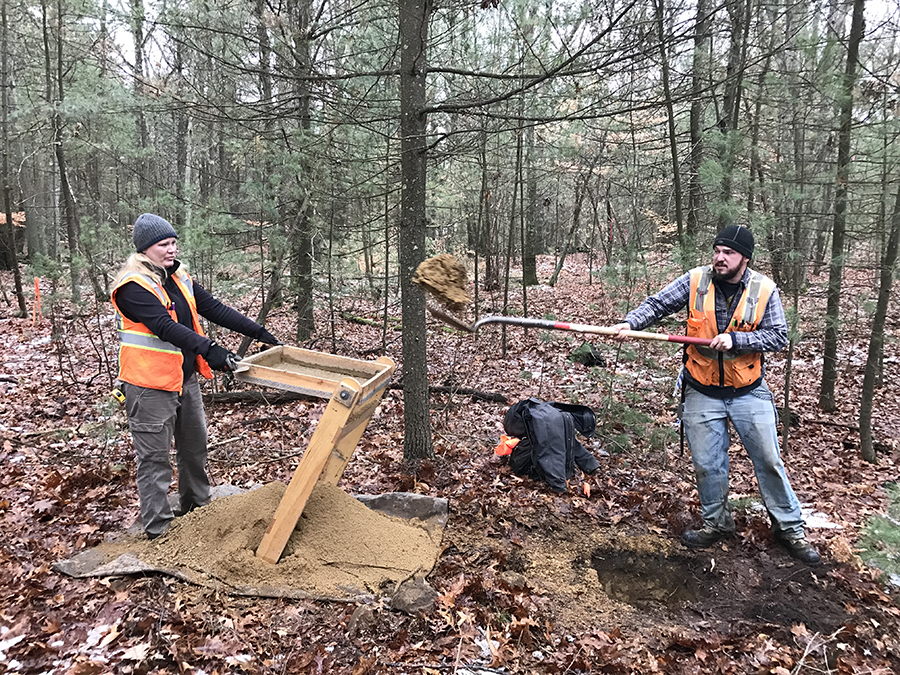
Jennifer Banister and Colin Stevenson of PAL sift soil form the archeological dig near Minuteman High School.

Public hearings with two town boards are scheduled for the new Minuteman High School project starting this week. Meanwhile, a recent archeological dig at the site of the new building in Lincoln did not turn up any historically significant artifacts.

The Planning Board will hold a public hearing for site plan review on Tuesday, Feb. 28 (time TBA). The board will also conduct a preliminary site plan review on Tuesday, Feb. 14 at 7 p.m. The Conservation Commission will hold its first public hearing on Wednesday, Feb. 15 at 8 p.m. All meetings are in the Town Office Building.

Because Minuteman High School is an educational institution, it is largely exempt from local zoning rules for the building itself. However, the two boards will have a say on matters such as parking, landscaping, visual screening and wetlands.

Minuteman documents on file for the Planning Board can be found here, and those for the Conservation Commission are here. Given the size and complexity of the project, the town plans to hire a consultant to assist with the reviews.

Pending permitting by the town, the Minuteman district hopes to break ground this spring and open the new school to students in the fall of 2019.

Archeological dig

Minuteman commissioned a four-member crew from the Public Archaeology Laboratory, Inc. (PAL) of Pawtucket, R.I., to survey the future construction site for artifacts, but researchers came up empty, finding just one shotgun shell and one piece of broken glass, both of recent vintage.

The survey was undertaken because the site’s proximity to Battle Road, wetlands and water sources meant it might contain items from pre-European Native Americans or colonial-era residents. The work was not required by a government agency but was ordered by Minuteman Superintendent Edward Bouquillon to ease any concerns about the site’s potential historical significance and to ease his own mind about building a school there.

“This area is rich in Revolutionary War history. I had no idea what we might find out there, but I’m glad we did this. It was the right thing to do,” he said. The archeological survey cost the district $15,000, a small fraction of the school project’s $144.9 million total cost.   

The PAL team spent more than 150 hours digging 90 cube-shaped shovel test pits, each about feet on a side, and then used a screen to sift the soil for items for interest.

“No artifacts were identified as part of the survey, which is a little surprising, but I think it has a lot to do with the shallow ledge that covers most of the area,” said senior archeologist Holly Herbster. “Our testing coverage was thorough and we targeted areas that were most likely for pre-contact as well as historic sites, so it appears this area just wasn’t utilized as neighboring areas were.”

Even though no artifacts were found, the dig offered an educational benefit for Minuteman students. Social studies teacher Tracey Sierra brought her sophomore classes out to the site to see the direct connection between science and history, and students they also learned about career pathways they didn’t know existed.

Sometimes PAL has the chance to explore a significant archeological find. The firm recently helped document the discovery of a 19th-century schooner buried deep in the mudflats in the Seaport district in South Boston. The shipwreck was found during excavation on a construction project.

Category: history, land use, schools Leave a Comment

Town Meeting warrant article list published

February 5, 2017

The list of articles for the 2017 Annual Town Meeting on March 25 includes 42 articles that will ask residents for a “year” or “nay” on numerous issues that have been in the news in Lincoln over the past year or more.

Below are links to previous Lincoln Squirrel stories about some of the items. The Squirrel will also publish new stories about Town Meeting articles in the coming days and weeks as more details become available.

Wang property acquisition (article 11)

  • ConsComm OKs approves ‘land swap’ for solar installation
  • Sale closes on Wang property; town will be asked for $850,000+
  • Land purchase aims to help town and Birches School

Accessory apartments (articles 12-14)

  • Residents hear about affordable accessory apartment proposal

School project (articles 33 and 34)

  • Officials offer school recommendations, borrowing estimates
  • School Committee recommends Lincoln-only school project; multiboard meeting Monday night
  • Town to grapple once again with future of school project
  • State says no to Lincoln school funding for the third time

Community center feasibility study (article 35)

  • No major obstacles to putting community center on campus, consultant says
  • Community center on Hartwell campus would cost $13 million, panel says
  • Residents delve into community center, school project at State of the Town

Landfill solar initiative (article 36)

  • ConsComm OKs approves ‘land swap’ for solar installation
  • Benefits and hurdles for solar array at landfill discussed
  • Solar array considered for landfill site

Agricultural bylaw amendment (article 38)

  • Small-scale agriculture expansion discussed at SOTT

Category: agriculture and flora, conservation, government, land use, news, schools, seniors, sports & recreation Leave a Comment

Correction

February 2, 2017

A February 1 article headlined “Officials offer school recommendations, borrowing estimates” incorrectly referenced another upcoming multiboard meeting in February. The next such meeting will be on March 8 at 7 p.m. in the Brooks gym. The original story has been corrected.


Category: government, schools Leave a Comment

Officials offer school recommendations, borrowing estimates

February 1, 2017

Saying “we believe it’s time to act on our own,” School Committee Chair Jennifer Glass outlined next steps for a town-funded school project at a multi-board meeting earlier this week.

Glass told the Board of Selectmen last month that her group recommended not applying again for state funding, but start the planning process for a school project that the town would pay for by itself. At the multiboard meeting, she explained the committee’s reasoning, while Finance Committee Vice Chair Jim Hutchinson outlined some funding and property tax scenarios.

There will be two warrant articles at Town Meeting next month—one on whether to spend a previously approved $750,000 on a town-funded school feasibility study, and another on whether to reapply for state funding—but “we see that as a fork in the road, an either/or choice,” Glass said. The increased competition for state grants and the immediate needs of the Lincoln School from both facilities and educational standpoints mean that waiting any longer is not the best option, she said.

Previous meetings and votes indicate that there is community consensus on four points:

  • The education value of a school project is a top priority
  • Residents understand that the town will have to spend a minimum of $30 million for a “responsible project”
  • There is “strong support” for a project that would cost $45 million to $60 million even without state funding
  • There is interest in planning collaboration for a school project and community center

The cost estimates were provided by Dore and Whitter in their report in late 2014. At that time, they outlined three groups of renovation and construction options and price ranges:

  • Option 1 – facilities needs only: $12–$29 million
  • Option 2 – facilities needs plus “a la carte” educational enhancements: $29–$47 million
  • Option 3 – facilities needs plus comprehensive educational enhancements: $54–$66 million

The new feasibility study process would again outline the school’s needs, the town’s educational and community vision and building options, as well as an eventual a decision on one option to put forward for a town vote. The Dore & Whittier report did some of this but did not include faculty input, nor did it address the overall site plan in terms of roadways, athletic fields, etc., Glass noted.

Borrowing costs

Although construction costs have climbed since 2014, interest rates have remained steady, Hutchinson said. The Finance Committee has consulted with bond advisors and concluded that the town can borrow up to $80 million without losing its AAA bond rating, which affects future borrowing costs. That level of borrowing would drive the town’s debt-to-operating ration from the 3-4% range up to 12-13%, he said.

To soften the tax impact, the Finance Committee recommends additional steps such as repaying the bonds over 30 years rather than 20. Also advisable is a “level debt” whereby annual payments would remain the same, though they would effectively decline as a percentage of revenue over time due to inflation, Hutchinson said. Although the town has a debt stabilization fund, spending all of it is not a good idea, because “there are always unanticipated things that happen to towns and we need to have some kind of buffer,” he added.

Another way to spread out the repayments would be to borrow for a community center and a school project separately “and put it in two lumps rather than one big lump,” Hutchinson said.

Voters at Town Meeting will be asked for a $150,000 appropriation for a feasibility study by a community center building committee that would work alongside the new school building committee. The Board of Selectmen would “mandate cooperation between the two,” Selectman Peter Braun said.

One advantage of not involving the MSBA is it frees the town from having to clearly separate design and planning for a school project and a community center, Glass noted.

Property tax impact

What does this mean for Lincoln taxpayers? Hutchinson did not have final estimates this week (the committee will present them at another multi-board meeting on March 8), but an earlier analysis that assumed a 4.6% interest rate and a more aggressive repayment schedule showed that tax bills would rise by $367 per year on a median-value home for every $10 million that the town borrowed. The median home value is $883,000, so someone with a home of that value would pay an additional $1,101 per year if the town borrowed $30 million, for example.

However, Hutchinson noted that interest rates are actually lower than the projected figure (about 3.4% right now), so the repayment cost would be lower than the example—more like $300 per $10 million borrowed, he said.

Even if the town decided on a “repair-only” direction, it would not be eligible for Massachusetts School Building Authority funding, Glass said. The MSBA has two grant programs: the core program and the “accelerated repair” program, which funds individual repair projects such as roofs and boilers. However, schools who get the second type of funding have no other major facilities or educational flaws aside from the isolated issue, and Lincoln does not meet that standard.

Other area towns have done town-funded school projects in recent years, including a new elementary school in Brookline and a replacement for the Zervas School in Newton. Lexington has done several projects, some with MSBA funding and some without. Wellesley has been turned down by the MSBA several times for a project that would consolidate three elementary schools into two and is also contemplating going it alone, Glass said.

One focus of debate is sure to be which major project to do first. The Council on Aging and the Parks and Recreation Department are advocating for a community center and have suggested that if it were built first, some of its space would be used by the school while staged school construction work was taking place.

But resident Ken Hurd disagreed. “My preference would be if the focus is really the school because this is what we need the most. We’re going to attract more people if we have the school situation resolved. A community center is nice is nice and we need it, but it’s not going to bring people to Lincoln,” he said.

“Town leadership should take a position on what the priorities should be,” said Steve Perlmutter, a member of the 2014 School Building Advisory Committee.


Category: community center*, government, school project*, schools Leave a Comment

  • « Go to Previous Page
  • Page 1
  • Interim pages omitted …
  • Page 25
  • Page 26
  • Page 27
  • Page 28
  • Page 29
  • Interim pages omitted …
  • Page 47
  • Go to Next Page »

Primary Sidebar

Recent Posts

  • Water bills to go up by 13% March 5, 2026
  • News acorns March 5, 2026
  • Property sales in January 2026 March 4, 2026
  • My Turn: Unraveling the Hanscom misallocation March 3, 2026
  • Police log for Feb. 19–25, 2026 March 3, 2026

Squirrel Archives

Categories

Secondary Sidebar

Search the Squirrel:

Privacy policy

© Copyright 2026 The Lincoln Squirrel · All Rights Reserved.