• Skip to primary navigation
  • Skip to main content
  • Skip to primary sidebar
  • Skip to secondary sidebar

The Lincoln Squirrel – News, features and photos from Lincoln, Mass.

  • Home
  • About/Contact
  • Advertise
  • Legal Notices
    • Submitting legal notices
  • Lincoln Resources
    • Coming Up in Lincoln
    • Municipal Calendar
    • Lincoln Links
  • Merchandise
  • Subscriptions
    • My Account
    • Log In
    • Log Out
  • Lincoln Review
    • About the Lincoln Review
    • Issues
    • Submit your work

schools

SBC hears preliminary school cost estimates

December 18, 2017

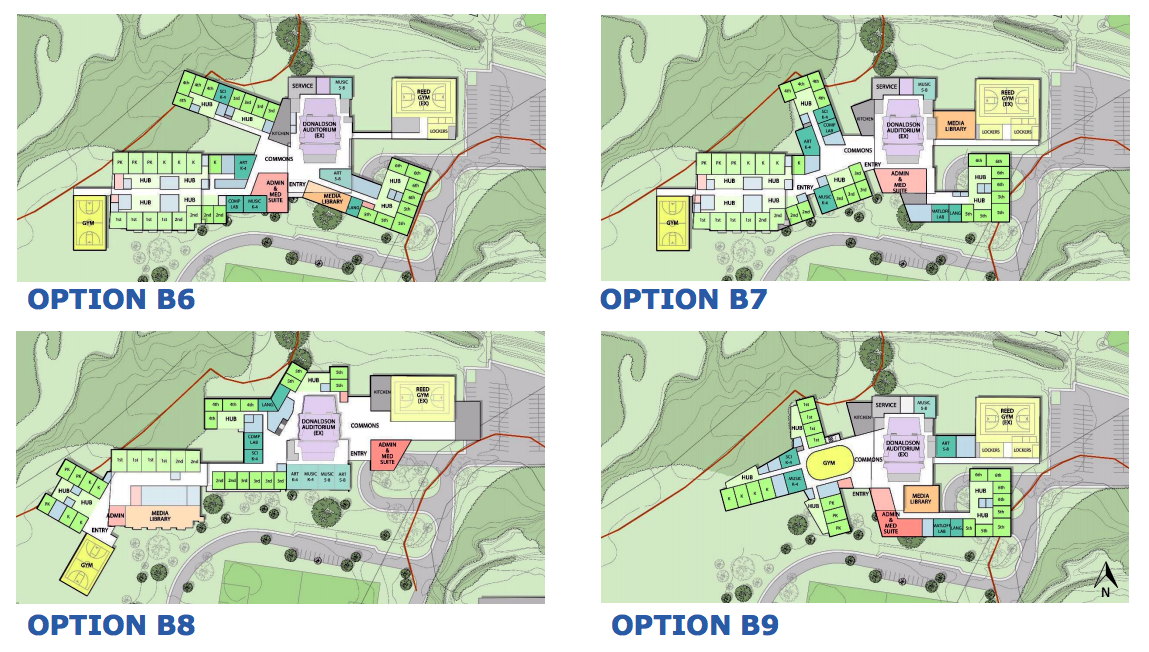
The “B” series of concepts that call for mostly new construction at the Lincoln School (click to enlarge).

Officials now have some rough cost estimates in hand for different approaches to a Lincoln School project, and they urge residents to attend a community workshop on Tuesday, Jan. 23 to offer feedback on the various options that architects have presented to the School Building Committee.

The identical January 23 workshops will be held from 8–10 a.m. and 7–9 p.m. in the Reed Gym. They are a critical point of community engagement and guidance and will play an important role in shaping what residents will see at a special Town Meeting on June 9 when they vote to select a preliminary design.

There will also be a multi-board meeting of the SBC, Board of Selectmen, School Committee, Finance Committee, Capital Planning Committee, School Building Committee, and Community Center Planning & Preliminary Design Committee on Tuesday, Jan. 9 at 6 p.m. in the Town Office Building.

To cap off the month, preliminary designs for a community center on the Hartwell campus will be presented at public forums on Tuesday, Jan. 30 from 8–10 a.m. and 7–9 p.m. in the Hartwell B pod.

The SBC learned in mid-November that a basic project to make repairs and bring the school building up to code would cost about $46 million. A significant portion of this cost would be eaten up by no- instructional space because of required code compliance upgrades. For example, outside entrances now require an airlock, and converted closet spaces could no longer be used for teaching, Selectman and SBC member Jennifer Glass noted at a selectmen’s meeting on November 27.

The “A” series of school options would involve more renovation than new construction (click to enlarge).

At the SBC’s November 29 meeting, members looked at possibilities for “the other bookend,” as Glass put it—a comprehensive project with almost all new construction (though retaining the Reed Gym and Donaldson Auditorium in every case) that would achieve all of the school’s educational and sustainability goals.

Those plans aimed for the greatest possible efficiency in terms of devoting square footage to educational space compared to the elongated current building, which has 50,000 square feet of circulation space (primarily hallways and lobbies). This criterion also maximizes the building’s energy efficiency. At construction costs of $600 per square foot, each of the November 29 proposals would cost at least $90 million.

These four “B” concepts concentrate the school on the north side of the Ballfield Road campus. They are summarized in the SBC’s meeting minutes.

On December 13, the SBC saw four new “A” proposals that call for a greater proportion of renovation vs. demolition and new construction. In each case, the current 139,000-square-foot building would be transformed into a building of 150,000–156,000 square feet. All four call for demolishing the old Smith building and replacing it with a larger piece there. Options A2–A4 call for additions elsewhere in the school as well.

Option A1 (which does not include the “hubs” for grades 3–8 found in the other three alternatives) would cost about $73 million, while the other three are about $82–84 million.


Category: school project*, schools 1 Comment

Group looking at renovation options for Lincoln School

November 21, 2017

The School Building Committee is working on a “baseline renovation project” estimate and what such a project would need to include.

A recurring theme in public feedback from the State of the Town meeting earlier this month were questions about renovation options for the Lincoln School. The meeting was a ”big picture” look at possible configurations for the segments of the school and deliberately presented concepts for an all-new school only. In coming weeks, the SBC will examine ideas that combine different ratios of renovation and new construction.

The school needs significant renovations, but the amount of work required will automatically trigger requirements for the entire building to be brought up to current building and handicapped codes. A 2014 report by Dore & Whittier looked at various combinations of renovation and new construction and concluded that a project with required upgrades and “a la carte” educational enhancements would cost $29–$47 million, while a comprehensive project would cost $54–$66 million. However, construction costs have risen markedly since the report was issued.

“Given the various ages and conditions of different sections of the Lincoln School, renovation may be a good value in some areas and not in others,” the SBC noted it ins most recent blog post, which also has links to compilations of residents’ comments from the State of the Town.

The SBC’s next community workshop will be on Tuesday, Jan. 23, 2018. A wide range of concepts including cost estimates will be presented in detail.

Category: school project*, schools Leave a Comment

News acorns

November 6, 2017

Dolls on sale as holiday gifts to benefit METCO

The Lincoln METCO Coordinating Committee will have a table in front of Verrill Farm at 11 Wheeler Rd. in Concord on Saturday, Nov. 11 from 11 a.m.–2 p.m. to sell dolls and doll gift baskets, furniture and accessories for the holidays. The American Girl, Pleasant Company American Girl, and vintage porcelain and other unique dolls were all donated by the generous people of Lincoln, Carlisle, Concord, Acton, Sudbury, Lexington, Bedford, Weston, and Newton. 100% of the proceeds go toward enrichment programs and opportunities for the METCO-enrolled children in the Lincoln Public Schools.

Film on teenage prescription drug abuse on Tuesday

If Only, a short film about the dangers of teenage prescription drug abuse, will be shown on Tuesday, Nov. 7 in the Lincoln-Sudbury auditorium at 7:30 p.m. The event introduction will feature co-writ​er​ and co-producer Jim Wahlberg of the Mark Wahlberg Youth Foundation, which produced the film. After the screening​,​ there will be a panel discussion featuring members of local law enforcement, former L-S students currently in recovery​, ​a​nd​ mental health workers. Come ask questions of the panel as we attempt to understand how this danger is impacting our communities and what we can all do together to fight it. Tickets are free, but organizers are asking people to register online so they can get a sense of how many people to expect.

“The Emoji Movie” screening at library

Kids are invited to watch the movie The Emoji Movie (PG) at the Lincoln Public Library on Wednesday, Nov. 8 at 2 p.m. Hidden inside a smartphone, the bustling city of Textopolis is home to all emojis. During their travels through other apps, Gene and his emoji friends discover a great danger that could threaten their phone’s very existence.

Panel discussion on kids in nature

The Lincoln Land Conservation Trust invites residents to a panel representation and discussion on “Kids in Nature” on Sunday, Nov. ​12 from 4–6 p.m. in Bemis Hall. Hear from education experts about how they stimulate a connection between children and youth and their natural surroundings, and the resulting positive benefits. Advice and resources will be shared, and there will be a Q&A period.​ Jeffrey Perrin, associate professor of psychology at Lesley University, will give opening remarks. Panelists will be:

  • Jill Canelli, director, Mass Audubon Drumlin Farm Community Preschool
  • Mairead Curtis, science and engineering curriculum coordinator, Lincoln Public Schools
  • Wendy Matusovich, executive director, Farrington Nature Linc
  • Katherine Parisky, Ph.D., associate head and science teacher, Birches School

More information is available at lincolnconservation.org.​

Farmer’s market invites vendors

Lindentree Farm will hold a farmer’s market at Codman Community Farms on Saturday, Nov. 11 from 9:30 a.m–1 p.m. and there are still spaces left for people who would like to sell their wares, crafts, goods made in certified kitchens, small projects for kids to do who are passing through, etc. Those interested should email Moira at lindentreecsa@gmail.com.

Tull replaces Hedgerow at next LOMA event

Anna Huckabee Tull will be the featured performer on Monday, Nov. 13, replacing Hedgerow. An award-winning singer/songwriter and a psychologist, Anna has appeared on TEDx talks and TV concerts but rarely in live performances. Mickey Zibello will back her on guitar and vocals. Her latest album, The Days of Your Opening, is a companion to her new book, Living the Deeper Yes.

Category: educational, kids, schools Leave a Comment

Architects ask for reactions to school and community center possibilities

November 5, 2017

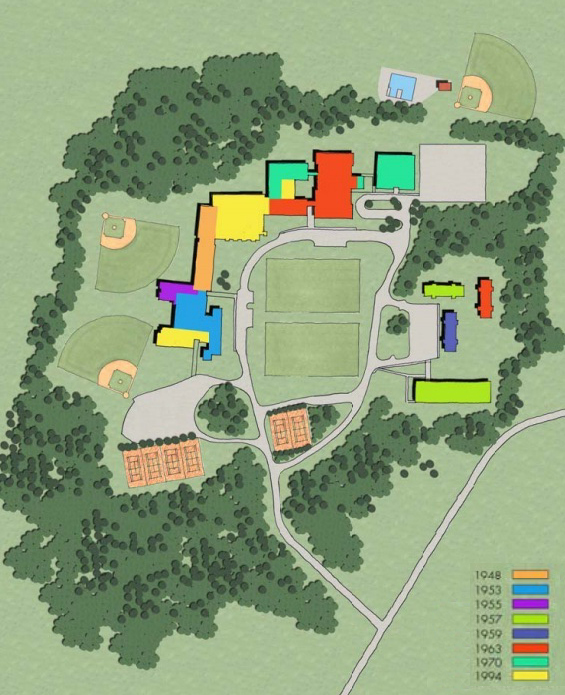
The current school campus showing when various sections were built.

(Editor’s note: Check back tomorrow for more coverage of the State of the Town meeting.)

At Saturday’s State of the Town meeting, residents began offering feedback on six concept drawings for a reconfigured Lincoln School as well as some photos of community center ideas.

The school campus drawings by Ewing-Cole and SMMA Architects represented only ideas for where various parts of the school could be located relative to each other on campus, rather than actual building outlines and walls, explained SMMA’s Joel Seeley. The presentation also did not address parking, fields and roadways, and it intentionally looked at a mostly new or completely new buildings.

All six designs had some features in common:

  • Academic hubs organized by grade level in for PreK–4 and by team teaching mode for grades 5–8.
  • Separate entrances for PreK, K–4, and 5–8.
  • Classrooms as well as breakout spaces for students groups of varying sizes and abilities in each hub.
  • Facilities for “specials” (art, music, science, and maker spaces) located close to the hubs.
  • A single dining commons and kitchen for the entire school.

The concepts are categorized in three groups according to whether the school building is concentrated in the current “L” configuration (Group A), or on the north or west side of the ballfield (Groups B and C). Some distinguishing features:

  • A1 — Retains the two gyms and auditorium, and is closest in shape to the current school.
  • A2 — Follows the same basic shape but in a curved rather than L-shaped fashion, with two new gyms and the existing auditorium.
  • B1 — A northern focus with five two-story linear classroom hubs, retaining and enclosing the Reed Gym and auditorium.
  • B2 — An all-new building on the north side, with a gym and theater space next to each other but separated from the rest of the school by a commons area to demarcate school and public uses.
  • C1 — A western focus having the clearest plan for two separate schools in one. Includes a new gym and a glassed-in or covered walkway to the existing auditorium.
  • C2 — A western focus with a ring of angled hubs around a central piazza and a new gym between the classrooms and the auditorium.

The concepts and explanations can be seen on the School Building Committee website. See larger versions of the drawings by clicking on one of the images below:

[Best_Wordpress_Gallery id=”89″ gal_title=”School concepts – Nov 2017″]

At the State of the Town, residents offered written comments, but others may use the SBC’s online feedback form. The form asks what viewers saw or heard that they liked, what they wished would be developed further, and what they wonder about, or what questions should be answered.

The SBC and architects will continue to gather public input and refine the concepts in the coming months. Residents will be asked to vote on a design concept at a special town meeting in June 2018. By that point, officials hope to have a plan that has “overwhelming community support. We don’t want to get to a vote in June and wonder what we missed,” said Chris Fasciano, chair of the SBC.

Community center

The Community Center Preliminary Planning and Design Committee (CCPPDC) recently hired Maryann Thompson Architects to work alongside SMMA and design a proposal for a community center. Their first step at State of the Town was to post “character study” photos of various community center interiors, exteriors, and landscapes and asked residents to jot down “gut reactions” on sticky notes with comments on the easels.

The architects are hoping for more detailed feedback via a “wish list” questionnaire on the CCPPDC website, which also includes the images shown on Saturday and an accompanying comment form. Residents are invited to download the questionnaire, answer whichever parts they wish, and email it back by noon on Friday, Nov. 10. The firm expects to have a proposed basic design along with “firm cost estimates” before the special town meeting in June, which will also address the school.

There are various advantages and disadvantages to having the community center physically connected to the school rather than on the Hartwell side, noted Town Administrator Tim Higgins. He briefly touched on some of those pluses and minuses as outlined by a group including the two school principals, Parks and Recreation Department Director Dan Pereira, Council on Aging Director Carolyn Bottum, and Administrator for Business and Finance Buck Creel.

Factors mitigating against having the two facilities side by side, according to their report:

  • There would be less space for athletic fields on the school side and the topography of the Hartwell side would also make it difficult to put a field there.
  • Sharing space would be impractical since the hours of operation of the school and community center would largely overlap.
  • The parking on the north and west side of campus would have to be significantly increased and the roadway network would have to be rethought.
  • There would be public safety and security concerns associated with keeping the various building users separate and out of restricted spaces.
Finances

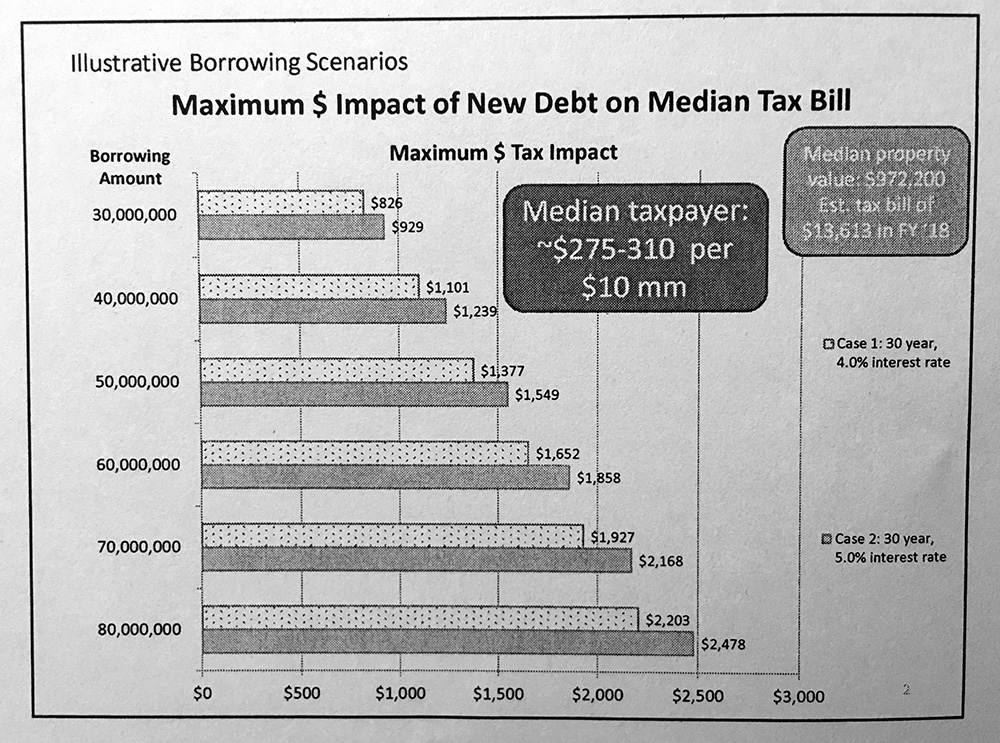
The town can afford to borrow up to $80 million for the projects and still retain its AAA bond rating, said Andrew Payne, vice chair of the Finance Committee. Each $10 million borrowed would increase the tax bill by about $275–300 per year, depending on the interest rate. The current median tax bill is $13,600.

The FinCom’s debt financing subcommittee also recommends that the town should make bond payments that are more or less equal throughout a 30-year term. Some of the town’s debt stabilization fund, currently at $4.7 million, can be used to even out some of the tax bill impact in the first few years, Payne added.

Category: community center*, government, land use, school project*, schools, seniors, sports & recreation Leave a Comment

Initial design concepts for school to be presented

October 30, 2017

Architects will unveil some initial design concepts for the Lincoln School and ask for feedback at Saturday’s State of the Town meeting, which starts at 9 a.m. in the Brooks auditorium.

The first 90 minutes of the meeting will be devoted to updates from the two campus project groups—the School Building Committee and the Community Center Preliminary Planning and Design Committee (CCPPDC). School architect SMMA will introduce a range of initial concepts that explore building size, shape, and location of the school, while CCPPDC architect Maryann Thompson will present a series of photographs to start a conversation about aesthetic preferences. The Finance Committee will also provide high-level financial context for the projects.

Residents will be asked to weigh in on the Lincoln School design concepts and to provide input about design elements they think reflect Lincoln values and are appropriate for the campus. The SBC will post directions for the feedback exercises and, if possible, images of those design concepts later this week. 

Also on the SOTT agenda are updates on Lincoln Station improvements and proposals for a plastic bag/water bottle ban, recreational marijuana rules, a gas leak repair resolution, the Lincoln Historic District, and Lincoln becoming a sanctuary town.

Category: government, land use, school project*, schools, seniors, sports & recreation Leave a Comment

Clarification

October 23, 2017

An October 23 article headlined “School committees float idea of a shared L-S/Sudbury superintendent” quoted a brief by attorney Marc Terry as saying that the ability of a town district and a regional district to share central office functions is “an unsettled point of law.” While this quote is accurate, it does mean to imply that the state Department of Elementary and Secondary Education does not allow such arrangements, only that state statutes are silent on the subject. The last paragraph of Terry’s memo notes that any potential challenge could be forestalled by an intermunicipal agreement (IMA) subject to approval by the Boards of Selectmen.

Category: news, schools Leave a Comment

School committees float idea of a shared L-S/Sudbury superintendent

October 22, 2017

In the wake of the pending retirement of Sudbury Superintendent of Schools Anne Wilson, Sudbury school officials are mulling the idea of a shared superintendent for Lincoln-Sudbury Regional High School and the Sudbury Public Schools.

The Sudbury School Committee (SSC) must decide what sort of position they would begin a search for: a permanent Sudbury superintendent, an interim superintendent while other options are studied, or a shared superintendent. The Concord-Carlisle and Acton-Boxborough districts have this shared structure, with one superintendent for the high school plus one of the town’s K-8 schools, while the other town has its own K-8 superintendent. Lincoln’s K-8 students have three schools (two of which are at Hanscom Air Force Base), while Sudbury has five (four elementary schools and one middle school.

The SSC had a special meeting on September 15 meeting with Glenn Koocher, executive director of the Massachusetts Association of School Committees, to learn more about leadership reorganization options in light of the opportunity created by Wilson’s departure, which is effective in June 2018. At her group’s October 6 meeting, SSC chair Christine Hogan made a motion to explore the idea of a shared superintendency.

However, some of her fellow committee members were wary of moving too quickly even in exploring the idea of a shared superintendency.

“It benefits our students, it may benefit the town as a whole, it benefits collaboration among staff and teachers—there’s a whole host of reasons we must explore uniting both districts,” SSC member Kouchakdjian said. “At the same time, Christine, I think we need to be careful. I think we need to move slowly, methodically, and respectfully of both districts, and be especially respectful of our friends and neighbors in Lincoln… we’ve waited a long time to do this and I want to make sure we do it well.”

Other members persuaded Hogan to amend her motion to explore not just a shared superintendency, but “all options with regard to district-level organization within the town of Sudbury, pending positive affirmation” from the Lincoln and Lincoln-Sudbury School Committees.

Meanwhile, Lincoln-Sudbury School Committee chair Kevin Matthews asked LSSC attorney Marc Terry in September for a memo outlining the various superintendency options under Massachusetts law. Under a “union superintendency,” where two elementary districts and a shared high school have a single superintendent, cost savings can be achieved by pooling some administrative, financial and special-education operations, but it’s unclear to what extent this could occur under a shared superintendency, Terry wrote in his September 25 memo. The ability of a town district and a regional district to share central office functions is also “an unsettled point of law,” he added.

At the request of SSC members Lucie St. George and Lisa Kouchakdjian, Hogan subsequently obtained Terry’s memo under a public records request and shared it with the rest of her committee.

At the LSSC’s September 26 meeting, Matthews sought to “form a consensus to explore [the idea of a shared superintendency], with no commitment as to whether we would do this or not.” The idea is worth pursuing, he said, because “it would make education stronger here and it would make the financial footing for L-S much stronger, and that can only be a benefit to our partners in Lincoln.”

But other LSSC members expressed concerns about the idea. They wondered what problem the proposed exploration was intended to solve, and whether officials even have the capacity to explore the issue right now, given everything else that’s going on in both towns.

The L-S school district has “a level of autonomy and independence we’ve fiercely guarded over 50-plus years of the school, and we need to be wary on behalf of both towns of giving up that control,” said member Gerald Quirk of Sudbury.”We should always be thinking about ways to build a better mousetrap, but we need to think about what’s in it for the kids.”

“We are elected by people in both towns,” said LSSC member Nancy Marshall of Lincoln. “As we examine this, what compels us to make it a priority for this year? I want to make sure Lincoln is heard and respected and that a process is duly served, and this is some that’s not taken lightly by anybody.”

The committee decided to defer a decision on the matter until its October 24 meeting.

In an October 10 interview with the Lincoln Squirrel, Matthews (who emphasized that he is expressing only his own opinion, not that of the LSSC as a whole) said “a singular approach is superior to a bifurcated approach” for the high school, which draws about 85 percent of its students from Sudbury.

“What I would like to see for 85 percent of our kids is that we have a singular vision and singular approach to managing educational benefits for kids from pre-K through age 22… if you increase the quality of the delivery of education for 85 percent of the kids in L-S, you have affected L-S in a positive way,” Matthews said. A shared superintendency is “only tricky if you consider Acton-Boxborough and Concord-Carlisle as failed models, and most people consider those to be our peers. The idea that this doesn’t work is disingenuous at best,” he added.

The three school committees will hold a previously scheduled tri-district public forum on the topic of diversity and inclusion on Monday, Oct. 23 at 7 p.m. in Lincoln’s Reed Gym. The agenda includes remarks by Dr. William Smith of the National Center for Race Amity and short presentations from Lincoln and Sudbury residents followed by about an hour of public discussion.

Category: schools Leave a Comment

Architects show how school design can enhance education

October 19, 2017

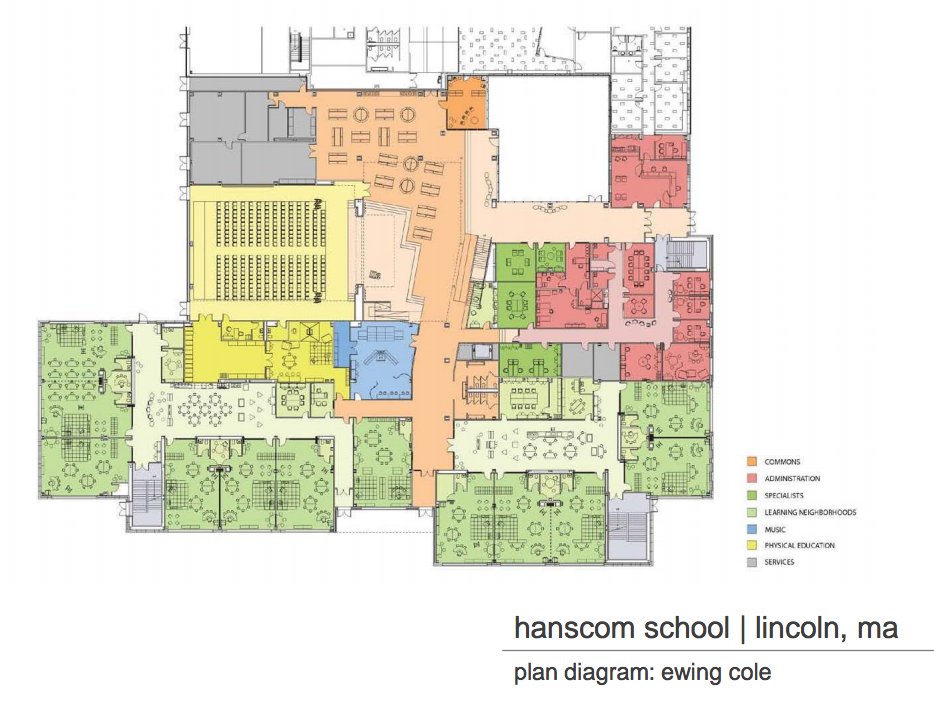
A 2014 drawing of the new Hanscom Middle School calling for “neighborhoods” of classrooms (click to enlarge).

Architects and Superintendent of Schools Rebecca McFall explained how the design elements of a school building can help realize an educational vision for its students at an October 17 School Building Committee workshop.

The building’s design should reflect the educational vision and strategic priorities as approved by the School Committee this year, said McFall, who first outlined the school’s educational needs in a renovated or new building in 2014.

“Educational environments are changing,” said architect Keith Fallon, executive vice president of EwingCole, one of the two firms hired by the SBC. Elementary and middle schools today are designed to support different ways for students to gather and work together. This means flexible spaces of various sizes in addition to the basic classroom so students can be easily taught in groups as small as three or four and as large as an entire grade.

Currently in many parts of the Lincoln School, individuals and small groups who want to work independently during a class must do so in the corridor. “It’s not that the work doesn’t happen, but the spaces could enhance that and increase the impact of the work we’re trying to do,” McFall said.

Many schools illustrated in slides by the EwingCole architects have several classrooms around a central hub rather than the traditional double-loaded corridors, as well as lots of natural light and “maker spaces” throughout. This approach maximizes teaching time by minimizing transitions from one place to another.

Larger common areas for art, music and performances can be centrally located and can even be transparent, such as the art room at the new Hanscom Middle School (HMS), which a number of residents have toured in recent months. Smaller spaces that are more private can also be carved out in a school design characterized by flexibility and ease of modification. “It’s about creating a wide range of educational experience,” McFall said.

Since the new HMS opened in the fall of 2016, students have benefited from the opportunities for student and staff collaboration that the building’s design offers. “They’re able to think about what the learning experience is and what the appropriate space for that might be, [and] they have to talk about who’s using [the common spaces] for what purpose,” McFall said. As a result, “the building has been a true catalyst for changing instruction.”

The ideal school design would also feature seamless technology infrastructure (such as places where students can plug in their own devices to work collaboratively), and a connection to the community and the environment. One of the questions the school’s design must address is “to what extent the life of the school and the life of the community should intersect?” Fallon said.

“We see the schools as an integral part of the community and a necessity for the community,” McFall said. “We’d be open to community events as much as we can.”

Another design question that impacts education is how to integrate sustainability into the curriculum, Fallon said. Seeing and measuring recycling in a new cafeteria and kitchen are natural teaching tools that aren’t available today, with cramped food service facilities without dishwashers where disposable utensils and uneaten food must be thrown out, McFall noted.

Sustainability will also be an important factor in the surrounding landscape design as well as environmental efficiencies in the building itself. Consequently, a single kitchen, cafeteria and food storage area will “absolutely” be part of the design, Fallon said. (Earlier discussions had included the possibility of two separate cafeterias for different age groups.)

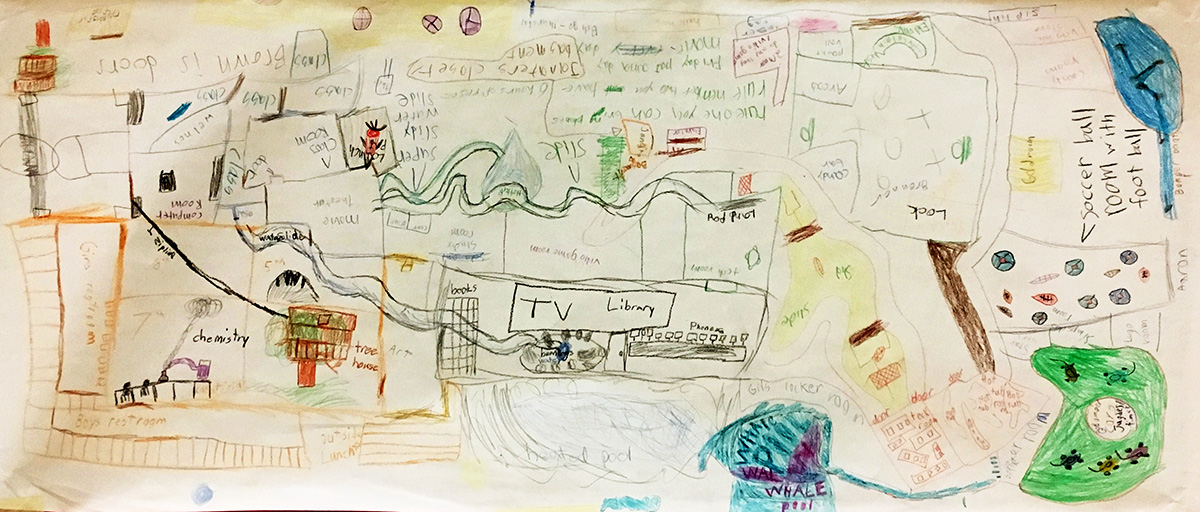
In addition to residents, teachers and architects, students are getting the chance to offer their ideas for the school. Groups of students were asked to illustrate their ideas on mural-size paper the previous week and came up with some very creative ideas, including a whale pool, a water slide into the library, and a tree house that could be accessed via zipline from the computer room.

Category: school project*, schools Leave a Comment

News acorns

October 19, 2017

School, community center updates on Friday

Join the School Building Committee (SBC) and the Community Center Preliminary Planning and Design Committee (CCPPDC) on Friday, Oct. 20 at 12:30 p.m. in Bemis Hall for an update on the two proposed Ballfield Road campus projects. This session is a great opportunity to get caught up on the campus projects and also to share your questions, concerns and feedback with the committees.

Water bottle documentary at St. Anne’s

The Lincoln-Sudbury Regional High School Environmental Club is joining up with St. Anne’s-in-the-Fields Church and its Climate Justice Film Series to discuss the club’s proposed single-use water bottle and plastic bottle ban and to view the documentary  film Tapped. Tapped looks at the bottled water industry and its environmental, health and economic long-term effects. Join the group on Tuesday, Oct. 24 at 6:30 p.m. for a light meal and presentation by the students. The film will begin at 7 p.m. with a discussion to follow.

LFA Halloween party is Oct. 29

The Lincoln Family Association will hold its annual Halloween party at Codman Barn on Sunday, Oct. 29 from 2–4 p.m. There will be crafts, pizza, popcorn, and a trick-or-treating parade and costume contest around 3 p.m. Free for LFA members, $10 for nonmembers (maximum $25 per family).

Piano recital with Rhapsody

Rhapsody, a group of amateur pianists, will offer a piano recital on Sunday, Oct. 29 at 3 p.m. in Bemis Hall. The performance is free and open to the public. The recital will feature selections from Beethoven, Brahms, Chopin, Debussy, Godowski, Guastavino, Ginastera, Liszt, Rachmaninoff, Schubert, Shchedrin, and Schumann. Rhapsody was formed in 2003 by a amateur pianists who sought a venue in which to perform for each other, both to grow musically and to share their musical journey with others. It has since grown to 18 people from the Boston metropolitan area, and members have met continuously every month for 14 years. Now an annual event, this will be their eighth public performance on Bemis Hall’s restored Steinway.

Category: arts, conservation, kids, schools, seniors Leave a Comment

Tuesday workshops to focus on school’s educational priorities

October 15, 2017

The School Building Committee (SBC) and school project design team will hold a series of meetings this week with residents and students as they continue to answer the question: How will the building support our vision of education?

Lincoln School administrators and faculty discussed the town’s educational priorities during a day-long session facilitated by the design team from SMMA and EwingCole:

  • Provide high quality education
  • Create an engaging and inspiring approach to learning
  • Encourage interactive, multi-disciplinary, project-based learning modes; foster curiosity
  • Value diversity; display creativity
  • Provide a variety of learning spaces
  • Value reflection
  • Optimize connection to the natural environment
  • Host community events and promote partnerships with the community

These priorities reflect those laid out in the Lincoln Public Schools strategic plan approved by the School Committee in August 2017.

On Tuesday, Oct. 17, residents are invited to community workshops focused on how physical space impacts teachers and students. The workshops will take place from 8–10 a.m. and 7–9 p.m. in the Brooks gym. Questions to be discussed will include:

  • How does our current building impede our educators?
  • If a new building is built, or significant renovations made, how will it affect what is taught and how it is taught?
  • How do we know our new/renovated building will meet the needs of the next generations of Lincoln students?

Also on Tuesday, members of the design team will meet with student groups from grades 3, 5, and 8 to talk about what they like about the Lincoln School building, see examples of other schools, and discuss what they’d like to see in a new/renovated school.

In discussions about the school, phrases such as “21st century learning,” “project-based learning,” and “maker spaces” are used a lot. The SBC offers some short videos to help make these concepts clearer, and invite residents to bring questions about them to one of the Tuesday workshops:

  • Video: “Changing the Subject“
  • Video: “Student Engagement: How the Maker Movement Connects Students to Engineering and Tech”
  • Blog: “Designing a School Makerspace”
  • Video: “Engaging Students in Work that Matters”
  • Video: “An Unfamiliar Revolution in Learning/Mission Hill K-8”

The SBC always welcomes feedback and questions about the process. You can make a public comment by clicking on the “comment” button at the bottom of any of the posts on the SBC website, or you can send a message directly to the SBC by clicking on “Contact the SBC” on the site’s home page menu.

Category: news, school project*, schools Leave a Comment

  • « Go to Previous Page
  • Page 1
  • Interim pages omitted …
  • Page 20
  • Page 21
  • Page 22
  • Page 23
  • Page 24
  • Interim pages omitted …
  • Page 47
  • Go to Next Page »

Primary Sidebar

Recent Posts

  • Water bills to go up by 13% March 5, 2026
  • News acorns March 5, 2026
  • Property sales in January 2026 March 4, 2026
  • My Turn: Unraveling the Hanscom misallocation March 3, 2026
  • Police log for Feb. 19–25, 2026 March 3, 2026

Squirrel Archives

Categories

Secondary Sidebar

Search the Squirrel:

Privacy policy

© Copyright 2026 The Lincoln Squirrel · All Rights Reserved.