• Skip to primary navigation
  • Skip to main content
  • Skip to primary sidebar
  • Skip to secondary sidebar

The Lincoln Squirrel – News, features and photos from Lincoln, Mass.

  • Home
  • About/Contact
  • Advertise
  • Legal Notices
    • Submitting legal notices
  • Lincoln Resources
    • Coming Up in Lincoln
    • Municipal Calendar
    • Lincoln Links
  • Merchandise
  • Subscription Info
    • My Account
    • Log In
    • Log Out
  • Lincoln Review
    • About the Lincoln Review
    • Previous Issues
    • Submit Your Work
    • Subscribe/Donate

history

Did you know… that Lincoln once had a murder of crows?

April 6, 2022

By Donald Hafner

Crows can be a nuisance for farmers. They raid grain fields and orchards in flocks numbering in the hundreds, if not thousands. Apparently the patience of Lincoln’s farmers ran out in March 1791, when a warrant at Town Meeting proposed “a bounty to the inhabitants of the town to encourage and bring forward the destruction of those mischievous birds called the black bird and the crow.” Residents “voted that there shall be the sum of six pence for each crow that is feathered and three pence for each young crow not feathered given as a bounty.” 

At some point, the bounty was doubled to one shilling, enough at the time to buy two pounds of salt pork. Plus, the bounty hunter only had to bring in the crow heads; he could keep the rest of the bird, and crow was said to taste as good as quail. Even the feathers were worth having, according to Abigail Adams, who preferred writing with a crow quill: “It is much smaller than a goose quill, and I can write much better with it.” 

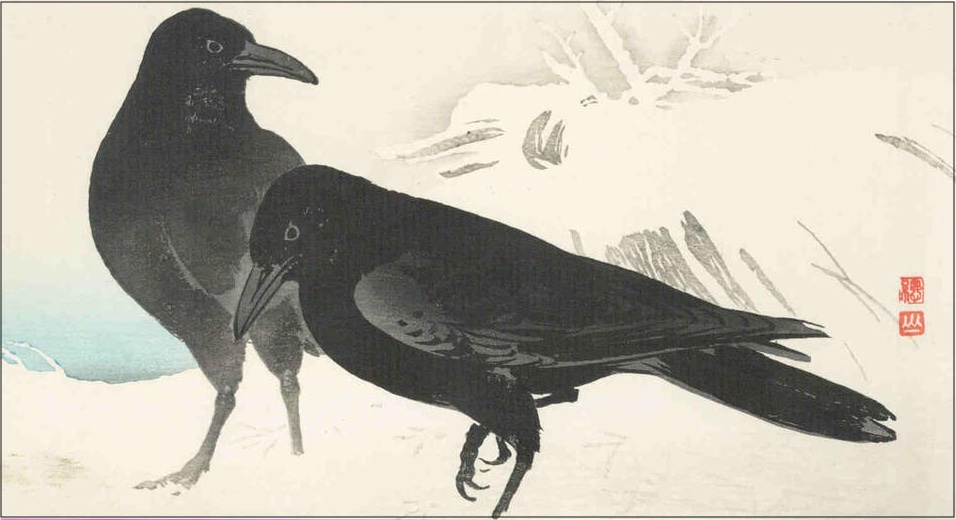
“Two Crows in Snow” by Ito Sozan (1884-1920)

Despite the reward offered by the town, not many bounties were paid. By 1799, the treasurer’s records showed only eight payments, for what may have been no more than a dozen or so crows. This would not have surprised the editor of The Boston Gazette, who reminded his readers in 1789 of John Gay’s witty remark: “To shoot at crows is powder flung away.”

Crows are among the most intelligent of birds, with excellent memories and eyesight. They readily learn where and when food can be found, and danger avoided. ’Tis said they can distinguish between one person and another and remember those who pose a threat, and they can pass that warning on to others — which may explain why the eight men of Lincoln who collected bounties did so only once.  

“A murther of crowes” first appears as a fanciful term for a flock of crows back in 15th-century England. The illusion dies hard that the problem of crows can be solved with gunpowder and birdshot. In the 1930s, the state of Wisconsin tried to entice the country folk into shooting more crows by touting “black partridges” as delicious food. That didn’t work either. The murder of crows was no answer to a murder of crows.


“Lincoln’s History” is an occasional column by members of the Lincoln Historical Society.
Category: history 1 Comment

Local Patriots Day events start on Saturday

April 6, 2022

Following are events scheduled in Minute Man National Historical Park (MMNHP) and other sites  to commemorate events surrounding Patriots Day.

Saturday, April 9

The Capture of Paul Revere: A Dramatic Narrative
MMNHP Visitors Center at 2:45 p.m. or Capture Site at 3 p.m.
March with the Lincoln Minute Men along Battle Road or meet at the capture site where Paul Revere’s ride ended in Lincoln. See Revere, Samuel Prescott, William Dawes, Mary Hartwell, Catharine Louisa Smith, and Major Mitchell tell the true story, despite poetic efforts by Henry Wadsworth Longfellow to tell a different tale. Music and musket fire. For all ages.

Saturday, April 16

Battle Road: Civilian Evacuation & Battles
Evacuation scenario at the home of William and Catharine Louisa Smith, 9:30 a.m. – noon.
Battle reenactment at Parker’s Revenge, MMNHP, noon–1 p.m.
Battle of Tower Park, 1200 Massachusetts Ave., Lexington, 4 p.m.
Families prepare to evacuate their homes on April 19, 1775. Later, hundreds of British and Provincial soldiers recreate the running battle along the deadly stretch of road through Lincoln, from Elm Brook Hill to the Lexington border. Then both sides regroup to battle again at Tower Park in Lexington.

Sunday, April 17

Alarm & Muster
Lincoln Public Library lawn, 7 p.m.
A Lincoln resident during the Revolutionary War reminisces about the fateful early hours of April 19, 1775. Capt. William Smith arrives on horseback to alarm the citizens of Lincoln. Bells ring, drums roll, and families say anxious goodbyes, as the Lincoln Minute Men assemble for musket drill and firing, and receive their orders to march.

Monday, April 18

Dawn Tribute & March to the Concord Parade
Outside Bemis Hall, 6:45 a.m.; Concord parade, 9 a.m.
The Lincoln Minute Men salute the Patriots buried in the Old Meeting House Burying Ground as they emerge from the mists for roll call. Fifers play a lament and the muskets fire a volley. Then join the Minute Men on their walk to Concord along Sandy Pond Road (three miles) amid colonial music and musket fire. All ages welcome.

Sunday, April 24

Lincoln Salute: A Festival of Fife & Drum Music
Pierce Park, 1:30–3 p.m. (in case of rain, see the Parks and Rec website)
The Lincoln Minute Men host fife and drum groups from far and wide in a musical performance for your enjoyment. Bring your picnic basket and lawn chairs for rousing entertainment.

Old Burying Ground Tribute
Pierce House, 3 p.m.
March with the Lincoln Minute Men and British Regulars from Pierce House to the Old Burying Ground on Lexington Road to honor the Patriot dead and the five British soldiers killed in Lincoln along the Battle Road. Mary Hartwell and Catharine Louisa Smith tell their stories of burying British soldiers, an enslaved soldier tells how he gained his freedom, and a British mother laments the loss of her son. Ceremonies include music and musket salutes.

Category: history Leave a Comment

Addendum

December 12, 2021

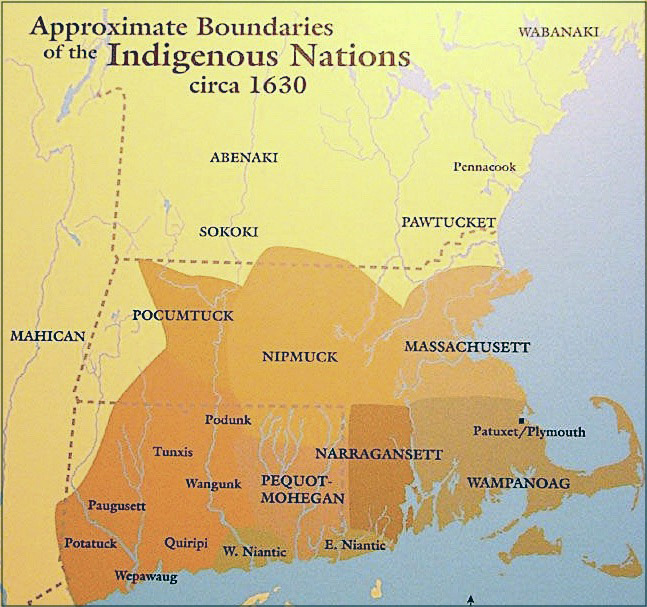
After the story headlined “Did you know…” who the first inhabitants of Lincoln were? story was published on December 9, town historian Jack MacLean offered this additional information abut the map that was included:

The map here shows Massachuset territories extending further north than was the case at the time of contact. Along the coast, lands associated with the Pawtucket Confederation extended down to Charlestown, which was purchased from Pawtucket leaders. Boston (Shawmut) was associated with the Massachuset, with the Charles River providing a divide. Watertown and Cambridge south of the river were also Massachuset. However, Lincoln’s primary parent community of Concord was purchased from local leaders (Tahattawan) and from Squaw Sachem, along with her second husband, who lived at Mistick (Medford). Squaw Sachem had succeeded her first husband (Nanepashemet) as the leader of the Pawtucket Confederation. While Concord was formally seen as being under Squaw Sachem and the Pawtucket Confederation, the close proximity of the two “tribal” groups in this area indeed suggests much fluidity and interconnectedness.

David, it should be noted, is the coauthor with his mother of The First Peoples of the Northeast.

Category: history 1 Comment

“Did you know…” who the first inhabitants of Lincoln were?

December 9, 2021

By David P. Braun

When people ask, “who were the first inhabitants of Lincoln,” they often mean, “what tribe lived here?” The short answer is, probably Massachuset.

But as best we can tell, most Native American “tribes” were somewhat fluid. They did not have rigid boundaries or a concept of land as property in the way that the European invaders did. With some exceptions, they were more like loose confederacies of local communities that sometimes acted together as larger groups. They had territories based upon their traditional uses of the landscape, their shared history, and their shared history of alliances and disputes with neighboring groups. They spoke related, mutually intelligible Algonquian languages and were descendants of Algonquian-speaking communities that had lived and evolved together for thousands of years.

The exact tribes known from the historic record may not have had that much antiquity. Social relationships and identities likely evolved over those thousands of years, as lifeways changed and as populations grew and shifted over time. But the incorporation of agriculture into their lifeways starting around 1000 A.D. likely brought considerable changes. Populations grew faster, and areas with good soils for farming would have become valuable resources.

Occasionally, where the edges of tribal territories met or overlapped, the communities would have worked out rules for sharing. There is a lake in Webster, Massachusetts, famously named (or at least so recorded), as

“Chargoggagoggmanchauggagoggchaubunagungamaugg”

If my memory serves, this native name is usually translated literally as something like “you fish on your side of the lake, we fish on our side of the lake, and nobody fishes in the middle.” However, Algonquian languages are very figurative. The local communities might have thought of the lake simply as “Border Treaty Lake.”

Places such as Lincoln, which is mostly upland terrain, may have been part of some native communities’ identities and hunting territories before Europeans arrived, but not the site of winter or even seasonal villages. That was not how the indigenous communities lived. Instead, the adjacent Sudbury/Concord/Merrimack River valley and its wetlands would have been far more important as dwelling places. The rivers were avenues of travel and sources of food, and the floodplains would have provided productive farmland near to their villages.

The arrival of the Europeans in the early 1600s and the fatal diseases they brought caused havoc, disrupting the indigenous peoples’ lives, locations, and connections with each other. Many communities became mixtures of local natives and refugees from neighboring areas that had suffered worse. And the written records we have of these communities post-date the start of that havoc. They do not necessarily record how the people lived beforehand. The historic records, biased though they may be (after all, who wrote them? Not the natives…), suggest that the natives did their best to maintain their sense of identity and their identification with their traditional home landscapes. But the European diseases killed their elders fast. As the native communities lost their elders (with their unwritten stores of history and traditional knowledge), they lost much of their collective cultural memories.

It is wrenching to think of the thousands of years of tradition and knowledge that were lost with the erasure of these communities.

For those who wish to read more, I recommend Charles Mann’s book, 1493: Uncovering the New World Columbus Created (2011). It is grim reading but also important and fascinating. Also valuable is Nathaniel Philbrick’s book, Mayflower (2006). This also is grim and specific to southeastern New England, but an excellent treatment of how the natives and early European settlers in the Massachusetts Bay area perceived and treated each other.

Addendum — After this story was published, town historian Jack MacLean offered this additional information abut the map:

The map here shows Massachuset territories extending further north than was the case at the time of contact. Along the coast, lands associated with the Pawtucket Confederation extended down to Charlestown, which was purchased from Pawtucket leaders. Boston (Shawmut) was associated with the Massachuset, with the Charles River providing a divide. Watertown and Cambridge south of the river were also Massachuset. However, Lincoln’s primary parent community of Concord was purchased from local leaders (Tahattawan) and from Squaw Sachem, along with her second husband, who lived at Mistick (Medford). Squaw Sachem had succeeded her first husband (Nanepashemet) as the leader of the Pawtucket Confederation. While Concord was formally seen as being under Squaw Sachem and the Pawtucket Confederation, the close proximity of the two “tribal” groups in this area indeed suggests much fluidity and interconnectedness.

David, it should be noted, is the coauthor with his mother of The First Peoples of the Northeast.


“Lincoln’s History” is an occasional column by members of the Lincoln Historical Society.
Category: history 3 Comments

Addendum

December 9, 2021

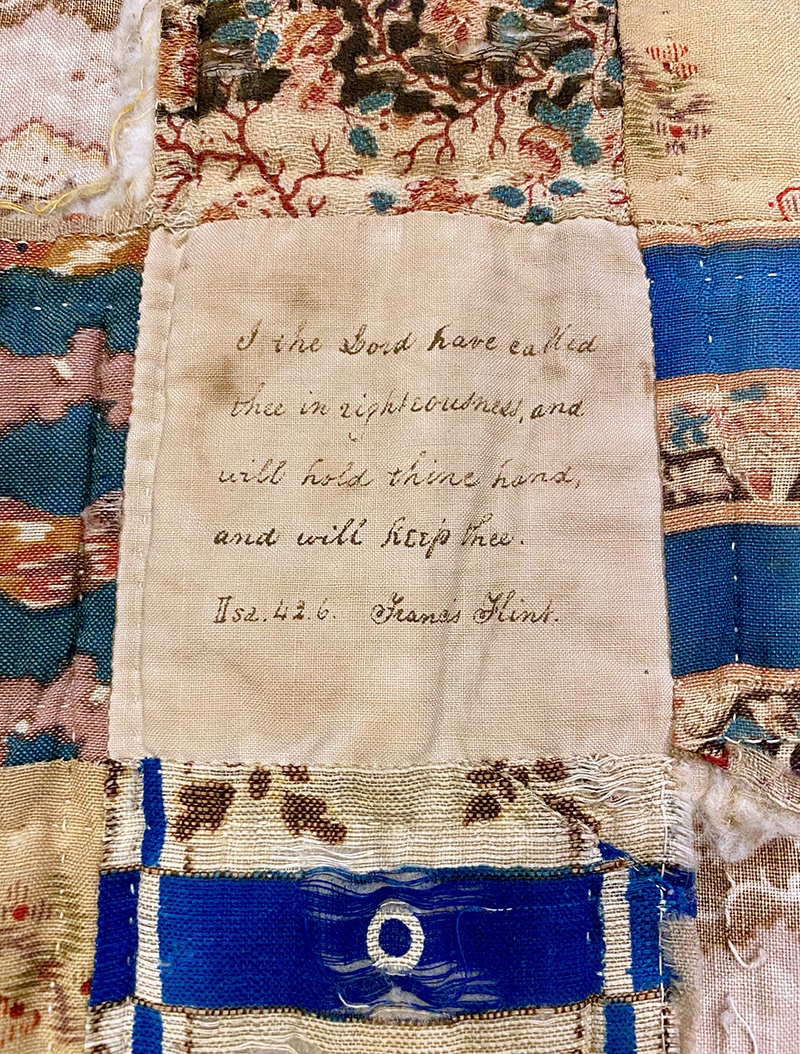
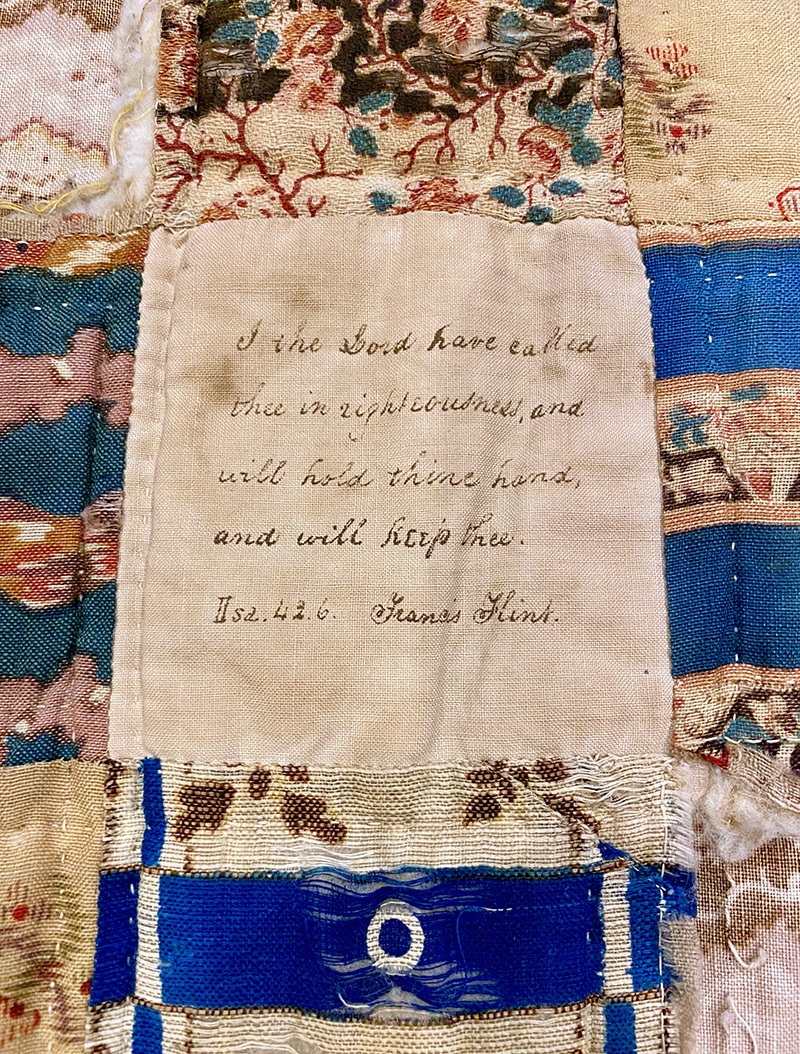
A new photo has been added to the photo gallery at the bottom of the December 8, 2021 story headlined “Archivist, family members unwrap a historic quilt.” The inadvertently omitted image shows a square hand-written by Joseph Flint.

Category: history Leave a Comment

Archivist, family members unwrap a historic quilt

December 8, 2021

The Lincoln Public Library archives contain all sorts of historical items, but not all of them are on paper — a quilt that was made for a woman before she sailed off to be a missionary recently came out of the vault to be admired and rewrapped.

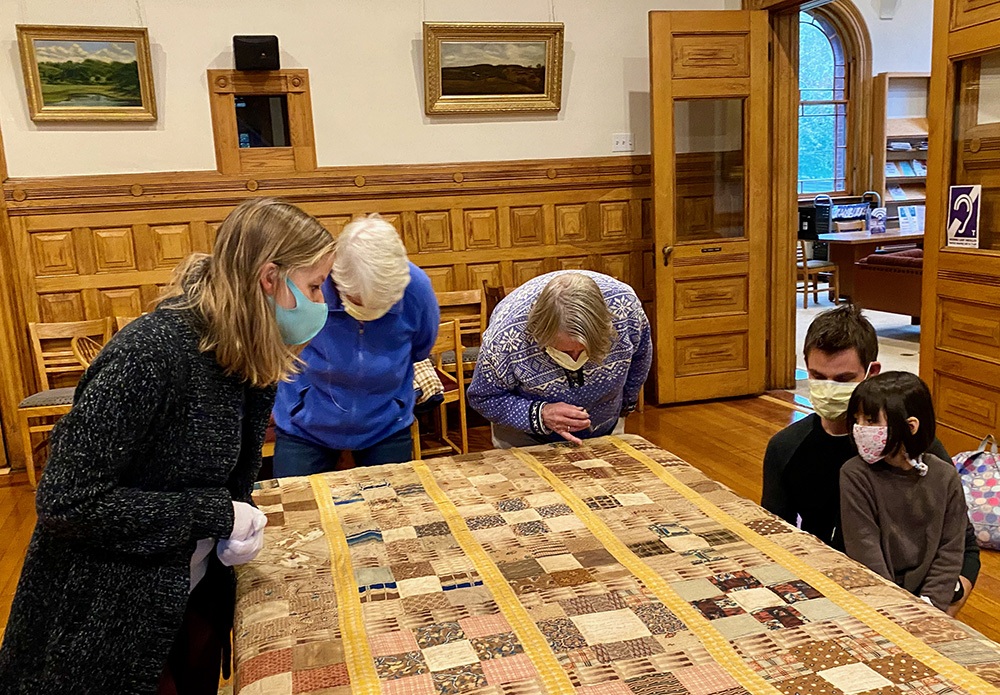
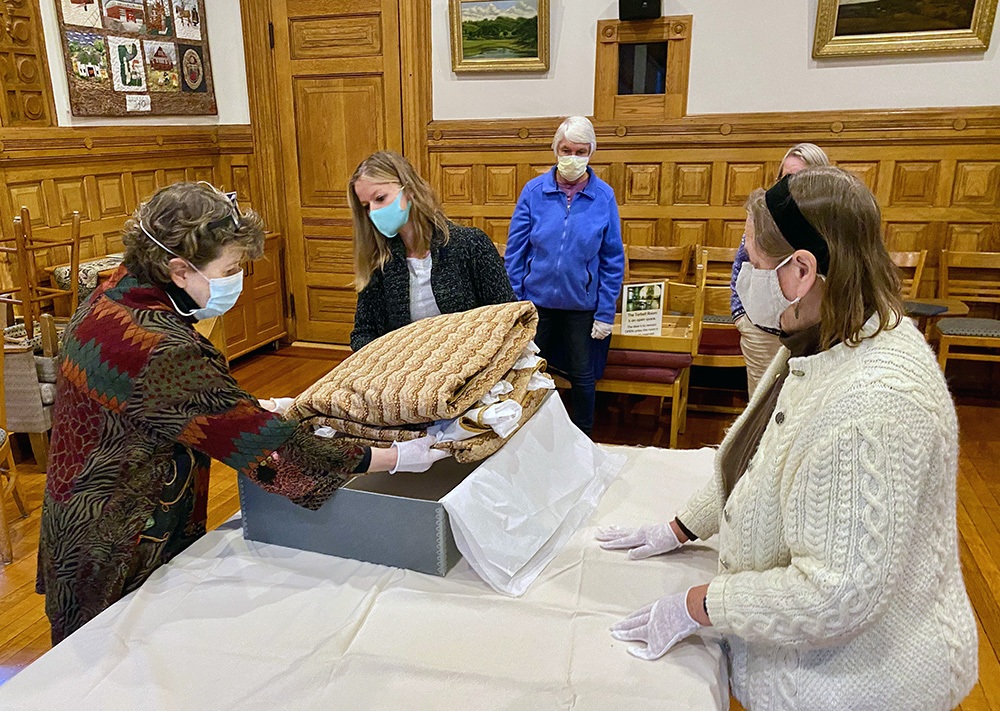
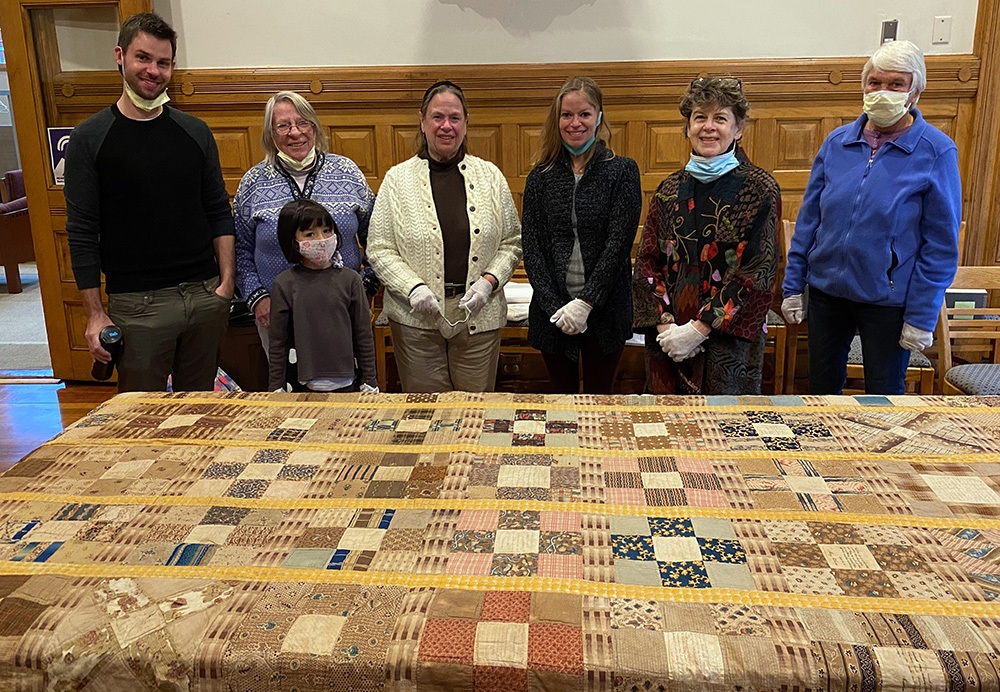
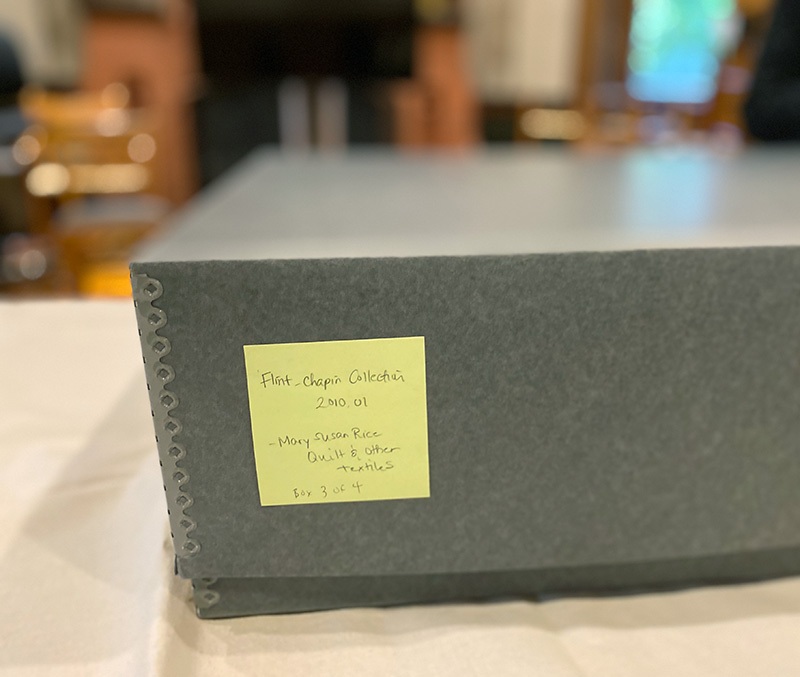
The Flint family, which has lived in Lincoln since the 1600s, donated the quilt to the library some years ago. Three generations of Flints were on hand in the Tarbell Room when the quilt was removed from its box, carefully unfolded on the big table, and refolded with layers of acid-free tissue paper for posterity.

Overseeing the process was Virginia Rundell, Lincoln’s town archivist, who splits her part-time job between the library and working with materials including vital records (births, marriages and deaths) the Town Office Building. 

When 26-year-old Mary Susan Rice, an ancestor of the Flints, decided to travel to Persia in 1847 to pursue her missionary vocation, members of the Lincoln Ladies’ Missionary Sewing Circle (part of the First Parish Congregational Church) sewed individual squares for the quilt and added hand-written messages of inspiration and affection, many of which are still legible today. They did this knowing that it would serve as a cherished reminder of her Lincoln home for Rice, who quite possibly would never return, given the dangers of distant travel at the time.

The large quilt (109” x 96”) has an unusual structure, with cutouts at the two bottom corners to allow it to be laid flat on a four-poster bed. It was made of scraps of many types of material but only lightly quilted for “sentimental value rather than hard everyday use,” according to a 1998 article by Tracy Barron of the American Quilt Study Group.

Each of the 82 squares contains a personal note or Bible verse signed by Rice’s numerous friends, family and acquaintances, among them her mother, who penned a heartfelt inscription into the cloth:

Father to Thee
I yield the trust. O bless her with a love
Deeper and purer, stronger far than mine.
Shield her from sin, from sorrow and from pain.
But should thy wisdom deem affliction best,
Let love be mingled with the chastening.
With an unshrinking heart I give her, Lord, to Thee.
Thy will, not mine be done.

(A bit of research revealed that this was not an original composition by Rice’s mother; it appeared at least once before in print. It’s part of “Love’s Offering” published in The Mother’s Magazine in 1840.)

Rice was well qualified to teach at the Fiske Girls’ School in Oroomiah, Persia (now Rezaiyeh, Iran) — she had attended Mt. Holyoke Female Seminary (later Mt. Holyoke College), founded just 10 years before her departure by Mary Lyon, who also contributed a Biblical verse and wish on one of the quilt’s squares.

Rice did in fact return to Lincoln after 22 years in Persia, where she “helped implement progressive ideas about the roe of women in a society where women were not educated and considered second-class citizens,” Barron says. Some of her students even converted to Christianity in “Holyoke-style revivals.” She resumed living in Lincoln and attending Sewing Circle meetings until her death in 1903.

Mary Susan Rice was the sister of Caroline Rice Flint, the great-grandmother of Peggy Flint Weir and Ephraim Flint. Mary and Caroline grew up in the house that still stands at 7 Old Lexington Rd. When Mary returned from Persia, she lived with her sister and brother-in-law Ephraim Flint in the Flint homestead on Lexington Road, still home to three generations of Flints. The quilt was found by Margaret Flint Sr. in the attic of Bertha Chapin, whose mother also grew up in the Flint homestead, according to family members.

Preserving artifacts like the quilt are central to the work of archivists like Rundell. Along with local historians, they’re sometimes called on when older residents are downsizing and looking to dispose of old letters, photos, papers, records and other materials that may have been sitting in attics or basements for decades. Documents that are deemed historically significant are treated so the paper so won’t degrade any further. Sometimes books are unbound and later archivally rebound so they can be digitized, making them available online to researchers anywhere in the world. Much of this work in Lincoln is funded by annual town budget appropriations requested by the Community Preservation Committee (the money comes from property taxes and the state).

Another part of the job is making archival materials more “discoverable” using finding aids for the various collections pertaining to Lincoln buildings, families, events, organizations and photographs. “One of the big goals is to get people engaged with the archives,” Rundell said. “You don’t get this stuff and put it in a vault so it just sits there — you went people to use it.”

Click on an image below for a larger version and caption (photos by Alice Waugh).

quilt1
quilt-square
quilt-box
quilt-flints
quilt-label

Category: history 3 Comments

Historical misunderstanding once shrouded the “muster field”

November 22, 2021

By Rick Wiggin

Contrary to popular Lincoln myth, the town’s Minute Men did not muster in the field at the corner of Sandy Pond and Baker Bridge Roads. The mistaken identity of that field as the “Muster Field” came about from a misreading of Lincoln’s history and from the politics of the town’s acquisition of that field in 1983.

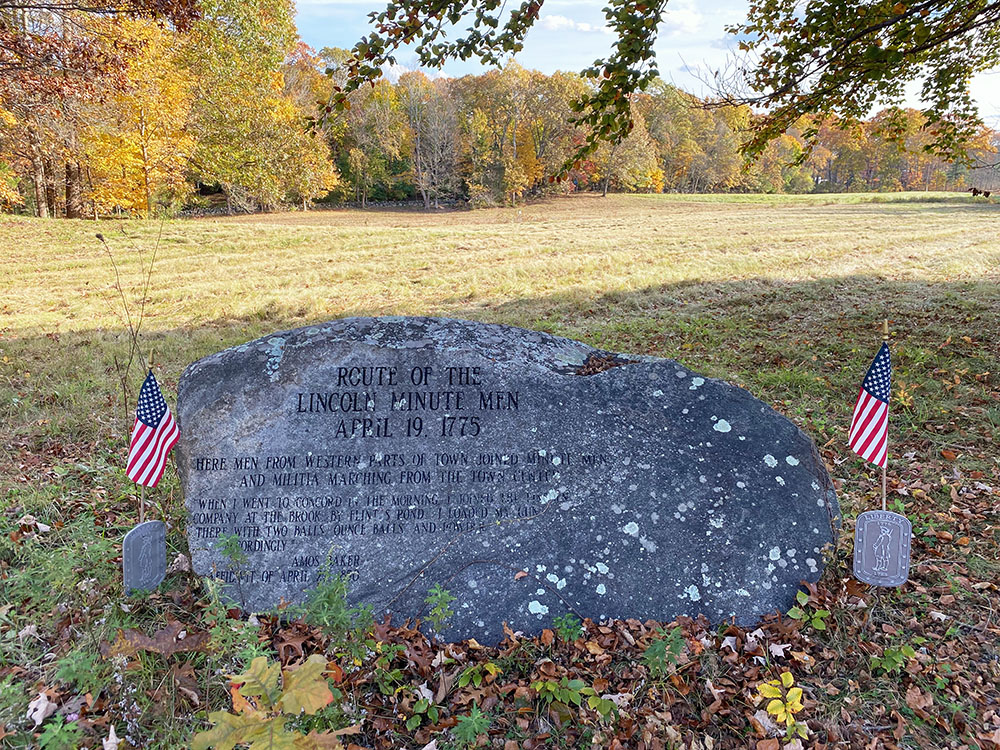
In the early hours of April 19, 1775, Lincoln’s Minute Men and militia company mustered on the Town Common near to the meetinghouse, where the town stored its gunpowder and military supplies. From there, the soldiers began their march to Concord along what is now Sandy Pond Road. When they reached the junction with modern Baker Bridge Road, they were joined by members of the Baker and Billing families, who lived along the western border of town. Amos Baker, age 19 at the time, wrote many years later that, “When I went to Concord in the morning, I joined the Lincoln company at the brook, by Flint’s pond, near the house then of Zachary Smith …”

The historically accurate marker at the “muster field” (click to enlarge).

In the early 1980s, Sumner Smith, who then owned much of the land around Flint’s Pond, offered to sell several large tracts to the town before offering them to a developer. A Special Town Meeting in November 1983 hotly debated the financial cost against the value of preserving the land as open space. In the debate, it was asserted the land was of incalculable historical importance because it was the place where the Minute Men mustered on April 19. But this was a misreading of Amos Baker, who only stated that he and his family joined up with the Minute Men at the site, not that all the town’s soldiers had mustered there. One of the town’s modern Minute Men even promised to erect a commemorative marker on the “Muster Field” if the town purchased it. The town responded enthusiastically and voted to buy the land, and a large stone was soon moved to the site.

The myth of the Muster Field began to unravel shortly after the purchase, and the large stone sat un‑engraved for 17 years. But the name stuck. In the year 2000 — the 225th anniversary of April 19, 1775 — engraved markers were finally placed on both the Town Common and the mis-named Muster Field, commemorating the march of Lincoln’s soldiers to Concord. Together, the two stone markers erected in 2000 tell the correct story. But old names — even incorrect ones — die hard.

For more about this history, see “Recognition of a Proud Legacy” by Rick Wiggin (The Lincoln Review, January/February 2000).


“Lincoln’s History” is an occasional column by members of the Lincoln Historical Society.
Category: history Leave a Comment

Lincoln once had a big greenhouse gas producer — a lime kiln

November 9, 2021

By Donald Hafner

In 1730, Samuel Dakin with his brothers and three other investors had high ambitions. They formed a partnership for “searching after, digging, and improving all such mines or ores as may be found in or upon the land of” Samuel Dakin. Iron ores were highly valued, and bog iron ore — which forms in iron-rich, swampy water — had been found around Iron Mine Brook near Beaver Pond in Lincoln. The partners hoped a lode of bog iron ore might lie buried beneath Dakin’s land. His mining ambitions, however, were a bust. If the partners ever found “such mines or ores,” they were meager.

Fortunately for Dakin, his father had bequeathed to him a limestone quarry and a kiln for roasting limestone at high heat, converting it into powdery, white lime. The quarry and the lime kiln were located on Dakin land bounded by modern Sandy Pond and Baker Bridge roads. For his neighbors, it might well have been cursed as “Lime Kiln Field.” The heat needed to roast limestone into lime required large amounts of wood and produced acrid smoke and toxic fumes. The lime kiln cannot have been a good neighbor.

Lime had many uses in 18th-century Lincoln. Weaver Joshua Child used “two pounds of the best rock lime” in his recipe for dyeing cloth. Joshua Brooks used lime at his tannery on the North Road to remove hair from the hides before tanning. And in March 1767, the town paid Joshua Brooks for “eight bushels and half of hair to mix with lime for the meeting house.” The town had built a new gallery in the meeting house, and lime bought from Amos Dakin was mixed with sand and the hair from Brooks’ tannery “to plaster under the galleries in the meeting house.” (The animal hair helped bind the plaster together.) Over the years, the town treasurer’s records are sprinkled with payments for lime to be used in whitewashing the walls of the town’s schoolhouses.

It is not clear when the lime kiln in Samuel Dakin’s field ceased belching smoke and fumes. In 1788, Dakin sold his land to a Lincoln newcomer, Zachariah Smith. Whatever became of Dakin’s lime kiln, clearly it had not transformed Lincoln into a mining town. Yet perhaps scattered in that field there still can be found a scorched stone or two that once were part of Lincoln’s ancient lime kiln.

This account of the Dakin lime kiln is indebted to Jack MacLean’s A Rich Harvest, which can be purchased from the Lincoln Historical Society. Illustration from “Pre-Industrial Lime Kilns” (Historic England, 2018).


“Lincoln’s History” is an occasional column by members of the Lincoln Historical Society.
Category: history 2 Comments

News acorns

October 25, 2021

Talk on Lincoln’s Black residents in the 1700s

Last spring, the Lincoln Historical Society began to explore Lincoln’s past as a town that included enslaved people with a talk by Elise Lemire (co-sponsored by the Bemis Free Lecture Series) on “Slavery in Lincoln, Massachusetts: Reckoning with Our Past, Planning for a More Honest and Inclusive Future” (click here to watch video). The LHS will dig deeper on Thursday, Oct. 28 at 7 p.m. with a talk on “Entangled Lives, Black and White: Lincoln and Its African American Residents in the 18th Century” by LHS board member Donald Hafner, a retired vice provost and professor of political science at Boston College. Click here for the Zoom link (meeting ID: 936 3276 0035, passcode: 177417).

The event is co-sponsored by the First Parish in Lincoln’s Racial Justice Journey, which began this fall with a focus on national, local, and church history and the ways in which that history has involved us in questions of race. The aim is to offer access to a variety of sources of information and perspectives that will let participants reconsider these questions together, in preparation for the next stages of the journey, focused on issues (winter) and action (spring). Every Thursday evening at 7 p.m. this fall, there will be Zoom meetings with talks, documentaries, book discussions, or movies. Field trips are also offered as part of the program. Everyone is invited. To learn more, contact Mary Helen Lorenz at mhelen808385@gmail.com.

Fall Fest this Saturday

The Parks and Recreation Department will host the first-ever Fall Fest at Pierce Park on Saturday, Oct. 30 from noon–3 p.m. The event will feature the popular Trunk-or-Treat along with activities such as caramel apple decorating, bounce house, hayrides, an apple pie contest, pony rides, a petting zoo, and more. This event requires online registration and a $5 per person entry fee ($20 maximum per family).

Learn how to restore apple trees

Want to learn how to restore an apple tree? Or a whole orchard? Join the Lincoln Garden Club on Wednesday, Nov. 3 at 7 p.m. for a presentation by Matt Kaminsky, aka “Gnarly Pippins.” Matt is an arborist, author, and expert in the production of cider. Click here to register in advance for this meeting; you will then receive a confirmation email with your Zoom link.

Enter work for the Lincoln Arts Show

Lincoln-affiliated artists and artisans of all ages are invited to submit their work for the Lincoln Arts Show from Friday to Sunday, Nov. 5–7 from noon–5 p.m. at the Pierce House. Show the town your two- and three-dimensional creations for display or sale. Click here to register (entry fees start at $10, though the fee is waived for students). Once you’ve registered, a form for the artist statement and labels will be sent to you. Entry forms, artist statements, and art labels must be received by Monday, Nov. 1 at 5 p.m. Any late entries will be accepted on a space-available basis.

There is no commission; artists are responsible for collecting sales tax. All work must be ready to hang or present. Hanging/displaying times are Thursday, Nov. 4 from 4–6 p.m. and Friday, Nov. 5 from 9 a.m.–noon. Take-down time is Sunday, Nov. 7 from 5–6 p.m. Artists or their designees will be responsible for hanging/displaying and removing their own works. Hanging materials and tools are provided. The opening reception is Friday, Nov. 5 from 5–7 p.m. Questions? Contact Sarah Chester at schester636@gmail.com.

Lincoln residents in area performances

John Lynch

Lincoln resident Sammy Andonian will be the featured artist in Massachusetts Peace Action’s Music for Peace series opening concert on Saturday, Oct. 30 at the Harvard-Epworth Methodist Church (1555 Massachusetts Ave., Cambridge) from 7:30–9 p.m. Limited tickets are available for in-person seating; the event will also be live streamed. Support a worthy cause while enjoying beautiful classical music for solo and accompanied violin.

Lincoln’s John Lynch will be on stage of Lovers and Other Strangers, a comedy of 1970s love lives in five one-act vignettes, on November 5, 6, 12, and 13 at 8 p.m. and November 7 at 2 pm. at Theater III (250 Central St., West Acton). Vaccination and masks are required. For details, see theatre3.org or email lsminkoff@theatre3.org.

Public form on use of Lincoln ‘s conservation trails

The Lincoln Land Conservation Trust (LLCT) and the Lincoln Conservation Commission (LCC) are hosting a virtual Trail Use Public Forum on Wednesday, Nov. 17 from 7–8:30 p.m. LLCT and LCC have begun a comprehensive review of the multiple uses of Lincoln trails and how best to manage them for the protection of open space and overall public benefit. Trail uses have changed over time, and we are seeking a current community understanding of the appropriate way to use and enjoy our open spaces and trails.

The forum will start with a brief slide show reviewing the goals of Lincoln’s 2017 Open Space and Recreation Plan and a summary of previous and current trail uses, with the goal of developing a trail use vision that is appropriate for Lincoln today. After the presentation, attendees are encouraged to provide feedback and comments. Click here for the Zoom link (meeting ID 927 0523 1109, passcode: 971375). If you’re unable to attend the public forum, please submit any comments you’d like to share regarding the use of Lincoln’s trails to the Conservation Department (conservation@lincolntown.org or 781-259-2612) by November 30. 

State to conduct triennial special ed/civil rights review of schools

During the week of November 15, the state Department of Elementary and Secondary Education’s Office of Public School Monitoring (PSM) will conduct a Tiered Focused Monitoring Review of the Lincoln Public Schools. The PSM visits each district and charter school every three years to monitor compliance with federal and state special education and civil rights regulations. Areas of review related to special education include student assessments, determination of eligibility, the Individualized Education Program (IEP) team process, and IEP development and implementation. Areas of review related to civil rights will include bullying, student discipline, physical restraint, and equal access to school programs for all students. 

In addition to the onsite visit, parent/guardian outreach is an important part of the review process. The review chairperson from PSM will send all parents of students with disabilities an online survey that focuses on key areas of their child’s special education program. Survey results will contribute to the development of a report. During the onsite review, PSM will interview the chair(s) of the district’s Interim Special Education Parent Advisory Council (SEPAC). Other onsite activities may include interviews of district staff and administrators, reviews of student records, and onsite observations.

Parents/guardians and others may email PSM chair Erin VandeVeer at erin.vandeveer@mass.gov or call 781-338-3735 to request a telephone interview. If an individual requires an accommodation such as translation, to participate in an interview, the Department will make the necessary arrangements.

Within approximately 60 business days after the onsite visit, the review chair will provide the district with a report with information about areas in which it meets or exceeds regulatory requirements and areas in which it requires assistance to correct or improve practices. The public will be able to access the report here.

Category: arts, history, kids, schools Leave a Comment

News acorns

October 7, 2021

Build Scarecrows at Stonegate to benefit PTO

Show fall spirit for your town and your school by build a scarecrow during the annual Scarecrows at Stonegate fundraiser. Bring a pillowcase for your scarecrow’s head, old clothing (pants with belt loops and long-sleeve shirts – teen to small adult sizes are best), and fun accessories (hats, masks, wigs, etc.) or old Halloween costumes. Stonegate Gardens provides hay, twine, stakes, additional craft supplies, and step-by-step instructions. Choose to display your scarecrow in Lincoln or take it home (display scarecrows will not be returned).Dates are as follows:

  • Wednesdays, Oct. 6 and 13 from 11 a.m.–3 p.m.
  • Saturday, Oct. 9 from 11 a.m.–4 p.m.
  • Sunday, Oct. 10 from noon–5 p.m.

Scarecrow-building takes place at Stonegate Gardens (33 South Great Rd.), and caretaker supervision is required at all times (no drop-offs). There is a $15 donation fee per scarecrow, which will be donated to the Lincoln School PTO. Social distancing and masks are required. For more information about how Stonegate is modifying this year’s event to prevent COVID spread and to sign up for a slot, please visit this SignUp Genius link.

Film on Mike Wallace at library

The Lincoln Library Film Society will screen “Mike Wallace is Here” on Thursday, Oct. 21 at 6 p.m. in the Tarbell Room. The documentary offers an unflinching look at the legendary reporter, who interrogated the 20th century’s biggest figures in over 50 years on air, and his aggressive reporting style and showmanship that redefined what America came to expect from broadcasters. Unearthing decades of never-before-seen footage from the 60 Minutes vault, the film explores what drove and plagued Wallace, whose storied career was entwined with the evolution of journalism itself.

LSB Players start season with “The Addams Family”

The LSB Players at Lincoln-Sudbury Regional High School have announced their schedule of plays for 2021-2022 and invite residents to subscribe for season tickets. The shows will be:

“The Addams Family”
November 17–20 at 7:30 p.m. (Kirschner Auditorium)
Directed and choreographed by Carly Evans, music directed by Michael Bunting. This hilarious and irreverent musical tells the story of the Addams Family, a loving yet macabre family set in their ghoulish ways, as they face the prospect of their daughter/sister marrying someone far too normal for their taste.

8th Annual Winter One-Acts
February 4 at 7:30 p.m., February 5 at 3 p.m. and 7:30 p.m. (Rogers Theater)
Three L-S seniors will direct “That’s Not How I Remember It,” “As It Was,” and “I, Chorus.”

“Sense and Sensibility”
April 8 at 7:30 p.m., April 9 at 2 p.m. and 7:30 p.m., April 10 at 2 p.m.
Kate Hamill’s fast-paced adaptation of the Jane Austen novel takes on the gossipy society of late 18th-century England and examines the societal pressures that affect the lives of sisters Elinor and Marianne Dashwood.

9th- and 10th-grade play (title TBA)
May 6 and 7 at 7:30 p.. (Rogers Black Box Theatre)

COLLAGE XXVI, a collection of scenes, one-acts and original pieces selected and directed by students
June 10 and 11 at 7:30 p.m. (Rogers Black Box Theatre)

Tickets for all 2021-2022 shows are $8 for students and senior citizens, and $15 for adults (Collage XXVI is free). Benefactors and season ticket holders receive advance notice before tickets are available to the general public so they can reserve for the evening of their choice. Season tickets are $40 for adults and $20 for students and senior citizens, while Benefactors’ tickets are $60. All Season Ticket holders and Benefactors are named in each program of the year. Click here to order.

Category: arts, charity/volunteer, history, kids Leave a Comment

  • « Go to Previous Page
  • Page 1
  • Page 2
  • Page 3
  • Page 4
  • Page 5
  • Page 6
  • Interim pages omitted …
  • Page 22
  • Go to Next Page »

Primary Sidebar

Recent Posts

  • Legal notice: Planning Board hearing (Civico) May 19, 2026
  • Fate of trees to be announced on June 8 May 18, 2026
  • Police log for May 5–13, 2026 May 17, 2026
  • Board accepts $1.35 million in donations for community center May 14, 2026
  • News acorns May 13, 2026

Squirrel Archives

Categories

Secondary Sidebar

Search the Squirrel:

Advanced search

Privacy policy

© Copyright 2026 The Lincoln Squirrel · All Rights Reserved.