By Donald Hafner
Crows can be a nuisance for farmers. They raid grain fields and orchards in flocks numbering in the hundreds, if not thousands. Apparently the patience of Lincoln’s farmers ran out in March 1791, when a warrant at Town Meeting proposed “a bounty to the inhabitants of the town to encourage and bring forward the destruction of those mischievous birds called the black bird and the crow.” Residents “voted that there shall be the sum of six pence for each crow that is feathered and three pence for each young crow not feathered given as a bounty.”
At some point, the bounty was doubled to one shilling, enough at the time to buy two pounds of salt pork. Plus, the bounty hunter only had to bring in the crow heads; he could keep the rest of the bird, and crow was said to taste as good as quail. Even the feathers were worth having, according to Abigail Adams, who preferred writing with a crow quill: “It is much smaller than a goose quill, and I can write much better with it.”
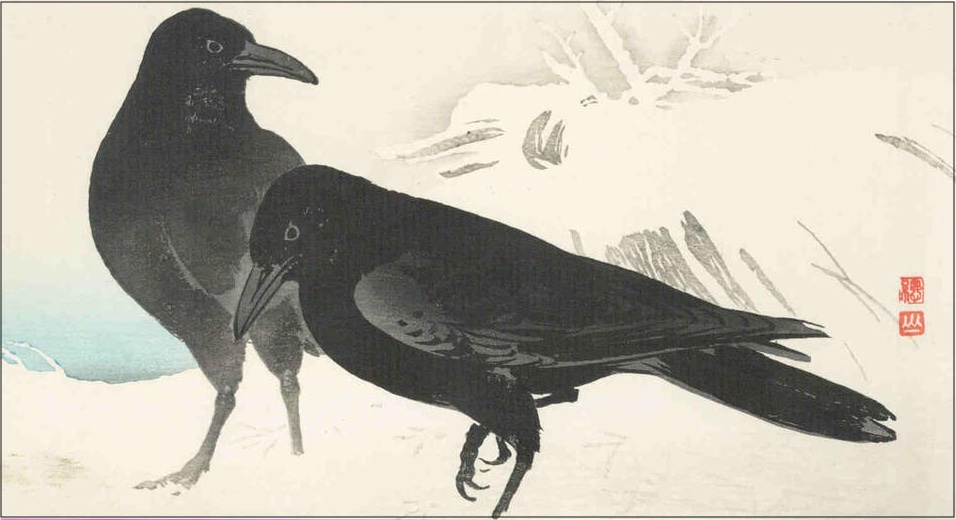
“Two Crows in Snow” by Ito Sozan (1884-1920)
Despite the reward offered by the town, not many bounties were paid. By 1799, the treasurer’s records showed only eight payments, for what may have been no more than a dozen or so crows. This would not have surprised the editor of The Boston Gazette, who reminded his readers in 1789 of John Gay’s witty remark: “To shoot at crows is powder flung away.”
Crows are among the most intelligent of birds, with excellent memories and eyesight. They readily learn where and when food can be found, and danger avoided. ’Tis said they can distinguish between one person and another and remember those who pose a threat, and they can pass that warning on to others — which may explain why the eight men of Lincoln who collected bounties did so only once.
“A murther of crowes” first appears as a fanciful term for a flock of crows back in 15th-century England. The illusion dies hard that the problem of crows can be solved with gunpowder and birdshot. In the 1930s, the state of Wisconsin tried to entice the country folk into shooting more crows by touting “black partridges” as delicious food. That didn’t work either. The murder of crows was no answer to a murder of crows.
“Lincoln’s History” is an occasional column by members of the Lincoln Historical Society.
It can be hard for people exposed to the modern environmental movement to understand what life was like. We still have a law on the books prohibiting interference with pigeon hunting. General Laws chapter 266 section 132. The pigeon referred to in that law is the passenger pigeon, a notable pest of the 18th and 19th centuries. States which tried to ban pigeon hunting to save the species had trouble getting juries of farmers to convict.