• Skip to primary navigation
  • Skip to main content
  • Skip to primary sidebar
  • Skip to secondary sidebar

The Lincoln Squirrel – News, features and photos from Lincoln, Mass.

  • Home
  • About/Contact
  • Advertise
  • Legal Notices
    • Submitting legal notices
  • Lincoln Resources
    • Coming Up in Lincoln
    • Municipal Calendar
    • Lincoln Links
  • Merchandise
  • Subscription Info
    • My Account
    • Log In
    • Log Out
  • Lincoln Review
    • About the Lincoln Review
    • Previous Issues
    • Submit Your Work
    • Subscribe/Donate

history

Remembering the Destruction of the Tea 250 years ago

December 13, 2023

By the Lincoln250 Planning Committee

In May 1773, the British Parliament passed the widely unpopular Tea Act, and in December that same year, nearly 100 patriots dumped an entire shipment of East India Company tea into the Boston Harbor.

Four days after the Destruction of the Tea and again a week later, Lincoln’s Town Meeting took up a request from Boston leaders for the town’s support. The town’s own Committee of Correspondence drafted a reply, and Town Meeting members deliberated over the draft text. They were cautious about endorsing the destruction of private property, but they nevertheless approved a stirring response: “We cannot therefor but Commend the Spirited behaviour of the town of Boston in Endeavouring to prevent the sale of the East India Company’s teas by Endeavouring to perswade the Consigners to Resign their office or any other Lawfull means.” In addition, Lincoln residents resolved neither to purchase nor use tea so long as there was a duty on it, and to “hold and esteem such as Do use such tea Enemies to their Country.” 1

On December 16, 2023, Boston will celebrate the 250th anniversary of the Destruction of the Tea (the “Boston Tea Party” phrase was coined in the 1830s). On this day at Griffin’s Wharf in Boston, 46 tons of tea (valued at £9,659 — roughly $2 million today) was dumped over the sides of three British ships. Britain retaliated by passing the Coercive Acts, which were meant to end the rebellion in New England, but the opposite happened. Within months the “shot heard around the world” rang out in Concord. This marked the beginning of the American Revolution.

To learn more about the history of the Boston Tea Party or see upcoming events to celebrate the 250th, please click on the links below:

  • Revolution250
  • Minute Man National Historical Park
  • National Park Service

Thank you to the Lincoln Library for recently hosting two events to commemorate the 250th anniversary of the Boston Tea Party! To learn more about Lincoln250 or watch for upcoming events in or around Lincoln to celebrate the 250th anniversary of the historic battles of Lexington and Concord, see the Lincoln250 website.
 
1 MacLean, John C. (1987). A Rich Harvest: The History, Buildings, and People of Lincoln, Massachusetts (Lincoln Historical Society).

Category: history 1 Comment

Lincoln field finally gets its historically correct name

October 22, 2023

Betsy Dakin (left) and Erica Dakin Voolich of Somerville at the dedication of Dakin Field.

Betsy Dakin (left) and Erica Dakin Voolich of Somerville at the dedication of Dakin Field.

For years, Lincolites have known the field at the corner of Sandy Pond and Baker Bridge Roads as the Muster Field. But now, thanks to some historical correction, it’s been officially renamed Dakin Field.

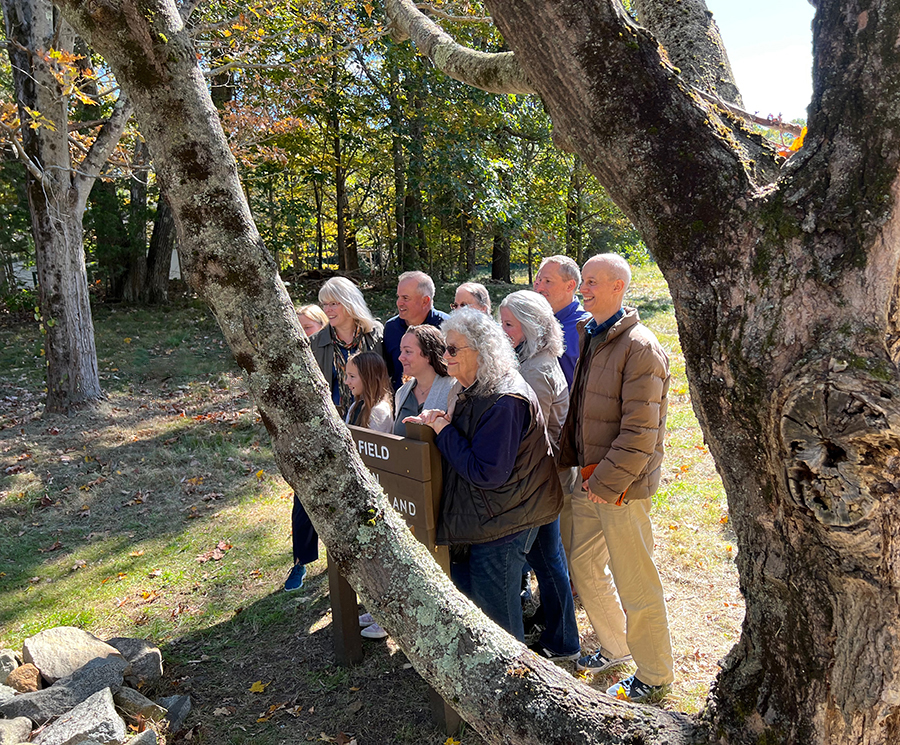
Almost a dozen Dakins from all over gathered at the field on October 13 to witness the installation of a new sign above the wooden “Lincoln Conservation Land” sign. Lincoln’s Betsy Dakin and others in her clan wielded a power screwdriver to tighten the last couple of bolts.

The etched rock a few feet away says “Here men from the western part of town joined the Minute Men and militia marching from the town center” and quotes from an 1850 affidavit by Amos Baker, then a 94-year-old veteran of the Revolutionary War’s opening battle. So far, so good — Baker and several others — did indeed meet other Lincoln soldiers on that spot, according to local historian Rick Wiggin, a guest at the Dakin Field dedication and author of a 2021 Lincoln Squirrel article on this topic.

There were seven members of the Baker family who were in arms at Concord the morning of April 19, 1775: brothers Amos, Jacob, James, Nathaniel, and Samuel; their father, Jacob Sr.; and their brother-in-law, Daniel Hosmer. Jacob Sr. was probably there as a private citizen (probably too old to have been in the militia) to look out for the well-being of his sons and son-in-law. Three of their neighbors (Daniel, Nathan, and Timothy Billing) were also in arms at Concord as members of the Minute Man company, so it’s likely that they were with the Bakers as they rendezvoused with the two companies at Dakin’s Field. The Bakers and Billings all lived more or less along what is today Route 126 and Old Concord Road and Baker Bridge Road.

Representatives from several branches of the Dakin family gathered at the dedication of Dakin Field.

When the alarm rose, it wouldn’t have made sense for them to go to the Lincoln’s actual muster (gathering of troops) in the town center, where they drilled and where Bemis Hall now stands, and then pass to the field near their home again on the way to fight the British in Concord, Wiggin explained.

The field didn’t actually get its erroneous name until the early 1980s, when Sumner Smith was offering to sell several parcels of land to the town, Wiggin said. His ancestors had bought the land from the Dakins and some years earlier, had given another large parcel to the town for the schools (hence Smith School, the name of the southern end of the Lincoln School when it was treated as a separate middle school).

The town couldn’t afford all the land being offered in 1983; “they were about to let this field go for development,” Wiggin said, until the late Henry Rugo (a charter member of the modern Lincoln Minute Men) stood up at Town Meeting and protested, saying, “This is where the Lincoln Minute Men mustered!” or words to that effect. Given the parcel’s apparently valuable historical significance, the town went ahead and bought it.

The story became local lore and the boulder dedicating the “Muster Field” was dedicated on the 225th anniversary of the battle in 2000. (The erroneous history can also be found on page 151 of the A Guide to Conservation Land in Lincoln.) It was another example of a misstatement inadvertently becoming received knowledge, “but it saved the land, and that’s the important thing,” Dakin said.

The Dakin family has not been continuous in Lincoln since the Revolution. Betsy Dakin moved here to Ryan Estate from Plainville several years ago. She had an idea of the family’s earlier connection to Lincoln and she was curious to find the site of the old homestead, “so I did some detective work,” she said. “I was delighted that it was conservation land — I was afraid I’d have to knock on the door” of a newer house standing on the spot.The Dakin name lives on in the area — the LEAP School, a Sudbury preschool, moved into the former Dakin Homestead at 123 Dakin Road in 1998.

Category: history 5 Comments

Lincoln starts gearing up for the nation’s 250th birthday

October 9, 2023

The Lincoln250 logo designed by Lis Herbert.

Here’s your SAT word for the day: “semiquincentennial.” That means 250th anniversary, which is coming up for the United States — and Lincoln and neighboring towns will be deeply involved in the celebration.

The Select Board has established the Lincoln250 Planning Committee to “identify thoughtful, creative, and inclusive opportunities to celebrate Lincoln’s contributions to the American Revolution” starting with the historic battles of Concord and Lexington in April 1775.

“Lincoln250 is committed to engaging our community in a variety of events that will bring together residents of all ages and backgrounds to learn and enjoy our place in history,” said committee chair and Select Board member Kim Bodnar. The group, which held its first meeting on September 25, held a logo contest, which was won by Lincolnite Lis Herbert.

The group envisions events beginning in 2024 and extending through July 2026 and is pursuing grant opportunities to fund some of the events and services for the expected influx of visitors. One of those possibilities is a shuttle service between Concord, Lexington and Lincoln, which was the focus of a 2021 feasibility study.

Although the semiquincentennial is a statewide effort, “there’s no question communities like Lincoln, Lexington and Concord will eventually be at the top of the line to get some serious funding,” State Sen. Michael Barrett said in July, when the Massachusetts Office of Travel and Tourism received a $1 million grant to hire staff and coordinate with cities and towns.

“The objective here in general is to celebrate groups that were marginalized in past celebrations — we’re talking about enslaved people, members of minority groups, women, and Native Americans. We certainly want to include the folks who carried the muskets and who were the demographics majority of the time the American Revolution, too, but the idea is to broaden the lens and widen the celebration,” Barrett said.

Lincoln250 is also collaborating with the Battle Road communities of Arlington, Concord, and Lexington as well as the Minuteman National Historical Park and Hanscom Air Force Base.

To learn more or volunteer at Lincoln250 events or activities, email Bodnar at bodnark@lincolntown.org. Activity and event information will be posted on the town website and will soon have its own web page.

Other members of the Lincoln250 Planning Committee are:

  • Chris Bibbo, DPW Superintendent
  • Brianna Doo, Parks and Recreation Department
  • Amanda Fargo, committee liaison to Lincoln’s businesses
  • Donald Hafner, Historical Society and member of Lincoln Minute Men
  • Tim Higgins, Town Administrator
  • Chief Kevin Kennedy and Lieutenant Sean Kennedy of the Lincoln Police
  • Sara Mattes, committee liaison to Lincoln’s nonprofit organizations, Historical Society, and Bemis Trustee
  • Kim Rajdev, School Committee
  • Rachel Marie Schachter, Bemis Trustee
  • Ray Shepard, Lincoln’s representative on Massachusetts Special Commission on the 250th Anniversary of the American Revolution and Lincoln Library Trustee
  • Rick Wiggin, member of Lincoln Minute Men

Category: history Leave a Comment

Minute Man NHP being spruced up for 250th anniversary

April 27, 2023

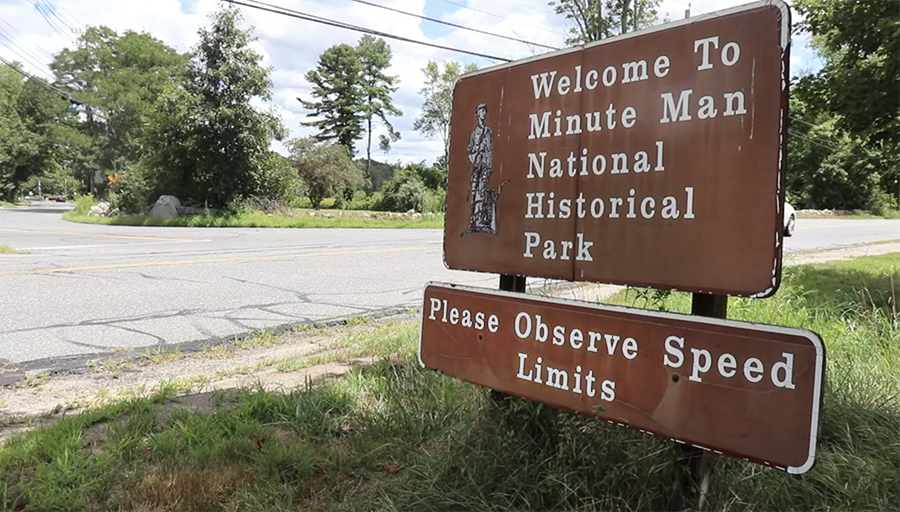
One of the worn signs at Minute Man National Historical Park that will be upgraded.

Minute Man National Historical Park is in the early stages of getting a $27 million facelift, due to be finished in time for the 250th anniversary of the start of the American Revolution in 2025.

The grant from the Great American Outdoors Act will fund repairs to the park’s buildings, structures, landscape, trails, signage, monuments, and statues. Phase 1 of the project includes interior and exterior rehabilitation and preservation work on 16 historic structures, including the repair or upgrade of mechanical, electrical, and plumbing systems in buildings including the 1740 Elisha Jones house and the 1692 Capt. William Smith House.

The Battle Road will also be repaired, and the landscaping will also get attention, such as pruning and replanting, repairing stone walls, and improving the “views and vistas,” according to this video about the project that began late last year.

In 2021, the park had 983,000 visitors who spent an estimated $64 million in local communities, according to the National Park Service.

Category: history Leave a Comment

Restored sampler gives a glimpse of life in Lincoln 200 years ago

February 15, 2023

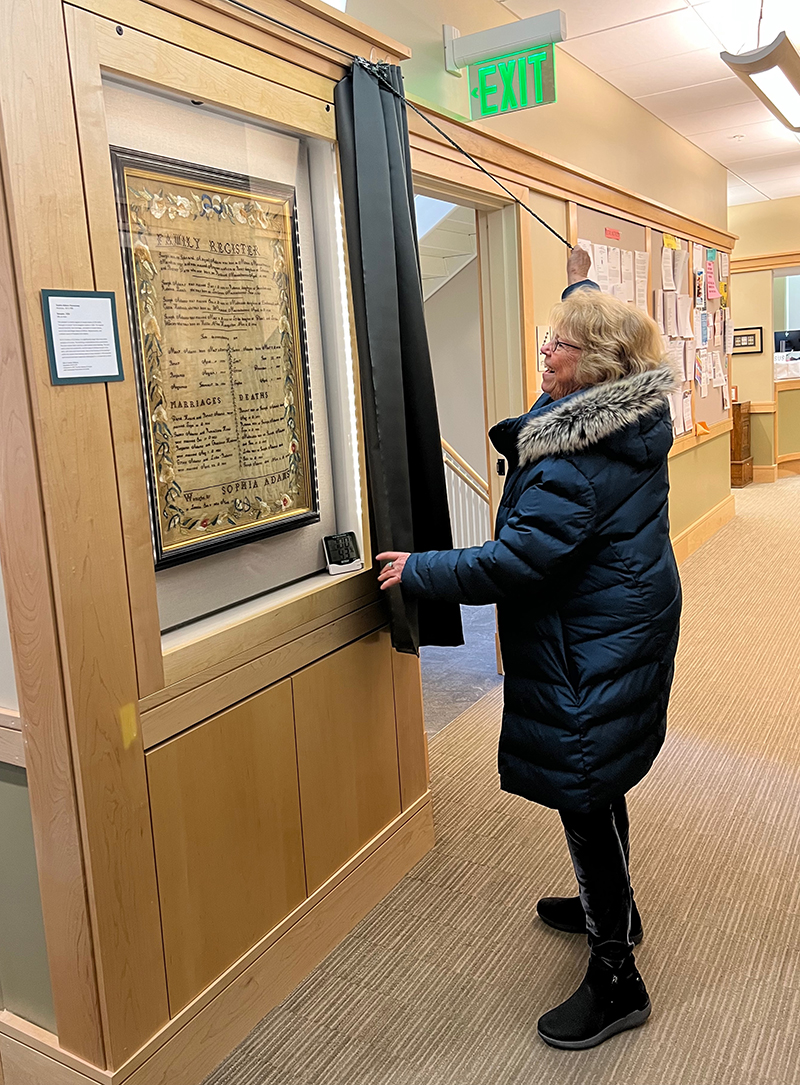
Former Town Clerk Susan Brooks unveils the restored sampler in Town Hall.

The Lincoln Town Hall is home to plenty of historically valuable documents — but until now, few if any of them were hand-stitched.

The Lincoln Town Archives and Lincoln Historical Society recently put on display a sampler created in 1826 by 13-year-old Sophia Adams. The artifact is in a climate-controlled case just down the hall from the Town Clerk’s office, and former Town Clerk Susan Brooks (one of those who was involved in the project) pulled the string at the official unveiling.

Samplers are pieces of embroidery worked in various types of stitching that were commonly created by girls and young women as a demonstration of their skills and perseverance. Many samplers are family registers, recording the births, marriages, and deaths in the life of a family. The Adams sampler was donated to the town in 2017 by Cynthia Williams, whose husband was a great-grandson of the young seamstress.

Sophia lived on Route 2A in Lincoln (the Battle Road) on what was then known as Foster’s farm, very close to the Paul Revere capture site. There were two houses on the property: one where the Smiths lived that’s still standing across from the end of Bedford Road; the other was a rental that became the Foster-Winship­-Adams residence where Sophia worked on her sampler, according to research done by Lincoln historians.

Sophia Adams’s sampler (click image to enlarge).

The names and dates give insight into the often-too-short lives of people in that era. It begins with the 1759 birth of Joseph Adams, a distant cousin of President John Adams, and lists his first marriage to Betsey Davis, who died at age 34, less than two weeks after her youngest son’s birth. Having five chil­dren to raise, Joseph married Rebecca Patch just over two years later. This was short-lived as Rebecca died within nine months. The sampler records that he then married Mehitable Hildreth, who bore him three children, the youngest being Sophia.

Mehitable died when Sophia was six, and Joseph was married for the last time in 1821 to Lincoln widow Lydia Winship (nee Wheeler), who may have taught So­phia to sew. Lydia owned the Foster property, which had been left to her on the death of her first husband, Benjamin Winship, in 1819. Winship had originally purchased the land from widow Catherine Louisa Smith, whose husband Captain William Smith was a younger brother of Abigail Adams, wife of the second President. Benjamin and Lydia Winship had only one daughter, also named Lydia, who died at age 16. All three of them have their final resting place at Meeting House Burial Ground behind Bemis Hall.

At 31.5 inches by 21.5 inches, the sampler is especially significant because it is quite large compared to other samplers of its time. Sophia’s silk stitching (which includes cross, satin, split stem and French knot stitches) was embroidered onto a particularly fine plain weave fabric with a plain weave cotton backing. Due to the fineness of the backing, unlike the coarser linen backing used on many samplers, this would have been especially chal­lenging for a 13-year-old to stitch.

“I’m rather amazed with the care and protection of this rather important textile, and I commend all of you for doing that. For me, it was a very unique piece,” said Deidre Windsor, who carried out the painstaking preservation. Among her other projects: restoring an 18th-century embroidered silk kerchief owned by the Old State House and Old South Meeting House that was damaged in a water leak.

When she first encountered the sampler, which had been hanging on the wall of the Williams home, “it was quite gray” from soil and dust, had some insect holes, and was attached to an acidic backing, Windsor said. The nearly translucent fabric was too delicate to withstand water, so the cleaning was done using a special type of vacuum cleaner and gentle sponging. Because the fabric was so thin, it was hard to keep in place while Sophia was sewing, “so her lines have a bit of a wiggle.” 

Lincoln voters approved a Community Preser­vation Act grant of $17,675 in 2017 to restore So­phia’s sampler and prepare it for public display at Town Offices, including framing it with mu­seum-quality UV filtering acrylic and building an archival box set into the wall with four preconditioned packets of silica gel to keep the air inside at 45% humidity.

Category: history 1 Comment

News acorns

January 12, 2023

Lincoln historian speaks on her latest book

Megan Kate Nelson

Civil War historian and Lincoln resident Megan Kate Nelson will give a talk about her new book, Saving Yellowstone: Exploration and Preservation in Reconstruction America (Scribner, 2022) at the Concord Museum on Tuesday, Jan. 24 at 7 p.m. at the Concord Museum. It tells the vivid story of how, 150 years ago, Yellowstone became the world’s first national park amid the nationwide turmoil and racial violence of the Reconstruction era. A narrative of adventure and exploration, the creation of Yellowstone is also a story of Indigenous resistance and the struggles of Black southerners during a turning point in the nation’s history. Nelson was a finalist for a Pulitzer Prize in 2020 for The Three-Cornered War: The Union, the Confederacy, and Native Peoples in the Fight for the West (read this Lincoln Squirrel profile of her). Click here to register.

Session on radon risks and testing

January is National Radon Action Month, Michael Feeney, director of the Indoor Air Quality Program at the Massachusetts Department of Public Health, will give a presentation on radon health risks, testing, and mitigation on Thursday, Jan. 26 at 6:30 p.m. in the Lincoln Public Library’s Tarbell Room. His talk will address residents’ health regarding exposure to radon that may accumulate in their homes and provide radon health and exposure reduction information to interested residents. Feeney has conducted over 1,800 indoor air quality investigations in schools, office buildings, libraries, courthouses, town halls, firehouses, police stations and homes throughout Massachusetts. Anyone may attend in person, but those who want to attend via Zoom must preregister; click here to register.

 Flu and Covid-19 vaccine clinic 

Lincoln residents ages 6 months and up may get free flu and Covid-19 vaccinations at a clinic on Friday, Jan. 27 from 4–7 p.m. in the Reed Gym. Advance registration required.

Category: health and science, history Leave a Comment

Booklet celebrates 10 years of the Lincoln Squirrel

December 12, 2022

The Lincoln Squirrel is celebrating 10 years of publication this month — a decade of covering Lincoln with 3,534 posts on the website as of December 9, 2022 (not to mention almost 4,000 individual calendar events). To celebrate, I’ve created “Lincoln Squirrel: The First Ten Years,” a 14-page PDF publication that gives a glimpse of goings-on over the past decade. And yes, it makes a great holiday gift!

The booklet features a collection of top headlines from each of the last 10 years. When you open the PDF on your computer, clicking on a headline or photo takes you to the story on the Lincoln Squirrel website. Some of those stories touch on familiar topics including the construction projects, businesses that have come and gone, debates over a community center and the future of South Lincoln, and new and departing faces around town. But there are also photos and features about your fellow Lincolnites, the occasion-al crime story, and maybe a few things you’ve forgotten about or never knew.

If you order a copy for yourself, I’ll email you the PDF right away. If it’s a gift for someone, I’ll send them a nice email gift card with my email address so they can contact me and have me send them their copy. Just tell me the recipient’s name and email address, and who should be listed as the sender. Each copy is just $20. To order, send an email to lincolnsquirrelnews@gmail.com with your name and how you’d like to pay. If it’s a gift, please also provide the recipient’s name and email address, and what day you would like them to receive the email gift card

You can pay in any of these ways:

  • PayPal: @lincolnsquirrelnews@gmail.com
  • Venmo: @Alice-Waugh
  • By check made out to “Watusi Words” and mailed to me at 178 Weston Rd. in Lincoln.

But wait, there’s more!

Speaking of gifts, how about giving a one-year gift subscription to the Lincoln Squirrel? Until December 31, 2022, the price is just $48 (new subscribers only, please). Just follow the directions above to order, or click the Subscriptions link at the top of any page on the website.

Last but not least, for that hard-to-shop-for person, give a fun and useful Lincoln Squirrel logo gift. We have T-shirts and sweatshirts as well as tote bags, drinkware, prints, and even aprons. Just click here to order, or use the “Merchandise” link at the top of the Lincoln Squirrel website. We also have items with the Lincoln Chipmunk logo, or both logos. The Chipmunk is a great way to see and share the creative work by the people in our town. 

Happy reading and happy holidays!

Alice Waugh
Editor, The Lincoln Squirrel and The Lincoln Chipmunk
lincolnsquirrelnews@gmail.com
617-710-5542 (mobile)
www.watusiwords.com

Category: history, news 1 Comment

The Storrows built New England’s first bomb shelter in Lincoln

October 30, 2022

By Sara Mattes

“Did you know…?” that Lincoln had the first bomb shelter in New England and possibly the first in the United States?

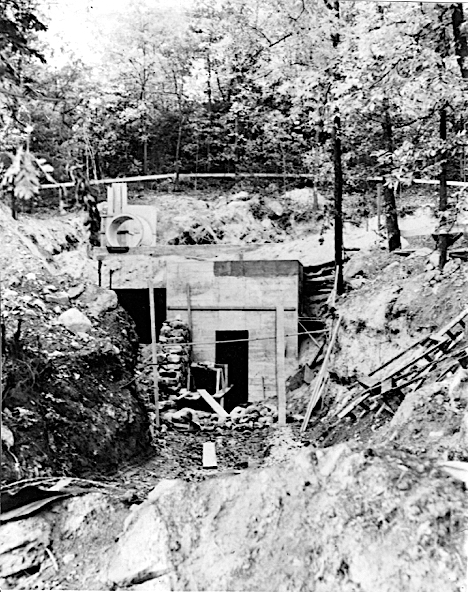
The Storrows’ bomb shelter was so newsworthy in 1940 that the Wide World photo service circulated this photo nationally. It even appeared in the Cleveland Plain Dealer.

The bomb shelter under construction in 1940 on the Lincoln estate of James and Helen Storrow (now the Carroll School). The entrance in the foreground is still visible from Baker Bridge Road.

The puzzle is: Why did the Storrows think they needed a bomb shelter? Granted, Europe had been at war for over a year, and the United States had started drafting young men into the military. But the U.S. was not yet at war, and the attack on Pearl Harbor was more than a year away. Did Helen and James Storrow really think that Hitler would send bombers across the Atlantic just to attack their home in Lincoln? Tell us what you know about the Storrows’ bomb shelter and help us fill out the story.

Are you curious about other people or places in Lincoln’s history?  Tell us your question, and we will try to respond with another “Did You Know…?” Send your suggestions to president@lincolnhistoricalsociety.org.


“Lincoln’s History” is an occasional column by members of the Lincoln Historical Society.

Category: history 2 Comments

MacLean honored by history group and town

October 12, 2022

Jack Maclean autographing a copy of his first book, “Lincoln Libraries 1798-1984” in the 1980s.

Town Historian Jack MacLean was recently honored with a proclamation of appreciation by the Select Board after he received the Star Award for “long-term volunteer contributions to public history” from the Massachusetts History Alliance.

MacLean, who was born and raised in Lincoln, began putting more time into researching the town’s history in the early 1980s and eventually became “the authoritative resource for any and all of the many inquiries directed his way about the town’s storied past,” according to the proclamation, which was based on a nomination submitted by the Lincoln Town Archives. He became the official town historian in 2016 and is author of A Rich Harvest: The History, Buildings, and People of Lincoln, Massachusetts.

MacLean giving a talk in Bemis Hall in 2015.

“For almost 40 years, Jack has willingly shared his encyclopedic knowledge of, and thoughtful insights about, local history with all who seek to know and understand,” the documents reads. “Jack reminds us that, every day, the legacy of the past shapes the town we currently inhabit, and can help inform our choices about the kind of community we want to leave to future generations.”

Category: history 2 Comments

“Did You Know …” About the battle over hymn singing in Lincoln’s first church?

August 31, 2022

By Donald Hafner

When Lincoln formed its first church in 1746, the hymn singing at Sunday services must have been dreadful.

One of the deacons would stand before the congregation and read a line or two of the psalm that had been selected for the day. The parishioners would sing the one or two lines and then stop. The deacon would read the next lines, and the congregation would again sing those and stop. There were only a few hymn melodies used at the time, and they were not attached to specific psalms. The deacon might propose his favorite melody, but since few parishioners did any singing at all, except at church, we can imagine the “tune” sung by many of them was an off-key warble or a droning monotone.

In May 1770, some parishioners had a better idea. They proposed that rows of seats to the front of the church be reserved for “those persons who have taken pains to acquire some good degree of understanding of the rules of singing.” This was a radical proposal, because seating at the front of the church had always been assigned according to the wealth of the family, not their singing ability. Nonetheless, the proposal was adopted. The following March, town meeting approved a list of 25 men and 15 women who had proved their skill in “the rules of singing” and were granted this privileged seating. Many were from the town’s prominent families, but a few were from the poorest.

This change did not sit well with some parishioners. In town meeting on May 17, 1771, a few disgruntled sorts proposed that the singers should be ousted from their seats at the front, and if they wanted to sit together, they should be sent to the back corners of the building.

The battle was joined, and there followed a rare event in Lincoln’s history. Up to this point, town meeting records were terse and bland. The town clerk wrote down each proposed warrant and whether the vote was “in the affirmative” or the negative. No record at all of the points of debate or the tally of votes, yea and nay. But not this time.

In clear handwriting, the clerk recorded: “Voted on the fourth article that it be dismissed with the contempt it deserves.” Take that, you disgruntled sorts!

For a more complete history of hymn singing in Lincoln, the Reverend Charles M. Styron’s The First Parish in Lincoln: History of the Church 1747-1942 is available in the Library.


“Lincoln’s History” is an occasional column by members of the Lincoln Historical Society.
Category: history 2 Comments

  • « Go to Previous Page
  • Page 1
  • Page 2
  • Page 3
  • Page 4
  • Page 5
  • Interim pages omitted …
  • Page 22
  • Go to Next Page »

Primary Sidebar

Upcoming Events

Jun 28 Sun
6:00 pm - 7:30 pm

deCordova Performance Series: Arias Aloft

Jun 29 Mon
10:00 am - 12:00 pm

“Poetry Across Culture”

Jul 4 Sat
7:45 am - 6:00 pm

Fourth of July activities

Jul 10 Fri
6:30 pm - 8:00 pm

deCordova Performance Series: Leslie Mendelson

Jul 24 Fri
6:30 pm - 8:15 pm

deCordova Performance Series: Ezekiel’s Wheels Klezmer Band

View Calendar

Recent Posts

  • Monday morning service for Sharon L. King, 1952–2026 June 7, 2026
  • Town to spare dozens of trees from removal by Eversource June 4, 2026
  • News acorns June 4, 2026
  • My Turn: Eighth-graders raise awareness of teen mental health June 3, 2026
  • News acorns June 2, 2026

Squirrel Archives

Categories

Secondary Sidebar

Search the Squirrel:

Advanced search

Privacy policy

© Copyright 2026 The Lincoln Squirrel · All Rights Reserved.