• Skip to primary navigation
  • Skip to main content
  • Skip to primary sidebar
  • Skip to secondary sidebar

The Lincoln Squirrel – News, features and photos from Lincoln, Mass.

  • Home
  • About/Contact
  • Advertise
  • Legal Notices
    • Submitting legal notices
  • Lincoln Resources
    • Coming Up in Lincoln
    • Municipal Calendar
    • Lincoln Links
  • Merchandise
  • Subscriptions
    • My Account
    • Log In
    • Log Out
  • Lincoln Review
    • About the Lincoln Review
    • Issues
    • Submit your work

government

News acorns

November 21, 2017

Screening of climate change film “Freightened”

The film Freightened will have a free showing on Tuesday, Nov. 28 at 6:30 p.m. at St. Anne’s Episcopal Church as part of the church’s ongoing Climate Justice Film Series. The shipping industry has become one of the planet’s most dangerous pollution sources contributing to climate change. It is calculated that the 20 largest vessels pump more sulphur into the atmosphere than all the billions cars on the planet. Every day, 5,000 tons of toxic waste are dumped into the sea.

A light vegetarian supper will be served at 6:30, followed by the film at 7:00. All are welcome. Donations will be accepted to defray the costs of public screening rights which are paid for all our films.

Marijuana committee seeks members

The Board of Selectmen is still seeking volunteers for a committee to make recommendations on regulations, policies and bylaws for recreational marijuana businesses that might be interested in operating in Lincoln. The state’s Cannabis Control Commission expects to establish license regulations by March 2018, though Lincoln has approved a moratorium until November 2018. The issue first came up for discussion at the 2015 State of the Town meeting. To learn more about the work of this Committee, please contact the Town Administrator, Timothy S. Higgins (781-259-2604 or higginst@lincolntown.org). To apply, please submit a letter of interest to Peggy Elder, administrative assistant (elderp@lincolntown.org). Applications will be accepted until  Thursday, Nov. 30.

More home energy assessments could result in grant for town

The town of Lincoln has achieved important milestones toward a grant from National Grid designed to motivate residents to take easy and inexpensive steps in 2017 to increase the energy efficiency of their homes. If 60 more residents sign up for no-cost home energy assessments by the end of December, Lincoln will receive almost $8,000 for energy saving programs. Lincoln has already reached 200 percent of the goal for new heating and cooling systems. We are at about 70 percent of our air sealing and insulation goals.

The energy assessments are performed by a trained technician who recommends improvements to insulation, air sealing, and heating and cooling systems. They also include a safety check on furnaces and gas water heaters and an inspection for asbestos, mold and mildew. Significant discounts and rebates are provided to the homeowner for insulation and HVAC systems. No-cost LED light bulbs, smart power strips, smart thermostats, and air sealing are provided by the program. For more information, see the Lincoln Energy Challenge website, or contact Sue Klem of Lincoln’s Green Energy Committee at Susan.M.Klem@gmail.com or 781-305-3319.
Category: arts, conservation, educational, government Leave a Comment

Roundup of other topics at State of the Town

November 7, 2017

Below is a roundup of State of the Town issues not already covered this week in the Squirrel. Links to previous articles:

  • South Lincoln revitalization ideas gathering steam
  • Architects ask for reactions to school and community center possibilities

Proposed plastic bag/bottle ban

The Lincoln-Sudbury Environmental Club is continuing discussions with Lincoln committees and businesses in an effort to build support for a ban on retail sales and distribution of single-use plastic grocery bags and plain water bottles holding less than one liter. The students’ presentation outlined the environmental hazards of unrecycled plastic bags and bottles, as well as retail alternatives such as water sold in disposable aluminum bottle or milk-carton-type containers. They will also explore creating a town “tap map” such as the one in Concord (which enacted its own bottle ban in 2012) showing businesses and public facilities where reusable water bottles can be refilled.

The students plan to submit a citizens’ petition for a vote at the 2018 Annual Town Meeting. A similar petition vote was withdrawn in 2017 after local business opposition. At the November 4 State of the Town meeting, Lincoln resident Jim White, co-owner of Lincoln Kitchen and Trails’ End as well as their sister restaurant in Concord, lauded the students’ effort to raise awareness, “but the difficulty I have with them is the solution, especially in Lincoln. It imposes a financial burden on two businesses [Trail’s End and Donelan’s], and I think that’s not fair.” White suggested more “broadly based solutions” such as public education and publicly available water refill sites.

Recreational marijuana

The Board of Selectmen is appointing a committee to study and make recommendations on regulations for recreational marijuana businesses that might be interested in operating in Lincoln. The state’s Cannabis Control COmmission expects to establish license regulations by March 2018, tough Lincoln has approved a moratorium until November 2018. The issue first came up for discussion at the 2015 State of the Town meeting.

Expanding the Lincoln Historic District

Historic District Commission (HDC) chair Andrew Glass outlined a proposal to expand the Lincoln Historic District by about one-third to include Modern houses on a voluntary basis. The proposal is a joint project of the HDC and Friends of Modern Architecture. There will be a public forum on Jan. 9, 2018 in preparation for a Town Meeting vote in March.

The town has hundreds of homes in the Modern style dating from 1937 to the 1970s, including the Gropius House and numerous Deck houses. There are at least 21 Modern homeowners who are interested in joining the district, according to Glass’ handout. Owners of Historic District houses have some restrictions on exterior renovations that are visible to the public. Assessor’s Office data  indicates that there is “very little impact one way or another” in terms of sales prices for Historic District homes, he said.

Mothers Out Front and gas leaks

The Lincoln chapter of Mothers Out Front presented information about the negative climate effects from leaks from natural gas lines. The group called attention to the issue last spring by installing hand-knitted scarves and posters at the sites of some of the 40 known leaks in town.

Mothers Out Front plans to introduce a resolution at the 2018 Annual Town Meeting calling for the “rapid repair and elimination of all gas leaks in Lincoln.” Public utilities are not currently required to pay for repairs of gas leaks on public streets, but the group is working with them to identify and fix “super-emitters,” or the 7 percent of gas leaks that emit 50 percent of the lost gas into the atmosphere.

“Let’s Make Lincoln a Welcoming, Safe Town”

A group that started as a movement to make Lincoln a “sanctuary town” in response to Trump administration threats to undocumented immigrants has will propose a resolution based on the one passed in Newton earlier this year. The measure would prohibit town law officials including police form assisting federal authorities in detaining people on the basis of their immigration status.

“A lot of people without proper papers are absolutely terrified but not willing to ask for help from local authorities” because they fear deportation, said resident Peter Pease. “We think we need to make some kind of statement to help people relax and have the town act lawfully and respect each person’s dignity.”

Category: conservation, government Leave a Comment

South Lincoln revitalization ideas gathering steam

November 7, 2017

An aerial perspective of what the green might look like (click to enlarge).

Major construction projects involving the Lincoln School and a community center attracted much of the limelight at the State of the Town meeting, but a third more modest project may also come to pass: revitalizing South Lincoln, piece by piece.

Several past studies by the town have consistently identified a desire for the area to be a “vibrant, walkable and sustainable village… but to be honest, not a lot of progress has been made over the years,” Margaret Olson of the South Lincoln Planning Implementation Committee (SLPIC) said at the November 4 town-wide meeting. Now, however, ideas are sprouting from SLPIC’s project teams for wayfinding, the MBTA station, placemaking, and village planning and zoning. Suggestions, discussion, and pictures are available on an interactive website at at courb.co/lincoln.

One of the goals of the Placemaking Team is revitalizing the green space tucked into the southeast corner of Donelan’s. The Rural Land Foundation, which owns the property, commissioned a study by Concord landscape architect Lemon Brooke LLC of how the space could be made more enjoyable and useful for the public. Their report includes illustrations of ideas for seating and a play area to replace the “tot lot” on the other side of a brushy area close to Lincoln Woods.

The underutilized green next to Donelan’s.

The town recently learned that it was turned down for a $50,000 matching grant from MassDevelopment to fund the work (which would cost a total of about $100,000). The SLPIC Placemaking Team will exploring other possible funding sources such as grants, crowdfunding or the possible use of Community Preservation Act funds, said Director of Planning and Land Use Jennifer Burney.

The Wayfinding Team will help solve the problem that “when you come to town for one thing, you don’t know other things are there,” said Olson, who is also chair of the Planning Board. Part of the $400,000 Complete Streets grant that the town recently received will help fund signs and informational kiosks in South Lincoln as well as roadway markings and other measures improve pedestrian, transit and bicycle circulation around Lincoln Station.

The Planning and Zoning Team is working on drafting new regulations to encourage a mix of housing and commercial uses in South Lincoln and will present them for a vote at a special town meeting in November 2018, Olson said. SLPIC has also commissioned a study of the DPW site on Lewis Street with an eye to possibly consolidating or moving some of its functions.

The MBTA team is thinking about improvements to the commuter rail station, which has inadequate signage, no passenger shelters or bike amenities, and is not ADA-compliant. Olson noted that the MBTA is under pressure to improve train travel times, and a handicapped-accessible platform such as the one in West Concord would make passenger boarding and alighting much faster. It’s also almost impossible under current conditions to get a bike onto the train “unless you’re pretty young and pretty strong,” Olson remarked.

Category: government, land use, South Lincoln/HCA* Leave a Comment

Architects ask for reactions to school and community center possibilities

November 5, 2017

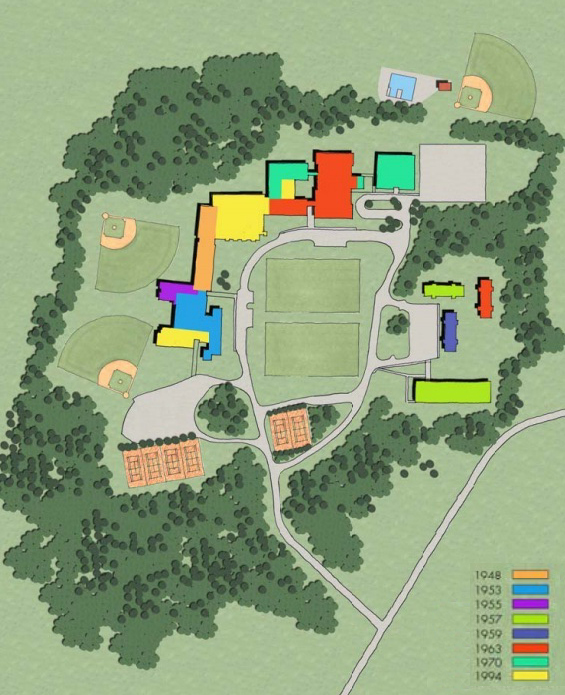
The current school campus showing when various sections were built.

(Editor’s note: Check back tomorrow for more coverage of the State of the Town meeting.)

At Saturday’s State of the Town meeting, residents began offering feedback on six concept drawings for a reconfigured Lincoln School as well as some photos of community center ideas.

The school campus drawings by Ewing-Cole and SMMA Architects represented only ideas for where various parts of the school could be located relative to each other on campus, rather than actual building outlines and walls, explained SMMA’s Joel Seeley. The presentation also did not address parking, fields and roadways, and it intentionally looked at a mostly new or completely new buildings.

All six designs had some features in common:

  • Academic hubs organized by grade level in for PreK–4 and by team teaching mode for grades 5–8.
  • Separate entrances for PreK, K–4, and 5–8.
  • Classrooms as well as breakout spaces for students groups of varying sizes and abilities in each hub.
  • Facilities for “specials” (art, music, science, and maker spaces) located close to the hubs.
  • A single dining commons and kitchen for the entire school.

The concepts are categorized in three groups according to whether the school building is concentrated in the current “L” configuration (Group A), or on the north or west side of the ballfield (Groups B and C). Some distinguishing features:

  • A1 — Retains the two gyms and auditorium, and is closest in shape to the current school.
  • A2 — Follows the same basic shape but in a curved rather than L-shaped fashion, with two new gyms and the existing auditorium.
  • B1 — A northern focus with five two-story linear classroom hubs, retaining and enclosing the Reed Gym and auditorium.
  • B2 — An all-new building on the north side, with a gym and theater space next to each other but separated from the rest of the school by a commons area to demarcate school and public uses.
  • C1 — A western focus having the clearest plan for two separate schools in one. Includes a new gym and a glassed-in or covered walkway to the existing auditorium.
  • C2 — A western focus with a ring of angled hubs around a central piazza and a new gym between the classrooms and the auditorium.

The concepts and explanations can be seen on the School Building Committee website. See larger versions of the drawings by clicking on one of the images below:

[Best_Wordpress_Gallery id=”89″ gal_title=”School concepts – Nov 2017″]

At the State of the Town, residents offered written comments, but others may use the SBC’s online feedback form. The form asks what viewers saw or heard that they liked, what they wished would be developed further, and what they wonder about, or what questions should be answered.

The SBC and architects will continue to gather public input and refine the concepts in the coming months. Residents will be asked to vote on a design concept at a special town meeting in June 2018. By that point, officials hope to have a plan that has “overwhelming community support. We don’t want to get to a vote in June and wonder what we missed,” said Chris Fasciano, chair of the SBC.

Community center

The Community Center Preliminary Planning and Design Committee (CCPPDC) recently hired Maryann Thompson Architects to work alongside SMMA and design a proposal for a community center. Their first step at State of the Town was to post “character study” photos of various community center interiors, exteriors, and landscapes and asked residents to jot down “gut reactions” on sticky notes with comments on the easels.

The architects are hoping for more detailed feedback via a “wish list” questionnaire on the CCPPDC website, which also includes the images shown on Saturday and an accompanying comment form. Residents are invited to download the questionnaire, answer whichever parts they wish, and email it back by noon on Friday, Nov. 10. The firm expects to have a proposed basic design along with “firm cost estimates” before the special town meeting in June, which will also address the school.

There are various advantages and disadvantages to having the community center physically connected to the school rather than on the Hartwell side, noted Town Administrator Tim Higgins. He briefly touched on some of those pluses and minuses as outlined by a group including the two school principals, Parks and Recreation Department Director Dan Pereira, Council on Aging Director Carolyn Bottum, and Administrator for Business and Finance Buck Creel.

Factors mitigating against having the two facilities side by side, according to their report:

  • There would be less space for athletic fields on the school side and the topography of the Hartwell side would also make it difficult to put a field there.
  • Sharing space would be impractical since the hours of operation of the school and community center would largely overlap.
  • The parking on the north and west side of campus would have to be significantly increased and the roadway network would have to be rethought.
  • There would be public safety and security concerns associated with keeping the various building users separate and out of restricted spaces.
Finances

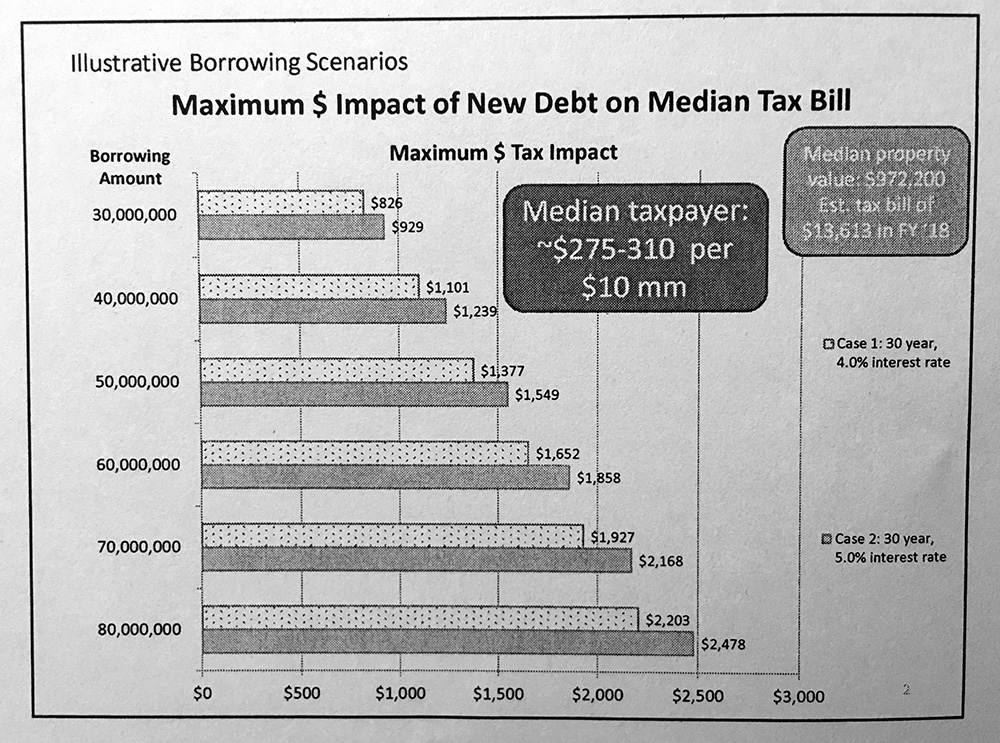
The town can afford to borrow up to $80 million for the projects and still retain its AAA bond rating, said Andrew Payne, vice chair of the Finance Committee. Each $10 million borrowed would increase the tax bill by about $275–300 per year, depending on the interest rate. The current median tax bill is $13,600.

The FinCom’s debt financing subcommittee also recommends that the town should make bond payments that are more or less equal throughout a 30-year term. Some of the town’s debt stabilization fund, currently at $4.7 million, can be used to even out some of the tax bill impact in the first few years, Payne added.

Category: community center*, government, land use, school project*, schools, seniors, sports & recreation Leave a Comment

Initial design concepts for school to be presented

October 30, 2017

Architects will unveil some initial design concepts for the Lincoln School and ask for feedback at Saturday’s State of the Town meeting, which starts at 9 a.m. in the Brooks auditorium.

The first 90 minutes of the meeting will be devoted to updates from the two campus project groups—the School Building Committee and the Community Center Preliminary Planning and Design Committee (CCPPDC). School architect SMMA will introduce a range of initial concepts that explore building size, shape, and location of the school, while CCPPDC architect Maryann Thompson will present a series of photographs to start a conversation about aesthetic preferences. The Finance Committee will also provide high-level financial context for the projects.

Residents will be asked to weigh in on the Lincoln School design concepts and to provide input about design elements they think reflect Lincoln values and are appropriate for the campus. The SBC will post directions for the feedback exercises and, if possible, images of those design concepts later this week. 

Also on the SOTT agenda are updates on Lincoln Station improvements and proposals for a plastic bag/water bottle ban, recreational marijuana rules, a gas leak repair resolution, the Lincoln Historic District, and Lincoln becoming a sanctuary town.

Category: government, land use, school project*, schools, seniors, sports & recreation Leave a Comment

Letter to the editor: sign Lincoln petition to overturn Citizens United

October 29, 2017

letter

To the editor:

Citizens in Lincoln and throughout the nation are working to restore regulation of campaign financing. The petitions seek to overturn the Supreme Court’s 5-4 decision in Citizens United v. Federal Election Commission 588 U.S. (2010) that invalidated bi-partisan rules on political advertising, based on the Court’s holding that corporations have a constitutional right to freedom of speech.

In 2012 Lincoln voted to support a bill filed by Mass. Rep. Jim McGovern proposing that the U.S. Constitution be amended to provide that corporations are not “people.” It stated that Constitutional rights are the rights of human beings only, and campaign contributions and expenditures may be regulated. In 2015 Lincoln again voted on this issue, calling for a Constitutional Convention and directing Congress and the states to place limits on political contributions and expenditures. These resolutions were approved in cities and towns throughout the Commonwealth and in many other states.

Citizens across Massachusetts and the nation are now trying to move forward with a 2018 ballot measure. This initiative petition would create citizens’ commissions in Massachusetts and other states to consider and recommend potential amendments to the U.S. Constitution to establish that corporations do not have the same Constitutional rights as human beings and that contributions and expenditures may be regulated.

It is not easy to amend the Constitution, and it can take many years of determined work. Massive and unregulated spending by our wealthiest citizens and corporations, including foreign corporations, threatens the integrity of our democracy. It is not a partisan issue. This amendment is supported by overwhelming majorities of Republican, Democrat and independent voters all across the nation.

Volunteers will be seeking Lincoln voter signatures in Lincoln Station on October 30 and November 7, and at the State of the Town Meeting on November 4.

Sincerely,

Peter Pease
40 Huckleberry Hill

Gary Davis
20R Indian Camp Lane


Letters to the editor must be signed with the writer’s name and street address and sent via email to lincolnsquirrelnews@gmail.com. Letters will be edited for punctuation, spelling, style, etc., and will be published at the discretion of the editor. Letters containing personal attacks, errors of fact or other inappropriate material will not be published.

Category: government, letters to the editor Leave a Comment

Updates on multitude of issues planned for State of the Town

October 26, 2017

An agenda chock-full of information and discussion about issues affecting Lincoln’s future will greet residents at the State of the Town meeting on Saturday, Nov. 4 from 9 a.m.–12:30 p.m. in the Lincoln School auditorium. The event offers informational updates on important issues in town and (in some cases) a preview of measures that will come up for votes at the Annual Town Meeting in spring 2018.

The first 90 minutes will consist of presentations the two proposed campus building projects: the Lincoln School building project and the Community Center project. Recent Lincoln Squirrel articles on these topics include:

  • Architects show how school design can enhance education
  • Five campus possibilities offered at SBC workshop
  • School Committee selects dual-firm design partnership
  • Community center group selects architect
  • Voters give the go-ahead to school project and community center planning

Other agenda items are below, and are also discussed in the latest Selectmen’s Newsletter. There will then be an open forum from 11:40 a.m.–noon and an opportunity to talk to representatives of the groups who presented during the meeting at information/discussion tables from 12:30–1 p.m.

Lincoln Station

The South Lincoln Implementation Planning Committee is studying improvements to the Lincoln Station area as well as possible rezoning, though a proposed zoning bylaw change is not likely by spring. There are five teams working on different topics for SLPIC, which reports to the Planning Board.

  • Interactive website brings residents into South Lincoln planning
  • Board approves study of DPW site
  • Groups proposed for economic development, south Lincoln

Plastic bags and bottles

The Lincoln-Sudbury Regional High School Environmental Club is revisiting its push to regulate the sale of disposable plastic grocery bags and single-use plastic water bottles in Lincoln. Warrant articles were tabled in Town Meeting in 2017 but passed in Sudbury. Town Meeting will feature either warrant articles or a general bylaw change proposal.

  • Roundup of further Town Meeting results
  • Water bottle, plastic bag issues may be tabled at Town Meeting
  • Students sponsor three Town Meeting citizens’ petitions

Recreational marijuana

The Board of Selectmen is forming a committee to help the town understand the 2016 statewide measure that legalized the cultivation, personal use and retail sale of recreational marijuana. The group will assess the law’s implications for Lincoln and make recommendations regarding potential policies, bylaws and regulations that may be desired and/or required to protect the town’s interests. Town Administrator Timothy Higgins said this week that a bylaw proposal may come up at a Special Town Meeting later in 2018 rather than the annual spring meeting.

To learn more about the committee, contact Higgins at 781-259-2604 or higginst@lincolntown.org. To apply, submit a letter of interest to Administrative Assistant Peggy Elder at elderp@lincolntown.org.

At Town Meeting in 2017, residents approved a moratorium on allowing use of land or structures for recreational marijuana establishments until November 30, 2018 pending new regulations from the Cannabis Control Commission and possible zoning amendments in Lincoln.

  • Roundup of further Town Meeting results
  • Up for discussion: marijuana businesses in Lincoln

Historic District

The Historic District Commission and Friends of Modern Architecture are working with property owners interested in adding their Modern houses to the Lincoln Historic District. At Town Meeting, residents will vote on a proposal that would allow at least 17 owners of Modern homes to voluntarily join the Lincoln Historic District. The district currently consists of 73 properties in four different areas.

Sanctuary Town

A planned Town Meeting measure seeks to make Lincoln an official Sanctuary Town, which organizers hope will safeguard illegal immigrants in Lincoln from federal immigration enforcement and otherwise help immigrants feel protected

Mothers Out Front

This group has been working on local responses to climate change such as curbing greenhouse gas emissions by fixing gas leaks from underground pipes. Members are expected to propose a resolution at Town Meeting calling for the repair of utilities’ leaking gas pipes.

  • Group uses humor and art to tag gas leaks

Category: agriculture and flora, community center*, educational, government, history, land use, news, seniors, sports & recreation Leave a Comment

Community center group selects architect

October 22, 2017

The Community Center Preliminary Planning and Design Committee (CCPPDC) has selected the firm of Maryann Thompson Architects to help design a proposal for a community center for Lincoln.

Massachusetts work by the Cambridge-based firm includes designs for the Atrium School in Watertown, the Broad Institute in Cambridge, the Walden Pond visitors’ center, and Temple Ahavat Achim in Gloucester. The firm is already working closely with SMMA Architects, which was hired to design the Lincoln School project.

The CCPPDC and the School Building Committee will present updates at the State of the Town meeting on November 4. By that time, “we want the two architectural firms to have spoken quite a bit and start aligning their processes and procedures, and maybe put a couple of community forums on the calendar,” said CCPPDC Vice Chair Margit Griffith.

Maryann Thompson Architects should have a proposed basic design for a community center along with firm cost estimates ready before an anticipated Special Town Meeting in June, when residents will be asked to vote on a school design, Griffith said. If and when residents decide to pursue the community center project, the town will ask for bids from firms to do the detailed design. “They’re not producing a plan for a community center that people vote on [in June] and break ground on,” she said.

The CCPPDC is drafting a timeline in conjunction with the SBC with “key choice points for decisions and deliverables by the architect,” said committee Chair Ellen Meyer Shorb. Designing a school and a community center simultaneously is “a really difficult, complex process that no one has done before, but the bottom line is to include the town early and often.”


Category: community center*, government, land use, news, seniors, sports & recreation Leave a Comment

Interactive website brings residents into South Lincoln planning

October 18, 2017

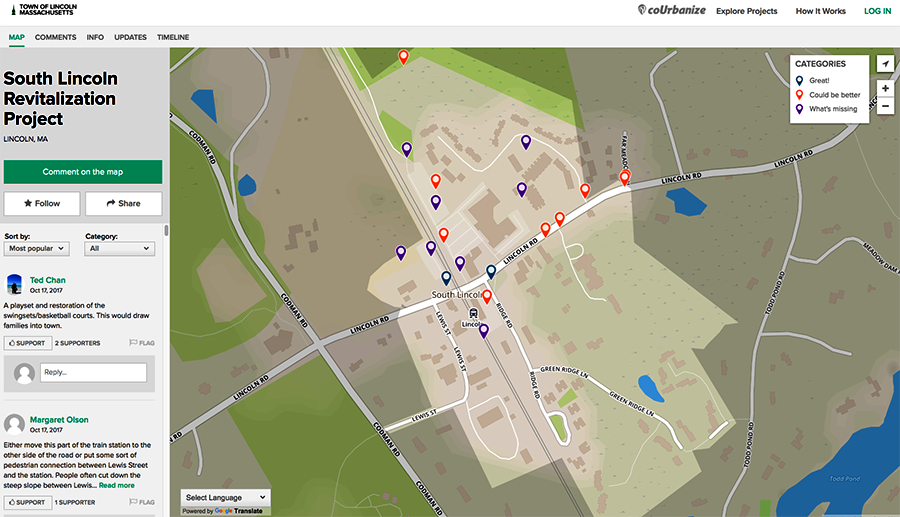
A screen shot of the South Lincoln revitalization website at courb.co/lincoln.

Using a new interactive website, residents can look at a map of South Lincoln, see some of the improvements being discussed, and add their own comments and suggestions.

The project page at courb.co/lincoln was created for the Lincoln Planning Board and the South Lincoln Planning Implementation Committee (SLPIC), which are working to make the area around Lincoln Station a vibrant, walkable and sustainable village center. Officials can post updates and respond to comments by residents as part of the public process, which also includes in-person workshops and events.

The project team behind the website can drop a “pin” on certain areas of the map to invite discussion. For example, when users click on one of pins, it opens a text box saying “If this underutilized green space next to Donelan’s and Lincoln Woods was revitalized, what events would you like to see held here?” Residents can then post and read each other’s responses, much like the comments section at the bottom of a blog post, or add their own pins to start discussion on another specific area of South Lincoln. Participants receive a notification when the project team replies.

The town was recently awarded a $400,000 Complete Streets grant for 10 projects in town, some of which include including signs, roadway markings, crosswalks, bike racks, and informational kiosks in South Lincoln. One of the website pins asks residents where they wold like to see these kiosks located.

The web platform was created by coUrbanize, a startup founded by urban planners from MIT with the goal of supplementing the traditional community process that planners use by connecting people online. “Traditional planning workshops are important, but they can be a challenge for many people to attend,” said coUrbanize co-founder Karin Brandt. “By using technology to reach people and lowering the bar to participation, we can ensure that more voices are heard.”

Category: government, land use, news, South Lincoln/HCA* Leave a Comment

News acorns

October 5, 2017

Public hearings coming up

  • The Lincoln Planning Board will hold a public hearing at 7 p.m. on Tuesday, Oct. 10 to review an application for a sign permit. The applicant, Sujit Sitole, proposes to construct a directory sign at 152 Lincoln Rd.
  • The Lincoln Historical Commission will hold a public hearing on Tuesday, Oct. 10 at 7:30 p.m. to consider the application of Ventianni, LLC to demolish two garden sheds at 144 Sandy Pond Rd.

DeCordova hosts after-school program, nursery school open house

The deCordova Sculpture Park and Museum is offering a new Art + Nature After School
drop-off program on five Thursdays for kids ages 7–11 from 3:30–5 p.m. starting on October 12 and running through November 9. Join artist and nature educator Ann Wynne this fall as we are inspired by five artists’ processes and visions. We will play, move, build, and see like outdoor sculptors. Click here to see the deCordova’s calendar of fall family programs.

The Lincoln Nursery School (LNS) in deCordova’s grounds will hold an open house on Saturday, Oct. 14 from 9–11 a.m. Tour the studios and play areas on deCordova’s campus and meet LNS faculty. For families with children ages 2.9 to kindergarten.

Open Studio library exhibit reception

There will be an artists’ reception at the Lincoln Public Library on Tuesday, Oct. 12 from 4:30–7 p.m. as part of the Lincoln Open Studio exhibit being shown in library’s main gallery until October 28. Offered through the Lincoln Parks and Recreation Department, Open Studio meets weekly for a five-hour block. The group welcomes newcomers of all skill levels and media (except turpentine-based oils). We meet during the school year on Thursdays from 9:30 a.m.–2:30 p.m. in Hartwell B-10. For more information, call Lincoln Parks and Recreation at 781-259-0784), or email Sarah Chester (schester636@gmail.com) or Joan Seville (joanseville1@gmail.com), and stop by at noon on Thursdays to say hello.

Apply for Lincoln Cultural Council grants

The Lincoln Cultural Council (LCC) invites applications for its 2017-18 grant cycle. Proposals for community-oriented arts, humanities, and science programs are due by Monday, Oct. 16. These grants support artistic projects and activities in Lincoln including exhibits, festivals, field trips, short-term artist residencies, performances in schools, workshops, and lectures. The Lincoln Cultural Council is especially interested in receiving grants to support performances and programs about local history and environmental issues.

The LCC is part of a network of 329 Local Cultural Councils serving 351 cities and towns in the Commonwealth. The state legislature provides an annual appropriation to the Massachusetts Cultural Council, which then allocates funds to each community. This year, the Lincoln Cultural Council will distribute about $4,400 in grants. Application forms and more information are available at www.mass-culture.org. For local guidelines and complete information on the LCC, contact council Chair Julie Dobrow at jdobrow111@gmail.com.

Category: arts, government, land use Leave a Comment

  • « Go to Previous Page
  • Page 1
  • Interim pages omitted …
  • Page 36
  • Page 37
  • Page 38
  • Page 39
  • Page 40
  • Interim pages omitted …
  • Page 93
  • Go to Next Page »

Primary Sidebar

Recent Posts

  • Water bills to go up by 13% March 5, 2026
  • News acorns March 5, 2026
  • Property sales in January 2026 March 4, 2026
  • My Turn: Unraveling the Hanscom misallocation March 3, 2026
  • Police log for Feb. 19–25, 2026 March 3, 2026

Squirrel Archives

Categories

Secondary Sidebar

Search the Squirrel:

Privacy policy

© Copyright 2026 The Lincoln Squirrel · All Rights Reserved.