• Skip to primary navigation
  • Skip to main content
  • Skip to primary sidebar
  • Skip to secondary sidebar

The Lincoln Squirrel – News, features and photos from Lincoln, Mass.

  • Home
  • About/Contact
  • Advertise
  • Legal Notices
    • Submitting legal notices
  • Lincoln Resources
    • Coming Up in Lincoln
    • Municipal Calendar
    • Lincoln Links
  • Merchandise
  • Subscription Info
    • My Account
    • Log In
    • Log Out
  • Lincoln Review
    • About the Lincoln Review
    • Previous Issues
    • Submit Your Work
    • Subscribe/Donate

elections

Volunteers helped count thousands of election ballots cast early

November 4, 2020

(Editor’s note: This story was written and intended to be posted on Sunday, Nov. 1, but a technical error prevented its timely publication.)

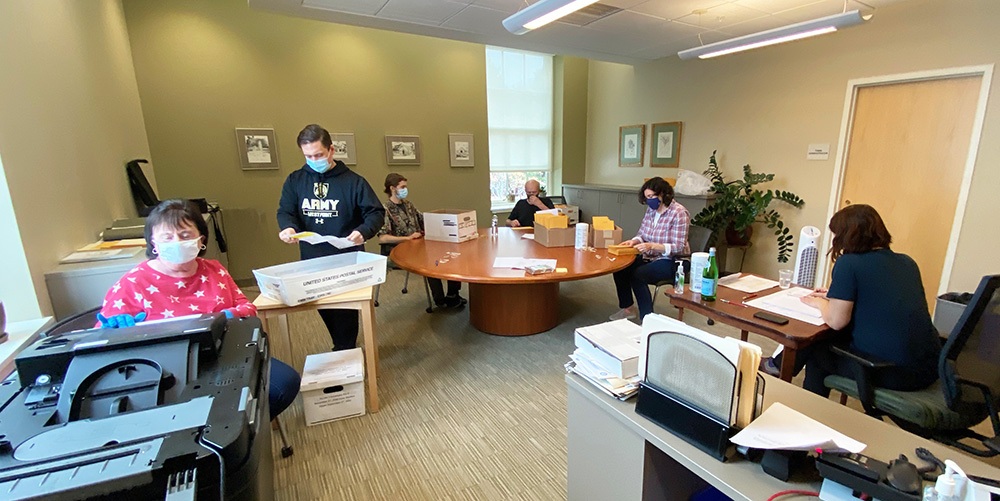
November 1, 2020 — Millions of ballots nationwide are already being tallied in advance of Election Day on Tuesday, and Lincoln is no different. On Sunday, Nov. 1, the Town Clerk staff and volunteers spent hours opening and recording votes submitted via absentee ballot and early in-person voting.

A total of 3,467 votes have been cast (2,111 in precinct 1 and 1,356 in precinct 2). With 5,015 registered voters among Lincoln’s 7,050 residents, that translates to a voter turnout of 69% even before the polls open on Tuesday. Nonetheless, the polls will undoubtedly be busy on Tuesday; voter turnout in the last presidential election in 2016 was almost 86%, according to Town Clerk Valerie Fox.

Sunday’s process involved two sets of volunteers in Town Hall opening ballots, checking them against lists of registered voters, and feeding them into a voting machine that will tabulate the votes but will not display results until the polls have closed at 8 p.m. on November 3.

The pandemic and the passions surrounding this year’s election have galvanized Lincoln voters who are generally quite enthusiastic and involved even in normal years. On the first day of early voting on October 17, “there was a constant line,” Fox said. 

In recent months, there was concern in many towns that there would not be enough help on and before Election Day, since polling volunteers tend to skew older and many senior citizens are wary of Covid-19. But this hasn’t been a problem, as younger residents have filled the gap, including college students who did not go back to campus in September because of the Covid-19 restrictions.

“One of the great things that’s come out of this election is the number of people who have volunteered,” Fox said. “Many seniors are not comfortable [working] on Election Day, but younger people have volunteered, and it’s their time to step in,” Fox said. 

The reliability of the U.S Postal Service amid reports of delivery slowdowns that could have depressed turnout has also been a concern nationwide, “but the Lincoln postal services have been beyond what I could have hoped for — they have been absolutely outstanding,” Fox said. As an example, town postal workers received 2,000 blank ballots on October 7 for distribution residents who requested them — and they were all delivered on the same day. Postal workers are also prioritizing ballots that are postmarked on or before November 3 that don’t arrive that day. If the Town Clerk’s office gets them by 5 p.m. on Friday, Nov. 6, they’ll still count.

Click the photos below for larger versions and captions:
2020count1
2020count2
2020count3

Category: elections, government, news Leave a Comment

Lincoln goes for Biden in a blowout as national results still undetermined

November 4, 2020

Lincoln’s unofficial election results are in, and as expected, Democrat Joe Biden trounced President Donald Trump by a margin of 81% to 19%. Statewide, Biden’s margin of victory was 66% to 33%.

Lincolnites also approved both ballot questions by comfortable margins. However, 55% of voters statewide said no to ranked-choice voting, according to The New York Times. The right-to-repair question passed in Massachusetts with 75% of voters saying yes.

In Lincoln, 4,152 voters cast ballots, or 83% of registered voters. A total of 3,467 (84%) of ballots were cast via absentee ballot, mail in, or early voting.

Click here to see a map outlining Lincoln’s two voting precincts.

Precinct #1Precinct #2Total% of ballots
cast*
U.S. PRESIDENT
Biden & Harris (D)2,0711,3033,37481%
Trump & Pence (R)34132066116%
Hawkins & Walker (Green/Rainbow)13518<1%
Jorgensen & Cohen (Libertarian)321951<1%
U.S. SENATE
Edward Markey (D)2,0261,2683,29479%
Kevin O'Connor (R)42435978319%
U.S. REPRESENTATIVE
Katherine Clark (D)2,0071,2463,25378%
Caroline Colarusso (R)42036278219%
COUNCILLOR
Marilyn Devaney (D)1,8791,2043,08374%
STATE SENATOR
Michael Barrett1,9811,2553,32678%
STATE REPRESENTATIVE
Thomas Stanley (D)1,7651,1372,90270%
George Darcy (I)41429971317%
REGISTER OF PROBATE
Tara deCristofaro (D)1,5991,0662,66564%
QUESTION #1
(Right to repair)
Yes1,9151,2653,18077%
No47133880919%
QUESTION #2
(Ranked-choice voting)
Yes1,5781,0092,58762%
No8015841,38533%

* Totals do not add up to 100% because write-in and blank ballots are not included.

Category: elections, government, news Leave a Comment

Markey defeats Kennedy handily in Lincoln primary

September 2, 2020

Lincolnites overwhelmingly voted for incumbent U.S. Senator Edward M. Markey over U.S. Rep. Joseph P. Kennedy III in the September 1 Democratic primary by a margin of 76%–24%. The margin far exceeded Markey’s statewide result, where he won 55% to 45%.

Interestingly, several other Democratic incumbents (U.S. Rep. Katharine Clark, State Sen. Michael Barrett, and State Rep. Thomas Stanley) each got more votes than Markey, even though all three were running unopposed.

Largely as a result of the Covid-19 pandemic, almost three-quarters of Lincolnites voted in some nontraditional way (mail-in, absentee ballot, or early voting in person). Of the 2,378 ballots cast, only 630 (24%) were voted on Election Day in the Smith gym.

In the Republican primary, 178 votes were cast. Kevin J. O’Connor edged out Shiva Ayyadurai, 93–82 (52%–46%, not including one write-in and two blank ballots). Though still in the minority, a much larger percentage of Lincoln Republicans (45%) cast their ballots on Election Day compared to the Democrats.

Democratic primary in Lincoln

Precinct 1Precinct 2CTF for
Precinct 1*
CTF for
Precinct 2*
Total
U.S. Senator
Edward J. Markey3141618814451,801
Joseph P. Kennedy III9657253166572
Write-in01102
Blank10023
U.S. Representative
Katherine M. Clark3511789885272,044
Write-in116513
Blank594014181321
Register of Probate
Marilyn M. P. Devaney3151628174431,737
Write-in216514
Blank9456312165627
State Senator
Michael J. Barrett3371719344971,939
Write-in116412
Blank7347195112427
State Representative
Thomas M. Stanley3311658944891,879
Write-in21137
Blank7853240121492
Councillor
Tara E. DeCristoforo3171608404581,775
Write-in115310
Blank9358290152593

*CTF stands for Central Tabulating Facility, which totals all the votes cast by mail, absentee ballot, and early in-person voting.


Republican primary in Lincoln

Precinct 1Precinct 1CTF for
Precinct 1*
CTF for
Precinct 2*
Total
U.S. Senator
Shiva Ayyadurai3013201982
Kevin J. O'Connor2115381993
Write-in00011
Blank01102
U.S. Representative
Caroline Colarusso39265130146
Write-in10012
Blank1138830
Councillor
Write-in629522
Blank45275034156
State Senator
Write-in8111424
Blank43284835154
State Representative
Write-in6111422
Blank45284835156
Register of Probate
Write-in5110420
Blank46284935158

*CTF stands for Central Tabulating Facility, which totals all the votes cast by mail, absentee ballot, and early in-person voting.

Category: elections, government Leave a Comment

Planning Board candidates reflect on election result

June 17, 2020

The candidates in the hard-fought Planning Board race had gracious words for each other and said the election was a good experience for the town, even though it became contentious at times.

“I’d like to congratulate Lynn [DeLisi] and Rick [Rundell] for a good campaign that stuck to the issues,” said Bob Domnitz, who will serve his second stint on the board after winning more votes than Rundell in the three-way race for two seats. “I know some of our supporters were overly enthusiastic, but the candidates took the high road and that’s the way it should be. I’m proud of the entire town for coming out and voting in the numbers they did in this pandemic.”

“I’m impressed that over 800 people felt the issues were important enough to take the trouble to vote under complicated circumstances,” Rundell echoed in a letter posted in LincolnTalk. “I do think an enthusiastically contested election benefits the town by surfacing issues we should be talking about.”

DeLisi, who got the most votes of the three, said she was surprised to finish in first place. “Actually, I thought I would lose,” she said, since much of the campaign discussion focused on Domnitz vs. Rundell rather than DeLisi alone.

DeLisi was co-chair of the South Lincoln Planning and Implementation Committee, a large group with several subcommittees, one of which was the Village Planning and Zoning team. That team’s proposal for rezoning part of South Lincoln and changing the project approval process to give the board more latitude provoked much criticism. But the full SLPIC group rarely met, and DeLisi said she was not even aware of what the zoning team was suggesting until the process was well along.

“I thought the zoning subcommittee was working on ways to make it easier for businesses to open in town… and not focusing on regulations to help developers build dense condos as well,” DeLisi said. “I’ve never chaired a committee where I didn’t know what was going on, and I clearly did not know what was going on,” she said.

Her SLIPC co-chair was Gary Taylor, who was the board’s representative on the zoning subcommittee (and ironically, the person who beat out Domnitz in another close election in 2015).

Domnitz and DeLisi want to see any future zoning change proposals come from the full Planning Board, not SLPAC (the successor to SLPIC) or a subcommittee.

One thing all three candidates agreed on: the discussion about South Lincoln isn’t over.

“My position was that the town should have the conversation — not just a matter of one group shouting it down before everybody had the chance to engage in it,” Rundell said.

“We’re going to have to talk about South Lincoln and how to sustain what we have there. Maybe we do have to change the zoning, but not in the way it was proposed,” DeLisi said. “I think we need to be speaking to the people who live around there and involve them in the conversation.”

Category: elections, government, land use Tagged: elections Leave a Comment

Rundell is out and Domnitz back on Planning Board

June 15, 2020

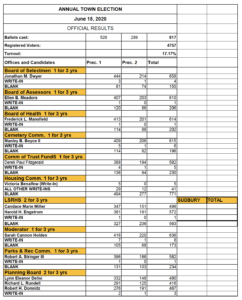
In a very close race for Planning Board, incumbent Lynn DeLisi and challenger Bob Domnitz won the two open seats, ousting Rick Rundell, who has been on the board since 2012. Domnitz previously served on the board from 2003–15 but himself was beaten by Gary Taylor in 2015 by a margin of 481-441 (click on ballot image). 

In the June 15 election, residents could vote for two of the three candidates. Domnitz, a Mill Street resident, beat Rundell in Precinct 2 (northern and eastern Lincoln), 459-412, but came in third in Precinct 1. DeLisi garnered the most votes of the three candidates, but Domnitz’s margin in his home precinct was enough to allow him to finish in second place overall, beating Rundell by 47 votes. A total of 806 ballots were cast in the election for a turnout of 17% of registered voters (the Planning Board was the only contested race).

The race was the focus of much townwide debate and campaigning. Over the last year, the board has been at the center of  controversial proposal (since shelved) by one of the South Lincoln Planning and Implementation Committee’s teams to relax some of the zoning rules for the Lincoln Station area and give the board more power to approve projects that might otherwise have had to go to Town Meeting. 

Unofficial town election results for June 2020 (click to see both pages).

In the June 11 candidate forum, DeLisi and Domnitz roundly criticized the proposal by SLPIC. But Rundell pushed back, noting that the board could not change its decision-making scope without approval at Town Meeting. The SLPIC proposal was originally on the docket when Town Meeting was scheduled for March but were withdrawn before the meeting was rescheduled due to the pandemic. SLPIC then planned to bring a revised proposal to a Special Town Meeting this fall but subsequently shelved the plan entirely. 

During the forum, Rundell characterized himself as a “forward-looking candidate” and said the board’s role should not be “fossilizing the town in a certain state.” 

Ironically, Rundell said in March that he was recruited to the Planning Board shortly after arriving in Lincoln by Domnitz because he felt the board lacked a professional architect. 

The Lincoln Squirrel will interview all three candidates about the results and hopes to publish a story on June 16.

Category: elections, government Tagged: elections Leave a Comment

Planning Board candidates square off at well-attended forum

June 12, 2020

More than 60 residents packed a room (on Zoom) on Thursday night to hear from the three candidates running for two Planning Board seats in the June 15 election. In the forum organized by resident Sharon Antia, the trio answered questions about issues facing the Planning Board and the town more generally: South Lincoln rezoning, how to support businesses during the pandemic, affordable housing, and more.

Challenger Bob Domnitz, a former Planning Board member who was ousted by Gary Taylor in 2015, said he was running to regain his seat when “I realized the Planning Board was serious about bringing a zoning amendment before Town Meeting to make the Planning Board the decision-maker on major projects” by majority vote, he said. “That didn’t fit in with the nature of Lincoln as I knew it, and it’s antithetical to how we operate as a community.”

Under a proposal unveiled last year by a subcommittee of the former South Lincoln Planning and Implementation Committee (SLPIC), mixed-use projects would be allowed in areas around the mall and the MBTA station with s site plan review and a special permit from the Planning Board. With that permit, housing projects could be up to 20 units per acre, and a greater maximum lot coverage (60% for residential and 100% for business) would be allowed. However, Town Meeting approval would not be required unless a proposed project exceeded the special-permit density.

Incumbent Rick Rundell pushed back, saying it was “an absurd position” to imply that the Planning Board could take away power from Town Meeting without residents’ consent. (The SLPIC proposal was initially slated for a Special Town Meeting vote in the fall, but the Planning Board withdrew its proposal after encountering opposition.)

“How did they misread the character of this town so much that they worked on a proposal to take away Town Meeting authority for major projects?” Domnitz asked later in the forum.

“I had no idea what was going on [with the SLPIC subcommittee proposal] or I would have fought it,” incumbent Lynn DeLisi responded.


  • Planning Board candidate roundup (March 2020)
  • New statements by Lynn DeLisi, Bob Domnitz, and Rick Rundell (June 2020)

Rundell, who said he was recruited to the board in 2013 by Domnitz, argued that its duties should not focus on “fossilizing the town in a certain state” and that it has become more transparent since he was the chairman in 2014-15. The board has also “sunsetted” the requirement for site plan reviews after five years. “Today’s Planning Board has made light-years of progress since 2015,” he said.

Some of the questions focuses on what the Planning Board could do to help the town in this time of Covid-19. Incumbent candidate Lynn DeLisi suggested a public health center somewhere in town to promote vaccination once a vaccine becomes available.

The pandemic is a major challenge for both developers and prospective occupants of affordable housing. However, changing zoning regulations now to encourage more affordable housing and demographic diversity is not a good idea, the candidates agreed.

“I think we need to take a breath, wait a few months, and see how things settle out,” Domnitz said. “We may be heading towards a totally new world or at least a new equilibrium, and we need to go cautiously at this point.”

“I’m not sure the Planning Board can necessarily take the lead and make decisions about any of this. These are dialogues we need to have with people in the town,” DeLisi said.

The bigger question, Rundell said, “is whether we want to put a wall around our community and preserve the status quo… or be a part of a larger society, and I don’t think the town is at all aligned on that choice.”

Social diversity in Lincoln is certainly desirable, “but we can’t legislate that. All we can do is set up economic possibilities to create the kind of diversity we’re talking about,” Domnitz said. However, “getting some geographic diversity on our major boards would be constructive,” he added. Few if any current town board and committee members are residents of North Lincoln — although Domnitz is — “and the view from here is a little different than the view from elsewhere in town.”

As to where and how more affordable housing should be built, “does it have to be developing more dense housing in South Lincoln? I think it can be in other ways,” DeLisi said.

The candidates agreed that the SLPIC subcommittee’s efforts to reimagine South Lincoln were flawed but not about how to fix the process. The “sprawling” nature of SLPIC and its subcommittees meant that the effort was “not as transparent or receptive to input as it could have been,” Rundell acknowledged.

The board voted on June 9 to reconstitute SLPIC as a five-member South Lincoln Planning and Advisory Committee (SLPAC) but disagreed on the size of the new panel and who should be represented on it. Four of the five board members approved a group comprising only elected officials, “but I advocated very strongly for a member to be a resident from the affected area, and I was shot down by the other board members and I don’t understand why,” DeLisi said.

The parent board rather than a subcommittee should be responsible for coming up with future rezoning proposals, even though it will create more work and long meetings, Domnitz said. “This is very important and should take place within the Planning Board itself… the board needs to realize they own what that subcommittee is doing.”

Asked about the 2009 Comprehensive Long-Range Plan that was never acted on, Domnitz said, “The plan is vague, let’s put it that way…  It’s much easier for people to deal with a tangible proposal than an abstract concept.”

“I mark it as a failure of leadership that there was not real follow-up to that plan,” Rundell said. “Absent planning, Lincoln is going to be like a ship in a storm without rudders or sails and will soon find itself on the rocks.”

From the candidates’ opening and closing statements:

“My motto is ‘Responsible planning by collaboration with neighborhoods’ — that says it all.”
— Lynn DeLisi

“The Planning Board is on the wrong track. We need to put it on a better track so something actually happens in South Lincoln.”
— Bob Domnitz

“Respect for the past and planning for the future with integrity, fairness, and transparency…
Look at today’s board and how they operate, and give your vote to a forward-looking candidate.”
— Rick Rundell

Category: elections, government, land use 1 Comment

Candidates offer their views and make their pitch

June 4, 2020

Earlier this year, the Lincoln Squirrel asked candidates running in the annual town election (then scheduled for late March) to discuss their experience and the important issues they thought would face their board or commission in coming months and years. The Squirrel published responses from candidates for the Water Commission and the Planning Board (the only contested race this year) earlier this spring, as well as three new pieces by Planning Board candidates Lynn DeLisi, Bob Domnitz, and Rick Rundell. See the full slate on this specimen ballot. Here are the responses from the remaining candidates.

Manley B. Boyce II

Cemetery Commission (22-year incumbent)

Hard to believe that I have been on this commission since 1998. Before being on this commission, I spent three years on the Emergency Fund with the Council of Aging under the direction of the Board of Selectmen.

Although some of the land formation has changed, the direction of the members of the Cemetery Commission has not. We have always, as a commission, been united in our mission to support our townspeople with a beautiful and restful sanctuary to respect and honor our friends and family members.

If reelected to this position, I would strive to be a part of this commission to continue to oversee and orchestrate the tranquil presence of our cemeteries. This requires funding and land expansion that is needed now and will be required to accommodate future generations.

As our cemetery expands, we find we now need a full-time custodian to oversee the preservation of the cemetery land and for the ongoing burials. Funding is imperative to achieve this goal. A second and crucial funding need is for a mini-excavator to reach our hard-to-access lots. This mini-excavator would be shared, used, and maintained by the Highway Department;

Jonathan Dwyer

Board of Selectmen (three-year incumbent)

Having finished one term on the Board of Selectmen, I am running for reelection. A key BOS responsibility is to ensure the town’s government is responsive to residents. I consistently hear concerns about the cost of living in town, the need for expanded social services, and desires for developing a more diverse tax base. Residents want a community center, a vibrant town center, greater town commitment to net-zero living, and improved transportation infrastructure supporting multi-mobility and safety for all roadway users. Voices also call for more diverse housing, expanded conservation of land, and greater investment in our historic structures. 

Considering that big projects like the town office renovation and athletic fields expansion are done, the new school project is underway and Oriole Landing is on course to meet our affordable housing goals, I think it is time to discern the town’s current priorities and update its 11-year-old Comprehensive Long Range Plan. I would be honored to serve another term on the board to listen and to lead in partnership with colleagues Jennifer Glass and James Craig.

I respectfully ask that you make me the last “Selectman” to run for office in Lincoln (there is a citizen’s petition to rename BOS to “Select Board” at a future Town Meeting yet to be scheduled).

Harold Engstrom

Lincoln-Sudbury High School District Committee (first-time candidate)

While I have helped on boards around Lincoln before (Codman, soccer, etc.), I haven’t run for nor been elected to any position anywhere. In the three-year term I’m running for, probably the most important part of the job will be helping to select new leadership for L-S because the current superintendent will come to the end of her tenure. My motivation for running for L-S School Committee is very general: provide responsible stewardship and help our community maximize the potential and development of all students and staff at L-S. I expect that my approach will be to (1) first understand how the L-S school committee currently functions and why it functions that way, then (2) understand what the currently stated guiding principles and currently approved plan for L-S is, and then (3) work to execute duties as decided on by the committee. It is possible that I may not agree with the majority sometimes, but that will not keep me from working constructively to do what we vote to do. Our public schools are our biggest and most important ongoing community project.

I was asked to run and I also feel that giving back is important. My sons graduated from L-S and my daughter graduates this spring. Helping to keep L-S a great place for others, and possibly helping to make it even better, would be a privilege.

Derek P. Fitzgerald

Commissioner of Trust Funds (six-year incumbent)

The town’s trust investments have had a good run over the last several years as the markets have gone up significantly. The immediate task is to keep a good monitoring program in place and to avoid unneeded risks and complexity. At some point the markets will turn and trusts need to be positioned to minimize risk to capital yet still earn a reasonable return on investment. I believe the Lincoln trusts investments are well positioned, but this is an on-going process. 

In the last year, the board directed our portfolio managers to minimize the trusts investments in the fossil fuel industry in pursuit of the ESG goal of supporting a greener planet. Lincoln didn’t have much exposure to begin with so the impact has been minimal on the investment holdings and performance.

Less glamorously but perhaps just as importantly for the prudent management of the trust, the board updated and adopted a new investment policy to direct our portfolio managers in the oversite and allocation of the town trusts.

Adam Hogue

School Committee (one-year incumbent)

The biggest challenge facing us currently is the current pandemic. My goals on the committee is to keep our budget fiscally responsible to the town and also be an advocate for our students to give them the best education possible.

Sarah Cannon Holden

Town Moderator (12-year incumbent)

I am running for my fourth three-year term as Lincoln’s Town Moderator. My prior experience includes six years on the Finance Committee, two years on the Community Preservation Committee, nine years on the L-S School Committee, and six years on the Board of Selectmen. In each position I have learned a little bit more about the town (and probably myself), and I cherish the friendships that I have made while serving the town.

My interests in civics, politics, and service led me to law school 20 years after I graduated from college. I have had an active and interesting career in labor arbitration and mediation. It was interrupted briefly in 2001-02 when I ran unsuccessfully for lieutenant governor as a qualified Clean Elections Candidate. My role now as moderator seems to fit in with this background. I certainly enjoy the role and the challenges that it poses. I hope always to conduct a fair, open and respectful meeting, and to be receptive to new ideas for making the meeting run efficiently without sacrificing the robust and complex essence of democracy.

My three children attended the Lincoln and Lincoln-Sudbury Public Schools.

This year’s Town Meeting will be a new experience for all of us. It will be in a tent on June 13; it will be a very abbreviated meeting with all presentations having been done online in the weeks and days beforehand, and it will include a comprehensive consent calendar with only three other articles for our consideration. Our primary concern is the health of all in attendance. With that in mind, I believe that it is important for us to work through the agenda carefully and as efficiently as possible.

I will do my best to lead us through the meeting after so many volunteers and staff have done the work to get us prepared. Please check in early on June 13 so we can get started at 9:30 a.m.

I ask for your vote on Monday, June 15. The polls at the Hartwell School parking lot will be open from 12–4 p.m. Thank you.

Fred Mansfield

Board of Health (20-year incumbent)

Important issues for the upcoming year(s) include:

  • Infectious diseases and the town’s response, e.g. EEE, Covid-19, West Nile, tick-borne disease
  • Water quality
  • Natural gas leaks
  • Town nurse coverage for elderly and disabled
  • Immunization advocacy: measles, flu, Covid -19
  • Issues around control of nicotine and cannabinoid distribution and use

Ellen Meadors

Board of Assessors (18-year incumbent)

The main goals of the Board of Assessors are to:

  • Provide fair and equitable assessments based on true market values
  • Meet with citizens and citizen groups to discuss their assessment concerns
  • Propose and support tax relief measures for those who need them
  • Coordinate with and support other departments, boards, and commissions
  • Incorporate new technologies to improve assessments, enhance services and reduce costs.

In the next few years, we expect to be incorporating new technologies into our assessing process. In particular, our assessing contractor, Regional Resource Group, is finding it more and more challenging to do the yearly periodic re-inspections of properties. Qualified assessing staff is getting more and more difficult to find and some homeowners feel it‘s an invasion of privacy to have people walking around their house measuring the exterior. We are hoping to be able to use high-definition aerial images and image processing software tools to do detailed exterior inspections via computer that are sufficiently accurate to meet State requirements. The Board will be working with RRG to define a new process and get State approval.

Tara Mitchell

School Committee (three-year incumbent and current chair)

There are so many exciting aspects of working with the school district at this point. The new primary and middle schools at Hanscom and the Lincoln campus renovation project is allowing our district to advance into 21st-century education. Teachers at both schools are building skills, honing techniques, and collaborating to help better prepare students for the challenges they will face in the future. Lincoln staff have started to reimagine how they use spaces and how they work with students and colleagues now and in the future.

As a school committee member, I’m excited to support the district’s strategic plan, which focuses on professional development, elevating instructional practices within all classrooms, and providing deeper learning for all students. I look forward to communicating how this vision is becoming a reality and ensuring the policies and budget recommendations continue to support the district’s goals. 

Rob Stringer

Recreation Department (first-time candidate)

No previous government offices held, but I am a soccer coach, baseball and basketball assistant coach, and I’m on the PTO.

There are a few things I’m very interested in helping the Rec Department deal with in the next few years: how to handle the adjustments to our yearly program of events due to the school building work (Fourth of July, parking for the pool, use of fields) and how can we build on the work to leave a legacy that makes us stronger. Look for new ways to engage Lincoln residents and surrounding communities using the wonderful parks and people we have. 

I enjoy working with the communities I’m already involved in (PTO and local sports) and thought it would be another way to stay involved as my kids age out of my ability to coach them.

Category: elections, government Tagged: elections 1 Comment

June 13 is the new target date for Town Meeting

May 5, 2020

Officials are now hoping to have a bare-bones Town Meeting outdoors on June 13 and the local election on June 15.

“The goal is to have it be as stripped-down as possible,” Selectman Jennifer Glass said at the board’s meeting on May 4. As previously discussed, Town Meeting will include only votes on budget matters that require a decision before the start of the new fiscal year on July 1, with votes on less time-sensitive items shelved until the fall. The meeting this spring will incorporate what was originally planned as a separate Special Town Meeting — a vote on restoring items to the school building project.

Presentations and other information that are normally part of the Town Meeting will occur online ahead of time, “so when we get to Town Meeting, it’s about the voting, not about the presentation,” Selectman Jennifer Glass said. Some presentations may be given live using Zoom  so residents can ask questions in real time.

June 13 is the earliest date that the meeting could be held while still satisfying the 30-day public notice requirement after the end of the Massachusetts state of emergency banning gatherings, which is set to expire on May 18.

“Whether or not there is an extension of the state of emergency, we should pick a date and start putting the engine of local government into operation to get that done,” with the option of further postponing until the fall if conditions warrant, Town Administrator Tim Higgins said. Officials are reluctant to schedule an Annual Town Meeting over the summer when many residents are away, and a fall date (in addition to complicating town accounting and budgeting procedures) could be jeopardized if the pandemic makes a comeback just as the next flu season approaches.

The tentative plan is to have Town Meeting outdoors to maximize social distancing — probably in the field next to Codman Pool, with as many people as possible under a large tent (overflow attendees could sit outside the tent if necessary). In case of rain, the meeting could be quickly convened and postponed for a day or two, which may require holding it on a weekday evening.

The election will happen on June 15 regardless of when Town Meeting takes place. Residents can vote by mail, or return sealed ballots to the Town Clerk’s office or leave them in the mailbox outside Town Hall.

Early voting is normally not allowed for municipal elections, but the state legislature has relaxed that rule. Early and absentee voting are both allowed this spring without having to provide a reason (other than the Covid-19 pandemic). All ballots must be received by the time the polls close. By law, polls must be open and staffed on Election Day for at least four hours, but “we hope everyone votes absentee,” Higgins said.

Category: Covid-19*, elections, government 1 Comment

Town meeting, election postponed for at least a month

March 13, 2020

The town meetings and election scheduled for the end of this month have been called off, with tentative new dates in late April, though town officials have the option of postponing again if the Covid-19 epidemic has not abated.

“The sentiment is very clear — everyone thinks we should postpone,” said Town Moderator Sarah Cannon Holden at an emergency meeting of the Board of Selectmen on Friday morning.

“We are very strongly against pulling people together at any public gathering at this point in time,” said Patricia Miller, a member of the Board of Health, which met on March 11.

Holden officially declared that the Town Meeting and Special Town Meeting will be postponed “to a time certain” — Saturday, April 25 a 9:30 a.m. in the Donaldson Auditorium. The actions came just hours before Gov. Baker issued an order banning public gatherings with more than 250 people, with some exceptions.

The most time-sensitive issue that was due for a vote on March 28 was the Special Town Meeting question about the school project. Last month, the School Building was forced to cut items totaling $3.5 million after construction bids came in higher than expected, so they’re hoping residents approve adding back up to $2 million for the items they consider most important. 

Architects and construction firms need to know by June 1 which items will be part of the project, and they would prefer that the town vote by mid-May. However, the project as a whole is not stalled. “The contracts are signed, the project is moving forward,” Selectman Jennifer Glass said. “The pieces in question are the items we’re thinking about adding back.”

Virtual meetings

In the coming weeks, town officials will be thinking about ways to make both the town meetings and town government function given the necessity of social distancing. Meetings of boards and commissions and their accompanying public hearings will be postponed when possible or held remotely. The state’s open Meeting Law requires members of town boards to meet in person in public, but an executive order issued by Gov. Baker on Thursday night relaxes that requirement, allowing meetings to be held remotely, without a quorum gathered at a single location, as long as the public has access in real time to the proceedings via the web or some other audio or videoconferencing method.

“We need to move on that now,” Miller said about the issue of getting access to the appropriate technology for board chairs. These methods could also be used to shorten the town meetings when they do take place, such as having televised presentations of the warrant articles. 

Unlike elections, residents may not vote early or by absentee ballot at Town Meeting. However, officials could survey residents ahead of time to shape a shortened agenda with just the most popular or important items. Votes on other matters such as the citizens’ petitions could  be postponed until later in the year or even 2021.

If necessary, the April 25 Town Meetings could be opened and the immediately postponed to another “time certain.”

Town election

Under state law, the only way to postpone town elections is via court injunction or special legislation by the state. Voters as well as poll workers at elections tend to skew toward the senior citizen population, who are more vulnerable to serious illness from Covid-19, and the idea of them interacting with hundreds of people on Election Day is “disconcerting,” Town Administrator Tim Higgins said.

The board voted to ask the governor to file emergency legislation on behalf of the town seeking authorization to postpone the election to a date on or before June 30. However, if the election is to be held the customary two days after Town Meeting (which is now scheduled for April 27), officials must nail down the election date by April 5 because 20 days’ notice is required. That period is to allow people who were not eligible to vote in March to register.

The rescheduled election will probably also allow “modified early voting by mail,” which is essentially the same as absentee ballot voting, but without the requirement for the voter to sign an affidavit saying they are unable to vote in person for religious or medical reasons or because they are out of town. Voters would still have to request ballots in advance.

Lincoln’s town election is normally held on the same day as Sudbury’s so the two towns can simultaneously elect members of the Lincoln-Sudbury Regional School Committee. However, that isn’t critical this year, since the seats for that board are uncontested.

Like everything else nowadays, these tentative plans are subject to change, depending on what happens with the pandemic and whether the state offers more rules or guidance on how town government should be conducted in the Covid-19 era.

Lincoln public health nurse Trish McGean, who was also at the selectmen’s meeting, said that as of Friday morning she did not know if and when the town’s preschools and private schools would close, though she assumed they would follow the lead of the Lincoln Public Schools.

There were no official cases as of Covid-19 on Friday, though experts agree that the virus is circulating widely. When someone does test positive or presumptively positive, the state Department of Public Health will inform McGean, who will publish that fact (minus patient-identifying information) on the town’s Covid-19 website at lincolnpublichealthnews.com.

Category: Covid-19*, elections, government, health and science Tagged: elections Leave a Comment

Water Commission candidates discuss the issues

March 8, 2020

Terms on town boards and committees are usually staggered so new members join others who have more experience on that board, but this year, all three seats on the Water Commission are open due to two resignations and a normally expiring term. Three candidates are running for those seats (down from six residents who initially expressed interest):

  1. Michelle Barnes was appointed as an interim member and is now running for a full three-year term.
  2. Incumbent Ruth Ann Hendrickson (chair of the commission) is up for reelection and is running for a two-year term. She has previously said in a letter to the editor to the Squirrel that, if reelected, this will be her last term.
  3. Jim Hutchinson is resigning from the Finance Committee a year before his term expires to run for a one-year term on the Water Commission.

Barnes and Selectman Jennifer Glass were both sworn in as emergency interim Water Commissioners in October after Bob Antia and Heather Ring resigned (in Ring’s case, because of dissatisfaction with management by Water Department Superintendent MaryBeth Wiser).

Below are Q&As and statements from the three candidates, lightly edited for length and clarity.


Michelle Barnes

South Great Road

Please tell us a bit about your background.

Most of my career I spent as a macrofinancial economist in the research department of the Federal Reserve Bank of Boston. Before that I was a tenured lecturer at the University of Adelaide teaching finance, international monetary economics, and macroeconomics. During graduate school, I worked as a consultant at both JP Morgan and the World Bank, and before going to graduate school, I managed Teamsters at Roadway Express in my hometown of Sacramento, Calif. I received my PhD in economics in 1998, and my last day on the job at the Fed was in December 2018.

I’ve lived in Lincoln since 2008, and feel super lucky to be able to fully enjoy Lincoln’s bucolic open spaces with my 10-year-old daughter and our border collie. During our time in Lincoln, I have had the opportunity and pleasure to serve on the Magic Garden board, the Lincoln METCO Coordinating Committee (as co-chair in 2015, secretary through 2019, and as president since then), and on the Lincoln Land Conservation Trust/Rural Land Foundation Board of Trustees (as chair since 2019).

Why are you running for the Water Commission?

I’ve chosen to run for Water Commissioner to continue the efforts our team has made since October 2019 to stabilize the Lincoln Water Department (LWD). I believe that at this important juncture, continuity, stability, and a strong measure of critical and analytical thinking are required to further stabilize the LWD and bring it to the point where it is successfully delivering safe and reliable water in a fiscally prudent and sustainable manner. Due to my recent tenure as a Water Commissioner and my background as a macrofinancial economist, I bring both attributes to the table.

Back in October 2019, when there was a call for the need to fill two Water Commissioner vacancies, I heeded that call (as did Jennifer Glass and Jim Hutchinson, who have been members of our team since then as well). I have thoroughly enjoyed climbing the steep learning curve of overseeing the Water Department’s operating and long-term planning process, getting to know all of the people involved in this organization and process, and being able to use my background in macro-financial policy analysis to help frame some of our debates about LWD fiscal management and long-term capital planning

In your opinion, what are the biggest problems or decisions facing the Water Commission, and how do you propose to tackle them?

The biggest problems facing the Water Department are personnel issues, chronic underinvestment in maintenance and infrastructure, and the long-standing leadership culture that brought the LWD to this critical point. It bears emphasizing, however, that I believe that a certain amount of continuity and stability in leadership are integral to moving the LWD forward in the most constructive possible way; the role of institutional knowledge in solving the LWD’s problems should not be underestimated.

I have confidence in the ability of the chair of the Water Commissioners, in conjunction with the team that has been assembled, to address and solve the critical issues facing the LWD for the benefit of the town and its water customers.  More personally, I am committed to facing head-on the multiple challenges I outlined above with candor, curiosity, clarity of vision, and a critical mind, and in a manner that simultaneously celebrates and preserves our positive contributions while having the courage to mitigate and reshape efforts that I believe are a detriment to the LWD’s mission.

Why should Lincolnites vote for you?

Lincoln voters should vote for me because I am deeply committed to ensuring the delivery of safe and reliable drinking water to the Town of Lincoln in a manner that is financially prudent and fair, both in the short- and long-term. Given my recent tenure on the Water Commission, I have been able to come up to speed in the areas that matter most for ensuring the current and future safety and stability of water treatment and delivery in Lincoln.  My skills as a macrofinancial economist focused for much of my career on policy analysis can continue to help the LWD chart a clear path to a more financially sustainable future.


Ruth Ann Hendrickson

Concord Road

Please tell us a bit about your background.

I’ve lived in Lincoln since 1967. While I was home raising my children, I served as president of the Recycling Committee for several years in the 1970s and as the Lincoln’s representative to the Regional Solid Waste Committee for several years after that. I was on the board of the Lincoln League of Women Voters, which was very active in town issues as well as state and national issues. I served as president for two years and vice president for several years.

I chaired studies on whether the town assessors were undervaluing older houses and on the per-pupil cost of our public schools, the latter leading me to run for School Committee, where I pushed for consolidation of all the grades into the Smith-Brooks complex. I also led the move to close the town’s polluting open dump and create the current transfer station. I went back to work in 1989 and retired in 2009.

In 2011, I ran for Water Commissioner after looking for a way to serve the town that would utilize my technical background and allow me to promote water conservation. For the past few years I have also served as the liaison to the School Building Committee (SBC), promoting both water and energy conservation. I recently withdrew from the SBC due to the demands on my time from chairing the Water Commission.

As I said in my letter to the editor, given the recent changes in Water Superintendent and Commissioners, I believe my continuing on the commission for another two years would lend a needed continuity. Moreover, since I am retired, I can devote a substantial amount of time to gathering and analyzing data to ensure knowledge-based decision-making. I bring to the position communication and creative problem-solving skills honed by my years in industry and an aptitude for electromechanical systems developed during my work on advanced gyroscopes and vacuum robotic systems.

In your opinion, what are the biggest problems or decisions facing the Water Commission, and how do you propose to tackle them?

Going forward, the issues are:

  • Successfully completing the projects needed to upgrade the water system infrastructure
  • Developing both short-term and long-term financial plans
  • Assessing whether to continue with the existing upgraded treatment plant, to build in new treatment plant, or to sign up for MWRA water
  • Attracting seasoned personnel to fully staff the Water Department

We are making significant progress on all four issues, especially in staffing, as we have hired a new and very experienced senior plant manager and several experienced part-time water operators, and we are about to add another full-time operator. We are in the midst of revamping our fee and rate structure to ensure we have the funds needed to provide clean, safe water. I’m confident that by the end of the next two years, the department will be back on an even keel with a solid plan for the future.


Jim Hutchinson

Stonehedge

Please tell us a bit about your background.

I hold a Ph.D. in computer science from MIT. Earlier in my career I developed novel machine learning and financial applications for supercomputers. I then co-founded a hedge fund with two partners, where as CEO I led the R&D for our quantitative, systematic trading strategies as well as managing all outside vendors and services for the firm, including legal, brokerage, fund administration, and hardware and software services. I am now retired.

My family and I have enjoyed living in Lincoln since 1999. I’ve always admired how so many good and capable residents have volunteered over the years to help keep our town running smoothly, and once I had the time I’ve tried to step up and do my part. I served as treasurer of Codman Community Farms from 2010–2013, and on the Finance Committee since March 2013, serving two years as chair and two years as vice chair. I’m resigning from FinCom as my seat has one more year on it. I’m not allowed to serve on FinCom and the Water Commission at the same time, and I feel like Water needs some attention.

While on FinCom, I’ve had the opportunity to act at times as liaison to various other groups including the Green Energy Committee, the Affordable Housing Trust, and most recently the Capital Planning Committee and the PPA Subcommittee, which is in charge of getting solar on our new school project. Since October 2019, I’ve also been invited to attend Water Commission meetings as an additional FinCom liaison.

Another relevant fact is that I own and maintain my own swimming pool, and am quite comfortable discussing water chemistry and sanitation. My setup is not as complex or sophisticated as our water treatment plant, of course, and I have plenty to learn if I am to become a Water Commissioner. But I find the water processes and equipment quite interesting and will be happy to dig in and learn more on the job.

In your opinion, what are the biggest problems or decisions facing the Water Commission, and how do you propose to tackle them?

The Water Department has been going through a very challenging period, with high staff turnover, difficulty hiring and retaining staff, and aging infrastructure to replace, all while trying to meet regulatory standards as the chemistry of Flint’s Pond changes over the years. Some of these challenges have already begun to be addressed starting last fall by a coalition of the Water Superintendent, town administration and finance staff, the elected and interim commissioners, and two liaisons from FinCom (including myself). However, much work remains to be done, including answering big-picture questions like whether the town would be better off switching to MWRA service.

Of course I don’t have all the answers to these questions yet. But in my opinion, the staffing issue is the most critical to resolve, for two reasons. First, the FY21 budget has risen sharply, in part due to the Water Department’s current need to engage outside consultants to get necessary tasks done. I’d like to see as much of the necessary work done in house as possible, since that would be more cost-effective.

Second, even if we decide to switch to MWRA, it will take years to do so, and in the interim we need to continue to operate our plant smoothly and safely. On the capital equipment issues, since October I have been advocating for deferring any capital investments that are not needed in the near term for safety or regulatory compliance reasons until we can make an informed decision about MWRA, although given the projects that have already been approved, it may be a foregone conclusion to stick with our own plant. In any case, I believe it is incumbent upon the Water Department and commission to make capital equipment decisions that get what value we can out of our existing investments and only replace or supplement that equipment when necessary to meet regulatory standards and provide clean drinking water to residents.

Why should Lincolnites vote for you?

I believe I have the management and team-building experience to help guide and oversee the staffing issues and rebuild a capable and stable team; the technical skills and interest to evaluate engineering trade-offs and make the correct capital equipment decisions; and the finance experience and orientation that will be needed to bring all of this together in a cost-effective manner.

Category: elections, government, Water Dept.* 1 Comment

  • « Go to Previous Page
  • Page 1
  • Interim pages omitted …
  • Page 5
  • Page 6
  • Page 7
  • Page 8
  • Page 9
  • Interim pages omitted …
  • Page 11
  • Go to Next Page »

Primary Sidebar

Recent Posts

  • News acorns April 21, 2026
  • Service in June for Tim Barclay April 21, 2026
  • Legal notice: Conservation Commisson public hearing (29 Lincoln) April 21, 2026
  • News acorns April 19, 2026
  • Police log for April 3–15, 2026 April 19, 2026

Squirrel Archives

Categories

Secondary Sidebar

Search the Squirrel:

Advanced search

Privacy policy

© Copyright 2026 The Lincoln Squirrel · All Rights Reserved.