• Skip to primary navigation
  • Skip to main content
  • Skip to primary sidebar
  • Skip to secondary sidebar

The Lincoln Squirrel – News, features and photos from Lincoln, Mass.

  • Home
  • About/Contact
  • Advertise
  • Legal Notices
    • Submitting legal notices
  • Lincoln Resources
    • Coming Up in Lincoln
    • Municipal Calendar
    • Lincoln Links
  • Merchandise
  • Subscriptions
    • My Account
    • Log In
    • Log Out
  • Lincoln Review
    • About the Lincoln Review
    • Issues
    • Submit your work

Water Dept.*

Water Dept. needs to borrow more than $1 million

March 18, 2019

New state requirements and deferred maintenance mean that the Lincoln Water Department is asking to borrow just over $1 million.

Of the $1.01 million to be requested via bonding at the March 23 Annual Town Meeting, $817,000 is earmarked for regulatory compliance items required by the state Department of Environmental Protection’s 2018 Sanitary Survey of the Lincoln system. Another $128,000 will pay for for overdue maintenance and replacement of failed equipment (curb boxes, gate valves and hydrants), and $60,000 for a standby generator for the Tower Road well.

The department also plans to transfer another $155,000 from its retained earnings fund to pay for other overdue maintenance items including a truck, repairs to the pump station, office furniture, communications upgrades, and paving work after last year’s Bedford Road water main break, bringing the total planned capital investment to $1.165 million. (See page 46 of the Town Meeting Financial Section and Warrant for details.)

The bond will be repaid entirely from user fees and the Water Department’s retained revenue. The department operates as an enterprise fund, meaning that revenues are expected to meet or exceed expenditures on a year-to-year basis and its budget is separate from the rest of the town’s. In January, the Water Commissioners approved a rate hike (the first since 2015) and a three-tiered system of charges to encourage water conservation.

As required by the Safe Drinking Water Act, DEP surveys are done every three years to inspect surface water system’s facilities, operations, and record keeping. “This year they recorded a lot of violations,” said Water Commissioner Packy Lawler. “I can’t explain why in 2015 none of these things showed up… if [the items] had been demanded at that time, we would have known about it.”

Lawler said he couldn’t comment on whether previous Water Department Director Greg Woods was remiss in being unaware of the problems or failing to address them. Woods was succeeded by current director MaryBeth Wise in March 2018.

The two recent water main breaks (the Bedford Road incident in August 2018 and another along Route 2A between Hanscom Drive and Bedford Road last month) don’t mean that the system as a whole is about to fail, despite the age of its pipes, Lawler said. Officials hope in the future to proactively replace the mains a bit at a time, but a study done several years ago indicated that the cost would be prohibitive at $1 million per mile (Lincoln’s 55 miles of water mains).

Newer technology to reline pipes from the inside without digging up the roads is coming along, Lawler said. “I’m keeping my fingers crossed that that cost will come down to the point where we could begin to proactively repair the mains in place.”
Category: government, news, Water Dept.* Leave a Comment

Flint’s Pond still too low for twice-weekly watering

July 20, 2017

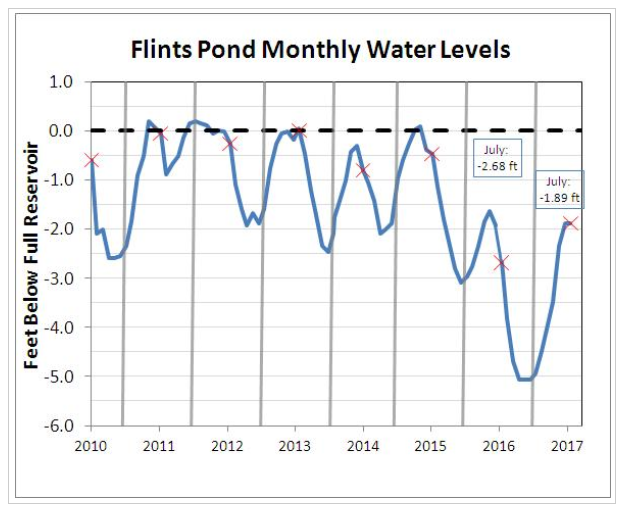
Water levels in Flint’s Pond since 2010 (click to enlarge). The last two red X’s indicate levels in July 2016 and July 2017.

Despite the rainy spring and summer thus far, lawn watering via sprinklers is still permitted in Lincoln only once a week because Flint’s Pond has not yet rebounded to a level that would allow more water use.

Though watering is normally allowed two days a week in the summer, the Board of Water Commissioners banned all outdoor watering in August 2016 during the drought. The board relaxed it to once a week in May and maintained that restriction in June and July.

Precipitation for 2017 overall has been normal, with the first three months below normal and the second three months above. Although the Flint’s Pond’s water level has risen, it’s still markedly below where it usually is at this time of year, according to Water Department Superintendent Greg Woods.

“The water use by our customers has actually been below normal thanks to their compliance with the water restrictions. If the rainfall continues and our customers continue to conserve, we might be able to relax back to the two-day-a-week restriction next month,” he said.

The two-day-a-week schedule is the normal restriction for Lincoln from May 1 through September 30 as per the Massachusetts Department of Environmental Protection (DEP) because Lincolnites use more than 65 gallons per person per day on average, “and we also draw more water annually from our water sources than allowed by our DEP permit,” Woods added.

Some have wondered why Flint’s Pond is still low when the nearby Cambridge Reservoir appears to be full. The reservoir filled up more quickly because it has a very large watershed to capture the precipitation and funnel it into the reservoir’s basin, Woods said. Flint’s Pond has a relatively small watershed and essentially sees a 1:1 ratio of precipitation and pond level increases, compared to about 2:1 for the Cambridge Reservoir. The Flint’s Pond dam is not overtopping or leaking and is experiencing the normal amount of seepage underneath, Woods said.

The water commissioners have open meetings on the second Wednesday of every month at 4:30 p.m. in the Water Department pump house to review the latest data and decide what (if any) water restrictions to impose. “We expect the water level to be lower in the end of the summer, so at the next meeting, we will compare the measured level to the normal level in August,” said Water Commissioner Ruth Ann Hendrickson.

See the Water Department web page for details on what types of watering ares allowed and when.

Category: conservation, news, Water Dept.* Leave a Comment

Flint’s Pond dam to get upgrade

November 21, 2016

damPerhaps ironically in this year of drought, the Flint’s Pond dam will be getting some rehab work this winter to make sure it can withstand a 50-year flood.

A hydraulic evaluation  required by the Office of Dam Safety indicated that the dam would overtop during a 50-year flood because the current spillway is undersized, said Water Department Superintendent Greg Woods. When water overflows a dam beyond its spillway capacity, it erodes soil and other material whose weight holds the dam in place, putting it in danger of failure.

Construction signs on Sandy Pond Road and Baker Bridge Road will alert motorists to the fact that trucks and equipment will be entering and exiting via a temporary easement being constructed at 67 Sandy Pond Road to access the dam site, which is at the southeast corner of Flint’s Pond. Work could begin as soon as December, and while the contract calls for the work to be completed in 75 days, the contractor will probably have to return in the spring to finish work on the ground cover, Woods said.

The town’s water supply and water quality will not be affected by the work, mainly because the water level is so low, although engineering plans were developed under the assumption that Flint’s Pond was at normal capacity. The cost to the town will be $125,000.

Category: news, Water Dept.* Leave a Comment

Drought playing havoc with plants and wildlife, speakers say

September 26, 2016

Lincoln resident Ron Rosenbaum photographed these turkeys helping themselves to some much-needed water.

Lincoln resident Ron Rosenbaum photographed these turkeys helping themselves to some much-needed water.

The drought we’re experiencing is causing brown lawns and dry land where water used to be—but it’s no picnic for the area’s plants and animals either, as three local experts explained at a presentation titled “Brown is the New Green.”

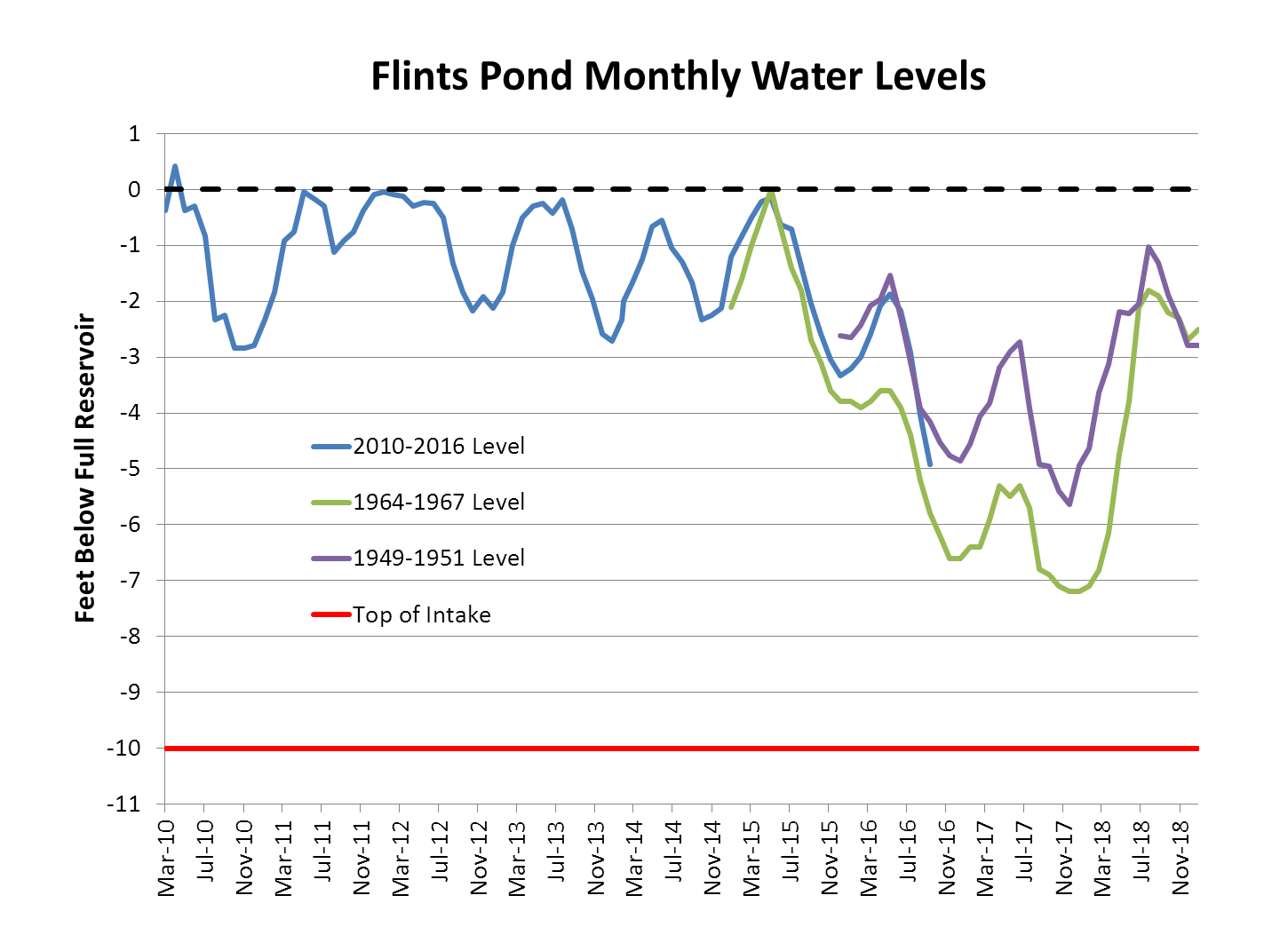
Residents at the well-attended September 21 event in Bemis Hall learned that this isn’t the worst drought in recent history—yet. The worst droughts in Lincoln in the last few decades were in 1949-51 and 1964-67, said Greg Woods, Superintendent of the Lincoln Water Department.

“We’ve been at this level before,” said Woods, showing old photos of Flint’s Pond at low levels. However, the coming of winter snows doesn’t necessarily mean things will go back to normal right away. “We have to prepare for the worst and hope we have a very wet winter and spring,” he said.

deviation-from-50-year-average

Precipitation totals compared to the 50-year average since 2002 (click any image to enlarge).

flints-pond-monthly-water-levels

Water levels in Flint’s Pond, with different colored lines for 2010-16 and two earlier droughts, 1949-1951 and 1964-1967.

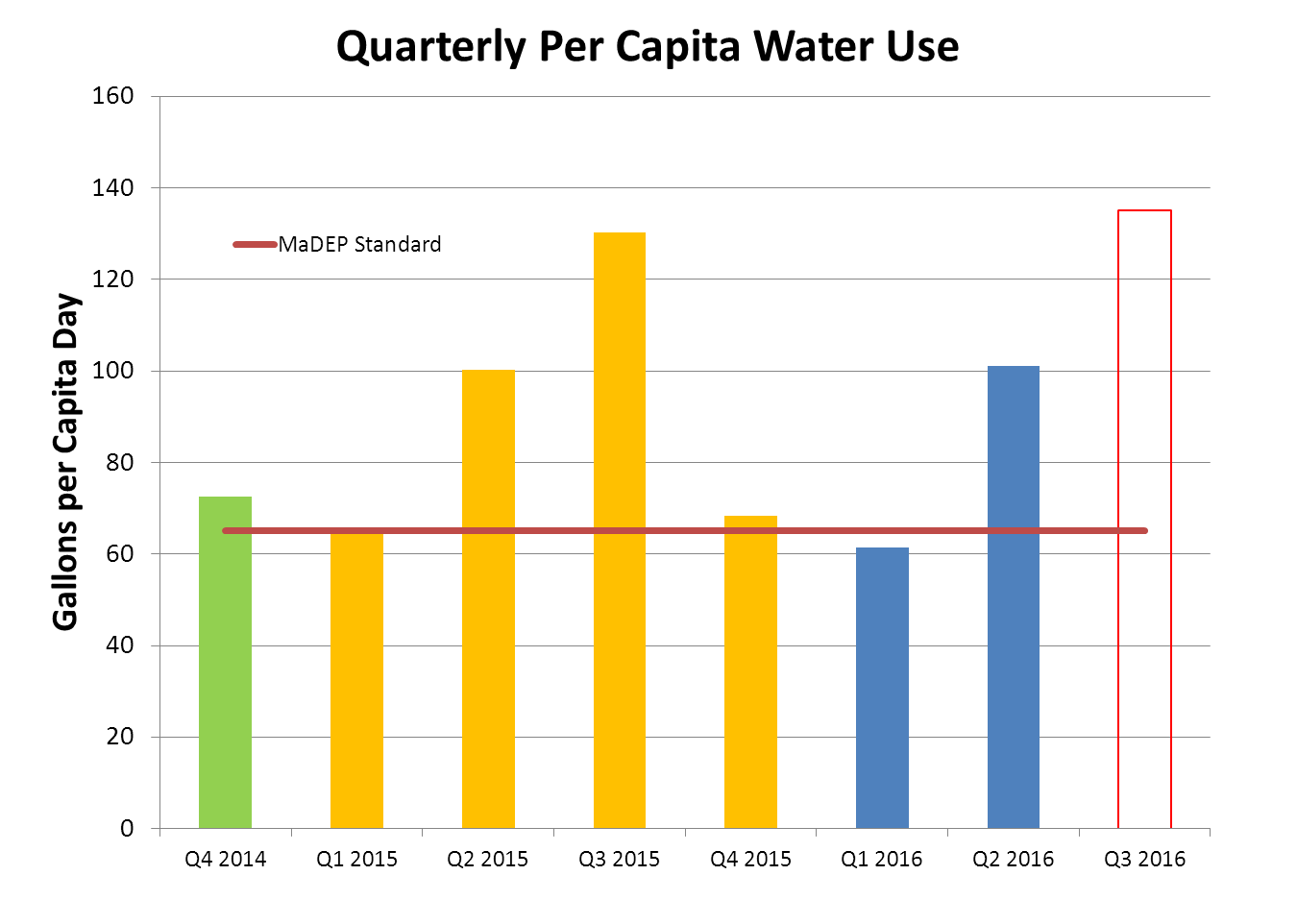
quarterly-per-capita-water-use

Quarterly per-capita water usage in Lincoln, with a red line showing the Massachusetts Department of Environmental Protection standard.

Lincoln residents have used about 10 million more gallons of public water this summer than the average for previous summers, said Woods as he showed a series of charts on water consumption and precipitation. Usage has declined somewhat since the mandatory outdoor watering ban went into effect on August 21, but residents are still using far more than the state target of 65 gallons per person per day. The town meets the goal from October to March, but it goes up to about 130 gallons per person per day during growing season, Woods said.

The biggest culprits in outdoor watering are traditional sprinklers, which spread water in places where it isn’t needed and also result in water loss due to evaporation, Woods said. Soaker hoses minimize evaporation loss but still use about a gallon of water per minute, “so you’re still going to use hundreds or thousands of gallons,” he said. The gold standard today is a drip irrigation system, he added

Effects on flora and fauna

The current drought should be viewed in the context of a warming climate, according to Richard Primack, professor of biology at Boston University. “It’s very clear we’re in a warming trend associated with global warming and the urbanization of Boston,” he said, noting that last month was the warmest August on record here.

Swaths of brown grass may be something of an eyesore to those who prefer a lush green lawn, but it’s a matter of life and death for insects that live in grass, and the birds that eat those insects. Streams that have gone way down or dried up completely are also bad news for many species, said Primack, who was quoted in an August 27 Boston Globe article about the drought’s effects on wildlife.

“They’re going to die—there’s no place for the fish and aquatic insects to live,” he said. “A lot of aquatic animals are in trouble.” Making things worse is that nutrients in the remaining water become more concentrated, leading to algal blooms and lack of oxygen in the water.

Plant life has changed as well, said Primack as he showed photos of the banks of Walden Pond where the water has receded. Alders that used to be on the water’s edge have died, while shrubs, grasses and wildflowers such as purple gerardia and golden hyssop have grown in the soil that was formerly underwater. They, too, will perish when the water level rises again, said Primack, who has studied the effects of warming climate on New England plants, birds and butterflies for the last 14 years and is the author of .”

Farmers are certainly feeling the effects of the drought. Corn, pumpkins and other crops will die if they aren’t irrigated, and the yield from fruit trees will also be down this fall. Plants and trees that didn’t flower mean trouble for bees and butterflies as well. But not all plants are suffering, Primack said; succulents (relatives of desert plants) such as purslane, knotweed, spurges and sedum are “really common and really huge,” he said. By the same token, Southern magnolias and even fig trees may thrive in a climate that was once too harsh for them.

The biggest losers may be birds, who are usually eating juicy wild berries and crabapples but have little to eat this year. “There are very few birds in forests and fields; they’ve left to find food somewhere else, and migratory birds have left early. It will take many years for bird populations to recover,” Primack said.

Also scarcer due to the dry weather are insects such as mosquitoes, ticks and deer flies, and amphibians such as salamanders that live in vernal pools that dried up earlier than usual. People may have noticed fewer of the nuisance insects and more butterflies and bees congregating in their flower gardens, which (assuming they’ve been watered over the summer) are a target for the hungry insects. One insect that has thrived, however, is the antlion, which build sand traps resembling inverse anthills in sandy areas around dried-up lakebeds.

The rain will return, but New England will see these conditions more and more often, primack said. With temperatures predicted to get 4–6 degrees F. warmer over the next century, “this will be a typical year 80 years from now,” while low-lying coastal areas of South Boston, Somerville and Everett will be underwater, he said

Gardening with less water

In conditions like this, what’s a gardener to do? Lincoln Garden Club member Daniela Caride had some suggestions focusing on “sustainable gardening.” To minimize water usage, she recommended investing in rain barrels, avoiding sprinklers, and watering only at night or early in the morning rather than in the heat of the day.

Options for lawns include simply having a smaller lawn, planting other types of ground cover, or turning your lawn into a wildflower meadow. Mulch (especially leaf mulch, which is cheaper and easier to handle than bark mulch) is good for keeping moisture in the soil and providing shade and shelter for small animals and insects, Caride added.

When planning your garden, “think before you plant,” Caride said. Avoid “thirsty” plants like chameleon, roses and astilbe, which can suck up water even from surrounding plants, and go for more native plants, which are adapted to our climate (thus needing less watering) and offer food and shelter for small animals and insects.

Category: agriculture and flora, conservation, nature, news, Water Dept.* Leave a Comment

42 watering warnings since sprinkler ban

August 29, 2016

watering-banSince Lincoln’s outdoor watering ban went into effect last week, the town’s Water Department has issued 42 warnings to residents for violating the ban—about 30 percent more than the usual total for an entire summer.

The sharp increase is a result of the complete ban on sprinklers and automatic watering systems necessitated by the severe drought. Normally, residents are allowed to water lawns two days a week during certain times of day during the summer, but this is the first time there’s been a total prohibition. Town officials informed residents about the ban with a reverse 911 call to all households as well as the town website, social media and news outlets.

Lincoln is not alone—many Massachusetts towns have instituted voluntary or mandatory watering bans as the dry conditions have only worsened as the summer has gone on. However, not everyone in the area has complied, some even going so far as to post bogus “Well Water” signs on their lush green lawns, according to an August 25 Boston Globe article.

Water Department Superintendent Greg Woods patrols the town several times a week looking for watering violators, knocking on doors and leaving notices on doorknobs for violations he can see from the road. The department also gets occasional phone calls from civic-minded residents who take to heart the dictum “see something, say something” when it comes to water conservation.

This summer has seen an uptick on the number of calls from “people reporting that their neighbors have unusually green yards and they suspect excessive watering is going on,” said Woods, whose department issues 20 to 30 warnings in a normal year for watering violations. “Irrigator violators” are slapped with a $50 fine for a second offense and $100 for subsequent offenses. Two or three residents a year incur fines for a second offense, “but we’ve never gone to a third notice,” he said.

Despite the public outreach (which will be augmented with sandwich boards this week), “there are still people that don’t know,” Woods said. One resident who was out of town and has an automated watering system called the Water Department to apologize. “We were about two hours away from mailing that warning to them,” he said with a smile.

Although the increased demand on the town water supply due to outdoor watering will drop off once the fall weather arrives, there’s no telling how long the drought will last. “The hope is that we have a wet fall, winter and spring,” Woods said. “I’ll be doing the rain dance a lot.”

Category: conservation, news, Water Dept.* Leave a Comment

Outdoor water ban now in effect as drought drags on

August 23, 2016

xxx

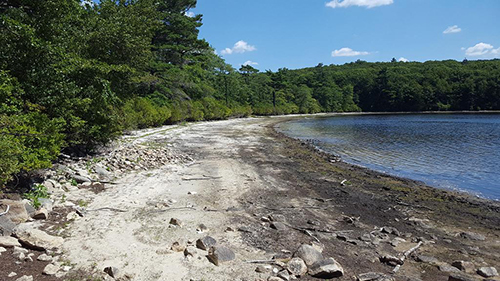
The north shore of Flint’s Pond on August 19. (Photo courtesy Greg Woods)

The Lincoln Water Department has instituted a mandatory outdoor water ban that prohibits all lawn watering by means of automatic irrigation systems or manual sprinklers due to the worsening drought, which Monday morning’s storm did little to help.

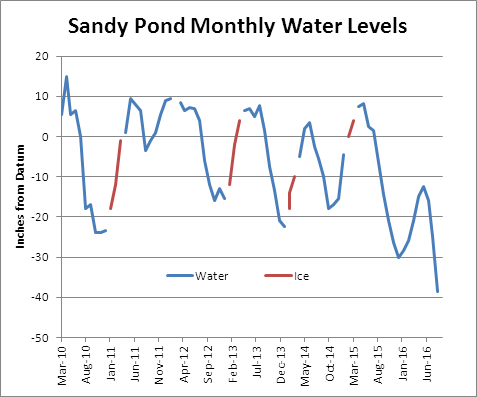
The storm, which brought an EF-1 tornado to parts of Concord, dropped 0.55 inches of rain on Lincoln, according to Water Department Superintendent Greg Woods. Flint’s Pond, Lincoln’s primary public water source, is 55 inches below full capacity, “so even a full year’s worth of precipitation (typically 48 inches in Massachusetts) won’t bring us back to normal levels, even assuming we don’t withdraw any water as it’s filling,” he said.

The Water Department’s precipitation records show that the town is almost 7 inches below its median precipitation level for the last 40 years. Ground water levels have decreased 1.8 feet since May. As a result of the scarce rainfall, there’s been more demand for water for lawns and gardens; water use for June and July was 20 percent above 2015 and 30 percent above the five-year average, and current withdrawal rates are causing the pond level to drop one foot per month, Woods said.

On August 18, the U.S. Drought Monitor upgraded its drought assessment for most of Middlesex (including Lincoln) and Essex Counties to “extreme drought.” Several other area towns including Concord, Acton, Wayland and Sudbury have instituted watering bans similar to Lincoln’s, and 53 Massachusetts communities have restricted outdoor watering to one day a week or less.

Water levels in Flint's Pond (formerly called Sandy Pond) since 2010.

Water levels in Flint’s Pond (formerly called Sandy Pond) since 2010.

Until the drought is over, Lincoln resident may not use underground or above-ground sprinklers or soaker hoses. They also may not fill or top swimming pools by more than two inches, or use games or toys such as water slides and sprinklers that use a continuous stream. Car washing is also prohibited.

Watering vegetable or flower gardens by means of a handheld hose is allowed from 6 p.m. to 9 a.m. only. Drip irrigation systems are also permitted for two days a week as determined by a resident’s street address (even-numbered houses may water on Tuesdays and Thursdays, while off-numbered houses may do so on Wednesdays and Fridays). Violators will receive a written warning for a first offense, a $50 fine for a second offense and a $100 fine for a third offense.

Although the ban covers only outdoor water use, the Water Department encourages everyone to conserve water inside their homes as well. Conservation measures include reducing shower frequency and duration, showering instead of taking baths, reducing toilet flushing, avoiding continuous running of faucets, and using the washing machine and dishwasher only when full.

Woods said he didn’t think a complete outdoor water ban had ever been imposed in Lincoln. The water level in Flint’s Pond was lower during the 1964-1966 drought and residents were asked to conserve water voluntarily, but lawn irrigation systems were not as prevalent as they are today, he noted.

There’s no immediate danger that Flint’s Pond will run dry. The pond is still at slightly more than 50% capacity and the Water Department has increased its use of its Tower Road well to help reduce the demand on the pond. However water levels in the well have dropped 1.8 feet since May, “so we need to watch that level as well so the well pump isn’t damaged,” Woods said.

The microfiltration plant on Sandy Pond Road that treats the water from Flint’s Pond can cope with the increased concentration of organic matter in the water, Woods said. The plant treats anywhere from 450,000 to 900,000 gallons a day before sending it to a 1.2-million-gallon holding tank at the top of the hill on Bedford Road. From there, the treated and filtered water flows through Lincoln’s 57 miles of water mains to residents’ faucets (see the Lincoln Squirrel, September 28, 2014).

The bigger concern is the uncertainty in the long-range forecast and whether this will be a multiyear drought. “We started this year  about 20 inches below full capacity because 2015 was dry. If the pond level doesn’t recover this winter and spring, we could be in the same [watering ban] situation next year, but potentially earlier in the season than August,” Woods said.

Category: conservation, news, Water Dept.* Leave a Comment

More frequent bills, new rates for town water in 2015

January 2, 2015

water tapBy Alice Waugh

For homes that use town water, it’s a new year with new things to look forward to—including quarterly water bills and new rates to encourage water conservation.

The change in billing frequency from semiannually to quarterly came about because Lincoln has failed to meet its state target limit of 65 gallons per person per day. As a result, the Department of Environmental Protection required the town to come up with a set of measures to try to meet the goal, and one of those measures is more frequent billing to keep closer tabs on usage.

“It’s like when you overspend your budget, you tend to balance your checkbook a little more frequently,” said Water Department Superintendent Greg Woods. The changes were outlined in this letter from the Water Commission that was mailed to residents several weeks ago.

Rates are also going down for homes that use less water. Under the old billing system, those that used up to 48,000 gallons of water every six months were changed $5.07 per thousand gallons. Now, homes that use up to 40,000 gallons per year will be charged only $4.06 per thousand gallons.

However, after that level of usage, the price goes up. Homes that use 40,002 to 80,000 gallons every six months will pay $8.57 per thousand gallons, compared to last year’s rate of $7.79 per thousand gallons for homes using 48,001 to 90,000 gallons every six months. Homes with a separate meter for irrigation water will also be paying 20 percent more for that water (see chart below).

A family of four that meets the target of 65 gallons per capita per day would use about 100,000 gallons per year, according to the Water Department’s latest annual report.

In comparing Lincoln to five neighboring towns, four (including Lincoln) had annual rates between $500 and $600 for a home using 100,000 gallons per year. Wayland was considerably higher at $977. However, Woods cautioned that it’s difficult to make exact comparisons because each town has a different distribution system. For example, Lincoln relies on surface water from Flint’s Pond, while Acton, at four times Lincoln’s population, has a much larger system that relies more on groundwater wells, he explained.

Currently the DEP has no plans to fine residents or towns for exceeding their water usage targets. “All indications are that they will work with communities to get into compliance,” Woods said.

Microsoft Word - water fees.docx

Category: government, Water Dept.* Leave a Comment

Keeping Lincoln’s water flowing for 140 years

September 28, 2014

Greg Woods, Lincoln Water Department superintendent, with one of the membrane filter used to treat clean the town's water. See below for more photos.

Greg Woods, Lincoln Water Department superintendent, with one of the membrane filters used to treat clean the town’s water. See below for more photos.  —Photos by Alice Waugh

By Alice Waugh

You don’t have to think about it — just turn on your tap and clean water flows. For most Lincoln households, that water starts its journey in Flint’s Pond and navigates a surprisingly intricate route on its way to your shower, sink or lawn — a journey that once involved wooden water mains and a coal-fired pump.

All but about 400 Lincoln residents (mostly on Old County Road and Conant Road) get town water, which is pumped from Flint’s Pond via a pump house next to the pond, explained Lincoln Water Department Superintendent Greg Woods. From there, it travels north across Sandy Pond Road to a nondescript one-story building where an automated system adds sodium hydroxide to adjust the pH, sodium fluoride to help prevent tooth decay, and zinc orthophosphate to reduce corrosion in the water pipes.

Then all the water — anywhere from 450,000 to 900,000 gallons a day — passes through a membrane filtration system before heading to a 20-foot-tall holding tank at the top of a hill on Bedford Road. (The 1.2-million-gallon tank won’t offend anyone’s aesthetic sensibilities, however; all but two feet of it are buried underground.) From there, the treated and filtered water flows through Lincoln’s 57 miles of water mains to residents’ faucets.

There are several safety and backup systems in place to keep the water flowing in case of emergency. The pump house has an emergency backup generator that runs on natural gas in case of a power outage. In the aftermath of Hurricane Sandy, it kept the water flowing for three full days, Woods said. There’s also a well on Tower Road that serves as a secondary water source when the main facility requires maintenance. And the system’s water is sampled every two weeks at various locations in town and tested to make sure the chemistry is correct and that there are no harmful pathogens present.

More than a century of service

Lincoln has had a water department since 1874. In the old days, water was drawn from the pond, screened in the small house at the water’s edge and pumped directly to homes via a coal-fired facility that was torn down in 1900, Woods said. Today, the larger building houses the modern pumping facility and generator as well as repair equipment and an assortment of old water meters and gate boxes — the metal tubes set into roadway and sidewalks with caps that workers can remove to access each gate, or valve, to shut off water between two points.

The state Department of Environmental Protection eventually began requiring towns to disinfect surface water that’s piped to homes (water from public and private wells below a certain depth doesn’t have this requirement), so Lincoln built the disinfection facility in 1993 and added the membrane filtration system in 2003. The disused screening building next to the pond is still there, although it started sliding off its foundation about 15 years ago and a resident paid to have it filled with cement to anchor it in place.

The pond itself is closed to all recreational use including swimming, fishing, skating and even picnicking by the shore. “I don’t want to be a Nazi and shoo people away because it really is a beautiful sight, but it is our main water supply,” Woods said.

Owing to the lack of human predators, “there are some really big fish in there,” said Woods. The pond is about 35 feet at its deepest, and one can see down about 15 feet from the surface. “It’s a very, very clear pond,” he said. Canada geese visit now and then, but he chases them off in a boat to minimize bacteriological contamination from bird poop.

Conservation measures

Not surprisingly, residents use a lot more water in the summer, when lawns and gardens get their share. In fact, the time of day with the highest demand is at about 3 a.m., because many homeowners have their sprinkler systems hooked up to timers that are set to soak the plants in the middle of the night, which is better for them than getting water in the heat of the day. There’s also a morning and evening rush, when residents are taking showers, using toilets, cooking meals and doing the dishes.

At first glance, Massachusetts doesn’t seem to resemble the Southwest in terms of water supply, but, “there are some very stressed water basins in the state,” Woods said. By state law, residents are supposed to limit themselves to 65 gallons of water per person per day, and Lincoln “has been hanging out in the upper 60s,” he said. Over the course of a year, Lincoln uses 200 million gallons of town water, but the town is supposed to reduce its usage to 182 million gallons to comply with current regulations.

Although there are no specific penalties at the moment, towns must show they have plans in place for conservation and leak detection and are making progress. In Lincoln, sandwich boards appear around town during the growing season to remind residents that they may use outside water only twice a week. Some residents get around the limit by using a private well for outdoor irrigation and town water just for indoor use, Woods noted.

Another state-mandated water conservation rule says that no more than 10 percent of pumped water may be lost to leaks somewhere in the system. Lincoln loses somewhere between 10 and 20 percent each year, “so we need to find some leaks,” Woods said. The town must repair leaks up to each owner’s property line, but homeowners are responsible for fixing pipes on their property.

If townwide water usage town suddenly spikes, workers will look for an underground leak by listening from surface points between hydrants with headphones to try to pin down the location of the suspected leak (though sometimes it remains a mystery — see the Lincoln Squirrel, Aug. 17, 2013). Water escaping from a crack in a pipe agitates the surrounding sediment, which causes vibrations that can be picked up on sophisticated detection systems. A contractor also inspects the entire system using this method once a year and identifies, on average, about a dozen locations annually (including faulty hydrants) that are leaking more than one gallon a minute, Woods said.

Leaks are a never-ending issue because many of the water mains are quite old, but it’s prohibitively expensive to replace them before they actually fail. The original water mains were made of wood strips held together with metal bands, because cast iron was very expensive back in the day. The town eventually moved to cast iron pipes and, more recently, longer-lasting ductile iron.

“We have pipe in the ground that’s more than 100 years old,” said Woods, pointing to an ancient pipe segment that had become drastically narrowed from the inside by iron and manganese deposits. Nowadays, water mains are flushed once a year by opening hydrants. This creates an artificial leak that causes the system to pump water at higher pressure to compensate, and the temporary rush of water scours the deposits the inside the pipes.

Though it’s safe to drink, the water that day might be a bit discolored, so notices are posted about when hydrant flushing will take place. “You don’t want to launder your silk curtains that day,” Woods said.

Click on an image below to see larger versions and captions.
Photos by Alice Waugh

[Best_Wordpress_Gallery id=”106″ gal_title=”Water works”]

Category: features, health and science, Water Dept.* Leave a Comment

  • « Go to Previous Page
  • Page 1
  • Interim pages omitted …
  • Page 3
  • Page 4
  • Page 5

Primary Sidebar

Recent Posts

  • Water bills to go up by 13% March 5, 2026
  • News acorns March 5, 2026
  • Property sales in January 2026 March 4, 2026
  • My Turn: Unraveling the Hanscom misallocation March 3, 2026
  • Police log for Feb. 19–25, 2026 March 3, 2026

Squirrel Archives

Categories

Secondary Sidebar

Search the Squirrel:

Privacy policy

© Copyright 2026 The Lincoln Squirrel · All Rights Reserved.