• Skip to primary navigation
  • Skip to main content
  • Skip to primary sidebar
  • Skip to secondary sidebar

The Lincoln Squirrel – News, features and photos from Lincoln, Mass.

  • Home
  • About/Contact
  • Advertise
  • Legal Notices
    • Submitting legal notices
  • Lincoln Resources
    • Coming Up in Lincoln
    • Municipal Calendar
    • Lincoln Links
  • Merchandise
  • Subscriptions
    • My Account
    • Log In
    • Log Out
  • Lincoln Review
    • About the Lincoln Review
    • Issues
    • Submit your work

schools

Last community forum before school vote is May 15

May 10, 2018

There’s one more community workshop and two school tours before the milestone vote to decide which school project scheme the town should pursue.

The public forum on the six current concepts will be on Tuesday, May 15 from 7–9:30 p.m. in the Reed Gym. This session will focus mostly on audience Q&A with the School Building Committee (SBC) and other officials, and attendees will also be asked to informally rank the concepts in order of preference.

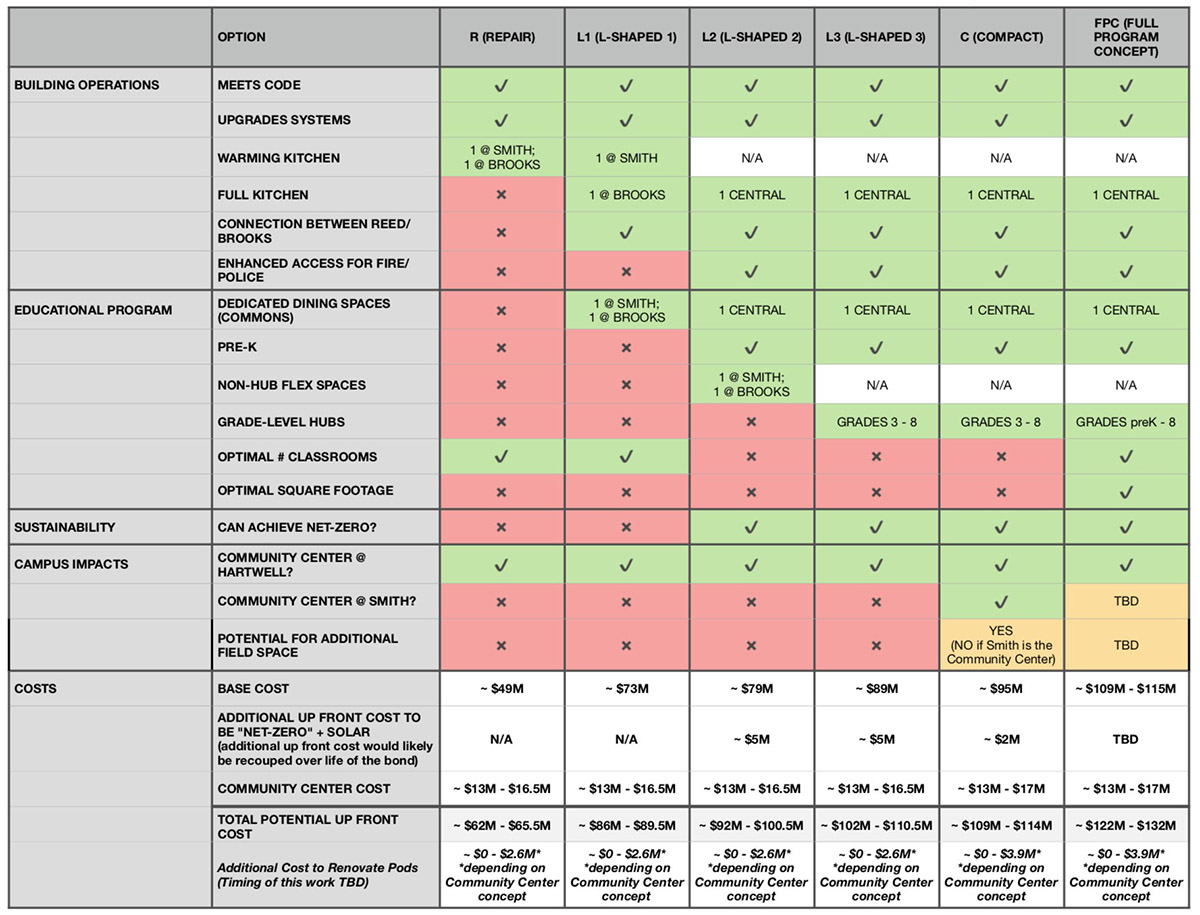
  • See a table comparing the six current school options, plus sketches and tax increase estimates for each.

At the forum, SBC members will walk attendees through the process they used to generate and then narrow down the concepts from 12 at the start to the current six.

Last week, the committee considered two additional school design options. One of them had been in the mix before and one was a concept that the SBC requested from the consulting architects at a set price point of $85 million. However, “after discussion, it was determined that neither one of them brought anything incremental when compared to what we already had,” SBC Chair Chris Fasciano said.

The Board of Selectmen has yet to issue a recommendation on the options, though members are hoping to provide some guidance without being “overly directive,” Selectman Jennifer Glass said at the board’s May 7 meeting. The Finance Committee also debated the matter last week but decided not to recommend any of the options over the others, though they may yet recommend a dollar amount to keep in reserve when the town votes on bonding.

At its May 16 meeting, the SBC will finalize the concepts to be presented on June 9. Members will discuss on May 30 how they would rank the six options and why.

The June 9 Town Meeting will feature two votes: one using the voting machines and the second being a stand-and-count vote. In the first vote, registered voters will be asked to choose one of the six school options and possibly also what factors were most important in their decision. The votes will then be tabulated by machine, and the two options receiving the most votes will be presented for the final standing vote.

The SBC is hosting tours of the new Hanscom Middle School and the Lincoln School on Monday, May 21, where school officials will point out the educational benefits of various design attributes in both buildings. Anyone interested in the Hanscom tour must email Janice Gross at jgross@lincnet.org by noon on Monday, May 14, as all Hanscom Air Force Base visitors must provide in advance their full legal name as shown on their driver’s license and date of birth.

Visitors on May 21 must travel to the base with the group by bus, which will leave the Hartwell lot at 9:30 a.m. and return by noon, with lunch provided in the multipurpose room. A tour of the Lincoln School follows at 12:45 p.m. Anyone who just wants to tour the Lincoln School should email Gross and meet at the Smith office by 12:45 p.m.

Category: government, news, school project*, schools Leave a Comment

L-S School Committee disputes lawsuit allegations

May 7, 2018

The Lincoln-Sudbury Regional School Committee released a statement on May 7 denying charges in a recent lawsuit that the high school discriminated against the victim of an alleged sexual assault on campus in 2013.

A former student identified only as “Jane Roe” filed suit last month, charging L-S with failure to train and supervise response to sexual assault, intentional infliction of emotional distress, and discrimination on the basis of gender in violation of Title IX. In addition to the school, the suit names Superintendent/Principal Bella Wong, Director of Special Education and Director of Student Services Aida Ramos, and East House Housemaster/Associate Principal Leslie Patterson as defendants.

According to the lawsuit, after Jane was sexually assaulted by two boys during a football game, the school did not adequately protect her from coming into contact with the boys at the school and did not provide her with sufficient educational and counseling resources. Jane later went to a therapeutic school and eventually graduated from Lawrence Academy, the suit says.

“These allegations were fully investigated at the time by the Sudbury Police and School District officials. Upon learning of the incident, School District personnel immediately provided the female student with the support and assistance necessary to pursue her studies in a safe and harassment-free environment. Appropriate measures were also taken against the alleged assailants,” the School Committee’s statement reads.

“Any allegations that the school district dragged its feet, was unresponsive to the student, or somehow tried to sweep the incident under the rug, are entirely false. Due to the nature of the incident and ages of all involved, the school district was obliged to maintain strict confidentiality.”

The statement includes a link to a 2017 letter from the U.S. Department of Education’s Office for Civil Rights, which investigated the district’s response to the incident and said it found “insufficient evidence to support the complainants’ allegation” that “the school discriminated against the student by failing to respond promptly and appropriately.”

“The Superintendent-Principal and her administrative team have kept the School Committee apprised of the matters related to the incident and subsequent proceedings at all times,” the School Committee wrote, adding that it “stands behind its policies and unequivocally supports the administrators named in the lawsuit.”

Category: news, schools Leave a Comment

No consensus from FinCom on school options or cost limit

May 6, 2018

After hours of discussion, the Finance Committee on May 3 decided not to endorse any of the school project plans over the others and did not specify a project price limit to recommend to voters. However, members made other recommendations, including that Lincoln should not appeal to the state to go over its borrowing limit.

In its discussion on that to recommend to voters at the Special Town Meeting on June 9, the FinCom also said in unanimous resolutions that:

  • The estimated construction costs, exclusive of “soft” and escalation costs, are well within the norms of comparable Massachusetts school construction costs.
  • The town should not delay the school project in hopes of more favorable construction costs down the road.
  • It is more fiscally responsible to do a single project that addresses all the needs of the building rather than doing a series of piecemeal repairs.

Members debated how much financial cushion—in the form of additional borrowing “headroom” under the town’s borrowing limit, and/or cash to leave in the debt stabilization fund—the town ought to preserve after borrowing for the school project. They also discussed how much of that fund should be used to cushion the first year or two of repayments or to reduce the initial bond amount.

Much of the uncertainty on the part of committee members stems from the fact that several of the six cost estimates for the school project are very close to the town’s current $97 million borrowing limit (Option C is estimated at $95 million and Option L3 at $89 million). And those figures do not include another $2 million for a net-zero energy-efficient building with solar panels.

  • See a table comparing the six current school options, and sketches and tax increase estimates for each.

Adding to the uncertainty is the distinct possibility that the price tag on whatever option is chosen on June 9 could drop before the bonding votes happen in the fall, as officials noted on April 30.

“It’s entirely realistic to expect a fair amount of movement in the cost estimates between June 9 and December 1, but it’s not realistic to expect any shift” before June, School Committee chair Tim Christenfeld said at Thursday’s FinCom meeting.

In 2011, the SBC initially included preK in the building and adding a two-story addition, but to reduce cost and square footage, preK was taken out and the addition was reduced to one floor.

Also, “there are many, many contingencies built in at this stage of the process,” Selectman and former School Committee chair Jennifer Glass said on Sunday. “As decisions are made, the ‘knowns’ replace the ‘estimates’ and some of the contingencies get reduced.

“For this project, I would never presume to say that history is an indicator of future performance,” Glass continued. “We cannot make any guarantees of a percentage decrease—we can only say that the SBC will take the June 9th vote as a budget cap, and do everything reasonable to reduce up-front costs to the town without overly sacrificing long-term value.”

The FinCom tabled its discussion on a financial buffer until its next meeting on May 22.

No agreement on cost limit

Committee members also wrestled with recommending a specific cost ceiling for the school project.

“I struggled mightily with this one. I do believe there should be a ‘do not exceed’ number… but I struggle with giving guidance on a specific number,” FinCom member Andy Payne said. “At the end of the day, it’s a resident decision and I feel that very strongly… My concern is that we collectively [on town boards and committees] don’t necessarily have a good pulse on the resident appetite here. My worry is that without that pulse, we risk not having a supermajority” in the fall, when a two-third majority is required at Town Meeting to bond a project.

Setting a dollar-limit recommendation is “putting the cart before the horse and trying to imagine the will of the town,” said member Tom Sander.

Without first setting parameters for how much money or borrowing capacity to hold in reserve, “I feel like we’d be making a decision without making some of the building-block decisions,” member Gina Halsted said.

Outgoing and non-voting FinCom member Eric Harris was not so circumspect. He proposed a limit of $85 million for a school project in light of the fact that more money will be needed for a community center right after the school is finished. A community center is currently expected to cost at least $13 million. However, the town will have paid off some of its current and future debt by the time that project is bonded and property values will increase, so its total borrowing limit will be higher than it is today.

$85 million “is a reasonable expense for the town. As a Finance Committee, we should say we can spend the amount of money that’s likely to pass [at Town Meeting] and that meets everyone’s needs, not just the school,” Harris said. “I just think we need to pay more attention to building a prudent plan that includes both… I’m worried that the community center is getting pushed off in a way that’s going to piss a lot of people off.”

Design options

Turning to discussion of which of the six design options to recommend, if any, “I believe narrowing down concepts is the School Building Committee’s job. Why should we be operating as a shadow SBC?” Payne said.

FinCom chair Jim Hutchinson disagreed, saying, “We’re not talking about disabling any concepts from being selected by the town; we’re trying to help residents with our opinion, not just on the cost straight up, but on the value of those concepts.”

Although it didn’t take a formal vote, the committee was deadlocked 3-3 on whether to recommend for or against specific designs, though members agreed in principle that the $109 million “FPC” option was not feasible, and that the $49 million repair-only option was not fiscally prudent.

But resident Owen Beenhouwer, an architect and veteran of past School Building Committees, argued that the FinCom should strongly recommend against the repair-only option, saying the last major school project did not go far enough. He implied that the current plan to offer a broad range of options to voters is an overreaction to the negative vote on a single option in 2012.

“I am disturbed at the fact that next year, we are looking at the 25-year anniversary of what I consider to be a bad job in 1994,” he said. “People really want help… people are puzzled with the mountains of information and too many choices to be made, and are looking to the committees to be helpful in some way.”

A repair-only option would be “a bad investment,” Beenhouwer continued. “I speak from experience as an architect that we are pushing the ball down the road. It would be better to turn the task back to the SBC and say ‘try again’ instead of saying it would be acceptable just to do a repair job.”

Category: government, school project*, schools Leave a Comment

Officials discuss school voting plan and possible outcomes

May 1, 2018

Town officials wrestled on Monday night with how to present the various school project choices to voters at the Special Town Meeting on June 9. And the biggest barrier to passage, unlike in 2012, will probably be building cost rather than design.

Even if a plan is approved in June, it still may see some changes; the June vote is only on the cost and the footprint, School Building Committee (SBC) Chair Chris Fasciano noted. In 2011-2012, the “preferred option”—a mostly new, 164,000-square-foot building with a two-story addition for $64 million—morphed into a 140,000-square-foot, $49.9 million building with a one-story addition that was only 35 percent new, once the schematic designs were finished and Town Meeting voted.

As for the mechanics of the vote itself, the tentative plan is to offer all six of the current options for a first vote by paper ballot to residents in the Brooks auditorium and in overflow space in the Reed gym. Then the two concepts with the most votes would go on to s second stand-and-count vote in both venues. Architects will then develop schematic designs for the winner, and there will be a bonding vote in the fall.

A simple majority is required for concept approval in June. The vote to bond the project in the fall will require a two-thirds majority at Town Meeting plus a simple majority at the ballot box shortly thereafter.

If the fall Town Meeting vote doesn’t pass by a two-thirds majority, the next step will depend on how close the vote is. Since the town is not bound by Massachusetts School Building Authority deadlines as it was in 2012, officials can continue to refine concepts and schedule more Special Town Meetings until a project wins approval. However, if the June vote is lopsidedly negative, “it means we missed a step on the way and we’ll have to regroup and see where we are,” Selectman Jennifer Glass said.

The Finance Committee also spent considerable time on Monday night grilling school officials and architects on details of how they arrived at their cost estimates and assumptions of how big the school building needs to be. Their questions followed up on written answers to dozens of questions that the SBC had submitted before the meeting.

The FinCom will meet on Thursday, May 3 to come up with a recommendation to the town—either for a specific option or “just a set of boundaries,” Chair Jim Hutchinson said. The SBC is trying to leave the decision in the hands of voters as much as possible, but “there will be something coming from our committee to let folks know what we’re thinking” in terms of a preferred concept, Fasciano added.

Residents at Monday’s multiboard meeting offered various other suggestions for the June vote, including allowing voters to choose which educational enhancements they would most like to see, or offering them a choice of three price points rather than specific design concepts.

Feedback from the various public forums so far has been overwhelmingly in favor of a compact building shape offering a high level of educational enhancement over the current school. However, people who attend such forums are often more engaged and informed and tend to be in favor of a project in general, and there will be a much broader cross-section of voters at Town Meeting, Glass noted.

Meanwhile, architects will present a seventh design concept to the SBC this week, and there will be another public forum in May to gauge sentiment and try to narrow down the options to be considered in June.

The June vote will focus only on a school project; the Community Center Preliminary Planning and Design Committee has agreed since the beginning of the planning process that construction on a community center will not start until after the school is complete, most likely in 2023. This is mainly because the school campus does not have space for construction staging areas and student swing space for two simultaneous projects, and there would not be any cost savings since the two projects are of such different sizes that the same contractors would not bid on both, officials said.

This is a disappointment to some seniors in town, including Barbara Low. “is it going to be another 10 years before a community center is looked at because there won’t be any more money [after the school project]?” she said.

But Hutchinson reassured her that town finances will not stand in the way. “We’re pretty comfortable that the community center could fairly quickly follow the school building project,” he said.

Though the bonding for both projects could be done in one go—or even borrowing the full amount for just the school in a single bond issue—this would be the :worst-case scenario,” hutchinson said. “Spreading it out will soften the impact a little bit.”

Current estimates for the school project range from $49 million to $109 million. Finance officials have already determined that the town can borrow up to about $97 million without affecting its bond rating or needing special permission from the state. However, the effect on individual property tax bills will carry more weight when it comes to how people vote, they noted.

“What the town can afford in a debt load/bond rating sense is not necessarily the same as residents’ appetite for expenditure,” FinCom member Andy Payne said. “What will residents be willing to invest in? That’s a very tough question to answer outside the ballot box but we’re trying to figure that out.”

Category: government, school project*, schools Leave a Comment

School, community center groups respond to Finance Committee questions

April 29, 2018

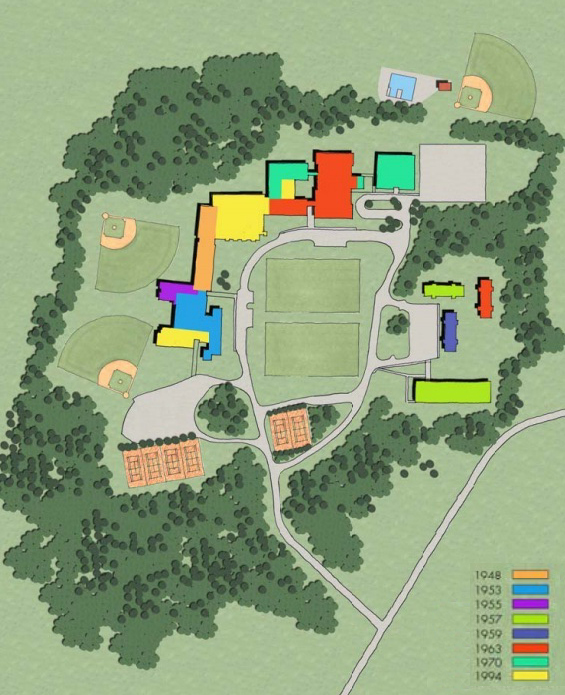
The current Ballfield Road campus.

Committees for the two campus projects have submitted answers to a series of questions from the Finance Committee in advance of two April 30 meetings on project costs.

A multi-board meeting on the campus projects begins at 6 p.m. in the Hartwell B pod, followed by a joint meeting of the FinCom and the Capital Planning Committee from 7:30–9 p.m. A Special Town Meeting on the projects will take place on June 9.

In their answers to the FinCom, both the school and community center committees recommended against building a school project and a community center at the same time, citing the different projects scopes and timelines, construction durations, and problems in using the campus while two projects were under construction simultaneously.

The Community Center Planning and Preliminary Design Committee (CCPPDC) noted that contractors who are able to build a 160,000-square-foot square foot project such as the school do not typically compete for 23,000-square-foot buildings, and “it is likely that using the general contractor and subcontractors that typically handle the bigger, more complex projects for the smaller community center will actually add cost to the community center.”

The School Building Committee offered some FAQs about cost estimates on its website on April 29. Earlier, the SBC responded to a list of questions from the FinCom on:

  • Factors driving the cost per square foot of the various concepts
  • Enrollment projections
  • Space and cost numbers for comparable projects in other towns
  • Incremental costs of specific features such as a new or renovated Smith gym, renovated auditorium, and hubs for grades 3-8
  • Construction cost inflation and escalation
  • Comparisons to revant data form the Massachusetts School Building Authority
  • Operation and maintenance costs (also asked by the CapComm)
  • What’s included in “soft costs”

The CCPPDC was asked to supply figures and assumptions used for capacity planning for the community center design, and to explain why Bemis Hall can’t be renovated for the Council on Aging. The group’s answers are here, with more information on their research here (click on the “Finance Committee information for April 30” tab in the middle of the page).

In a discussion of the square footage sought for the community center, the CCPPDC noted that even newer community centers in other towns have proved to be too small. “The one town our size that offers a senior facility larger than the senior component of the community center says that they are already short on space,” the committee wrote. “Almost all towns we spoke with, including those with quite new facilities, said that they built too small and now need more space. We do not want to make the same mistakes as other towns by assuming that their facilities are adequate for their population when they are not, especially when these mistakes cost towns more in the long run when additions need to be built.”

Category: community center*, government, land use, news, school project*, schools Leave a Comment

Lincoln-Sudbury walkout planned after alleged sexual assault of student in 2013

April 29, 2018

In the wake of a sexual assault lawsuit recently filed against Lincoln-Sudbury Regional High School, some students have planned a walkout for 9:30 a.m. on Monday, April 29.

L-S Superintendent/Principal Bella Wong noted in an email to the L-S community on Sunday night that the walkout is permitted by school policy. However, non-L-S individuals who aren’t already at the school for a specific school-related purpose will be excluded from campus during the event.

The school as well as Wong, Director of Special Education and Director of Student Services Aida Ramos, and East House Housemaster/Associate Principal Leslie Patterson were sued  on April 24 by a former student who claims the school discriminated against her and inflicted emotional distress after she was allegedly sexually assaulted by two other students in 2013.

Allegations in the lawsuit include the following (the plaintiff is referred to as“Jane Roe” and the two boys are not named):

  • During a football game at the high school on November 1, 2013, Jane was lured to an adjacent field by the boys, who assaulted her on the bleachers of the field adjacent to the football field and in an unlocked storage shed near the bleachers. “Although Jane tried to resist, the perpetrators forced Jane to perform oral sex and penetrated her with their fingers.”
  • In text messages to Jane afterwards, “both perpetrators admit to having acted improperly and [begged] for Jane’s forgiveness and silence.” One of them told her he was terrified of going to “juvie” and losing his girlfriend if the incident became public. He tried to persuade Jane to keep silent by indicating that he was crying, to which Jane said that she’d “been crying ever since I left u guys,” and continued, “I resisted… I tried to run away… you both raped me.” In a separate text exchange with the other boy, Jane confronted him for attempting to justify his actions to another classmate by saying he was ‘drunk and high’.”
  • Six days after the incident, Jane reported it to L-S clinical counselor Sue Leichtman, who notified Patterson and Jane’s mother, a Lincoln-Sudbury teacher. Jane also showed screenshots of the text messages between her and the boys. Sudbury police subsequently began investigating. Jane’s parents obtained Harassment Prevention Orders from Middlesex County Juvenile Court to prohibit the boys from interacting with her.
  • Though Jane returned to school on November 12, she was unable to attend classes because the boys were allowed to remain in school and shared classes with her. Patterson therefore had her sit in the East House common area for most of the day. “She was not assigned work to complete and had little to no interaction with teachers, counselors or other Lincoln-Sudbury personnel. She spent her days sitting alone, listening to her iPod” while a steady stream of students, including the boys, passed through the area to check their mailboxes.
  • Wong told Jane’s parents that the school could not give them information about any investigation or discipline, citing privacy concerns because “the perpetrators were allegedly special education students, as was Jane.”
  • L-S did not provide Jane with any counseling or therapy services. She began seeing a therapist at her family’s expense.
  • On November 20, Patterson told Jane’s parents that L-S was finally allowed by the police to conduct its own investigation of Jane’s allegations, but that the school was not allowed to talk to the perpetrators and had no authority to punish or remove them from the school.
  • Because the school could not adequately support Jane or keep her apart at all times from the boys, it suggested she enroll in a therapeutic school, EDCO Collaborative School (then in Watertown). The district denied the Roes’ request for Jane to attend a different equivalent public or private school closer to home; also, her EDCO education was inferior because she had to drop her double enrollment in math, did not receive a wellness credit, and could no continue as a two-season athlete. When Jane’s special education liaison sent her a recommendation for private schools, she was reprimanded by Ramos.
  • In March 2014, Jane was admitted to Anna Jacques Hospital for a week after telling her therapist she felt suicidal.
  • L-S launched the BEACON program in the fall of 2014 for students who had either formerly been outplaced due to depression and anxiety or to avoid such outplacement, but Jane’s parents were told she did not qualify.
  • In the fall of 2014, Jane’s parents enrolled her at Lawrence Academy at their expense. She graduated from that school in 2017.
  • In October 2015, the district told the Roes that its investigation of Jane’s allegations was inconclusive. However, in August 2017 after both boys had graduated, Jane’s mother received another letter from Ramos and South House Housemaster Peter Elenbaas claiming that the 2015 letter had incorrectly reported the school’s findings. “In that August 2017 letter, Lincoln-Sudbury for the first time admitted and acknowledged that its investigation had found ‘that there was sufficient evidence that an interaction of an egregious nature did occur on the evening of November 1st, and that the boys’ conduct substantially violated one of the core values of L-S’.”
  • Lincoln-Sudbury “deliberately failed to accurately report the results of its investigation prior to August of 2017 because the perpetrators remained students at the school and defendants did not want to contend with adverse publicity or parental complaints about the presence of known perpetrators of ‘physical assault and inappropriate sexual behavior’ within the school.”

The lawsuit charges L-S with failure to train and supervise response to sexual assault, intentional infliction of emotional distress, and discrimination on the basis of gender in violation of Title IX.

While noting that she could not comment on the specifics of the lawsuit that had been reported by various media outlets, Wong addressed the issue of sexual assault in two emails to the L-S community on April 27. In the first, she urged any student who had experienced unwanted verbal or physical sexual contact to notify someone at the school.

“The second you disclose to a trusted adult at L-S you will receive immediate attention and support,” Wong said. “You can tell ANY adult in this building and they will know what to do to make sure you get the help that you need.”

In the second email, Wong outlined the school’s measures to prevent sexual assault and support victims, including education around boundaries and consent, peer leaders trained through the Mentors in Violence Prevention program, self-defense classes and security cameras.

When an allegation of sexual assault occurs, “the police are provided the first opportunity to fully interview the affected parties in order to ascertain criminality,” Wong said. “We are able to interview the students more fully once the police have had their opportunity to interview. School discipline can only occur after these interviews are held. At the close of any incident of sexual assault, we also conduct a separate Title IX investigation to ensure that the civil rights of the student involved have been adequately protected.”

“We rely on every member of our community to help each of our students reach their fullest potential and to keep them safe. We cannot stress enough the importance of their learning about how to best maintain their own personal safety, and to reach out when in need of support,” Wong said.

Category: news, schools Leave a Comment

Residents drill down on school, community center options before June vote

April 12, 2018

This School Building Committee chart compares the six options on features and cost and also shows total estimated campus costs that include the community center. (click to enlarge).

Residents who packed two workshops on April 10 on the campus building projects were asked for feedback on six school concepts and three community center schemes in preparation for votes at a Special Town Meeting on June 9.

At that meeting, voters will be asked to choose from among the three community center ideas and an as-yet-unknown number of school concepts, though it will be at least two. Firm cost estimates for each will be presented, and there will be two votes in the fall to bond the project. To win approval, Town Meeting must approve by a two-thirds majority; a simple majority is required at the polls.

The footprint, features and cost of the school concepts are described in this six-page summary, which also includes an energy performance analysis for all but one of the concepts, and the added cost to bring each concept into compliance with the “stretch” code (a higher level of energy efficiency than the state’s base building code) and net-zero energy use.

The paper version of the six-page concept summary handed out at Tuesday’s meeting also listed the annual tax bill increase for the median Lincoln taxpayers based on a 4 percent of 5 percent bond interest rates:

School conceptEstimated costAnnual tax increase (4% interest)Annual tax increase (4% interest)Added cost for stretch code compliance/net zero energy efficiency, including solar
R
$49 million$1,329$1,494N/A
L1
$73 million$1,980$2,226N/A
L2
$79 million$2,142$2,409$0 / $6 million
L3
$89 million$2,413$2,714$0 / $6 million
C
$95 million$2,576$2,897$0 / $2 million
FPC
$109 millionAnalysis not yet performed for this optionAnalysis not yet performed for this optionAnalysis not yet performed for this option

Superintendent of Schools Becky McFall outlined the educational advantages of each of the six options:

Option R

  • There would be no educational improvement except for a more consistent temperature climate due to the heating system upgrade.

Option L1

  • The new dining commons between the Brooks gym and auditorium lobby could serve as a learning space for large groups.

Option L2

  • Bringing preK into the main school from Hartwell saves time for staff who serve both preK and K-8, as well as preK students who must sometimes cross the campus, and it also eases the integration of preK children into the school as well as faculty collaboration.
  • Two new flexible-use spaces on each side of the school.
  • Having a single, centrally located lower and middle school office and dining commons  also reduces travel time for students and staff.

Option L3

  • Hub spaces for grades 3-8 where classes can open out into larger collaboration or teaching spaces, and which allow more collaboration among teachers. At the new Hanscom Middle School, which includes hubs, “we find teachers are doing much more conscious planning together, and we see the impact of more integrated curricula being developed,” McFall said. For each grade, the hubs also “create a bit of a community within a community,” she added.
  • A larger commons space than previous concepts, and the space looks out onto the woods, which is less distracting for students.

Option C

  • Having two floors in part of the building reduces transition times for middle schoolers by shortening corridors. “The compactness helps with efficiencies and interactions for both faculty and students, as well as greater sustainability,” McFall said. “I feel like it’s a better design for education.”
  • More space for playing fields

Option FPC

  • Allows for the “optimal” educational program, with three more classrooms than the current school (or options L2, L3 and C), as well as hubs for all nine grades and more athletic field space.
  • This option was recently added at the request of residents who wanted to see what an “ideal” building would look like, so the design is still in flux and it may be more compact building with two floors in some places, McFall said.

Almost every elementary school in Massachusetts designs within the past 10 years includes small breakout rooms and/or larger hub spaces between classrooms, McFall said. The U.S Department of Defense’s education arm, which oversees construction of schools on military bases, mandated this type of design for the Hanscom school. “They did a lot of research, and they’re convinced of it—their analysis shows a true benefit,” McFall said.

Having hubs and breakout rooms “is the catalyst to change… an eruptor that makes you think something else is possible,” said resident Jen Holleran. “This is a generational opportunity.”

The Capital Planning Committee is now researching long-term operating costs for the various options, which would include estimating the financial value of making a greater up-front investment in a more sustainable design, Finance Committee chair Andy Payne said. Any savings on current utility costs would not help pay down the bond but would show up in slower growth in the school’s annual operating costs, he said.

Following the presentation, residents were asked to specify their two favorite options to help the School Building Committee gauge how many concepts should be presented for a vote on June 9. In 2012, the SBC offered only one option for an up-or-down vote that failed to garner the required two-thirds majority, “and we will not make the same mistake—we feel like we have to bring that choice to you,” said Selectman and former SBC chair Jennifer Glass.

Community center

Workshop attendees then saw the three latest concepts for a community center located on the Hartwell side of campus and were asked for feedback on paper. (The fourth concept on the Community Center Preliminary Planning and Design Committee website—putting the facility in renovated Smith school space—is no longer being considered.)

All are 23,000 square feet and include renovation of any remaining standalone Hartwell pods. Scheme 3 calls for having the community center linked to all three pods, with a resulting total cost ($13.5 million to $16.5 million) lower than the estimate for the other two options (both $15 million to $18 million).

There will be a multi-board meeting to discuss more details of how to finance the campus projects on Monday, April 30.

Category: community center*, government, land use, news, school project*, schools Leave a Comment

News acorns

April 10, 2018

Wine tasting benefits Domestic Violence Roundtable

Sudbury Wine and Spirits (410 Boston Post Rd., Sudbury) will host a complimentary wine tasting for the Sudbury-Wayland-Lincoln Domestic Violence Roundtable’s annual Shower for Shelters fundraiser on Friday, April 20 at 7 p.m. Please bring a new, unwrapped housewarming gift to the event.

New household items are vital for helping survivors of domestic violence establish new homes. Requested items include twin-size sheets and pillowcases, summer blankets, and comforters as well as bed pillows, crib sheets, bath towels and face cloths, unscented cleaning products and laundry detergent, laundry baskets, kitchen utensils, flatware, dishes, drinking glasses, and small kitchen appliances. Gift cards are also welcome. Donations also help the Shelters and Transitional Housing Programs of Reach Beyond Domestic Violence, The Second Step, and Voices Against Violence.

Learn about India’s golden period at daylong event

The India Discovery Center‘s next day-long on India’s cultural history will look at “The Golden Period of India: 200 BC to 500 AD” on Saturday, April 28 from 9:30 a.m.–4 p.m. in Bemis Hall. There will be survey talks on various aspects of Indian life during the period, including art and culture, language and literature, politics, philosophy and religion, and participants will celebrate the era with a church choir, a Sanskrit song, and a grammar recitation. Organizers request a donation of $20 ($15 for Lincoln residents). For more information, contact India Discovery Center president and Lincoln resident Bijoy Misra at misra.bijoy@gmail.com or 781-259-0029.

Talk focuses on “deeper learning” in public schools

Harvard Graduate School of Education professor and Lincoln resident Jal Mehta will discuss findings from his forthcoming book, In Search of Deeper Learning: Inside the Effort to Remake the American High School, in a talk on Tuesday, May 1 at 7 p.m. in Bemis Hall. The talk, which is sponsored by the Lincoln School Foundation and the Bemis Trustees, will include audience interaction and Q&A.

Drawing on research in 30 schools across the nation, the talk will explore what it means to understand something deeply, why such learning is rare in American public schools, and how some teachers and schools manage to transcend these realities and create powerful, intellectually enlivening education. Mehta will suggest both reformist and radical ways to make the kind of powerful learning which is currently the exception in American public schools the rule.

Lecture series on FDR in May and June

President Franklin D. Roosevelt

The Lincoln Public Library and the Lincoln Council on Aging present a six-part lecture series on President Franklin D. Roosevelt, the Great Depression and World War II on Thursday evenings at 7 p.m. in the library’s Tarbell Room starting Thursday, May 3. The lecture series is presented by Gary Hylander, visiting professor at Framingham State University and the Boston University School of Education. Come to one session or all; no registration required. The schedule is as follows:

  • May 3 — The Great Crash Turns into the Great Depression
  • May 17 — 1932: The Worst Year of The Depression and the New Deal; Could Roosevelt Meet the Challenge?
  • May 24 — The “100 Days” in Review
  • May 31 — A Growing Threat in Europe
  • June 7 — September 1, 1939: Hitler Invades Poland/the Arsenal of Democracy
  • June 28 — War on Two Fronts

Concert to raise awareness about campus projects

The Lincoln-based cover band Dadda (Mike Killick, Doug Carson, Bryce Wells, and Andy Ory) is hosting a musical event to “rock the vote” on Saturday, May 5 from 7–10 p.m. in Bemis Hall to raise awareness about the campus project vote that will take place at a Special Town Meeting on June 9. The event is free for Lincoln residents. There will be speakers and information available about the school and community center projects now under consideration.

Category: arts, charity/volunteer, community center*, history, schools Leave a Comment

News acorns

April 2, 2018

Lincoln Cultural Council seeks feedback and members

The Lincoln Cultural Council asks residents to take a quick online survey to help it shape the programs it brings to town. The council—whose mission is to solicit and review proposals for grants to sponsor cultural activities in Lincoln—is also seeking members. You don’t need to be an artist, musician or writer to join; all you need is a desire to help. Because the LCC is an official council of the town of Lincoln, members must apply to and be approved by the Board of Selectmen. If appointed, members should be willing to serve at least one three-year term and complete a short online basic training program on the Massachusetts Cultural Council website.

Learn more by attending an introductory meeting on Saturday, April 7 at 10 a.m. at 152 Lincoln Rd., Suite #4 or contacting Meg Ramsey, president, at meg.ramsey@verizon.net.

Recycle styrofoam in Sudbury

Residents can recycle styrofoam on Saturday, April 7 from 9 a.m.—noon at the Sudbury Department of Public Works at 275 Old Lancaster Rd. in Sudbury. Recycling is free for members of Sustainable Sudbury, or you can pay a $5 drop-off fee. Bring your hard packing styrofoam (#6) and soft (#4) LDPE foam. To receive a reminder about the next collection, email sustainablesudbury@gmail.com.

“The Role of Men in the Time of #Metoo”

The Sudbury-Wayland-Lincoln Domestic Violence Roundtable White Ribbon Day commemoration originally scheduled in March will be held on Tuesday, April 10 at 3 p.m. in the Community Meeting Room of the Wayland Public Safety Building (38 Cochituate Rd.) starting with a discussion of “The Role of Men in the Time of #Metoo.” After an opening ceremony featuring the raising of the White Ribbon flag, there will be two short films—one with local men and boys sharing their thoughts on the #MeToo movement and a segment of the CBS program, “A Panel of Men on the #MeToo Movement”—followed by a moderated discussion.

The Massachusetts White Ribbon Day Campaign was conceived as a call to action for men and women to take a pledge to move from the sidelines and be part of the solution to ending violence against women and all gender-based violence. White Ribbon Day messaging focuses on promoting healthy masculinity and assessing the impact that toxic norms have on all of us but especially men and boys.

“Prom, Parties and Parked Cars”

LSRHS Connections will sponsor “Prom, Parties and Parked Cars: How to Survive and Enjoy Prom Season” on Tuesday, April 24 from 7:30–9 p.m. in the L-S cafeteria. This event is open to parents of all grades, as you may have a ninth- or tenth-grader who will attending the Junior or Senior Prom (and parents of seniors are very welcome to share their experiences). We will be going over key logistics for prom night (bus, limo or car to the prom?) as well as tips and strategies for handling last-minute changes in prom plans. This is an opportunity to brainstorm with other parents about how to handle the myriad issues that come up around prom. You’ll leave with a “Plan B” sheet, a list of questions to ask your students and other parents, and the realization that we are all in this together. No cost, but please RSVP here for a head count.

Category: arts, conservation, schools Leave a Comment

L-S welcomes German government delegation

April 1, 2018

Left to right: Joan Campbell, L-S German faculty; Heidrun Tempel, German Foreign Office; student Caitlin Kenney; Rolf Horlemann, New England German consul general; students Audrey Bauer and Cal Hamandi; and Liz Von Wagner, consular cultural and press affairs officer.

A German government delegation visited Lincoln-Sudbury Regional High School on March 20 in connection with the L-S World Language Department’s participation in the PASCH program, which is supported by the German government.

PASCH (“Schools: Partner for the Future Initiative” in German) is a global network of approximately 1,800 schools that place a high value on German language education. L-S was named a PASCH school in 2009 and is one of nine PASCH program schools in the United States.

The German visitors included Heidrun Tempel, director of research and academic relations policy and cultural relations policy for the German Foreign Office in Berlin, PASCH program overseer, and co-chair of the German Fulbright Commission. She was accompanied by Rolf Horlemann, New England consul general at the German Consulate in Boston, and Liz von Wagner, consular cultural and press affairs officer. Coincidentally, von Wagner was a judge in the World Language Declamation at L-S on March 16.

The delegation toured the high school with L-S German language students and heard about their experiences in the German exchange program. The trio also met with teachers Joan Campbell, World Language Department coordinator, and Sarah Farrell; Superintendent/Principal Bella Wong; Virginia Blake, director of curriculum and scheduling, and Nancy Marshall, L-S School Committee member and parent of two former L-S German language students. They concluded their morning by attending a German level 4 class taught by Farrell.

One offering of the PASCH program is a fully funded language and cultural immersion for two L-S students for three weeks every summer. In addition, through PASCH, L-S receives professional development support for teachers, teaching materials and technical equipment, opportunities for faculty visits to Germany, and exposure to German educational practices, student language and study abroad support, including secondary and college-level educational opportunities as well as cultural student exchange programs. The links between the PASCH schools around the world allow for networking and curriculum sharing.

Since 1983, L-S has had an annual three-week cultural exchange through the German American Partnership Program. L-S families host 20 students in the fall; the following summer, 20 L-S students go to Germany for home stays and to attend the Gymnasium Vilshofen in Bavaria. Additionally, one L-S student plans to attend a German secondary school through the AFS program in 2018-19.

“Foreign language is a critical tool for student growth in its exposure to—and empathy for—other cultures and differing world perspectives,” Blake said.

Many universities are pairing of German and engineering majors, resulting in a broad array of job opportunities for students after graduation.  “Speaking German sets you apart… there are lots of business and scientific opportunities,” Campbell told the Sudbury Town Crier in 2009. L-S has 190 students enrolled in German in 2017-18.

In 2009, Campbell was recognized by the American Association of Teachers of German and the Massachusetts Association of Teachers of German as Massachusetts German Teacher of the Year.

Category: schools Leave a Comment

  • « Go to Previous Page
  • Page 1
  • Interim pages omitted …
  • Page 15
  • Page 16
  • Page 17
  • Page 18
  • Page 19
  • Interim pages omitted …
  • Page 47
  • Go to Next Page »

Primary Sidebar

Recent Posts

  • Water bills to go up by 13% March 5, 2026
  • News acorns March 5, 2026
  • Property sales in January 2026 March 4, 2026
  • My Turn: Unraveling the Hanscom misallocation March 3, 2026
  • Police log for Feb. 19–25, 2026 March 3, 2026

Squirrel Archives

Categories

Secondary Sidebar

Search the Squirrel:

Privacy policy

© Copyright 2026 The Lincoln Squirrel · All Rights Reserved.