
• Skip to primary navigation
  • Skip to main content
  • Skip to primary sidebar
  • Skip to secondary sidebar

The Lincoln Squirrel – News, features and photos from Lincoln, Mass.

  • Home
  • About/Contact
  • Advertise
  • Legal Notices
    • Submitting legal notices
  • Lincoln Resources
    • Coming Up in Lincoln
    • Municipal Calendar
    • Lincoln Links
  • Merchandise
  • Subscriptions
    • My Account
    • Log In
    • Log Out
  • Lincoln Review
    • About the Lincoln Review
    • Issues
    • Submit your work

government

Letter to the editor: town resources for questions on roads

April 5, 2016

letter

To the editor:

This letter is from the Board of Selectmen to participants in the LincolnTalk discussion forum on roads, as well as all Lincoln residents. In recent days, there has been considerable dialogue in LincolnTalk regarding questions and concerns with roads.

Public safety on our roads is a primary responsibility of the Board of Selectmen and is a regular topic for our discussion and decision. We encourage residents to bring their specific questions and concerns directly to the Board of Selectmen as outlined below.

We understand and appreciate that residents have always had and will continue to have concerns with traffic and road safety. Our roads are busy with traffic generated by residents and non-residents. We also attract bicyclists, and many of us like to walk alongside our roads, most of which do not have a roadside path. Some of our roads more easily accommodate traffic and traffic-related design than others. Moreover, the town has always valued the appearance of its roads and viewscapes. Finding the appropriate balance for managing these conditions is a regular challenge for us. As a result, the Board of Selectmen and its agents are the repository of many decades of experience.

With more than two decades as our Town Administrator, Tim Higgins is very knowledgeable about road safety and regulation. Tim is also a good listener, enjoys interacting with individual residents, and is ready and willing to provide guidance. He is reachable at 781-259-2604 or higginst@lincolntown.org. Please contact Tim directly. He and we welcome it.

As Tim will explain to you, road regulation is complicated by being subject to state regulations that constrain how we control usage of our local roads. Moreover, the state has direct jurisdiction over state and “county” roads. Therefore, we rely heavily on the experts in our Police Department who not only enforce our road regulations but also help us evaluate specific road issues and understand the universe of solutions permitted by law. This includes maintaining and regularly updating a database on traffic speed, usage and incidents, as well as proactively observing and alerting us to potential areas for increased attention.

In addition, we have a longstanding relationship with an excellent traffic engineering firm. And we maintain a standing advisory committee known as the Roadside and Traffic Committee, who assist us and our DPW Superintendent on the design and aesthetic aspects of maintaining our roads, and on whom we call for advice from time to time on specific matters.

In the near future, we hope to provide residents with a primer on road regulation, to help provide context and history for understanding prior and future decisions on enforcement, speed bumps, speed limits, crosswalks, signage, lines, turning restrictions, one-ways, roadside paths, and similar matters, along with a forum for further public discussion if desired. In the meantime, we encourage those with specific concerns to contact Tim.

Sincerely,

Peter Braun (Chairman, Lincoln Board of Selectmen)
16 Trapelo Rd.


Letters to the editor must be signed with the writer’s name and street address and sent via email to lincolnsquirrelnews@gmail.com. Letters will be edited for punctuation, spelling, style, etc., and will be published at the discretion of the editor. Letters containing personal attacks, errors of fact or other inappropriate material will not be published.


Category: government, letters to the editor Leave a Comment

News acorns

March 31, 2016

Page wins Lifetime Achievement Award
Katherine Hall Page

Katherine Hall Page

Mystery writer and Lincoln resident Katherine Hall Page will receive the Lifetime Achievement Award at the Malice Domestic mystery writers’ conference in April. She is one of the only authors to have won an Agatha Award in all three categories: Best Novel, Best Short Story and Best First Novel. Page’s latest book, The Body in the Wardrobe, features part-time sleuth, minister’s wife and caterer Faith Fairchild, alongside new series favorite Sophie Maxwell, last seen in The Body in the Birches and now a newlywed living in historic Savannah, Ga., where she crosses paths with murder.

Town seeks volunteers for Community Preservation Committee

The Board of Selectmen seeks volunteers to fill several vacancies on the Community Preservation Committee (CPC). This is an opportunity to help your town, to learn about its historic preservation, affordable housing, open space preservation and recreational programs and initiatives, and to help determine how to most wisely invest our limited Community Preservation Act funds. Visit the town website for a volunteer application and information about other volunteer opportunities. Applications should be submitted to the Selectmen’s Office, attn: Peggy Elder, administrative assistant: elderp@lincolntown.org or 781 259-2601.

Andrew McNight plays at next LOMA
Andrew McKnight

Andrew McKnight

Andrew McKnight will perform at the next LOMA (Lincoln Open-Mic Acoustic) night on Monday, April 11 from 7-10 p.m.  He’ll perform a half-hour set starting around 8:30 p.m. His powerful, entertaining show provides one-man theatre delivered with down-home comfort with finely crafted songs weaving together humorous stories and poetic drama. He frequently performs with Les Thompson, founding member of the Nitty Gritty Dirt Band.

LOMA is a monthly event. Performers can sign up at the event or email Rich Eilbert at loma3re@gmail.com before noon of the open-mike day) for a slot. We have a sound system with mikes and instrumental pickups suitable for individuals or small groups playing acoustic-style.

Hazardous waste dates for 2016

The following is a list of the 2016 collection dates for household hazardous waste at 60 Hartwell Ave, in Lexington from 9 a.m. to 2 p.m.:

  • April 16
  • May 14
  • June 18
  • July 16
  • August 13
  • September 18 (the only Sunday date)
  • October 15
  • November 12

All Lincoln residents must pre-register by calling Elaine Carroll at 781-259-2613 or by coming to the Lincoln Board of Health office at 16 Lincoln Rd., second floor. Latex paint will not be accepted at this facility since it is not a hazardous product. Please contact the Board of Health office for ways to properly dispose of latex paint.

Category: arts, features, government Leave a Comment

Letter to the editor: monopoles may boost cell phone coverage

March 31, 2016

letter

Editor’s note: The following was one of several comments made on the March 29 story about proposed MBTA monopoles and is reprinted as a letter with the permission of Mr. Domnitz, who served on the Planning Board from 2003-2015.

To the editor:

Although it is never easy to accept the preemptive authority of a state agency, a potential benefit of the proposed towers is that they may finally provide a relatively benign solution to the coverage gaps in two neighborhoods that have been relentlessly targeted by cellular telephone companies—the Red Rail Farm/Walden Pond area, and the Route 117 corridor near the Weston line.

About 11 years ago, the Planning Board did a comprehensive town-wide study of potential cell tower sites in an attempt to relieve the pressure we were experiencing from cell phone carriers who were seeking to locate at will throughout the town. Ironically, we identified the MBTA right-of-way sites near Red Rail Farm and Weston as viable options, but we were unable to arouse any interest from the MBTA. They are now interested, and they seem willing to work with Lincoln stakeholders.

A few points:

  1. The Planning Board should reach out to the affected neighborhoods and invite them to attend the April 26 meeting. The Walden Woods Project and DCR [Department of Conservation and Recreation]/Walden Pond should also be notified.
  2. Although the MBTA appears to be exempt from local zoning, the Planning Board should assess the extent to which the current proposals do not comply with current zoning dimensional controls. This might help the town negotiate any issues of concern to abutters.
  3. The Planning Board should consider whether it makes sense to put the proposed sites into the Wireless Communications Facilities overlay district. This might provide some benefit to the town in the future by discouraging cell phone companies from attempting to negotiate siting with other property owners.

Sincerely,

Bob Domnitz
21 Mill St.


Letters to the editor must be signed with the writer’s name and street address and sent via email to lincolnsquirrelnews@gmail.com. Letters will be edited for punctuation, spelling, style, etc., and will be published at the discretion of the editor. Letters containing personal attacks, errors of fact or other inappropriate material will not be published.
Category: government, land use 1 Comment

Three concrete towers planned along railroad tracks in Lincoln

March 29, 2016

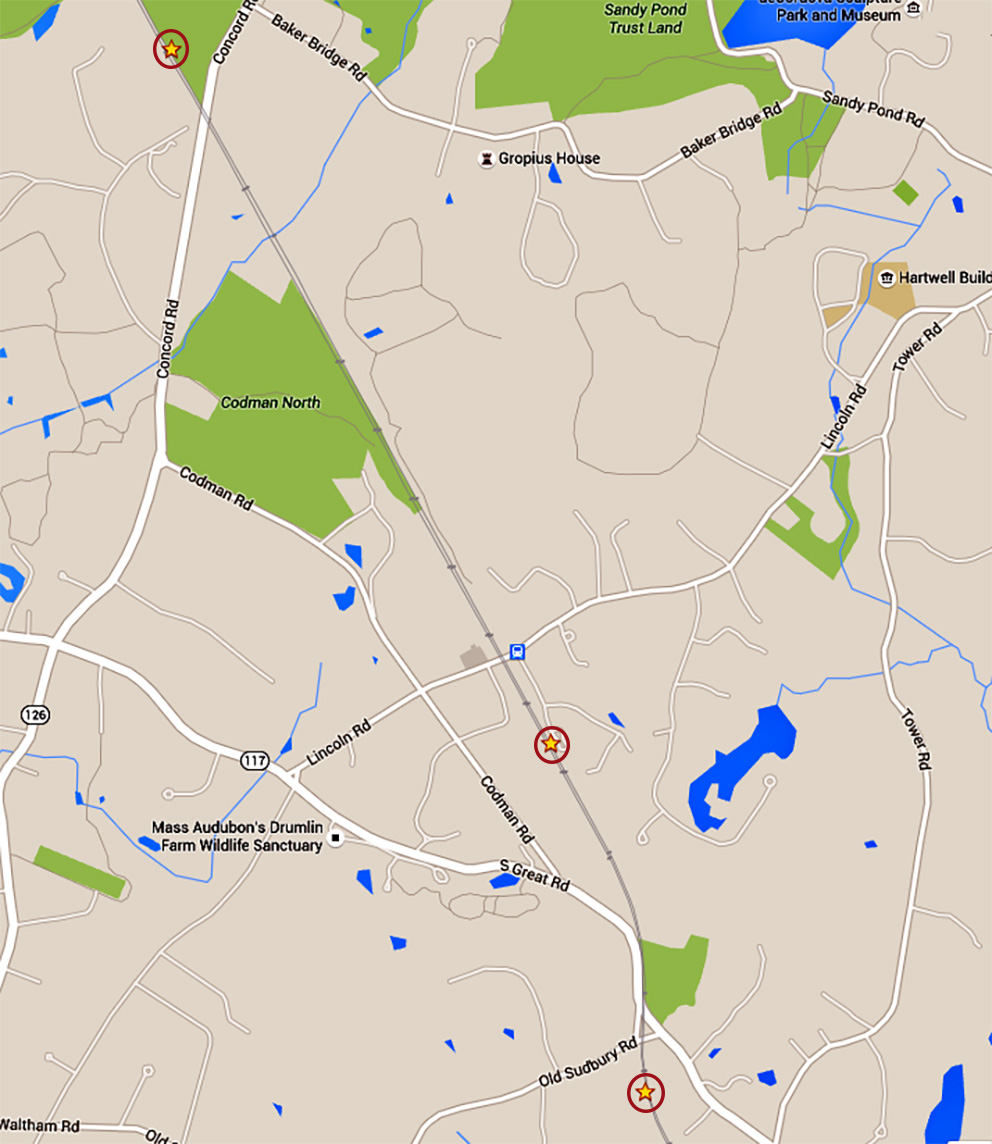
Yellow stars indicate the three sites in Lincoln where the MBTA is proposing to put monopoles (click to enlarge).

Yellow stars indicate the three sites in Lincoln where the MBTA is proposing to put monopoles (click to enlarge).

By Alice Waugh

The MBTA plans to install three monopole towers along the commuter rail tracks in Lincoln to comply with a federal mandate for emergency train stop controls. The concrete towers will range in height from about 65 to 75 feet.

Because the pole sites are within the MBTA’s right of way, the agency is not required to obtain approval from town land use boards unless the sites fall within a wetlands area, said Director of Planning and Land Use Jennifer Burney, adding that she heard about the plan only indirectly.

At least one of the towers will have “multiple arrays” of antennas for both train control and passenger Wi-Fi access, according to a Request for Determination of Applicability submitted to the Conservation Commission by Ramaker & Associates, a Wisconsin engineering firm hired by the MBTA. The tower will also support a radio equipment cabinet, and a 5-by-5-foot pad is proposed to support future radio equipment.

In response to a request from the town, the MBTA will attend the Lincoln Planning Board meeting on April 26 to give an overview of the project and answer questions. Representatives from the Conservation Commission and the Walden Woods Project will also attend, Burney said.

The monopoles will carry telecommunications equipment for a computerized system that combines GPS and wireless radio to monitor trains for excessive speed or proximity and to stop them before a collision or derailment can result. The U.S. Department of Transportation’s Positive Train Control regulations stem from the Rail Safety Improvement Act of 2008.

The MBTA plans to install a total of 330 poles along the commuter rail system starting in April with the Fitchburg and Rockport lines, said Jason Johnson, deputy press secretary for the MBTA.

The MBTA has also entered into a partnership with inMotion Wireless to offer commuter rail and boat passengers free Wi-Fi and broadband Internet access. The contractor paying for the monopole installations will also “have the option to examine private revenue generation” by adding antennas for cell phone companies and other commercial users, Johnson said.

To work properly, the poles need to be a maximum distance apart depending on the curvature of the track. They are being spaced as far apart as possible (an average of 1.3 miles) to minimize the number of poles required, and sites in “the least obtrusive areas available” were chosen, Johnson said. “In addition, this infrastructure has been designed as a multi-use structure that could support the needs for additional projects in the future, limiting the need for redundant building on the right of way,” he said.

Burney said MBTA officials told her that they might be open to suggestions about altering the locations of the monopoles only if there were “very small adjustments” of less than 30 feet involved. They have also agreed in principle to a “balloon test” where a tethered balloon is sent aloft at each site up to the height of the proposed pole so people in the area can see how high the top of each pole will be, and from what distance it can be seen, she said.

The Massachusetts Historical Commission has requested a “viewshed” analysis and archeological survey of the planned monopole site near where Route 126 goes over the train tracks. That area is close to the Walden Woods historical landscape as well as a Native American cremation and burial site that has not yet been systematically investigated.

Category: government, land use 10 Comments

Olson, Gladstone win Planning Board seats

March 28, 2016

In the two contested offices in the March 28 town election, Planning Board seats were won by incumbent Margaret Olson and Stephen Gladstone, while former Selectman Sara Mattes beat Stanley Solomon by a margin of nearly 2-1 in the race for Bemis Trustee.

Overall, the Planning Board votes were closely divided among the three candidates, with Gladstone taking the most at 37 percent, followed by Olson with 33 percent and Jennifer Morris Gundy with 29 percent. However, each of the town’s two precincts had different results. In a very close race in Precinct 1 (the southwest side of town), Olson, Gundy and Gladstone finished first, second and third respectively. In Precinct 2, Gladstone won by a wide margin, followed by Olson and Gundy.

Here are the complete unofficial results:

Town of Lincoln annual town election – March 28, 2016
Prec. 1 Prec. 2 Total
BOARD OF SELECTMEN
James E. Craig 215 94 309
Blanks 43 36 79
Write-in 2 0 2
BOARD OF ASSESSORS
John G. Robinson 214 93 307
Blanks 46 37 83
Write-in 0 0 0
BOARD OF HEALTH
Steven R. Kanner 206 88 294
Blanks 53 42 95
Write-in 1 0 1
CEMETERY COMMISSION
Conrad H. Todd 218 97 315
Blanks 40 33 73
Write-in 2 0 2
COMMISSIONER OF TRUST FUNDS
Douglas B. Harding 223 95 318
Blanks 37 35 72
Write-in 0 0 0
DeCORDOVA TRUSTEE
Dune D. Thorne 209 87 296
Blanks 49 43 92
Write-in 2 0 2
HOUSING COMMISSION
Sharon K. Antia 207 88 295
Blanks 51 41 92
Write-in 2 1 3
TOWN CLERK
Susan F. Brooks 228 110 338
Blanks 30 20 50
Write-in 2 0 2
LSRHS SCHOOL COMMITTEE (vote for 2)
Radha Raman Gargeya 199 79 278
Kevin J. Matthews 183 70 253
Blanks 138 111 249
Write-in 0 0 0
PARKS AND RECREATION
Patricia M. Donahue 212 95 307
Blanks 48 35 83
Write-in 0 0 0
PLANNING BOARD (vote for 2)
Setha Margaret Olson 146 59 205
Stephen R. Gladstone 135 94 229
Jennifer Morris Gundy 139 42 181
Blanks 99 65 164
Write-in 1 0 1
SCHOOL COMMITTEE
Timothy H.T. Christenfeld 207 34 241
Blanks 49 0 49
Write-in 4 0 4
BEMIS TRUSTEE (vote for 1)
Sara A. Mattes 151 84 235
Stanley J. Solomon 101 37 138
Blanks 8 0 8
Write-in 0 0 0
WATER COMMISSIONER
Patrick J. Lawler 213 39 252
Blanks 47 0 47
Write-in 0 0 0
LINCOLN LIBRARY TRUSTEE
Jennifer A. James 212 36 248
Blanks 46 0 46
Write-in 2 0 2
Question 1. To assess an additional $320,000 in taxes for DPW equipment
YES 206 22 228
NO 31 18 49
Blank 23 0 23
Question 2. Minuteman High School debt
YES 128 44 172
NO 67 40 107
Blank 65 0 65


Category: elections, government Tagged: elections 5 Comments

Letter to the editor: Town Meeting is something to celebrate

March 25, 2016

letter

To the editor:

As outgoing Selectman Eckhouse so eloquently noted, our open Town Meeting, marked by civil debates and a search for consensus, is in stark contrast to what is happening in some quarters of the national political arena. He noted that the final votes—the outcome our collective investment of time and thought this past Saturday—proved the value of that investment and the importance of coming together to shape our future. Indeed, our Town Meeting is something to celebrate.

This year’s meeting was marked by its civil debates and creative, collaborative engagement over issues. The debate over the investment of a piece of land that is part of our rural viewscape, across from the Town Office Building and next door to the Old Town Hall Exchange, led to a creative compromise. In the course of questions, the quick thinking of the Green Energy Committee Chair John Snell resulted in an amendment that would allow the potential “swap” of the town center purchase restriction for other land that might serve to host solar panels elsewhere in town. This would potentially allow for the location of a solar field on the capped landfill at our town transfer station—a goal long desired by many. The amendment offered a win/win for the town and allowed for the near unanimous passage of the measure.

We saw the value of Lincoln’s civic education. Our Lincoln school eighth-graders brought forward a warrant article to ask the town to invest in a water hydration system—a spot where you can fill a water bottle rather than use disposable cups. The presentations were informative and artful. It was during the question-and-answer portion of the debate that the true savvy and sophistication of the presenters was displayed. On a question about the cost of maintenance, one of the proponents opened with, “Short answer…” and then went into a more detailed response. Such quickness, poise and clarity are the envy of many more long-in-the-tooth public officials.

Perhaps of greatest importance was the near-unanimous (only one “no”) vote to support our schools submitting a request for consideration by the Massachusetts School Building Authority (MSBA). The School Committee, the Finance Committee and the Board of Selectmen made it clear that this was the only prudent and fiscally viable path to take. And the Town Meeting affirmed that in a resounding “yes” vote on Article 28. It is now universally accepted that out schools are in dire need of renovation and that we need the support of the Commonwealth to proceed. The message to the MSBA should now be clear and unambiguous: we are ready!

The importance of Town Meeting in reaffirming our faith in basic democracy and the importance of citizen participation was in full display this past Saturday. It truly was a day well spent and it truly was something to celebrate.

Sara Mattes
71 Conant Rd.


Letters to the editor must be signed with the writer’s name and street address and sent via email to lincolnsquirrelnews@gmail.com. Letters will be edited for punctuation, spelling, style, etc., and will be published at the discretion of the editor. Letters containing personal attacks, errors of fact or other inappropriate material will not be published.

Category: government, letters to the editor 1 Comment

School hydration station OK’d at Town Meeting

March 24, 2016

water bottleBy Alice Waugh

There will be fewer crumpled paper cups in the Lincoln School’s future after one of the water bubblers is be replaced by a “hydration station,” thanks to a Town Meeting citizen’s petition by a group of eighth-graders.

Laura Appleby, Hannah Hwang, Keith Hylton, Roshan Kharbanda, Tara O’Malley, Simon Perry and Zach Tam wanted to come up with a more environmentally friendly solution for dispensing drinking water at the school. The bubblers have replaceable five-gallon jugs that dispense water into disposable paper cups, so each one has a wastebasket next to it filled with this trash.

After looking into alternatives, the students found that users could fill up their reusable water bottles at a “hydration station” that dispenses filtered tap water. Their citizens’ petition asked voters to approve an expenditure of up to $3,500 for a hydration station in Reed Gym.

In the course of their research, the students learned that the water in the Lincoln School is in fact safe to drink and is used by the cafeteria every day. The school has always had ceramic water fountains, but they were mothballed in the 1900s over concerns about excessive lead and copper. A 1991 federal law required towns to test and eventually limit the amounts of those metals in municipal drinking water.

To help the students, Lincoln Water Department Superintendent Greg Woods researched the Lincoln history of issue and learned that the metals had come from lead solder and the copper pipes conveying water from the mains to individual homes and schools. The problem was most noticeable in cases where water sat in the pipes for extended periods of time, such as the days and weeks when school was not in session.

“Unlike Flint, Michigan, the town and schools do not have lead pipes transporting the drinking water to the tap,” Woods wrote in a letter to the student group in February.

In 1998, the Water Department installed a new corrosion control system at both of the town’s water supply sources to make the pH of the water non-corrosive and to provide a protective coating on the interior of a building’s plumbing to prevent leaching. The town subsequently achieved compliance with the new rules—so well, in fact, that the Massachusetts Department of Environmental Protection granted a waiver to reduce the frequency of required sampling to once every three years.

Nonetheless, “we note that the success of the corrosion control systems to protect Lincoln residents from elevated lead and copper has not been widely publicized,” Woods wrote.

The hydration station will also save money. The students found that the school now spends $2,625 per year on water and paper cups for each bubbler, “so we’d break even in about a year and three months,” Perry said during their Town Meeting presentation. Other schools with hydration stations have been successful in increasing student use of reusable water bottles, O’Malley added.

Asked why the group didn’t press for hydration stations to replace every bubbler in the school rather than just the one in Reed Gym, Perry replied, “As a group, we want to take a step rather than conquering the world. We want it as a step to look at as inspiration.”

Category: conservation, government Leave a Comment

Gun safety, fossil fuel measures passed

March 22, 2016

rifle-pollution montageBy Alice Waugh

Citizens’ petitions on national gun safety and fossil fuel divestment both passed at Town Meeting on March 19.

Article 36 asked voters to endorse “A Petition to the U.S. Congress to Adopt a Uniform National Gun Safety Law” and for town officials to convey this sentiment to federal officials. “We want to tell elected officials that we’re tired of the lack of progress in curbing the epidemic of gun violence,” said Gary Davis of the Lincoln Democratic Town Committee, which sponsored the Town Meeting measure.

The United States has the highest rate of firearm deaths among industrialized nations, and more than two-thirds of guns used in crimes in New Jersey and New York were brought there from other states with more lenient gun laws, Davis said.

“Overall, the background check system does not work,” he said, adding that in many parts of the country there are no laws barring felons, suspected terrorists and the mentally ill from buying guns at pawn shops, swap meets or online.

“We should not be quick to cede power to the federal government. Once you let it go, it’s very difficult to get back,” resident Barbara Darling said in opposition to the measure. “I would urge careful consideration of assumptions put forth in this article. It’s very easy to go out on the Internet and find all kinds of data supporting both sides of the argument.”

Saying she had no problem with owning guns for self-defense, hunting and sport, Joanna Hopkins argued that 33,000 annual gun-related deaths in the U.S. “are both heart-breaking and unacceptable.

“If enough cities and towns stand up and make our voices heard, eventually Congress will enact a nationwide gun safety set of standards. This is a sensible step for a safer and more civilized society for us all,” she said.

Fossil fuel divestment

Article 37 sought support for a bill (H.2269) that would require divestment of state retirement funds from holdings in fossil fuel companies. Resident Al Schmertzler said the issue was one of “acute moral, financial and long-term survival.” The warrant article focused on statewide pension investments because Lincoln has limited control over how its local pension funds are invested, he added.

Resident Len Darling argued against the measure, saying that many pension liabilities are already underfunded. “We need either better investment performance or higher contributions” to the funds, he said. “This is not our money. It’s really state employees who are depending on it for their retirement. Why do we want to tell investment professionals how to manage this money? We should not be micromanaging other people’s money.”

Fossil fuels in general are not the evil portrayed by some, Darling added, noting that natural gas is cheaper and produces less carbon dioxide than other fossil fuels, and the industry “has raised standard of living for billions of people.”

Both articles passed with a handful of “nay” votes.

Category: government Leave a Comment

Correction

March 22, 2016

correction-smThe March 21 articles headlined “Residents vote to try for school funding again” should have said that Rep. Tom Stanley arranged a tour of the Lincoln School last summer, not Sen. Mike Barrett. Also, the second application for MSBA funding was made in  2013, not 2014. Th article has been updated to reflect these corrections.

Category: government, schools Leave a Comment

Residents vote to try for school funding again

March 21, 2016

schoolBy Alice Waugh

The town will apply for the fourth time for state funding for a comprehensive school building project after residents overwhelmingly voted to authorize it at Town Meeting on March 19.

A year ago, residents authorized the third application to the Massachusetts School Building Authority (MSBA) and to set aside $750,000 for a feasibility study in the event that the Lincoln School was invited into the funding pipeline. However, the MSBA turned down Lincoln’s request in December 2015, and a 2013 application was also turned down. The MSBA gave conditional funding in 2012 but the project failed to win residents’ support.

Last summer, in a visit that state Sen. Michael Barrett helped to arrange, numerous officials from both the MSBA and the town toured the school to see the facilities issues first-hand. Although this year’s funding bid was ultimately unsuccessful, the MSBA “assured us that our statement of interest that was thorough and they understood the needs of our building,” said School Committee chair Jennifer Glass. “I believe we made a pretty compelling case that day that we had come together as a town.”

In 2015, there were 97 applications to the MSBA’s core program (the segment dealing with substantial renovation or reconstruction of schools); 26 were chosen for further consideration and eight were invited into the funding pipeline in December, though more are expected to be invited in later this year, Glass said.

MSBA officials told Glass and Superintendent of Schools Becky McFall that last year’s funding applicants included many schools that were faced with overcrowding or the possible loss of accreditation because of their physical condition, Glass said, adding that they encouraged Lincoln to apply again.

“Partnering with the MSBA is fiscally responsible and we believe it’s worth the wait,” she said.

A vote against Article 28 (pursuing MSBA funding again) and a “yes” vote on Article 29 would have authorized the town to spend last year’s $750,000 allocation on a feasibility study for a project funded solely by the town.

Glass acknowledged that there was no guarantee that the MSBA would invite Lincoln into the funding process next year, raising the question of when Lincoln should turn to its own resources.

“There’s not a clear answer as to that deadline—it’s a topic we struggle with,” she said. “But for right now, we can afford to be patient… the building certainly has its deficiencies, but it’s not going to fall on our heads, and we’re going to keep it safe.”

In the past couple of years, the school’s most urgent facilities needs have been funded by appropriations from the Capital Planning Committee. “We have had a few projects that really were dire,” McFall said, referring to a project last year that replaced electric switching gear, “so we’ve taken back the fear that the electrical system would go down and we would not be able to restart it again,” she said. “It backed us off the cliff a bit,”

SImilarly, there were fears that the smokestack outside the Brooks auditorium was in danger of falling gown, but money was allocated to inspect it and perform some repairs, “so we’re assured we’ll get through at least the next couple of years, and we’ll keep inspecting it,” McFall said.

The school roof is on ongoing concern. “Whenever we have a rainstorm, the buckets come out. It’s not going to fall in, but it leaks consistently,” McFall said.

Not everyone in agreement

But a few residents at the meeting were not in favor of applying for state funding yet again.

“I’m not particularly comfortable with that,” said Adam Greenberg. “The MSBA has its own view of things that may not include Lincoln in a year. I find this merry-go-round where we keep grabbing for the MSBA brass ring to be unsuccessful. I don’t see this as a way forward in a realistic sense.”

Greenberg suggested applying one more time but then planning to pursue a different course if the town is unsuccessful with the MSBA once again.

“To have the strongest case, we need to show that we recognize that [passing Article 28] is the way forward to achieving both facilities and educational needs,” Glass said. “I think it’s really important right now to show we understand how important help from the state is, and that’s what will make it a viable project.”

“The message from town needs to be overwhelming in favor of Article 28,” said Vincent Cannistraro, who urged a “resounding no” on Article 29 as well. “I don’t feel passing over 29 goes far enough,” he said. If it looked like residents were willing to go it alone without state funding, “what would you do if you were the MSBA? I think the message needs to be consistent,” he said.

Cannistraro’s position was an evolution from his stance in 2014, when he ran against incumbent Selectman Peter Braun. At the time, citing his construction background, he disputed the notion that a new school would cost $50 million and repairs would cost $30-$40 million.

It would be wrong to send the message that “we’re not even going to try without state help,” another resident said. “I can imagine then passing us over again. I don’t think we should be waiting to find out whether we can possible get help from the government. I would find it hard to believe that if we don’t get [a funding invitation] next year, we’re going to get it again” the following year, she said.

Last week, the Board of Selectmen as well as the Finance, Capital Planning and School Committees unanimously recommended passage of Article 28.

“We’ve got to show patience and tenacity here,” Selectman Noah Eckhouse said. “As a matter of history, we got invited [into the funding process] before we were really ready” in 2012.

Residents will get to vote on school configuration

One reason for 2012 school project’s failure to garner the necessary two-thirds majority is that many residents objected to the new layout of the school and campus in the “preferred option” approved by the MSBA. However, “the MSBA did not impose anything on us,” Glass said.

The town’s feasibility study identified 11 different options for the school, and for reasons of construction phasing and greater energy efficiency, “there was sort of a fork in the road” where the School Building Committee (SBC) opted to go with a different building configuration,” Glass said.

“A major mistake we made in 2012 was that when the SBC was trying to decide between different directions, there were outreach and information sessions, but no formal town vote saying ‘A or B, what do you like?’ and then we’d give it to MSBA,” Glass said. This time, “whatever process we’re in, we will not go forward with a preferred option until we have come to the town and said, ‘Here are some choices; let’s collectively agree on that concept before we get into final details of design’.”

“It’s not just about the money,” Cannistraro said. “If the town went on its own with the Lincoln Way, we’d finish three years later and that $30 million would turn into $60 million in a heartbeat and we wouldn’t get something as nice.” When it comes to building schools, “that’s [the MSBA’s] area of expertise and that’s the most important reason we need the.”

Category: government, school project*, schools Leave a Comment

  • « Go to Previous Page
  • Page 1
  • Interim pages omitted …
  • Page 54
  • Page 55
  • Page 56
  • Page 57
  • Page 58
  • Interim pages omitted …
  • Page 93
  • Go to Next Page »

Primary Sidebar

Recent Posts

  • Water bills to go up by 13% March 5, 2026
  • News acorns March 5, 2026
  • Property sales in January 2026 March 4, 2026
  • My Turn: Unraveling the Hanscom misallocation March 3, 2026
  • Police log for Feb. 19–25, 2026 March 3, 2026

Squirrel Archives

Categories

Secondary Sidebar

Search the Squirrel:

Privacy policy

© Copyright 2026 The Lincoln Squirrel · All Rights Reserved.