• Skip to primary navigation
  • Skip to main content
  • Skip to primary sidebar
  • Skip to secondary sidebar

The Lincoln Squirrel – News, features and photos from Lincoln, Mass.

  • Home
  • About/Contact
  • Advertise
  • Legal Notices
    • Submitting legal notices
  • Lincoln Resources
    • Coming Up in Lincoln
    • Municipal Calendar
    • Lincoln Links
  • Merchandise
  • Subscription Info
    • My Account
    • Log In
    • Log Out
  • Lincoln Review
    • About the Lincoln Review
    • Previous Issues
    • Submit Your Work
    • Subscribe/Donate

government

Stephen Breyer to appear at Walden Woods Project

April 7, 2025

Retired U.S. Supreme Court Justice Stephen Breyer.

The public is invited to attend a special event with the honorable Stephen Breyer, a retired associate justice of the U.S. Supreme Court in a conversation moderated by historian Douglas Brinkley, at the Walden Woods Project in Lincoln on Friday, May 30.

The outdoor event will be held rain or shine in an enclosed tent. We ask guests to arrive promptly between 5:15 and 5:30pm for the introduction at 5:40pm. Advance registration is required for admission. Click here to:

  • Reserve your seat(s)
  • Pre-order signed copies of Justice Breyer’s recent book, Reading the Constitution: Why I Chose Pragmatism, Not Textualism and Douglas Brinkley’s book, Silent Spring Revolution
  • View a list of FAQs
  • Submit a question for Justice Breyer (please note: time constraints limit the number of questions that will be selected for response)

Preceding the conversational program will be the first public showing of a nine-minute introduction to the feature documentary, “Henry David Thoreau.” The film, by Ewers Brothers Productions and Executive Producers Ken Burns and Don Henley, is scheduled to air on PBS in 2026.

Breyer served on the U.S. Supreme Court from 1994 to 2022. His other books include Active Liberty (2005), Making Our Democracy Work: A Judge’s View (2010), The Court and the World (2015), and The Authority of the Court and the Peril of Politics (2021). Brinkley is the Katherine Tsanoff Brown Chair in Humanities and Professor of History at Rice University and a CNN Presidential Historian. Six of his books were named New York Times “Notable Books of the Year” and seven became New York Times bestsellers.

The event is co-sponsored by Lincoln250, Concord250, the Bemis Free Lecture Series, and the Lincoln Historical Society.
Category: government, history Leave a Comment

Town Meeting free of controversy and “nay” votes

March 30, 2025

Lincoln’s Annual Town Meeting set a non-pandemic record for brevity, wrapping up in under three hours as every warrant article was approved by unanimous voice vote in a rare controversy-free edition.

Perhaps the most interesting aspect of the March 29 meeting was the confluence of past and future. It started out with a demonstration of the new voting clickers and later moved to a reenactment of Lincoln residents debating at a 1775 Town Meeting whether to allocate money for the war that many saw coming (see related story and “My Turn” piece).

Votes approved funding to buy the clickers last year and were thrilled on Saturday with the instant tallies during a test run, when they were asked to indicate whether this was their first Town Meeting or not (result: 149 no, 24 yes). They also tested the multiple-choice function. Ranked-choice voting will be an option in the future.

Saturday’s vote means that “we can add clickers to the list of techniques that the town moderator can use to ask for a vote,” Select Board member Jim Hutchinson explained. Voice votes will be the first go-to method and standing votes are still an option, but it’s at the discretion of the moderator. The only substantive and unavoidable change from traditional vote-counting is that voting by clicker is anonymous, so attendees can’t see how their neighbors are voting on an issue.

Hutchinson also encouraged officials to use the clickers to get a sense of attendees at future Town Meetings and those of boards and committees even if it’s not a formal vote. “We believe this is a good way to get more feedback from residents,” he said.

Budget

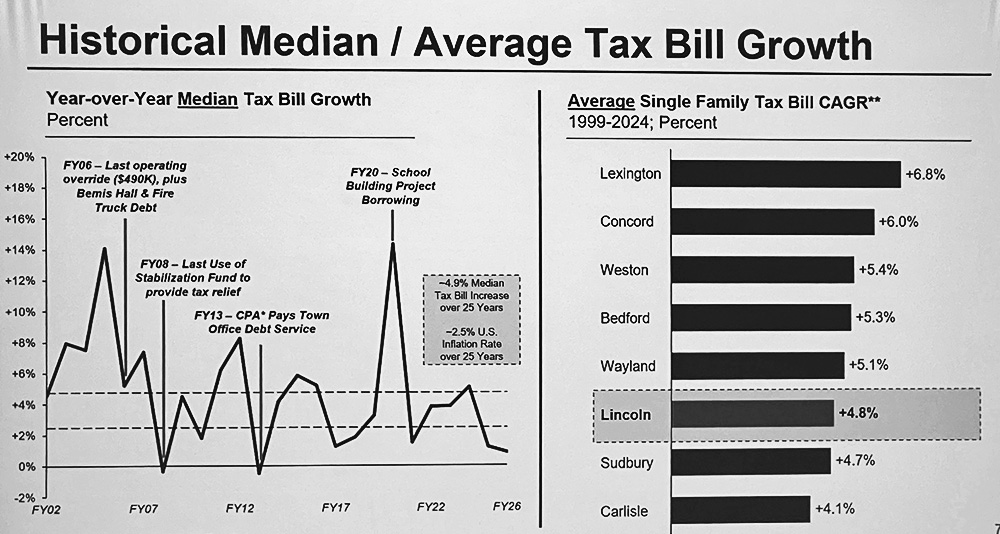
Revenues and expenses will grow by 7.9% in the budget approved for fiscal 2026. However, property owners will see a tax increase of only 0.9%, largely due to the Finance Committee’s use of $902,000 from free cash for tax relief. It’s a big change from 2020, when the tax rate ballooned by 14% due to borrowing for the school renovation project. “Preferred items” that were approved in addition to the FY26 base budget included a new police officer (the first in 25 years) and a part-time administrative assistant in the Planning Office.

These two charts show how Lincoln’s property tax rate has grown over the last decade in comparison to neighboring towns (click image to enlarge).

Future town budgets will be more unpredictable than usual, given the “sweeping and rapidly evolving” presidential orders on public health education, the environment, immigration, and more, said Select Board Chair Kim Bodnar. Pending the outcome of a flurry of legal challenges, “we have insufficient information to warrant making changes to budget and programs” in Lincoln, but the town will need to “evaluate what we need to do to maintain compliance with federal laws… while remaining true to the town’s vision statement and commitment to keeping Lincoln a welcoming community for all our residents, students, staff and visitors.”

Town Meeting Study Committee

Andrew Pang reported on the work of the committee, which was formed after last year’s controversial Annual Town Meeting (ATM) debate and vote on Housing Choice Act rezoning. Among its accomplishments so far:

  • The pre-ATM moderator’s meeting, seen by some as “proverbial smoke-filled room,” is now hybrid for greater transparency.
  • Publication of a Town Meeting primer
  • A two-minute timer visible to those who speak at the audience microphones, though by law, the moderator reserves the right to allow speakers to go longer. The group is also working on improvements to the audiovisual technology that’s used when an overflow room such as the Reed Gym is used.

Pang acknowledged that there have been “perceptions that differing viewpoints were not welcome” and said that the committee is “working on digesting and assimilating those comments [and will then] develop criteria and rules.” Other suggestions that the group is studying are having separate sessions for Town Meeting debate and voting; allowing remote participation in debate, which is complex from a technical standpoint. Remote voting is not permitted by state law, nor is absentee or early voting, he noted. Most would agree that boosting Town Meeting turnout is desirable, though Lincoln had the highest average rate in the immediate area in 2014-2023 (8.4% of registered voters, vs. a low of 3.7% in Bedford).

Pang urged residents to offer feedback on how Town Meeting went using this website, which the committee will consider as it reviews the primer and makes future recommendations. They expect to issue its final report to the Select Board in October and to residents at the November State of the Town meeting.

Water Enterprise Fund

Voters approved a bond issue of $6.79 million to fund Water Department projects, chiefly a water main replacement through the center of town for $6.2 million. Department Superintendent Darin Lafalam recapped his March 4 public hearing presentation outlining Lincoln’s aging water main infrastructure as Water Commission member Steve Gladstone noted that the town has never replaced an entire water main. Bids just came in for the first of two phases from the top of the hill on Bedford Road down Lincoln Road to Ballfield Road and were in line with estimates; work on that piece will take place this summer.

The bond interest and principal will be repaid from water rates, which rose 10% this year and are slated to do the same in the next two years as well.

Zoning amendments

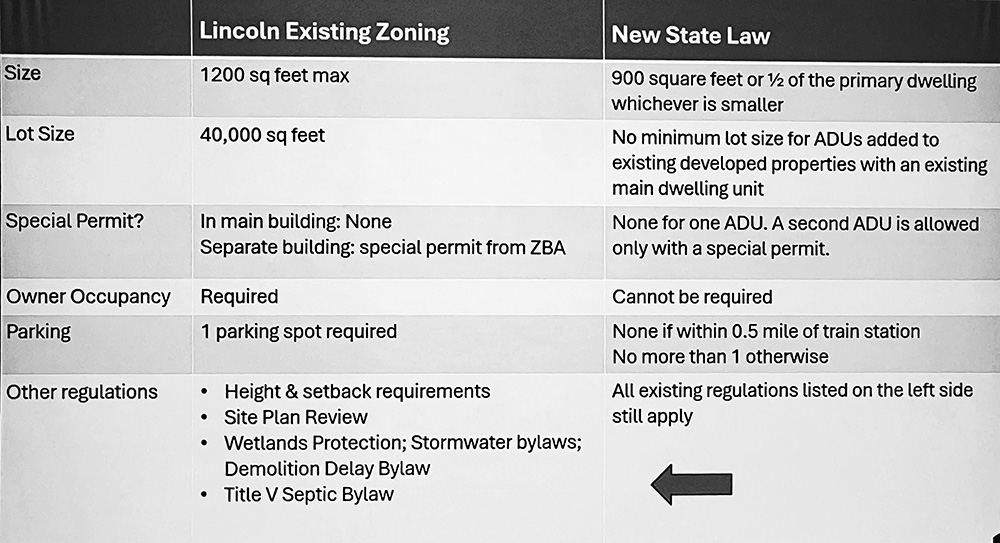
A comparison of Lincoln’s previous ADU regulations (left), and what voters adopted last week to align with new state law (click image to enlarge).

Voters also approved zoning bylaw amendments to have the town’s rules on accessory dwelling units (ADUs) follow recent changes in state law. Those changes relax the rules around units of up to 900 square feet, though the town retained additional restrictions on units from 900 to 1,200 square feet. ADUs up to 900 square feet are now allowed by right with no special permit required.

Asked why the town didn’t simply adopt the same rules for all ADUs rather than keeping different ones for larger units, Planning Board Chair Margaret Olson said, “the Planning Board prefers to make small incremental changes [because] it’s extremely difficult to get regulations right.” It may make further changes in the future; “we’ll see what happens… but we’re making the minimum necessary changes today.”

Category: government Leave a Comment

My Turn: Revolution comes to Lincoln Town Meeting

March 30, 2025

By Lynne Smith

The 1775 Lincoln Town Meeting featured a heated but civil debate about the need for a tax increase to equip Lincoln volunteers to fight the British.

This debate came alive last Saturday at the 2025 Town Meeting as seven reenactors, led by Rick Wiggins as Eleazer Brooks, argued the topic. The passion and clarity of the different views rang out in the Donaldson Auditorium as they must have done in the Old Town Hall 250 years ago.  Those in favor of the tax were eloquent about the need for Lincoln volunteers to be armed and ready. Those opposing the tax and the revolution explained the difficulties caused by a tax increase, the loss of their sons to work the farm, and their hope that the problems with the British could be resolved without resorting to war. 

I was deeply moved by the elegant language of the reenactors. It was, in fact, a recreation written recently, but it captured the serious tone and reflected the views of the speakers, pro and con. That our town records preserved the outcome of this 1775 meeting illustrates the value our Lincoln forebears had for free speech and civil debate. Thank you to Kim Bodnar, the Lincoln Minute Men, and the Lincoln250 Committee for reminding us of what we are celebrating this year — and what we hope to continue.


“My Turn” is a forum for readers to offer their letters to the editor or views on any subject of interest to other Lincolnites. Submissions must be signed with the writer’s name and street address and sent via email to lincolnsquirrelnews@gmail.com. Items will be edited for punctuation, spelling, style, etc., and will be published at the discretion of the editor. Submissions containing personal attacks, errors of fact, or other inappropriate material will not be published.

Category: government, My Turn Leave a Comment

What you need to know for Town Meeting on Saturday

March 27, 2025

(This information is provide by Assistant Town Manager Dan Pereira.)

Annual Town Meeting is this Saturday, March 29. The Town is providing as much information as possible in advance to ensure a smooth experience for all.

Website

Please visit our Annual Town Meeting web page for up-to-date meeting information. It contains links to meeting procedures and materials, services, and background on the key articles being presented. 

Logistics

  • Voter check-in begins at 8:30am and Town Meeting begins at 9:30am sharp!
  • View our Ballfield Road parking map, which highlights available parking locations as well as the entrance to Town Meeting, so you can plan accordingly. 
  • View our auditorium seating map, which provides an overview of the room layout and handicap seating as well as public microphone locations. Microphones can also be brought to your seat if you are unable to get to a microphone.

New this year — voting clickers

Electronic voting devices or “clickers” will be introduced this year in order to expedite hand counts, if necessary.

  • You will receive your clicker when you check in, along with your voter card. You need both to vote.
  • Article 3 will include a few fun questions to demonstrate the electronic voting process.
  • You should not leave the school building with your clicker! When you leave, please drop your clicker in a designated receptacle.
  • If you want to leave and return later, please return your clicker to an attendant at check-in and they’ll provide you with a “clicker ticket,” which will allow you to get a new clicker when you return.

Food

  • Coffee and treats will be served by the Lincoln Girl Scouts throughout the duration of the meeting.
  • Twisted Tree Cafe will be offering lunch in the school cafeteria; view their menu here. We are planning a 45-minute lunch break at some point around midday.
  • If you are new — or still feel new — to Town Meeting, please join the Newcomers Lunch Table in the cafeteria, sponsored by the same IDEA Committee that organized the Newcomers’ Party in January. We will be glad to see you! Look for the blue tablecloth and friendly faces.

Services

  • We have reserved parking close to the entrance for handicap and mobility-impaired residents. 
  • Assisted listening devices are available — just approach AV personnel at the console in the middle of the auditorium and they will assist you.

Broadcast

The meeting will be broadcast (for viewing only) on your local Cable TV channel (Comcast Channel 8/Verizon Channel 33) as well as on the Town of Lincoln TV website.

Category: government Leave a Comment

Budget request for fiscal 2026 up by 7.9%

February 26, 2025

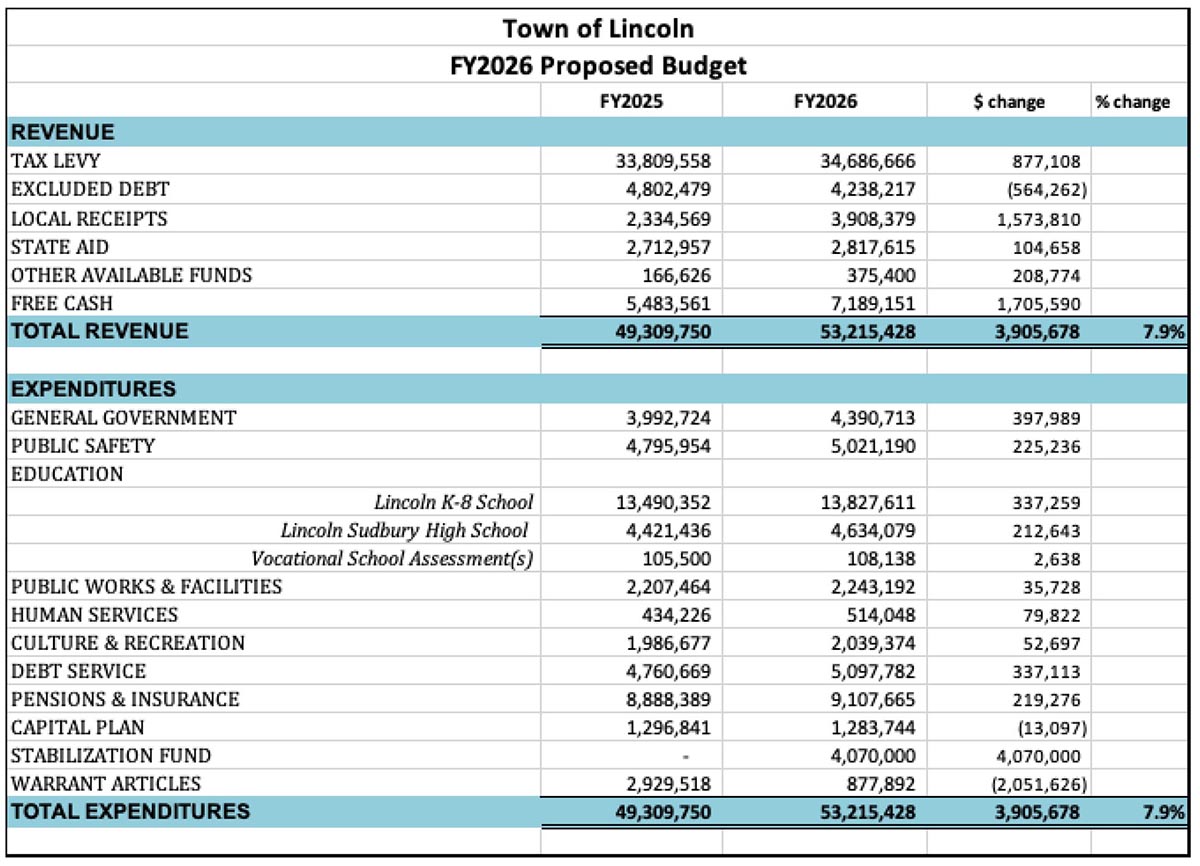
The Finance Committee is proposing a budget of $53.2 million for fiscal 2026, an increase of 7.9%. Residents will vote on the budget and other matters at Annual Town Meeting on March 29.

Property tax revenue is expected to rise from $33.80 million to $34.69 million, and local receipts (motor vehicle excise taxes, service and permit fees, etc.) are projected to go up by 67% ($2.33 million to $3.90 million).

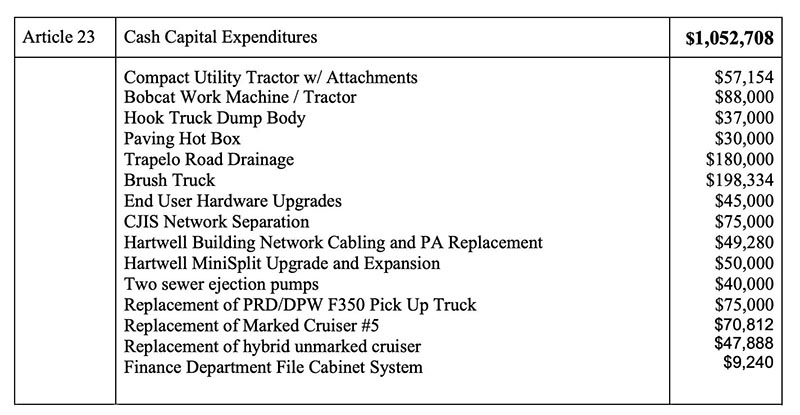
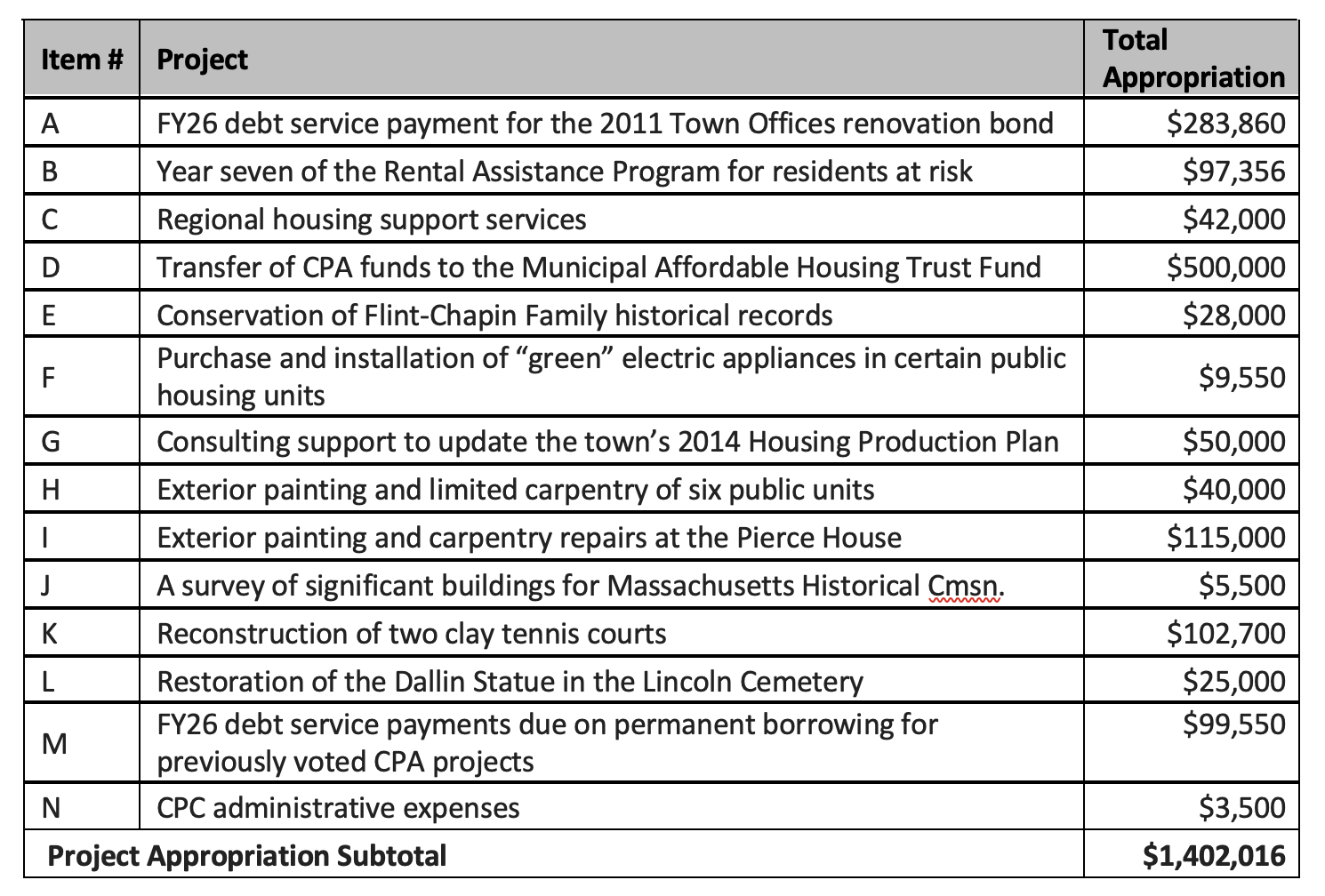
Expenditures will remain fairly stable, with one major exception: the FinCom plans to add $4.07 million to the stabilization fund, whereas it did not allocate anything for that purpose in fiscal 2025. This allocation will help restore much of the $4.75 million that was used last year to reduce the amount that will be borrowed for construction of the community center. Capital expenditures sought include $1.40 million for Community Preservation Act projects and $1.05 for Capital Committee requests (see tables below). Details on the proposed budget can be found beginning on page 1 of the PDF (browser page 8) of the Financial Report and Warrant.

The Finance Committee will host a virtual Q&A session on the proposed FY26 town budget on Tuesday, March 25 at 7:30pm (Zoom link here; meeting ID is 849 2072 7318, password is fincom). To keep Town Meeting as short and focused as possible, the committee hopes to address comments and questions in this virtual Q&A session before the in-person gathering. Click here to see a video of the February 25 budget presentation.

Click on the charts below to see larger versions.


Proposed Town of Lincoln budget — fiscal 2026


Capital expenditures


Community Preservation Act expenditures

Category: government

Legal notices in the Lincoln Squirrel OK’d by state

February 20, 2025

An example of a legal notice in a print newspaper.

(Editor’s note: this story was updated in Dcember 2025.)

Thanks to passage of a state law late last year, governmental organizations and others may now publish legal notices in the Lincoln Squirrel without also having to pay for publication in a print newspaper. 

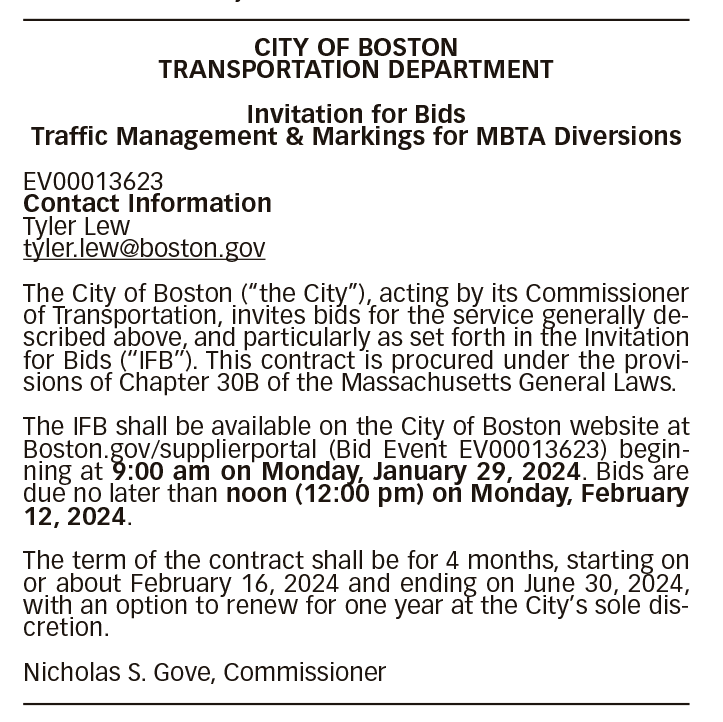
State law (MGL Part 1, Title 1, Chapter 4, Sec. 13) requires that certain legal notices must be published in a print newspaper, including municipal notices of upcoming public hearings, requests for bids, etc., as well as property foreclosures, notices informing creditors of dissolving corporations, etc. This closes off an important source of potential revenue for digital-only news sites like the Lincoln Squirrel and does a disservice to residents who no longer get their information from hollowed-out legacy news sources.

However, Lincoln is now exempt from the print requirement. Go to the Legal Notices tab at the top of every Squirrel web page to see the notices for the last 12 months. Note that this part of the website is always available to nonsubscribers as well as subscribers.

This all started with a citizen’s petition that was circulated by the Lincoln Squirrel and approved by residents at Town Meeting in March 2024. The Select Board subsequently sent a home rule petition to the state legislature, which approved House bill H.4664 (sponsored by Assistant House Minority Leader Alice Peisch and Carmine Gentile, and Assistant Senate Majority Leader Mike Barrett of Lexington) late last year. It was signed by Gov. Healey in January 2025 — an unexpectedly swift process. In the same session, similar bills for Arlington, Bedford, and Franklin were approved (learn more here). Many thanks to our state legislators, town officials and residents for their support!

Meanwhile, the Squirrel and other members of the Eastern Mass. News Alliance are still pushing for a statewide law change so other towns don’t have to go through the same home-rule petition process. It’s not easy because the newspaper industry is understandably fighting to preserve one of their last steady sources of revenue, but it’s probably only a matter of time in a rapidly evolving media environment.

Category: government

Legal notice: Lincoln Historic District Commission hearing

February 20, 2025

Lincoln Historic District Commission 

The Historic District Commission will hold a virtual online public hearing at 7:30pm on Tuesday, March 4, 2025, to consider the application of 68 Conant Rd., M/P 168-1-0, to replace several windows and add a new one. Anyone wishing to be heard on this matter should be present at the designated time and place. 


Category: government

Residents hear about finances, zoning, Lincoln250, and more

December 8, 2024

Six organizations offered updates and a look ahead at the State of the Town meeting on December 7. There are links to each group’s presentation on the SOTT web page. Some highlights discussed on Saturday:

Finance Committee

“Lincoln’s financials remain incredibly strong,” said FinCom chair Paul Blanchfield. His presentation included a summary of revenue and expenses in the current fiscal year, a budget process timetable for fiscal 2026, tax comparisons to other area towns, and some possible future capital projects. The closest in expected timeframe is roadway improvements, which will be needed in the next 3–5 years for approximately $15 million, he said. 

Community center

The detailed design for the building is now being produced and the $24.02 million project is expected to break ground in July 2025, with completion by late fall 2026, said Community Center Building Committee co-chair Sarah Chester. The town has already made a $6.7 million “down payment” from free cash, the stabilization fund, and donations; the remaining $15.8 million will be bonded next fall. The borrowing amount may be slightly less than originally expected because “interest rates are moving in our favor — we’re in a much better position than we expected to be,” Blanchfield said.

Initial plans were based on a 4.5% projected interest rate, but the current rate is about 3.8%, so officials are now factoring a rate of 4.25% into the borrowing estimate. As a result, the FinCom hopes to offset the previously expected tax increase associated with the project for the next fiscal year. The town has $40 million of debt capacity and will have $23 million remaining after the bonding, Blanchfield said.

Ned Collier of ICON Architects showed the latest renderings of what the inside and outside of the building will look. 

Planning Board

In March 2025, residents will be asked to vote on two zoning updates, both of which are required in order to have the town bylaw reflect associated changes in state or federal law. One of those changes was an update to FEMA’s flood plain maps, which means Lincoln has to update wording in the flood plain overlay district section of the zoning bylaw in order to have residents qualify for flood insurance.

At the state level, the legislature recently made changes to its accessory dwelling unit rules. These changes apply to ADUs of up to 900 square feet, so for units up to that size, the town may not require more than one parking spot, may not require any parking if the unit is within half a mile of the train station, and ma not require owner occupancy of the overall structure.

Lincoln allows ADUs of up to 1,200 square feet with certain restrictions, but the state law applies only to ADUs of up to 900 square feet, so local rules for units of 900–1,200 square feet will not change, said Planning Board Chair Margaret Olson. Property owners also won’t require a special permit for ADUs that are part of an existing dwelling as opposed to a separate building (see page 4 of Olson’s presentation).

She also outlined the various updates to ADU rules in recent years and noted that since 2021, there have been an average of 2.75 ADUs built annually in town.

Dark Skies

A subcommittee of the Planning Board is working on updates to the rules around outdoor lighting. Currently, regulations are found only in the zoning bylaw, which applies only to new construction, so the group is planning to propose changes to the general bylaw as well, which would affect existing outdoor lighting. The goal is to have limits on the brightness, illumination direction and color temperature of outside lights to minimize disruption for animals and insects, and to encourage timers and motion activators on lights that stay on all night.

IDEA

The Inclusion, Diversity, Equity and Antiracism Committee has done an equity audit and a gap analysis of town policies as part of its mission to foster racial, age ethnic and economic diversity in Lincoln, said IDEA Committee Chair Rob Stringer. The resulting action plan calls for collaboration with boards and committees in applying DEI tools in recruiting, meeting management, and policy making.

Also on tap: A Newcomers/Get to Know Lincoln event on January 26, 2025 and more future occasions “to support our mission and to ensure residents see themselves in town events,” Stringer said.

Lincoln250

The 250th anniversary of the Battle of Lexington and Concord will be observed in an array of events in those towns as well as Lincoln and Arlington. Here in Lincoln, the kickoff starts on January 30 with a library-sponsored webinar on “Causes of the American Revolution.” February will see a dance party in the style of 1775 and a virtual talk by Lincoln historian Don Hafner on “Entangled Lives, Black and White, Enslaved and Free, in 18th-century Lincoln.”


The bulk of the action takes place in April; on Saturday, April 19, there could well be 150,000 people in Lexington, Lincoln and Concord, said Police Chief Sean Kennedy. As a result, Route 2A and Hanscom Drive will be closed to all vehicles that day (causing a feigned groan of dismay from the audience at the prospect of the planned transfer station closure) so Route 2A can be used as a transportation corridor for buses, event staff, and visiting dignitaries.

In addition, numerous other roads in the area of Minute Man National Historic Park will be closed to all but residents of those roads, who will be issued vehicle passes in advance — see the Lincoln250 presentation starting on page 6.


Most of the events within Lincoln will take place from April 12–27 but there will also be a townwide Lincoln250 Fair and Feast on June 14 in Pierce Park. For more information on the months-long observances see the Lincoln25 Planning Committee web page.

Category: government Leave a Comment

Town Meeting Study Committee members named

October 23, 2024

Seven Lincoln residents were appointed this week as at-large members of the new Town Meeting Study Committee from a field of 18 initial applicants.

The Select Board interviewed candidates at its October 21 meeting and made their selections on October 22. Committee members are Jennifer Gundy, Ariane Liazos, Kenny Mitchell, Taylor Ortiz, Andrew Pang, Ben Shiller, and Andy Wang. Others who applied were Robert Ahlert, Chris Burns, David Cuetos, Jude Frodyma, Kevin Guarnotta, John Greco, Sara Mattes, Barbara Peskin, Collette Sizer, Ned Young, and Michael Killick (though Burns and Sizer later withdrew their candidacies). Also on the committee are Twn Moderator Sarah Cannon Holden and a Select Board member.

The move stems from the March 2024 Town Meeting, where an unexpected amendment to the proposed Housing Choice Act was made on the floor. Controversy swirled that day and well afterwards about who was allowed to speak, when, and from where. Residents offered initial feedback and ideas at a kickoff session in September.

In the preceding months, Lincoln Residents for Housing Alternatives (now called Lincoln HCA Info) had formed to oppose the town’s rezoning proposal under the HCA. Only one of the newly named committee members (Ben Shiller) is listed as an Lincoln HCA Info supporter on the group’s website. Ahlert, Cuetos, and Peskin were also active in the group last spring but were not chosen for the TMSC.

The TMSC will be introduced at the State of the Town meeting on December 7, which will be “an opportunity to engage residents on one or two questions that would benefit from early feedback,” according to the committee’s charge. The TMSC will present its preliminary report at Annual Town Meeting on March 29, 2025. The final report and recommendations are due in October 2025 to the Select Board and Town Moderator, who will present it to residents at the 2025 State of the Town meting later that fall.

Category: government, news Leave a Comment

Town Meeting study process gets underway

September 17, 2024

The process of examining Lincoln’s open Town Meeting — “democracy in its purest form,” as Moderator Sarah Cannon Holden said — kicked off on September 16 with two sessions where dozens of residents offered initial feedback.

Anyone who wasn’t able to attend may offer their feedback on this Padlet page, which asks what currently works well about Town Meeting, what could be improved, and topics that the Town Meeting Study Committee (TMSC) should explore. Links to the slide deck and a recording of the morning Zoom sessions as well as the Padlet link can be found on the TMSC web page. The Padlet page — which already includes transcribed comments from both of this week’s sessions as well as those submitted to the Select Board since last spring — will stay open for comments and questions until Friday, Sept. 20.

Holden outlined some basic procedures as well as changes in recent years that have made Town Meeting more efficient, such as putting more warrant articles onto the consent calendar for a single vote, and rolling multiple budget presentations from each major cost center into a single presentation by the Finance Committee.

Town counsel Joel Bard addressed the legal aspects of some ideas that have already been floated since last spring’s controversial Annual Town Meeting:

  1. A split-session Town Meeting where issues would be debated on the usual Saturday and then all votes would take place at another gathering several days later — state law doesn’t prohibit this, but Lincoln’s bylaw would have to be amended, Bard said. Voting would be handled the same way as it now is: in person, either by voice vote or clickers. Although money has been approved to buy clickers, exactly how they will be used (for example, whether or not votes will be anonymous) is yet to be determined. Also, it’s up to the moderator how each article’s vote will be conducted; “it’s much faster to have yeas and nays when the outcome is clear” for relatively noncontroversial issues, he said.
  1. Voting at the ballot box rather than in person — this isn’t possible without a change in state law, Bard said: “Then it becomes an election that’s highly regulated, as well as extremely  inefficient and time-consuming.”
  1. Remote participation — This, too, would require a change in state law. Since the pandemic, the state has allowed remote attendance and discussion at meetings of boards and commissions, but not Town Meeting. It’s possible to have some attendees in a different collective location, such as the gym or some other overflow location, “but not remotely dialing in from home,” Bard said. And if there’s an insoluble technical breakdown preventing those in a secondary location from hearing and participating, the entire Town Meeting must be adjourned. “That’s a serious consideration,” he noted.

The Select Board will vote to confirm the TMSC’s charge at its September 30 meeting and begin accepting applications to serve on the committee in the first half October (an application form will be posted on the TMSC web page). Candidate interviews and appointments will happen late in October and meetings will begin in early November. A final report and recommendations are expected in fall 2025.

Category: government 1 Comment

  • « Go to Previous Page
  • Page 1
  • Page 2
  • Page 3
  • Page 4
  • Page 5
  • Page 6
  • Interim pages omitted …
  • Page 94
  • Go to Next Page »

Primary Sidebar

Recent Posts

  • News acorns October 15, 2026
  • Clarification October 15, 2026
  • News acorns October 13, 2026
  • Service in November for Hopeton Kimball October 13, 2026
  • Service on Dec. 9 for Kit Dreier, 1930–2026 October 12, 2026

Squirrel Archives

Categories

Secondary Sidebar

Search the Squirrel:

Advanced search

Privacy policy

© Copyright 2026 The Lincoln Squirrel · All Rights Reserved.