• Skip to primary navigation
  • Skip to main content
  • Skip to primary sidebar
  • Skip to secondary sidebar

The Lincoln Squirrel – News, features and photos from Lincoln, Mass.

  • Home
  • About/Contact
  • Advertise
  • Legal Notices
    • Submitting legal notices
  • Lincoln Resources
    • Coming Up in Lincoln
    • Municipal Calendar
    • Lincoln Links
  • Merchandise
  • Subscriptions
    • My Account
    • Log In
    • Log Out
  • Lincoln Review
    • About the Lincoln Review
    • Issues
    • Submit your work

government

Town Meeting Study Committee to be formed in the fall

May 9, 2024

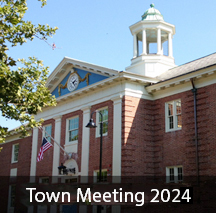
The Select Board outlined a plan for the Town Meeting Study Committee this week, starting with a September kickoff meeting.

The board expects to create a website over the summer with background material about local and state laws governing Town Meeting, information from the Massachusetts Moderators Association, and more. They will draft a charge and seek a broad range of potential members in the fall, though a number of people have already volunteered, according to Select Board member Jim Hutchinson. 

The study committee will do an initial study and gather feedback about the group’s initial ideas in December at the State of the Town Meeting, where voting clickers may be tried for the first time in one or more nonbinding votes on questions to be determined. Another presentation will take place at Annual Town Meeting in March 2025, with a final report and recommendations to the Select Board in November 2025.

Earlier, officials discussed having a spring forum headed by Town Moderator Sarah CannonHolden after the March 2024 Town Meeting where an unexpected amendment to the proposed Housing Choice Act was made on the floor. Controversy swirled during and after that day as residents argued over who was allowed to speak when and from where.

The timetable is longer than some had hoped, “but it would be a mistake for us to try to minimize this or pass it off as a forum or a single meeting kind of topic,” Hutchinson said at the board’s April 29 meeting. 

“I don’t want to have a meeting where we do all the talking,” Holden said. “From my perspective, what is it that the public wants? I want to hear from them.”

“I also have to insist that this committee does polling of as broad a spectrum of the population as possible,” perhaps including a townwide mail-in poll, Hutchinson said. “I don’t like the idea of the 20 or 50 or 100 people who show up at a forum to set the ideas that get pursued.”

Meanwhile, the Planning Board is also working on a set of policies and procedures for its meetings, particularly with regard to public comment. They expect to vote on their most recent draft at their meeting on May 14.

Category: government Leave a Comment

LincolnTalk guidelines for town officials are clarified

April 30, 2024

An earlier prohibition on town officials participating in LincolnTalk for fear of open Meeting Law violations has been loosened and clarified by Town Counsel Joel Bard.

Planning Board members were advised at their April 16 meeting that they were no longer allowed to post emails to LincolnTalk or even subscribe to the listserv. Director of Planning and Land Use Paula Vaughn-MacKenzie said this was the advice of Town Counsel Joel Bard and accompanied a recent public records request by resident Barbara Peskin for emails and other communications relating to the March 23 Town Meeting.

“The one-sentence summary is that town officials may participate and post on social media, but they must avoid any discussions or ‘deliberations’ with fellow board members and should limit their posts to simple factual points,” Town Administrator Tim Higgins told the Select Board on April 29.

Board and committee members may post information about meeting schedules and other basic administrative matters on LincolnTalk as well as basic factual information, including offering corrections to misstatements, Higgins wrote in a memo to the Select Board, which makes reference to the Attorney General’s Office FAQs on the Open Meeting Law. However, they may not post a response to the posting of another member, “as doing so risks becoming a deliberation outside the confines of a properly convened public meeting,” and they also may not use LincolnTalk to “engage in debate with fellow board members or the public.”

“‘Deliberation’ is defined broadly,” Higgins said at the meeting. “If we start to respond to one another’s posts or even respond to a post by a resident other than to clarify basic factual information, it’s a slippery slope, and [Bard] has seen a number of clients slide down that slope.”

At the heart of the matter is that LincolnTalk should not be viewed by residents as a primary information source about town government. “Lincoln Talk has a limited place among the town’s communication and outreach strategies. It is not the primary vehicle through which the town communicates with its residents. Residents who post questions or concerns to LincolnTalk should not expect that a town official will be responding,” Higgins’s memo notes.

Instead, residents who have questions should contact the relevant department listed on the town website (hover your mouse over the Government link at the top of the page). Those who aren’t sure where to start may contact the Town Administrator’s Office.

“My takeaway is that there’s frustration on this side of the table that more folks don’t reach out directly to us,” Higgins said. “LincolnTalk is valuable in its own way but it’s not an official communications vehicle for the town.” There is no staff member whose job includes monitoring LincolnTalk, “and none of us is authorized to respond on behalf of the town in an official way” on that platform.

Category: government Leave a Comment

Peskin files public records requests on Article 3 Town Meeting process

April 25, 2024

Resident Barbara Peskin recently submitted three public records requests to the town in connection with the controversial March 23 Annual Town Meeting vote on Housing Choice Act rezoning.

Town administrator Tim Higgins received the requests under the Massachusetts Public Records Law on April 5. Peskin confirmed that she had made the requests but declined further comment. Her specific requests seek emails, files, and communications regarding the March 20 Moderator’s meeting (see “Groups will get time to present positions” subheading) and Article 3 at the March 23 Town Meeting that were shared among town officials including Planning Board and Select Board members, Town Meeting Moderator Sarah Cannon Holden, Director of Planning and Land Use Paula Vaughn-MacKenzie, Assistant Director of Planning and Land Use Jennifer Curtin, Higgins, Assistant Town Administrator Dan Pereira, IT Director Michael Dolan, and “staff who support them.”

Peskin and a number of other residents were unhappy about how the zoning bylaw in the Housing Choice Act warrant article was presented and amended at Town Meeting. Questions were raised about who said what to whom and when regarding the amendment in the preceding days.

The public records law requires the town to provide its initial response within 10 business days. “When the scope of the request is extensive, the town responds with an estimate of the time and expense involved in searching and preparing its response,” Higgins said on April 23. “Once the fee is paid, the town undertakes the search and compiles its response. In the process, the town does review the records to determine whether any of the materials may be withheld or redacted pursuant to the exceptions that are spelled out in the statute. The requester is free to appeal the town’s decisions to the Supervisor of Public Records under 950 CMR 32.08 (1)(d). We are required to advise all requesters of their appeal rights when we send our response.”

Asked if he knew how much time and expense that meeting the process would involve, Higgins said on April 25, “We are in the process of working with the requester. Out of respect to the requester and the process, I would prefer not to comment on the request until the process is concluded.”

Perhaps not coincidentally, Vaughn-MacKenzie told Planning Board members on April 16 that they had to use their town-issued email addresses to discuss town government matters in the future. She also said that Town Counsel Joel Bard had advised that officials unsubscribe from LincolnTalk. However, it isn’t clear whether (1) officials must unsubscribe entirely (i.e., not be able to read posts to the listserv), or if they can post emails about non-town-related issues, and (2) if the recommendation applies to elected officials appointed officials, paid town employees, or all three.

On April 24, Higgins said he had spoken with Bard in an attempt to clarify what is permissible for board and committee members regarding listservs and social media, and that he would report on the issue at the Select Board meeting on April 29.

Category: government, South Lincoln/HCA* 4 Comments

Officials offer more information about Town Meeting

March 20, 2024

From Assistant Town Manager Dan Pereira:

Annual Town Meeting is this Saturday, March 23, and we anticipate a very large turnout. The town is providing as much information as possible in advance to ensure a smooth experience for all.

Website

  • Please visit our Annual Town Meeting web page for up-to-date meeting information. It contains links to meeting procedures and materials, services, and background on the key articles being presented. 

Logistics

  • Voter check-in begins at 8 a.m. and Town Meeting begins at 9:30 a.m. sharp. We are opening doors earlier than originally planned to spread out the arrival window and shorten the line to check in.  
  • We have doubled the number of poll pads to move you through as quickly as possible, but we strongly encourage you to arrive early, just in case.
    • You will be given a voter card at check in. You must keep this card with you at all times as you will not be permitted to vote without this card.
  • We expect parking on the Ballfield Road campus to be over capacity, so please carpool, arrive early, or walk!  If you arrive and the campus has been closed to more cars, you will be directed to park in nearby parking areas such as Town Hall.
  • We will have three seating areas this year: the Brooks Auditorium, the Reed Gym and the school learning commons. The auditorium and Reed Gym/Field house are expected to be very full, so we have added the school learning commons to facilitate more socially distanced viewing. All three spaces will be fully participatory and moderated.
  • We have maps detailing campus parking and the building entrance.
  • We are planning for a half-hour food break at some point in the early afternoon. Coffee and treats will be served by the Lincoln Girl Scouts, but a full lunch will not be served. We have a very busy day and want to keep the meeting moving, so please plan accordingly.

Services

  • We have reserved parking closest to the entrance for handicap and mobility-impaired residents. 
  • We provide the option for fully interactive, socially distanced seating in the Lincoln School Learning Commons.
  • Childcare is being provided by LEAP (Lincoln Extended-day Activity Program), click here to sign up.
  • Assisted listening devices are available — just approach AV personnel in any room and they will assist you.

Category: government 1 Comment

Q&A on Town Meeting and election

March 13, 2024

The Town Clerk’s office has supplied answers to questions they are commonly receiving about the upcoming Annual Town Meeting and town election. See below for accessibility information. Click here for all materials relating to the Town Meeting and click here for election information (sample ballot here).

Q:  I want to vote on the Housing Choice Act (HCA) zoning.

A:  The HCA zoning will be voted on at the Annual Town Meeting (ATM) on Saturday, March 23.  The HCA zoning is not part of the election on Monday, March 25; the issue will be decided solely by the voters who attend the ATM. To cast your vote, you MUST be present at the ATM on Saturday, March 23. The meeting starts at 9:30 a.m. The HCA warrant article is #3 on the ATM agenda.

Q:  I want to vote on the community center.

A:  The community center vote will be a two-part process.

  • Part One: the community center will be voted on at the Annual Town Meeting on Saturday, March 23. A two-thirds majority is required for approval. The community center warrant article is #4 on the ATM agenda.
  • Part Two: a ballot question at the annual town election on Monday, March 25. A simple majority is required for approval.
Q:  I want to vote for my preferred candidates running in the Lincoln town election.

A:  There are several ways to vote:

  • You can vote early in person — early voting in person will begin on Saturday, March 16 from 10 a.m. – 3 p.m. at Town Hall and continue from Monday, March 18 through Thursday, March 21 (also 10 a.m. – 3 p.m. at Town Hall).
  • You can vote by mail — If you have requested a vote-by-mail ballot, you can return it to the drop box behind Town Hall, bring it to the Town Clerk’s office, or mail it back in the envelope provided. Ballots must be returned by 8 p.m. on Monday, March 25 (Election Day).
  • You can vote on Election Day on Monday, March 25.  Polls are open from 7:30 a.m. – 8 p.m. at the Reed Gym on Ballfield Road.

Please call the Town Clerk’s office at 781-259-2507 if you have any questions.

Accessibility for Town Meeting

The Council on Aging & Human Services have some more information regarding accessibility accommodations for Annual Town Meeting for those with mobility impairments and for seniors who do not drive.

First, Public Safety is reserving the spaces adjacent to the build for those of any age who have difficulty walking long distances. Residents in need of a parking accommodation should simply approach Public Safety when arriving and they will guide the residents to a spot.

Second, the COA&HS is providing residents aged 60+ who do not drive with transportation to and from Annual Town Meeting again this year. Capacity for this Town Meeting transportation is limited and available on a first-come, first-served basis. 

Category: government 2 Comments

CapCom, CPC spending proposals to be aired on March 11

March 10, 2024

The Capital Planning Committee and the Community Preservation Committee will present their FY25 spending recommendations at a Zoom session on Monday, March 11 at 7:30 p.m. The session will provide information about the proposals and offer an opportunity for residents to ask questions in advance of the March 23 Annual Town Meeting. Click here for the Zoom link (passcode: 284293).

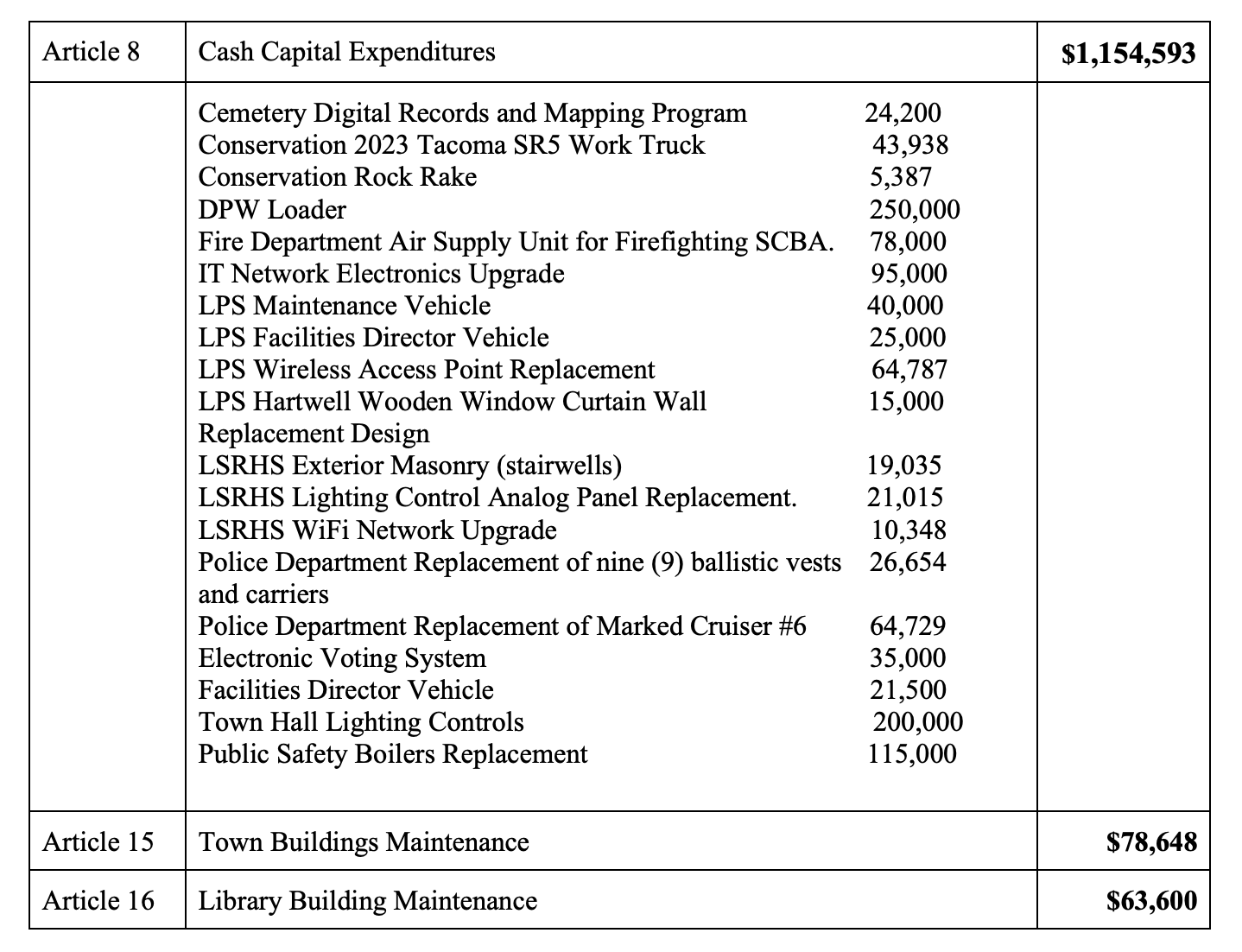
CapCom is recommending items totaling $1.15 million. Most of those are part of Article 8, while Article 15 specifies $78,648 for town buildings maintenance and Article 16 seeks $63,600 for library maintenance. All but three of the 2o items in Article 8 are under $100,000 apiece; the exceptions are $250,000 for a Department of Public Works loader, $200,000 for Town Office Building lighting controls, and $115,000 for replacing boilers in the Public Safety Building.

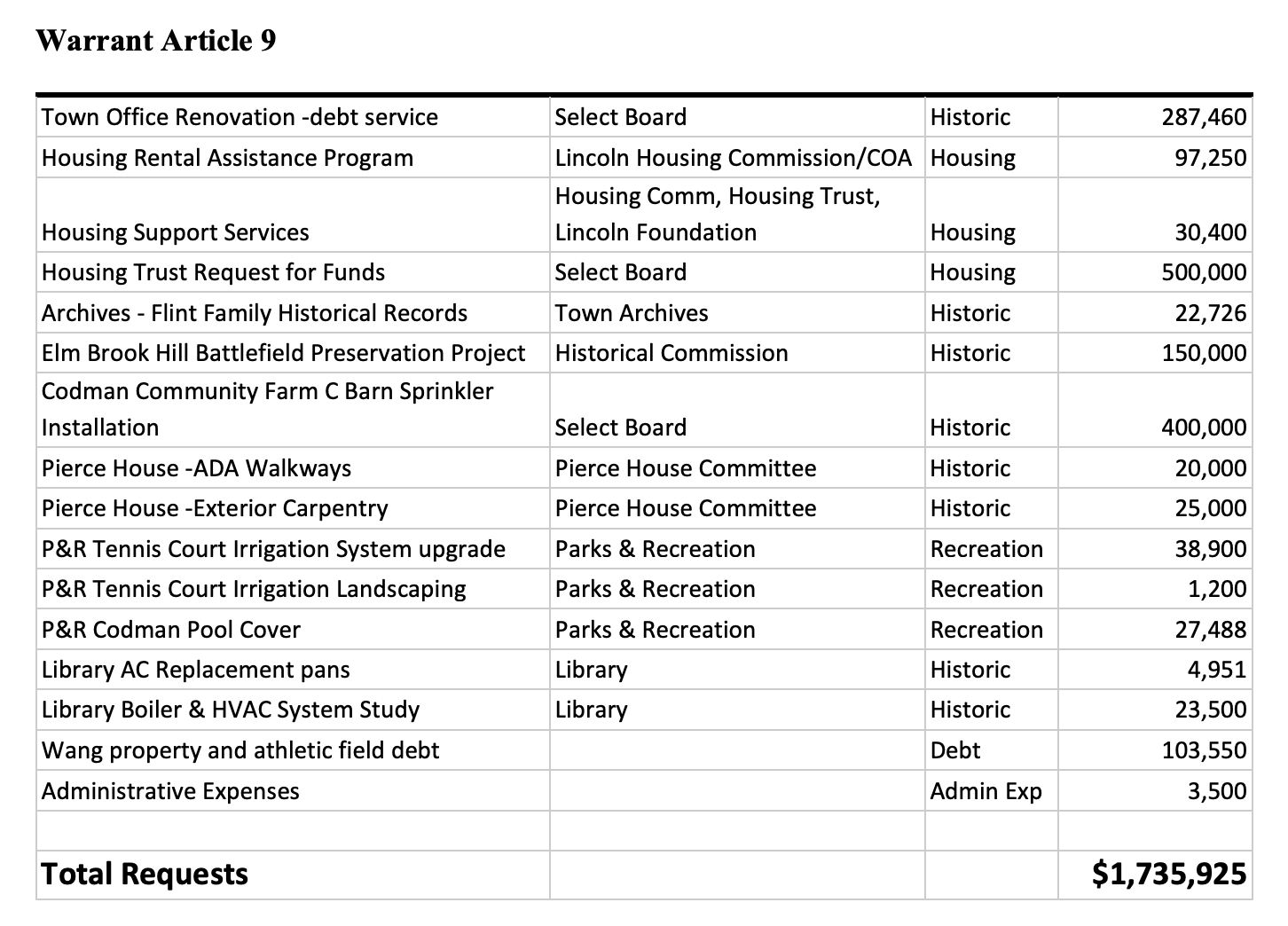
The CPC is recommending a total appropriation of $1.74 million for 16 items in Article 9. Those over $100,000 apiece are funds for the Housing Trust ($500,000), a sprinkler system for the Codman Community Farms main barn ($400,000), the Elm Brook battlefield restoration project $150,000), and debt service for the Town Office Building renovation project ($287,460) and the Wang property purchase ($103,550).

The presentations will also be recorded and posted on the town website and available for review before then. For complete Town Meeting materials, including the warrant, procedures, and the Annual Town Report, click here.

Category: government Leave a Comment

FinCom hosts budget Q&A on March 18

March 4, 2024

The Lincoln Finance Committee is hosting a Virtual Budget Q&A session on Zoom on Monday, March 18 at 7:30 p.m. (meeting ID: 849 2072 7318l; password: fincom). To keep Town Meeting as short and focused as possible, the panel hopes to address comments and questions in this virtual Q&A session as much as possible.

This is not a budget presentation; see the video link below. The Q&A session will be recorded and posted. Complete Town Meeting materials are available here.

Background materials:

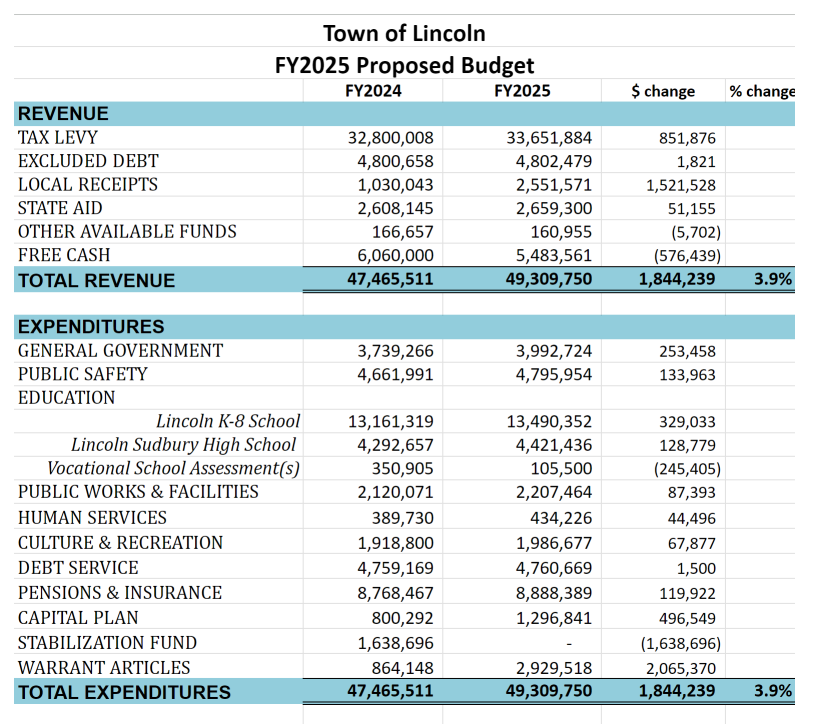
  • Video budget presentation — a recording of the FinCom’s February budget hearing.  It’s posted here (and The budget presentation starts around 14:50 and includes an option for accelerated playback for those who want to review material quickly. 
  • Financial report and warrant — Table 1 on page 54 lists the budget amounts proposed for each town department.
  • Budget summary table — see below (click to enlarge).

Category: government Leave a Comment

Clickers could be used at future Town Meetings — but not this March

January 9, 2024

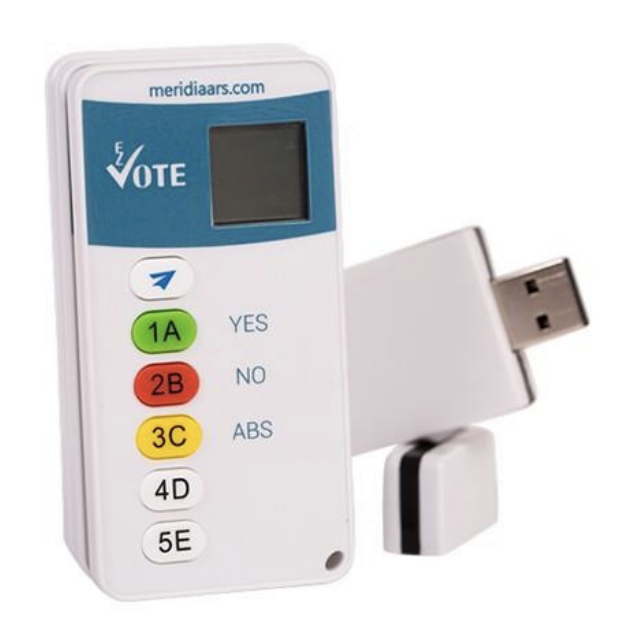
A vote-tallying clicker made by Meridia.

The town is moving toward buying electronic handheld “clickers” to record resident votes in real time and speed up the tallying process at Town Meetings — but they won’t be available for the Annual Town Meeting (ATM) in March.

The drive for clickers went into high gear after the December 2, 2023 Special Town Meeting, which featured two multiple-choice votes whose results required hours to tally. The slow process highlighted a problem with Town Meetings in general: they’re too long, and many residents aren’t able to sit through a meeting of several hours to vote on the one or two articles that interest them.

Citing state law that requires Town Meetings to be held in person (both discussion and voting), Town counsel has given its “unequivocal opinion” that any sort of direct remote participation is not allowed, Town Administrator Tim Higgins said at the January 8 Select Board meeting, noting that the requirement was not altered even at the height of the Covid pandemic. Meetings can be streamed, meaning people can follow the proceedings online, but they may not speak or vote unless they attend in person.

One idea that was alluded to at the meeting but not discussed in detail was having people watch the meeting from home and then go to the school auditorium to vote when they saw that the item of interest was coming up shortly. Town Meetings now require voters to check in at the start of the meeting.

Another idea: splitting Town Meeting into two sessions, one for discussion of the issues and one solely for voting. But this would seem to clash with the requirement that questions and discussion be allowed on each motion once it’s on the floor. This would be a problem for voters who weren’t able to attend the first session. The town plans to seek a legal opinion about whether splitting up a Town Meeting in this way is allowed.

Same format but with clickers?

“I’m not going to pretend it went smoothly [in December] and we shouldn’t be moving toward clickers,” Select Board member Kim Bodnar said. The technology would save the time needed to count standing votes on issues where there isn’t a clear majority after the voice vote.

At the upcoming ATM, the Town Clerk’s office is requesting about $30,000 in the fiscal 2025 budget to buy clickers — though even if approved, those funds would not be available until July 2024.

Another hitch: any expenditure over $10,00 must be put out to bid, further constraining the timeline. “You can’t just go out and purchase them off the shelf,” Higgins said. Even if the money were raised privately, “you have to have confirmation that the funds are in hand before going out to bid… Under any circumstances, it would be rushed to have it for March, but we especially want to be careful” this spring, because of the crucial issues to be voted on: Housing Choice Act rezoning, and a community center.

However, Sara Mattes argued at the Select Board meeting that this was the very reason that clickers are needed in March, because quick and accurate voting results are vital when the issues are so important to the town’s future.

“It is not rocket science,” she said, noting that town officials have reports from other towns that have successfully implemented a clicker system. She also suggested gathering donations to rent clickers. “Let’s call it a pilot project that is privately funded for this upcoming Town Meeting… It would certainly go a long way toward restoring some faith in decision-making and [alleviate] the frustration we had at the last Town Meeting.”

The Selects were not receptive, however. For one thing, there’s a learning curve for employing clickers on the part of officials and residents at the meeting. Bodnar suggested trying them out at an unofficial State of the Town vote, or on an ATM warrant article that is less critical and controversial.

Another issue is the question of anonymity. When a clicker is given to a resident at a Town Meeting, “does it become public record what vote they cast? Those are the kind of things we have to carefully think through,” Higgins said.

Fortunately, there will not be any complicated multi-part votes in March. If a voice vote on a given issue is inconclusive, “there will be a standing vote, it will be secured, it will be formal. It’s an up or down vote,” he said.

“On a municipal scale, we’re moving at lightning speed with this one,” Select Board member Jim Hutchinson said.

But Mattes was not mollified. “You’re not going to have [clickers] in place for a generational vote. I find it, with all due respect, unconscionable,” she said.

Category: government 5 Comments

Town reminds residents of leafblower regulations

January 3, 2024

In response to a resident complaint, Building Commissioner and Zoning Enforcement Officer Mark Robidoux recently issued a letter reminding Lincolnites of the town’s 2019 leaf blower bylaw:

  • Electric and battery-powered leaf blowers may be used all year, subject to time-of-day limitations: Monday through Friday, 9 a.m.–6 p.m. and Saturdays from 9 am.–5 p.m. for all users (residents and contractors), plus Sundays and holidays from 9 a.m.–5 p.m. for residents only.
  • Gas-powered leaf blowers may be used only from October 1 to December 20 and from March 20 to May 31, subject to the same time-of-day restrictions.

The bylaw allows exceptions for public safety and emergency situations, and the building inspector has some limited discretion to grant one-day exemptions based on written applications.

“In terms of enforcement, I am hopeful that by making our landscape professionals (a letter was sent out to all major local landscape companies) and residents aware of this bylaw that the need for enforcement will be limited,” Robidoux wrote. “Complaints will be investigated in a timely manner; please contact the building commissioner during normal business hours and the police during non-business hours. When enforcement is required, warnings will be issued for a first violation, with a fine of $100 for each subsequent violation.”

Anyone with questions may contact Robidoux at 781-259-2613 or robidouxm@lincolntown.org.

Category: government Leave a Comment

Public education, forum planned in wake of STM voting difficulties

December 21, 2023

In the wake of the excruciatingly lengthy voting process for two of the issues at the December 2 Special Town Meeting, the Select Board will distribute general information on the process in advance of a public forum to gauge the town’s appetite for changes.

The time-consuming task of counting paper ballots for the community center and Housing Choice Act issues led several residents afterwards to suggest using electronic “clickers” to vote. Many also said that the many hours required for all presentations, discussion, and voting at all Town Meetings are excessive and unfair to those who can’t come in person for the entire meeting.

Part of the public education process is explaining what Lincolnites alone can and cannot do. Among the “cannots”: changing Lincoln’s Town Meeting rules to allow remote voting, or to have the votes happen at different times than the presentations and public comment period. Both of those prohibitions are based on state law and would require an act of the legislature to change.

“It’s never going to be “walk in, vote, walk out,” Select Board member Kim Bodnar observed at the board’s December 18 meeting, which was also attended by Town Moderator Sarah Cannon Holden.

The separate issue of speeding along the voting is more feasible. A number of towns distribute electronic clickers to Town Meeting attendees so votes can be recorded and tallied in very little time. However, that would mean that voting would be anonymous rather than public, where people can see how their fellow residents are voting when they stand up or raise a hand. 

“Even something as simple as that turns into a multifaceted discussion,” board member Jim Hutchinson said. He also noted that there is no money in the current fiscal year’s budget to purchase clickers in time for the March 2024 Annual Town Meeting. “We’re not actually going to need them in March,” since the votes will all be simple yes-or-no, he added.

The biggest problem on December 2 was the time it took to tally the votes on the community center and Housing Choice Act, because they involved several rounds of multiple-choice voting via paper ballot. The HCA vote was originally going to be on a single option formulated by the Housing Choice Act Working group, but a late-breaking demand for other options that would not concentrate multifamily housing in the South Lincoln area led to expansion of the vote.

“We do things differently from other towns. It’s very unusual to give voters multiple choices,” Hutchinson noted. Lincoln first used the method at a Special Town Meeting in June 2018 to select a design option for the school project. In discussions with colleagues from other towns, Town Administrator Tim Higgins said Lincoln seems to be unique in this respect. “It’s unheard of to add that step to the process,” he said.

Higgins noted that Lincoln has made efforts over the years to streamline Town Meetings, including expanding use of the consent calendar (where several noncontroversial items are voted on as a bloc if nobody objects), having presentations online and recorded in advance of Town Meetings, tightening up the town budget presentation, creating the State of the Town meeting about 20 years ago, and even talking about moving Town Meeting to two or weeknights.

A 2015 report by the Town Meeting Advisory Committee in Weston contained many of the same recommendations that Lincoln has adopted in recent year, Higgins said. That committee also noted that the town had approved a change in guidelines for running Town Meetings, switching from Robert’s Rules of Order (first published in 1876) to Town Meeting Time: A Handbook of Parliamentary Law, a handbook of parliamentary law called that focuses especially on the operation of  town meetings by the Massachusetts Moderators Association (published in 1962 and revised twice since then).

To get a better sense of the town on major issues, conducting official online polls using technology to make sure voters are qualified and vote only once is another option to explore, Hutchinson said. But no decisions can be made until officials get a broader sense of what the majority would like to see from a public forum or committee.

Alongside with the complaints about the recent vote were other expressions of support for the current format, imperfect though it may be, the board noted. “We want to hear whether residents want Town Meeting changed or not,” Bodnar said.

“The people who are objecting to something are often louder than those who are satisfied with things,” Holden said.

Category: government 4 Comments

  • « Go to Previous Page
  • Page 1
  • Page 2
  • Page 3
  • Page 4
  • Page 5
  • Page 6
  • Interim pages omitted …
  • Page 93
  • Go to Next Page »

Primary Sidebar

Recent Posts

  • Water bills to go up by 13% March 5, 2026
  • News acorns March 5, 2026
  • Property sales in January 2026 March 4, 2026
  • My Turn: Unraveling the Hanscom misallocation March 3, 2026
  • Police log for Feb. 19–25, 2026 March 3, 2026

Squirrel Archives

Categories

Secondary Sidebar

Search the Squirrel:

Privacy policy

© Copyright 2026 The Lincoln Squirrel · All Rights Reserved.