• Skip to primary navigation
  • Skip to main content
  • Skip to primary sidebar
  • Skip to secondary sidebar

The Lincoln Squirrel – News, features and photos from Lincoln, Mass.

  • Home
  • About/Contact
  • Advertise
  • Legal Notices
    • Submitting legal notices
  • Lincoln Resources
    • Coming Up in Lincoln
    • Municipal Calendar
    • Lincoln Links
  • Merchandise
  • Subscriptions
    • My Account
    • Log In
    • Log Out
  • Lincoln Review
    • About the Lincoln Review
    • Issues
    • Submit your work

government

Special Town Meeting: What you need to know

June 24, 2025

The following was submitted to the Lincoln Squirrel by Assistant own manager Dan Pereira.

Special Town Meeting is Wednesday, June 25. The information below is intended to ensure a smooth experience for all.

Website

  • Please visit our Special Town Meeting web page for up-to-date meeting information. It contains links to meeting materials, services, and background on the key articles being presented.

Logistics

  • Voter check-in begins at 5:30pm and Town Meeting begins at 6:30pm sharp.
  • View our Ballfield Road Parking map, which highlights available parking locations as well as the entrance to Town Meeting so you can plan accordingly.
  • View our Auditorium Seating Map, which provides an overview of the room layout and handicap seating as well as public microphone locations. Microphones can also be brought to your seat if you are unable to get to a microphone.
  • The Brooks Gym will be available for viewing and voting but not public comment. Those wishing to speak should come to the auditorium and approach a microphone.
  • LEAP is offering free child care for town meeting attendees from 6:00-9:00pm. Sign up here.

Electronic voting

  • Electronic voting devices or “clickers” will again be used to expedite voting when necessary.
    • You will receive your clicker when you check in, along with instructions.
    • You should not leave the school building with your clicker! When you leave, please drop your clicker in a designated receptacle.
    • If you want to leave and return later, please return your clicker to an attendant at check-in and they’ll provide you with a “clicker ticket,” which will allow you to get a new clicker when you return.

Services

  • We have reserved parking close to the entrance for handicap and mobility-impaired residents.
  • Assisted listening devices are available — just approach AV personnel at the console in the middle of the auditorium and they will assist you.

Broadcast

  • The meeting will be broadcast (for viewing only) on your local cable TV channel (Comcast Channel 8/Verizon Channel 33) as well as on the Town of Lincoln TV website.

We look forward to seeing you and will be working hard to complete all meeting business in one night!


Category: government Leave a Comment

My Turn: FinCom has seen “breakdown in process”

June 23, 2025

The Finance Committee (FinCom) plays a critical role in our town: advising on budgets, reviewing expenditures, and helping guide decisions that affect every taxpayer. The integrity of its appointment process matters. And yet, recent public records obtained through a Freedom of Information Act (FOIA) request reveal a troubling breakdown in how this process was handled.

What the bylaw requires

Lincoln’s town bylaws are clear. They state:

“The Moderator of the Town shall, within thirty days after the final adjournment of every Annual Town Meeting, appoint for a term of three years either two persons or three persons, as may be necessary, to provide a committee of seven members (…) The term of office of each member shall commence immediately upon qualification and shall expire upon the final adjournment of the Annual Town Meeting of the last year of such person’s term of office.”

This language affirms that the responsibility to appoint FinCom members belongs solely to the moderator — not to the Finance Committee itself or any other individual. The process is meant to be transparent, timely, and grounded in public accountability.

What actually happened

Emails made public via FOIA show a very different process unfolding behind the scenes. Anyone can request these emails from the Town Clerk; they are public record. In one outreach message, the chair of FinCom wrote: “(…) me taking on the Chair Role and him taking on the Vice Chair Role and so recruiting falls in my purview.”

This directly misstates the bylaw. While the chair can assist with identifying strong candidates, the power to select and appoint belongs only to the moderator. The chair’s role should be limited to offering suggestions as one of several inputs, not acting as the main decision-maker in the selection process. But in this case, the chair handled nearly all outreach, correspondence, interviews and vetting.

The FOIA documents show that for each open slot, the moderator was presented by the chair with only one final candidate after the chair had already conducted the majority of outreach and narrowed the field. In one case, the moderator was informed of a candidate who later declined, but no broader pool of candidates was considered or interviewed. At least one resident (not affiliated with any current town committees) reached out to the moderator to express interest, yet was not offered even a preliminary conversation. This suggests the moderator had limited interest in evaluating any options outside those presented by the chair of FinCom.

The moderator confirms the delegation of duties in another email to the chair of Fincom: “Thank you so much for pursuing the search to fill Andy’s seat.” Essentially this suggests a self-appointed committee.

A pattern of exclusion

In another email, the chair remarked: “[Resident] continues to push and is asking when/if we’ll hold public interviews which I am not inclined to do.” That statement reflects a deliberate choice to avoid an open process. In fact, no general call for volunteers was made. Outreach was limited to those with close personal ties (recommendations from spouses and close friends), or individuals already serving on other committees. Qualified residents outside that inner circle were neither welcomed nor considered.

Even more concerning is this comment: “We really have till May/June as it’s been precedent to have folks serve out till June then roll off, vs. TM [Town Meeting], even though TM is the official line of demarcation… I do worry about our favorite resident sticking to the rules if folks serve a few months longer than the rules suggest.”

Precedent does not override bylaws. Suggesting that rules are flexible and describing a resident who expects compliance as a nuisance shows a troubling attitude toward public oversight and accountability. Residents who ask questions or seek transparency are not “favorites” or problems; they’re fulfilling the civic role we should all support.

Why this matters

Some may argue that because the appointments were ultimately made by the moderator, there’s no issue. But that misses the point. The process was not transparent. It was not inclusive. And it did not follow the spirit of the law. This has real consequences. Yes, Lincoln has a AAA credit rating. But that rating doesn’t reflect the full picture:

  • Our tax bills are among the highest in the state.
  • Our reserves greatly exceed credit agencies’ guidelines.
  • We misallocated $500,000 per year for several years — money we’ll never fully recover.
  • The budget presented at Town Meeting misrepresents our actual revenues and expenditures in order to raise reserves without explicit town approval.

The Finance Committee does not offer hybrid meetings. Roughly half of its meetings are held virtually, yet these are not recorded or made publicly available, despite repeated requests from both residents and town officials.

Notably, FinCom meetings were previously recorded, but the practice ceased after a resident raised a question about the Hanscom misallocation. During that exchange, the current chair provided a response that was proven to be inaccurate, and the resident’s public comment was abruptly shut down. Since then, recording has not resumed and FinCom developed a more restrictive public comment policy.

In-person meetings are not streamed and often overlap with other key town meetings, making it difficult for residents to attend. As a result, residents are effectively shut out of the process unless they can be physically present. (The only exception is the budget hearing leading into Town Meeting, which is recorded, but by then the budget has already been set).

The Finance Committee should be a check on our financials, not a closed circle where only familiar names are welcomed. We need a committee built on independence, rigor, and diverse perspectives.

What needs to change

The current process undermines trust. It discourages civic engagement. And it signals that governance happens behind the scenes, not in the open. We often hear that it’s difficult to find volunteers, but that raises the question: why aren’t we opening up the process to the many capable and willing residents who call Lincoln home?

We can, and must, do better. We owe it to every taxpayer to ensure that town governance is fair, transparent, and consistent with the rules we’ve collectively agreed to follow. The Finance Committee is too important to be treated any other way.

Sincerely,

Karla Gravis (145 Weston Rd.)
Sarah Postlethwait (7 Lewis St.)


“My Turn” is a forum for readers to offer their letters to the editor or views on any subject of interest to other Lincolnites. Submissions must be signed with the writer’s name and street address and sent via email to lincolnsquirrelnews@gmail.com. Items will be edited for punctuation, spelling, style, etc., and will be published at the discretion of the editor. Submissions containing personal attacks, errors of fact, or other inappropriate material will not be published.

Category: government, My Turn 1 Comment

Selects vote not to endorse FinCom appointment proposal

June 17, 2025

The Select Board voted not to endorse a move to change how Finance Committee members are appointed, saying the method proposed in a citizens’ petition would constitute a possible conflict of interest.

More than 130 residents signed the petition calling for a vote at the upcoming Special Town Meeting to have FinCom members appointed by the Select Board rather than the Town Moderator. Bob Domnitz, representing the signatories at the board’s June 16 meeting, said “there’s very little connection between residents and their priorities and the people on FinCom.” 

When openings arise on the committee, they are not advertised, nor are candidates publicly interviewed, Domnitz said. Also, as an individual, the Town Moderator’s deliberations are not subject to the open meeting law. Further, the doings of the FinCom itself are often obscure because that body does not hold hybrid meetings that residents can view from home, he said.

“There’s very little engagement with the FinCom,” Domnitz said, though he added, “that’s on us as residents” and acknowledged that the town routinely follows the committee’s budget advice.

But his allegations provoked a sharp response from board member Jim Hutchinson. “If residents have problems with the budget, they need to come to FinCom meetings or at least the annual budget hearing,” he said. “You can’t say they’re disconnected from residents — that’s not fair. I bristle and object to the notion that they’re disconnected.” 

He and the other two board members agreed that the biggest issue with the proposal is that, under the petition’s proposal, the Select Board would be in charge of naming the people who would then have the power to approve or disapprove the town budget submitted by the board. 

“I struggle with this idea that we could be perceived as having a conflict of interest for determining their budgets,” board chair Jennifer Glass said. 

“I do find our arms-length relationship with the Finance Committee is helpful,” said board member Kim Bodnar, who then asked Domnitz if the petitioners had given any thought to improving FinCom transparency without changing the town bylaw.

“What’s the problem we’re trying to solve? I feel like we’re in good financial shape as a town,” Glass said. 

The problem, Domnitz replied, is that what the FinCom recommends is “so weakly linked to what residents want [that] it feels not really democratic.”

In what may or may not be a coincidence, some of the first people to sign the citizens’ petition are among those who have also been outspoken on LincolnTalk in opposition to spending more money on the community center, or in opposition to the Nature Link project.

“We begged for an open process [of FinCom appointments] but it was flat-out denied,” said Karla Gravis. “It feels like a little clique is choosing each other for this committee.”

Sarah Postlethwait went even further, accusing Town Moderator Sarah Cannon Holden of “gaslighting” about requests to offer input that were “completely ignored.” She emphasized that she was not attacking FinCom members per se but rather the “closed-door process” by which people are named to “what is now basically a self-appointed committee” because “the current moderator has almost entirely given up the role” of recruiting and vetting candidates.

Domnitz also implied that there isn’t sufficient “liberal vs. conservative” diversity on the FinCom, but the board and Holden pushed back, saying there has always been an effort to recruit FinCom candidates with a diversity of views.

“I’ve always felt like every FinCom I’ve been in front of has had a variety of viewpoints and different takes on approaches to finances and asked really probing and difficult questions, as they should,” said Glass, who has also served on the School Committee and the Property Tax Study Committee.

Holden said that in fact, one person she tried to recruit for the FinCom was explicitly against one of the recent town-endorsed proposals, but they said no. This points to a bigger issue, which is that regardless of who appoints FinCom members, it’s hard to find qualified people who are willing to serve, she and board members noted. 

“There are some very valid suggestions for how things could be done differently,” such as publicly announcing FinCom vacancies and having public interviews of candidates, Holden said. 

When discussing what formal stance the board should take on the issue, Hutchinson said he was not in favor of the proposed change, though “there may be some process pieces that could be worked on and improved.” The other Selects agreed, voting not to endorse and saying they would issue a formal statement as to their reasons immediately before the Special Town Meeting on June 25. 

Also on June 16, the Select Board voted unanimously to support Article 1 — the transfer of money from the stabilization fund to the community center building project to close the gap that appeared when bids came in $2.3 million over budget.

Category: government 2 Comments

My Turn: Change how FinCom members are named

June 10, 2025

By Bob Domnitz (on behalf of petitioners)

Several weeks ago, 130 residents signed a citizens’ petition asking that our Special Town Meeting consider an amendment to the General Bylaws of the town. If adopted, the amendment would grant authority to the Select Board to appoint the members of the town’s Finance Committee. That authority is currently held by the Town Moderator.

The Finance Committee (FinCom) is one of Lincoln’s most important volunteer committees. Its work is complex and its analysis and recommendations have a decisive impact on town operations and residents’ taxes. Despite its importance, FinCom receives limited direct engagement from residents.

As signatures were gathered for the petition, the vast majority of residents said they did not know how the members of FinCom were chosen. They thought that the moderator’s role was limited to presiding over Town Meeting. No one could recall a contested election for the position of Moderator, and no one could recall that a moderator had ever expressed a viewpoint on town finances or FinCom appointments.

The disconnect between FinCom and residents has been compounded by the current practice of relying on FinCom to screen potential candidates for membership. Vacant positions have not been advertised, and public interviews have not been held.

If endorsed by Town Meeting, the citizens’ petition will make the Select Board the appointing authority for FinCom. Residents look to the Select Board for overall management of the town. It seems natural that they ought to be the authority that appoints FinCom. The town usually has a contested race for Select Board, and candidates differentiate themselves based on their views and policy preferences. That process helps align our Select Board with residents.

Adoption of this amendment will empower the Select Board to solicit and publicly interview volunteers for FinCom, following the same public process they use for other committees that they appoint. Appointment by the Select Board will therefore create a clear link between residents and FinCom.

Although many Massachusetts towns continue the tradition of a moderator-appointed Finance Committee, the trend is toward other methods of appointment. A substantial minority of towns now rely on appointment by Select Boards, direct election by residents, or appointment by a committee composed of various town officials.

By considering this amendment, the town has an opportunity to strengthen transparency, accountability, and resident engagement in a vital part of our local government. Embracing best practices that encourage diverse perspectives and open public participation will not only enhance the Finance Committee’s effectiveness but also foster greater trust and collaboration within our community. Together, we can ensure that Lincoln’s financial decisions reflect the voices and values of all its residents, building a stronger, more inclusive future for our town.


“My Turn” is a forum for readers to offer their letters to the editor or views on any subject of interest to other Lincolnites. Submissions must be signed with the writer’s name and street address and sent via email to lincolnsquirrelnews@gmail.com. Items will be edited for punctuation, spelling, style, etc., and will be published at the discretion of the editor. Submissions containing personal attacks, errors of fact, or other inappropriate material will not be published.

Category: government, My Turn 3 Comments

Town Meeting procedures to be finalized on Wednesday

June 9, 2025

Town Moderator Sarah Cannon Holden will allow a single speaker to present dissenting views and accompanying slides at the podium on the Nature Link proposal at the Special Town Meeting on June 25. After the pre-STM moderator’s meeting on Tuesday, June 11 at 6:30pm, she will ask the dissenters to identify their representative speaker. The agenda and Zoom link for that meeting can found here.

“After conversations on the [Town Meeting Study Committee], it became clear that with regard to dissenting opinions, we need to develop more procedural guidelines than have been followed in the past. I welcome supporters, dissenters and the undecided to attend,” Holden wrote on LincolnTalk on June 6.

In past years, the procedural moderator’s meeting has usually been pro forma. But in 2024, more than 300 residents who opposed to the Housing Choice Act rezoning measure asked Holden for more than the standard two minutes from the floor, and also the opportunity to show slides. She ultimately granted the speaking request but not the slides.

Category: government Leave a Comment

Corrections

June 4, 2025

The June 3 story headlined “Community center bids come in high; $2.3m fund transfer sought” misstated the dollar amount by which the Finance Committee hopes to increase the town’s fiscal 2025 reserve fund in order to cover unanticipated expenses this year. Those expenses total about $635,000, but the reserve fund already has about $616,000, so the transfer request will be $50,000 or less, depending on the final numbers. The FinCom will finalize details at its June 10 meeting.

The same story also misstated the source of expected additions to the reserve funds. The total balance of $11.1 million will rise by about another $2.6 million in the fall from underspent amounts and/or revenues in excess of the FY25 budget assumptions, not from property tax income.

Category: government, Uncategorized Leave a Comment

Impetus for citizens’ petition on FinCom still unclear

June 3, 2025

The last item on the agenda for the June 25 Special Town Meeting is a citizens’ petition asking voters to have Finance Committee members named by the Select Board rather than the Town Moderator. But exactly why the organizers are pushing the measure is still unclear.

The Lincoln Squirrel obtained a copy of material that was given to people who were asked to sign the petition, which says that FinCom members are “appointed by a single individual through a closed process.” The proposed change would “encourage fresh ideas and broader perspectives” as well as “increase transparency and access.” The material also says that FinCom meetings are not routinely recorded or opened to the public via Zoom unlike several other committees, though it’s unclear how the proposed change would affect that.

In a reply to an email from the Lincoln Squirrel last week, one of those petition organizers, Suzanne Szeto, declined to comment on the underlying motivation for the proposal, saying that the group will discuss it at the June 16 Select Board meeting. Asked in a follow-up email if she would share names of other organizers, she replied, “I am sorry I don’t have the answer to your question and would appreciate if you could stop emailing me on this! Thank you!”


Category: government Leave a Comment

Citizens’ petition seeks change in FinCom appointments

June 1, 2025

A citizens’ petition that will be on the agenda at the Special Town Meeting on June 25 will ask voters to change the way members of the Finance Committee are appointed.

FinCom members are currently appointed by the Town Moderator, but the petitioners seek to have the Select Board appoint members instead.

Suzanne Szeto of Giles Road and The Commons in Lincoln, one of the organizers, emphatically declined to comment last week on the motivation for the proposal, saying that the group will discuss it at the June 16 Select Board meeting. 

Category: government 2 Comments

Stephen Breyer to appear at Walden Woods Project

April 7, 2025

Retired U.S. Supreme Court Justice Stephen Breyer.

The public is invited to attend a special event with the honorable Stephen Breyer, a retired associate justice of the U.S. Supreme Court in a conversation moderated by historian Douglas Brinkley, at the Walden Woods Project in Lincoln on Friday, May 30.

The outdoor event will be held rain or shine in an enclosed tent. We ask guests to arrive promptly between 5:15 and 5:30pm for the introduction at 5:40pm. Advance registration is required for admission. Click here to:

  • Reserve your seat(s)
  • Pre-order signed copies of Justice Breyer’s recent book, Reading the Constitution: Why I Chose Pragmatism, Not Textualism and Douglas Brinkley’s book, Silent Spring Revolution
  • View a list of FAQs
  • Submit a question for Justice Breyer (please note: time constraints limit the number of questions that will be selected for response)

Preceding the conversational program will be the first public showing of a nine-minute introduction to the feature documentary, “Henry David Thoreau.” The film, by Ewers Brothers Productions and Executive Producers Ken Burns and Don Henley, is scheduled to air on PBS in 2026.

Breyer served on the U.S. Supreme Court from 1994 to 2022. His other books include Active Liberty (2005), Making Our Democracy Work: A Judge’s View (2010), The Court and the World (2015), and The Authority of the Court and the Peril of Politics (2021). Brinkley is the Katherine Tsanoff Brown Chair in Humanities and Professor of History at Rice University and a CNN Presidential Historian. Six of his books were named New York Times “Notable Books of the Year” and seven became New York Times bestsellers.

The event is co-sponsored by Lincoln250, Concord250, the Bemis Free Lecture Series, and the Lincoln Historical Society.

Category: government, history Leave a Comment

Town Meeting free of controversy and “nay” votes

March 30, 2025

Lincoln’s Annual Town Meeting set a non-pandemic record for brevity, wrapping up in under three hours as every warrant article was approved by unanimous voice vote in a rare controversy-free edition.

Perhaps the most interesting aspect of the March 29 meeting was the confluence of past and future. It started out with a demonstration of the new voting clickers and later moved to a reenactment of Lincoln residents debating at a 1775 Town Meeting whether to allocate money for the war that many saw coming (see related story and “My Turn” piece).

Votes approved funding to buy the clickers last year and were thrilled on Saturday with the instant tallies during a test run, when they were asked to indicate whether this was their first Town Meeting or not (result: 149 no, 24 yes). They also tested the multiple-choice function. Ranked-choice voting will be an option in the future.

Saturday’s vote means that “we can add clickers to the list of techniques that the town moderator can use to ask for a vote,” Select Board member Jim Hutchinson explained. Voice votes will be the first go-to method and standing votes are still an option, but it’s at the discretion of the moderator. The only substantive and unavoidable change from traditional vote-counting is that voting by clicker is anonymous, so attendees can’t see how their neighbors are voting on an issue.

Hutchinson also encouraged officials to use the clickers to get a sense of attendees at future Town Meetings and those of boards and committees even if it’s not a formal vote. “We believe this is a good way to get more feedback from residents,” he said.

Budget

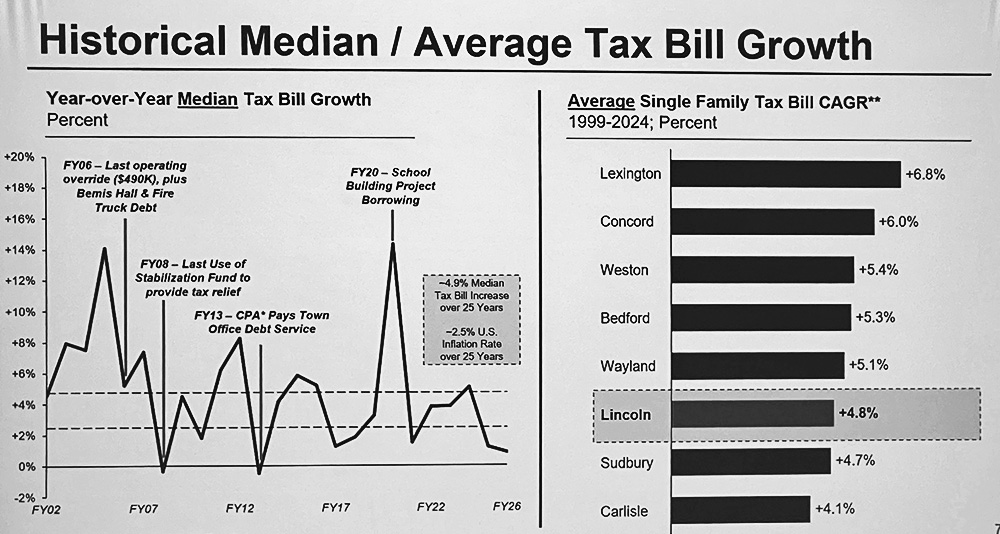
Revenues and expenses will grow by 7.9% in the budget approved for fiscal 2026. However, property owners will see a tax increase of only 0.9%, largely due to the Finance Committee’s use of $902,000 from free cash for tax relief. It’s a big change from 2020, when the tax rate ballooned by 14% due to borrowing for the school renovation project. “Preferred items” that were approved in addition to the FY26 base budget included a new police officer (the first in 25 years) and a part-time administrative assistant in the Planning Office.

These two charts show how Lincoln’s property tax rate has grown over the last decade in comparison to neighboring towns (click image to enlarge).

Future town budgets will be more unpredictable than usual, given the “sweeping and rapidly evolving” presidential orders on public health education, the environment, immigration, and more, said Select Board Chair Kim Bodnar. Pending the outcome of a flurry of legal challenges, “we have insufficient information to warrant making changes to budget and programs” in Lincoln, but the town will need to “evaluate what we need to do to maintain compliance with federal laws… while remaining true to the town’s vision statement and commitment to keeping Lincoln a welcoming community for all our residents, students, staff and visitors.”

Town Meeting Study Committee

Andrew Pang reported on the work of the committee, which was formed after last year’s controversial Annual Town Meeting (ATM) debate and vote on Housing Choice Act rezoning. Among its accomplishments so far:

  • The pre-ATM moderator’s meeting, seen by some as “proverbial smoke-filled room,” is now hybrid for greater transparency.
  • Publication of a Town Meeting primer
  • A two-minute timer visible to those who speak at the audience microphones, though by law, the moderator reserves the right to allow speakers to go longer. The group is also working on improvements to the audiovisual technology that’s used when an overflow room such as the Reed Gym is used.

Pang acknowledged that there have been “perceptions that differing viewpoints were not welcome” and said that the committee is “working on digesting and assimilating those comments [and will then] develop criteria and rules.” Other suggestions that the group is studying are having separate sessions for Town Meeting debate and voting; allowing remote participation in debate, which is complex from a technical standpoint. Remote voting is not permitted by state law, nor is absentee or early voting, he noted. Most would agree that boosting Town Meeting turnout is desirable, though Lincoln had the highest average rate in the immediate area in 2014-2023 (8.4% of registered voters, vs. a low of 3.7% in Bedford).

Pang urged residents to offer feedback on how Town Meeting went using this website, which the committee will consider as it reviews the primer and makes future recommendations. They expect to issue its final report to the Select Board in October and to residents at the November State of the Town meeting.

Water Enterprise Fund

Voters approved a bond issue of $6.79 million to fund Water Department projects, chiefly a water main replacement through the center of town for $6.2 million. Department Superintendent Darin Lafalam recapped his March 4 public hearing presentation outlining Lincoln’s aging water main infrastructure as Water Commission member Steve Gladstone noted that the town has never replaced an entire water main. Bids just came in for the first of two phases from the top of the hill on Bedford Road down Lincoln Road to Ballfield Road and were in line with estimates; work on that piece will take place this summer.

The bond interest and principal will be repaid from water rates, which rose 10% this year and are slated to do the same in the next two years as well.

Zoning amendments

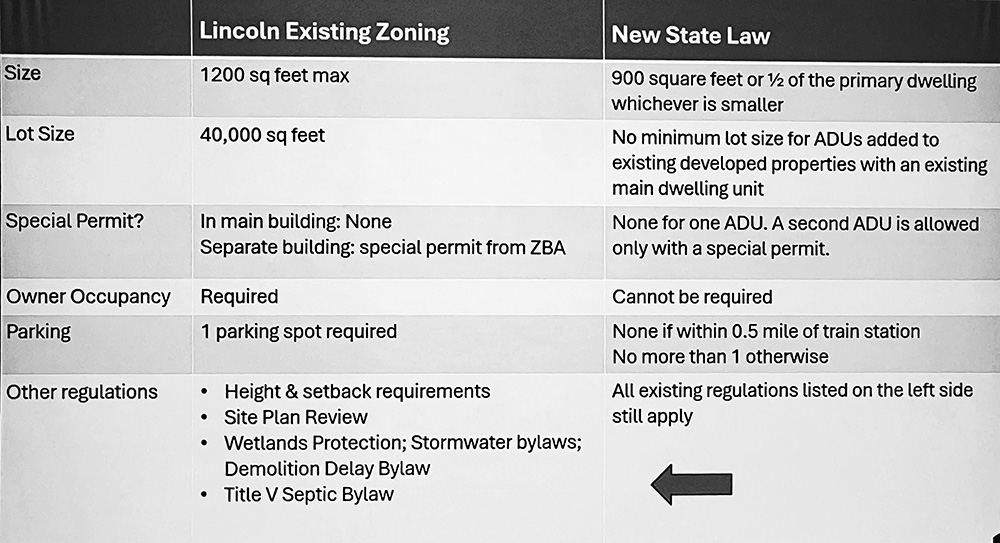
A comparison of Lincoln’s previous ADU regulations (left), and what voters adopted last week to align with new state law (click image to enlarge).

Voters also approved zoning bylaw amendments to have the town’s rules on accessory dwelling units (ADUs) follow recent changes in state law. Those changes relax the rules around units of up to 900 square feet, though the town retained additional restrictions on units from 900 to 1,200 square feet. ADUs up to 900 square feet are now allowed by right with no special permit required.

Asked why the town didn’t simply adopt the same rules for all ADUs rather than keeping different ones for larger units, Planning Board Chair Margaret Olson said, “the Planning Board prefers to make small incremental changes [because] it’s extremely difficult to get regulations right.” It may make further changes in the future; “we’ll see what happens… but we’re making the minimum necessary changes today.”

Category: government Leave a Comment

  • « Go to Previous Page
  • Page 1
  • Page 2
  • Page 3
  • Page 4
  • Interim pages omitted …
  • Page 93
  • Go to Next Page »

Primary Sidebar

Upcoming Events

Mar 21 Sat
12:30 pm - 3:00 pm

Craft Supply Swap

Mar 21 Sat
1:00 pm - 3:00 pm

Film: “Memories Flow Beneath It: From Valley to Quabbin”

Mar 27 Fri
12:30 pm - 1:30 pm

Lincoln’s Invaluable Vernal Pools

View Calendar

Recent Posts

  • Water bills to go up by 13% March 5, 2026
  • News acorns March 5, 2026
  • Property sales in January 2026 March 4, 2026
  • My Turn: Unraveling the Hanscom misallocation March 3, 2026
  • Police log for Feb. 19–25, 2026 March 3, 2026

Squirrel Archives

Categories

Secondary Sidebar

Search the Squirrel:

Privacy policy

© Copyright 2026 The Lincoln Squirrel · All Rights Reserved.