• Skip to primary navigation
  • Skip to main content
  • Skip to primary sidebar
  • Skip to secondary sidebar

The Lincoln Squirrel – News, features and photos from Lincoln, Mass.

  • Home
  • About/Contact
  • Advertise
  • Legal Notices
    • Submitting legal notices
  • Lincoln Resources
    • Coming Up in Lincoln
    • Municipal Calendar
    • Lincoln Links
  • Merchandise
  • Subscriptions
    • My Account
    • Log In
    • Log Out
  • Lincoln Review
    • About the Lincoln Review
    • Issues
    • Submit your work

community center*

School project budget, financing aired at SOTT

October 21, 2018

A summary of “value engineering” items trimmed to bring the school project back to the approved $93.9 budget (click to enlarge).

Town officials provided updates on the two pending school campus construction projects at the State of the Town meeting on October 20, outlining a series of cuts made to bring the school project under budget and a timeline for the community center.

The detailed construction cost estimate presented to the School Building Committee in September was about $9 million more than the $93.9 million budget approved by voters in June, so the SBC had just weeks to decide what to trim as it prepares for bonding votes at a Special Town Meeting on December 1 and at the ballot box on December 3. The areas where cost estimates rose the most compared to the figures presented in June were site work, which went up by $5.22 million, and temporary modular classrooms, which rose by $2.94 million.

After three weeks of painstakingly combing through a list of more than 100 construction items, the SBC got the project under budget. Members actually trimmed more than $9 million because they also added two items: $870,000 for an upgraded HVAC system and $150,000 for a slightly redesigned center of the building.

The biggest savings will come from site work. The SBC lopped $3.9 million from that category by cutting back on granite curbs and repaving and foregoing new plantings, sod for the ballfield, and new playground equipment. Officials expect to save $1.68 million by negotiating less expensive temporary classrooms.

To save another $2.5 million, the town will hire a third-party firm to install the solar equipment rather than paying for and owning it as part of the project. Lincoln would then enter into a power purchase agreement where it would buy electricity, thus shifting much of the financial burden from the construction budget to the operating budget. On the bright side, this also means that enough solar equipment can be installed to make the school “net zero” in terms of energy use.

The final borrowing amount that the town will vote on in December hasn’t been determined yet, because other sources of funding have to be nailed down. Those sources include the following (with current balances in parentheses):

  • The debt stabilization fund ($5.5 million). This fund has been accumulating for years in anticipation of the school project, though the Finance Committee may recommend retaining some of it for the Community Center project
  • Free cash (about $1 million). This is a relatively large amount because the town recently received a large building permit fee.
  • Community Preservation Act funds (about $600,000 not otherwise designated). These funds can be used to outdoor recreational things like athletic fields and playgrounds.
  • The cable revolving fund ($226,000) from the annual license fee to support local cable access. This fund balance increases by about $80,000 a year and Town Administrator Tim Higgins will recommend that the Board of Selectmen “commit the lion’s share of that money” to applicable parts of the school project such as audiovisual work in the Brooks auditorium, he said at an October 18 multiboard meeting.

The town considered using Chapter 90 state funds for roadway improvements to Ballfield Road as part of the school project but decided it would be unwise to divert that money from regular road maintenance around town.

  • Click here for the State of the Town presentations by the School Building Committee and Finance Committee

Estimated property tax increases as a result of the school borrowing (click to enlarge).

The precise tax impacts of the borrowing won’t be known until the final borrowing amount and bond interest rate are known. “It’ll be less than the 20 percent people had in their minds due to the tranching, but it won’t be a lot less,” Finance Committee chair Jim Hutchinson said. “Tranching” means splitting up the borrowing into two or more loans over a period of time rather than borrowing the full amount in a single loan. Earlier FinCom figures indicated tax increases of 19 to 21 percent. The median tax bill in fiscal 2018 was $13,566.

The town also expects to borrow roughly another $20 million in 2024 to build the community center, which will bring the town’s debt service levels back up to 2019 levels. The most recent estimates for that project range from $15.3 million to $16.2 million depending on which design is selected.

”The school project is the biggest need for the town,” Selectman James Dwyer said at the State of the Town meeting, adding that work on the community center will not begin until the school is “substantially complete.” However, a community center building committee could be formed as soon as 2021, he said. There has been talk of forming a “Friends of…” group to solicit private donations for one or both campus projects, but this hasn’t yet moved beyond the discussion phase.

There will be two community workshops on the project on Thursday, November 1 at 8 a.m. and 7 p.m. in the Reed Gym. Officials have until November 17 to nail down a final bonding amount for the December 1 and December 3 votes. If approved, architects will require about 12 months to complete detailed drawings before the start of construction, which is expected to take up to three years in two phases.

Category: community center*, government, school project*, schools 1 Comment

Corrections

October 10, 2018

  • The agenda for the October 20 State of the Town meeting posted in the Squirrel on October 9 was incorrect. Here is the correct agenda for the meting, which will take place in Brooks auditorium from 10:30 a.m.–12:30 p.m.:
    • Campus building projects (10:30–11 a.m.)
    • South Lincoln planning (11–11:30 a.m.)
    • deCordova bylaws (11:30a.m.–noon)
    • Open forum (12–12:30 p.m.)
    • Post-meeting table session (12:45–1:15 p.m.)
  • A photo caption in the October 10 story headlined “Sales of dolls, antiques providing big share of MCC budget” was initially incorrect; the second person in the photo is Erica Gonella, the MCC’s treasurer and director of annual giving.

Both posts have bene updated to reflect these corrections.

Category: community center*, government, land use, schools Leave a Comment

Schedules proposed for school, community center projects

July 23, 2018

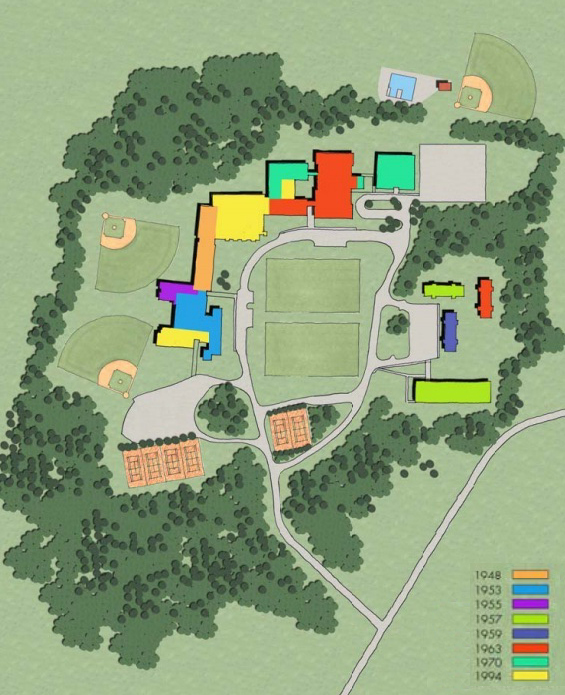
The current school campus showing when various sections were built.

School and community center planners have proposed schedules for further community input and eventual start dates for their respective projects.

Daedalus Projects Inc., the owner’s project manager for the school project, presented a schedule to the School Building Committee earlier this month calling for three community forums from August to October as well as six committee charrettes on various aspects of the school design.

Charrettes on hubs and commons and on building envelope and sustainability took place on June 27 and July 11, respectively. The next session on Wednesday, July 25 at 7 p.n. in the Hartwell multipurpose room will focus on building exteriors and site circulation. Other charrette dates and topics:

  • Systems and photovoltaic panels – August 8
  • Interior spaces and security – August 22
  • Schematic design pricing set – September 5
  • Cost review: September 27

The final cost estimate is due on October 1. Residents must vote on a dollar amount to borrow for the project at a Special Town Meeting on December 1, 2018 (with a two-thirds majority required for passage) and at the ballot box on December 3.

Assuming the project is approved, construction documents and bidding will take place next, with modular classrooms installed in spring and summer 2019, and actual construction running from November 2019 to November 2023.

Community center plan

The Community Center Planning and Preliminary Design Committee submitted its final report outlining two possible design directions on July 19. A survey of residents who attended the June 9 Special Town Meeting showed that voters were almost evenly split on which of the two they preferred.

In their report to the Board of Selectmen, the CCPPDC recommended creating a community center building committee in late 2020. That group would approve a budget for schematic design (currently estimated at $300,000), hire an architect and owner’s project manager, and prepare for a Town Meeting vote on the building site and budget in March 2021.

The town will not have the borrowing or campus space capacity to begin the community center until after the school project is nearly complete. The CCPPDC therefore recommended holding a bonding vote on March 2022 and starting construction in March 2023.

Category: community center*, school project*, schools, seniors Leave a Comment

Residents split on preferred community center design

June 24, 2018

The two community center options. Click on image to enlarge or click here for a more detailed view.

Residents were almost evenly split as to which of two design concepts they preferred for a future community center. The choices were presented in a paper survey at the June 9 Special Town Meeting on the school project.  

A total of 158 residents completed the survey, or 25 percent of the 632 who cast votes on the school project ballot question, according to results released by the Community Center Preliminary Planning and Design Committee (CCPPDC). Seventy-five preferred Scheme 1 and 73 said they liked Scheme 2 better. 

Since the two design ideas are fairly similar, the goal of the exercise was not to eliminate one and move ahead with the other, but to gauge “the relative importance to the voters of the features of each design,” the CCPPDC noted. “In many cases, the features can easily be incorporated into a single, final design scheme.”

Creating a new Hartwell green with its large, playable area and allowing a more open campus feel was the most frequently mentioned reason for those who preferred Scheme 1. Other features people liked were the “pinwheel” external design, a more light-filled orientation, new construction, the interior design, and the fact that the building would be built into the hillside on the east end of the site.

Voters who preferred Scheme 2 cited reuse of the pods, consolidation of the buildings, more cost-effective construction, the courtyards, and the more centralized parking.

Schemes 1 and 2 are estimated to cost $16.2 million and $15.3 million, respectively. However, construction is not expected to start until the school project is near completion, probably in 2023. By that time, the cost will have probably increased to about $20 million, CCPPDC Vice Chair Margit Griffith said in May.


Category: community center* Leave a Comment

School option L3 wins the day

June 10, 2018

School option L3 (click to enlarge)

After almost a year of meetings, community forums, architectural work, and spirited debate, Lincoln residents voted to move forward with school concept L3 at a Special Town Meeting on June 9.

Consulting architects SMMA will now produce a schematic design with detailed specifications and an updated cost estimate. The current estimate for Option L3 is $93.9 million, including solar panels and other “net zero” energy use features. A two-thirds majority is required at a Special Town Meeting on December 1 to approve bonding for the project. There will also be a December 3 town-wide ballot that must win a simple majority for the project to advance.

On the first vote, which was conducted using paper ballots and voting machines (a first for a Town Meeting), 632 voters in the Brooks Auditorium and nearby gym weeded down the initial five options to three, with Option L3 gaining a majority already:

Number of votesPercentage
Option R274.3%
Option L1101.6%
Option L28513.4%
Option L335456.0%
Option C15625.7%

Option L3 won a substantial majority in the second round of voting:

  • Option L3 – 74%
  • Option C – 17%
  • Option L2 – 9%

Before turning to the school issue, the Community Center Preliminary Planning and Design Committee presented two possible design ideas for a community center on the Hartwell side of campus and asked residents to complete survey forms on which they preferred. That feedback will be part of the group’s final report to the Board of Selectmen in coming weeks.

The meeting opened with presentations about the five school options and their costs, the tax impacts of borrowing varying amounts, the conditions and repair work needed at the school, and a history of school project planning and construction since 1994, as well as recommendations from the Board of Selectmen, Capital Planning Committee, and Finance Committee (see links below).


Background:

  • A roundup of past Lincoln Squirrel stories and letters to the editor on the school project (updated June 10, 2018)

Town Meeting presentations:

  • Full slide deck
  • Plans and views of the two Community Center options
  • School project history
  • Repairs and code work needed on the school
  • The five school options
  • Borrowing and tax implications plus Finance Committee recommendations

The two community center options (click to enlarge)

Over the past year, the School Building Committee looked at 39 different school options before settling on five to present for the June 9 vote. A sixth option was rejected earlier as being beyond the town’s normal borrowing limit.

Much of the discussion before the votes centered on the educational benefits of hub spaces that would allow teachers to work with student of different sizes and more easily collaborate on teaching within a grade, vs. whether such spaces were worth the added cost.

Dozens of residents stood in line at microphones to ask questions and make a case for their choices before the votes. A sampling of those remarks:

  • “I’m a huge proponent of Options L3 and C… but L3 is probably a compromise,” said Jen Holleran, member of a Lincoln educators group.
  • Option L3 would put Lincoln “in the middle of the pack for residential tax rate,” said Ginger Reiner. “What we are experiencing as a giant leap in taxes is just recalibrating to bring us more in line with our neighbors. We’ve enjoyed lower than average taxes by essentially borrowing against our future selves; we’ve artificially suppressed our taxes and it’s time to pay that debt… Option L3 is the perfect intersection of the town’s values.”
  • “Our kids are doing all right,” said Carolyn Montie, noting the top-tier colleges that many Lincoln School graduates have attended. “All options are viable… but putting those resources to direct services to students would result in a better outcome.”
  • “Every dollar put into the school made real estate prices rise by $1.50” compared to similar towns that didn’t do a major school project, said Ben Shiller, assistant professor of economics at Brandeis University, citing academic research. “The selfish decision is actually to choose one of the more expensive options.”
  • Lincoln’s master plan doesn’t mention an upgraded school but does call for continued investment in affordable housing, open space and conservation, and economic development, said Sharon Antia. “Where will we find the dollars for our stated priorities?”
  • Children today “have information at their fingertips—they don’t need to cram it all into their heads” in a traditional classroom setting, said D.J. Mitchell. “We need to [develop] collaborators, tinkerers, and problem solvers. Sometimes this requires larger spaces, multi-age groupings, teachers working across disciplines, quiet reflection and loud collaboration… we need to transform educational spaces for the 21st
    century.”
  • “We have a responsibility to honor the historical legacy of the Smith School, which was groundbreaking in its day,” said Christopher Boit. Option L2 “honors our commitment to net zero as well as a full kitchen and [the option of] collaboration at mealtimes… the difference in my education was not the buildings, it was the teachers.”
  • The hub spaces in Options L3 and C mean that children taken aside for individual or small-group instruction for any reason “are not stigmatized by being pulled into hallways,” said Cathy Bitter.
  • “We’re going to end up taking people out of this community because this is going to impact their taxes a lot,” said Daniela Caride. “In Lincoln, you go anywhere and you see three generations of people living here. [Other area towns] are generally bedroom communities. Do we want to be this kind of community? I’m still looking for an option here. We should be mindful of our neighbors who may get into trouble with all this cost.”
  • The tax increase from L2 to either L3 or C “sounds like a pretty good bargain,” said Cheryl Gray.
  • The increase between the higher-end options which is in the vicinity of $200-300 annually “is just one less trip to Donelan’s,” said Chris Gill.
  • “Some people are concerned that the price is still not optimal for what we’re getting, so I hope do some serious value engineering” between now and December,” said Steve Massaquoi.
  • “Given the total dollar amounts we’re talking about, I’m not that concerned” about the relative difference in tax hikes between the top two or three options, said Allen Vander Meulen. “But which of the plans do the teachers prefer?”
  • At the most basic level, consistent classroom temperature and lighting are the top priorities for teachers, Superintendent of Schools Becky McFall said in answer to Vander Meulen’s question. But since the new Hanscom Middle School opened, “they’re seeing the collaboration possibilities… the flexible grouping of students and targeted instruction… for either more intervention or more challenges.”
  • The presence of hubs in a school “affects our ability to attract good teachers big-time,” said Bob Shudy. Without hubs, many of the best young teachers “wouldn’t even consider” applying to work at the Lincoln School.
  • Option L2 “contains the reasonable minimum for facilities and teachers. I find the notion of adding hubs or flex spaces to be speculative,” said Adam Greenberg. “Education is changing much more rapidly than any snapshot you choose to pick today.”
  • Saying she hoped to persuade fans of both Option L2 and C to agree on L3, Lis Herbert said that L2’s concept of having only single flex spaces for Smith and Brooks is “deficient and doesn’t rise to the occasion” but that Option C reflects “a uniquely American desire for shiny, efficient new things. We often forget about what we have and what we can adapt to suit our needs… we literally pull up stakes and go west.”
  • “A difference of $10 million between L2 and L3 is significant,” said Diana Abrashkin. “There’s so much that could be done with $10 million in terms of teacher salaries, or more amenities in the actual buildings. The difference is the teachers, not the shape of the classrooms.”
  • Option L3 has a better distribution of hub spaces, while Option C has “a perfectly good gym moved from present location,” said Graham Atkinson.

Category: community center*, government, news, school project*, schools 3 Comments

The school project: a look back since 2012

June 5, 2018

 width=(Editor’s note: the links to articles and letters to the editor were updated on June 1, 2018.)

As a service to readers in advance of the Special Town Meeting on Saturday, June 9, here are links to past Lincoln Squirrel stories about the school project, as well as letters to the editor and some of the documents cited in those stories.

The articles go back to late 2012, shortly after the last town-wide school project vote took place—and also when the Lincoln Squirrel began publication. For earlier school project history, information on educational impacts, and all official documents, see the School Building Committee website.

Details on the June 9 meeting

  • New check-in procedure for Town Meeting
  • Agenda and procedure
  • Construction phasing, Town Meeting child care

Charts and slide decks

  • Drawings of the six school options along with costs and tax impacts for each
  • A chart comparing the features and costs of the options
  • The Finance Committee’s tax impact projections and comparisons to other area towns
  • The SBC’s guiding principles
  • Dore and Whitter summary of renovation and construction options (2015)

News articles

2018:

  • Committees recommend school options L3 and C; selectmen also include L2 (5/31/18)
  • Committees offer guidelines in advance of June 9 school vote (5/17/28)
  • School and campus ideas come into clearer focus (3/26/18)
  • 77% in survey prefer a mostly new school building (2/8/18)
  • Workshops focus on three main school project options (1/26/18)

2017:

  • Architects show how school design can enhance education (10/19/17)
  • School Committee selects dual-firm design partnership (8/27/17)
  • Voters give the go-ahead to school project and community center planning (3/26/17)
  • Officials offer school recommendations, borrowing estimates (2/1/17)
  • School Committee recommends Lincoln-only school project (1/29/17)

2016:

  • State says no to Lincoln school funding for the third time (12/23/16)
  • Residents vote to try for school funding again (3/21/16)
  • Campus study group presents final report (2/12/16)

2015:

  • Campus study draft to be presented next week (12/3/15)

2014:

  • Residents delve into community center, school project at State of the Town 11/17/14)
  • School needs at least $27.5m even without cafeterias, architects say (11/11/14)
  • McFall outlines educational needs for school (10/2/14)
  • Residents approve up to $250,000 for another school study (4/3/14)

2013:

  • State says no to Lincoln’s school building application (12/8/13)
  • Group concludes that school needs everything in building plan (11/26/13)
  • Town meeting approves funding for school project planning (4/2/13)
  • Town to submit new statement of interest for school project (3/9/13)
  • State says no to L-shaped school proposal (3/2/13)
  • Town asks state to consider “L-shaped option for school (2/24/13)

2012:

  • School hoping to buy time for building project (11/19/12)

Recent letters to the editor

  • L3 is the best—not a compromise (Lis Herbert, 6/8/18)
  • Stand up for Option C if education is your top priority (Paul Shorb, 6/8/18)
  • Option L3 is the best choice (Peter Watkinson, 6/7/18)
  • A look at the issues, and why I’m voting for L3 (Sara Mattes, 6/7/18)
  • Mostue supports option L3 (Brooks Mostue, 6/7/18)
  • A brief history of the school project (Gary Taylor, 6/6/18)
  • C or L3 deliver opportunity for 21st-century education (Lincoln educators, 6/3/18)
  • Support conservation and option L3 (Ken Bassett, 6/3/18)
  • What is a net zero building? (Sue Klem, 5/31/18)
  • LSF supports options L3 and C (Lincoln School Foundation, 5/31/18)
  • Option C offers the most benefits (Fuat Koro, 5/29/18)
  • Letter to the editor: do school repairs over a period of time (Jean Palmer, 5/29/18)
  • Invest in the future with option L3 or C (Hans Bitter, 5/28/18)
  • Vote for school option L3 (Ken Hurd, 5/24/18)
  • School option C is best for sustainability (Mothers Out Front, 5/21/18)

Category: community center*, school project*, schools Leave a Comment

Letter from the moderator #3: rules for Saturday’s Special Town Meeting

June 4, 2018

Editor’s note: This is the third in a series of pieces by Town Moderator Sarah Cannon Holden about preparations and procedures for the Special Town Meeting on June 9. The other letters appear here and here.

To the editor:

By now you should have received your Special Town Meeting Warrant with the two aBy now you should have received your Special Town Meeting Warrant with the two articles to be considered on June 9th. There is very important background information. Please read it carefully so you can come as prepared as possible for the discussion and voting on Saturday. It contains the meeting’s agenda as well as overview of what we will need as we delve further into the issues, choices and considerations before us. Also included in the mailing is an explanation of the voting process. Read it carefully and bring it with you to the meeting. Please note that while there will be a presentation and update regarding the community center, there will not be a vote.

Now let’s get into the rules of the meeting.

There will be presentations be several boards and committees. Discussion, questions and answers, votes and more votes will follow. The procedural rules and voting procedures will, hopefully, be the containers to hold it all together. Many will want to speak, so everyone must limit their time at the microphones to two minutes. Twenty-five people at two minutes each takes close to one hour, despite what the mathematical calculation tells you. I suspect that more than 25 people will want to speak.

General meeting rules

Motion to Amend—If you wish to amend something, you must first fill out the Amendment Form found on the table at the center of the auditorium and present it to town counsel, who will be seated on the stage with the moderator.

  • Once the wording has been settled upon, you may go to the line for the microphone, state you name and address, and make your amendment.
  • The motion requires a second.
  • We will then have discussion of the amendment and vote on it. I will ask for a voice vote. It requires a simple majority to pass.
  • If it passes, then we will discuss the main motion as amended; if it does not pass, we will go back to the main motion.

Move the question—If you wish to ask the meeting to go directly to a vote on the main motion, you must go to a microphone, state your name, and move the question.

  • The motion requires a second.
  • You may not speak or ask a question before you make the motion.
  • Such a motion is not debatable.
  • I will ask for a voice vote. It requires a two-thirds vote to pass.
  • Results of votes in both the gym and the auditorium will be calculated. If it passes we will go directly to a vote on the main motion.

The moderator has the discretion to deny the motion to move the question if she feels that there has not been sufficient discussion. For example, if someone were to rise after 10 minutes of discussion, the moderator is likely to find that this is too soon for such a motion.

Point of order—If you wish to challenge some perceived procedural error, you may rise without being recognized by the moderator and announce a “point of order.”

  • Give your name and street address.
  • State your point.
  • The moderator will consider your point and rule on it.

On Wednesday, I will send out the voting guidelines for the votes we will be taking on June 9.

Reminder: You may check in starting at 8:15 a.m. We will start the meeting promptly at 9:30.

Sincerely,

Sarah Cannon Holden, town moderator
Weston Road.

Category: community center*, government, letters to the editor, news, schools Leave a Comment

Letter from the moderator #1: checking in at the June 9 Town Meeting

May 21, 2018

To the editor,

I know that many of us have spent many hours planning for and learning about the issues we will be discussing at the Special Town Meeting on June 9. My hope is that in the next several weeks (hopefully on Monday mornings) I can explain some of the procedures we will follow at the meeting. For those not familiar with Town Meeting, I am hopeful that this information will be useful. Please share this information with others and, by all means, discuss the issues and the procedures between and among yourselves.  

Today is the day to review the checking-in process for June 9:

  • Come to the lobby of the Donaldson Auditorium in the Brooks School on Ballfield Road. Parking is always tight so walking, biking or carpooling is encouraged.  
  • Please arrive between 9:00 and 9:15 to check in so you’ll be ready when the gavel falls at 9:30. 
  • Check in with the tellers if you are a registered voter and be sure to get your hand stamped. See below if you are not a registered voter.
  • Collect various documents on the tables inside the auditorium offered by the town boards and committees.  
  • If need be, there will be overflow space in the Reed Gym.
  • Find your seat and get comfortable. We have a full day ahead of us.

You have until Wednesday, May 30 to register to vote at the June 9 meeting. If you are not a registered voter, you may attend the meeting, but you must ask for permission from the meeting to speak and may not vote. You must sit at the side of the auditorium.

If you have any questions, please send them my way and I will do my best to provide answers.

Sincerely,

Sarah Cannon Holden, Lincoln town moderator
Weston Road
sarahcannonholden@gmail.com

Category: community center*, government, news, schools Leave a Comment

Correction

May 10, 2018

The May 9 article headlined “Community center group narrows focus to two concepts” incorrectly stated that the Community Center Planning and Preliminary Design Committee had formally voted not to request funding for a community center at the June 9 Special Town Meeting. The group’s charge was only for preliminary work to further the community center, inform the school process and keep the campus coordinated. The article has been updated to reflect this correction.

Category: community center* Leave a Comment

Community center group narrows focus to two concepts

May 9, 2018

The group planning a future community center has narrowed down its choices to two schemes that will be presented at the Special Town Meeting on June 9, probably followed by a non-binding “sense of the town” vote on which one residents prefer.

At its meeting last week, the Community Center Planning and Preliminary Design Committee decided to eliminate Scheme 2 (“L on main campus green”), but members were evenly split over which of the other two ideas they preferred. The two remaining concepts both locate the parking on the east side of the Hartwell site and leave some open space on the west side for a playground between the building and Ballfield Road.

Scheme 1 calls for removing two of the existing pods and replacing them with a community center that’s all new construction. The third pod would be renovated and used for LEAP, and a fourth small building would be used for school maintenance. Scheme 3 incorporates two of the existing pods and adds connecting space between them; as with Scheme 1, the remaining pod would be used for LEAP. Both call for at least part of the building to be two floors. In Scheme 3, the second-floor part would cover only a portion of the ground floor, which would havea  larger open area.

[Not a valid template]


The CCPPDC’s work will conclude after the June Town Meeting, with a future group expected to supervise detailed design and final cost estimates. The June meeting will not include a community center funding vote because the campus can’t accommodate both construction projects at the same time. Even if it could, the CCPPDC determined that the town wouldn’t see any cost savings, primarily because the projects are of such different scope that contractors would not bid on both as a package, as well as the need for installing expensive temporary classrooms.

Nonetheless, it will cost more to build a community center later rather than sooner. “Just as the cost to build a new school has skyrocketed between the first school project in 2012 until now, building costs will likely increase between now and 2023, when we are likely to break ground on a community center,” CCPPDC Vice Chair Margit Griffith said. “In today’s terms, the designs have a price tag of about $13–15 million, which looks like it will go to $20 million if building costs increase at the same rate. There are a few models that suggest things are slowing a bit—time will out.”

On the other hand, by 2023, the town will have paid off some of its debt and property values will rise in the interim, meaning the town will have “headroom” under its borrowing limit. Debt payments will be smaller in early years of repayment than if the entire sum for a school and community center was borrowed at once. 

Some residents are worried that delaying the community center is politically risky because it could be seen as “pushing it off” and disappointing seniors and others who are more interested in using that facility than a renovated school. Asked why those people should first approve an expensive school project, Griffith said, “Because it’s the right thing to do. From a value-for-dollar perspective, we can pay a hell of a lot to put an Ace bandage and keep limping along on our bad knee (the current school), or foot the bill for the knee replacement that will last for a generation or more. From a ‘Lincoln way’ perspective, we value education and this town. Now is the time to put our money where our mouths are. From a personal interest perspective, property values in towns all around us are eclipsing ours—they have new schools, we don’t.”

The CCPPDC will incorporate feedback at the June 9 Town Meeting into its final report. That feedback may take the form of a standing “sense of the town” vote or with sticky notes as at earlier public forums. The committee has three more meetings scheduled before that.


Category: community center* Leave a Comment

  • « Go to Previous Page
  • Page 1
  • Interim pages omitted …
  • Page 8
  • Page 9
  • Page 10
  • Page 11
  • Page 12
  • Interim pages omitted …
  • Page 16
  • Go to Next Page »

Primary Sidebar

Recent Posts

  • Water bills to go up by 13% March 5, 2026
  • News acorns March 5, 2026
  • Property sales in January 2026 March 4, 2026
  • My Turn: Unraveling the Hanscom misallocation March 3, 2026
  • Police log for Feb. 19–25, 2026 March 3, 2026

Squirrel Archives

Categories

Secondary Sidebar

Search the Squirrel:

Privacy policy

© Copyright 2026 The Lincoln Squirrel · All Rights Reserved.