• Skip to primary navigation
  • Skip to main content
  • Skip to primary sidebar
  • Skip to secondary sidebar

The Lincoln Squirrel – News, features and photos from Lincoln, Mass.

  • Home
  • About/Contact
  • Advertise
  • Legal Notices
    • Submitting legal notices
  • Lincoln Resources
    • Coming Up in Lincoln
    • Municipal Calendar
    • Lincoln Links
  • Merchandise
  • Subscription Info
    • My Account
    • Log In
    • Log Out
  • Lincoln Review
    • About the Lincoln Review
    • Previous Issues
    • Submit Your Work
    • Subscribe/Donate

land use

My Turn: Rally highlights opposition to Hanscom proposal

October 5, 2023

By Trish O’Hagan and Alex Chatfield

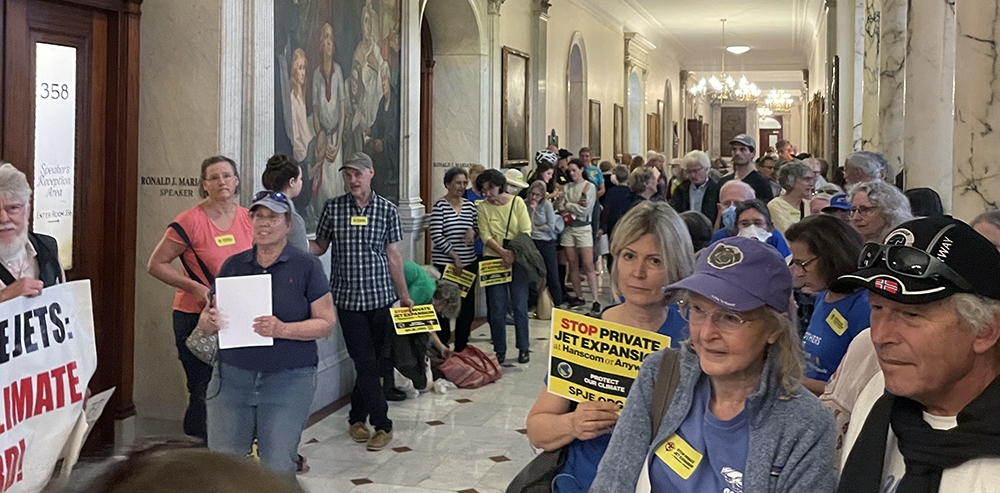
Lincolnites were out in force at a State House rally that one of us (Alex) MC’d on Monday, Oct. 2 and took part in presenting Gov. Maura Healey with a petition opposing private jet expansion at Hanscom Field or any airport.

Over 10,000 Massachusetts residents from around the state signed the petition expressing their opposition to the Massport plan to build 26 new private luxury hangars at Hanscom covering 500,000 square feet.

We reminded the crowd of 240 people that “we are here today supporting our governor, who has promised to be our climate protection champion. We are in here in solidarity with her administration, because we need her to show us that protecting the climate was not just a promise for her campaign, but an essential principal that will guide every decision she makes while she is in office.”

From the steps of the State House, speakers including State Sen. Mike Barrett (click here to read his remarks), Chuck Collins from the Institute for Policy Studies, Diane Proctor of the Concord League of Women Voters, and Chris Marchi of East Boston’s nonprofit advocacy group AIR, Inc., explained how Massport’s plans are a direct and immediate threat to Massachusetts’ efforts to combat climate change.

Perhaps the most compelling speaker was Lexington fifth-grader Kalea Foo, who also presented the printed petition to Gov. Healey’s staff. Speaking on behalf of the next generation, she reminded the adults that they need to do everything possible to preserve a safe climate and reduce our reliance on fossil fuels.

For people wondering “what’s next” in the process, there is a draft environmental impact report expected from the developers this fall, possibly in October. It will be reviewed by the administration, and there will be a public comment period. In the meantime, citizens can help by contacting the governor and urging her to use her all her power and authority to get Massport to cancel the plan.

For more news coverage on the rally, see this WGBH article. Background can be found in the Lincoln Squirrel (February 12 and February 5), the Bedford Citizen (numerous articles and opinion pieces), and this September 29 editorial in the Boston Globe, as well as the Stop Private Jet Expansion web site.

Want to help? Join the coalition, donate money, and show up to our Tuesday afternoon “stand-outs” at the Paul Revere Capture Site in the Minute Man Historic Park on Route 2A. We are there every Tuesday from 4–5 p.m. We have signs and banners, so just bring yourself!

rally
rally-inside2
rally-chatfield


“My Turn” is a forum for readers to offer their letters to the editor or views on any subject of interest to other Lincolnites. Submissions must be signed with the writer’s name and street address and sent via email to lincolnsquirrelnews@gmail.com. Items will be edited for punctuation, spelling, style, etc., and will be published at the discretion of the editor. Submissions containing personal attacks, errors of fact, or other inappropriate material will not be published.

Category: Hanscom Air Field, land use 2 Comments

The Commons returns with another expansion proposal

October 4, 2023

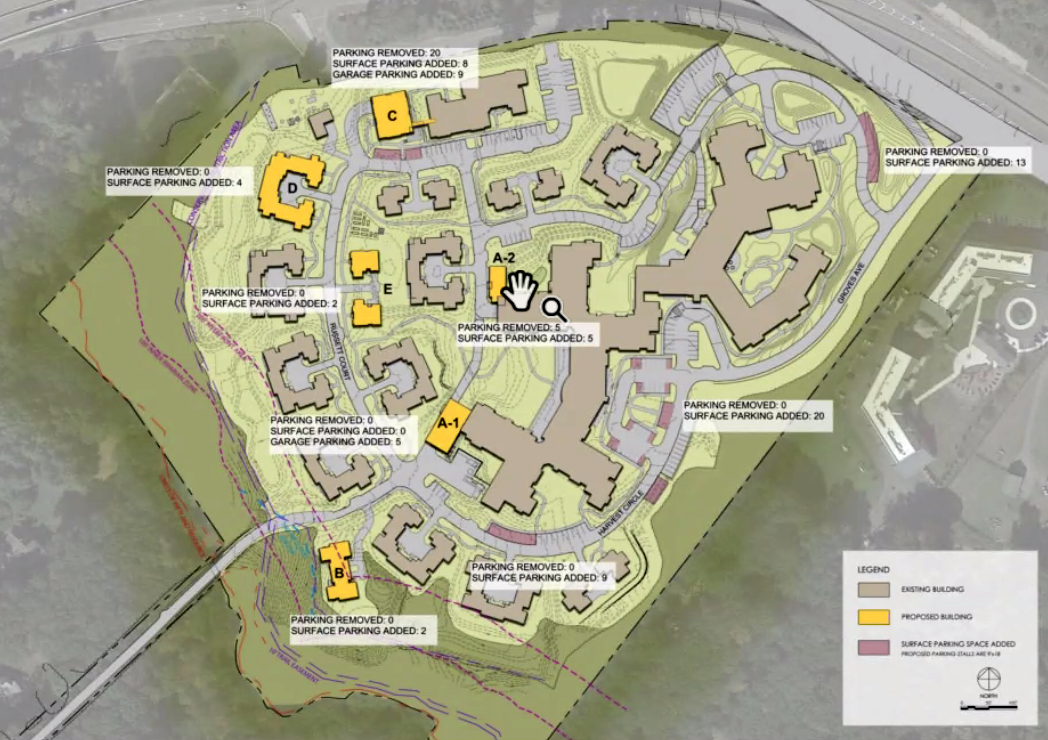
A sketch showing where new units (in yellow) and surface parking (purple) are proposed at The Commons. Additional parking not shown will be located under new units. Click image to enlarge.

The Commons in Lincoln is proposing to add 28 independent living units to its campus, down from 47 it sought in 2022. The earlier proposal was withdrawn in February 2023 after vehement protest from current Commons residents, who said they were blindsided by the plan and wanted significant input on how (or even if) to expand.

The Commons is owned by New England Life Plan Communities, which bought it in January 2022 from Benchmark Senior Living, though Benchmark was retained for day-to-day management of the facility. 

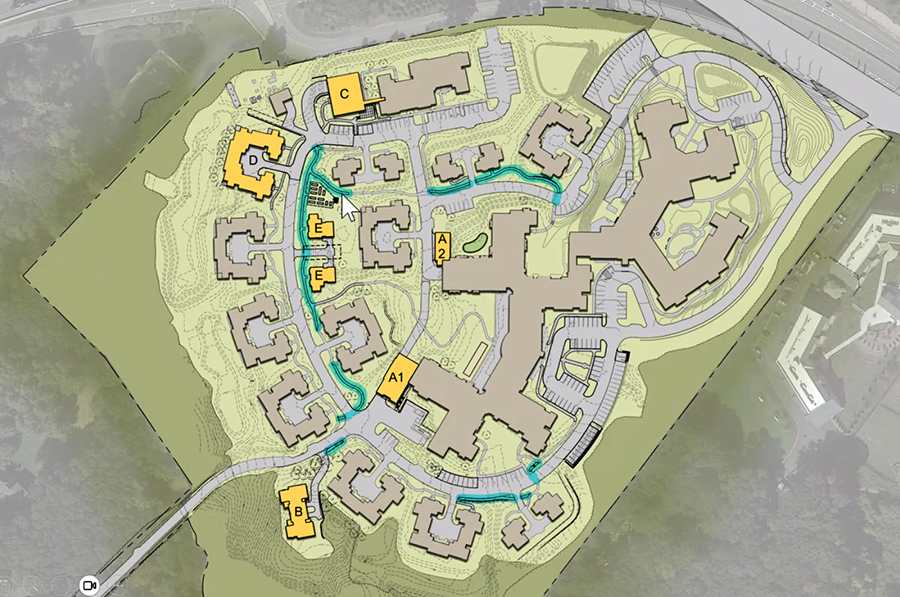
NELPC wants to build 14 two-bedroom units in the Flint building, six one-bedroom units in the Russell building, and eight new cottages. Plans also call for adding 77 surface and garage parking spots for a net gain of 52 after 25 are removed. A 1962 house near the Cider Lane entrance would be demolished to make room for one of the new structures. The community garden will also be reduced in size, though smaller plots will be created in other parts of the campus to compensate, and walking paths will be added in various places.

The work would start with the parking additions (in particular, spots cut into the hillside facing the main entrance) to alleviate congestion as much as possible during construction. Eight of the 30 units in Flint house are affordable, and the project would add four more of that type. The new cottages will be built to follow the latest opt-in building code.

The project is necessary to “increase long-term financial stability” and make previously planned capital improvements in other parts of the campus; the project “expedites that work,” said Ryan Herchenroether, senior project manager with owner’s representative OnePoint Partners. Independent living units are the bread and butter of continuing care communities like The Commons, he noted. The project would increase the proportion of those units from 65% to 69%, which is still less than Brookhaven at Lexington (82%) or Waterstone of Lexington (74%).

Because The Commons is in a zoning overlay district with specific conditions, a two-thirds majority approval is required at Town Meeting for the plan to go forward. NELPC will also need a special permit from the Planning Board and signoff from the Historical Commission and Conservation Commission. “If we’re under construction a year from now, that would be a success,” Herchenroether said.

Proposed new walking paths are shown in bright green. Click image to enlarge.

Officials from The Commons said at a well-attended October 3 multiboard meeting that they had listened to residents and would make every effort to minimize disruption during construction. However, “I don’t want to portray that every single resident is on board with this plan,” Herchenroether acknowledged.

Dozens of those residents and their family members attended the meeting via Zoom to express their displeasure. Some whose units adjoin the proposed additions protested the loss of windows or unobstructed views (“It looks as if my sunset years will be minus the sunsets,” quipped Mark Byers), while others questioned the financial necessity for the project.

“Without accurate financial reporting, it’s impossible to evaluate the true state of the community,” said Michael Kaminer, son of a Commons resident. He read from a letter signed by many family members of Commons residents that was sent to the Planning Board and asserted that there were many others against the proposal who were afraid to speak up due to fear of “retribution” from staff. He also said that the dining and cleaning services “are already understaffed and the quality of service has decreased” and wondered how the organization would fix those problems while also adding space and capacity.

Joyce Phillips, whose Russell Building unit would be directly affected by the project, said that staff had offered to move her temporarily to another unit while work was under way and then returning her to the original one afterwards. “I have no interest in moving. I moved to The Commons so I wouldn’t have to move again in my lifetime,” she said, adding that she and others are “too old to live through the noise, dust, and construction.”

Earlier in the meeting, Select Board member Jim Hutchinson asked if NELPC might offer inconvenienced residents the right of first refusal to buy one of the new units — something Herchenroether said they would look into.

“There’s a minimum unit count that would make it feasible to help pay for refurbishments and updates to the Flint Building,” said Ryan Larkin, a financial analyst with OnePoint Partners. The added revenue generated from the new Russell units and cottages “can be reinvested across campus… Independent units boost our operating margin and give us more cash [for operations] and make us less reliant on entrance fees.”

Judy Foster, president of the Resident Council at The Commons, agreed that the 2022 proposal “was like a bomb hit the community. Everyone was up in arms… they couldn’t have done a worse job if they’d tried.” Since then, there have been numerous meetings with the council as well as the Steering Committee and more than two dozen other resident groups and clubs  to explain ideas and solicit feedback.

“The expansion will impact many of our residents, some more than others,” she said. “I’m so sorry that everybody couldn’t come out of this unscathed,” but the benefits from deferred-maintenance projects and other improvements will make it worthwhile.

“You say there’s a lot of cash flow but residents see deferred maintenance and services. And you say there’s lots of demand. I’m confused — there’s plenty of money, there’s not enough money…” said Becky Regan, who has a parent at The Commons. “I want much clearer financials before the hearing.”

As of Wednesday night, OnePoint had not replied to questions sent by the Lincoln Squirrel after Tuesday’s meeting. 

The Planning Board will hold a public hearing on the proposal on November 21. There will also be a public session at the Lincoln Public Library on Wednesday, Oct. 11 from 10 am.–2 p.m.

Category: land use Leave a Comment

Third multifamily rezoning option omits North Lincoln

September 27, 2023

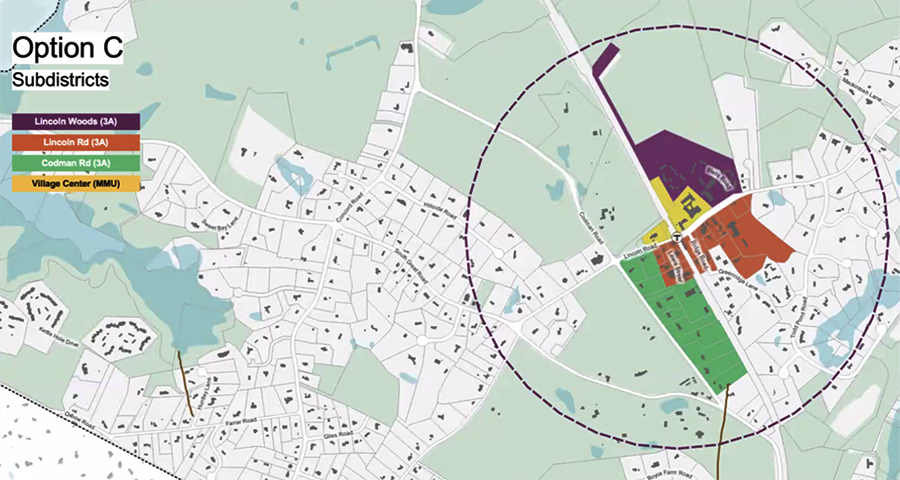
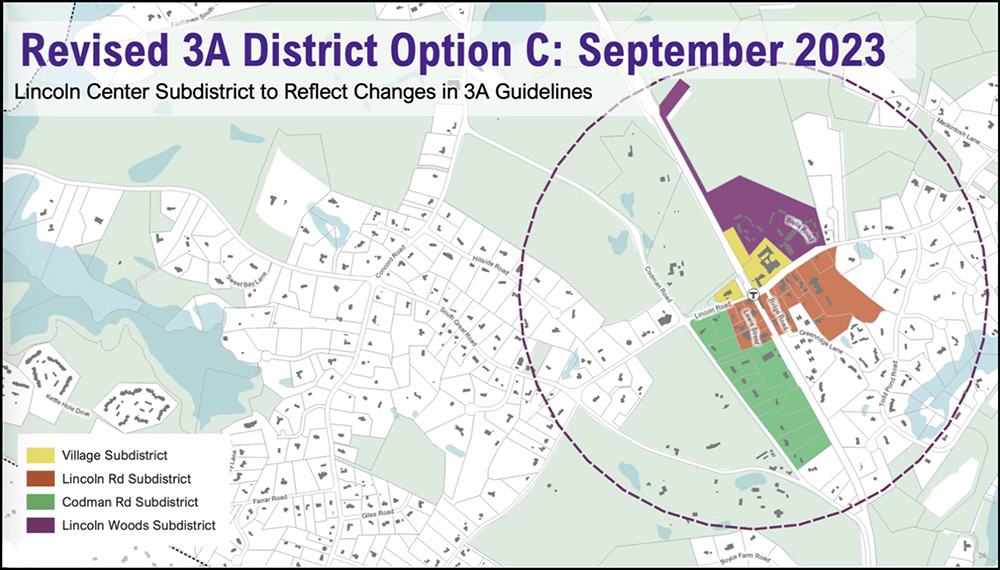
The new HCA Option C includes the mall (in yellow) but not any parts of North Lincoln. The dotted circle indicates the required half-mile radius from the train station in which some multifamily housing must be allowed. Click image to enlarge.

Thanks to a change in state guidelines for complying with the Housing Choice Act, Lincoln now has the option of creating a single multifamily district around the train station without involving parts of North Lincoln — unless residents decide they want to rezone those areas.

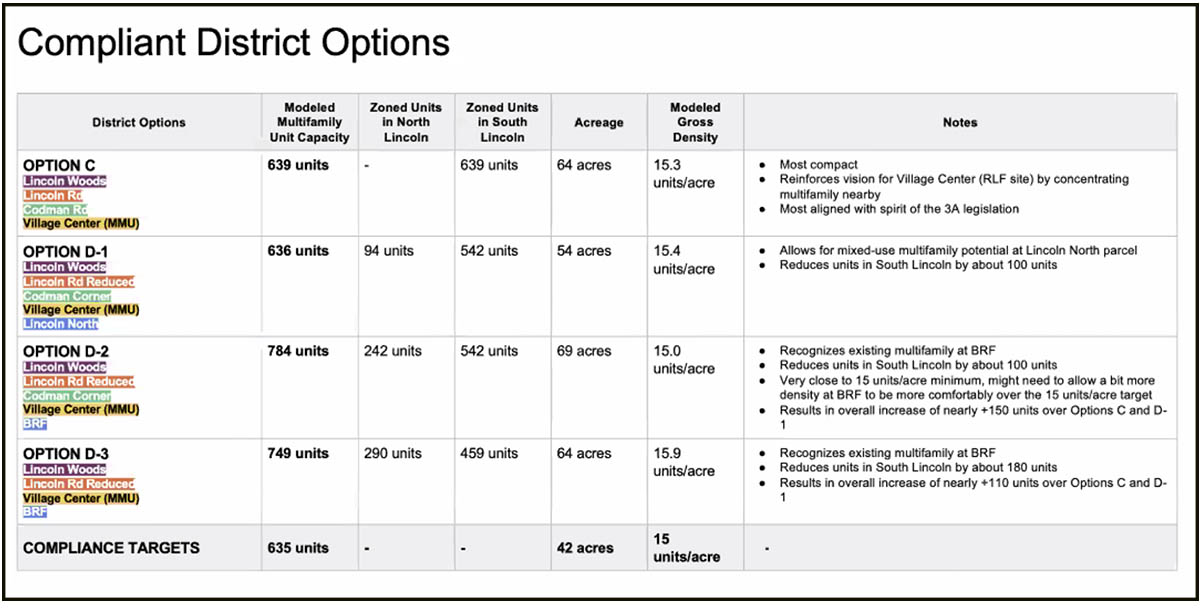
Residents will see three rezoning options at the State of the Town (SOTT) meeting on Saturday, Sept. 30 starting at 10 a.m. The first two were formulated by the Housing Choice Act Working Group (HCAWG) and consultant Utile before the state’s change in August. Both include three subdistricts in South Lincoln (excluding the mall) as well as either (A) a Lincoln North mixed-use subdistrict or (B) a Battle Road Farm housing subdistrict.

Before August, towns couldn’t allow commercial development in a multifamily housing district as part of their plan to comply with the HCA. This meant that redeveloping the mall as a mixture of ground-floor commercial and housing on the second and third floors wouldn’t satisfy HCA’s multifamily housing requirements, and the mall would have to be rezoned separately in order to allow housing there.

Now the state says that towns can count multifamily housing units they allow in commercial areas. As a result, the two rezoning efforts (HCA compliance and redeveloping the mall) can be folded into a single Option C that includes four South Lincoln subdistricts and none in North Lincoln.

In Lincoln’s rezoned HCA or “3A” subdistricts (named after the relevant section of state law), multifamily housing at 15 units per acre for a total of at least 635 units must be allowed by right, without the need for a special permit or Town Meeting approval. That housing may not be age-restricted, and commercial uses can’t be required in those districts, though now they are allowed since the August change.

The new option met with general approval among officials and residents at a Planning and meeting on September 26 — to the point where some questioned why Options A and B were even still on the table. Given the recent change in HCA guidelines, the town should simply “take the win and go home” rather than add the complexity of offering two other rezoning options, said resident Vicky Diaduk.

“We felt it was worth having a discussion in town and getting people’s feedback to see if there was an overwhelming feeling about one or the other of the options,” Select Board member Jennifer Glass said. In conversations with Battle Road Farm residents, some were in favor of the idea of allowing a coffee shop or a few retail locations in their neighborhood, she noted. (However, as Diaduk pointed out, residents can propose rezoning those areas or any others in the future if they decide they want to.)

HCAWG will host a neighborhood conversation about the proposed HCA zoning options on Thursday, Sept. 28 at 7 p.m. in the Lincoln Woods Community Room (50 Wells Rd.). They have also posted an updated set of FAQs that address issues including the consequences of noncompliance with the HCA (go to the HCAWG page and scroll halfway down to “FAQs – updated September 17, 2023”).

At Saturday’s State of the Town meeting, officials will gather feedback about which of the three zoning options that residents prefer. On October 10, the Select Board, Planning Board, and HCAWG will formally select one option to submit to the state for preapproval in December. Residents must then vote on that rezoning proposal at the Annual Town Meeting in March. That vote requires a simple majority. In past years, zoning changes required a two-thirds majority to pass, but the state changed that requirement as part of the HCA. Affected towns have until December 2024 to have a new multifamily zoning plan in place.

The SOTT meeting will also include presentations and discussion on three other topics: the proposed community center, the town’s new Climate Action Plan, and the Inclusion, Diversity, Equity, & Anti-Racism Action Plan.

Mall redevelopment

Any of the three rezoning proposals would allow the Rural Land Foundation, which owns the mall,  to redevelop the main building (Donelan’s and the post office/restaurant building are not being considered as part of this). Civico (which built Oriole Landing) and town officials will work toward a mutually agreeable design; the RLF would then convey the property to the company via a sale or long-term lease. The RLF/Civico partnership is necessary because the town does not have the resources to do the project itself.

The town is also working with The Community Builders, which owns Lincoln Woods, to design an upgrade to the wastewater treatment plant that serves that housing and the mall. That upgrade will also allow development on the town-owned MBTA parking lot at the back of the mall. State grants — which will be mostly unavailable to the town if it doesn’t approve the new 3A zoning — are expected to offset some of the upgrade cost. Construction will be phased to accommodate the existing anchor tenants.

It’s too early in the process for Civico and the town to develop a concrete proposal, other than the general plan of putting two stories with about 50 housing units above the ground-floor retail portion of the mall. Planning Board member Ephraim Flint expressed concern that lack; “without it, you put the [rezoning] vote at risk,” he said. However, because there is already an interested developer, the mall project will likely come to pass in the next few years. Properties in the other districts would need to attract developers to actually result in more housing — a longer-term prospect, officials noted.

Category: land use, South Lincoln/HCA* Leave a Comment

Property sales in July 2023

August 29, 2023

15 Oak Meadow Rd. — Sean Crovetti to Taylor Ortiz and Veronica Lei for $1,407,500 (July 31)

5 Red Maple Lane — John P. Neri Trust to Xida Sun and Yuan Zhao for $895,000 (July 26)

11 Sunnyside Lane — Chung Yao Chao to Brett Cramp and Maria Obolensky for $961,000 (July 25)

154 Chestnut Circle — Christine McElvenny to Jonathan Wolfson for $810,000 (July 25)

4 Farrar Rd. — Mary Steedly to Thomas Martin and Martha Davis for $1,200,000 (July 17)

93 Tower Rd. — Seppo Rinne to Charles Libby and Lindsay Lawrence for $1,370,000 (July 14)

140 Lincoln Rd. — Esther Kalisky Trust to Jeffrey Exelrod and Sharon Milinsky for $540,800 (July 7)

Category: land use Leave a Comment

Property sales in May 2023

July 26, 2023

8C North Commons — Shanshan Yue to Aditi Agashe and Radhakrishnan Srinivasan for $445,000 (May 30)

82 Virginia Rd. #A102 — Anne Coyle to Harold Posgate for $216,706 (May 31)

47 Deerhaven Rd. — Thomas Griggs Jr. to Clary Realty Trust for $1,100,000 (May 1)

24 Sandy Pond Rd. — Geoffrey Hargreaves Heald to Douglas A. Melton Trust and Gail A. O’Keefe Trust for $1,950,000 (May 31)

58 Weston Rd. — Joachim Fruebis Trust to Vincent Roche 2004 Trust for $3,250,000 (May 1)

139 South Great Rd. — Lawrence B. Cohen Trust to Ethan Litman and Cara Sunberg for $1,007,000 (May 8)

140 Lincoln Rd. #115 — Mary S. Cancian Trust to Kathleen Stewart for $418,000 (May 8)

136 Weston Rd. — Jude McColgan to 126 Weston Rd. Nominee Trust for $2,480,000 (May 31)

194 Lincoln Rd. — Umar Ashad to Benjamin Shiller and Laurie Gray for $1,920,000 (May 16)

300 South Great Rd. — Daniel A. Nelson to Robert Haslinger and Rheinila Fernandes for $1,764,750 (May 11)

Category: land use Leave a Comment

New zoning option includes more South Lincoln land

July 13, 2023

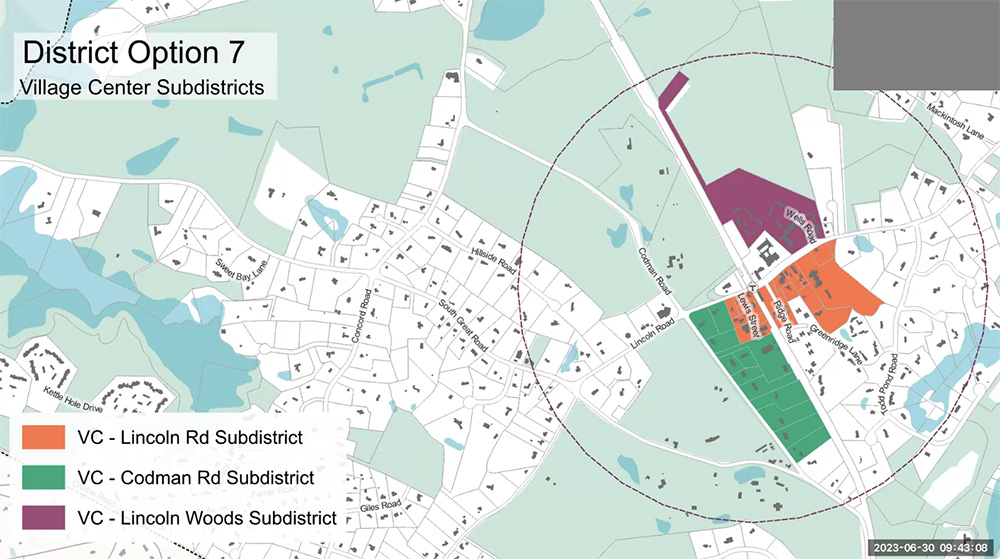
Option 7 for rezoning Lincoln to comply with the Housing Choice Act. Not shown is a fifth subdistrict encompassing the Lincoln North office park. (Click image to enlarge).

To comply with the Housing Choice Act, town officials are considering a new multifamily zoning district in addition to those that were previously examined after consultants refocused on the village center in response to feedback at two public forums on June 16 and June 20.

The HCA requires Lincoln to approve new zoning that would allow at least 15 multifamily housing units per acre and a total of 635 units on a total of 42 acres. The final district can include several subdistricts in various locations as long as several requirements are met (i.e., one of the subdistricts must account for at least half of the district’s total land area, 20% of the land must be within half a mile of the commuter rail station, all the land targeted must be developable, and existing properties may not be divided into more than one new zone). 

Five initial subdistricts were presented on June 6. Two combinations of those subdistricts met all state requirements. Both included several South Lincoln parcels around the intersection of the railroad tracks and Lincoln Road. One of them also included a 39-acre Battle Road Farm/Lincoln North/MinuteMan parcel, while the other included a 37-acre Commons of Lincoln/Oriole Landing segment instead.

Two new options discussed at the Housing Choice Act Working Group meeting on June 30 (video here) include subdistricts of various shapes in the South Lincoln village area as well as some land in North Lincoln. One variation, Option 6, probably isn’t viable because it’s uncomfortably close to the minimum HCA requirements around wetlands and other exclusions. “This is sort of a precarious version, threading the needle a little too much,” said Zoë Mueller, an urban planner with consulting firm Utile.

Option 7, which Utile is recommending to the town, includes:

  • Lincoln Woods, which now has 125 units but would be allowed to have up to 159.
  • A Lincoln Road subdistrict encompassing both sides of Lewis Street east to Ryan Estate and 136 Lincoln Rd., including the first rectangular Ridge Road condo building but not the “flying nuns”.
  • A Codman Road subdistrict bounded by Codman Road to the west, Lincoln Road to the north, the railroad tracks to the east, and 108 Codman Rd. to the south. The DPW site is inside that subdistrict but can’t be included in the housing calculation.
  • The Lincoln North office park property, but not Battle Road Farm or other parcels in the area.

None of the proposals that have been discussed include the Lincoln Mall because the HCA says that towns can’t require multifamily housing in commercial districts. In a separate plan, the town hopes to redevelop the mall in partnership with Civico Inc. to as a three-story building with businesses on the ground floor and residences on the two floors above. That rezoning proposal, which may also end up including the Doherty’s Garage property, will require separate voter approval at Town Meeting.

Option 7 “very comfortably”  meets state guidelines, Mueller said. “This was a really good outcome, I think, responding to a lot of the feedback that was provided.”

Some of the earlier ideas would have allowed significantly more total units that the HCA requires, so some of the feedback included questions about “whether we could get closer to what our [minimum] target was,” said Select Board member Jennifer Glass. Others wondered why the proposals included so much land around Oriole Landing and North Lincoln. There is an MBTA bus stop in North Lincoln but the train is far more heavily used by commuters and others, which the HCA aims to encourage.

If approved at Town Meeting in March 2024, the rezoning would allow affected property owners to build (or sell to a developer to build) denser housing on their land, but no one would be required to sell. Construction on the site of an existing condominium development would require approval or sale by every condo owner. Any multifamily development would also be constrained by septic and parking requirements.

Category: land use, South Lincoln/HCA* 2 Comments

Property sales in April 2023

July 5, 2023

140 Lincoln Rd. #111 — Correia Family Limited Partnership to Elizabeth Szekely for $575,000 (April 29)

38 Lincoln Rd. — Matthew Cummings to Thomas and Hayley Wilcox for $1,623,000 (April 28)

110 Concord Rd. — Frank Forti to MDEpaula LLC for $780,000 (April 21)

80 Trapelo Rd. — Anthony Buendia to Kevin Kingman and Abigail Wattley for $2,447,500 (April 14)

21 Blackburnian Rd. — Mary Williamson to Mario Chiuccariello and the 21 Blackburnian Rd. Nominee Trust for $2,400,000 (April 14)

Category: land use Leave a Comment

Mall redevelopment coming sooner than state-mandated rezoning

June 25, 2023

An illustration of what the mall building might look like if the area was rezoned to allow 25 units of housing per acre. This sketch shows a denser massing of 42 units per acre at the front of the subdistrict, which would be balanced by a lower concentration of housing in the rest. Donelan’s is in white at left rear.

Rezoning to comply with the Housing Choice Act may some day result in more multifamily housing in South Lincoln and perhaps other areas, if developers are interested — but change is probably coming much sooner to the mall. Civico, which designed and built Oriole Landing, is poised to redevelop the mall’s main building with more commercial space and housing — assuming a separate rezoning proposal is approved by voters.

In the second of two public forums on June 20, consultants recapped their June 6 presentation about rezoning options to comply with the HCA. The law will require Lincoln to allow at least 15 housing units per acre (for a total capacity of 635 units) on parcels of land totaling at least 42 acres, 20% of which must be within half a mile of the train station — click here to see the updated slide deck.

Running alongside the HCA work is a separate effort to rezone just the mall area with the goal of encouraging more commercial use while also adding housing above stores in the main building (the post office and restaurant buildings would not be affected). One of the HCA’s stipulations is that commercial use can’t be required in the rezoned areas, but the Rural Land Foundation (owners of the mall) and Civico are proposing a new subdistrict that would pave the way for a mixed-use buildout by right with improved commercial space and 25 multifamily housing units per acre. The subdistrict would include the commuter lot on the east side of the railroad tracks.

“We need to think holistically about this area,” Select Board Jennifer Glass said. “These two kind of work together — two ideas with one zoning package.” The two proposals — a preferred rezoning option selected from five viable HCA concepts, and the mall subdistrict — will be presented at the State of the Town meeting on September 30 and submitted to votes at Town Meeting in March 2024.

“Without a mall subdistrict, it’s highly unlikely we’ll be able to revitalize the mall in keeping with Lincoln’s values and rural character,” said Michelle Barnes, chair of the Lincoln Land Conservation Trust/RLF Board of Trustees. This effort would go beyond the HCA moves (which simply allow denser housing but do not require anyone to build them) because the RLF already has a development partner and a preliminary sketch of a project.

Civico, a developer that is “known to and trusted by the town,” went through the arduous Town Meeting approval process for Oriole Landing but has indicated that “they would not be willing to do so again,” Barnes said.

The mall project would actually allow Lincoln to respond more quickly to the area-wide housing crisis and the state’s push for more transit-oriented housing, she added. If all goes as planned, Civico and the town (which does not have the resources to redevelop the mall on its own) would collaborate on a project in keeping with the town’s character, with the sale of the mall contingent on such a design.

One stumbling block to redevelopment is the age and limited capacity of the wastewater treatment plant that services both the mall and Lincoln Woods. The plant is owned by TCB (The Community Builders, Inc.). Paula Vaughn-MacKenzie, Director of Planning and Land Use, said that the RLF is working with TCB on a plan for upgrading the plant, but the financial details are still unknown. However, the town already received $400,000 from the state in late 2021 to design an upgrade.

TCB and Civico are “both more than confident that they would be able to get a Massworks grant for the mall project as long as the town complies with the HCA,” Barnes said.

Massworks grants are often in the millions and could pay for more than half of the project, Vaughn-MacKenzie said. Even if the HCA weren’t in the picture, “the state would be thrilled [with the mall project]. It’s just the type of project they’d want to support,” Vaughn-MacKenzie said.

Town rezoning approval for a mall project funded by Civico and the state would be a big plus for Lincoln, which would broaden its tax base as well as improve housing and commercial options there, said Planning Board member Gary Taylor. “Right now everything seems to be aligned in trying to make this happen.”

Lexington is the first town to approve rezoning to comply with the HCA while also encouraging improved commercial use. The measure was the subject of articles in the Boston Globe and the New Yorker.

Category: land use, South Lincoln/HCA* 1 Comment

Rezoning ideas to comply with HCA and redevelop mall are aired

June 8, 2023

The five parcels proposed for multifamily rezoning (click to enlarge). Some combinations of four of them would satisfy HCA requirements.

Five parcels of land in Lincoln have been identified for possible multifamily rezoning to satisfy the state Housing Choice Act, according to a consultant hired to help the town comply with the law. In a separate effort, the Rural Land Foundation is also proposing to rezone the area occupied by the Mall at Lincoln Station to allow redevelopment of the mall along with multifamily housing.

The HCA and mall initiatives were both presented at a multiboard meeting led by the Housing Choice Act Working Group on June 6. There will be two public forums later this month where residents can get information and ask questions, and more detailed proposals will be presented at the State of the Town meeting in September in preparation for a vote at Town Meeting in March 2024.

The state law aims to encourage more transit-oriented zoning areas on land surrounding MBTA stops by mandating “by right” zoning of at least 15 units per acre across the district. Lincoln, which has two MBTA stops (the train station and bus stop), must allow a total of 635 units.

The timeline is tight because the HCA requires commuter-rail towns such as Lincoln to have a rezoning plan in place by 18 months from now. Plans must be presented prior to a townwide vote ahead of time to the state Department of Housing and Community Development, which (along with the Attorney General’s Office) must also sign off after voter approval at Town Meeting — all by December 2024.

Early proposals for rezoning parts of Lincoln have identified five candidate parcels, four of which together would allow enough multifamily units to satisfy the HCA. Three of the parcels are in South Lincoln near the train station; the others are in north Lincoln around Oriole Landing and the Lincoln North office complex. Four of the five possible subdistrict combinations would meet all the conditions.

“You have options as a town. This is a good place to be,” said Will Cohen of consulting firm Utile Design.


  • Download the Powerpoint slide deck from the June 6 multiboard meeting

Towns aren’t required to create a single multifamily district; they may split it up into several nonadjacent subdistricts. However, the work to determine which areas would together meet state requirements is constrained by a complicated set of rules and formulas. For example, one of the subdistricts must account for at least half of the district’s total land area; all the land targeted must be developable (i.e., not conservation land or wetlands); and existing properties may not be divided into more than one new zone.

In Lincoln, the district must total at least 42 acres, and 20% of that land must be within half a mile of the commuter rail station. Some of it may also be around the bus stop at the corner of Hanscom Drive and Old Bedford Road. The working group focused on those areas as well as others that already have multifamily housing.

Additional wrinkles:

  • Since the HCA is aimed at residential zoning, commercial use cannot be required in a compliant district (though it may be allowed). This limits the ability to require mixed-use development in places like South Lincoln.
  • Lincoln now requires 15% of the units in multifamily developments to be income-restricted, but the HCA doesn’t have any requirements around affordability. In fact, if a town wants to have a zone mandate that more than 10% of the units are affordable, it must pay for an independent feasibility study that will demonstrate that that local requirement will not hurt the economic viability of a proposed project. Lincoln has already taken steps to have such a study done.

Lincoln and other towns can require developers to submit a site plan review and comply with reasonable design guidelines relating to traffic circulation, screening, lighting, etc., but “they can’t put out guidelines that make it impossible to do something,” Planning Board member Margaret Olson noted.

Finance Board member Andy asked if the state would pre-approve several rezoning proposals and allow voters to choose which one they preferred. “Lincoln has a history of getting state approval, [then] turning things down at Town Meeting and getting in a bind,” he said, referring to the school project that was pre-approved and partially funded by the state but was subsequently shot down at Town Meeting in 2012.

“That’s a great question that I don’t know the answer to,” Cohen said.

The HCAWG public forums will be on:

  • Friday, June 16 at 8 a.m. in person at the Town Hall
  • Tuesday, June 20 at 7 p.m. via Zoom — click here to register.

Redeveloping the mall

Along a parallel path in recent years, the Rural Land Foundation has been thinking about how to redevelop and revitalize the Mall at Lincoln Station to make it more attractive to commercial tenants and encourage multifamily housing. They propose to create a mall subdistrict that could accommodate 42 housing units above the building now housing the Bank of America and other stores (the portion with the post office and restaurant would not be affected).

“We though that looked pretty nice and in keeping with a town village center feel,” said Michelle Barnes, chair of the Lincoln Land Conservation Trust/RLF Board of Trustees, as she showed a rendering of one idea. “Greater density doesn’t have to look as scary as we might think.”

An artist’s rendering of one concept for how the mall might look after rezoning and redevelopment. Donelan’s is the white building at left rear.

As a commercial use, the mall area can’t be in the HCA district, as noted earlier. Instead, the town could rezone the mall to allow mixed use by right while also ensuring that commercial space is preserved.

A better quality of commercial space is crucial for the economic viability of the mall, which the trustees see as “an increasingly risky and hard-to-justify fiduciary obligation of the RLF,” Barnes said. However, without the opportunity for a developer to create a viable mixed-use project, the value of the mall will decline and the RLF will probably need to sell it (which it may have to do in any case).

RLF doesn’t have the capital to redevelop the mall by itself, so the group is working with CIVICO, which won approval for and built Oriole Landing before selling it in 2022. The RLF and CIVICO are conceptualizing a project with the idea that the mall would eventually be sold to the company, but contingent on an agreed-upon design “in keeping with the town’s ethos and values” that’s developed with input from residents and town leadership, Barnes said. To guarantee long-term financial viability for the project, a minimum of 25 housing units per acre built above the commercial spaces would be needed, she added.

Along with the HCA proposal, a mall rezoning measure will be presented at the State of the Town meeting on September 30 and at Town Meeting in March 2024.

Category: land use, news, South Lincoln/HCA* 2 Comments

Meeting, public forums to tackle town’s options under Housing Choice Act

May 14, 2023

The Housing Choice Act Working Group (HCAWG) has scheduled a virtual multi-board meeting and two public forums in June to discuss the town’s path towards compliance with the state housing law.

The goal of the Housing Choice Act is to create more transit-oriented zoning areas (meaning areas surrounding MBTA stops including Lincoln’s train station) where multifamily housing is allowed by right. Under the updated guidelines released last fall, Lincoln would be required to allow either 692 or 563 units in one or more multifamily zones, depending on whether or not the Hanscom housing units are counted. In March, HCAWG met with consultants from Utile Design to review how the state calculates developable land and to walk through an initial analysis of current zoning in Lincoln to begin identifying areas that might be logical places for rezoning. 

The meeting co-hosted by the Select Board and the Planning Board will be on Tuesday, June 6 at 7 p.m. Click here for the Zoom link. The public forums will be:

  • Friday, June 16 at 8 a.m. in person at the Town Hall
  • Tuesday, June 20 at 7 p.m. via Zoom — click here to register.

Category: land use, South Lincoln/HCA* Leave a Comment

  • « Go to Previous Page
  • Page 1
  • Interim pages omitted …
  • Page 7
  • Page 8
  • Page 9
  • Page 10
  • Page 11
  • Interim pages omitted …
  • Page 38
  • Go to Next Page »

Primary Sidebar

Recent Posts

  • Town gets grant for climate-friendly library HVAC system June 29, 2026
  • Board mulls social media policy, OK’s bikes on part of new trail June 29, 2026
  • Five graduate after 13 years together as Girl Scouts June 25, 2026
  • Legal notice: Historical Commission (58 Codman) June 25, 2026
  • Legal notice: ZBA (July 9, 2026 hearing) June 25, 2026

Squirrel Archives

Categories

Secondary Sidebar

Search the Squirrel:

Advanced search

Privacy policy

© Copyright 2026 The Lincoln Squirrel · All Rights Reserved.