(Editor’s note: This article originally appeared in the Lincoln Agricultural Commission’s Fall 2026 newsletter and is republished here with permission. See also the accompanying story on “The little green farm that could.”)
By the Lincoln Agricultural Commission
Lincoln agriculture is thriving, not only at well-known farms like Codman Community Farm, but also in backyards, community garden plots, orchards, conservation fields, nonprofit programs and small farmsteads across town.
This spring, the Lincoln Agricultural Commission surveyed residential households as well as larger-scale farmers, growers, nonprofit employees and others engaged in agricultural activity in Lincoln. We received 92 responses.
Survey Highlights
- 81 respondents live in Lincoln, and 88 reported that their agricultural activity takes place entirely within Lincoln.
- 70 respondents described their activity as household-based, compared with 13 for-profit agricultural businesses and nine nonprofit agricultural organizations.
- 55 respondents cultivate less than one-quarter acre, highlighting the importance of backyard and community-scale agriculture.
- 61 respondents have been engaged in agricultural activity in Lincoln for more than 10 years, suggesting that this activity is deeply rooted rather than temporary or new.
The results give us a broader picture of how agriculture is practiced in Lincoln today, what people are growing and raising, the challenges they face, and how the Commission might support agricultural activity going forward.
Lincolnites are growing vegetables, flowers, berries and fruit trees; composting; tapping maple trees; raising chickens and livestock; keeping bees; and producing hay, grain, forestry products and other agricultural goods.
A few high-level findings stood out (see p2). One of the clearest takeaways is that Lincoln’s agricultural ecosystem is broader than a simple distinction between “farms” and “gardens.” The survey points to several overlapping types of agricultural activity: backyard and community gardeners, small farmstead-style households, conservation land users, formal farms, nonprofit organizations and agricultural service providers.
Backyard and community-scale growers make up the largest share of respondents. Many are growing vegetables, flowers, berries and fruit trees and composting, often on and composting, often on relatively small plots and primarily for household or community use. Their most common challenges are practical ones: time, personal capacity, weather, water, pests and maintaining productive growing spaces.
The survey also highlighted a meaningful “middle” group of growers cultivating roughly one-quarter to three acres. These are often household-based rather than formal businesses, but many are engaged in diverse agricultural activity, including orchards, poultry, berries, vegetables, compost, honey and small livestock. This group may be an important part of Lincoln’s agricultural identity even though it is not always visible in a traditional view of farming.
Formal farms and nonprofit agricultural organizations reported a somewhat different set of needs. While time and capacity remain common challenges, these respondents were more likely to raise issues such as labor availability, access to land, capital, market channels, permitting, infrastructure, water and long-term viability.
The results also reinforce Lincoln’s identity as a “right to farm” town. Adopted in 2011, the town bylaw protects and encourages “the maintenance and improvement of agricultural land for the production of food and agricultural products.”
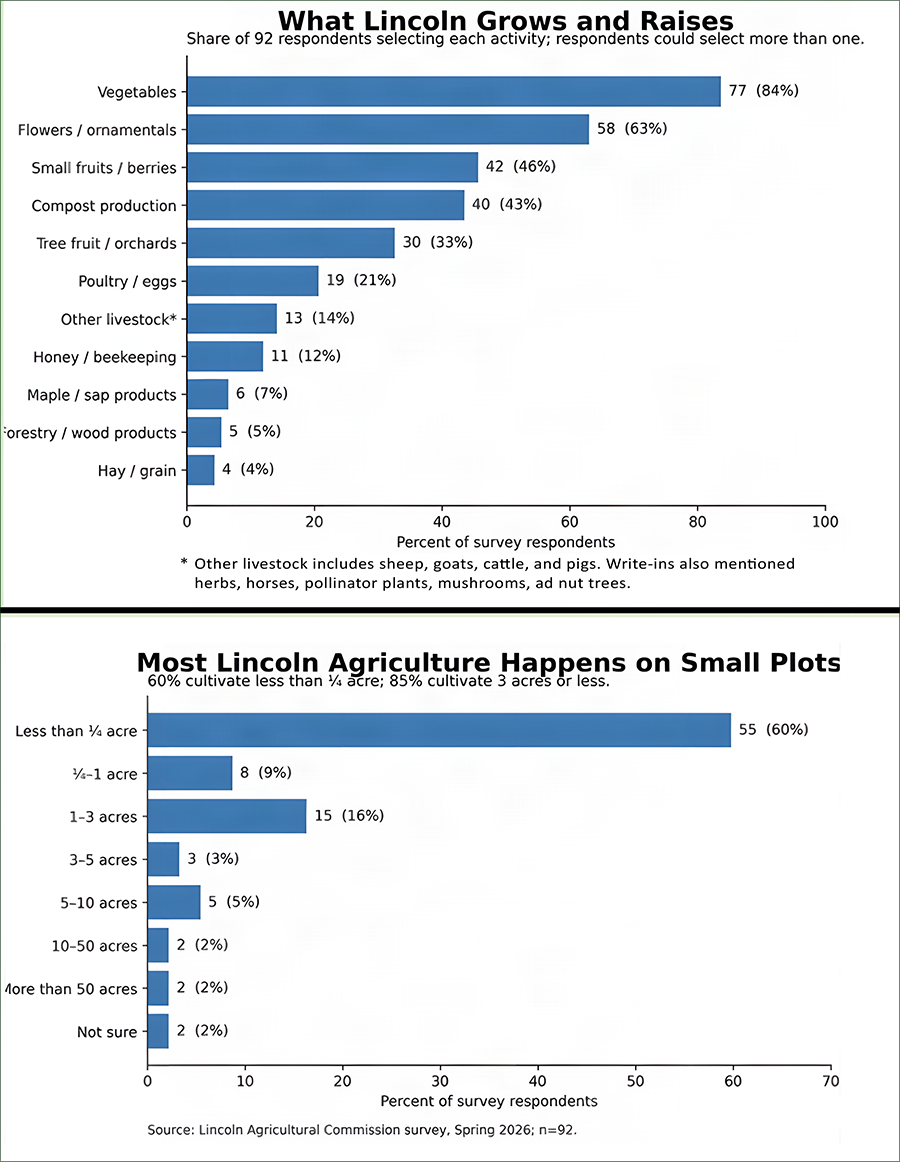
Some of the AgCom survey results (click to enlarge).
Just as importantly, the survey reinforced that agriculture in Lincoln provides value beyond revenue. Respondents described agriculture as important for local food, community connection, education, conservation, recreation, mental health and connection to place. A number of respondents also reported donating some of what they produce or expressed interest in learning more about donation pathways.
What’s next?
The Agricultural Commission is reviewing the survey results and considering several practical next steps.
One priority is expanding education and information for backyard and community growers, including simple materials for residents who want to get started growing food at home. Other possibilities include farm tours, garden walks, seasonal best-practice resources, and information on composting, water-wise gardening, wildlife and pest issues, tree fruit, poultry, livestock and donation pathways.
The Commission also plans to look at ways to expand or build upon Lincoln’s farmers market and other local channels for sharing produce, potentially creating more opportunities for backyard growers, small farmsteads and established farms to share or sell what they produce within the community.
Other areas for exploration include creating stronger connections between community growers and Lincoln’s more formal farms; better understanding the needs of the one-quarter to three-acre farmstead segment; supporting volunteerism and seasonal farm labor needs; and helping formal farms, nonprofits and conservation land users address issues involving labor, land access, infrastructure, market channels, permitting, water and long-term sustainability.
The Commission will also explore practical ways to make donation pathways easier, especially for backyard gardeners and small growers who may have surplus produce but need a simple way to connect with local food-access organizations.
The survey did not reveal one unexpected issue or one simple solution. Instead, it confirmed that agriculture in Lincoln is broad, varied, long-standing and deeply connected to the character of the town.
The Commission’s goal is to use these findings to better understand the full range of agricultural activity in Lincoln and identify practical ways to support it over time.
Thank you to everyone who completed the survey and shared it with others.
Leave a Reply