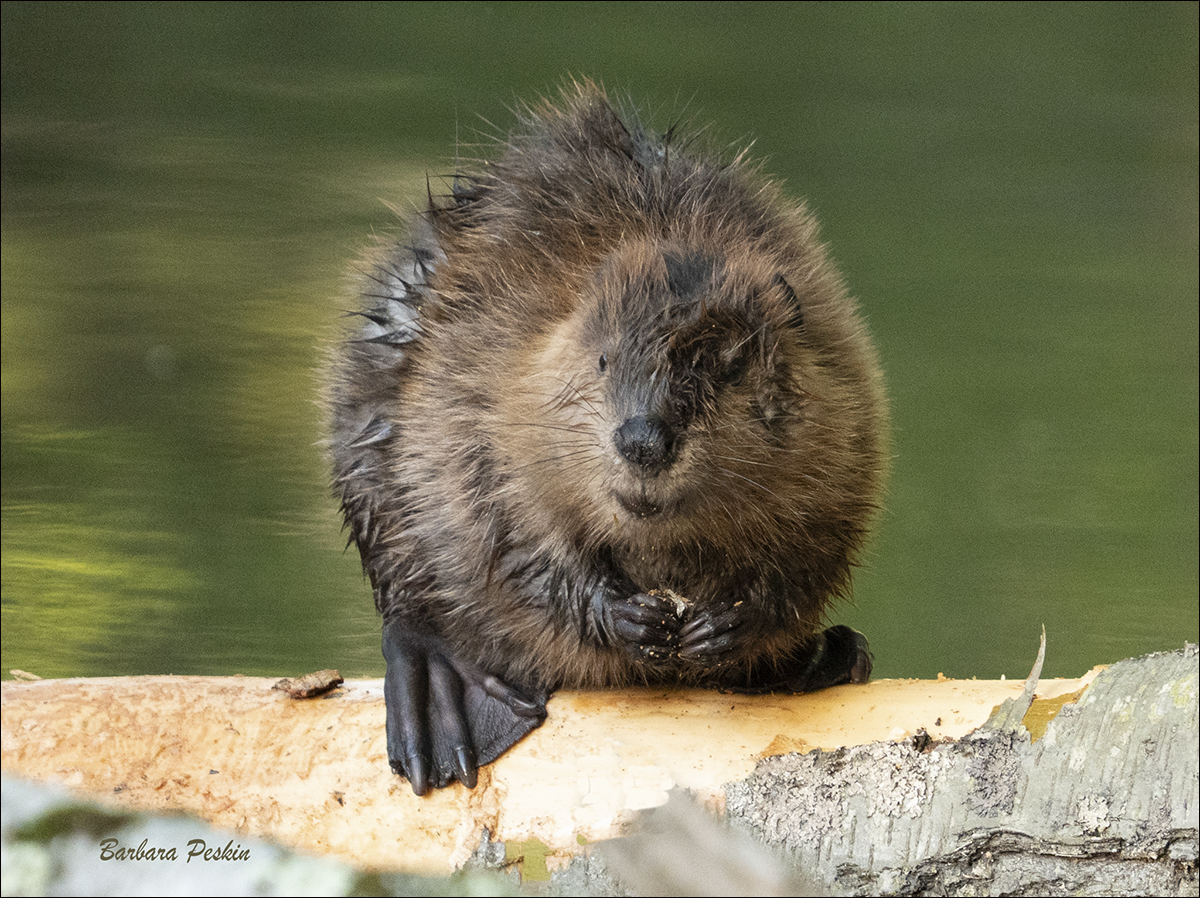
One of Barbara Peskin’s photos of Mt. Misery beavers.
Images of beavers in their natural habitat on Mt. Misery by four photographers including Lincoln’s Barbara Peskin will be on display in Concord starting on April 24.
“Beaver Life” is a show running through May 24 with an opening reception on Friday, April 24 from 5:00–7:00pm at Wright Tavern (2 Lexington Road, Concord). It’s sponsored by OARS (the Organization for the Assabet, Sudbury and Concord Rivers) as part of their 18th annual Wild & Scenic Film Festival.
Once the Mt. Misery beavers were discovered by Sudbury Valley Nature Photographers club member Jean Fain, she shared her find with three other members (Peskin, Nicole Mordecai, and Phyllis Neufeld), and they returned several times to photograph the animals.
“Barbara has a particular affinity with the Mt. Misery beavers, and has spent many an afternoon with a couple of very friendly Mt. Misery beavers. Spring, summer and fall, we’ve continued to photograph these tail-slapping creatures formerly considered pests and currently considered climate heroes. Come winter, nature’s engineers hole up in their beaver lodges out of view,” Fain said.
The women have also photographed beavers in Lincoln’s Heywood Meadow and the pond behind St. Anne’s-in-the-Fields Episcopal Church as well as Concord’s Great Meadow. But it was at Mt. Misery that Peskin and Fain met the former program director for OARS, who had the idea to put together the exhibit, Fain said.
“Little did we know that beavers would be having a moment around the time of our exhibit,” she added. Beavers are the focus of the new Pixar movie “Hoppers,” an article in Scientific American, and a new children’s book, When Beavers Move In. To top it off, April 7 was International Beaver Day.
Fain shared some of the information that the photographers learned over the course of their year-long project:
- Beavers, the largest rodents in North America, are crepuscular (active at dawn and dusk).
- Beavers are extraordinary engineers. They can hold their breath underwater for up to 15 minutes while building dams with sticks and mud.
- Beaver teeth are orange due to their iron-rich coating of enamel. Their teeth grow continuously throughout their life, but gnawing on bark and branches helps trim them down.
- Beavers slap their tails on the water to signal danger to their fellow beavers. “That sudden, loud slap also signals us humans to step away from the pond,” she said.
- Beavers mate for life, forming strong, long-term relationships that last until one partner dies. The couple works together to maintain dams, gather food, and raise their offspring (kits).
Leave a Reply