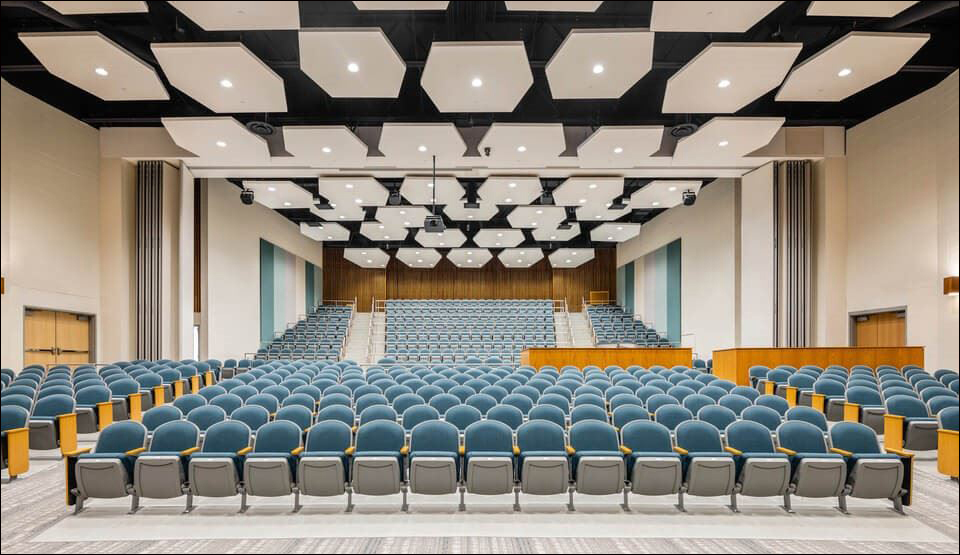
Donaldson Auditorium, the site of Town Meetings for decades.
Presenting motions in a more balanced manner and improving voting access were among the recommendations for improving Town Meeting outlined by a study committee at the Feb. 9 Select Board meeting.
The Town Meeting Study Committee was formed in October 2024 after the Annual Town Meeting earlier that year, where an unexpected amendment to the hotly debated proposed Housing Choice Act was made on the floor. Controversy swirled about who was allowed to speak, when, and from where. Shortly before the TMSC was formed, residents offered initial feedback and ideas at a kickoff session in September 2024.
One of the group’s goals was to preserve and enhance Town Meeting traditions including resident questions, discussion and deliberation, as well as greater use of the consent calendar for noncontroversial items, and gathering data on meeting metrics and overall satisfaction with the process.
“The biggest issue is the length of Town Meeting,” TMSC Chair Kenny Mitchell said. Also, presentations on warrant articles are often seen as “very one-sided [in favor of] the proponent and the town board or committee pushing it,” he added.
Respondents to a survey in fall 2025 showed that a large majority of residents wanted to see written “pro and con” summaries of warrant articles before voting. Among the recommendations to address these issues:
- Have sponsors of “high-interest” measures hold public forums with two-way discussion and feedback before Town Meeting
- Allow differing viewpoints to be presented via written pro-vs.con handouts and/or slide presentations as well as designating the two floor microphones for supporters and opponents.
The survey confirmed that the length and scheduling of Town Meeting are major barriers to participation, especially for those with young children. The TMSC therefore recommends:
- Continuing to use clickers for voting
- Enforcing the two-minute limit on speakers from the floor, and encourage article presenters to limit the number of speaking slots for other boards and commissioners who support a measure
- Considering imposing a time limit on podium speakers
- Considering scheduling high-interest items at the start of the meeting
Another idea that would require a town bylaw change is to schedule specific times for votes on specific warrant articles. The change that many people really want — the ability to participate and vote at Town Meeting remotely — would require state legislation as well as a local bylaw.
Since the pandemic, the state allowed towns to conduct other types of meetings remotely, an innovation that has been largely successful. The legislature has extended that allowance until March 2027 and there are discussions about making it permanent, but it doesn’t apply to Town Meetings.
To reduce overall confusion at Town Meeting, the TMSC recommends doing systematic educational outreach work, especially to new voters, and creating educational informational material in multiple modalities to reach a broad audience in town.
Mitchell said the next steps will be issuing a written report and scheduling public forums in person and via Zoom before the Annual Town Meeting on March 28 to review the recommendations and answer questions.
Thank you to all the members of the Town Meeting Study Committee who gave a tremendous amount of time to study the issues, gather extensive feedback through a variety of forums, and present your findings. I am really grateful for your work, and hope your recommendations are implemented.