
• Skip to primary navigation
  • Skip to main content
  • Skip to primary sidebar
  • Skip to secondary sidebar

The Lincoln Squirrel – News, features and photos from Lincoln, Mass.

  • Home
  • About/Contact
  • Advertise
  • Legal Notices
    • Submitting legal notices
  • Lincoln Resources
    • Coming Up in Lincoln
    • Municipal Calendar
    • Lincoln Links
  • Merchandise
  • Subscriptions
    • My Account
    • Log In
    • Log Out
  • Lincoln Review
    • About the Lincoln Review
    • Issues
    • Submit your work

schools

Letter to the editor: Lincoln architects support school project

November 26, 2018

To the editor:

The undersigned Lincoln residents support the plan for revitalizing our K-8 schools. As members of the design community, we believe the process for choosing a path forward has been inclusive, has afforded multiple opportunities for comment and input, and has brought us as a community to an important decision about investing in our collective future.

The plans before us reflect a well-considered pathway that capitalizes on our existing facilities by the incorporation of new educational spaces that are essential to support forward looking methods of instruction. At the same time, the plans build upon our schools as a broad community resource, including a central commons that serves not only educational purposes but also as a meeting place for community activities.

We urge your support for our schools at the important votes on December 1 and 3. There remains significant effort ahead to complete the schools project and we plan to support the schools with our votes and our participation going forward.

Sincerely,

Douglas Adams
Gary Anderson
Ken Bassett
Ken Hurd
Judith Lawler
Mary Helen Lorenz
Brooks Mostue
David O’Neil
Dana Robbat
Peter Sugar


Letters to the editor must be signed with the writer’s name and street address and sent via email to lincolnsquirrelnews@gmail.com. Letters will be edited for punctuation, spelling, style, etc., and will be published at the discretion of the editor. Letters containing personal attacks, errors of fact or other inappropriate material will not be published.

Category: letters to the editor, news, school project*, schools Leave a Comment

Letter to the editor: SBC urges “yes” vote on school project

November 25, 2018

To the editor:

Lincoln has reached a critical juncture. Our school is in need of a serious upgrade, having had no real work done on the buildings since 1994. Add to this the consideration that education has also developed since that time. We must think seriously about designing educational spaces that embody teaching strategies that respond to 21st-century needs.

We have been making a concentrated effort to respond to the challenges. After the 2012 project did not succeed, the town’s leadership promised that when the town was ready to choose the scope and budget of a new school project, the choice would rest with the citizens of Lincoln. The current School Building Committee (SBC) worked to bring 5 choices to the town, and on June 9, we came together as a community and gave overwhelming support to the “L3” design which comprehensively renovates the existing school, provides significant upgrades to the “bones of the school,” transforms many of the educational spaces needed to have our children thrive, and will be one of the first “net zero” school renovations in Massachusetts.

The SBC has worked diligently since May 2017 on the school project. It has met 44 times and invested countless hours on this important community project. We are proud of the work of our design team and owners’ project manager, and we are grateful for the dedication of the many liaisons from other committees and to the members of the public who have consistently engaged in the process. The proposed solution embodies the latest thinking by educators, an approach which has demonstrated its results at the now completed Hanscom Middle School. This design incorporates a series of hubs or neighborhoods at each grade level to encourage flexibility for our teachers, creating a collaborative and enthusiastic learning environment for our children.

Lincoln residents, not the SBC or town leadership, chose the $93.9 million budget for the project at the June 9, 2018 Special Town Meeting. This budget is in line with recent school construction/renovation costs for projects in the greater Boston area, when adjustments are made for the size and time of the various school projects. The town has reduced the amount of necessary bonding for the project from $93.9 million to $88.5 million through the use of $4.4 million from the stabilization fund and $1 million from free cash. The SBC has also collaborated with the Assessors, the Council on Aging, the Finance Committee, and the Board of Selectmen to publicize all the available tax deferral and mitigation programs, and to expand those, such as the Senior Tax Work-off Program, over which the town has direct control.

In each generation, Lincoln has invested in its schools—and this is the time to do so again. Our community has an opportunity to move forward with a project that balances innovative educational spaces, sustainability, and respect for our history and our strong civic tradition. We do not take the financial impact on our community lightly, and we know that it is not an easy decision for our fellow citizens. We do believe this project provides significant value for the investment, and we hope that we will come together on this final step and vote to move the town forward. Please join us in voting “yes” both at the Special Town Meeting on December 1 and at the ballot on December 3. Thank you.

Sincerely,

The Lincoln School Building Committee


Letters to the editor must be signed with the writer’s name and street address and sent via email to lincolnsquirrelnews@gmail.com. Letters will be edited for punctuation, spelling, style, etc., and will be published at the discretion of the editor. Letters containing personal attacks, errors of fact or other inappropriate material will not be published.

Category: letters to the editor, school project*, schools Leave a Comment

Letter to the editor: thoughts about the school building project

November 25, 2018

To the editor:

As you think about the upcoming votes on the school, here are a few thoughts from someone has been involved in the process for the last six years, first as a School Building Advisory Committee member and now as a School Building Committee (SBC) member. Not surprisingly, I believe the project is important for our school and our town. I would like to share with you some of the reasons behind my thinking.

The town, not the SBC or town leadership, chose this project

It is important to remember that it was the town’s residents, not the SBC or town leadership, who chose the option to be voted on December 1 and December 3. This was done at the June 9, 2018 Special Town Meeting (STM), which was attended by almost 650 people. At that time, the SBC presented five options. The options ranged in cost from $49 million to $98 million. The STM overwhelming chose the option that is the subject of the December bonding votes. This option, whose budget is $93.9 million, received 74 percent of the vote. The more expensive option received 17 percent of the vote. The least expensive option, the “repair only” option, received 4.3 percent of the vote in the first round and was eliminated from contention at that time.

I recognize and respect that some would prefer the cost to be less. I also acknowledge that many people in town do not attend town meetings, although I believe a turnout of about 650 people is pretty high for one in Lincoln. Town Meeting has been an integral part of how our town democracy has worked for a long time. It is also a fair and open process, as was the one followed by the SBC before the June 9 vote. In my opinion, we need to be cautious about attempting to re-litigate matters that were decided at a town meeting if we want the town to move forward and avoid a debilitating gridlock.

A “no” vote could depress property values

Understandably, taxes are what people focus on. However, another relevant consideration is property values. In my opinion, there is a risk that, if Lincoln votes down a school building project for a second time in the last six years, property values in town may decline because the town may get the reputation that it does not support its schools. This could drive young families to other towns—those that have a reputation for supporting their schools. If this occurs, there is a risk, particularly for those who do not plan to remain in town long-term, that the financial “hit” they will sustain, on account of a decrease in their property values, could exceed (in some cases substantially) the amount of additional taxes they will have to pay over the period of time they remain in town on account of the school building project. Even a small decrease of only 3 percent in one’s property value could have a significant negative impact on the homeowner.

The tax increase

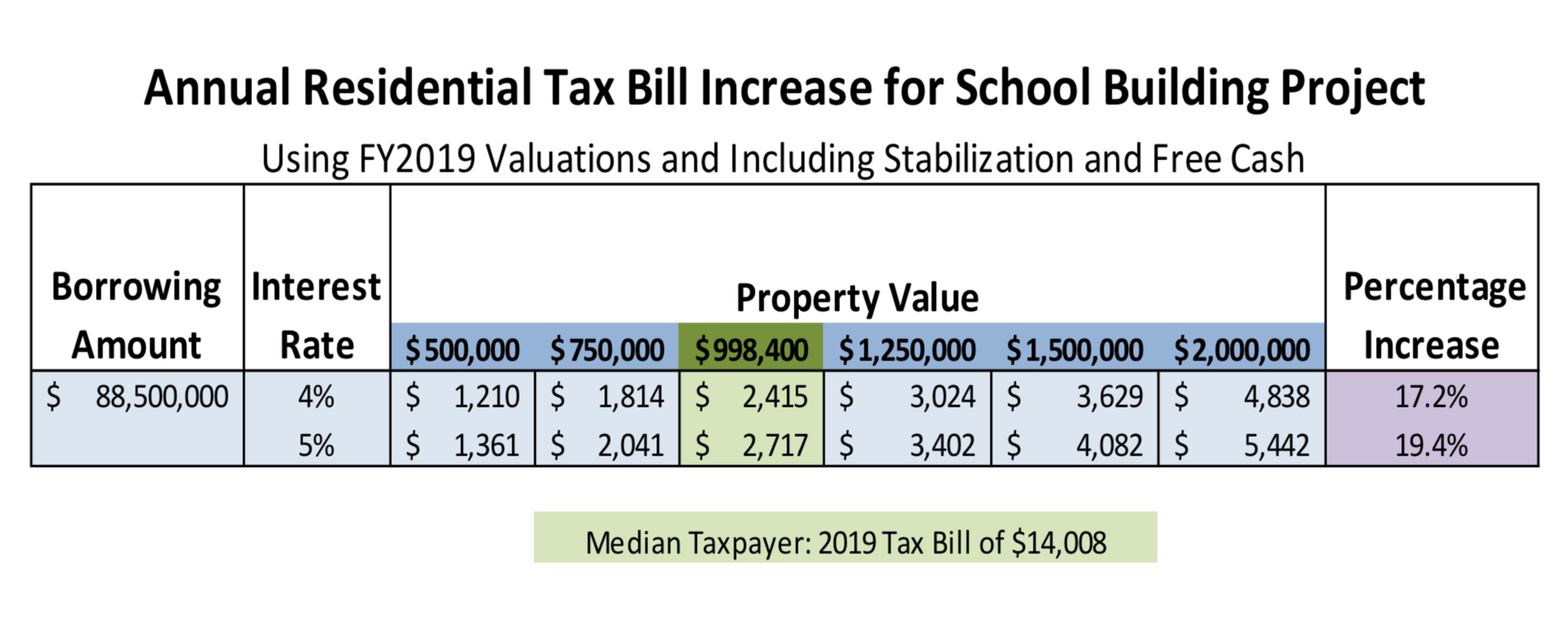
The June 9 vote indicated that the voters believed it would be irresponsible and shortsighted to simply bring the building up to code for $49 million but provide no educational enhancements to it.  Since we recognize that the school needs more than $49 million worth of work, the question becomes: what are we getting for the incremental $44.9 million ($49 million + $44.9 million = $93.9 million) in order to achieve educational enhancements? This question, in turn, leads to the critical question for the taxpayers: how much more in taxes will we be required to pay on account of this $44.9 million? Excluding the $5.4 million of “cash in hand,” an $88.5 million bond that carries an interest rate of either 4 percent or 5 percent will add $2,415 or $2,717 to the median taxpayer’s annual tax bill. However, the incremental amount of $44.9 million for the educational enhancements only adds about $1,225 or $1,435. The ultimate question for many taxpayers becomes whether this incremental amount is a fair amount to pay in order to realize the educational enhancements that the school project offers.

Tax assistance programs

I realize that some people in town may have trouble paying either the full or incremental amount of the tax increase. Those in this position should investigate the town’s programs for helping people with their property taxes. Depending on the program and whether a person qualifies for it, taxes can be deferred or the benefits can amount to as much as $1,000, $1,500, or $2000, annually. Whether the median tax increase is $2,415 or $2,717 for the full project or $1,225 or $1,435 for the incremental portion of the project, this type of assistance could substantially soften the tax impact of the project. See pages 9-12 of the FAQ document.

The educational enhancements to the school

The educators will explain the educational enhancements the project brings to the school and the students. I will only make a few observations. In my view, the space in which teachers and students teach and learn can have an impact on the breath and depth of educational programming. Instead of continuing with the single classroom model (i.e., each teacher has her/his own box to teach from), the renovated school will combine “distinct classrooms and multi-use spaces that can adapt to changing educational needs over time.” The “neighborhood” model in grades 3-8 features classrooms clustered around a shared common space (“hub”) that supports a curriculum based on the ability to flexibly group students and teachers together and to foster age-appropriate independence.

The new center of the school will include a “learning commons” that can accommodate large-scale programming and a “dining commons” that can be used as flexible educational space during non-dining hours. The addition of the flexible spaces throughout the building provides spaces that can handle different-sized groups for different educational purposes. In my opinion, this flexibility model, which combines traditional separate classrooms with different-sized flexible spaces, is not an educational fad. It is also not a return to the discredited “open classroom” model. It represents common sense because education is not a one-size-fits-all experience for students or teachers.

The cost of the project is in line with comparable school projects

The cost of the school project is not excessive when it is compared with the cost of other school projects in our area. The SBC, working with its owner’s project manager, Daedalus Projects, whose business is the school public construction market in Massachusetts, investigated this issue and concluded that the cost of the Lincoln project is not out of line, when adjustments are made for when the projects were undertaken and the size of the other projects. See the SBC post titled “Construction Costs and Other Matters” and SBC member Craig Nicholson’s November 20, 2018 post on LincolnTalk. The FinCom also investigated this issue and reached the same conclusion (see points 3 and 4 in its May 22, 2018 recommendations).

The costs of public and home construction projects are not comparable

Based on what the SBC has learned from Daedalus and an SBC member who works in the construction industry, this type of comparison is not valid. A public construction project in Massachusetts is governed by a panoply of statutes and regulations that do not apply to home construction, such as earthquake resistance and additional fire resistance. Wage rates for workers on such projects are determined by the Commonwealth, which ensures a middle-class income level for the skilled tradesmen who will build the school. The market for the public construction of a school is separate and distinct from that for home construction. See page 4 of “Construction Costs and Other Matters.”

I hope this letter has helped you prepare for the very important votes you will cast on December 1 and December 3. In my opinion, they will have a significant impact on the future of the school and our town. For the above reasons, and many more, I think that future is best secured by a “yes” vote.

Sincerely,

Steven P. Perlmutter
90 Todd Pond Road


Letters to the editor must be signed with the writer’s name and street address and sent via email to lincolnsquirrelnews@gmail.com. Letters will be edited for punctuation, spelling, style, etc., and will be published at the discretion of the editor. Letters containing personal attacks, errors of fact or other inappropriate material will not be published.

Category: letters to the editor, school project*, schools Leave a Comment

A note to readers

November 20, 2018

Happy Thanksgiving! A couple of notes:

Letters to the editor

As we prepare for the Special Town Meeting on December 1 and the ballot vote on December 3 to decide on school project funding, the Squirrel will accept letters to the editor on this subject up until noon on Tuesday, Nov. 27. Readers are welcome to submit new letters or opinions they have already posted on LincolnTalk. As always, letters will be edited for punctuation, spelling, style, etc., and those containing personal attacks, errors of fact or other inappropriate material will not be published.

A lot less logging in

Good news! I think we’ve found a way to “log in for a lifetime.” Previously, you had to log in again every three months or so, but now, your login is extended for one year every time you visit the site. As a practical matter, this means as long as you log in and read a story at least once a year, you shouldn’t have to log in ever again on that device, unless you clear your browser cookies, switch to a different browser, etc. If you ever have any trouble logging in or recovering your password, just let me know, and I can get you back into the Squirrel very quickly.

Enjoy the holiday!

Sincerely,

Alice Waugh
Editor, The Lincoln Squirrel
lincolnsquirrelnews@gmail.com
617-710-5542 (mobile) ~ 781-259-0526 (home)

Category: letters to the editor, schools Leave a Comment

Letter to the editor: Lincoln teachers urge “yes” vote on school project

November 15, 2018

To the editor:

The Lincoln Teachers Association, the Lincoln School Committee and the Lincoln School Administration have a long history of working collaboratively to support the education of the children in Lincoln. It is with this collaboration in mind that we are reaching out to the residents of Lincoln prior to the new school building vote in December. The Lincoln Teachers Association strongly supports the school building project for several reasons.

In our work together, the LTA, School Committee, and administration share a commitment to teaching the children of Lincoln in a forward-thinking manner. We aim to create an innovative learning environment where students’ academic and social development can flourish, where students develop confidence to see themselves as leaders of their own learning, and one that fosters collaboration amongst students and faculty. We see the following as some of the positives points in the building project:

  • A new building will provide a climate-controlled environment that will better allow students and teachers to better engage in and focus on learning.
  • The variety of spaces the new building will provide allows students to be taught in a variety of different groupings and allow for more interdisciplinary and collaborative work.
    between students and within teaching teams. These spaces are more suitable for collaborative, project-based learning.
  • In addition, the numerous learning spaces allow teachers to better meet student needs, as we have a variety of teaching spaces to work within.
  • The new learning commons, dining space, and media center/library have the flexibility to be used in a number of ways, both for the school and the community.
  • A dedicated kitchen/dining space allows for the gyms to be used full-time for learning.
  • Given the beautiful town we live in, it is always our desire to get students outside for both learning and recreation. The new building provides opportunities to further connections to the outdoors.
  • The specific design of the building for grades 3–8 allows for better use of resources and provides dedicated spaces for collaboration.
  • Bringing preK into the same building allows all the teachers in Lincoln to work together as we teach students from preK to eighth grade. It allows for greater cross-grade interaction and eases the transition from preK to K.
  • With a central entrance and single administrative suite it allows the building to truly feel like a preK–8 building.

The LTA hopes you take these factors into your thinking during the upcoming building project process vote and decision. As always, we look forward to seeing residents in and around the school and appreciate your support in our efforts to provide the best education for your children along with the School Committee and administration.

Sincerely,

Matt Reed and Elaine Herzog
Lincoln Teachers Association co-presidents


Letters to the editor must be signed with the writer’s name and street address and sent via email to lincolnsquirrelnews@gmail.com. Letters will be edited for punctuation, spelling, style, etc., and will be published at the discretion of the editor. Letters containing personal attacks, errors of fact or other inappropriate material will not be published.

Category: letters to the editor, school project*, schools Leave a Comment

Borrowing plans for school project outlined

November 12, 2018

(Editor’s note: this post was updated on November 13 to correct errors in the tax increase range and the debt stabilization amount.)

Lincoln residents will be asked if they approve borrowing $88.5 million for the school project, which will cost a total of $93.9 million. This will result in a property tax increase of somewhere between 17.2 percent and 19.4 percent, depending on the bond interest rate (assuming it is in the 4–5 percent range). 

The Finance Committee unanimously recommended that the town pay for the project with an $88.5 million bond issue plus $1 million in free cash and $4.4 million from the debt stabilization fund. That fund currently stands at $5.5 million after voters approved adding $772,000 at the Annual Town Meeting earlier this year.

For a tax bill of $14,008 on a property valued at $998,400 (the 2019 median figures), the tax increase would translate to roughly $2,415–$2,717 (see table below). However, this full increase will not appear in the first year of repayment, because the Finance Committee may divide the borrowing into two or more separate bond issues or tranches. Thus,  the $2,415–$2,717 increase would not be in year one but might take two to four years before it reaches that level of increase. Then this higher level would remain in effect for the life of the 30-year bonds.

On December 1 (Special Town Meeting) and December 3 (election), residents will be asked to approve the total bond amount of $88.5 million, but it will be up to the Finance Committee at a later date  as to how the debt will be financed in terms of tranching.

After its vote on the funding recommendations, the Finance Committee released the following statement:

“On June 9th, the town decisively supported a school project that embodied educational values and sustainability through a renovated school project. We believe:

  • The SBC has faithfully executed on this charge designing a project staying within the $93.9 million budget,
  • The town can finance it and should be able to maintain our AAA bond rating,

and thus FinCom supports this project.”

A table showing the range of possible tax increases due to borrowing for the school project (click to enlarge).

Category: news, school project*, schools 3 Comments

Letter to the editor: “yes” on school project is the wise choice financially

November 7, 2018

(Editor’s note: Shiller is an assistant professor of economics at Brandeis University and a father of two.)

As an academic economist at Brandeis University, I study empirical relationships in economic markets. As our town considers a major school building project, I want to share the results of some peer-reviewed, high-quality economics studies that look at how school projects affect property values.

Rigorous research strongly supports the contention that school funding pays for itself by raising property values. In fact, there is quite a bit of research supporting this claim. Consider one example: Lisa Barrow and Cecilia Rouse (2003) exploited a change in the formula which determines state-provided support for local school districts. They found that every $1 increase in state-provided funding raised the total value of homes in a school district by $20.

But perhaps a more pertinent question is whether spending on school structures raises property values. Like many questions, this one is hard to answer. Raw correlations may lie. Towns that choose to build new schools or renovate may be different in many ways from towns that choose not to do so. Maybe these other differences explain why property values rise in towns that choose to build new schools or renovate them. Fortunately, empirical economists have developed techniques to answer these types of questions.

To address this concern, Cellini, Ferreira, and Rothstein (2010) used an estimation strategy called a “regression discontinuity.” Intuitively, the approach exploits the relationship between the share voting to approve school building projects and property values. Of course, towns with 75% of voters agreeing to fund a new or renovated school structure are inherently different than towns with only 25% approval. But the approach focuses on towns right around the vote-share threshold needed to approve funding. Presumably, on average, towns where 49% of voters approved funding are very similar to towns where 50% of voters approved funding. But only in the latter case is school structure funding approved. Hence, we can compare property values across towns barely on either side of the 50% vote share cutoff (note that in Lincoln, a two-thirds vote is needed to secure funding).

Cellini, Ferreira, and Rothstein focused on California, which had enough local school infrastructure funding referenda to determine the impact with a high degree of statistical significance, i.e., confidence that the results are correct. They found that funding for school facilities more than paid for itself. Each $1 increase in capital spending on schools increased the aggregate values of homes in the district by $1.50.

While their study focused on less expensive measures than we are currently considering (there are not enough larger measures to yield statistical significance), available evidence suggests property values will go up by more than costs. After all, new school structures are a very conspicuous indication that a town supports education.

Even though the school should pay for itself by raising property values, it is natural to think back to the school building costs from 2012, when we failed to reach the super-majority needed for approval. Many might ask: why should we pay for a new school now, since the total cost has gone up? The answer is that we still have an opportunity to build at a reasonably low cost, and costs will probably only move higher.

Yes, the price of a new school structure was very low in 2012, but only because of a perfect storm—three separate rare occurrences, each of which lowered the price and all of which happened to line up at the same time.

First, the state had promised to pay $20 million. I am not an expert on these state programs, but I think it is unlikely that the state will offer $20 million again soon, since we spurned them once and there are many needier towns. Second, interest rates were near all-time lows. Hence, the costs of borrowing to fund the project were incredibly low. Third, construction costs were low.

So yes, we may have missed a once-in-a-lifetime opportunity to build/renovate the school in 2012 at an incredibly low cost. But we cannot undo that decision. The question now is, what to do going forward. We need to build or renovate relatively soon. Should we do so now?

While we may not receive as good a deal as in 2012, it still makes financial sense to build now. Interest rates are still low by historical standards, but going up. We should try to lock in the loan’s interest rate soon, to lessen the costs of borrowing the money up front to pay for the school building project.

In conclusion, I believe we should approve the school building project for two reasons. First, and most importantly, it is the right thing to do for the children of Lincoln. Second, approving the school building project appears to be the wise choice financially. Be selfish, and vote YES for the school building project.

Sincerely,

Ben Shiller
181 Bedford Rd.


Letters to the editor must be signed with the writer’s name and street address and sent via email to lincolnsquirrelnews@gmail.com. Letters will be edited for punctuation, spelling, style, etc., and will be published at the discretion of the editor. Letters containing personal attacks, errors of fact or other inappropriate material will not be published.

Category: letters to the editor, school project*, schools Leave a Comment

Letter to the editor: support L-S music programs

November 5, 2018

To the editor:

Another year of music education has begun at Lincoln-Sudbury Regional High School. Directors Tom Grandprey, Kyung-Nam Oh, and Michael Bunting are working diligently to create and carry out a rich curriculum with a wide array of performances opportunities.

Lincoln-Sudbury Friends of Music (LSFOM), a volunteer organization, seeks to raise funds that will benefit all students enrolled in band, orchestra, and chorus. The financial support you lend will allow us to honor specific requests from the Music Department that the school budget is unable to support. This may include enrichment through master classes, clinics and music festivals; the purchase of supplementary instruments and musical scores; and year-end awards and grants for music lessons, concert attire, and any other needs that families in our district may require to allow their children to succeed in this program.

Specifically, this year we aim to support coaches for orchestra sectionals, clinicians for chorus and band, and equipment requests for band, jazz, guitar, and multimedia music classes. Contributing (tax deductions and matching gifts available) helps us fund the efforts of the staff, directors, and performers. We are grateful and appreciative of those who support us financially and/or by attending our performances.

For more information about LSFOM, a list of upcoming events and to donate, please visit www.lsfom.org. Thank you.

Sincerely,

L-S Friends of Music:
Julie Alix, Laurence Baize, Theresa Kneeland, Carla Lievano, Glenn Merrill-Skoloff, Amy Rose, Rob Silsby, Dawn Solowey, and Maryann Tabola


Letters to the editor must be signed with the writer’s name and street address and sent via email to lincolnsquirrelnews@gmail.com. Letters will be edited for punctuation, spelling, style, etc., and will be published at the discretion of the editor. Letters containing personal attacks, errors of fact or other inappropriate material will not be published.

Category: letters to the editor, schools Leave a Comment

School project outreach sessions scheduled as December vote nears

November 5, 2018

The most recent floor plan for the revitalized Lincoln School (click to enlarge).

The School Building Committee is hosting a series of outreach sessions this week and next to explain and answer questions about the school project. Members are also seeking public input on the appearance of the roof over the central part of the renovated school.

The outreach sessions will be on the following dates:

  • Friday, Nov. 9 — 8:30–10:30 a.m. in the Lincoln Woods community room, and 1–2:30 p.m. in Bemis Hall
  • Saturday, Nov. 10 — 1–3 p.m., Lincoln Public Library
  • Tuesday, Nov. 13 — 8–10 a.m., Lincoln School
  • Wednesday, Nov. 14 — 9:15–10:15 a.m. the deCordova Cafe/Lincoln Nursery School
  • Thursday, Nov. 15 — 11 a.m.–noon, The Commons

There will also be a multiboard meeting and community workshop on Thursday, Nov. 15 from 7–9 p.m. in Hartwell Pod B.

At the November 1 community workshops, participants were asked to give their opinions about the look of the roof over the new central entrance and commons areas. As of late last week, 79 percent of those who offered feedback at the workshops or online have said they prefer the sloped roof design. Click here to comment on which you prefer. The SBC will discuss the two options at its next meeting on Wednesday, Nov. 7 at 7 p.m. in the Hartwell multipurpose room.

The Green Energy Committee also gave a presentation November 1 about the sustainability aspects of the project—how the school will be “net zero,” what that means, and how it will be accomplished. Click here to see those slides, and click here for an FAQ document from the committee.

Residents will be asked to vote on bonding the $92.9 million project at a Special Town Meeting on Saturday, Dec. 1 (where a two-thirds majority is required for approval) and at the ballot box on Monday, Dec. 3.

Category: school project*, schools Leave a Comment

School Committee, Magic Garden have openings

November 1, 2018

Al Schmertzler has retired from the Lincoln School Committee after 26 consecutive years of service to the town, 12 on this committee and a previous 14 on the Finance Committee, among many other contributions of time and intelligence.

To fill the vacancy created by this retirement, the Lincoln School Committee invites and encourages any town resident with an interest in serving on the School Committee to submit a statement of interest detailing qualifications and experience to schoolcomm@lincnet.org. The deadline is Friday, Nov. 9.

There will be interviews of all candidates in a joint, open meeting of the School Committee and the Board of Selectmen on Tuesday, Nov. 13, at 6:30 p.m. in the town office building. Each candidate will be asked to make a brief opening statement, respond to a set of questions from the committee and board members, and have an opportunity to ask questions. Members will vote at that meeting to select one of the candidates to serve as an interim member of the School Committee.

The interim member will serve until the next annual election in spring 2019, at which time there will be an election for a two-year term on the School Committee. (The reason for this unusual arrangement is that Schmertzler’s term ends in 2021, so that is the date for the next election for a full term for this seat.)

Anyone with questions is invited to contact one of the School Committee members.

Magic Garden is hiring

Magic Garden Children’s Center is seeking to hire several staff members as it prepares to expand into a second location (see the Lincoln Squirrel, Oct. 3, 2018). Applications are being accepted for EEC-certified lead teachers for the preschool classroom (3-year-olds), pre-K (mixed ages), and the new Infant and Toddler Center, which is also seeking part-time assistant teachers (20–30 hours per week) and is set to open in early 2019. For more information, see the Magic Garden careers page, contact director Lori Leo at 781-259-8161 or lori.leo@staff.magic-garden.org.


Category: schools Leave a Comment

  • « Go to Previous Page
  • Page 1
  • Interim pages omitted …
  • Page 10
  • Page 11
  • Page 12
  • Page 13
  • Page 14
  • Interim pages omitted …
  • Page 47
  • Go to Next Page »

Primary Sidebar

Recent Posts

  • Water bills to go up by 13% March 5, 2026
  • News acorns March 5, 2026
  • Property sales in January 2026 March 4, 2026
  • My Turn: Unraveling the Hanscom misallocation March 3, 2026
  • Police log for Feb. 19–25, 2026 March 3, 2026

Squirrel Archives

Categories

Secondary Sidebar

Search the Squirrel:

Privacy policy

© Copyright 2026 The Lincoln Squirrel · All Rights Reserved.