• Skip to primary navigation
  • Skip to main content
  • Skip to primary sidebar
  • Skip to secondary sidebar

The Lincoln Squirrel – News, features and photos from Lincoln, Mass.

  • Home
  • About/Contact
  • Advertise
  • Legal Notices
    • Submitting legal notices
  • Lincoln Resources
    • Coming Up in Lincoln
    • Municipal Calendar
    • Lincoln Links
  • Merchandise
  • Subscriptions
    • My Account
    • Log In
    • Log Out
  • Lincoln Review
    • About the Lincoln Review
    • Issues
    • Submit your work

news

Missing cat – now a few sizes smaller – is reunited with family

August 3, 2023

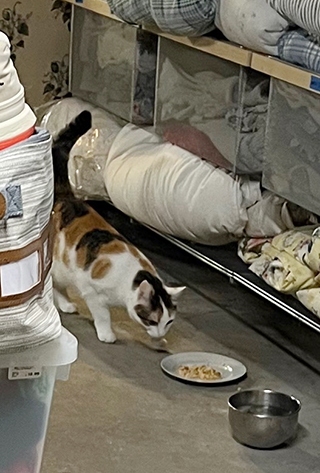
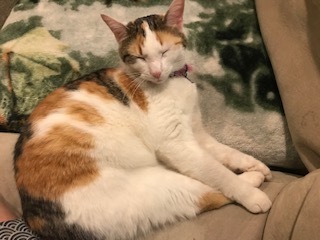
Evena, who was once what you might call well-padded, went on a strict diet and now looks great— but the slenderizing certainly wasn’t intentional.

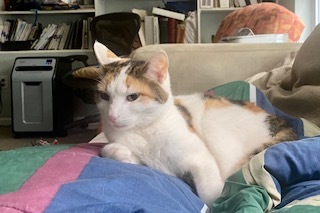
Evena is a three-year-old calico cat who went missing from her Willarch Road home in mid-May. As an indoor-outdoor cat, she was free to come and go through a window in the basement, but she usually returned each night — until she didn’t, which “wasn’t like her,” owner Melissa Hallowell said.

Hallowell tried to figure out where Evena had gotten to. Maybe she had stowed away in one of road construction vehicles that was being used for repairs on nearby Route 126, or was frightened by their noise and wandered farther off than usual. She made “lost cat” posters and put them up in the neighborhood. A couple of neighbors told her early on that they had seen the cat, but as more time went by, Hallowell began to fear the worst.

“I was 85% sure that a predator had gotten her,” she said.

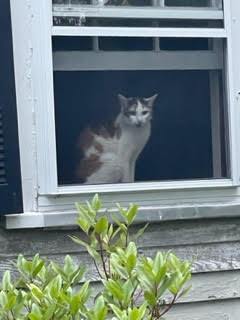
The family was starting to accept the fact they might never see Evena again. But all that changed one night in late June when a neighbor called to say he’d heard meowing while on a walk earlier in the day and then spotted the cat — sitting behind a window screen of an apparently vacant house on Route 126. He snapped a photo (see below) and sent it to Hallowell, who immediately started trying to track down keys to the house. But that turned out to be unnecessary. When her husband came home that night, he simply walked over to the house, removed the screen, “and she jumped into his arms, she said.

The Hallowells aren’t sure how Evena got into the house or why she couldn’t get out by herself, but they did learn later that it had a leaky bathtub faucet, which apparently gave the cat enough to drink over the five weeks she was missing. No food was to be had, however, but she had enough fat to see her through. Not surprisingly, when she was reunited with her family, “she was half her size,” Hallowell said. “She looked like an adolescent cat again — it was like turning back the clock.”

Aside from the enforced weight loss, Evena (now an indoor-only cat) was none the worse for wear, though her voice was hoarse for about two weeks. Being corralled for a checkup at the vet has also made her somewhat wary — she often now hides in the basement.

“This is the value of listening when you walk,” Hallowell said, noting that they may not have rescued the cat in time if their neighbor hadn’t heard meowing and wondered where it was coming from. Hallowell herself had walked by the same house several times, and though she never heard Evena, “I always got a weird feeling of her presence.”
evena
evena-home
evena-basement
evena-lg

Category: news Leave a Comment

Gerald Lee Foster, 1936–2023

July 29, 2023

Gerry Foster

Gerald Lee Foster, Lincoln architect, artist and author, died, on June 25 in Lincoln. He was 86. An artist from the start, Gerry’s skill carried him through a rich life, often by unexpected turns. He was at one time a student of the Boston painter R.H. Ives Gammell and later a vice president of The Architects Collaborative, the famous firm founded by Bauhaus architect Walter Gropius.

Born on July 13, 1936, in Marshall, Mo., Gerry arrived in the midst of both the Great Depression and a legendary heat wave so ferocious that insects disappeared, weary sleepers dragged mattresses outdoors, and Gerry’s blistered head was covered with wet cloth for fear the heat would kill him. His parents, Albert B. Foster and Esther Mason, resided in Keytesville, where Albert was the high school “ag” teacher, near the Mason farm. Forever beloved by Gerry, “the farm” became a frequent vacation spot for the family, with its cow, chickens, hogs, mules (Tom and Jerry), and a fine pair of doting grandparents.

Albert soon took a job with Roosevelt’s expanded Soil Conservation Service (SCS) and the family began a dizzying series of moves, finally coming to rest outside Milwaukee at Whitefish Bay in 1947. By that time, Gerry had been joined by younger siblings Ken, Dave, and Martha. Early on, Gerry showed a natural ability in art and was encouraged by family friend Felix Summers, an SCS illustrator. At school he was a good athlete and bright pupil, but often a poor student: he preferred to draw during class.

Graduating from high school in 1954, Gerry loved drawing and cars but lacked direction, so he joined the Air Force. He served as crew chief for a B-47 bomber at Homestead Air Force Base in Florida and in a tactical missile squadron at Ramstein Air Base in Germany. His art followed him: he painted teeth on his aircraft, which were removed by orders, and added murals to one of his bases, for which he was commended. According to Gerry, the Air Force straightened him out, while road trips to Europe’s museums showed him there was more to art than car illustration.

Discharged in 1958, Gerry married Patricia Patrick of Orlando, worked in an aircraft factory, and painted hotel murals for architect Harry Merritt, Jr. Moving to Milwaukee in 1959, Gerry was a semi-Beat, enjoying Kerouac, jazz, car races, road trips, and boisterous parties, one of which got the couple kicked out of an apartment. He tried a semester at the University of Wisconsin, and failed everything but his art classes — because they were the only classes he went to. Instead, he got a job selling sports cars for race car driver and brewery heir Augie Pabst, work at which he excelled, and occasionally served on Augie’s pit crew. A son, Mark, was born in 1961.

The first of two pivotal moments in Gerry’s early life came in 1962, after the family moved to New London, Conn. While selling Mercedes for T.N.M. Lathrop, Gerry happened to enter an art contest, which he won, and which led to an interview with the Boston painter R.H. Ives Gammell. Gammell accepted Gerry as a student and Gerry spent a year of intensive study with the painter at Boston’s Fenway Studios, an experience that had a significant impact on Gerry’s art. Gammell would be a lifelong influence, yet Gerry grew increasingly interested in modern architecture and was desperately short of money — which brought a second turning point.

By chance, one of Gerry’s landlords was designer and feminist Fran Hoskens, who had hired Gerry to do several drawings. She connected Gerry to Louis MacMillan, a principal at The Architects Collaborative (TAC), the famous Cambridge firm established by Walter Gropius and his students. Louis asked Gerry if he could draw buildings, whereupon Gerry went home, drew, and returned, only to be asked again if he could draw buildings. The process repeated until one meeting when sketches of highway construction equipment happened to fall from Gerry’s portfolio. Louis asked to see them. “If you can do that,” said Louis, “you can draw buildings.” In 1963, Gerry was hired as an “office boy” in TAC office services, but was soon asked to sit down and draft. He never got up.

Gerry spent two decades at TAC. He mastered the design of medical and research facilities, becoming a team leader, an associate (1976), and finally a vice president (1980). He studied for a year at the Boston Architectural Center, won the Outstanding Student Award, and quit — he said he was learning more at work. He briefly worked for Ben Thompson, but it was principal Roland Kluver that became his friend and mentor. Gerry, as Roland noted, had a rare combination of conceptual design skill and practical knowledge of construction, as well as a natural ability as a team leader, which brought the respect of his team. A skilled artist, Gerry occasionally provided renderings for his own projects which reflected the modernism he admired, and took pride in those projects consistently producing earnings for the firm. He designed buildings in the U.S. and overseas, a small sampling of which includes the Seeley G. Mudd Building at Harvard Medical School, the Nursing and Allied Sciences Building at the University of Vermont, and Deaconess Hospital’s William A. Meissner Building (since removed), which was his favorite.

TAC also provided a community of dear friends, for whom Gerry often created cartoons marking birthdays and other events that affectionately poked fun at the recipient. As Gerry was fond of recounting, he himself received unique recognition: noting his singular rise from office boy to associate, the staff in TAC office services, generally aspiring architects, created a small “Gerry Foster Shrine” at which to worship. Looking back at the humble start that led to his 20-year career at TAC, Gerry said simply, “It came to me naturally.”

In 1968, Gerry married Diana Wallace of Cambridge and in 1972 rented a dilapidated house deep in the woods in Lincoln. In 1975, Gerry married Candace Frankman, a former TAC employee, originally of Hopkins, Minn. They bought the dilapidated house, significantly improved it, built a second house on the Cape, and added two children, Ryan and Shelby, to the family. In 1982, Gerry established his own small firm, Gerald Foster, Inc., where he continued with institutional work and the occasional residence. In 1989, he merged with Linea 5, Inc., which now specializes in the work he introduced them to.

In the 1990s, as the constraints of his profession loosened, other interests cultivated throughout Gerry’s life emerged. They were indulged in a studio above the garage, crowded with books, art materials, and a menagerie of objects. He attended UMass-Amherst’s University Without Walls program to study art and received his bachelor’s degree in 1993. He returned to painting, often portraying the broad farmland of central Missouri, and exhibited at the Concord Art Association and elsewhere. He took classes in painting at deCordova Museum with Kathleen (Dudty) Fletcher, who became a dear friend. He studied sailboat design and model trains and did illustration, including work for Historic New England, the National Park Service, Nantucket Historical Association and, on one occasion, the New York Times Magazine. He produced A Field Guide to Airplanes (1984; 2006) with friend and Boston Globe columnist M.R. Montgomery; wrote and illustrated guides to trains (1996) and houses (2004); and illustrated the children’s book, Whale Port (2007), which won a Massachusetts Book Award. Though supposedly retired, in later years he took great pleasure in working part-time for Designer Cabinetry in Newton designing high-end kitchens.

Gerry balanced all this with care for his younger children. His services were extensive and varied. He was a regular partner for evening basketball and catch until it grew too dark to see, in addition to coaching baseball and soccer. He provided design consultation and construction services for dollhouses. He produced Chinese food twice a week, in a cooking process that included dancing and sound effects. He lightened the day with humorous reports on the activities of pets during school hours. He was a reliable and knowledgeable companion for long walks to the bus stop and for watching baseball games and Formula 1 races. He facilitated trips to Fenway Park, baseball camp, and racing school. He provided town-wide taxi service and unlimited (and patient) homework assistance. And he entertained everyone at Christmas by dancing to Bruce Springsteen’s version of “Run, Run, Rudolph” (he was a big Springsteen fan).

Gerry was never without a pen. He processed his life through drawing and he could draw anything. A designer, he evaluated all — as when, while arranging his father’s cremation, he paused to critique the funeral home’s interior finishes. He loved nature — binoculars and field guides were always near — and gardening. He was a gentle man, with a sense of humor, often at his own expense. He could be silly, as when he stood at the dishwasher and tossed dishes across the room to one of his children, who, laughing, would put them away. He was a pleasure to talk with, as he knew at least something about most things, though especially art and architecture, and yet never imposed. He was an unquenchable reader (fiction and nonfiction), always with a stack of books next to the bed and a pile of finished crosswords on it. He read the Boston Globe, the New York Times and the New Yorker until his last day. Having seen more than his share of hard times, Gerry was kind. He adored his grandchildren and enjoyed any time he spent with his own children, who worried about him constantly and loved him dearly. He often said, “It’s my children that keep me going.”

Gerry passed quietly in his sleep, at home, as he had hoped. The day that followed turned into the first real day of summer, with a hot sun beating down and tall thunderstorms rolling through in the afternoon. It was the kind of weather he had always loved because it reminded him of Missouri.

Gerry is survived by his son Mark Foster and his wife Erin Wells of Arlington, son Ryan Foster and his wife Alyssa of Newton, and daughter Shelby O’Neill and her husband William of Harvard. He was proud “Grandad” to Coraline, Chase, Levi, and Finn. He is also survived by his partner, Candace Foster of Lincoln, and his sister, Martha Lurz of Annapolis, Md.

At his request, a celebration of his life will be held one year from now. Contributions in his memory may be made to Mass Audubon, 208 South Great Road, Lincoln, MA 01773 (www.massaudubon.org).

Arrangements are entrusted to Dee Funeral Home & Cremation Service of Concord, which provided this obituary. For Gerry’s online guestbook, please click here.

Category: news Leave a Comment

House and car break-ins seen in Lincoln and other towns

July 18, 2023

A July 9 house break-in and burglary on Davison Drive appears to be part of a regional pattern, according to Lincoln police, who also noted an uptick of car break-ins and thefts.

“The region has seen a significant number of house breaks where the victims are of an Indian or Asian descent. This trend is not just being seen in Massachusetts, but all over the country,” Lincoln police said in a statement. “The burglars are focusing on jewelry and cash inside the home. These groups appear to be very well organized. This is Lincoln’s first of this nature, however several area towns have experienced them in Weston, Wellesley, Natick, Easton, North Attleboro, and Hopkinton. The losses in these house breaks have been significant. We urge residents to use their burglar alarms and video surveillance systems, let their neighbors know that they’re going to be away, and report any suspicious activity. We continue to be in contact with local, state, and federal partners regarding the investigation.”

Police also received reports on the morning of July 13 that the cars of residents on Concord Road and Bedford Road had been broken into and gone through. The cars were all unlocked, though nothing was stolen from them.

“The area has seen an uptick in cars getting broken into which are unlocked. If the keys are found to be inside, the thieves are stealing the cars,” Lincoln police said. “Concord had two cars stolen the same night of our car breaks, and we had a car stolen a couple weeks ago [on Trapelo Road on the night of June 23]. We remind residents to lock their cars and report any suspicious activity.”


Police log for July 5–13, 2023

July 5

Huckleberry Hill (9:43 a.m.) — A home health care agency called seeking a well-being check on a resident who wasn’t answering the door. They called back to cancel as they made contact with the resident.

Bypass Road (3:01 p.m.) — A caller requested assistance with an owl in their yard. Resident was referred to Drumlin Farm.

July 6

Lincoln Road (2:30 p.m.) — A caller reported three dogs inside a vehicle and was concerned. An officer responded and spoke to the owner. The dogs were fine.

Baker Bridge Road (8:18 p.m.) — A caller reported a party waving a stick at cars on Baker Bridge Road near Sandy Pond Rd. Officers checked the area but were unable to locate anyone.

July 7

Ridge Road (9:12 a.m.) — A caller requested a well-being check on a resident who they couldn’t get in touch with. An officer responded everything was fine.

Old Cambridge Turnpike (10:03 a.m.) — A caller requested an officer to assist with a civil matter. An officer responded and assisted the residents.

Old Concord Road (11:14 a.m.) — A resident called reported a vehicle parked blocking a fire hydrant. An officer responded and the vehicle was towed.

Wells Road (12:50 p.m.) — Officers responded to a well-being check on a resident. Everything was fine.

Harvest Circle (1:04 p.m.) — Staff members called reported a missing person. Officers investigated and located the resident, who was in the hospital.

Trapelo Road (1:18 p.m.) — An officer located people fishing in the reservoir. They were moved along.

South Commons (3:35 p.m.) — A person came to the station to report that over the past two years, their cars have been scratched and damaged while in the lot. An officer documented the incident.

Hanscom Air Force Base (5:30 p.m.) — A resident turned in ammunition to be destroyed.

July 8

Stratford Way (7:26 a.m.) — A resident called requested a site check of their home. An officer checked the residence and everything was fine.

Wells Road (6:50 p.m.) — A resident called to report someone had sprayed soda on their car time overnight. An officer responded and documented the incident.

July 9

Codman Community Farms (7:18 a.m.) — Police received a report that a sheep was in walking in the roadway. The farmer was contacted and handled the matter.

Ridge Road (10:21 a.m.) — A person came to the station to see if anyone had been complaining about their dog barking at the complex.

Conant Road (11:59 a.m.) — A resident reported that their dog had been bitten by a coyote in their yard. Animal Control was contacted.

South Great Road (1:25 p.m.) — A caller reported seeing a coyote near the Weston town line. Animal Control was contacted.

Davison Drive (1:41 p.m.) — A resident reported that their residence was burglarized while they were away. Officers responded and an investigation is ongoing.

Lexington Road, Concord (1:49 p.m.) — Lincoln firefighters assisted the Concord Fire Department at a shed fire in their town.

Baker Bridge Road (3:37 p.m.) — An officer addressed cars parked in the No Parking zone.

Concord Road (4:36 p.m.) — Concord police requested assistance in locating a person involved with several fires in their town. Lincoln officer checked the area but were unable to locate them. The person was later located out of town.

Lexington Road (7:52 p.m.) — A resident reported that individuals knocked on her door and then ran from the area. The juveniles were later identified and their parents were spoken to about the behavior.

July 10

Codman Road (4:33 p.m.) — A caller said they thought they were being followed by a car carrier. While on the phone, the caller reported the vehicle turned off onto a side road and everything was fine.

July 11

Oak Meadow Road (3:07 p.m.) — Concord police requested assistance in locating a person who may have been involved in a minor crash in their town. An officer responded and the person was not at the Lincoln residence.

Sandy Pond Road (6:51 p.m.) — An officer checked on someone fishing at the pump house. The person was advised not to fish and sent on their way.

July 12

Lexington Road (11:55 a.m.) — A caller reported discarded Amazon boxes along the side of the roadway. An officer located the boxes, which had been there for a significant amount of time.

Indian Camp Lane (12:30 p.m.) — Police and fire personnel responded for a well-being check. Officers made contact with the party and everything was fine.

Lincoln Road (1:06 p.m.) — The Fire Department assisted a resident with a house lockout.

Colonial Place, Hanscom AFB (2:10 p.m.) — An officer took a fraud report. It was later determined to have happened out of state.

Wells Road (5:05 p.m.) — A person asked an officer to stand by while retrieving items from a residence.

Weston Road (5:51 p.m.) — A caller reported that a vehicle struck a deer along Weston Road. Officers checked the area but the car and deer were gone on arrival.

July 13

Concord Road (8:49 a.m.) — A resident report that their unlocked car was broken into overnight and gone through. No items were stolen.

Bedford Road (9:35 a.m.) — A resident reported that three of their cars were broken into overnight. Nothing was stolen from the cars; all were unlocked.

Old Concord Road (9:32 a.m.) — A resident reported that someone damaged their generator. The damage was found during a service call. An officer responded and took a report.

Ryan Estate (10:08 a.m.) — A resident called to report that someone backed into a lamp post on the property and then left. An officer responded and was able to make contact with the driver, who will handle the matter with the property owner.

Tower Road (12:32 p.m.) — A resident called to complain that a landscaper was parked at their property and refused to leave. An officer responded and spoke to the landscaper, who agreed to move the vehicle.

Old Sudbury Road (3:11 p.m.) — A resident dropped off some ammunition at the station to be destroyed.

Category: news Leave a Comment

Proudly on parade

July 9, 2023

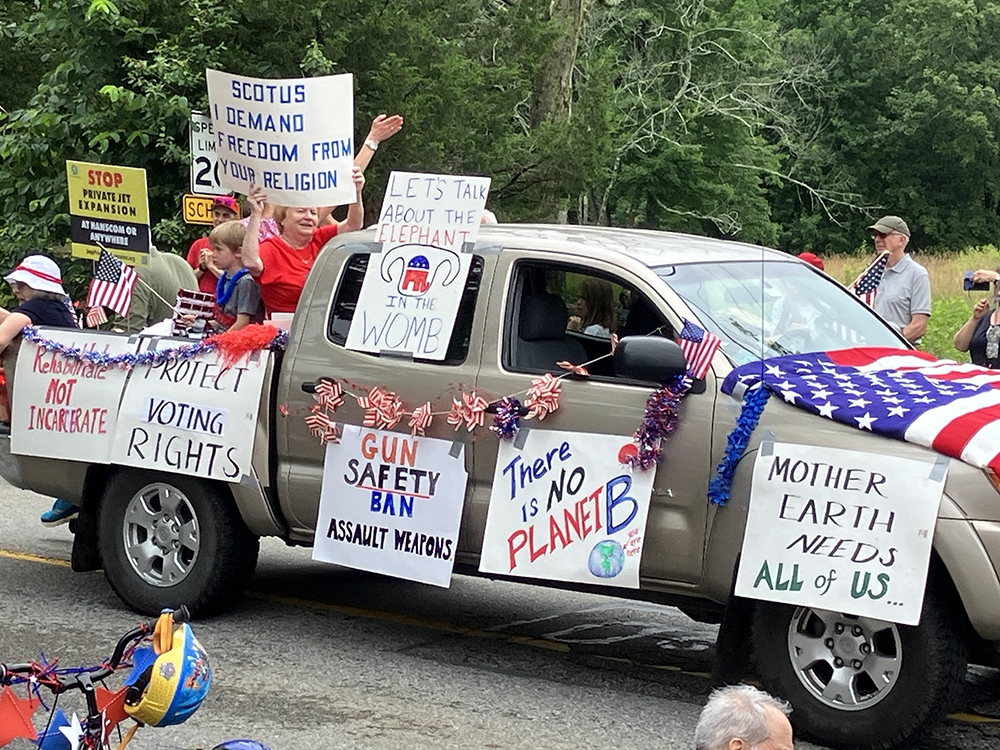
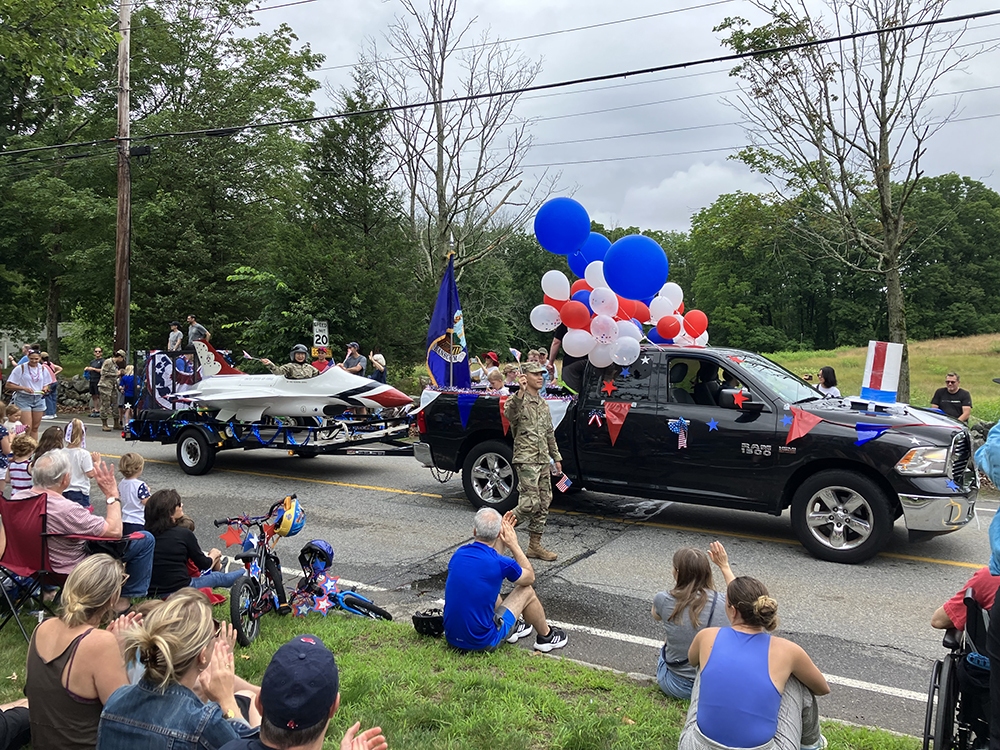
Susan Hall Mygatt took these photos and video of Lincoln’s July 4 parade before the rains came.

74-guns
74-truck
74-signs
74-plane

Category: news Leave a Comment

Correction

June 25, 2023

In the June 22 article headlined “My Turn: In support of a community center,” author Sally Kindleberger’s name was omitted. the article has been corrected.


Category: news Leave a Comment

My Turn: CCBC meetings focus on building size and parking lot

June 19, 2023

By Lynne Smith

One of the reasons many of us suggested looking at other buildings in town to host programs for seniors was to reduce the size of buildings required on the small Hartwell campus. The space there is precious, especially the green space that hosts the approximately 150 children at LEAP and Magic Garden. Concerns about the size of the buildings and the location of the parking lot were discussed at both the June 13 public forum and the June 14 regular CCBC meeting.

At the public forum, ICON architect Ned Collier presented five site plans illustrating five cost levels. The plans included a variety of buildings: a new two-story building, a new one-story building, and renovations of existing pods. All plans required removal of the existing parking lot and a new one installed at the back of the building. All plans included the same cost of $3.5 million for site work. (Full description of the plans and the meeting included in the Lincoln Squirrel on June 14 and on the Lincoln Community Center website.)

Committee members and public attendees were seeing these plans for the first time and it was a lot to take in. I appreciated the printed version provided to those of us attending in person. For the 35 people on line, it must have been difficult to process so much information. Collier cautioned us that these were not “designs” but site plans.

For those of us who were hoping for a viable low-cost option, the site plan labeled 2A was a good start. The plan called for housing programs in 10,000 square feet located in total renovation of pods A and B. Many in town believe that 9,000 to 10,000 square feet is sufficient for accommodating all the “needed” programs. However, as with all five plans, the parking lot behind the building came at the expense of the green space. Parents of children at LEAP and Magic Garden expressed concern as they realized what the loss of the playing areas would mean to the 150 after-school and 120 preschool children.

At the June 14 meeting, CCBC Chair Sarah Chester announced the agenda as a discussion of the comments from the forum the night before. Instead, committee members spent over an hour discussing the siting of the parking lot but did not reach a consensus decision. The discussion was important, but it should have been conducted in a working group weeks ago with ICON providing topography and other technical information.

The parking discussion delayed a topic that was at the core of the comments at the public forum: the attendance data that supports the required square footage. COA Director Abby Butt has provided a great deal of data but it does not include numbers for “actual attendance.” Serious people in Lincoln are asking for this data because they don’t want to support a building that is larger than required. Susan Taylor commented that this information is critical for answering community questions about the actual size required to meet program needs. Peter von Mertens suggested that these numbers be gathered for COA programs. (PRD attendance data has already been posted on the CCBC website.) Jonathan Dwyer volunteered to help Butt develop these numbers and bring them back to the committee in the next week or two. Collier said that ICON needed confidence that this number was solid for final development of the schematic design.

In the last few minutes of the meeting as it opened to the public, Dennis Picker read a prepared set of comments about ways to reduce the amount of “shared space” by utilizing existing town-owned buildings. He had carefully looked at the programs listed for the COA and concluded that about 1,500 square feet of space could be saved by having several regular programs at the Pierce House and Bemis Hall. Locating these programs off site would mean that a 9,000-to-10,000-square-foot option on the Hartwell campus would not leave out valuable programs. He also proposed minimizing the amount of area devoted to lobby, reception area, and waiting rooms.

We need to consider carefully Picker’s suggestion, COA attendance data, and the location of the parking lot. I believe there is an opportunity to put a new building on the existing footprint of Pod A and leave the parking lot where it is. We could then do a slight remodel of Pod B so it could continue to be used for the maintenance facility and COA and PRD programs. That will save the wonderful green space and play areas at the back of the building. If the parking lot is undisturbed, we might not have to worry about the wetlands setback and the site work would be minimized. A walkway to the Brooks Gym parking lot could be used for additional parking.

The committee will have one more meeting in June to confirm the attendance data, square footage required, and site plans so ICON can proceed with design over the summer. CCBC will schedule one meeting in July and one in August with ICON. These meetings will be posted on the community center website. As always, I urge everyone in town to participate in these meetings before we make a final decision on the community center.


“My Turn” is a forum for readers to offer their letters to the editor or views on any subject of interest to other Lincolnites. Submissions must be signed with the writer’s name and street address and sent via email to lincolnsquirrelnews@gmail.com. Items will be edited for punctuation, spelling, style, etc., and will be published at the discretion of the editor. Submissions containing personal attacks, errors of fact, or other inappropriate material will not be published.

Category: community center*, news 2 Comments

Architects unveil cost estimates for community center

June 14, 2023

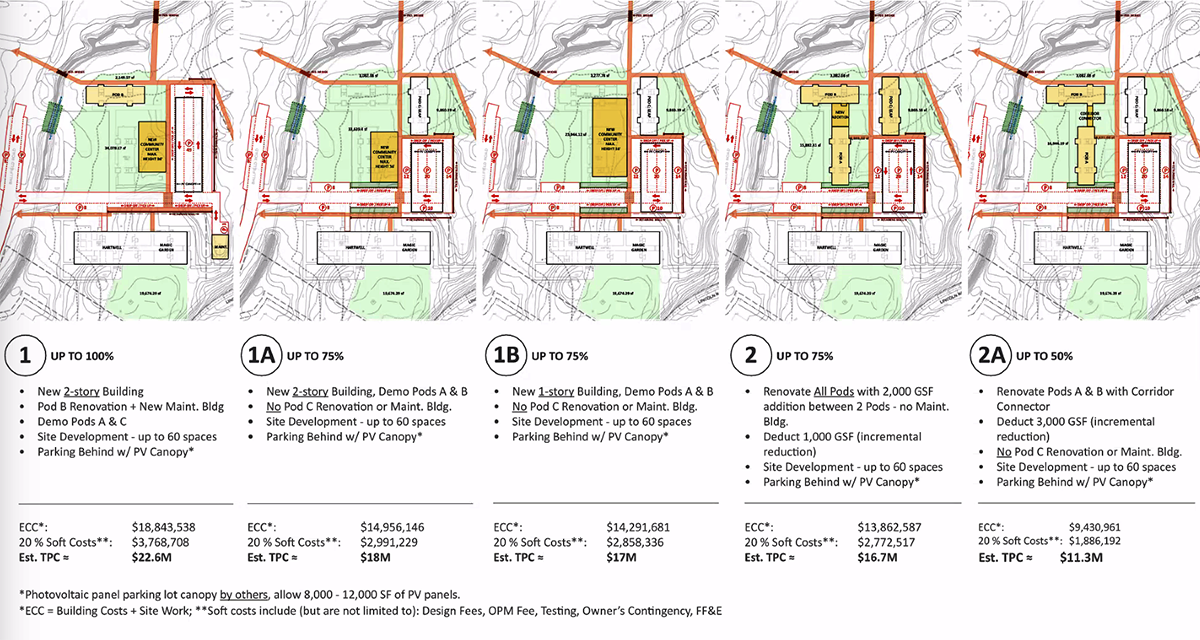
The five community center site options and costs from ICON Architects (click to enlarge).

At a June 13 public forum, architects presented five basic site designs for a community center that satisfy the three cost parameters approved by residents in November 2022 — but some residents were disappointed in some features of the lower-cost options.

All five concepts call for 60 parking spaces behind the “solar-ready” community center (a solar PV canopy would be installed as part of a separate project). Site work is expected to cost $3.5 million regardless of how the buildings and parking are configured. The figures include site work, construction and “soft costs” (professional fees, owner’s contingency, furniture and equipment, etc.) as explained in the presentation that will be posted soon on the Community Center Building Committee website.

Option 1 (the “100% option”) come to $22.6 million and includes a new two-story building to replace pods A and C, a new maintenance building, and a renovated pod B. Options 1A, 1B and 2 are $16.7 to $18 million, while Option 2A would cost $11.3 million. The four options at 50% and 75% would require some combination of less new construction, not renovating one of the pods, and/or fewer total square feet for programming for Parks and Recreation and the Council on Aging and Human Services. 

The price points were set as percentages of a $25 million estimate for two concepts developed by Mary Ann Thomson Architects in 2018. Those concepts were estimated to cost $15.2 million to $16.2 million in 2018 dollars. In 2021, that figure was revised upward by cost estimators to $25.4 million in 2025 dollars. However, Ned Collier of ICON Architects reported that his firm’s cost estimators looked again at the 2018 concepts and determined that they would cost about $30 million today, partly because construction costs have risen by around 8% annually rather than the projected 5%.

“Materials and labor and labor have greatly increased over the intervening years,” he said.

Only Option 1 includes a new maintenance building on the Hartwell campus, which would add about $1 million to the price tags for options 1a, 1B, 2, and 2A. “We ask the town to consider whether this is the highest and best use [as a] large percentage of the project cost,” Collier said. But he got immediate pushback.

“A maintenance building is a must — you can’t not include that in the cost,” said Susan Taylor, the School Committee’s representative on the CCBC.”You can’t just lop off part of this project and say we’ll think about maintenance another day.”

“I’m discouraged that you dispensed with a function that’s currently being provided” in part of pod B, said Buck Creel, former Administrator for Business and Finance for the Lincoln Public Schools. Collier responded that the structure could be added to any of the other options, which (except for option 1A) are “below [cost] targets by a sufficient amount.”

Other residents at the forum were worried about losing the possibility of not renovating the LEAP pods (Options 1A, 1B and 2A)  or losing program space. Option 2 would deduct 1,000 square feet, while option 2A would remove 3,000 square feet. 

“This doesn’t have enough space for the programs we already have,” said Parks & Recreation Commission member Rob Stringer. “I’m concerned that Lincoln is selling itself short.”

He also noted that if some of the programs of the COA&HS and Park & Rec (which is headquartered in pod C) were to remain in Bemis Hall and an unrenovated pod C respectively, the cost to renovate those buildings would have to be figured in. Collier estimated that a standalone renovation of any of the pods (which would include bringing it up to current building code) would cost $3 million.

If square footage is removed for the COA&HS as per Options 2 and 2A , “what are Abby [Butt, COA&HS director] and her team expected to do?” Select Board member Km Bodnar said. “If you’re building a building that’s shrinking but adding services [over time], how does that make sense if we’re using this building for the next 30 years? I understand the price points but I don’t think we are going in a realistic direction by decreasing the size.”

“More people will be coming,” said resident Wendy Kusik, noting that as the town’s population ages, the need for COA&HS will only increase over time.

Taylor said she had thought before the forum that the three price opinions would deliver the same programming. “What programs or services are we eliminating?” she asked.

“I shared your hope that we would be able to fit the [full] program in each of the scenarios, but changes in the market are really preventing that,” Collier said, adding that “this exercise is cost-driven” and the architects are not taking a position.

There was still some sentiment to scale back the community center size and/or locate some services in other buildings in town. “Do we really need 13,000 square feet? I don’t think so. The rooms we designed are way too big,” said resident David Cuetos.

Over the summer, ICON will flesh out the options with some design detail in preparation for a presentation and charrette at the State of the Town meeting on September 30. Residents will choose a preferred option at a Special Town Meeting on December 2 and then vote to authorize a spending measure at Annual Meeting and at the ballot box in March 2024.

Category: community center*, news Leave a Comment

Rezoning ideas to comply with HCA and redevelop mall are aired

June 8, 2023

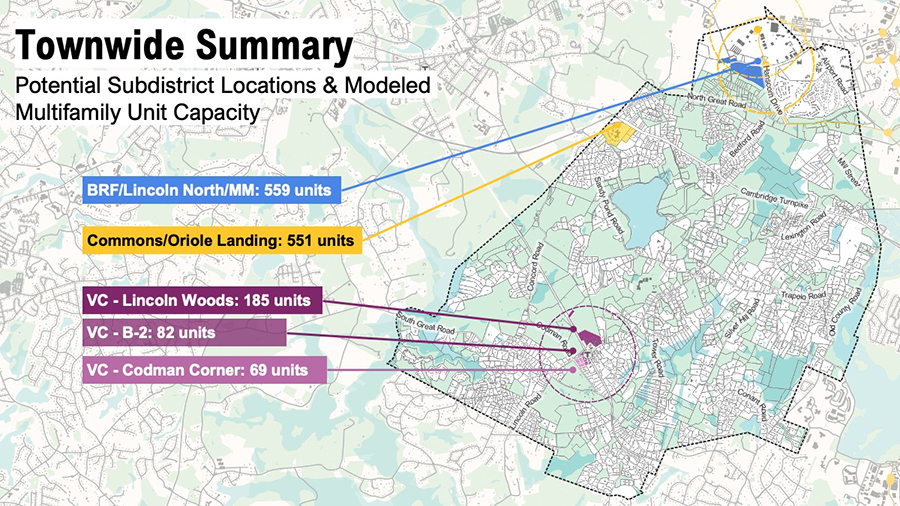
The five parcels proposed for multifamily rezoning (click to enlarge). Some combinations of four of them would satisfy HCA requirements.

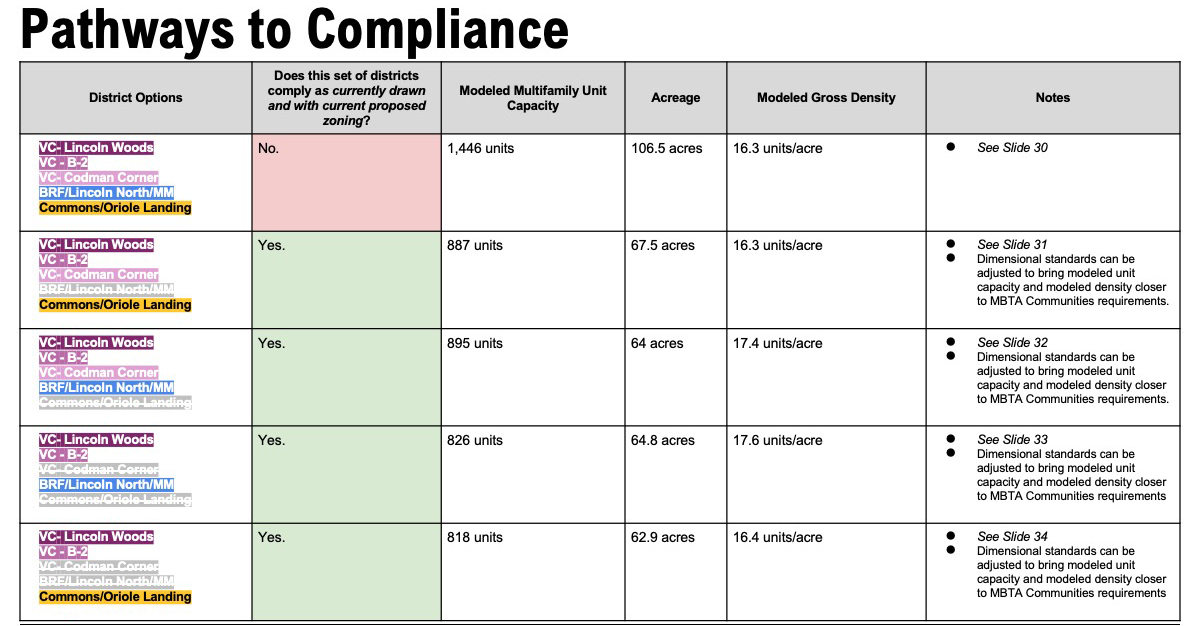
Five parcels of land in Lincoln have been identified for possible multifamily rezoning to satisfy the state Housing Choice Act, according to a consultant hired to help the town comply with the law. In a separate effort, the Rural Land Foundation is also proposing to rezone the area occupied by the Mall at Lincoln Station to allow redevelopment of the mall along with multifamily housing.

The HCA and mall initiatives were both presented at a multiboard meeting led by the Housing Choice Act Working Group on June 6. There will be two public forums later this month where residents can get information and ask questions, and more detailed proposals will be presented at the State of the Town meeting in September in preparation for a vote at Town Meeting in March 2024.

The state law aims to encourage more transit-oriented zoning areas on land surrounding MBTA stops by mandating “by right” zoning of at least 15 units per acre across the district. Lincoln, which has two MBTA stops (the train station and bus stop), must allow a total of 635 units.

The timeline is tight because the HCA requires commuter-rail towns such as Lincoln to have a rezoning plan in place by 18 months from now. Plans must be presented prior to a townwide vote ahead of time to the state Department of Housing and Community Development, which (along with the Attorney General’s Office) must also sign off after voter approval at Town Meeting — all by December 2024.

Early proposals for rezoning parts of Lincoln have identified five candidate parcels, four of which together would allow enough multifamily units to satisfy the HCA. Three of the parcels are in South Lincoln near the train station; the others are in north Lincoln around Oriole Landing and the Lincoln North office complex. Four of the five possible subdistrict combinations would meet all the conditions.

“You have options as a town. This is a good place to be,” said Will Cohen of consulting firm Utile Design.


  • Download the Powerpoint slide deck from the June 6 multiboard meeting

Towns aren’t required to create a single multifamily district; they may split it up into several nonadjacent subdistricts. However, the work to determine which areas would together meet state requirements is constrained by a complicated set of rules and formulas. For example, one of the subdistricts must account for at least half of the district’s total land area; all the land targeted must be developable (i.e., not conservation land or wetlands); and existing properties may not be divided into more than one new zone.

In Lincoln, the district must total at least 42 acres, and 20% of that land must be within half a mile of the commuter rail station. Some of it may also be around the bus stop at the corner of Hanscom Drive and Old Bedford Road. The working group focused on those areas as well as others that already have multifamily housing.

Additional wrinkles:

  • Since the HCA is aimed at residential zoning, commercial use cannot be required in a compliant district (though it may be allowed). This limits the ability to require mixed-use development in places like South Lincoln.
  • Lincoln now requires 15% of the units in multifamily developments to be income-restricted, but the HCA doesn’t have any requirements around affordability. In fact, if a town wants to have a zone mandate that more than 10% of the units are affordable, it must pay for an independent feasibility study that will demonstrate that that local requirement will not hurt the economic viability of a proposed project. Lincoln has already taken steps to have such a study done.

Lincoln and other towns can require developers to submit a site plan review and comply with reasonable design guidelines relating to traffic circulation, screening, lighting, etc., but “they can’t put out guidelines that make it impossible to do something,” Planning Board member Margaret Olson noted.

Finance Board member Andy asked if the state would pre-approve several rezoning proposals and allow voters to choose which one they preferred. “Lincoln has a history of getting state approval, [then] turning things down at Town Meeting and getting in a bind,” he said, referring to the school project that was pre-approved and partially funded by the state but was subsequently shot down at Town Meeting in 2012.

“That’s a great question that I don’t know the answer to,” Cohen said.

The HCAWG public forums will be on:

  • Friday, June 16 at 8 a.m. in person at the Town Hall
  • Tuesday, June 20 at 7 p.m. via Zoom — click here to register.

Redeveloping the mall

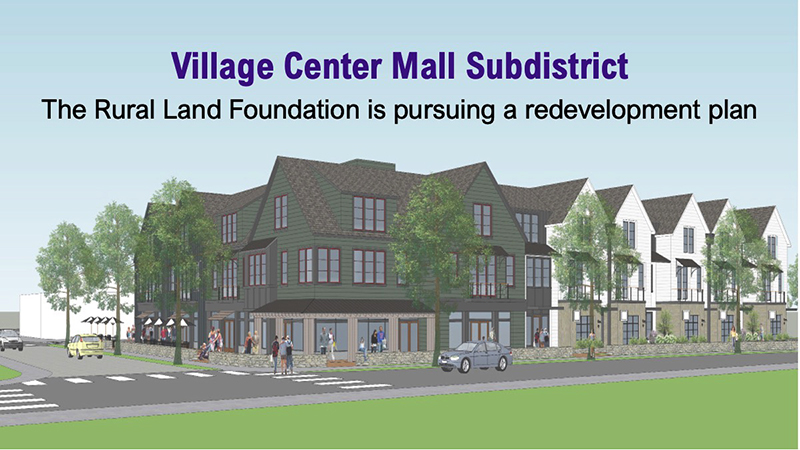
Along a parallel path in recent years, the Rural Land Foundation has been thinking about how to redevelop and revitalize the Mall at Lincoln Station to make it more attractive to commercial tenants and encourage multifamily housing. They propose to create a mall subdistrict that could accommodate 42 housing units above the building now housing the Bank of America and other stores (the portion with the post office and restaurant would not be affected).

“We though that looked pretty nice and in keeping with a town village center feel,” said Michelle Barnes, chair of the Lincoln Land Conservation Trust/RLF Board of Trustees, as she showed a rendering of one idea. “Greater density doesn’t have to look as scary as we might think.”

An artist’s rendering of one concept for how the mall might look after rezoning and redevelopment. Donelan’s is the white building at left rear.

As a commercial use, the mall area can’t be in the HCA district, as noted earlier. Instead, the town could rezone the mall to allow mixed use by right while also ensuring that commercial space is preserved.

A better quality of commercial space is crucial for the economic viability of the mall, which the trustees see as “an increasingly risky and hard-to-justify fiduciary obligation of the RLF,” Barnes said. However, without the opportunity for a developer to create a viable mixed-use project, the value of the mall will decline and the RLF will probably need to sell it (which it may have to do in any case).

RLF doesn’t have the capital to redevelop the mall by itself, so the group is working with CIVICO, which won approval for and built Oriole Landing before selling it in 2022. The RLF and CIVICO are conceptualizing a project with the idea that the mall would eventually be sold to the company, but contingent on an agreed-upon design “in keeping with the town’s ethos and values” that’s developed with input from residents and town leadership, Barnes said. To guarantee long-term financial viability for the project, a minimum of 25 housing units per acre built above the commercial spaces would be needed, she added.

Along with the HCA proposal, a mall rezoning measure will be presented at the State of the Town meeting on September 30 and at Town Meeting in March 2024.

Category: land use, news, South Lincoln/HCA* 2 Comments

Correction

June 7, 2023

In the June 6 edition of “News acorns,” an incorrect link was given for the website showing what parts of the Battle Road Trail are closed for repair. Click here to see the map (scroll down). The original post has been updated.

Category: news Leave a Comment

News acorns

June 6, 2023

Evenings at Gropius 2023

The Gropius House on Baker Bridge Road.

During an evening slide show and house tour on Friday, June 9 (as well as July 7, August 11, and September 15) from 7–9 p.m., see how Walter Gropius’s innovative lighting scheme comes to life at night. Gropius, founder of the German design school the Bauhaus, was one of the most influential architects of the twentieth century. His 1938 home at 68 Baker Bridge Road highlights the clean lines of Modernist design. Light refreshments are individual “nibbles” picnic bags. $65 for Historic New England members, $75 for nonmembers. Advance tickets required; call 781-259-8098 or buy online.

Class for kids on making summer recipes

Lincoln dietician and Happy Jars owner Jodi Gorman will offer a cooking class featuring summer parties and picnics for kids age 10+ on Friday, June 9 at 3:30 p.m. in the Lincoln Public Library. Jodi will go over basic kitchen skills as well as how to create a versatile, tasty salad for all seasons. All materials will be provided. Email sfeather@minlib.net for registration and more information.

Talk on Middle East policy

The GRALTA Foundation presents “What Can Progressives Do to Change America’s Middle East Policy?” with Philip Weiss, founder and senior editor of Mondoweiss, on Saturday, June 10 at 1:30 p.m. in Bemis Hall. Weiss is co-editor of “The Goldstone Report: The Legacy of the Landmark Investigation of the Gaza Conflict,” a 2011 retrospective on the official report prepared for the U.N. on Israel’s 2009 incursion into Gaza.  Mondoweiss is a source of news and analysis for progressives interested in the struggle for human rights equality for all people— Jews and non-Jews—living in Israel and the territories it has annexed and/or occupies. For more information, contact Steve Low at 781-259-1300 or steve.low@gordianconcepts.com.

Summer concert series at St. Anne’s

The Society for Historically Informed Performance (SoHIP) presents concerts at St. Anne’s Episcopal Church on most Thursdays from June 20 to August 8 from 7:30–9 p.m. The June 20 event, “The Road Less Traveled,” features 18th-century sonatas and dances performed by Titti Bassi — baroque cello duo Sarah Freiberg and Colleen McGary-Smith of the Handel and Haydn Society. Click here to see the full schedule of performers and to buy tickets ($26 regular admission, $21 for students and seniors, or $150/$117 for a season pass).

Battle Road Trail getting improvements

One of the recently repaired boardwalks in the national park.

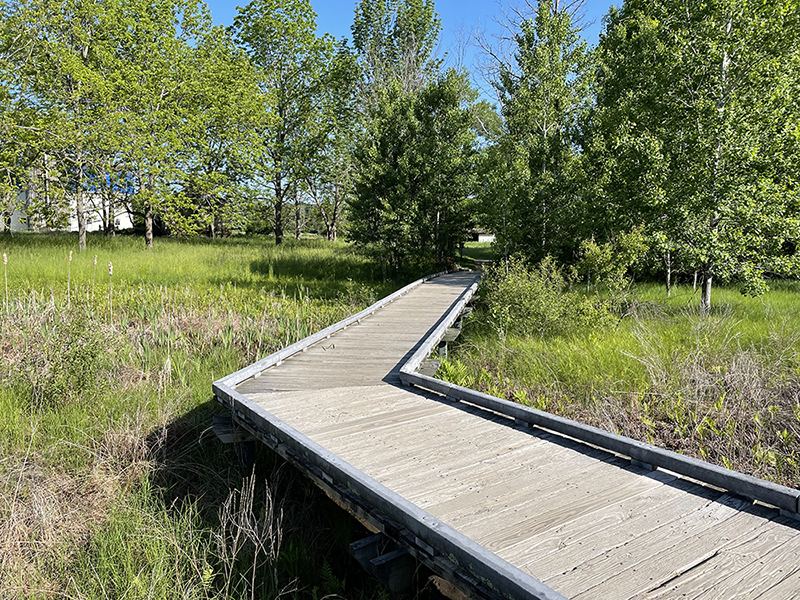
As part of a park-wide $27 million refurbishment project, several sections of the Battle Road Trail in the Minute Man National Historical Park are scheduled for trail rehabilitation and multiple boardwalks are scheduled for replacement this summer and fall. These projects will require temporary trail closures to the public at different locations along Battle Road Trail for safety and protections of the park’s natural and cultural resources. Click here for locations of the temporary closures and estimated closure dates.

Apply to teen Youth in Philanthropy program

The Foundation for MetroWest is now accepting student applications to its 2023-2024 Youth in Philanthropy (YIP) programs. YIP offers high school students who live or learn in MetroWest the opportunity to develop leadership, critical thinking, and collaboration skills while giving back to their community. Participating students work together to identify community needs, learn about local nonprofits, and make funding decisions that have a direct impact on youth in the MetroWest region.

To learn more or apply, visit yipmetrowest.org. Students interested in the fall programs are encouraged to apply before the fall priority deadline on Friday, June 30. Rolling admission then continues throughout the summer based on availability. The priority application deadline for spring 2024 programs is October 31, 2023.

SSEF receives $90,000 grant

The Lincoln-based South Sudanese Enrichment for Families has awarded a three-year, $90,000 grant by the Cummings Foundation. SSEF is one of 150 local nonprofits Selected from a pool of 630 applicants that will share $30 million through the foundation’s annual grants program.

SSEF is committed to building self-sufficiency and promoting community for all South Sudanese Americans in Massachusetts. “We are so grateful for this investment in our community that will be transformative for SSEF’s Educational Empowerment Initiative,” said Susan Winship, SSEF’s executive director. “Connecting the families we serve to existing educational resources and making sure the children of immigrants are receiving quality enrichment is our goal.

SSEF created a position to focus specifically on the Covid-related educational crisis impacting the South Sudanese community. The new Educational Liaisons assist families in connecting and communicating with schools, and advocating for their children. With the grant from Cummings, SSEF will increase the scope and efforts of this initiative.

The Cummings Foundation owns commercial property that is managed at no cost to the foundation by its affiliate, Cummings Properties. The Woburn-based commercial real estate firm leases and manages 11 million square feet of debt-free space, the majority of which exclusively benefits the foundation.

Category: news Leave a Comment

  • « Go to Previous Page
  • Page 1
  • Interim pages omitted …
  • Page 8
  • Page 9
  • Page 10
  • Page 11
  • Page 12
  • Interim pages omitted …
  • Page 156
  • Go to Next Page »

Primary Sidebar

Recent Posts

  • Water bills to go up by 13% March 5, 2026
  • News acorns March 5, 2026
  • Property sales in January 2026 March 4, 2026
  • My Turn: Unraveling the Hanscom misallocation March 3, 2026
  • Police log for Feb. 19–25, 2026 March 3, 2026

Squirrel Archives

Categories

Secondary Sidebar

Search the Squirrel:

Privacy policy

© Copyright 2026 The Lincoln Squirrel · All Rights Reserved.