• Skip to primary navigation
  • Skip to main content
  • Skip to primary sidebar
  • Skip to secondary sidebar

The Lincoln Squirrel – News, features and photos from Lincoln, Mass.

  • Home
  • About/Contact
  • Advertise
  • Legal Notices
    • Submitting legal notices
  • Lincoln Resources
    • Coming Up in Lincoln
    • Municipal Calendar
    • Lincoln Links
  • Merchandise
  • Subscription Info
    • My Account
    • Log In
    • Log Out
  • Lincoln Review
    • About the Lincoln Review
    • Previous Issues
    • Submit Your Work
    • Subscribe/Donate

land use

20-home development eyed for Panetta/Farrington land

April 27, 2025

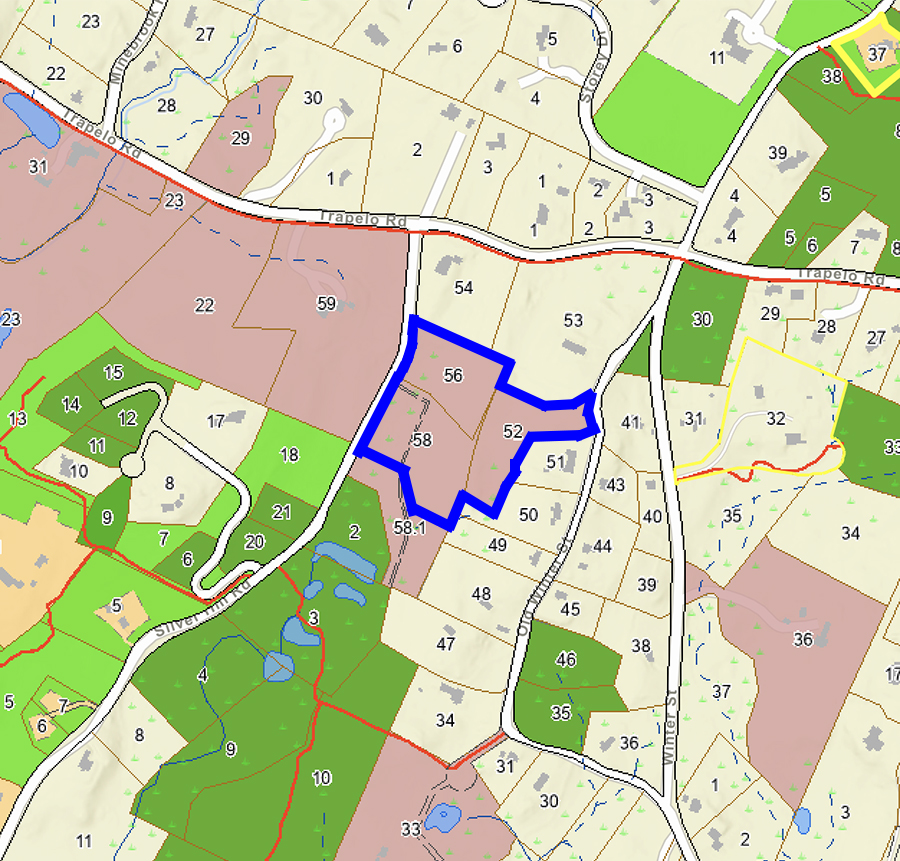
A map showing the land that the town hopes to purchase (click to enlarge).

Lincoln could see 20 new homes near Route 2 along with dozens of acres of newly town-owned woods and wetlands if residents vote yes at a Special Town Meeting on June 25.

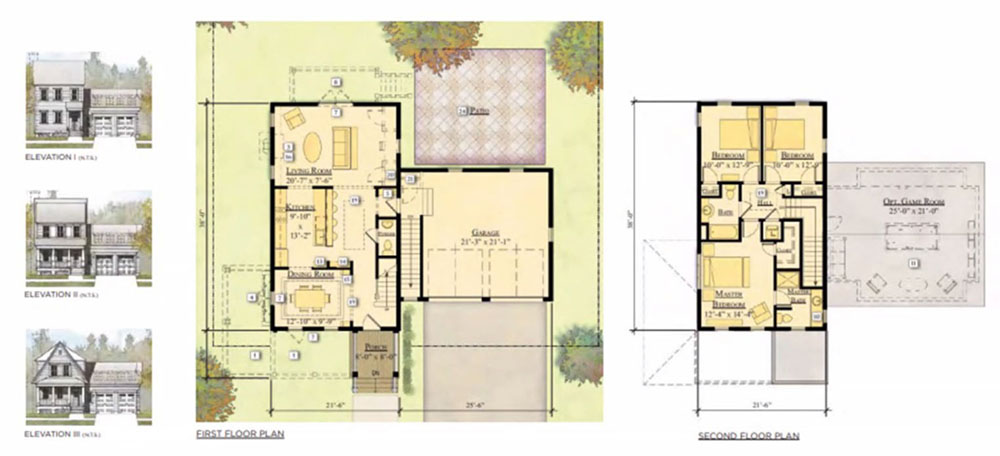
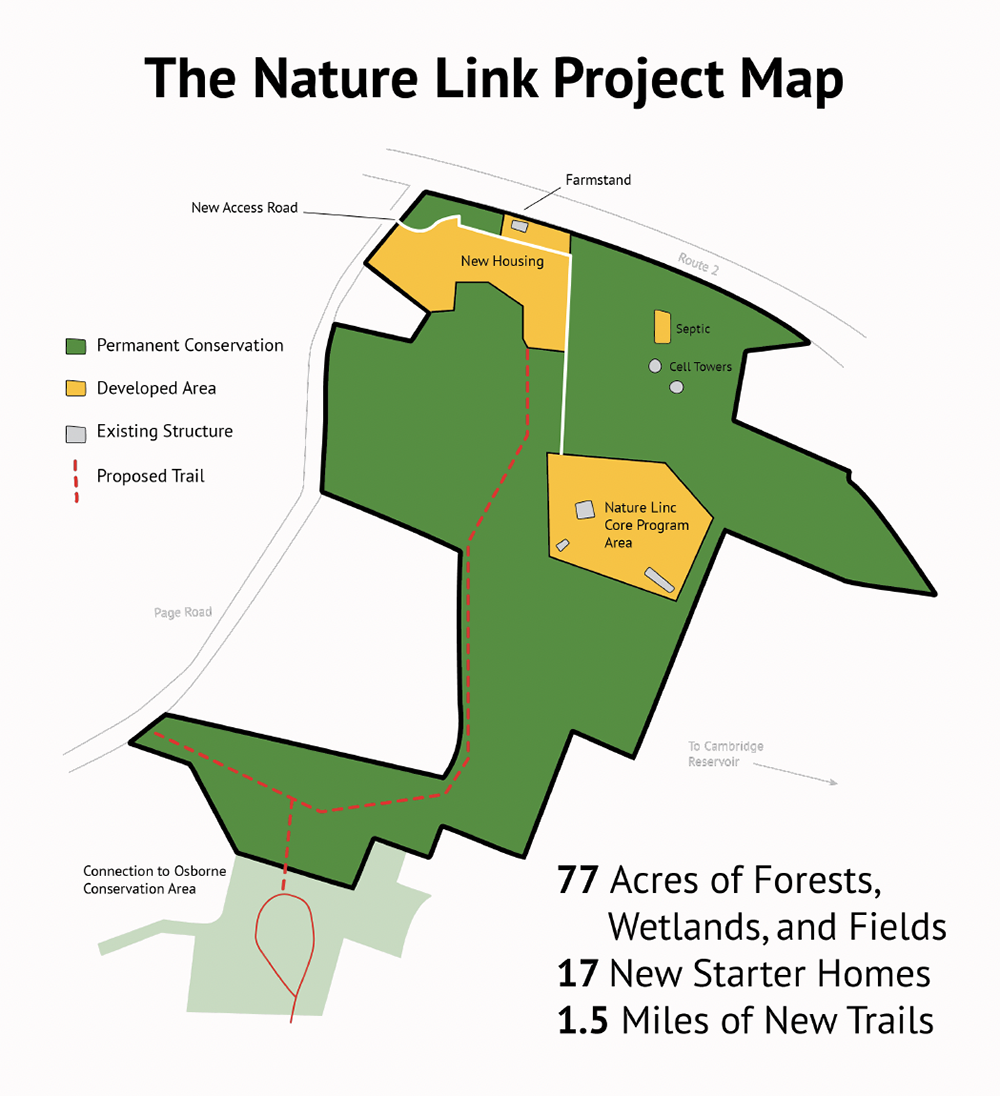
Seventeen of the 20 homes will be tightly clustered 1,850-square-foot “starter homes” on 14 acres of Page Road land currently owned by the Panetta family. The town proposes to buy a total of 77 acres from the Panettas and Farrington Memorial (which operates the nonprofit Farrington Nature Linc) for $6.4 million. Funds for the purchase would come from developer Consigli ($3.3 million), which built Oriole Landing, as well as $800,000 from the City of Cambridge, $950,000 from the Lincoln’s Community Preservation Act fund, and $1.35 million in private donations.

Farrington Memorial will retain ownership of some of its land within its parcel that will be accessed (as will the new houses) from a roadway coming off Page Road, and Farrington Nature Linc will continue to operate as it now does (see the Lincoln Squirrel, April 17, 2015).

A sketch of where the homes would be placed.

To make it all happen, voters must two zoning measures by a two-thirds margin — a change to the existing North Lincoln Overlay District for the proposed housing and another to preserve the existing Gerard’s Farm Stand on Route 2 — plus the CPA funding for the conservation component of the project that would protect the land from development and eventually add 1.5 miles of new trails connecting to the Osborn Conservation area to the south.

The deal won’t go through unless the RLF can raise $1.35 million in donations by June 25. RLF Executive Director Geoff McGean acknowledged the tight timeline for fundraising and voter approval. “It’s a very complicated project with a lot of moving parts that somehow all come together at this brief moment in time, unfortunately,” he said.

The fundraising effort will include appeals to foundations, friends of conservation, and a townwide mailing. “Most of the time it’s individual Lincoln residents that step up, and we’re hopeful that residents will think this is a good project worth supporting,” McGean said.

The housing plan is modeled on the state’s nascent 40Y program, which offers a zoning tool for towns to approve “starter homes” of up to 1,850 square feet in districts that allow at least four starter homes per acre. However, though the law has been passed, the state has not yet released specific guidelines for towns and developers, so there will be no opportunity for state grants or other involvement, McGean said.

The RLF presented the proposal to the Select Board on April 14 and will make an informal presentation to the Planning Board on Tuesday, April 29.

The plan is similar in some respects to the town’s 2016 purchase of the Wang property on Bedford Road. That deal paved the way for a new home for the Birches School, a new town playing field, and several acres of conservation land.

Category: Farrington/Nature Link project*, land use Leave a Comment

Four-unit townhouse proposed for Lincoln Road

April 24, 2025

Front and rear views of the townhouse proposal.

A proposal for a four-unit multifamily townhouse near condos on Ridge Road will be the subject of a Planning Board public hearing on May 13.

The 2.1-acre parcel was formerly owned by the Teabo family (Prince Teabo died in 2018 and his wife Betty in 2022) that’s accessed by an existing private right of way running from Lincoln Road to Greenridge Lane. The land isn’t part of the recently rezoned Housing Choice Act area; it’s in the R-2 General Residence District, where townhouses are allowed by right with a site plan review by the Planning Board.

Applicant Fabio Andrade hopes to replace the single-family home on the property with a flat-roofed two-story structure covering 2,262 square feet with four two-bedroom units built over above-ground garage parking.

Category: land use Leave a Comment

Proposal would clear-cut and replant several wooded acres

March 13, 2025

The three lots owned by the Plauts are outlined in blue (click to enlarge).

Editor’s note: This article was updated on March 19, 2025.

The owners of three lots on Old Winter Street totaling 8.5 wooded acres want to clear-cut about one-third of the land, regrade part of it for a driveway, and plant new native trees and shrubs.

The Planning Board held a hearing on the landscaping plan on March 11, which will be continued on March 25. The applicants, Timothy and Madeleine Plaut, are hoping to get approval for cutting down 137 mature trees, installing a driveway, and planting 268 new trees of varying sizes before going back to the board to seek approval for a single-family house in the southwestern area of the three-lot parcel.

The Plauts currently live in London and own several other properties around the world, though they hope to split their time between Lincoln and Europe once their new home is built, according to the narrative supplied by their landscape architect. They bought the properties in April 2024 from Thomas and Katherine DeNormandie.

The Plauts, who are in their late 60s, want to create a more diverse “three-layered woodland” by replacing some of the white pines and invasive species with local plantings, shrubs, ground cover, and pollinator meadows without a formal lawn area, modeling it after
Garden in the Woods
in Framingham, said Jen Stephens of Matthew Cunningham Landscape Design.

“They very much see this as a legacy property and are anxious to get plantings underway,” she said.

The property owners hope to clear-cut, regrade and replant the area in darker green (click to enlarge).

“Philosophically, we’re pretty aligned with this project… it’s a better outcome than it could have been for the neighborhood,” said Justin Hopson, one of the abutters, noting that zoning rules allow a house on each of the three lots.

However, one aspect of the project met with opposition: the plan to install a permanent driveway from Old Winter Street rather than from Silver Hill Road, as the owners originally proposed. The latter idea was rejected by the Conservation Commission (ConCom) because a driveway, even if unpaved, is considered a “permanent structure” and is therefore prohibited in the wetlands just east of Silver Hill Road.

A permanent driveway from Old Winter Street won’t be a major problem for the neighborhood, but during landscaping, utilities, and house construction, “there will be a huge amount of disruption” to an area with four nearby homes with young families, said abutter Chris Murphy. It’s “insane” for the Conservation Commission to route construction traffic from Old Winter Street when a much shorter temporary construction driveway could be built coming off Silver Hill Road, he said. That strip of land could later be restored, Stephens suggested.

Planning Board Chair Margaret Olson asked Susan Hall Mygatt, a ConCom member who was at the board’s meeting, to get a sense of the commission’s willingness to change its regulations to allow the temporary access road, if in fact those rules “are forcing [the owners]  to do something that none us think is environmentally the right thing to do.” Stephens said she would try to get on the commission’s March 26 agenda for that purpose. The Planning Board might be able to give its landscaping plan approval contingent on ConCom’s permission to move the temporary driveway, Olson said.

Category: land use Leave a Comment

My Turn: Proposed private-jet Hanscom expansion is a climate bomb in sheep’s clothing

February 23, 2025

By Alex Chatfield

Fellow Lincolnites: Don’t let Massport pull the wool over our eyes. The proposal for an immense private jet hangar facility at Hanscom Field is a climate bomb in sheep’s clothing that must be stopped. Hanscom Field civilian airport is owned and operated by Massport, and is distinct from Hanscom Air Force Base which focuses on research and development and has no airfield. 

Private jets are the most carbon-intensive form of travel per passenger, and frequently used for leisure and convenience. Expanding this form of travel in the midst of a climate crisis is indefensible. For this reason, Massport and prospective developers have packaged their enormous 522,000-square-foot, highly polluting proposal as a model of “sustainable aviation” to distract the public and policymakers.

A 5-minute CBS News segment on “How Airports are ‘Greenwashing’ their Reputations” reveals that when airports claim to be sustainable, they are referring solely to their green buildings and infrastructure, which comprise only 2% of the emissions generated at airports, while excluding aircraft emissions, which constitute the remaining 98%.

The CBS report further spotlights the hope and hype surrounding sustainable aviation fuels (SAFs), which the prospective Hanscom developers enthusiastically tout, saying their new facility will promote SAFs. This claim is misleading on several counts. First, the word “promote” holds little weight since, as the CBS report discloses, the FAA prohibits airports or airport facilities from requiring a specific type of fuel. Second, by the Hanscom developers’ own admission, “the aviation industry projects use of alternative/clean-fuel aircraft (i.e., electric or SAF) to be approximately 10 percent of aircraft by 2030” (see the developers’ DEIR [Draft Environmental Impact Report], Section 3.1.3).

These points were reinforced by a January 8 webinar on SAFs attended by nearly 200 participants statewide. After examining several types of SAFs, independent analysts from MIT, the World Resources Institute, and the Institute for Policy Studies cautioned that while SAFs are technically feasible, it is not likely that they will be available at scale by 2050, the year that scientists say we must reach net zero to avert the worst impacts of climate change. 

Moreover, the trade-offs with SAF production at scale are daunting. Crop-based SAFs would sabotage food production by hijacking arable land for jet fuel. For example, to reach the current U.S. goal of 35 billion gallons of SAF in 2050 would require 114 million acres of corn—20 percent more than the current total land area of corn crops in the U.S. Meanwhile, synthetic SAFs for jets would put an enormous burden on the electric grid, competing with internet, AI, heat/AC, light and refrigeration.

Concerns about greenwashing were echoed by area Select Board members and our state legislators at the January 28 virtual HATS meeting (Hanscom-Area Town Selectboards) with new Massport CEO Rich Davey.

Mark Sandeen, chair of HATS stated that, if the proposed private jet expansion were to go forward, the 75 or so additional private jets at the new facility would generate more emissions than all of the houses and cars in Lexington, Bedford, Concord and Lincoln combined. “You’re looking at a group of people here who dedicated decades of their lives to reducing the emissions of their towns, and to see one project wipe out any possibility of success… we don’t view that as small,” he said.

State Sen. Mike Barrett posited to Davey that “there is a sense in which you’re rolling out SAFs, I think, as a shield and in order to disarm us,” a point that Davey heatedly denied, referencing an SAF startup in Charlestown in his defense. To this, Barrett replied: “We have lots of startups in Massachusetts that hope someday to cure cancer, and we certainly want to encourage them to try. But none of us go out and encourage our kids to smoke cigarettes because the cure is going to come in their lifetimes.”

Christopher Eliot, chair of HFAC (Hanscom Field Advisory Commission, representing the four Hanscom-area towns) added that after studying SAFs in “excruciating detail,” he doesn’t believe they have technical merit: “Each new version solves one problem and creates two others… They’re either going to blow out agriculture or blow out the electrical system.” 

Speaking for many, Eliot shared this comment: “The only thing that’s acceptable to anybody… here is the status quo… there’s none who would have any tolerance for the expansion.” 

Eliot’s view is shared by more than 14,000 people across the Commonwealth that have signed a petition urging Gov. Healey to take all possible action to stop private jet expansion at Hanscom or anywhere because it is antithetical to Massachusetts’ efforts to rein in climate change.


“My Turn” is a forum for readers to offer their letters to the editor or views on any subject of interest to other Lincolnites. Submissions must be signed with the writer’s name and street address and sent via email to lincolnsquirrelnews@gmail.com. Items will be edited for punctuation, spelling, style, etc., and will be published at the discretion of the editor. Submissions containing personal attacks, errors of fact, or other inappropriate material will not be published.
Category: Hanscom Air Field, land use, My Turn

Property sales in December 2024

January 14, 2025

140 Lincoln Rd. #117 — Cambridge Trust Co. Trust to Martin and Nancy Robb for $741,000 (December 27)

68 Conant Rd. — Patricia F. Horwitz Trust to Olivia Pennock and Bjorn Slate for $1,365,000 (December 27)

285 South Great Rd. — Charles Peters III to Matthew Zbawiony and Hathairat Sawaengsri for $950,000 (December 23)

0 South Great Rd. — Virginia Steele Wood Trust to Krisha Kandarpa for $550,000 (December 20)

22 Old Cambridge Turnpike — Nicholas Konstandakis to Nicholas and Monique Nikolaou for $1,800,000 (December 16)

22 Goose Pond Rd. — Beverly Tomasic Bowman Trust to Jon and Nicola Sillari for $1,830,210 (December 4)

181 South Great Rd. — Diana Abrashkin to William and Katelyn Maronn for $699,000 (December 4)

43 Greenridge Lane — Robert Wadsworth to Mary Toland for $580,000 (December 2)

Category: land use Leave a Comment

Property sales in November 2024

December 30, 2024

140 Lincoln Rd. #217 — Marian E. Anderson Trust to Elaine Garnache for $568,830 (November 25)
 
243 Aspen Circle — G. Mitchell Eckel III Trust to Kelley Seelagy Trust and KS Trust for $817,000 (November 15)
 
10D North Commons — Wendy Jamieson to Mark Zielinski and Julia Pirvu for $770,000 (November 13)
 
77 Weston Rd. — John Peck to Benjamin Steele and Jane Zimmerman for $2,755,000 (November 12)
 
15 Hillside Rd. — Jonathan Wyman to Leah Rogoff and Jacob Mingolla for $1,450,000 (November 4)

Category: land use Leave a Comment

Family to fund awards honoring Lincoln woman

December 18, 2024

The giving spirit is certainly in evidence at this time of year. A new town committee backed by a Lincoln family who wants to remain anonymous will award grants to charities every month to recognize women — and in an unrelated development, another family has donated a piece of property to the town for conservation purposes.

In its first year, the Women Positively Impacting Lincoln Lives program, known as WILL, will honor “women who have lived or worked in Lincoln and whose contributions have benefited the town of Lincoln, the local area, or society at large,” said Select Board Chair Kim Bodnar. The group will seek nominations of “women of today” and will award 12 monthly grants of $2,500 to the organization of the winning nominee’s choice. Once a year, it will also select women from history who have had an impact on Lincoln and award $2,500 in her name. 

The family initially offered to appoint and run the committee to spare the town the administrative work that accompanies an official committee. But the Select Board ultimately decided that such a group should be operated by the town under its usual procedures, even though it’s administering private funds, much as the Lincoln Scholarship Committee does.

The identity of the philanthropic family is still a mystery, but that may change at some point. “The donor family would like to remain anonymous but recognize that it might be challenging should they participate in the committee’s meetings, which are subject to the requirements of Open Meeting Law,” Bodnar said. 

The parcel abutting Trapelo Road and the Cambridge Water Dept. land that will be known as “Le Champ du Maroni.”

New town-owned parcel

The parcel of vacant land being donated to the town is on the south side of Trapelo Road abutting the Cambridge Water Department’s land abutting the reservoir (see map at right). It’s one of two adjoining parcels that were once owned by the parents of Kevin Maroni (the second lot abutting Huckleberry Hill includes a home and has been sold). The lot will be left in a natural state as a memorial to his parents and will eventually bear a sign marking it as “Le Champ du Maroni,” said Conservation Director Michele Grzenda. 

Category: charity/volunteer, land use Leave a Comment

Updates to outdoor lighting rules mulled

November 26, 2024

Examples of permitted and unacceptable outdoor lighting from 2015. The yellow dots indicates the position of the lightbulb.

At the December 7 State of the Town meeting, the Dark Skies Committee will give an update on its work to update rules on outdoor lighting to reflect changes in technology since they were last amended in 2016.

Artificial light at night keeps away wildlife (thus reducing their habitat), kills insects, and interferes with nocturnal breeding cycles and bird migration, said Louise Bergeron, head of the Planning Board subcommittee, in a presentation at the November 18 Select Board meeting.

Current zoning rules require permanent lighting to be installed or shielded to “prevent direct light or glare from the light source from interfering with the vision of motorists or pedestrians” or illuminating neighboring properties, and exterior lamps to have a color temperature of 3,000K or below. Lights must also be no more than 900 lumens (a measure of brightness). Color temperature refers to the color of the light — the lower the temperature, the more orange it appears, whereas higher-temperature numbers indicate bluer light.

Outdoor lighting was the topic of heated debate at Town Meeting in 2015, when voters rejected some rule changes.

In recent years, LED lights — which tend to have a cooler color temperature than incandescent lights — have become commonplace, and people are often tempted to buy the brightest outdoor lights they can, Bergeron said. Her group is also studying ideas such as allowing only activated lights in certain circumstances, and asking or requiring owners of larger buildings to turn off outdoor lights that currently shine all night, such as those in parking lots, schools, churches, and the Water Department.

Town officials can grant exceptions if warranted, and the public safety will continue to be exempt.

“This is a lot about education,” Select Board member Jennifer Glass said. “You’re going to get the best result when you educate people, because we don’t have the capacity to go around policing everyone.”

Category: land use Leave a Comment

Construction at The Commons to begin in early 2025

November 25, 2024

An illustration showing proposed new construction in yellow and new walking paths are shown in bright green. Click image to enlarge.

The owners of The Commons in Lincoln won approval for their planned expansion earlier this month, though the exact construction schedule is still unclear.

The Planning Board gave its thumbs-up on November 12 after the close of public hearings, concluding a process that began in February 2023. Residents of the senior living community objected to the original plan for 47 new independent living units, so The Commons returned with scaled-down plan for 23 units, and voters approved a zoning amendment to allows the project in December 2023. More recently, owners updated the plans for landscaping and the location of new parking spaces.

At the hearing in September, representatives for The Commons said that construction would begin with the additions to the main building. Cottages will be on their own timeframe and isolated with fencing as separate construction sites. sites

“We are excited to get started in Q1 of 2025 and will be happy to share more phasing details after our financing on the project has closed,” Rey LeBlanc, executive director of The Commons, told the Squirrel last week.

Category: land use Leave a Comment

My Turn: Climate bill gives hope to opponents of Hanscom expansion

November 21, 2024

By Alex Chatfield, Trish O’Hagan, Lara Sullivan, and Kati Winchell

The climate bill just signed by Gov. Healey contains a provision that was not noted in the official summary but is profoundly important — an update to the Massport charter. From now on, Massport will be required to promote “environmental protection and resilience, reductions in greenhouse gas emissions, and environmental justice principles” in its decisions regarding its responsibilities and the entities with which it does business. Massport’s responsibilities, currently limited to the narrow roles of promoting commerce and economic growth, will therefore expand to include climate priorities. 

This update is encouraging to advocates across Massachusetts who oppose the proposed expansion of private jet infrastructure at Massport-owned Hanscom Field (separate from Hanscom Air Force Base). Massport is currently working with private developers to build a 522,380-square-foot expansion in hangar space for private jets — the largest such expansion in Hanscom’s history. An October 2023 study documented that at least half the private jet flights out of Hanscom go to vacation destinations like Martha’s Vineyard or the Super Bowl. They are airborne yachts for the ultra-wealthy.

Massport’s and Runway Realty Venture Inc.’s proposal for expansion has generated a storm of controversy. Opposition has been led by Stop Private Jet Expansion at Hanscom or Anywhere (SPJE). SPJE observes, based on an April independent analysis, that the proposed private jet hangar development at Hanscom alone could result in as many as 6,000 additional private jet flights annually, producing about 150,000 tons of carbon equivalent emissions every single year. If the expansion goes forward, private jet emissions from Hanscom alone could cancel nearly 70% of the environmental benefits of all the solar PV ever installed in Massachusetts and would offset the investment and hard work of many towns and cities to help the state meet the goals of its ambitious climate plans.

The legislation updating Massport’s charter follows EEA Secretary Tepper’s rejection of the developers’ draft environmental impact report (DEIR) in June. More than 1,500 public comments and over 13,500 petition signatures critical of the developers’ plans were submitted to MEPA (Mass. Office of Environmental Policy Act). Based in part on the volume of public response, as well as on independent analyses that were submitted, Tepper criticized the developers’ argument that the massive hangar expansion would decrease operations and reduce greenhouse gas emissions, calling it unsupported. She found that the report did not meet the requirements of Massachusetts law and directed the developers to produce a Supplemental DEIR that would address the many questions that the initial draft failed to consider adequately.

This was the context in which state Sen. Mike Barrett and Reps. Simon Cataldo, Michelle Ciccolo, Carmine Gentile, Ken Gordon, and Alice Peisch introduced language into the Mass. Climate Bill that would update Massport’s charter to prioritize reductions in greenhouse gas emissions. The Senate passed the bill on October 24 with a vote of 38-2, followed by a House vote of 128-17 on November 14. And on November 20, Gov. Healey signed it.

Sen. Barrett left no doubt that he expected the new language to prompt Massport to reconsider the project. “We live in an age where rampant economic growth is no longer sufficient as a raison d’etre for public agencies,” he said. “The governor has said that an all-government approach to climate change is needed, so now we ask of every single organization — Massport included — ‘What’s your role in fighting the existential crisis of our time?’” 

This is a pivotal moment. The legislature’s overwhelming support for a change in Massport’s charter sends a powerful message that the agency needs to align its own approach to climate change with the approach taken by the rest of the state. Massport’s first chance to show that it understands this new environment will be its stance toward the proposed Hanscom expansion. It’s already clear that that expansion is completely inconsistent with state climate change policy. It’s time for Massport to just say no.


“My Turn” is a forum for readers to offer their letters to the editor or views on any subject of interest to other Lincolnites. Submissions must be signed with the writer’s name and street address and sent via email to lincolnsquirrelnews@gmail.com. Items will be edited for punctuation, spelling, style, etc., and will be published at the discretion of the editor. Submissions containing personal attacks, errors of fact, or other inappropriate material will not be published.

Category: Hanscom Air Field, land use, My Turn Leave a Comment

  • « Go to Previous Page
  • Page 1
  • Interim pages omitted …
  • Page 3
  • Page 4
  • Page 5
  • Page 6
  • Page 7
  • Interim pages omitted …
  • Page 38
  • Go to Next Page »

Primary Sidebar

Recent Posts

  • News acorns April 21, 2026
  • Service in June for Tim Barclay April 21, 2026
  • Legal notice: Conservation Commisson public hearing (29 Lincoln) April 21, 2026
  • News acorns April 19, 2026
  • Police log for April 3–15, 2026 April 19, 2026

Squirrel Archives

Categories

Secondary Sidebar

Search the Squirrel:

Advanced search

Privacy policy

© Copyright 2026 The Lincoln Squirrel · All Rights Reserved.