• Skip to primary navigation
  • Skip to main content
  • Skip to primary sidebar
  • Skip to secondary sidebar

The Lincoln Squirrel – News, features and photos from Lincoln, Mass.

  • Home
  • About/Contact
  • Advertise
  • Legal Notices
    • Submitting legal notices
  • Lincoln Resources
    • Coming Up in Lincoln
    • Municipal Calendar
    • Lincoln Links
  • Merchandise
  • Subscription Info
    • My Account
    • Log In
    • Log Out
  • Lincoln Review
    • About the Lincoln Review
    • Previous Issues
    • Submit Your Work
    • Subscribe/Donate

history

Violet Thayer, successful Lincoln businesswoman born into slavery

February 21, 2021

Editor’s note: This is the first article in a new series called “Lincoln’s History” written by the Lincoln Historical Society.

By Don Hafner

Black History Month is a time to reflect upon stories of Lincoln’s own history of slavery. Here is one such story.

Against all odds, Violet Thayer of Lincoln was a successful businesswoman. When she died in 1813, she was in her seventies and had never married. Violet’s mother was still alive, but she was blind and incapable of managing her late daughter’s affairs, so John Hartwell, proprietor of the Hartwell tavern, handled Violet’s estate.

The probate inventory of Violet’s property included what we might expect of a successful seamstress — two calico gowns, one cambric gown, four short gowns, twenty yards of shirting fabric, thimbles, yarn. In all, the estate was valued at $114. Three more items showed Violet’s success and savvy as a businesswoman. She had $30 in cash, as well as two loans she had made that paid her interest—one to Bulkley Adams for $20 and the other to Samuel Hartwell for $27.

During the seven weeks of Violet’s terminal illness, she was cared for by John and Hepzibah Hartwell. John Hartwell claimed a third of Violet’s estate for his expenses in boarding her during these weeks, but that still left something for her aged and blind mother.

Violet Thayer’s success did not come easily. She had been born into slavery and had been enslaved “from infancy” in the households of Ephraim and Elizabeth Hartwell and then John and Hepzibah Hartwell. Yet by the time of her death, Violet had earned enough money on her own to make loans to two of Lincoln’s prominent citizens. Quite likely, these “loans” were Violet’s shrewd equivalent of a savings account that paid interest at a time when Lincoln had no banks.
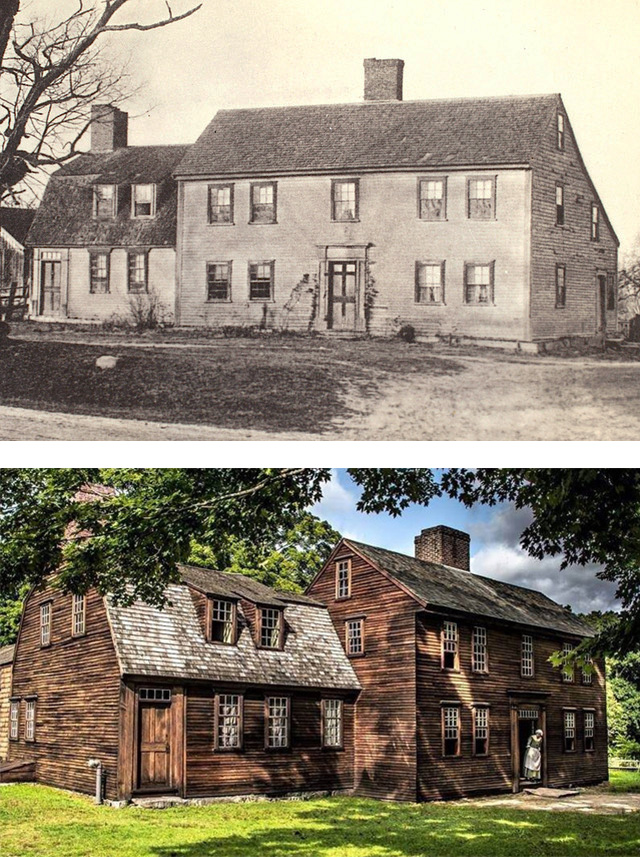
Hartwell Tavern in 1904 and in modern times. The house (now part of Minute Man National Historical Park) was originally built as a home for Ephraim Hartwell and his newlywed wife Elizabeth in 1733.

Also against the odds, the Hartwells attempted to hold Violet in bondage even after the state Supreme Judicial Court pronounced in 1783 that the court was “fully of the opinion that perpetual servitude can no longer be tolerated in our government.” Essentially, the court gave every “servant for life” in Massachusetts the opportunity to simply walk away from their owners, including the dozen or so slave owners in Lincoln. Yet five years later, when Ephraim Hartwell made out his will in 1788, he included this clause: “I give unto Elizabeth Hartwell my beloved wife … my Negro woman, named Violet for her own service & disposal.”

Ephraim Hartwell died in 1793, and the probate inventory of his estate did not include any mention of Violet among his “property.” Perhaps she had challenged her enslavement; perhaps she had simply been released by the Hartwells. Either way, when freedom finally came to her, Violet Thayer made her own path in the world—and quite successfully.

For more on slavery in Lincoln, see A Rich Harvest by John C. MacLean, especially pages 216-221. Copies of are available from the Lincoln Historical Society.


Addendum (March 1, 2021):

Did you know that the end of slavery in Massachusetts was complicated, and there was not a single action or case that ended it. Although in the 1790 census no individuals within Massachusetts were identified as slaves, Hartwell’s ongoing treatment of Violet as a slave two years earlier was not unique and not illegal.

In 1781 there were two important lower-court cases brought by slaves Mum Bett and Quock Walker that resulted in their being declared free. Walker had been owned by Nathaniel Jennison, and other charges developed out of the original case. One was Commonwealth v. Jennison, which related to an incident where Jennison had beaten Walker. In 1783 it had gone to the Supreme Judicial Court, and Jennison was found guilty and fined forty shillings.

Chief Justice William Cushing argued the view that based upon language in the 1780 Massachusetts Constitution (an issue earlier argued in the Mum Bett case), Cushing was “fully of the opinion that perpetual servitude can no longer be tolerated in our government.”

Although highly suggestive, those statements were not part of the formal decision of the court, which was dealing with a narrower issue of assault and battery—so slavery legally continued (including with the Hartwells), but it now became clear that the SJC would not uphold it.

For those interested in research into Massachusetts slavery, a general article I wrote some time back for the New England Historic Genealogical Society includes Lincoln references and is available here.

Jack MacLean
Lincoln Town Historian

Category: history 4 Comments

My Turn: The saga of the lost Dallin sculpture

January 10, 2021

By Don Hafner

Did you know that one of sculptor Cyrus Dallin’s most famous statues has been lost?

Cyrus Dallin, the sculptor of “The Boy and His Dog” in Lincoln’s cemetery, is best known for a set of four statues of Native Americans called “The Epic of the Indian.” The fourth and most famous in the series, “Appeal to the Great Spirit,” stands at the entrance of Boston’s Museum of Fine Arts.

Lost forever is Dallin’s “Protest of the Sioux,” which was created for the St. Louis World’s Fair in 1904. Dallin’s Native American statues have been criticized recently as “stereotypical imagery” of Native Americans by white artists. Dallin was a vigorous advocate of Native American rights, and when his series of four statues were displayed, they would have been controversial for a very different reason. When Dallin’s “Protest of the Sioux” was displayed in 1904, the U.S. Army was still waging war against Native American tribes in the Southwest. Dallin’s statue of a Sioux warrior on horseback, with fist raised in defiance against the loss of Sioux lands and way of life, must have seemed to some visitors at the World’s Fair as siding with the enemy. As one newspaper correspondent put it, “The North American Indian will make his last stand at the World’s Fair.”

Dallin’s “Protest of the Sioux” was monumental. On its pedestal, it stood forty feet high. But it was made of a perishable artificial stone, not cast in bronze like all of Dallin’s other work. After the World’s Fair, it was moved to a park in St. Louis, and reportedly one night the statue “crumbled into a heap of dust.” A cast bronze replica, only 21 inches tall, survives in a museum in Utah.

Fortunately, Dallin’s sculpture of “The Boy and His Dog” in Lincoln’s cemetery is made of durable cast bronze. To hear more about Cyrus Dallin and “The Boy and His Dog,” join the Zoom webinar with Nancy Blanton of the Cyrus Dallin Art Museum on Monday, Jan. 11 at noon. The presentation is cosponsored by the Lincoln Council on Aging’s Lincoln Academy, the Lincoln Historical Society, the Lincoln Cemetery Commission, and the Lincoln Town Archives.

Zoom link: https://zoom.us/j/97474874876

Don Hafner is a member of the Lincoln Historical Society.


”My Turn” is a forum for readers to offer their views on any subject of interest to other Lincolnites. Submissions must be signed with the writer’s name and street address and sent via email to lincolnsquirrelnews@gmail.com. Items will be edited for punctuation, spelling, style, etc., and will be published at the discretion of the editor. Submissions containing personal attacks, errors of fact, or other inappropriate material will not be published.

Category: history, My Turn Leave a Comment

Council on Aging activities in January

December 28, 2020

Here are some of the January activities hosted by the Lincoln Council on Aging. Most events are open to Lincoln residents of all ages. For a full list, including exercise classes, regular meetings of interest groups, and online chats with town officials, see the COA’s calendar page or January newsletter. Contact the COA at 781-259-8811 or gagnea@Lincolntown.org for Zoom links to events.

Lincoln Academy: The “Boy and His Dog” statue

Monday, Jan. 11 from noon–1 p.m.
The talk will explore the life and work of sculptor Cyrus Dallin with a focus on his Lincoln masterpiece, Storrow Memorial, given to Lincoln in 1925. Known affectionately to those in Lincoln as “Boy and his Dog,” the statue stands near the entrance of the Lexington Road cemetery and is a great feature of both Lincoln and Dallin’s work. The presentation is in conjunction with the Cyrus Dallin Art Museum, the Lincoln Historical Society, the Cemetery Commission, the Lincoln Town Archives, and COA. Details to follow.

Learn to host meetings on Zoom with Andy Payne

Wednesday, Jan. 20 at 1 p.m.
Andy will present some basic lessons and give you a chance to learn and explore Zoom’s settings and features in a low-stakes environment. Zoom is a very popular system for video chats with groups and is supported on Mac, Windows, iPhone/iPad, and Android devices. Click here to download Zoom if you don’t have it on your device. Once you have it installed, just click on a Zoom link to participate in a meeting. Zoom meeting link: https://zoom.us/j/577144331

Lincoln Academy: The Story Behind the Greatest of Liberations

Monday, Jan. 25 from noon–1 p.m.
This session with Bernice Lerner, author of All the Horrors of War, follows Glyn Hughes, a high-ranking British officer, and Rachel Genuth, a teenager from the Hungarian provinces, as they navigate their respective forms of hell during the final brutal year of World War II. Their stories converge in the Bergen-Belsen concentration camp, where Hughes finds himself responsible for an unprecedented situation: 25,000 of 60,000 war-ravaged inmates are in need of immediate hospitalization, and Rachel is among those at death’s door. Their narratives tell a larger story about the suffering of the victims, the struggles of liberators who strove to save lives, and the human capacity for fortitude and redemption. For more information, call 781-259-8811 x102 or email gagnea@lincolntown.org.

Wanda Paik: Classical piano music recital

Monday, Feb. 1
Wanda Paik will present a recital of some her favorite classic piano pieces, anchoring it with a masterpiece: J.S. Bach’s “Toccata, Fantasia and Fugue in D major.” Also on the playbill are works by Frederic Chopin (“Impromptu in A-flat major,” “Nocturne in C-sharp minor,” and “Etude in A-flat major,” which was thought to make the piano sound like an Aeolian harp); Brahms’s iconic “Intermezzo in E-flat minor,” which weaves an ancient Gregorian chant throughout the piece; and Debussy’s luminously beautiful “Clair de Lune” from the “Suite Bergamasque,” followed by his sweeping, jazzy Prelude from the “Suite Pour le Piano.” For details, email gagnea@lincolntown.org.

Caring transitions: educate yourself before a healthcare crisis

Wednesday, Jan. 27 at 2 p.m.
Join elder law attorney Sasha Golden and Emily Tamilio of Deaconess Abundant Life to learn about navigating healthcare in a crisis. These local professions will walk us through the continuum of care from skilled nursing to rehab and back home again. For details, email gagnea@lincolntown.org.

Category: educational, history Leave a Comment

My Turn: It takes a village

October 27, 2020

By Sara Mattes

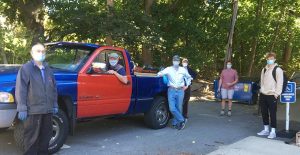
On Saturday, Sept. 19, the Lincoln Historical Society was on the move with its “Book Brigade.” Over 60 cartons of books (1,700 lbs. at last calculation) were moved from the basement of Bemis Hall for temporary storage elsewhere while Bemis Hall is being cleaned and made rodent-free.

Young and not-so-young accomplished the move in matter of hours. Critical to the success were the young, strong backs and good spirits of Lukas Lenkutis and Peter Covino.

Sara Mattes
Lincoln Historical Society


”My Turn” is a forum for readers to offer their views on any subject of interest to other Lincolnites. Submissions must be signed with the writer’s name and street address and sent via email to lincolnsquirrelnews@gmail.com. Items will be edited for punctuation, spelling, style, etc., and will be published at the discretion of the editor. Submissions containing personal attacks, errors of fact, or other inappropriate material will not be published.

Left to right: Jim Cunningham, Craig Donaldson, Gus Brown, Don Hafner, Chris Taylor, and Lukas Kenkutis.

Category: history, My Turn, news 2 Comments

My Turn: Lincoln Historical Society reaches out

September 3, 2020

By the Lincoln Historical Society

Hello Lincoln!

The Lincoln Historical Society, like everyone else, has been figuring out this new world of Covid-19. We are regrouping and seeing this as an opportunity to find new ways to reach out to you and bring you things of historical interest both from our beginnings, but also more recent developments in our town.

In order to do this, we will be making more use of web and social media platforms. That will include regular pieces in LincolnTalk, The Lincoln Squirrel, The Lincoln Chipmunk, and The Lincoln/Concord Journal.

Many pieces will concern national events and Lincoln’s role and/or response. Recent articles were published about the ratification of the 19th Amendment and Lincoln’s response to suffrage, as seen at the voting booth, and the 75th anniversary of the end of World War II.

A new regular entry is called “Did you know…” It will offer tidbits and snippets of Lincoln lore and legend… and, of course, facts. If there’s anything you have wondered about, let us know. And if you have anything to add to our “to do” list, please let us know. We look forward to hearing from you and we hope you look forward to hearing from us! 

Members of the Lincoln Historical Society are Gus Brown, Jim Cunningham, Craig Donaldson, Palmer Faran, Andrew Glass, Don Hafner, Sara Mattes (chair), Harold McAleer, BJ Scheff, Chris Taylor, and Rick Wiggin.


”My Turn” is a forum for Lincoln residents to offer their views on any subject of interest to other Lincolnites. Submissions must be signed with the writer’s name and street address and sent via email to lincolnsquirrelnews@gmail.com. Items will be edited for punctuation, spelling, style, etc., and will be published at the discretion of the editor. Submissions containing personal attacks, errors of fact, or other inappropriate material will not be published.

Category: history, My Turn Leave a Comment

Corrections

September 1, 2020

The story headlined “My Turn: On this WWII anniversary, remember Lincolnites who served” was mistakenly published on September 1 rather than September 2, the 75th anniversary of the signing of the surrender documents by Japan that ended World War II.

The September 1 story headlined “Chamber orchestra offers “Music-Grams” gave the wrong date for the Lyrica Boston concert at Farrar Pond. It is on October 18, not October 28. The story and calendar listing have been corrected.

Category: charity/volunteer, history, news Leave a Comment

My Turn: On this WWII anniversary, remember Lincolnites who served

September 1, 2020

By Donald Hafner and Rick Wiggin

Did you know that today is the 75th anniversary of the formal end of  World War II?

And did you know that 227 Lincolnites, 217 men and 10 women, served in WW II and that five of these men lost their lives in the war: Leland M. Burr Jr., John M. Fradd, Whiton Jackson, Donald L. MacLea, and Domenic Panetta? Their names can be found in the War Memorial Book, located on the second floor of the Lincoln Public Library on the display table in the periodical/reading room, just outside the Tarbell Room.

The War Memorial Book of the Town of Lincoln was given to the town in 1960 by the Veterans Memorial Committee, which consisted of Leo J. Algeo, Clifford W. Bradley, Edward J. Chisholm, Andrew J. Dougherty, Harriet Rogers, William Whalen, and E. Donlan Rooney, chairman. The calligraphy was done by Al Sturgis. The book has been recently edited and updated by Agnes and Rick Wiggin.

The current display cabinet for the book was provided by the Lincoln Historical Society and the Friends of the Lincoln Library. Learn more about the book and its history, and see the names of those who served in World War II on pages 72-104. As you scroll through the names, many will be familiar. Most are now gone.

On this day, Sept. 2, 2020, the 75th anniversary of the signing of the surrender documents by Japan, ending World War II, we honor them and thank them for their service.

Hafner and Wiggin are members of the Lincoln Historical Society.


”My Turn” is a forum for Lincoln residents to offer their views on any subject of interest to other Lincolnites. Submissions must be signed with the writer’s name and street address and sent via email to lincolnsquirrelnews@gmail.com. Items will be edited for punctuation, spelling, style, etc., and will be published at the discretion of the editor. Submissions containing personal attacks, errors of fact, or other inappropriate material will not be published.

Category: history, news 3 Comments

My Turn: On the centennial of the 19th Amendment

August 20, 2020

By Donald Hafner

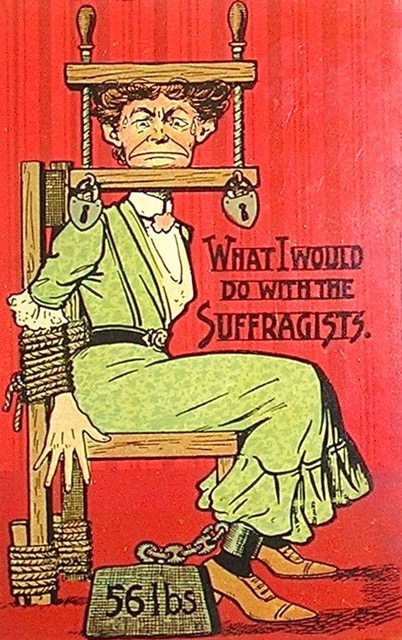
In November 1915, the men of Massachusetts trekked to the polls to decide whether the word “male” should be removed from the state’s qualifications for voting. The Massachusetts Woman Suffrage Association in mid-October had staged a pro-suffrage parade in downtown Boston, with 15,000 marchers and 30 bands, urging a “Yes” vote. A parade of 15,000. Yet according to the Massachusetts Anti-Suffrage Committee, what men should do was deliver “not merely a defeat for woman suffrage, but a defeat so overwhelming that the question will not rise again at least in this generation.”

The men of the town of Lincoln in 1915 took the advice and voted against suffrage for women, 143 to 66 — an even larger rejection than the overall vote in Massachusetts. The Anti-Suffrage Committee asserted that most women did not, in fact, want the right to vote. Given the opportunity, women seemingly ignored it.

In 1879, when women in Massachusetts had been granted the vote for members of their local school committees, fewer than 5% of eligible Massachusetts women registered to vote, and only 2% ever voted. In Lincoln, three women promptly registered to vote, but only one went to the polls.

Women argued that the right to vote for male school board members (only men could hold public office) was too trivial for the bother. Yet in 1895, when Massachusetts women were allowed to vote in a referendum granting women the vote for all local offices, only 7% of eligible women in the state registered to vote and only 4% went to the polls. The 1895 referendum was overwhelmingly defeated by men. In Lincoln, only five women were registered to vote in the referendum, and only three cast ballots — all “Yes” votes.

At the turn of the 20th century, more women in Lincoln registered to vote, perhaps from interest in the local school committee, perhaps just to make a point. Still, by 1919, there were 285 Lincoln women eligible to vote, yet only 40 had registered.

Then on August 28, 1920 — ten days after ratification of the 19th Amendment — 71 Lincoln women flocked to the town clerk’s office to register for their first Presidential election. Impressive, but still only 25% of those women eligible. The anti-suffrage message — that the woman’s place was in the home, not in politics — still had a powerful grip.

On the centennial of the 19th Amendment, one hundred years of slow progress — and more to come.

*    *    *

Donald Hafner is a member of the board of the Lincoln Historical Society and drum major for the Lincoln Minute Men. He is a retired professor of political science who loves exploring the rich history of the town of Lincoln.


”My Turn” is a forum for Lincoln residents to offer their views on any subject of interest to other Lincolnites. Submissions must be signed with the writer’s name and street address and sent via email to lincolnsquirrelnews@gmail.com. Items will be edited for punctuation, spelling, style, etc., and will be published at the discretion of the editor. Submissions containing personal attacks, errors of fact, or other inappropriate material will not be published.

Category: history, My Turn 4 Comments

Region seeks special designation for Battle Road Scenic Byway

April 20, 2020

There will be a virtual public meeting on Thursday, April 30 at 7 p.m. on the efforts to nominate the Battle Road Scenic Byway, which includes Minuteman National Historical Park in Lincoln and other towns, as an All-American Road.

A National Scenic Byway is a road recognized as having one or more of six “intrinsic qualities” — archeological, cultural, historic, natural, recreational, or scenic. The program was established by Congress in 1991 to preserve and protect the nation’s scenic but less traveled roads and promote tourism and economic development. All-American Roads must have two of the six intrinsic qualities. The designation means they have features that do not exist elsewhere in the United States and are unique and important enough to be tourist destinations unto themselves.

There are 150 National Scenic Byways in the United States; 41 of them are All-American Roads. The Battle Road Scenic Byway was established in 2006.

The Lincoln Board of Selectmen submitted a letter to the Federal Highway Administration in support of the nomination and outlining the road’s history earlier this month. An All-America Road designation “will enshrine the storied Byway that sparked revolutionary thought and action essential to the American narrative and will continue to promote its status as a national tourist attraction,” the letter says.

Speakers at the virtual meeting will be Clarissa Rowe, chair of the Battle Road Scenic Byway Committee (BRSBC); Richard Canale, committee vice-chair and B.J. Dunn, Minute Man National Historical Park superintendent. To participate in the meeting, click here. For questions, contact Ali Carter at acarter@town.arlington.ma.us.

Category: history Leave a Comment

News acorns

February 6, 2020

Megan Kate Nelson

Lincoln author gives book talk

Lincoln resident and historian Megan Kate Nelson will talk about her new book, The Three-Cornered War: The Union, the Confederacy, and Native Peoples in the Fight for the West, on Thursday, Feb. 13 at 7 p.m. at the Concord Bookshop (65 Main St., Concord). Exploring the connections among the Civil War, the Indian wars, and western expansion, Nelson reframes the era as one of national conflict—involving not just the North and South, but also the West. She portrays how nine charismatic individuals fought for self-determination and control of the region, showing the importance of individual actions in the midst of a larger military conflict.

February vacation programs at Minuteman

Minuteman Community Education is offering hands-on learning programs for students in grades 1-12 during February school vacation (Tuesday–Friday, Feb. 18–21). Programs for grades 1-8 include Artrageous Art; Aspiring Chefs; Beginner Baking; Creative Writing; Digital Photography; The Language of Java (computer programming); Business Sharks; Earth, Space, and Sea; and Expert Architects. Minuteman also offers a driver’s education course for students in grades 9-12 and a Girls in STEM Camp for students in grades 7 and 8.

Morning sessions run from 8:30 a.m.–11:30 a.m. and afternoon sessions from noon–3 p.m. Students may register for just one program or bring lunch and stay the full day. Visit the Minuteman Community Education website to register.

Food Project receives grant

The Food Project has received a grant of $150,000 from the Ann Theodore Foundation to support the employment, training, and mentorship of youth participating in its three-tiered youth development program.

“Now more than ever, young people must learn to transcend difference through shared work in service of a more just and compassionate world,” said Anne Hayes, executive director of The Food Project. “This substantial grant from the Ann Theodore Foundation will expand our foundational Seed Crew program in greater Boston while supporting our entire youth development program in greater Boston and the north shore.”

Category: charity/volunteer, history, kids Leave a Comment

  • « Go to Previous Page
  • Page 1
  • Interim pages omitted …
  • Page 5
  • Page 6
  • Page 7
  • Page 8
  • Page 9
  • Interim pages omitted …
  • Page 22
  • Go to Next Page »

Primary Sidebar

Recent Posts

  • Police log for Aug. 12–22, 2026 August 27, 2026
  • Legal notice: Property Tax Classification Hearing August 27, 2026
  • Resident at The Commons honored with a rose from her caregiver August 26, 2026
  • Tickets on sake for TEDx Walden Pond August 25, 2026
  • Groups continue pressure on ICE activities, private jet expansion at Hanscom Field August 25, 2026

Squirrel Archives

Categories

Secondary Sidebar

Search the Squirrel:

Advanced search

Privacy policy

© Copyright 2026 The Lincoln Squirrel · All Rights Reserved.