• Skip to primary navigation
  • Skip to main content
  • Skip to primary sidebar
  • Skip to secondary sidebar

The Lincoln Squirrel – News, features and photos from Lincoln, Mass.

  • Home
  • About/Contact
  • Advertise
  • Legal Notices
    • Submitting legal notices
  • Lincoln Resources
    • Coming Up in Lincoln
    • Municipal Calendar
    • Lincoln Links
  • Merchandise
  • Subscriptions
    • My Account
    • Log In
    • Log Out
  • Lincoln Review
    • About the Lincoln Review
    • Issues
    • Submit your work

government

Town Clerk transition coming; Deputy Town Clerk sought

May 15, 2018

With the impending retirement of Town Clerk Susan Brooks on June 30, Deputy Town Clerk Valerie Fox will serve as interim Town Clerk until the position is up for election at Annual Town Meeting in 2019. The town is therefore inviting applicants for the open position of full-time Deputy Town Clerk starting on July 1.

The Deputy Town Clerk provides supervisory and administrative support to help the Town Clerk discharge the duties of the office including, but not limited to:

  • Maintenance of vital records
  • Licensing and permits
  • Records management
  • Cemetery and Town Archives support
  • Election administration

Thorough knowledge of Town Clerk operations and service functions preferred. Candidates for this 40-hour-a week position must demonstrate exceptional verbal communication and interpersonal skills, customer service skills, multitasking ability and management support skills. 

A bachelor’s degree is preferred, along with several years of office and customer service experience, preferably in a municipal setting. Candidates should have demonstrated organizational skills and the ability to prioritize workflow, accuracy and attention to detail, and proficiency with MS Office applications.

Regular hours are Monday through Friday from 8 a.m.–4:30 p.m., with a 40-hour, four-day work week during July and August. Some evening and occasional Saturday hours will be required for special events such as Town Meetings and early voting. Salary range (grade 11) is $26.16/h0ur to $33.12 hour.

To apply, submit a cover letter and resume to the Town Clerk’s office, 16 Lincoln Rd., Lincoln, MA 01773, or email as a Word document or PDF to brookss@lincolntown.org by June 1.

Category: government, news Leave a Comment

Last community forum before school vote is May 15

May 10, 2018

There’s one more community workshop and two school tours before the milestone vote to decide which school project scheme the town should pursue.

The public forum on the six current concepts will be on Tuesday, May 15 from 7–9:30 p.m. in the Reed Gym. This session will focus mostly on audience Q&A with the School Building Committee (SBC) and other officials, and attendees will also be asked to informally rank the concepts in order of preference.

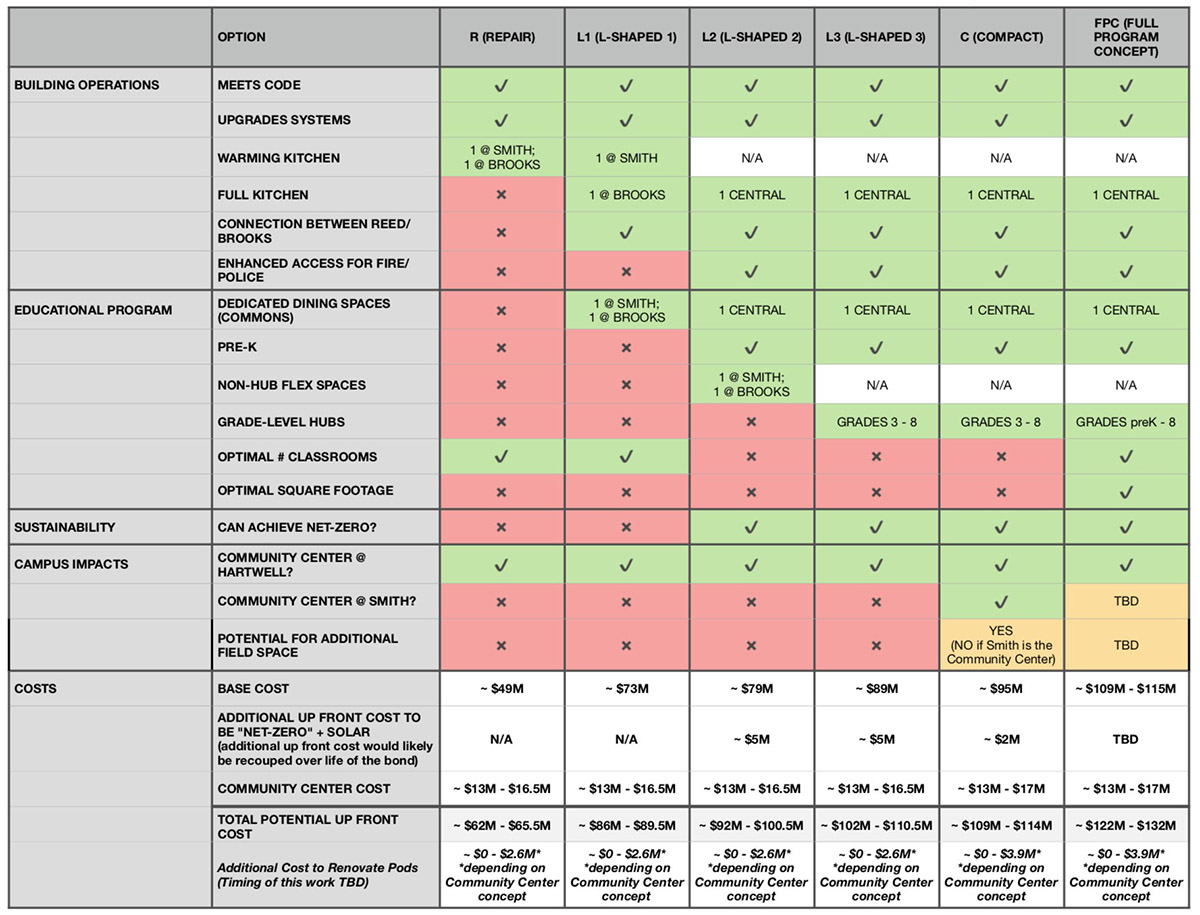
  • See a table comparing the six current school options, plus sketches and tax increase estimates for each.

At the forum, SBC members will walk attendees through the process they used to generate and then narrow down the concepts from 12 at the start to the current six.

Last week, the committee considered two additional school design options. One of them had been in the mix before and one was a concept that the SBC requested from the consulting architects at a set price point of $85 million. However, “after discussion, it was determined that neither one of them brought anything incremental when compared to what we already had,” SBC Chair Chris Fasciano said.

The Board of Selectmen has yet to issue a recommendation on the options, though members are hoping to provide some guidance without being “overly directive,” Selectman Jennifer Glass said at the board’s May 7 meeting. The Finance Committee also debated the matter last week but decided not to recommend any of the options over the others, though they may yet recommend a dollar amount to keep in reserve when the town votes on bonding.

At its May 16 meeting, the SBC will finalize the concepts to be presented on June 9. Members will discuss on May 30 how they would rank the six options and why.

The June 9 Town Meeting will feature two votes: one using the voting machines and the second being a stand-and-count vote. In the first vote, registered voters will be asked to choose one of the six school options and possibly also what factors were most important in their decision. The votes will then be tabulated by machine, and the two options receiving the most votes will be presented for the final standing vote.

The SBC is hosting tours of the new Hanscom Middle School and the Lincoln School on Monday, May 21, where school officials will point out the educational benefits of various design attributes in both buildings. Anyone interested in the Hanscom tour must email Janice Gross at jgross@lincnet.org by noon on Monday, May 14, as all Hanscom Air Force Base visitors must provide in advance their full legal name as shown on their driver’s license and date of birth.

Visitors on May 21 must travel to the base with the group by bus, which will leave the Hartwell lot at 9:30 a.m. and return by noon, with lunch provided in the multipurpose room. A tour of the Lincoln School follows at 12:45 p.m. Anyone who just wants to tour the Lincoln School should email Gross and meet at the Smith office by 12:45 p.m.

Category: government, news, school project*, schools Leave a Comment

No consensus from FinCom on school options or cost limit

May 6, 2018

After hours of discussion, the Finance Committee on May 3 decided not to endorse any of the school project plans over the others and did not specify a project price limit to recommend to voters. However, members made other recommendations, including that Lincoln should not appeal to the state to go over its borrowing limit.

In its discussion on that to recommend to voters at the Special Town Meeting on June 9, the FinCom also said in unanimous resolutions that:

  • The estimated construction costs, exclusive of “soft” and escalation costs, are well within the norms of comparable Massachusetts school construction costs.
  • The town should not delay the school project in hopes of more favorable construction costs down the road.
  • It is more fiscally responsible to do a single project that addresses all the needs of the building rather than doing a series of piecemeal repairs.

Members debated how much financial cushion—in the form of additional borrowing “headroom” under the town’s borrowing limit, and/or cash to leave in the debt stabilization fund—the town ought to preserve after borrowing for the school project. They also discussed how much of that fund should be used to cushion the first year or two of repayments or to reduce the initial bond amount.

Much of the uncertainty on the part of committee members stems from the fact that several of the six cost estimates for the school project are very close to the town’s current $97 million borrowing limit (Option C is estimated at $95 million and Option L3 at $89 million). And those figures do not include another $2 million for a net-zero energy-efficient building with solar panels.

  • See a table comparing the six current school options, and sketches and tax increase estimates for each.

Adding to the uncertainty is the distinct possibility that the price tag on whatever option is chosen on June 9 could drop before the bonding votes happen in the fall, as officials noted on April 30.

“It’s entirely realistic to expect a fair amount of movement in the cost estimates between June 9 and December 1, but it’s not realistic to expect any shift” before June, School Committee chair Tim Christenfeld said at Thursday’s FinCom meeting.

In 2011, the SBC initially included preK in the building and adding a two-story addition, but to reduce cost and square footage, preK was taken out and the addition was reduced to one floor.

Also, “there are many, many contingencies built in at this stage of the process,” Selectman and former School Committee chair Jennifer Glass said on Sunday. “As decisions are made, the ‘knowns’ replace the ‘estimates’ and some of the contingencies get reduced.

“For this project, I would never presume to say that history is an indicator of future performance,” Glass continued. “We cannot make any guarantees of a percentage decrease—we can only say that the SBC will take the June 9th vote as a budget cap, and do everything reasonable to reduce up-front costs to the town without overly sacrificing long-term value.”

The FinCom tabled its discussion on a financial buffer until its next meeting on May 22.

No agreement on cost limit

Committee members also wrestled with recommending a specific cost ceiling for the school project.

“I struggled mightily with this one. I do believe there should be a ‘do not exceed’ number… but I struggle with giving guidance on a specific number,” FinCom member Andy Payne said. “At the end of the day, it’s a resident decision and I feel that very strongly… My concern is that we collectively [on town boards and committees] don’t necessarily have a good pulse on the resident appetite here. My worry is that without that pulse, we risk not having a supermajority” in the fall, when a two-third majority is required at Town Meeting to bond a project.

Setting a dollar-limit recommendation is “putting the cart before the horse and trying to imagine the will of the town,” said member Tom Sander.

Without first setting parameters for how much money or borrowing capacity to hold in reserve, “I feel like we’d be making a decision without making some of the building-block decisions,” member Gina Halsted said.

Outgoing and non-voting FinCom member Eric Harris was not so circumspect. He proposed a limit of $85 million for a school project in light of the fact that more money will be needed for a community center right after the school is finished. A community center is currently expected to cost at least $13 million. However, the town will have paid off some of its current and future debt by the time that project is bonded and property values will increase, so its total borrowing limit will be higher than it is today.

$85 million “is a reasonable expense for the town. As a Finance Committee, we should say we can spend the amount of money that’s likely to pass [at Town Meeting] and that meets everyone’s needs, not just the school,” Harris said. “I just think we need to pay more attention to building a prudent plan that includes both… I’m worried that the community center is getting pushed off in a way that’s going to piss a lot of people off.”

Design options

Turning to discussion of which of the six design options to recommend, if any, “I believe narrowing down concepts is the School Building Committee’s job. Why should we be operating as a shadow SBC?” Payne said.

FinCom chair Jim Hutchinson disagreed, saying, “We’re not talking about disabling any concepts from being selected by the town; we’re trying to help residents with our opinion, not just on the cost straight up, but on the value of those concepts.”

Although it didn’t take a formal vote, the committee was deadlocked 3-3 on whether to recommend for or against specific designs, though members agreed in principle that the $109 million “FPC” option was not feasible, and that the $49 million repair-only option was not fiscally prudent.

But resident Owen Beenhouwer, an architect and veteran of past School Building Committees, argued that the FinCom should strongly recommend against the repair-only option, saying the last major school project did not go far enough. He implied that the current plan to offer a broad range of options to voters is an overreaction to the negative vote on a single option in 2012.

“I am disturbed at the fact that next year, we are looking at the 25-year anniversary of what I consider to be a bad job in 1994,” he said. “People really want help… people are puzzled with the mountains of information and too many choices to be made, and are looking to the committees to be helpful in some way.”

A repair-only option would be “a bad investment,” Beenhouwer continued. “I speak from experience as an architect that we are pushing the ball down the road. It would be better to turn the task back to the SBC and say ‘try again’ instead of saying it would be acceptable just to do a repair job.”

Category: government, school project*, schools Leave a Comment

Panelists share views on marijuana sales and use

May 1, 2018

A panel including a doctor, Lincoln Police Chief Kevin Kennedy, and a cannabis industry researcher and consultant discussed some of the issues Lincoln voters will need to think about when deciding whether or not to permit cannabis businesses in town.

Massachusetts legalized recreational marijuana sales in 2016, but individual cities and towns can choose to opt out of marijuana growing, processing, testing or retail businesses. To enact a partial or full ban, a Town Meeting vote to adopt a zoning bylaw amendment restricting or banning such businesses must pass by a two-thirds majority, followed by a simple majority at a town election. Lincoln’s current moratorium on cannabis businesses expires in November.

  • Read this FAQ document about marijuana businesses from Lincoln’s Marijuana Study Committee

To be allowed to grow marijuana outdoors, businesses must have the crop fenced and equipped with security cameras, and the plants must be out of view of any public right of way, said Ari Kurtz, a member of the Marijuana Study Committee (MSC) and ]the Agricultural Commission. Growers must undergo background checks and can sell only to licensed dispensaries or product manufacturers. Cannabis can also be grown in secure indoor facilities with windows blacked out.

An advantage to the town of allowing marijuana business stems from the host community agreement provision built into the state law whereby the town gets 3 percent of the business’ gross income.

Marijuana could become a billion-dollar industry in Massachusetts by 2020, according to research reported in the Boston Globe last year, “and people ask, why not keep some of the money in the community through tax dollars?” Kurtz said. “Even small-scale growing can be extremely lucrative.” However, marijuana farming requires a large investment up front in licenses, utilities, and equipment as well as security, he added.

If the town were to permit commercial marijuana growing, it could use zoning rules and the site plan review process to limit what areas of town the plant can be grown, odor mitigation, screening from neighbors, etc. Those measures could restrict other types of marijuana businesses as well.

Panelist Jean Welsh, a Lincoln resident, is a cannabis educator and policy researcher. She said she also uses cannabis to help relieve chronic back pain after many other medical treatments had been ineffective. Medical marijuana does have side effects—”you can get inebriated, but you don’t have to, if you understand how to titrate and deliver the dose,” she said.

Welsh advocated making marijuana more affordable and easier to obtain for medical purposes, “but I have no problem if you want to use my medicine for recreation,” she said. “Some people just want to come home at night and chill with some cannabis instead of a glass of wine… and be able to just walk into a shop and see the products available.”

Legal concerns surrounding marijuana businesses center around security and the fact that marijuana is still illegal at the federal level, Kennedy said. This means that businesses can’t access the banking system and must therefore rely on cash transactions, making them a potential robbery target. There are also concerns about children getting easier access to cannabis, as well as the potential for increased emergency room visits for users who become too intoxicated, he added.

“I would encourage Lincoln to opt out of retail [cannabis] businesses,” said Dr. Eden Evins, an addiction researcher and professor of psychiatry at Harvard Medical School. At issue is the potential for easier access by children, especially in newer forms such as oils, vaping and edibles. In adolescents, “repeated marijuana use in adolescents can cause lasting changes in brain structure and function,” she sai

Even though retail sales nationwide are restricted to adults only, its very availability lends an air of social acceptability, Evins said. Tobacco and alcohol are definitely more harmful than marijuana for users of all ages, but for those other substances, “it’s a health issue not just because they’re more dangerous, but because their legal status causes more widespread use.”

Although deaths from marijuana overdose are almost nonexistent, the drug can be addictive, Evins said. Since the 1960s and 1970s, the potency of marijuana has increased significantly, and this has led to increases in admissions to addiction programs for people whose primary complaint is marijuana addiction, she said, adding that 25 to 30 percent of teenagers who use marijuana daily become addicted.

“Everyone in this industry agrees that kids should not have access to cannabis,” Welsh said. Edibles also pose more of a risk because the drug tends to last longer and feel stronger, she added. “If you’re a newbie, don’t do them.”

To give officials a better sense of what the public thinks about marijuana businesses as they mull what rules to propose, Selectman and MSC member James Craig urged residents to return the one-page paper survey that was recently mailed to all homes. There will be a second town forum in September, followed by a Special Town Meeting and special election in October, in addition to the Town Meeting on the school project.

Other area towns are already voting on the issue Winchester has banned all marijuana businesses except testing labs, and Concord has banned all types of businesses. Sudbury will vote on whether to prohibit marijuana manufacture, cultivation or sales on May 7.

Category: government, land use Leave a Comment

Officials discuss school voting plan and possible outcomes

May 1, 2018

Town officials wrestled on Monday night with how to present the various school project choices to voters at the Special Town Meeting on June 9. And the biggest barrier to passage, unlike in 2012, will probably be building cost rather than design.

Even if a plan is approved in June, it still may see some changes; the June vote is only on the cost and the footprint, School Building Committee (SBC) Chair Chris Fasciano noted. In 2011-2012, the “preferred option”—a mostly new, 164,000-square-foot building with a two-story addition for $64 million—morphed into a 140,000-square-foot, $49.9 million building with a one-story addition that was only 35 percent new, once the schematic designs were finished and Town Meeting voted.

As for the mechanics of the vote itself, the tentative plan is to offer all six of the current options for a first vote by paper ballot to residents in the Brooks auditorium and in overflow space in the Reed gym. Then the two concepts with the most votes would go on to s second stand-and-count vote in both venues. Architects will then develop schematic designs for the winner, and there will be a bonding vote in the fall.

A simple majority is required for concept approval in June. The vote to bond the project in the fall will require a two-thirds majority at Town Meeting plus a simple majority at the ballot box shortly thereafter.

If the fall Town Meeting vote doesn’t pass by a two-thirds majority, the next step will depend on how close the vote is. Since the town is not bound by Massachusetts School Building Authority deadlines as it was in 2012, officials can continue to refine concepts and schedule more Special Town Meetings until a project wins approval. However, if the June vote is lopsidedly negative, “it means we missed a step on the way and we’ll have to regroup and see where we are,” Selectman Jennifer Glass said.

The Finance Committee also spent considerable time on Monday night grilling school officials and architects on details of how they arrived at their cost estimates and assumptions of how big the school building needs to be. Their questions followed up on written answers to dozens of questions that the SBC had submitted before the meeting.

The FinCom will meet on Thursday, May 3 to come up with a recommendation to the town—either for a specific option or “just a set of boundaries,” Chair Jim Hutchinson said. The SBC is trying to leave the decision in the hands of voters as much as possible, but “there will be something coming from our committee to let folks know what we’re thinking” in terms of a preferred concept, Fasciano added.

Residents at Monday’s multiboard meeting offered various other suggestions for the June vote, including allowing voters to choose which educational enhancements they would most like to see, or offering them a choice of three price points rather than specific design concepts.

Feedback from the various public forums so far has been overwhelmingly in favor of a compact building shape offering a high level of educational enhancement over the current school. However, people who attend such forums are often more engaged and informed and tend to be in favor of a project in general, and there will be a much broader cross-section of voters at Town Meeting, Glass noted.

Meanwhile, architects will present a seventh design concept to the SBC this week, and there will be another public forum in May to gauge sentiment and try to narrow down the options to be considered in June.

The June vote will focus only on a school project; the Community Center Preliminary Planning and Design Committee has agreed since the beginning of the planning process that construction on a community center will not start until after the school is complete, most likely in 2023. This is mainly because the school campus does not have space for construction staging areas and student swing space for two simultaneous projects, and there would not be any cost savings since the two projects are of such different sizes that the same contractors would not bid on both, officials said.

This is a disappointment to some seniors in town, including Barbara Low. “is it going to be another 10 years before a community center is looked at because there won’t be any more money [after the school project]?” she said.

But Hutchinson reassured her that town finances will not stand in the way. “We’re pretty comfortable that the community center could fairly quickly follow the school building project,” he said.

Though the bonding for both projects could be done in one go—or even borrowing the full amount for just the school in a single bond issue—this would be the :worst-case scenario,” hutchinson said. “Spreading it out will soften the impact a little bit.”

Current estimates for the school project range from $49 million to $109 million. Finance officials have already determined that the town can borrow up to about $97 million without affecting its bond rating or needing special permission from the state. However, the effect on individual property tax bills will carry more weight when it comes to how people vote, they noted.

“What the town can afford in a debt load/bond rating sense is not necessarily the same as residents’ appetite for expenditure,” FinCom member Andy Payne said. “What will residents be willing to invest in? That’s a very tough question to answer outside the ballot box but we’re trying to figure that out.”

Category: government, school project*, schools Leave a Comment

School, community center groups respond to Finance Committee questions

April 29, 2018

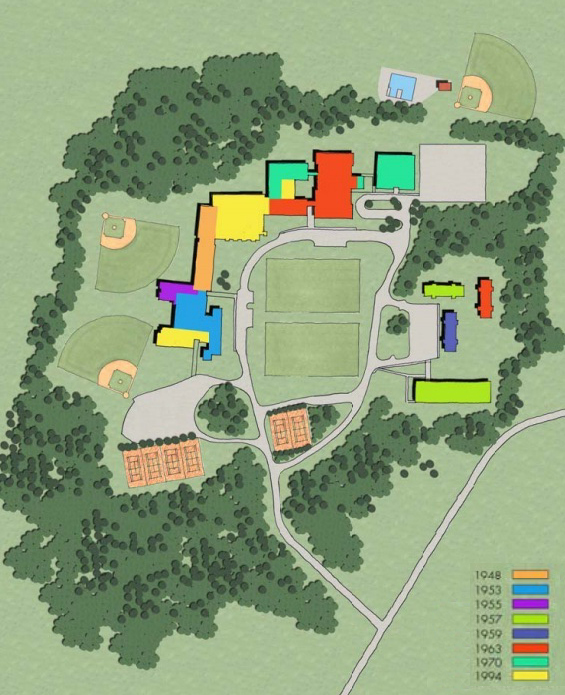
The current Ballfield Road campus.

Committees for the two campus projects have submitted answers to a series of questions from the Finance Committee in advance of two April 30 meetings on project costs.

A multi-board meeting on the campus projects begins at 6 p.m. in the Hartwell B pod, followed by a joint meeting of the FinCom and the Capital Planning Committee from 7:30–9 p.m. A Special Town Meeting on the projects will take place on June 9.

In their answers to the FinCom, both the school and community center committees recommended against building a school project and a community center at the same time, citing the different projects scopes and timelines, construction durations, and problems in using the campus while two projects were under construction simultaneously.

The Community Center Planning and Preliminary Design Committee (CCPPDC) noted that contractors who are able to build a 160,000-square-foot square foot project such as the school do not typically compete for 23,000-square-foot buildings, and “it is likely that using the general contractor and subcontractors that typically handle the bigger, more complex projects for the smaller community center will actually add cost to the community center.”

The School Building Committee offered some FAQs about cost estimates on its website on April 29. Earlier, the SBC responded to a list of questions from the FinCom on:

  • Factors driving the cost per square foot of the various concepts
  • Enrollment projections
  • Space and cost numbers for comparable projects in other towns
  • Incremental costs of specific features such as a new or renovated Smith gym, renovated auditorium, and hubs for grades 3-8
  • Construction cost inflation and escalation
  • Comparisons to revant data form the Massachusetts School Building Authority
  • Operation and maintenance costs (also asked by the CapComm)
  • What’s included in “soft costs”

The CCPPDC was asked to supply figures and assumptions used for capacity planning for the community center design, and to explain why Bemis Hall can’t be renovated for the Council on Aging. The group’s answers are here, with more information on their research here (click on the “Finance Committee information for April 30” tab in the middle of the page).

In a discussion of the square footage sought for the community center, the CCPPDC noted that even newer community centers in other towns have proved to be too small. “The one town our size that offers a senior facility larger than the senior component of the community center says that they are already short on space,” the committee wrote. “Almost all towns we spoke with, including those with quite new facilities, said that they built too small and now need more space. We do not want to make the same mistakes as other towns by assuming that their facilities are adequate for their population when they are not, especially when these mistakes cost towns more in the long run when additions need to be built.”

Category: community center*, government, land use, news, school project*, schools Leave a Comment

Residents drill down on school, community center options before June vote

April 12, 2018

This School Building Committee chart compares the six options on features and cost and also shows total estimated campus costs that include the community center. (click to enlarge).

Residents who packed two workshops on April 10 on the campus building projects were asked for feedback on six school concepts and three community center schemes in preparation for votes at a Special Town Meeting on June 9.

At that meeting, voters will be asked to choose from among the three community center ideas and an as-yet-unknown number of school concepts, though it will be at least two. Firm cost estimates for each will be presented, and there will be two votes in the fall to bond the project. To win approval, Town Meeting must approve by a two-thirds majority; a simple majority is required at the polls.

The footprint, features and cost of the school concepts are described in this six-page summary, which also includes an energy performance analysis for all but one of the concepts, and the added cost to bring each concept into compliance with the “stretch” code (a higher level of energy efficiency than the state’s base building code) and net-zero energy use.

The paper version of the six-page concept summary handed out at Tuesday’s meeting also listed the annual tax bill increase for the median Lincoln taxpayers based on a 4 percent of 5 percent bond interest rates:

School conceptEstimated costAnnual tax increase (4% interest)Annual tax increase (4% interest)Added cost for stretch code compliance/net zero energy efficiency, including solar
R
$49 million$1,329$1,494N/A
L1
$73 million$1,980$2,226N/A
L2
$79 million$2,142$2,409$0 / $6 million
L3
$89 million$2,413$2,714$0 / $6 million
C
$95 million$2,576$2,897$0 / $2 million
FPC
$109 millionAnalysis not yet performed for this optionAnalysis not yet performed for this optionAnalysis not yet performed for this option

Superintendent of Schools Becky McFall outlined the educational advantages of each of the six options:

Option R

  • There would be no educational improvement except for a more consistent temperature climate due to the heating system upgrade.

Option L1

  • The new dining commons between the Brooks gym and auditorium lobby could serve as a learning space for large groups.

Option L2

  • Bringing preK into the main school from Hartwell saves time for staff who serve both preK and K-8, as well as preK students who must sometimes cross the campus, and it also eases the integration of preK children into the school as well as faculty collaboration.
  • Two new flexible-use spaces on each side of the school.
  • Having a single, centrally located lower and middle school office and dining commons  also reduces travel time for students and staff.

Option L3

  • Hub spaces for grades 3-8 where classes can open out into larger collaboration or teaching spaces, and which allow more collaboration among teachers. At the new Hanscom Middle School, which includes hubs, “we find teachers are doing much more conscious planning together, and we see the impact of more integrated curricula being developed,” McFall said. For each grade, the hubs also “create a bit of a community within a community,” she added.
  • A larger commons space than previous concepts, and the space looks out onto the woods, which is less distracting for students.

Option C

  • Having two floors in part of the building reduces transition times for middle schoolers by shortening corridors. “The compactness helps with efficiencies and interactions for both faculty and students, as well as greater sustainability,” McFall said. “I feel like it’s a better design for education.”
  • More space for playing fields

Option FPC

  • Allows for the “optimal” educational program, with three more classrooms than the current school (or options L2, L3 and C), as well as hubs for all nine grades and more athletic field space.
  • This option was recently added at the request of residents who wanted to see what an “ideal” building would look like, so the design is still in flux and it may be more compact building with two floors in some places, McFall said.

Almost every elementary school in Massachusetts designs within the past 10 years includes small breakout rooms and/or larger hub spaces between classrooms, McFall said. The U.S Department of Defense’s education arm, which oversees construction of schools on military bases, mandated this type of design for the Hanscom school. “They did a lot of research, and they’re convinced of it—their analysis shows a true benefit,” McFall said.

Having hubs and breakout rooms “is the catalyst to change… an eruptor that makes you think something else is possible,” said resident Jen Holleran. “This is a generational opportunity.”

The Capital Planning Committee is now researching long-term operating costs for the various options, which would include estimating the financial value of making a greater up-front investment in a more sustainable design, Finance Committee chair Andy Payne said. Any savings on current utility costs would not help pay down the bond but would show up in slower growth in the school’s annual operating costs, he said.

Following the presentation, residents were asked to specify their two favorite options to help the School Building Committee gauge how many concepts should be presented for a vote on June 9. In 2012, the SBC offered only one option for an up-or-down vote that failed to garner the required two-thirds majority, “and we will not make the same mistake—we feel like we have to bring that choice to you,” said Selectman and former SBC chair Jennifer Glass.

Community center

Workshop attendees then saw the three latest concepts for a community center located on the Hartwell side of campus and were asked for feedback on paper. (The fourth concept on the Community Center Preliminary Planning and Design Committee website—putting the facility in renovated Smith school space—is no longer being considered.)

All are 23,000 square feet and include renovation of any remaining standalone Hartwell pods. Scheme 3 calls for having the community center linked to all three pods, with a resulting total cost ($13.5 million to $16.5 million) lower than the estimate for the other two options (both $15 million to $18 million).

There will be a multi-board meeting to discuss more details of how to finance the campus projects on Monday, April 30.

Category: community center*, government, land use, news, school project*, schools Leave a Comment

Marijuana Study Committee hosts panel

April 9, 2018

The town’s Marijuana Study Committee will host a panel discussion on Wednesday, April 25 from 7–9 p.m. in Town Hall to consider the implications of the state law that legalized the personal use, cultivation, processing, lab testing, and retail sale of recreational marijuana.

Before November 2018, when a temporary town moratorium on marijuana businesses is set to expire, Lincoln must vote on whether or not to allow recreational marijuana cultivation, processing, and retail dispensaries in town. The issue first came up for local discussion at the 2015 State of the Town meeting in the context of medical marijuana dispensaries.

For the April 25 event, the Board of Selectmen has assembled a panel of legal, public safety, agriculture, medical, and industry experts to help Lincoln explore the issues and help inform residents’ thinking about our public policy options. Come learn more about the law, ask questions, and voice your opinions. The committee will also post a comprehensive FAQ document on its web page before the discussion.

Category: businesses, government Leave a Comment

News acorns

April 4, 2018

Hazard Mitigation Plan approved

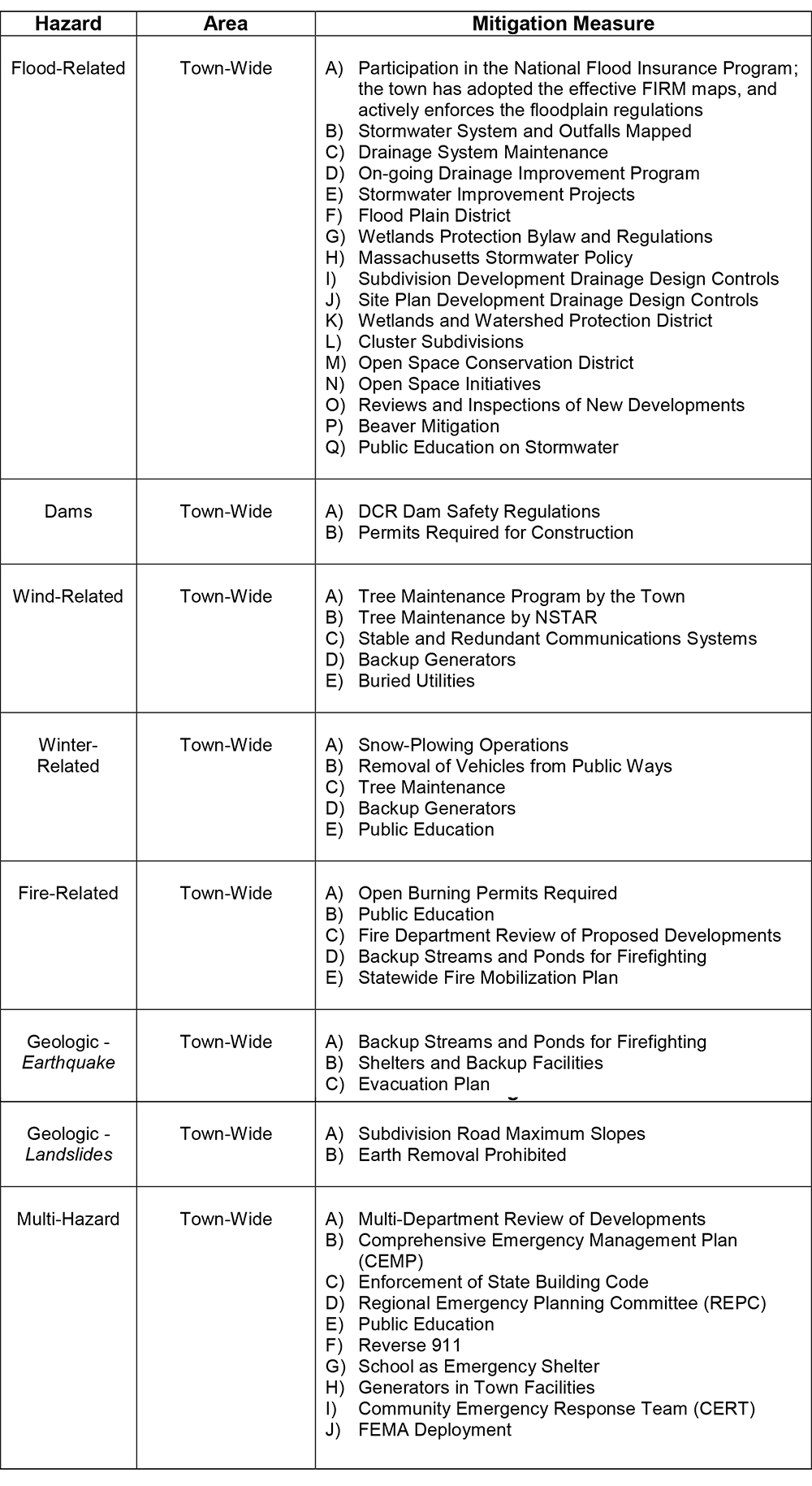
A summary of Lincoln’s existing hazard mitigation measures (click to enlarge).

The Lincoln Hazard Mitigation Plan has been approved by the Massachusetts Emergency Management Agency and will go before the Board of Selectmen for adoption. The document was created as a useful guide for the town of Lincoln  to meet the challenges of natural hazard events such as flooding, hurricanes and blizzards. Lincoln’s Plan will then be in effect for the next five years. Because the Town will now have an approved Hazard Mitigation Plan, the Town it is now eligible to apply for many state and federal grants.

DPW expands hours for brush disposal

To help with the cleanup from the March storms, the Highway Department yard at 30 Lewis St. will be open all four Saturdays in April to accept brush disposal from residents who have a Transfer Station sticker. The yard is normally available for brush disposal Monday through Friday and on the first Saturday of each month from 7:30 a.m. to 3 p.m.

To limit the use of emergency brush disposal privileges solely to Lincoln residents, staff will be checking vehicles to ensure they have valid Transfer Station stickers. If you are hiring an individual or company to clear your brush, you must contact the Highway Department in advance and provide your address, the name of the individual or company you have hired, and the date when this individual or company is expected to dispose at the yard. Any individual or company who does not meet the above conditions will be denied access to the DPW brush disposal area. Please call the Lincoln Highway Department at 781-259-8999 for more information.

ZBA seeks members

The Zoning Board of Appeals is seeking new members for open seats on the board. The ZBA is a land use board that interprets and applies the town’s zoning bylaw, acting on requests for variances, special permits, and appeals of decisions by the Building Inspector, considering the impact on the town and neighborhoods and the requirements of the bylaws. The ZBA has five regular members and three associate members and generally meets one evening a month. For more information, call the Selectmen’s Office at 781-259-2601 or click here for a volunteer application.

Cultural Council session postponed

Due to a family emergency, the Lincoln Cultural Council introduction meeting scheduled for Saturday, April 7 has been postponed. Anyone interested in learning more about the council and becoming a member should contact Melinda Bruno-Smith at melindabruno@hotmail.com.

Gospel group coming to First Parish

Joyful Voices of Inspiration, a community gospel choir, will perform at the First Parish in Lincoln on Sunday, April 22 at 3 p.m. in the Parish House Auditorium (14 Bedford Rd.) Joyful Voices of Inspiration is non-denominational and represents musicians from a wide range of religious backgrounds who find joy and power in the gospel’s music and message. They often donate their services at civic and fund-raising events in the Boston area. Suggested donation for the concert is $20 per person or $40 for a family. Children under 12 are free. Proceeds will benefit the First Parish in Lincoln.

Annual benefit gala at deCordova is May 12

Tickets are now available for the deCordova Sculpture Park and Museum’s annual Party for the Park gala benefit on Saturday, May 12 from 6:30–10 p.m. The event honors Phyllis and Jerry Rappaport, who have been loyal supporters of deCordova for the past three decades, most notably by establishing and funding the prestigious $25,000 Rappaport Prize. Established in 2000, the Rappaport Prize celebrates contemporary artists with strong connections to New England and a strong record of achievement.

The gala will be chaired by Gerard Frank, a founding partner of Bechtel Frank Erickson Architects and former board president of deCordova. Joyce Kulhawik, the Emmy Award-winning longtime arts and entertainment critic for CBS-Boston, will be a special guest.

Individual tickets are $500 and tables start at $5,000. Proceeds support deCordova’s exhibitions, lectures, and programs, and can be reserved by emailing rsvp@decordova.org or online at decordova.org/party.

FoMA sponsors tour of Modern houses

Friends of Modern Architecture is sponsoring a tour of three Modern houses in the newly created Brown’s Wood Historic District on Saturday, April 29 from 3–5 p.m. Built in 1956, 1957, and 1959, each house has been updated and adapted to the needs of its current owners while successfully maintaining the spirit and intent of the original house. Cost is $35 for FoMA members and $45 for non-members. RSVP to fomalincoln@gmail.com.

Category: arts, charity/volunteer, government, history, religious Leave a Comment

Newly elected town officials sworn in

April 3, 2018

Town officials being sworn in by Town Clerk Susan Brooks are (left to right) Selectman Jennifer Glass, deCordova Trustee Jonathan Rapaport, Finance Committee members Elisa Sartori and Gina Halsted, Parks & Recreation Committee member Sarah Chester, School Committee members Al Schmertzler and Peter Borden, Bemis Trustee Mimi Borden, Registrar of Voters Margaret Flint, and Housing Commission member Even Gorman.

The induction ceremony for newly elected and appointed officers of the town took place on March 28, two days after the Lincoln election. The event is held annually and is meant to celebrate those who have stepped up to serve the town, and to acquaint them with one another and with the legal obligations of their public service. It culminates with the administration of the oath of office to the group and with each person signing a leather-bound registry of public service.

One of the new officials signs the Register of Oaths Sworn.

Category: government Leave a Comment

  • « Go to Previous Page
  • Page 1
  • Interim pages omitted …
  • Page 30
  • Page 31
  • Page 32
  • Page 33
  • Page 34
  • Interim pages omitted …
  • Page 93
  • Go to Next Page »

Primary Sidebar

Recent Posts

  • Water bills to go up by 13% March 5, 2026
  • News acorns March 5, 2026
  • Property sales in January 2026 March 4, 2026
  • My Turn: Unraveling the Hanscom misallocation March 3, 2026
  • Police log for Feb. 19–25, 2026 March 3, 2026

Squirrel Archives

Categories

Secondary Sidebar

Search the Squirrel:

Privacy policy

© Copyright 2026 The Lincoln Squirrel · All Rights Reserved.