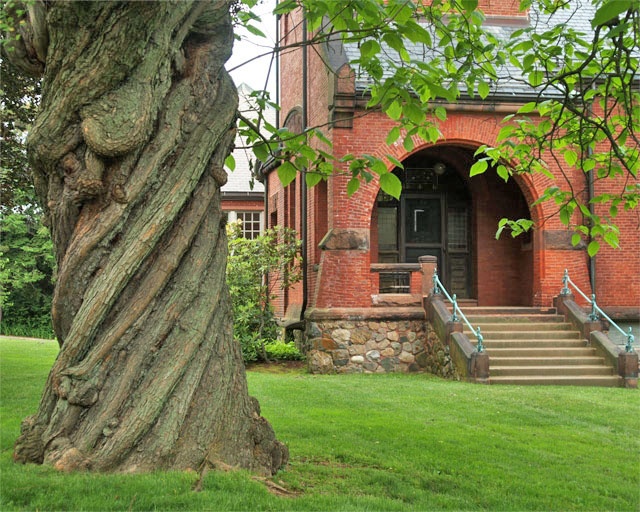
 Residents will vote at a Special Town Meeting on October 24 on two multimillion-dollar options for replacing the HVAC system at the Lincoln Public Library.
Officials from several boards met on July 13 and determined that either a ground-source heat pump system or a conventional HVAC system would cost $2.8 million to $3.1 million if green energy grants and tax incentives are included.
The town originally planned to have a vote at Annual Town Meeting in March 2026 on two options, a $5.4 million green option (net cost: about $2.47 million) or $330,000 for a conventional boiler to replace the library’s aging gas-fired boiler. However, the motions were tabled after officials found that the expected tax incentive estimates were “too optimistic.”
Since then, officials got updated cost and tax incentive estimates from consultants. But they also realized that just replacing the boiler won’t be enough, because other work will be needed to match the upgrades and benefits included in the geothermal option (for example, the air conditioning system is just as old as the boiler). Once the upgrades to various other elements of the HVAC system and building envelope are included, the price tags for the two approaches are very similar.
If the town were to opt for a conventional in-kind HVAC replacement option, the estimate from consultant ESG is approximately $2.85 million vs. Northeast Engineering’s estimate of approximately $2.66 million, both a bit lower than the March net cost estimate for geothermal. However, the net cost of a conventional system would rise to the level of the geothermal option because it would not qualify for a $1 million grant and green energy tax incentives.
“This option has a lower upfront cost than the ground source heat pump option, but it does not provide the same incentive opportunity, energy reduction, or decarbonization benefit,” Assistant Town Administrator Dan Pereira said in a July 9 memo to the Select Board, the library trustees, and the Green Energy, Finance, Capital Planning, and Community Preservation committees.
Despite the apparent similarity in conventional vs. geothermal net cost estimates, FinCom Chair Paul Blanchfield urged his fellow officials to offer both options to voters rather than a yes-or-no vote on geothermal. He noted that the $130,000 difference between the two (assuming all green energy incentives are realized) rises to $1.5 million without incentives, which would translate to $67 vs. $770 in terms of the one-time impact on the median tax bill. However, if the ground-source heat pump option is approved, it won’t result in an immediate tax increase because it will be paid from future Community Preservation Act funds.
While emphasizing that the FinCom has “has not necessarily deliberated or aligned on a position,” FinCom Chair Paul Blanchfield noted that Lincoln now has the third-highest median tax rate in Massachusetts after the school and community center projects. And while the town is adhering to its value of being environmentally conscious, “I would also note that no one has referenced the mission statement value of economic diversity,” he said. “The sentiment of the town is increasingly clear that they would prefer multiple options to consider.”
The fossil-fuel-free geothermal option will also require more electricity than a conventional system, which may not be entirely met by the solar array that will soon go online at the old landfill, though the Green Energy Committee may propose additional solar arrays on town land in the coming years.
Officials will be reviewing the updated operating cost analysis in the coming weeks. There will be several opportunities to learn more and ask questions before October 24, when the town will also host the State of the Town meeting.
This is a staggering expense.
The assessed value of the Library building is $8,141,800. The $2.8 million heating system cost computes to 35% of the building’s value.
The population of Lincoln (excluding Hanscom) is estimated at 5,152. A $2.8 million heating system is equal to $543 per Lincoln resident.
There are approximately 2,000 year-round residential households in Lincoln. A $2.8 million heating system computes to $1,400 per family.
In 1883, George Tarbell’s $28,000 gift to the Town paid for the original brick library building, and he is honored with a named room within it. Could another generous donor can be found to gift the $2.8 million HVAC system, and thus be honored with a named duct?
Where is a Master Capital Plan that includes this + water works+ roads + … who knows ? What else? Who knows? We need to have confidence that leadership is looking at a truly big picture and sharing with us. We need to see “wants” vs “needs”. Certainly infrastructure is a need and should be on everyone’s radar, esp on the radar of our finance gurus. It seems these projects just “ pop up.” It is head scratching and truly troubling. Perhaps we should have known of all this as we debated new building projects, like a ”community “ center? Where is our long-range Capital Planning? Where has it been for the last 10 years? Given we know the age and lifespan of all systems and roads, all this should have been part of planning and determining votes.
We need answers.