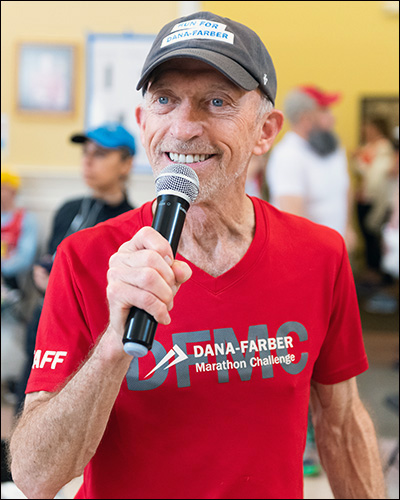
Jack Fultz. (Photo courtesy Dana-Farber Cancer Institute Media Relations)
Jack Fultz of Lincoln will be Grand Marshal of next Monday’s Boston Marathon — the race he won 50 years ago in some of the most challenging conditions in the event’s history.
The start of the 1976 Boston Marathon saw temperatures in the 90s. Many participants were unable to finish, and timing was stopped after 3:30 when only about 40% of the field had finished, according to the New York Times. Spectators sprayed runners with garden hoses to prevent heatstroke, so that year’s event became known as the “Run for the Hoses” (a nod to “Run for the Roses,” a.k.a. the Kentucky Derby). Asked in this 2020 Boston Buddies Run Club video abut the race and how he managed to beat the heat, he quipped, “I’m still trying to figure that out.”
Fultz’s chances were helped by the fact that several elite marathon runners did not enter the Boston race that year because they were preparing for the upcoming Olympic trials. He ran fast enough in Boston to qualify for the trials but didn’t make the Olympic team, which eventually consisted of Frank Shorter, Bill Rodgers, and Don Karong. Fultz also qualified for the trails in 1972 and 1980, though he opted not to run in the 1980 trials due to the U.S. boycott of the Moscow games.
A year after his Boston victory, Fultz finished ninth in the 1977 marathon with a time of 2:20:40 and fourth in 1978, just two seconds behind the third-place winner, with a personal best time of 2:11:17. He also won the 1981 Newport Marathon in a course-record 2:17:09. In 1990, he became the training advisor for the new Dana-Farber Marathon Challenge (DFMC) team (a post he has held ever since). This year, the 500-runner team hopes to raise $8.75 million for the Claudia Adams Barr Program in Innovative Basic Cancer Research at Dana-Farber Cancer Institute in Boston.
Fultz went into more detail about his running career in this Q&A with the Lincoln Squirrel, which has been edited for length.
Squirrel: What spurred your lifelong interest in running?
Fultz: From as far back as I can remember, playing hide and seek and other neighborhood games as a young kid, I always enjoyed running. When I started playing organized sports in junior high school, I enjoyed them all equally, except for getting beaten up on the football field, but I found more success on the track. By senior year, I was cultivating dreams of getting an athletic scholarship to college for my running.
Despite my moderate successes throughout northwestern Pennsylvania high school track, no colleges came knocking to my door to offer me that scholarship. Consequently, I was a walk-on at the University of Arizona. I literally walked into the track coach’s office in my Chuck Taylor high-top Converse basketball shoes and said I wanted to try out for the track team. Because my track times were pretty much a dime-a-dozen at any Division 1 college or university, the coach offered me nothing more than permission to train with the distance runners. But the runners on the team were very supportive, so I just kept showing up.
Having started college mid-year, when I returned to Tucson for my second semester of freshman year, freshman athletes had been deemed eligible for varsity participation in the minor sports like cross country. By the end of the season, I was seventh man on the team and was awarded a varsity letter jacket. I could not have been prouder of that accomplishment which provided more reinforcement for me to continue pursuing competitive running.
I lettered again in cross country my sophomore year but despite enjoying my time in Tucson, I transferred back east. This was 1969 during the Vietnam War and being out of classes for three months during that transfer process, I was drafted into the U.S. Army. I was able to enlist in the Coast Guard for a four-year commitment which took me to the Washington, D.C., area. There I continued to pursue competitive running at local road races and eventually met runners from Georgetown University. At 24, I was discharged from the Coast Guard when Georgetown offered me the full scholarship I had coveted for so many years.
Squirrel: Fifty years later, what sticks most in your memory about the 1976 race?
Fultz: Earlier in the year, I had no intention of running Boston year. 1976 was an Olympic year so my goal early in that year was to run a qualifying marathon time to be eligible to race in the U.S. Olympic Marathon Trials. The top three finishers in that race make the Olympic team but the Boston Marathon was only six weeks before the trials marathon and that’s not enough time to fully recover between two all-out marathon efforts.
My two previous qualifying attempts in January and March didn’t work out, primarily due to circumstances and unfavorable weather conditions, but I was confident I could run a Trials-qualifying “A-standard” time. So Boston was my final opportunity to qualify for the Olympic Trials race.
The “A” standard for the Olympic Trials Marathon was 2:20. By running that time or faster, the U.S. Olympic Committee would pay a runner’s expenses to the marathon trials in Eugene, Ore. I also felt that if I could not meet and exceed that time by a significant margin, I would not have even a remote chance of making the Olympic team. But there was also a “B” standard of 2:23 which would grant me access into the Olympic Trials race but I would receive no funding.
My track times at Georgetown indicated to me that I was capable of a 2:15 marathon or quicker in ideal weather conditions. When it turned out to be exceedingly hot, peaking at 96 degrees at the noontime start on Marathon Monday, I had still convinced myself that the heat would affect all of us top runners somewhat equally and that hopefully it would not slow us down by any more than four or five minutes. That would still put me under the 2:20 “A” standard.
Because my primary goal was to run the trials qualifying time, my finishing place at Boston that year was of secondary importance to me. As such, I viewed my opponents as potential allies: the faster they ran, the faster I was likely to run, and I needed to run fast. That mindset played a significant role by keeping me very relaxed throughout the entire race.
Only when I moved into fourth place just past the 16-mile mark did I realize I might now win the race outright. That realization did alter my mindset from a focus on my finish time to my finish place, which I wrestled with a bit once I took the lead near the 18-mile mark. [Editor’s note: he won with a time of 2:20:19.]
Squirrel: Have you always worked in athletics-related jobs?
Fultz: My entire working career since graduating from Georgetown in 1976 with a business degree has been related one way or another to my running career. As my best competitive days began to wind down in the early to mid-1980s, I enrolled in the Graduate School of Education at Boston University to study sports psychology. Upon graduation, I was hired to teach sports psychology at Tufts University, which I did for the next 27 years. About that same time, I worked full-time at New Balance as the Director of Running Promotions.
My attempts to get New Balance to eliminate smoking in the workplace shortly before I departed were successful. During that process, I befriended the Boston chapter of the American Lung Association, then quit working at New Balance to bike across the United States with 200 other riders from across the country as a fundraiser for the ALA.
In 1988, during my early years at Tufts, I was hired by the Boston Athletic Association as Elite Athlete Liaison, a position I held for eight years. Two years later, our Dana-Farber Marathon Challenge team began, and after a few years, Dana-Farber hired me to continue at training advisor to our rapidly expanding team.
Squirrel: How did you come to live in Lincoln?
Fultz: I moved to the Boston area in January of 1979 at the behest of Bill Rodgers with intentions of working for his fledgling running shoe company and his “BR” line of running apparel. I never did work for his company, though our friendship is closer now than ever.
I replied to a newspaper ad for a fourth housemate here in Lincoln. As I drove through the backroads of Weston and Lincoln in search for that house on Old Sudbury Road behind Drumlin Farm, I was enthralled with what appeared to be to be a road runner’s dream playground. As appealing as the back roads in this area are for a runner, the bucolic wooded trails I soon discovered added more to my love of Lincoln. Other than a year in Weston and two in West Concord, I’ve lived in Lincoln and I intend to never leave.
Squirrel: When did you run your last marathon? Do you miss running?
Fultz: My last marathon was Boston, 2000. My ailing hip caused me to drop out at 17 miles, and that ended my racing career. And I damaged my knee when rehabbing my hip, so I’m relegated to the bike for vigorous aerobic exercise, but I still walk/shuffle, and I’m a regular at Beede in Concord since HealthPoint/BSC Waltham closed during Covid. But yes, I do miss running for the simplicity and purity of motion it offers.
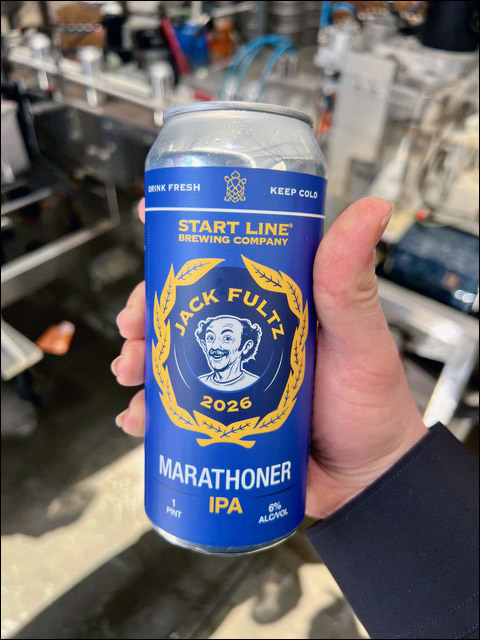
A can of the Start Line Marathoner IPA. (Click to enlarge; photo courtesy Jack Fultz)
Squirrel: What gives you the most satisfaction or pleasure these days?
Fultz: Helping others realize their own running dreams and aspiration. I borrow this from the former HBO series “Arli$$” — “my job is to make their dreams come true” 🙂 But I also love to travel and to read good books and magazines. I’m a current affairs junkie, I still exercise regularly to stay healthy and fit but [also] to maintain a vigorous appetite because I very much enjoy good food, good wine, and a good IPA. In face, Start Line Brewing Company currently honored me with their annual Boston Marathon vintage IPA.
Jack’s winning performance in the “Run for the Hoses” is a legendary feat by a Boston local! Congratulations, and thank you for inspiring a generation of joggers!
Great interview with one of Lincoln’s finest!