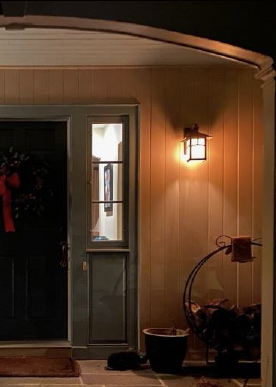
 The Planning Board’s Dark Skies Subcommittee has drawn up amended zoning regulations for exterior lighting fixtures for new construction, and the issue will be on the agenda at two meetings this week: the Select Board on Monday, March 9, and a Planning Board public hearing on Tuesday, March 10 at 7:15pm.
The subcommittee has been trying since “dark skies” rules were first enacted in Lincoln in 2004 to update the regulations on outdoor lighting, which can be harmful to insects and wildlife (see their Jan. 12 Select Board presentation). An amendment proposed at Town Meeting in 2015 was hotly debated but ultimately went down to defeat. In 2025, the group drafted zoning and general bylaw amendments and initially got on the warrant for Town Meeting using citizens’ petitions but ultimately withdrew the items. This year, they had hoped to extend the rules to existing lighting but backed off at the suggestion of the Planning Board and Select Board.
“There’s often a misconception that this is making people have to makes changes in their current residence, and that is not the case,” said Sherry Haydock, co-chair of the subcommittee. If approved, the new rules will apply only to new and substantially renovated homes, though they will also apply to replacement fixtures (not just bulbs) on existing homes.
Members were also hoping to have new rules for streetlights and town-owned buildings, but those, too, will wait for another day. The two boards “really wanted us to do this in multiple stages,” Haydock said.
The 2004 bylaw says that outdoor lighting fixtures on new homes must be fully shielded light fixtures and have a color temperature of 3,000°K or below. The revisions that residents will vote on at Town Meeting on March 29 call for:
- A color temperature upper limit of 2,700°K (lower figures correspond to the orange end of the color spectrum, with bluer and whiter lights having higher color temperatures)
- Brightness limits of 450 lumens for walkway luminaires (lighting assembly consisting of a lamp/bulb, housing, etc.) and 900 lumens for all other exterior luminaires.
- Shielding that causes no direct light to be emitted above a horizontal plane of the lowest light-emitting part of the fixture
- Limits on “light trespass” onto environmentally sensitive areas and neighboring properties
- Time restrictions: lights must be “turned off when a property or use is not actively occupied or in operation” between 10:00pm and sunrise for private homes, and for non-residential properties, within one hour after the close of business or the end of the activity or use for which the lighting is provided. In both cases, motion-activated lights that conform to the other rules are acceptable.
- A detailed exterior lighting plan as part of construction proposals submitted to the Planning Board
The proposed regulations would exempt:
- Emergency lighting used emergency responders
- Temporary lighting used for construction, maintenance, repair, or special events for up to 30 days
- Temporary holiday lighting
- Lighting required by federal or state law
- American flag illumination
- Recreational and athletic field lighting (subject to Planning Board review)
- Streetlights on public ways
The next step for the Dark Skies group will be working to manage lighting used on streetlights and public buildings. Streetlights have become more of a problem since 2012, when the town got a grant to update all of its streetlights with energy-efficient LED bulbs. However, the new bulbs are brighter than the old ones, and they were installed on many streetlights that weren’t working at the time.
Officials were unwilling to see new rules at this pot that would cost the town money needed to change public building lights and streetlights, though they agreed to hire a lighting consultant to examine this issue. Ideally, the town should “consider turning off the streetlights that don’t serve a purpose or seeing if they can dim them or change the color temperature, but that might need to be done of a street-by-street basis,” Haydock said.
The Dark Skies subcommittee has also published a summary document about the issue as well as an online survey to gauge residents’ knowledge about lighting rules and their feelings about restrictions. “We’re trying to ascertain is what is it people don’t know,” Haydock said. For example, “there’s no scientific data showing that leaving lights on improves security;” motion-activated lights are actually more effective, she said.
The group’s other immediate focus is education about “the importance of dark skies on the hope that people will voluntarily turn off their lights or lower the intensity,” Haydock said. there will also be a system in place where residents who feel that a neighbor’s outdoor lighting is excessive can contact a subcommittee member and have educational materials sent to the neighbor.
Leave a Reply