By Donald Hafner
During the early 1800s, Lincoln was pretty much a Whig town. Time after time, it voted overwhelmingly for the Whigs’ presidential candidate, who then lost to the candidate of the Jacksonian Democratic party. But the election of 1848 was different.
The Whig party had been ambivalent about whether slavery should be allowed in the new territories of the southwest acquired during the Mexican-American War. That sparked the rise of a new Free Soil party, adamantly opposed to the extension of slavery. In the 1848 election, Lincoln’s voters split with 52 votes for the Whig Zachary Taylor and 50 votes for Martin Van Buren of the Free Soil Party.
The town’s political division carried over to town meeting in March 1849. It took seven ballots to choose the three selectmen, and then one of those chosen — Abel Wheeler — refused to serve. Two more ballots were needed before Dr. Henry Chapin was elected to fill that spot. Two days later, Dr. Chapin resigned. Six more ballots were needed before William Wheeler was elected and agreed to serve. The polarized politics had delayed the election of other minor town officers, and it was days before a town treasurer was finally selected.
James L. Chapin, who attended the seemingly endless meetings, lamented the political paralysis: “We are a strange set of people here in Lincoln — always quarreling about something. We have two parties, and if one of them attempts to do anything, the other is sure to oppose them to the last.”
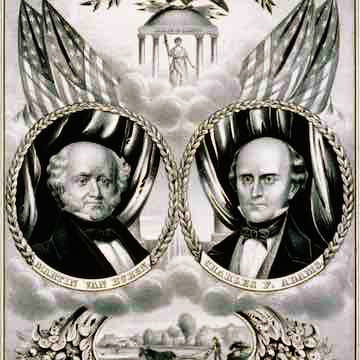
Charles Frances Adams was Vice President on the Free Soil ticket in 1848 with Martin Van Buren. His son was later a resident of Lincoln.
In the next two presidential elections, Lincoln voters would again side overwhelmingly with the (losing) Whig candidate. Finally, in 1860, Lincoln voted in a landslide for a winning presidential candidate — a rough-hewn man from Illinois named Abraham Lincoln.
For more on Lincoln’s politics in the era before the Civil War, see Jack MacLean’s A Rich Harvest, available from the Lincoln Historical Society.
“Lincoln’s History” is an occasional column by members of the Lincoln Historical Society.
The mor things change, the more they stay the same!
Enlightening and amusing story. Thanks.