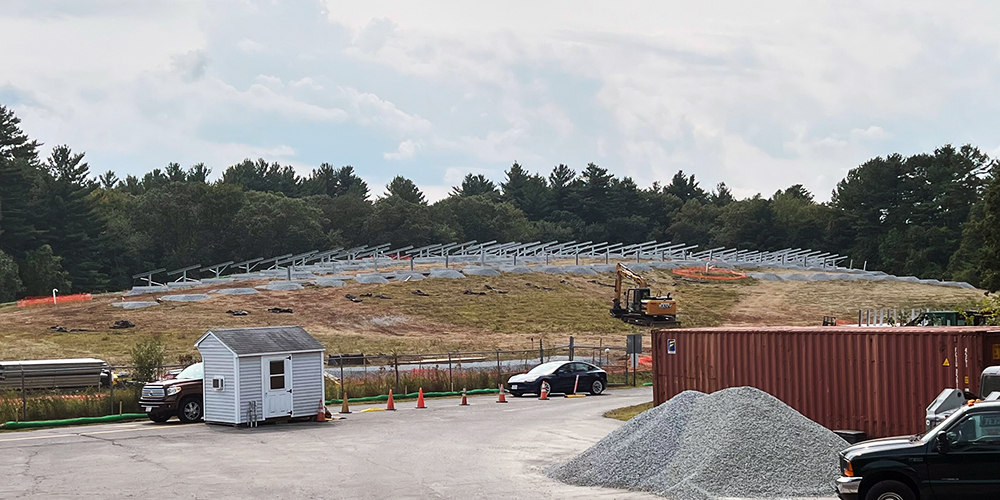
Solar supports begin to rise from the landfill.
Construction on the solar installation atop the capped landfill is finally underway. When complete, the facility should supply all of the electricity needs of town-owned buildings except the Lincoln School, which have its own solar collection system to make them net zero.
The electricity will go directly to the electrical grid via the Eversource poles and wires on Mill Street and the town will then receive income from a power purchase agreement (PPA).
Lincoln won’t have to pay anything and will actually see three revenue streams from the deal. In addition to income from the PPA in the form of electricity savings — estimated at $170,000 to $200,000 per year — HESP Solar will make lease payments for use of the land and PILOT (payments in lieu of taxes) for their personal property on the site.
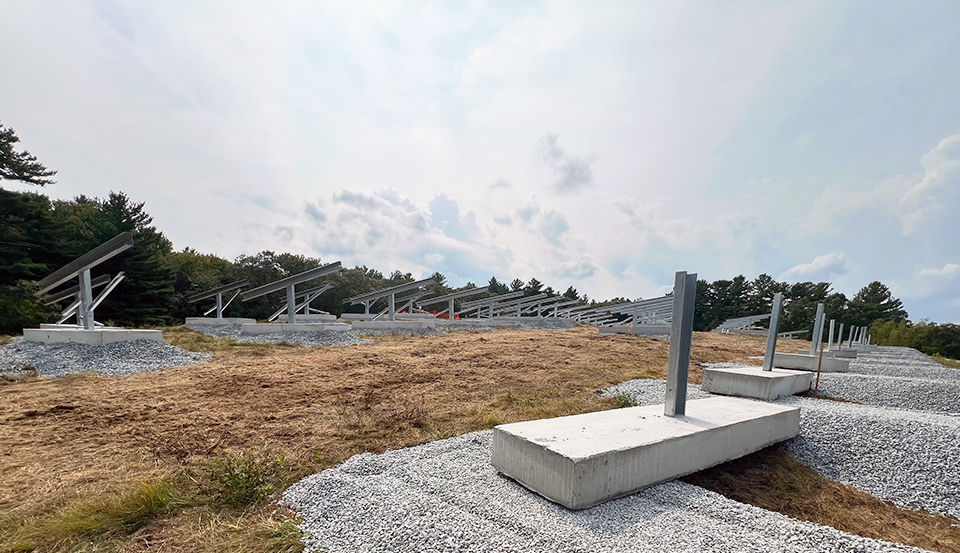
A closer view of the panel footings.
The project was slowed by several factors including the pandemic and lengthy negotiations with Minute Man National Historical Park. The park owns the right of way on either side of Route 2A, so the town needed their approval to install power lines from the landfill out to the road.
The town will receive financial credits from Eversource for the energy produced, as well as annual property tax payments and payment in lieu of taxes.The facility is expected to generate about 1.4 million kWh in the first year, yielding about $150,000 a year for the town in total savings and revenue.
In 2017, residents approved a “land swap” arrangement whereby some of the landfill property was taken out of conservation status in exchange for putting the same amount of land elsewhere into conservation. That land is part of the Wang property on Bedford Road that the town purchased, now the site of an athletic field as well as nine acres of conservation land.