• Skip to primary navigation
  • Skip to main content
  • Skip to primary sidebar
  • Skip to secondary sidebar

The Lincoln Squirrel – News, features and photos from Lincoln, Mass.

  • Home
  • About/Contact
  • Advertise
  • Legal Notices
    • Submitting legal notices
  • Lincoln Resources
    • Coming Up in Lincoln
    • Municipal Calendar
    • Lincoln Links
  • Merchandise
  • Subscriptions
    • My Account
    • Log In
    • Log Out
  • Lincoln Review
    • About the Lincoln Review
    • Issues
    • Submit your work

schools

Changes at First Parish, School Committee

September 13, 2018

The School Committee is seeking an interim member to fill an unexpired term, while the First Parish in Lincoln has announced an interim minister for the next two years.

The School Committee invites residents who are interested in serving as an interim member (replacing Jena Salon, who resigned as of August 31) to submit a statement of interest detailing their qualifications and experience. Statements should be emailed to schoolcomm@lincnet.org by Thursday, Sept. 20. 

There will be interviews of all candidates in a joint open meeting of the School Committee and the Board of Selectmen on Thursday, Sept. 27 at 7 p.m. in the Hartwell Multipurpose Room. Each candidate will be asked to make a brief opening statement, respond to a set of questions from the committee and board members, and have an opportunity to ask questions of the members. The members will vote at that meeting to select one of the candidates to serve as an interim member of the School Committee.

The interim member will serve until the next annual election this spring, at which time there will be an election for a one-year term on the School Committee (filling out Salon’s term) as well with an election for a three-year term.

Transition at First Parish

Rev. Jenny Rankin

Rev. Jenny Rankin has been named interim minister at the First Parish in Lincoln effective August 15. She succeeds Rev. Manish Mishra-Marzetti, who left after two and a half years in Lincoln to become senior minister at the First Parish in Ann Arbor, Mich., one of the anchor churches of the Unitarian Universalist Association (UUA).

Ordained in 1988, Rankin began her career as acting university chaplain at Tufts University before serving congregations in Hopedale, Hingham and Cohasset as an interim minister. Called to First Parish in Concord in 1997, Jenny served as minister there for 15 years, followed by interim ministries  in Gloucester, Lexington, and Franklin. She has taught and lectured on Transcendentalism, Emerson, and Margaret Fuller as well as Celtic spirituality, spiritual autobiography, the contemplative tradition, and creativity as a spiritual practice.

Both religious organizations to which the First Parish belongs (the UUA and the United Church of Christ) require a two-year term for an interim ministers. “The time between settled ministers is a great opportunity for the congregation to take a fresh look at itself, see what areas might need attention, and grow clearer about who they are and how they’re called to serve the world,” Rankin said. A permanent minister is expected to start in August 2020.

Registration is now open for religious education classes at the First Parish for children in grades K-7. 7 as well as the OWL (Our Whole Lives) classes. OWL is a human anatomy and sexuality course that’s open to all eighth-graders, including those whose families do not attend First Parish in Lincoln. Required parent orientation night is scheduled for Thursday, Oct. 4 from 7–9 p.m. OWL will meet approximately twice each month on Sundays from 7–8:30 p.m. beginning October 14.

For more information about First Parish religious education programs, click here or contact Education Director Margit at 781-259-8118 x112 or Margit@FPLincoln.org.

Category: news, religious, schools Leave a Comment

Architects show latest school plans

September 6, 2018

The school floor plan as of September 5 (click to enlarge).

Residents at two workshops on Wednesday saw the latest drawings of the Lincoln School project showing what SMMA principal architect architect Alex Pitkin called “reinvention of the heart of the building” as well as campus circulation and construction phasing.

The middle of the refurbished building includes a central office area and entrance with an “airlock” for both security and climate control. Nearby are offices for the school psychologist, social worker and some special education staff, as well as two large common areas to minimize walking time for students. The media center has been moved to the west side of the building (away from the driveway) since the last presentation two weeks ago.


September 5 workshop presentation:

  • Overall floor plan – pg. 11
  • Entrances – pg. 21
  • Bus and car circulation and dropoffs – pgs. 22-25
  • Pedestrian and bike circulation – pgs. 26-27
  • Sustainable design features – pgs. 35-41
  • Construction phasing – pgs. 44-46

The central area “is a focal point for the building that makes a statement,” said Superintendent of Schools Becky McFall.

There will be a preK entrance at the southwest end of the building and a community entrance at the northeast end to give access to the auditorium and Brooks gyn, which will be connected to the main building. A learning commons for all nine grades replaces the current story room and the seldom used stage area of the Smith gym. Next to it is the dining commons and kitchen.

The new media center will be smaller than what exists today. The current space “is nice, but not ideal for instruction and not well organized for how library/media arts centers are used today.” We don’t efficiently utilize our space right now,” McFall said. Although there will be some “weeding” of the book collection, “we hold tangible paper books in very high value, especially for young kids,” she added.

Pitkin also pointed out the grade-level hubs with movable walls, which “require teachers to have really conscious thought and decision-making about what gets taught where and by whom (movable walls) and which kids are with which teachers where… as opposed to teaching in a one-size-fits-all approach,” McFall said. At the new Hanscom Middle School, which has hubs of this type, “they have made amazing progress in that regard in the last two years, and we still have room to grow in that area.”

Environmentally sustainable features include net zero energy use with all-electric heat as well as photovoltaic arrays on rooftops and over the Brooks parking area, a 30 percent reduction in indoor potable water use, sustainable construction materials, and recycling 75–90 percent of the construction waste.

“The entire building on this campus is going to be re-skinned” with new triple-paned windows and insulation, Pitkin said.

Construction will occur in two phases spanning three years. The auditorium and Smith gym will each be out of commission during one of the 18-month phases. Assuming all goes as planned, 28 modular classrooms plus storage trailers will be installed on the central ballfield in summer 2019.

The schematic designs should take another few weeks, after which teams of cost estimators will come up with firm budget figures to present to the School Building Committee in late September or early October, Pitkin said. The estimates presented at the June 9 Special Town Meeting, where residents selected option L3, was $94 million. 

Category: school project*, schools Leave a Comment

School Building Committee workshops on Wednesday

September 4, 2018

The School Building Committee will hold a pair of identical community workshops on Wednesday, Sept. 5 from 8–10 a.m. and 7–9 p.m. in Reed Gym to recap its work over the summer since the Special Town Meeting vote on June 9. Topics will include:

  • Floor plans – Where are the grades located? How are the hubs and the commons laid out? Where is the new kitchen?
  • Site plan – Traffic flow, pedestrian paths, bike paths, parking.
  • Sustainability – What needs to be done to try to reach our goal of a net zero building?
  • Phasing – Where will students go during renovation?
  • Next steps – What is the SBC working on over the next couple of months?

Topics of future meetings this fall before the December 1 Special Town Meeting to vote on financing the project:

  • September 26 — Review preliminary cost estimates
  • October 3 — Review reconciled cost estimates and value engineering items
  • October 17 — Approve final cost

For more information and a full schedule, see the SBC website or watch videos of past meetings.

Category: school project*, schools Leave a Comment

School Building Committee adds Aug. 15 session

August 12, 2018

The School Building Committee (SBC) has added a meeting to tis summer schedule on Wednesday, Aug. 15 at 7 p.m. in the Hartwell multipurpose room. Topics for the next several meetings:

August 15

  • Mechanical systems: update and discussion
  • Energy model: presentation and discussion
  • Photovoltaic plan: presentation and discussion

August 22

  • Review site plan
  • Review floor plans
  • Review updated exterior elevations
  • Phasing plans
  • Preliminary interior spaces review

September 5

  • Final site plan
  • Final floor plans
  • Final elevations review
  • Final mechanical and electrical systems
September 26
  • Review preliminary cost estimates
October 3
  • Review reconciled cost estimates
  • Review value engineering items
October 17
  • Approve final cost

For more information and a full schedule, see the SBC website or watch videos of past meetings.

Category: schools Leave a Comment

Schedules proposed for school, community center projects

July 23, 2018

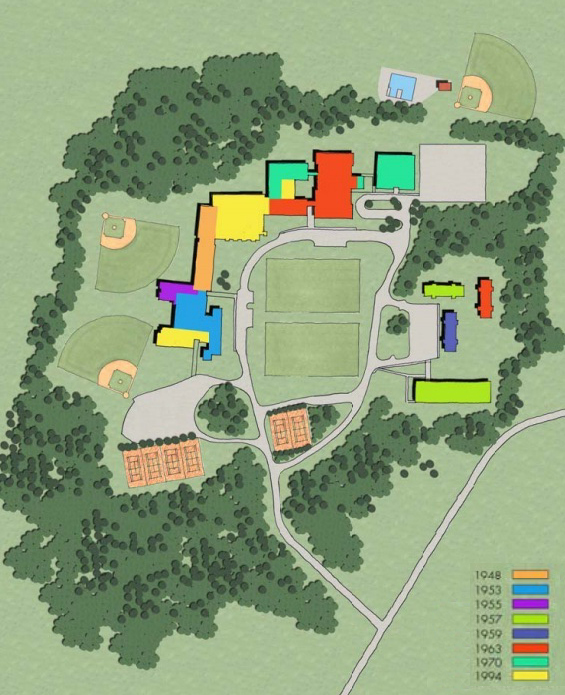
The current school campus showing when various sections were built.

School and community center planners have proposed schedules for further community input and eventual start dates for their respective projects.

Daedalus Projects Inc., the owner’s project manager for the school project, presented a schedule to the School Building Committee earlier this month calling for three community forums from August to October as well as six committee charrettes on various aspects of the school design.

Charrettes on hubs and commons and on building envelope and sustainability took place on June 27 and July 11, respectively. The next session on Wednesday, July 25 at 7 p.n. in the Hartwell multipurpose room will focus on building exteriors and site circulation. Other charrette dates and topics:

  • Systems and photovoltaic panels – August 8
  • Interior spaces and security – August 22
  • Schematic design pricing set – September 5
  • Cost review: September 27

The final cost estimate is due on October 1. Residents must vote on a dollar amount to borrow for the project at a Special Town Meeting on December 1, 2018 (with a two-thirds majority required for passage) and at the ballot box on December 3.

Assuming the project is approved, construction documents and bidding will take place next, with modular classrooms installed in spring and summer 2019, and actual construction running from November 2019 to November 2023.

Community center plan

The Community Center Planning and Preliminary Design Committee submitted its final report outlining two possible design directions on July 19. A survey of residents who attended the June 9 Special Town Meeting showed that voters were almost evenly split on which of the two they preferred.

In their report to the Board of Selectmen, the CCPPDC recommended creating a community center building committee in late 2020. That group would approve a budget for schematic design (currently estimated at $300,000), hire an architect and owner’s project manager, and prepare for a Town Meeting vote on the building site and budget in March 2021.

The town will not have the borrowing or campus space capacity to begin the community center until after the school project is nearly complete. The CCPPDC therefore recommended holding a bonding vote on March 2022 and starting construction in March 2023.

Category: community center*, school project*, schools, seniors Leave a Comment

School option L3 wins the day

June 10, 2018

School option L3 (click to enlarge)

After almost a year of meetings, community forums, architectural work, and spirited debate, Lincoln residents voted to move forward with school concept L3 at a Special Town Meeting on June 9.

Consulting architects SMMA will now produce a schematic design with detailed specifications and an updated cost estimate. The current estimate for Option L3 is $93.9 million, including solar panels and other “net zero” energy use features. A two-thirds majority is required at a Special Town Meeting on December 1 to approve bonding for the project. There will also be a December 3 town-wide ballot that must win a simple majority for the project to advance.

On the first vote, which was conducted using paper ballots and voting machines (a first for a Town Meeting), 632 voters in the Brooks Auditorium and nearby gym weeded down the initial five options to three, with Option L3 gaining a majority already:

Number of votesPercentage
Option R274.3%
Option L1101.6%
Option L28513.4%
Option L335456.0%
Option C15625.7%

Option L3 won a substantial majority in the second round of voting:

  • Option L3 – 74%
  • Option C – 17%
  • Option L2 – 9%

Before turning to the school issue, the Community Center Preliminary Planning and Design Committee presented two possible design ideas for a community center on the Hartwell side of campus and asked residents to complete survey forms on which they preferred. That feedback will be part of the group’s final report to the Board of Selectmen in coming weeks.

The meeting opened with presentations about the five school options and their costs, the tax impacts of borrowing varying amounts, the conditions and repair work needed at the school, and a history of school project planning and construction since 1994, as well as recommendations from the Board of Selectmen, Capital Planning Committee, and Finance Committee (see links below).


Background:

  • A roundup of past Lincoln Squirrel stories and letters to the editor on the school project (updated June 10, 2018)

Town Meeting presentations:

  • Full slide deck
  • Plans and views of the two Community Center options
  • School project history
  • Repairs and code work needed on the school
  • The five school options
  • Borrowing and tax implications plus Finance Committee recommendations

The two community center options (click to enlarge)

Over the past year, the School Building Committee looked at 39 different school options before settling on five to present for the June 9 vote. A sixth option was rejected earlier as being beyond the town’s normal borrowing limit.

Much of the discussion before the votes centered on the educational benefits of hub spaces that would allow teachers to work with student of different sizes and more easily collaborate on teaching within a grade, vs. whether such spaces were worth the added cost.

Dozens of residents stood in line at microphones to ask questions and make a case for their choices before the votes. A sampling of those remarks:

  • “I’m a huge proponent of Options L3 and C… but L3 is probably a compromise,” said Jen Holleran, member of a Lincoln educators group.
  • Option L3 would put Lincoln “in the middle of the pack for residential tax rate,” said Ginger Reiner. “What we are experiencing as a giant leap in taxes is just recalibrating to bring us more in line with our neighbors. We’ve enjoyed lower than average taxes by essentially borrowing against our future selves; we’ve artificially suppressed our taxes and it’s time to pay that debt… Option L3 is the perfect intersection of the town’s values.”
  • “Our kids are doing all right,” said Carolyn Montie, noting the top-tier colleges that many Lincoln School graduates have attended. “All options are viable… but putting those resources to direct services to students would result in a better outcome.”
  • “Every dollar put into the school made real estate prices rise by $1.50” compared to similar towns that didn’t do a major school project, said Ben Shiller, assistant professor of economics at Brandeis University, citing academic research. “The selfish decision is actually to choose one of the more expensive options.”
  • Lincoln’s master plan doesn’t mention an upgraded school but does call for continued investment in affordable housing, open space and conservation, and economic development, said Sharon Antia. “Where will we find the dollars for our stated priorities?”
  • Children today “have information at their fingertips—they don’t need to cram it all into their heads” in a traditional classroom setting, said D.J. Mitchell. “We need to [develop] collaborators, tinkerers, and problem solvers. Sometimes this requires larger spaces, multi-age groupings, teachers working across disciplines, quiet reflection and loud collaboration… we need to transform educational spaces for the 21st
    century.”
  • “We have a responsibility to honor the historical legacy of the Smith School, which was groundbreaking in its day,” said Christopher Boit. Option L2 “honors our commitment to net zero as well as a full kitchen and [the option of] collaboration at mealtimes… the difference in my education was not the buildings, it was the teachers.”
  • The hub spaces in Options L3 and C mean that children taken aside for individual or small-group instruction for any reason “are not stigmatized by being pulled into hallways,” said Cathy Bitter.
  • “We’re going to end up taking people out of this community because this is going to impact their taxes a lot,” said Daniela Caride. “In Lincoln, you go anywhere and you see three generations of people living here. [Other area towns] are generally bedroom communities. Do we want to be this kind of community? I’m still looking for an option here. We should be mindful of our neighbors who may get into trouble with all this cost.”
  • The tax increase from L2 to either L3 or C “sounds like a pretty good bargain,” said Cheryl Gray.
  • The increase between the higher-end options which is in the vicinity of $200-300 annually “is just one less trip to Donelan’s,” said Chris Gill.
  • “Some people are concerned that the price is still not optimal for what we’re getting, so I hope do some serious value engineering” between now and December,” said Steve Massaquoi.
  • “Given the total dollar amounts we’re talking about, I’m not that concerned” about the relative difference in tax hikes between the top two or three options, said Allen Vander Meulen. “But which of the plans do the teachers prefer?”
  • At the most basic level, consistent classroom temperature and lighting are the top priorities for teachers, Superintendent of Schools Becky McFall said in answer to Vander Meulen’s question. But since the new Hanscom Middle School opened, “they’re seeing the collaboration possibilities… the flexible grouping of students and targeted instruction… for either more intervention or more challenges.”
  • The presence of hubs in a school “affects our ability to attract good teachers big-time,” said Bob Shudy. Without hubs, many of the best young teachers “wouldn’t even consider” applying to work at the Lincoln School.
  • Option L2 “contains the reasonable minimum for facilities and teachers. I find the notion of adding hubs or flex spaces to be speculative,” said Adam Greenberg. “Education is changing much more rapidly than any snapshot you choose to pick today.”
  • Saying she hoped to persuade fans of both Option L2 and C to agree on L3, Lis Herbert said that L2’s concept of having only single flex spaces for Smith and Brooks is “deficient and doesn’t rise to the occasion” but that Option C reflects “a uniquely American desire for shiny, efficient new things. We often forget about what we have and what we can adapt to suit our needs… we literally pull up stakes and go west.”
  • “A difference of $10 million between L2 and L3 is significant,” said Diana Abrashkin. “There’s so much that could be done with $10 million in terms of teacher salaries, or more amenities in the actual buildings. The difference is the teachers, not the shape of the classrooms.”
  • Option L3 has a better distribution of hub spaces, while Option C has “a perfectly good gym moved from present location,” said Graham Atkinson.

Category: community center*, government, news, school project*, schools 3 Comments

Letter to the editor: L3 is the best—not a compromise

June 8, 2018

To the editor:

I don’t think of L3 as a compromise, or second best. I understand it to be the best choice for Lincoln, and for our children. This is based on personal value judgements, but they are value judgements that I think many of us share and make without realizing it. 

Much of the potential in L3 has to do with the L itself.  Not only is preserving and reusing the existing building a sustainable choice, it is a sensible one: it acknowledges the connection of the school to the land, to the roots of modernism in Lincoln, and to the values of the town and the reason many people choose to live here. The L is Lincoln.

A lot has been said about the way the L sits on the land, how it is viewed from the outside, how it is nestled into the landscape and tucked into the trees. Very little has been said about the view from the inside to the outside, and I am not sure people have focused on how much this matters with respect to how we feel inside a building. 

The L, and all of those hallways—which, with some creativity, can be lively, dynamic spaces in their own right—are the reason there is something to see from both sides of the building. The L offers a long, uninterrupted view of the fields and conservation land beyond. And there are mature trees that dot the campus, many of which will be lost if we condemn the L. The central spot on the L, which would become the central gathering space in a new school, also happens to have the best view. A new commons facing out to the conservation land would be a very special thing, drawing you outside, again, from the moment you step through the door. The L preserves the beautiful, underappreciated courtyard on the Brooks side of the building. The Smith art studio is thoughtfully positioned to face north and out. The Smith gym, with soaring wooden beams, would be preserved and smartly surrounded by classrooms to take advantage of the view.

By contrast, the X of the compressed shape of C dictates that in both wings the exterior views, on one side, are to the other side of the building. The other views from C are to parking lots, and the new Smith gym—windowless and monolithic—can’t be surrounded by classrooms to take advantage of any views because of the new parking lot. In C the art and science rooms for both elementary and middle school face a driveway. 

The interior spaces can shift, but we are voting on the perimeter, and the perimeter dictates the views. Drawing a visual distinction between L3 and C means giving points for unobstructed views, and if you were to hold one against the other, you would discover that L3 offers about twice as much visual connection to the land. 

Some people will brush this off as silly, frivolous stuff and say that aesthetic concerns shouldn’t play a role in our thinking. And yet, aesthetic choices are fundamentally what make us happy to be somewhere, especially for long stretches of time (11,000 or so hours for a child who starts in pre-K and is there through eighth grade). There is tremendous value—educationally, environmentally, emotionally—in feeling like you’re actually part of the surrounding environment. This is a value judgement, and one that hinges on the subconscious, but there is a reason we prefer the apartment with a view over the trees to the one with a view of an air shaft. We would rather look at a field than a parking lot. We would rather sit in a garden than sit in a warehouse.

So much flows from simply feeling good about where we spend our time, and I truly believe that L3 can and will be spectacular. Look at any thoughtfully renovated modernist building to understand what is possible. None of that magic is possible in a compressed school that looks inward, rather than outward. 

Sincerely,

Lis Herbert
28 Lincoln Rd.


Letters to the editor must be signed with the writer’s name and street address and sent via email to lincolnsquirrelnews@gmail.com. Letters will be edited for punctuation, spelling, style, etc., and will be published at the discretion of the editor. Letters containing personal attacks, errors of fact or other inappropriate material will not be published.

Category: letters to the editor, schools 1 Comment

Letter to the editor: Stand up for Option C if education is your top priority

June 8, 2018

To the editor:

I appreciate the many folks who have argued so well for choosing either options L3 or C on Saturday. I wholeheartedly agree. Although our kids are past the Lincoln School stage, we want to support the best educational outcomes for those who follow. A building with hubs and other flexible-use spaces (C and L3) best supports differentiated learning, cross-grade activities such as “reading buddies” and other educational best practices.

I believe our teachers will actually take advantage of such spaces: Hanscom experience demonstrates it can be done, and superintendent McFall supports the same for the Ballfield Road campus, so I trust additional teacher training will be provided as necessary. The building alone doesn’t guarantee best practices, but it enables them.

Net zero energy usage (L3 or C) is also important. Human-caused climate change is the biggest environmental, moral, and human rights issue of our time, and time is of the essence in trying to avoid its worst possible effects. So now is not the time to backtrack on the commitment the town made its energy bylaw.

How to choose what’s better between L3 and C3? Though many considerations have been mentioned, I would argue that the two main and potentially competing considerations are aesthetics versus education.

As to aesthetics, some apparently like the look of the familiar, sprawling “L” much more than that of a more compact, two-story building (C). They of course are entitled to their opinion. However, as a longtime user of the Ballfield Road campus who cares about visual design, I nevertheless feel no nostalgic attachment to the old buildings, and no aesthetic preference for their L-shaped arrangement. I think a new compact building, with more green space around it, could look great. Let’s recognize that beauty is in the eye of the beholder.

In terms of educational function, I think C beats L3. The more compact design allows shorter travel times, which makes certain kinds of beneficial interactions more feasible and more likely to happen. These include for example differentiated learning sessions in a hub mixing kids from different grades; “reading buddies” and similar mixed-grade activities; and collaboration by teachers across grade levels to continuously facilitate the above.

So I suggest you ask yourself what’s more important to you—maximizing educational outcomes or preserving the “L” look? For me, it’s educational outcomes.

The last major consideration—and it’s a crucial —is what can the town get passed when the final vote happens this fall? If I thought C would fail and L3 would pass, of course I’d support L3 for that reason. But we don’t actually know that is the case.

So let’s use the Town Meeting to get a better gauge on that. When we take the first vote Saturday morning, if you like C best, don’t stand up for L3 just because you think it might have a better chance of passing. Instead, stand up for C, and let’s find out how many people feel the same. I expect there would be time to coalesce around L3 in a later vote on Saturday, if that looks to be necessary.

Thanks very much to the volunteers and professionals who have put so much time into helping tee up these options for decision.

Sincerely,

Paul Shorb
99 South Great Rd., Lincoln


Letters to the editor must be signed with the writer’s name and street address and sent via email to lincolnsquirrelnews@gmail.com. Letters will be edited for punctuation, spelling, style, etc., and will be published at the discretion of the editor. Letters containing personal attacks, errors of fact or other inappropriate material will not be published

Category: letters to the editor, schools Leave a Comment

Letter to the editor: option L3 is the best choice

June 7, 2018

To the editor:

What follows is my personal perspective.

Lincoln has always been committed to a progressive education, and generations have spent untold hours and dollars to provide that education in this town. I want us to choose a school that the current parents of this town embrace for their children, so I canvassed many of them to understand their perspective. Two key elements are the school’s disrepair and the progressive educational infrastructure that hubs provide to kids. These hubs provide an innovative, collaborative, configurable environment for learning.

Many of today’s parents have kids who started school around the time Town Meeting voted down a new school in 2012. Those same parents will not see their kids in this new/renovated school, even if we vote for and bond a school option at the end of this year. I am impressed by the parents’ remarkable commitment and determination with no or limited benefit coming to their children from this school project. They are primarily thinking about the next wave of children to pass through the school.

I thought about option C, but it felt too similar to the design that Town Meeting did not support in 2012.

Through a number of friends with an eye to the architectural beauty and preservation of our structures, I also was influenced by the unique way our school campus nestles into the fields and forest surrounding the buildings. We barely notice that we are entering school grounds in a car or on foot from the trail system as the trees tower over the structure. Educators and kids look out from numerous vantage points at the natural setting which provides natural light.

So I thought about the L options that would maintain and upgrade this vision for our school.

I don’t know why it took so long to see the light, but earlier in May, the picture started to unfold. I listened as many in the town shared what they were looking for in their visions. The hubs and L design were the clear requirements for consensus between these two groups. L3 is the least expensive of the original three hubs options and the most expensive of the L options. It encompasses Lincoln’s commitment to progressive education and sustainability. New families are the lifeblood of a town and also a valuable demographic that I clearly support.

Please join me in voting for option L3 on Saturday morning in the ballot vote and again in the afternoon in the standing vote(s).

Sincerely,

Peter Watkinson
9 Wheeler Rd.

Category: letters to the editor, schools Leave a Comment

Letter to the editor: a look at the issues, and why I’m voting for L3

June 7, 2018

To the editor:

This Saturday we face a tough day of decision-making. I believe that there is only one proposal up for consideration that has the potential to satisfy the range of expressed aspirations and that checks enough boxes to get us to “yes” in December. That is L3.

Over the course of the development of these proposals, it seems to me that there are a number of points at issue, not necessarily competing, that are driving choices:

1. Educational vision

  • Flexible spaces and classrooms organized around rooms/hubs that facilitate collaboration and smaller spaces to allow for individualized instruction
  • Dining area (and kitchens) that are multi-use and close enough to classrooms to reduce time spent getting to and from lunch
  • Common space for larger gatherings

2. Environmental concerns

  • Achieving net zero
  • Appropriate sizing and location of solar panels
  • Minimizing demolition
  • Intelligent reuse/recycling/repurposing where possible

3. Aesthetics of the campus

  • Preservation of the unique landscape of buildings surrounding the center ballfield
  • Respect for the value of Lincoln’s architectural heritage
  • Concern regarding radical change in campus appearance

4. Shared space/community use

  • Preservation of easily accessible spaces for voting and hosting Town Meeting—Smith Gym and Donaldson Auditorium, a.k.a. Brooks auditorium
  • Creation of common area(s) and kitchen(s) for community use after school hours

5. Community/rec center

  • Concern that most expensive project will dim prospects for a community/rec center

6. Budget

  • Concern with increase in taxes
  • Perception of unnecessary “frill” expenditures
  • Spending close to bonding limit—“maxing out the credit card”

For some, budget is a serious issue that will drive decision-making. Town boards and committees talk about what is affordable for the town, and what are responsible and prudent investments. But what is deemed affordable, prudent, and responsible for the town may not seem so for individual homeowners/taxpayers.

Budget-driven decisions are legitimate and should not be dismissed or deemed irresponsible.
All of the choices are expensive, running from $49 million for R/Repair to $94.3 million for C/Compact. Tax impacts will be appreciable. While some seniors thankfully can use the array of senior tax relief programs offered by the town, the majority do not. Some will be digging deep.

Suggesting that we do not have to pick any of the options offered, including the R/Repair option, ignores reality. Our buildings have not had substantial repairs and/or upgrades since our last building project in 1994. We have made repairs, we have done the basics. Systems are old and need replacements. Undertaking the major repair projects triggers state code requirements and adds expense. That is why the comprehensive R/Repair option is on the table. We simply cannot do piecemeal repairs spread out over years. Building codes do not allow us to take this path. Doing nothing is irresponsible. Doing nothing is NOT an option.

The R/Repair option will proved a completely rehabilitated facility with an anticipated life expectancy of 30+ years, but it offers little else. It offers no programmatic/educational enhancements. It offers no ability to achieve net zero.

Getting to “yes” in December will require a coalition and compromise. Only L3 meets the most substantive concerns that will translate into community support so that we can reach a “yes” vote on December. It may not be the ideal solution for everyone, and certainly not for those driven by budget concerns alone, but it is not the most expensive option, and local experts in design construction and energy applications say there may be ways to bring the cost down in this option while maintaining hubs, educational enhancements, and programs, potentially allowing savings to be shifted to a community/rec center. L3 is more flexible and “forgiving” than C, and will allow the town to come together to get to “yes.”

The passion we have been reading on Lincoln talk is good—it means we care. Let’s sustain the passion and ensure we continue respectful debate with open minds. At the end of Town Meeting, we as a town must feel whole. We should see that our debate and decisions reflect sensitivity to our entire community. We must be mindful that decisions made today are an investment that will benefit Lincoln for generations to come.

See you on Saturday… and please consider L3 as a wise choice for now and for our future.

Sincerely,

Sara Mattes
Conant Rd.

Category: letters to the editor, schools Leave a Comment

  • « Go to Previous Page
  • Page 1
  • Interim pages omitted …
  • Page 12
  • Page 13
  • Page 14
  • Page 15
  • Page 16
  • Interim pages omitted …
  • Page 47
  • Go to Next Page »

Primary Sidebar

Recent Posts

  • Water bills to go up by 13% March 5, 2026
  • News acorns March 5, 2026
  • Property sales in January 2026 March 4, 2026
  • My Turn: Unraveling the Hanscom misallocation March 3, 2026
  • Police log for Feb. 19–25, 2026 March 3, 2026

Squirrel Archives

Categories

Secondary Sidebar

Search the Squirrel:

Privacy policy

© Copyright 2026 The Lincoln Squirrel · All Rights Reserved.