• Skip to primary navigation
  • Skip to main content
  • Skip to primary sidebar
  • Skip to secondary sidebar

The Lincoln Squirrel – News, features and photos from Lincoln, Mass.

  • Home
  • About/Contact
  • Advertise
  • Legal Notices
    • Submitting legal notices
  • Lincoln Resources
    • Coming Up in Lincoln
    • Municipal Calendar
    • Lincoln Links
  • Merchandise
  • Subscriptions
    • My Account
    • Log In
    • Log Out
  • Lincoln Review
    • About the Lincoln Review
    • Issues
    • Submit your work

Hanscom Air Field

Hanscom developers get approval to renovate Navy hangar

September 24, 2025

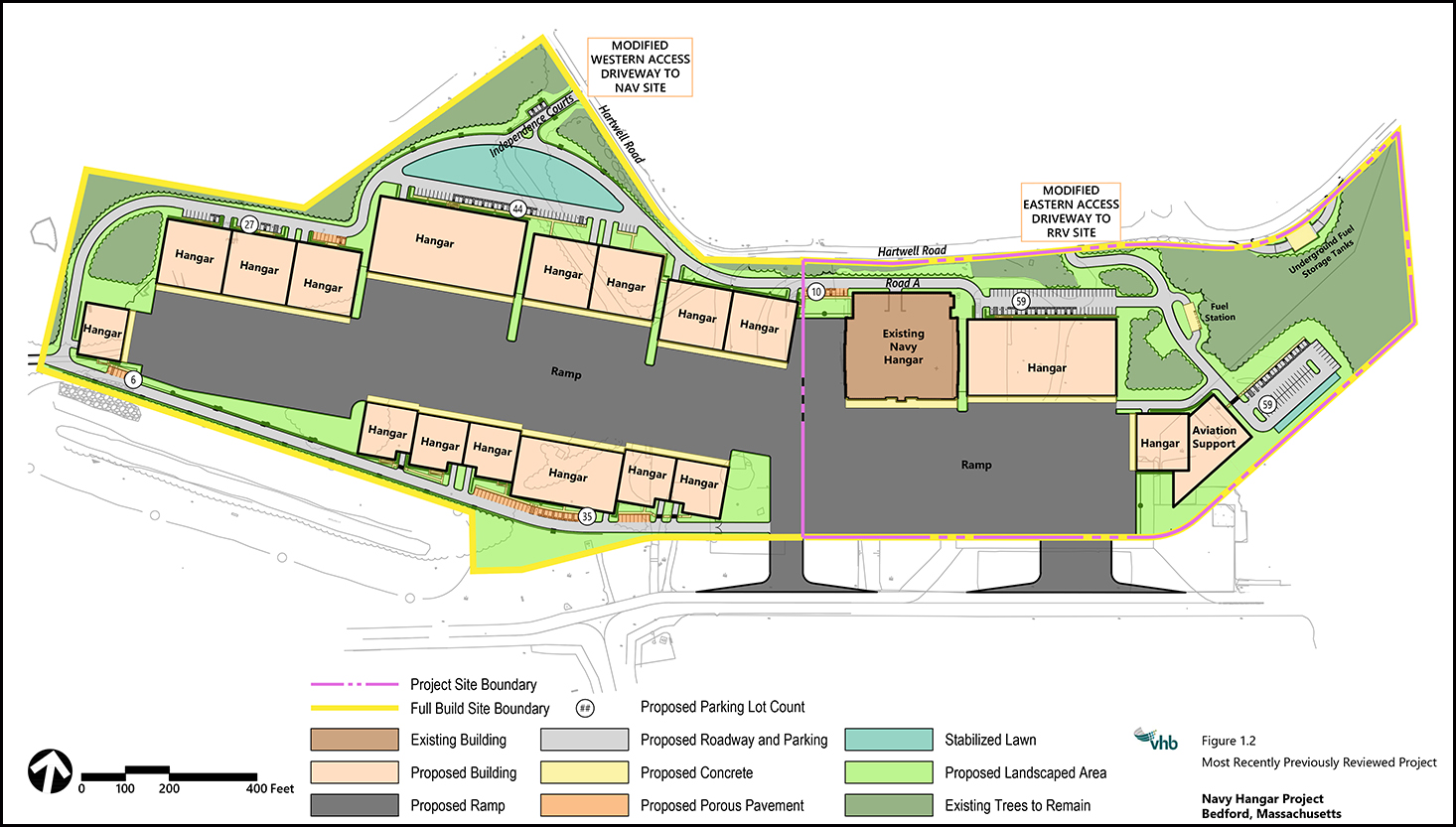
The originally proposed project that would add more than a dozen hangars at Hanscom Field. The Navy hangar is the darker brown square.

A state agency has granted a waiver to allow developers to renovate a disused Navy hangar at Hanscom Field in Bedford while they await a final decision on a plan to significantly increase hangar space and other work in a larger surrounding area for private and commercial aviation.

North Airfield Ventures LLC and Runway Realty Ventures LLC will lease space to Merlin, which has teamed up with MIT Lincoln Lab, the FAA, and the U.S. Air Force to test systems that would enable military and commercial aircraft to operate with just one person at the controls — and someday, perhaps, with no one at all, according to a May 30, 2024 Boston Globe article.

The original plan — which was first proposed in 2023 and engendered significant opposition from hundreds of residents, officials, scientists, and others — calls for adding almost 500,000 square feet of new hangar space on a 47-acre parcel on the north side of Hanscom Field. The state issued a ruling in June 2024 saying that the developers’ Draft Environmental Impact Report (DEIR) for the project that “does not adequately and properly comply” with Massachusetts Environmental Policy Act Office regulations. The developers are expected to file an amended environmental impact report later this year.
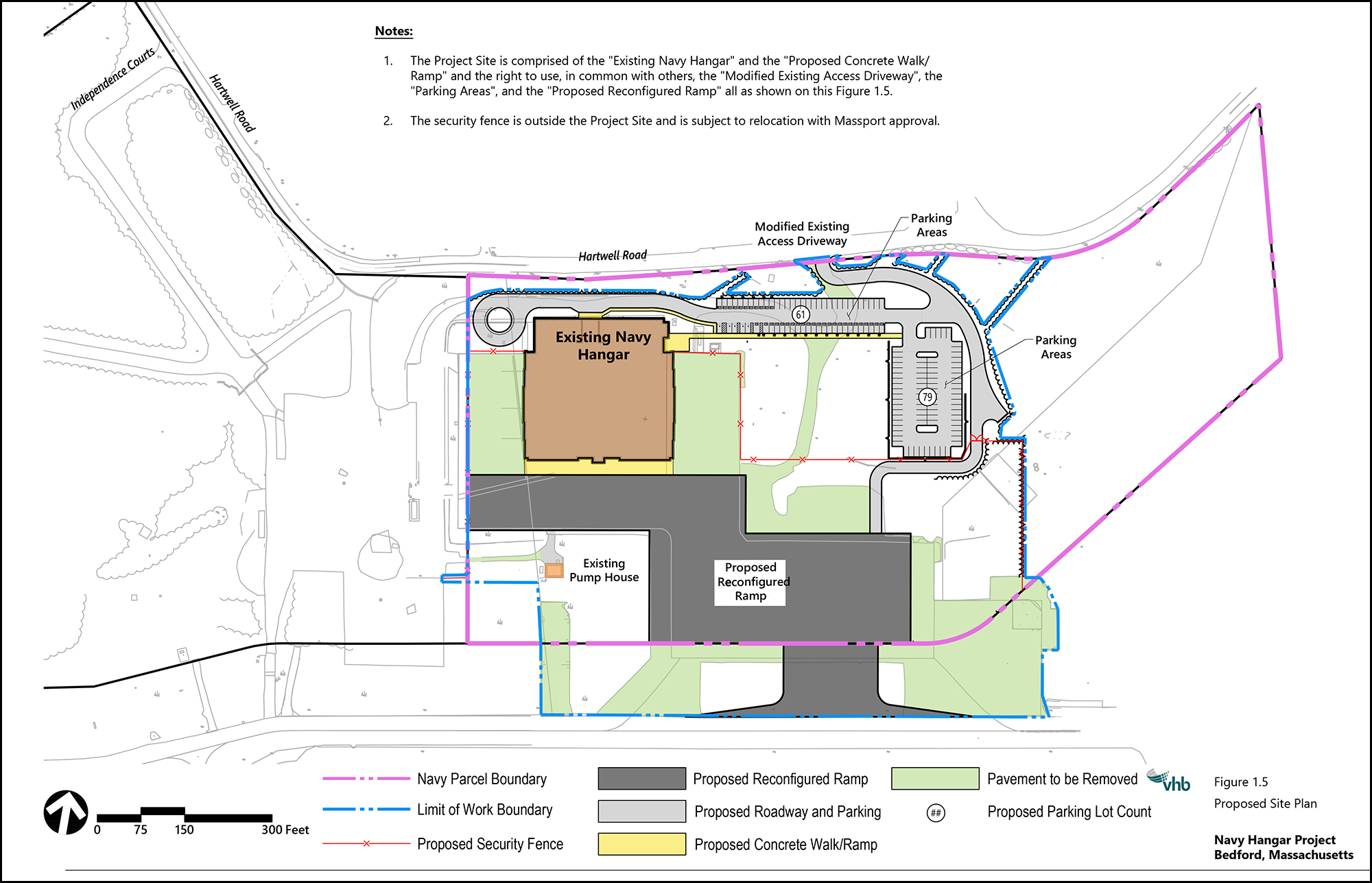
The subset of land that will be renovated to accommodate Merlin and other tenants.

In June 2025, the developers filed a Notice of Project Change with a Phase One Waiver Request  to allow them to renovate a smaller parcel including the Navy hangar while awaiting a decision on the rest of the property. The June request proposed a renovation of the hangar “consistent with its original R&D use dating back to the 1950s, including approximately 58,000 square feet of building space for office, research, and other similar uses, reuse of approximately 36,400 square feet of existing hangar space, creation of approximately 140 surface parking spaces, and reconfiguration of the access drive to Hartwell Road within an approximately 15.6-acre area in and outside the Navy Hangar Parcel.”

But five state lawmakers including Reps. Alice Peisch and Carmine Gentile, who represent Lincoln, wrote a letter to the Massachusetts Environmental Policy Act Office in June 2025 objecting to that proposal.

“While we don’t oppose the restoration and reuse of the historic Navy Hangar in principle, we urge [Energy and Environmental Affairs Secretary Rebecca Tepper] to consider this application in the context of the broader Hanscom development plans being pursued by this project’s proponents,” the legislators wrote. “Of particular note is the synergies of site work being undertaken in this project that would benefit the larger North Airfield Development project. This proposed work includes access and connectivity improvements, including modifying the existing curb cut and reconfiguring the existing site access drive from Hartwell Road, and expansion of the parking areas.”

On August 1, however, Tepper said the smaller hangar project does not require an Environmental Impact Report and granted a waiver that will allow the developers to proceed with the proposed Phase 1 work, including renovation of the Navy hangar, prior to conclusion of review for the full project.

ICE flights resume at Hanscom

In other Hanscom news, ICE has resumed flights in and out of the airfield for transporting arrestees as part of Patriot 2.0, its surge on alleged immigration violations in Massachusetts. WBUR reported on September 15 that flights were transporting people from the ICE intake center in Burlington to detention centers elsewhere in the country.

In response, Margaret Coppe, chair of the Hanscom Field Advisory Commission, called on Massport in a September 17 letter to “obtain and send us flight information in a timely manner, from both ICE and the Hanscom FBOs [commercial businesses that service aircraft], including dates, times, and type of aircraft.”

The HFAC acts as a liaison between Massport and the five towns surrounding the airfield and serves as an advisory body to review decisions concerning land use, noise abatement, and transportation needs. “In order for the HFAC to properly carry out our charge, we must have information in advance of any and all ICE activity on Hanscom Field,” Coppe wrote.

Patriot 2.0 followed “Operation Patriot,” when federal authorities arrested nearly 1,500 people in Massachusetts in May, according to WBUR.
Category: Hanscom Air Field Leave a Comment

Hanscom developers seek to renovate just one hangar for now

June 19, 2025

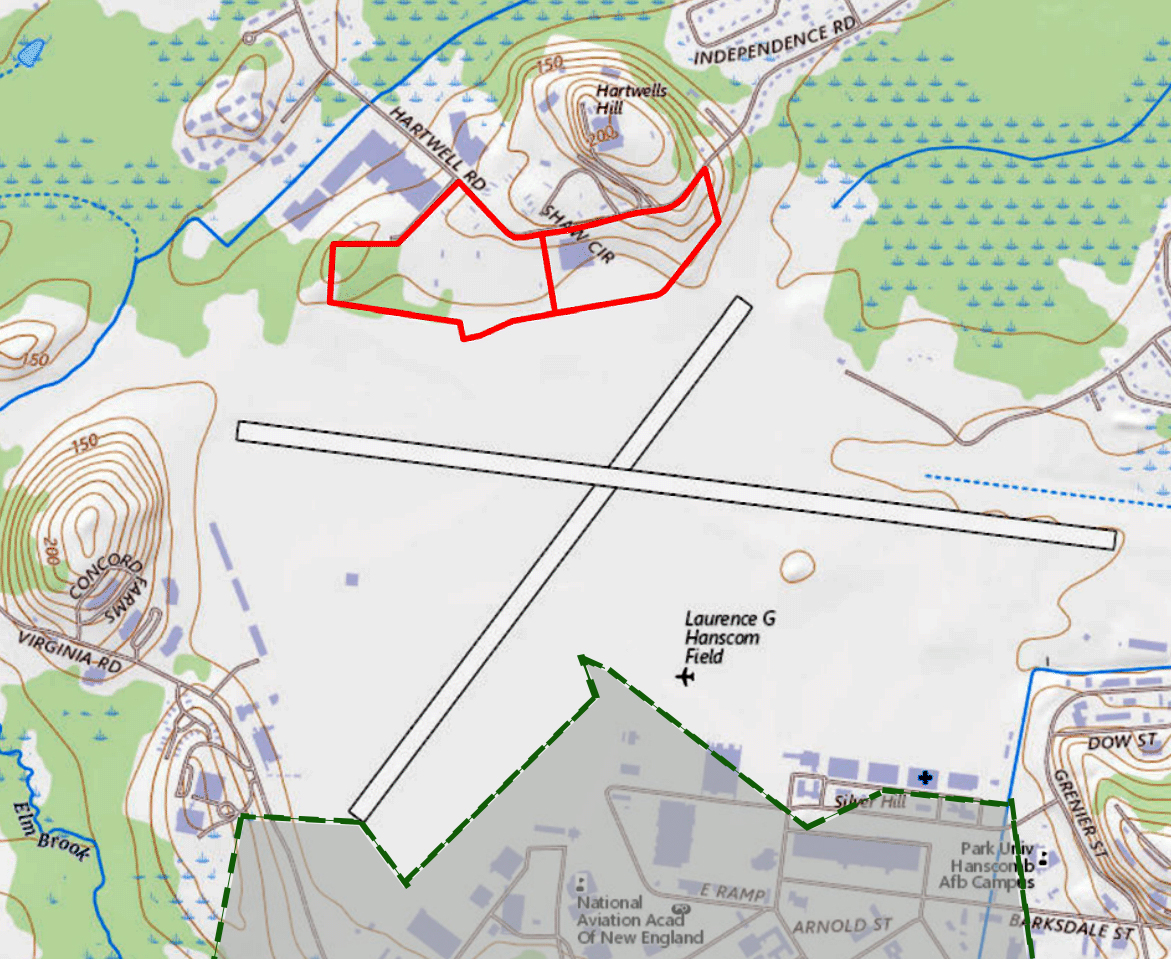
The Hanscom Field expansion area is outlined in red. Lincoln’s approximate town border to the south is indicated by the green dashed line.

Faced with a possible shorter-term revenue opportunity, the developers of the proposed Hanscom expansion are seeking to renovate the old Navy hangar and lease it, though their larger hangar space expansion proposal is not off the table.

North Airfield Ventures LLC and Runway Realty Ventures LLC recently filed a Notice of Project Change with a Phase One Waiver Request to allow them to renovate the historic hangar. According to the Bedford Citizen on June 19, 2025, they are in negotiations with Merlin Labs to renovate the historic hangar and sign a long-term deal to lease 70-80% of the space for research and development space for autonomous flight control systems. Specialty medical and pharmaceutical delivery companies have also shown interest and are in negotiations for the remaining space, the Citizen reported.

The Mass. Secretary of Energy and Environmental Affairs issued a ruling in June 2024 saying that the developers’ Draft Environmental Impact Report (DEIR) for the Hanscom Field expansion project first proposed in 2023 “does not adequately and properly comply” with Massachusetts Environmental Policy Act Office (MEPA) regulations. The Supplemental DEIR (sDEIR) for the single hangar renovation says that work does not meet the threshold for requiring MEPA approval. 

The original plan — which has engendered significant opposition from hundreds of residents, officials, scientists, and others — called for adding almost 500,000 square feet of new hangar space on a 47-acre parcel on the north side of Hanscom Field in Bedford. The developers are expected to file a DEIR for an amended version of that project later this year.

“They are not really pulling back, they are splitting the project into parts,” said Christopher Eliot of Lincoln, until recently the chair of the Hanscom Field Advisory Commission. “I think the Merlin project may be OK, or at least good enough that it is not worth asking for a major community effort to oppose it. We need to keep our powder dry and prepare for the expected sDEIR instead.”

Category: Hanscom Air Field 1 Comment

My Turn: Planning for climate-friendly aviation

May 8, 2025

By Christopher Eliot

In a previous Lincoln Squirrel article, I explained why “sustainable” aviation fuel (SAF) is unlikely to make aviation climate-friendly, barring one or more significant technological breakthroughs.

If SAF will not make aviation climate friendly, what should be done? Unfortunately, this is a very hard question to answer. I do not have an ideal solution any more than the aviation industry, but I believe my truthful admission is better than industry propaganda. It requires a lot of energy to fight the law of gravity. Currently, aircraft use the energy reservoir of millions of years of fossil fuel. It is unclear what renewable energy sources can practically be used to support aviation. It is more unclear if we can produce enough renewable energy for basic electrical needs and aviation too.

Expanding aviation is clearly wrong: we don’t want to make a hard problem bigger. We need to constrain the growth of aviation, starting with private jets which are the worst part of the problem as explained by Alex Chatfield on February 23 (“My Turn: Proposed private-jet Hanscom expansion is a climate bomb in sheep’s clothing“).

Existing aircraft can be made somewhat more efficient, thus reducing their environmental impact. Unfortunately, crowded seating, while loathsome for passengers, does reduce the fuel consumption per passenger mile. Scheduling that reduces empty seats is beneficial to the airlines and to the environment. Flying directly to a destination under 3,000 miles away is almost always more environmentally friendly than flights with layovers. Further efficiencies are possible but will only produce some percentage of improvement, easily outweighed by increases in travel.

Spending a trillion dollars to support production of SAF does not seem like a good use of resources or a path to a solution. Spending a trillion dollars on high-speed rail is much more likely to succeed and have a much better impact on climate considerations.

The single most impactful proposal is the development of blended wing aircraft. Fundamentally altering the shape of an airplane to generate much more lift will significantly reduce fuel consumption, and climate impact. JetZero claims the design can reduce emissions by up to 50%. However, more independent estimates predict more conservative benefits of 20-30%. Furthermore, the development of a new aircraft with associated production, servicing, and operational infrastructure is exceedingly challenging from a technical perspective, and maintaining the investment interest for the long development period is excruciatingly hard. The safety issues associated with a new design are immense. One or two fatal crashes could easily end production of an otherwise promising technology.

Jet contrails, while short-lived, turn out to have a massive effect on global warming and may account for 50% of the climate impact of aviation. Modifying flight paths to avoid the conditions where contrails form could substantially reduce this effect, although this has not been proven.

Electric aircraft are being tested and may soon become operational but it is not certain this technology will prove to be economically feasible. Several promising companies including Eviation and Lilium that have attempted to develop electric aircraft have recently failed. The industry wants to focus on electric vertical takeoff and landing (eVtol) instead of the simpler electric conventional takeoff and landing (eCtol) form of electric aircraft. From an environmental perspective, eVtol is probably bad and eCtol is probably good. All forms of electric aviation are technically difficult and have an uncertain future.

EVtol would create a whole new aviation industry providing a fast way to commute from cities to suburbs. Vertical takeoff and landing requires a prodigious expenditure of energy, likely limiting range to 25-50 miles. It is likely that eVtol will be a form of luxury travel unavailable to most people. It will probably be an expensive replacement for bus and automobile service to those who have the means. It will place a further drain on limited green energy sources, create new sources of overhead noise and confusion while reducing the environmental impact of nothing.

ECtol, on the other hand, could replace a certain number of short range flights (200-300 miles), including trips to The Cape and Islands. While this is a limited benefit, it is certainly better for the environment than using private jets to fly those same routes. Approximately half of all air travel is under 593 miles. More than 90% of high-traffic scheduled flights are less than 1,500 nautical miles. Current battery technology cannot produce electric aircraft that address a large percentage of the aviation problem. Increasing battery efficiency by at least a factor of three might allow electric aircraft to replace almost half of the current passenger miles. Electric aircraft do not have to cross oceans to dramatically reduce the climate impact of aviation.

My best plan for aviation requires (hopefully) addressing 10-30% of the problem with electric aircraft, 20-50% through the development of blended wing aircraft, 10-30% by reduction in contrails, 20-30% of the problem with high-speed rail, 10-20% of the problem with SAF, 10% from incremental optimization of engines, and remaining reductions due to remote meetings, more local vacationing, and some reductions in the use of air travel. The technological improvements are all uncertain; reduction in air travel is the only proven way to reduce aviation’s impact on the climate. However, while uncertain, the various engineering proposals (other than SAF) could greatly reduce the climate problem of aviation. Moving slowly toward this goal will be better for the aviation industry than following the false promise of SAF and being forced to drastically scale back operations when the scale of the climate crisis becomes inescapable.

What can you do?

The most direct action is to reduce your air travel slightly, maybe by 10%. Perhaps you can combine two trips into one (longer) trip or convert an in-person meeting to an online meeting. You can support groups opposed to private jet expansion and write to your government representatives.

Eliot, a Lincoln resident, is the former chair of the Hanscom Field Advisory Commission.


“My Turn” is a forum for readers to offer their letters to the editor or views on any subject of interest to other Lincolnites. Submissions must be signed with the writer’s name and street address and sent via email to lincolnsquirrelnews@gmail.com. Items will be edited for punctuation, spelling, style, etc., and will be published at the discretion of the editor. Submissions containing personal attacks, errors of fact, or other inappropriate material will not be published.

Category: conservation, Hanscom Air Field, My Turn 1 Comment

Dozens of luminaries petition Healey to stop Hanscom expansion

April 1, 2025

More than 40 leading historians, scientists, and climate and environmental advocates sent a letter today to Gov. Maura Healey asking her to stop the proposed private jet expansion of Hanscom Field.

The airfield is close to Minute Man National Historical Park (MMNHP), Walden Pond, and nearby landmarks which the National Trust for Historic Preservation and has designated as among America’s 11 Most Endangered Historic Places. Those areas are ground zero for the celebration of the 250th anniversary of the start of the Revolutionary War, with events that will draw thousands to the region.

Minute Man National Park, Walden, and their historic environs represent and reflect our nation’s ability to prevail, evolve, and enlighten in the face of extreme challenge,” the letter says. Signers include musician and Walden Woods project founder Don Henley, actor/activists Ed Begley Jr. and Ashley Judd, 350.org founder Bill McKibben, documentary filmmaker Ken Burns, musician James Taylor, historian Douglas Brinkley Jr., former Massachusetts secretary for environmental affairs John DeVillars, and Ellen Emerson and Mark Thoreau, direct descendants of Ralph Waldo Emerson and Henry Thoreau.

Last June, Energy and Environmental Affairs Secretary Rebecca Tepper rejected the draft environmental impact report for the expansion and asked the developers to submit a supplemental report with additional information about climate impacts, among other things. The proposal would add 17 hangars that could accommodate more than 60 additional private jets.

Healey is also the target of petitions from the National Trust for Historic Preservation and Stop Private Jet Expansion at Hanscom or Anywhere; the letter has garnered 14,000 signatures so far. The state legislature and the Massachusetts Environmental Policy Act office do not have the authority to stop a Massport project; only Healey has that power.

Click here to see previous news and opinion piece in the Lincoln Squirrel about this issue.

Category: Hanscom Air Field Leave a Comment

My Turn: Speakers in Lincoln give updates on latest political developments

March 25, 2025

By Barbara Slayter

More than 50 Lincoln residents gathered at Bemis Hall on Saturday, March 22 at a Lincoln Democratic Town Committee (LDTC) meeting to hear from State Rep. Carmine Gentile and Lincoln resident and environmental activist Paul Shorb on topics including what the Massachusetts legislature is doing to protect its citizens from adverse actions by the federal government.

Shorb, along with Lara Sullivan, project manager for Stop Private Jet Expansion at Hanscom and Anywhere (SPJE), addressed three key points:

  • The climate bill signed by Gov. Healey last November requires Massport to promote environmental protection, resilience, and justice in its undertakings, not just commerce and economic growth. A Draft Environmental Impact Report (DEIR) for expanding Hanscom Air Field was rejected last April by the Massachusetts Environmental Protetion Agency (MEPA). A supplemental one was requested and should be available in a few months. The SPJE regards this as an important step forward in the process.
  • Sustainable aviation fuel (SAF) is the idea that synthetic jet fuel can be made from renewable sources. This has been a key argument in support of expanding private jet use at the airport, but few regard it as a viable solution since renewable resources for this purpose cannot be developed at the scale required.
  • It is critical for the SPJE campaign (now composed of over 100 organizations including the LDTC) to keep a strategic focus on the issues, targeting the governor, legislature and the public with accurate information. Organizations are invited to become part of the coalition and residents are invited to sign the petition.

Gentile recognized Massachusetts Attorney General Andrea Campbell’s strong leadership in joining with Democratic AGs across the country to bring legal challenges to the federal government when it is violating state and individual constitutional rights. He also noted:

  • The large cash reserves (which have increased in recent years) in the Massachusetts treasury along with its high bond rating, as buffers against loss of federal funding.
  • The legislature’s awareness of both the challenges of the current federal government and need to move appropriate legislation through quickly. New rules should result in a speedier process. 
  • Bills co-sponsored by Gentile and currently pending in the Massachusetts legislature for raising the minimum wage, eliminating substandard care in for-profit hospitals and nursing homes, and underwriting various components of the educational system.

Lincoln residents expressed a variety of issues and concerns ranging from national politics to local land use, including:

  • Broadening the base of the Democratic party
  • Potential misuse of personal data of Massachusetts residents by DOGE
  • Protecting our laws, especially those that could be weaponized
  • Ways in which the loss of federal funds will affect Massachusetts
  • Appreciation for MassHealth but alarm over its shortcomings
  • Preventing concerns about antisemitism from becoming an infringement on free speech
  • Increasing progress on the Massachusetts housing shortage and need to improve public transportation
  • Options for land use of the area around the West Concord roundabout now that the prison has been closed

Questions demonstrated that residents who are proud of Massachusetts and pleased to live in this state are increasingly anxious and angry about the direction in which our federal government is moving.

LDTC Chair Travis Roland also announced upcoming events, including the Hands Off! protest on Saturday, April 5 at the Boston Common.


“My Turn” is a forum for readers to offer their letters to the editor or views on any subject of interest to other Lincolnites. Submissions must be signed with the writer’s name and street address and sent via email to lincolnsquirrelnews@gmail.com. Items will be edited for punctuation, spelling, style, etc., and will be published at the discretion of the editor. Submissions containing personal attacks, errors of fact, or other inappropriate material will not be published.

Category: Hanscom Air Field, My Turn Leave a Comment

My Turn: Understanding aviation’s “sustainable” aviation fuel

March 19, 2025

By Chris Eliot

The airline industry is desperate to show their environmental progress but jet fuel is critical to the industry. SAF, or so-called “sustainable” aviation fuel, is the idea that synthetic jet fuel can be made from renewable sources. Unfortunately, I think the industry has prematurely endorsed SAF without having a credible plan to implement this solution. Lara Sullivan wrote about this on March 3 (see “My Turn: Kudos for piece on sustainable aviation fuels“). The scale of the aviation industry is the fundamental problem.

There are many ways to create SAF but they all fall into three broad categories.

  1. It is technically possible to produce SAF from energy crops. According to a recent Department of Energy report, BETA-2023, this would require 76 million acres of land worth $76 billion to $760 billion. This amount of land is between the total size of Arizona and New Mexico. On the face of it, devoting this much land to the aviation industry seems excessive. It would result in higher food prices due to the amount of crops that would be used to fuel planes rather than feed people. In addition, it would inevitably lead to deforestation either in the United States or elsewhere, which will increase global warming. This means that producing this form of SAF would cause the very problem that the production of SAF aims to solve. Attempting to produce SAF from energy crops seems infeasible and may not actually address the climate change problem.
  1. It is technically possible to produce SAF from a wide variety of miscellaneous sources such as used cooking oil, wood chips, seaweed, municipal waste, etc. Unfortunately, all of these sources put together only address a small percentage of the quantities needed by the current and projected growth of the aviation industry. These miscellaneous sources do not solve the problem.
  1. Finally, SAF can be produced from component chemicals of hydrogen and carbon. This path is often called “e-fuel.” It may be described as a combination of carbon capture and hydrogen production by electrolysis. Jet fuel is chemically a hydrocarbon and there are industrial processes to combine gaseous hydrogen and carbon dioxide into hydrocarbons, although large amounts of energy are required. This process can be implemented with existing technology. However, it is impossible to scale up in the next half-century. The fundamental problem is that too much energy is needed to produce the required hydrogen.

The energy required would exceed the entire current capacity of the U.S. electrical grid. We already have to significantly increase our production of green electricity to support electric cars, houses, and industry. Doubling this effort in the available time frame would be almost impossible to do. However, aviation might drain our energy supply to satisfy their need for SAF and then disclaim responsibility for the problem.

The aviation industry denies all these problems and proposes that economy of scale is all that is required to cause a transition to SAF. I believe this is wishful thinking at best. The record of the fossil fuel industry as a source of truth about climate change speaks for itself.

The scale of the aviation industry is simply too large to fully transition to SAF, although some SAF will be produced and will contribute to a small percentage of the solution. There will always be a place for aviation, but it cannot massively grow and almost certainly must modestly shrink to fit within a limited supply of climate-friendly fuel. Alex Chatfield wrote on February 23 about the need to limit private jet usage (see “My Turn: Proposed private-jet Hanscom expansion is a climate bomb in sheep’s clothing“). The massive propaganda campaign currently attempting to portray SAF as a viable solution is greenwashing and ignores the fundamental limitations of this technology.

The new CEO of Massport suggested that we should “let them try” to create SAF to address aviation’s contribution to climate change. The problem with this is the same as false medical treatment: while aviation is pursuing the false hope that SAF will solve the problem, they are spending money and time going down a false path instead of investing that money and effort into addressing the real problem. Meanwhile, the Earth is rapidly approaching irreversible climate changes that will make life difficult for everyone, impacting food, water, livable space, and quality of life.

I oppose putting any public money into support for SAF unless and until there is a complete and viable production plan in place. We should not invest in promises that are vague and scientifically unsound. SAF at this time is a fantasy and distracts attention from the real problem. The aviation industry must be forced to develop a credible and executable plan to become climate friendly.

What can you do?

Be informed. Double-check my analysis and satisfy yourself that my research makes sense. Then, talk to your friends and explain the situation to them. This is a large and complex problem that won’t be solved quickly, but we need to convince people to push for a real solution and not to accept the false promise being pushed by the aviation and oil industry.

Chris Eliot of Lincoln is chair of the four-town Hanscom Field Advisory Commission.


“My Turn” is a forum for readers to offer their letters to the editor or views on any subject of interest to other Lincolnites. Submissions must be signed with the writer’s name and street address and sent via email to lincolnsquirrelnews@gmail.com. Items will be edited for punctuation, spelling, style, etc., and will be published at the discretion of the editor. Submissions containing personal attacks, errors of fact, or other inappropriate material will not be published.

Category: Hanscom Air Field, My Turn Leave a Comment

My Turn: Kudos for piece on sustainable aviation fuels

March 4, 2025

By Lara Sullivan

Alex Chatfield’s piece (“My Turn: Proposed private-jet Hanscom expansion is a climate bomb in sheep’s clothing,” February 23, 2025) was an incredibly informative piece on Sustainable Aviation Fuels (SAFs), which Massport touts as their solution to “green” aviation, despite their lack of technical merit. It should be pointed out that at the meeting referred to in Chatfield’s piece, Lincoln Select Board Member Jim Hutchinson made some excellent points that deserve to be highlighted.

For context, at the Jan. 28, 2025 HATS meeting, new Massport CEO Rich Davey enthusiastically promoted SAFs at their facilities, despite major concerns about the scalability and the drawbacks of SAFs. In response, Hutchinson pointed out that, even if Massport promotes the use of SAFs to the fullest extent possible, they don’t have the power to actually ensure that planes use SAFs. “Even if you had SAF, you can’t make jets that use the airports that you control use it,” said Hutchinson. “You’re not allowed to require them to use SAF… And in general, FAA doesn’t seem that interested in managing CO2 emissions. So how do we deal with that as a state that has… pretty serious climate goals?”

We will see how Massport plans to address these concerns in the coming weeks. For now, it seems as though they have their fingers in their ears, ready to push ahead with a faulty solution despite the well-researched concerns expressed by experts, state and town officials, and community members.

Lara Sullivan is the project manager for Stop Private Jet Expansion at Hanscom or Anywhere.

“My Turn” is a forum for readers to offer their letters to the editor or views on any subject of interest to other Lincolnites. Submissions must be signed with the writer’s name and street address and sent via email to lincolnsquirrelnews@gmail.com. Items will be edited for punctuation, spelling, style, etc., and will be published at the discretion of the editor. Submissions containing personal attacks, errors of fact, or other inappropriate material will not be published.

Category: Hanscom Air Field, My Turn

My Turn: Proposed private-jet Hanscom expansion is a climate bomb in sheep’s clothing

February 23, 2025

By Alex Chatfield

Fellow Lincolnites: Don’t let Massport pull the wool over our eyes. The proposal for an immense private jet hangar facility at Hanscom Field is a climate bomb in sheep’s clothing that must be stopped. Hanscom Field civilian airport is owned and operated by Massport, and is distinct from Hanscom Air Force Base which focuses on research and development and has no airfield. 

Private jets are the most carbon-intensive form of travel per passenger, and frequently used for leisure and convenience. Expanding this form of travel in the midst of a climate crisis is indefensible. For this reason, Massport and prospective developers have packaged their enormous 522,000-square-foot, highly polluting proposal as a model of “sustainable aviation” to distract the public and policymakers.

A 5-minute CBS News segment on “How Airports are ‘Greenwashing’ their Reputations” reveals that when airports claim to be sustainable, they are referring solely to their green buildings and infrastructure, which comprise only 2% of the emissions generated at airports, while excluding aircraft emissions, which constitute the remaining 98%.

The CBS report further spotlights the hope and hype surrounding sustainable aviation fuels (SAFs), which the prospective Hanscom developers enthusiastically tout, saying their new facility will promote SAFs. This claim is misleading on several counts. First, the word “promote” holds little weight since, as the CBS report discloses, the FAA prohibits airports or airport facilities from requiring a specific type of fuel. Second, by the Hanscom developers’ own admission, “the aviation industry projects use of alternative/clean-fuel aircraft (i.e., electric or SAF) to be approximately 10 percent of aircraft by 2030” (see the developers’ DEIR [Draft Environmental Impact Report], Section 3.1.3).

These points were reinforced by a January 8 webinar on SAFs attended by nearly 200 participants statewide. After examining several types of SAFs, independent analysts from MIT, the World Resources Institute, and the Institute for Policy Studies cautioned that while SAFs are technically feasible, it is not likely that they will be available at scale by 2050, the year that scientists say we must reach net zero to avert the worst impacts of climate change. 

Moreover, the trade-offs with SAF production at scale are daunting. Crop-based SAFs would sabotage food production by hijacking arable land for jet fuel. For example, to reach the current U.S. goal of 35 billion gallons of SAF in 2050 would require 114 million acres of corn—20 percent more than the current total land area of corn crops in the U.S. Meanwhile, synthetic SAFs for jets would put an enormous burden on the electric grid, competing with internet, AI, heat/AC, light and refrigeration.

Concerns about greenwashing were echoed by area Select Board members and our state legislators at the January 28 virtual HATS meeting (Hanscom-Area Town Selectboards) with new Massport CEO Rich Davey.

Mark Sandeen, chair of HATS stated that, if the proposed private jet expansion were to go forward, the 75 or so additional private jets at the new facility would generate more emissions than all of the houses and cars in Lexington, Bedford, Concord and Lincoln combined. “You’re looking at a group of people here who dedicated decades of their lives to reducing the emissions of their towns, and to see one project wipe out any possibility of success… we don’t view that as small,” he said.

State Sen. Mike Barrett posited to Davey that “there is a sense in which you’re rolling out SAFs, I think, as a shield and in order to disarm us,” a point that Davey heatedly denied, referencing an SAF startup in Charlestown in his defense. To this, Barrett replied: “We have lots of startups in Massachusetts that hope someday to cure cancer, and we certainly want to encourage them to try. But none of us go out and encourage our kids to smoke cigarettes because the cure is going to come in their lifetimes.”

Christopher Eliot, chair of HFAC (Hanscom Field Advisory Commission, representing the four Hanscom-area towns) added that after studying SAFs in “excruciating detail,” he doesn’t believe they have technical merit: “Each new version solves one problem and creates two others… They’re either going to blow out agriculture or blow out the electrical system.” 

Speaking for many, Eliot shared this comment: “The only thing that’s acceptable to anybody… here is the status quo… there’s none who would have any tolerance for the expansion.” 

Eliot’s view is shared by more than 14,000 people across the Commonwealth that have signed a petition urging Gov. Healey to take all possible action to stop private jet expansion at Hanscom or anywhere because it is antithetical to Massachusetts’ efforts to rein in climate change.


“My Turn” is a forum for readers to offer their letters to the editor or views on any subject of interest to other Lincolnites. Submissions must be signed with the writer’s name and street address and sent via email to lincolnsquirrelnews@gmail.com. Items will be edited for punctuation, spelling, style, etc., and will be published at the discretion of the editor. Submissions containing personal attacks, errors of fact, or other inappropriate material will not be published.

Category: Hanscom Air Field, land use, My Turn

My Turn: Learn about sustainable aviation fuels

January 2, 2025

By Ann Sobol

Next Wednesday, Jan. 8 at 7 p.m., the Massachusetts Sierra Club is conducting a webinar on sustainable aviation fuels (SAFs, pronounced “safes”). The issue is whether replacing current jet fuel with SAFs can reduce greenhouse gas (GHG) emissions sufficiently and quickly enough to meet our climate goals.
 
All of us who would like to get on a plane and go someplace for some reason important to us would like to think there’s some fix to deal with the huge amount of greenhouse gas emitted by jet planes. But is there? The Healey administration and Massport seem to be pinning their hopes on SAFs. Maybe it’s fairer to say they’re looking into it.
 
Under state law, Massachusetts has set goals of a 50% reduction in greenhouse gas emissions by 2030 and net zero by 2050. Every sector of the economy is expected to make reductions in GHG emissions. The transportation sector, which includes aviation, produces the largest amount of GHG — about 40% of the state’s total.
 
In January 2023, on her first day in office, Gov. Healey appointed Melissa Hoffer as her climate chief. In October 2023, Hoffer set out recommendations for reducing greenhouse gas emissions. Regarding aviation, she recommended developing a plan to use alternative fuels and to replace short-hop flights where rail is an alternative.
 
In the March 2024 Massachusetts Priority Climate Action Plan, Hoffer and Monica Tibbets-Nutt (Healey’s secretary of transportation) set out specific goals for meeting statutory emissions reductions. The transportation section of the plan focuses on reducing emissions from cars and trucks. In 2035, Massachusetts will ban the sale of new gas-powered vehicles and already supports the transition to electric vehicles through rebates, tax credits, and grants. But there is no element of the Priority Climate Action Plan pertaining to aviation.
 
In August 2024, the Massport Board appointed Rich Davey as its new chief executive officer. Consistent with the Healey administration’s focus on SAFs, the new CEO has stated he will examine the use of SAFs in reducing aviation emissions. In November, Gov. Healey signed into law an environmental bill which amended enabling legislation dating from the 1950s under which Massport has focused primarily on financial return with minimal regard to the GHG emissions of jet traffic out of the airports it administers (Logan, Hanscom, and Worcester). The legislative amendments require Massport to exercise its powers to promote commerce, economic prosperity, safety, security, environmental protection and resilience, and reductions in greenhouse gas emissions.
 
The Sierra Club webinar features three speakers highly qualified to evaluate whether SAFs can solve the problem of aviation emissions. For more information, see the SPJE website (Stop Private Jet Expansion at Hanscom or Anywhere), which includes a link to register for the webinar.


 “My Turn” is a forum for readers to offer their letters to the editor or views on any subject of interest to other Lincolnites. Submissions must be signed with the writer’s name and street address and sent via email to lincolnsquirrelnews@gmail.com. Items will be edited for punctuation, spelling, style, etc., and will be published at the discretion of the editor. Submissions containing personal attacks, errors of fact, or other inappropriate material will not be published.

Category: Hanscom Air Field, My Turn Leave a Comment

My Turn: Climate bill gives hope to opponents of Hanscom expansion

November 21, 2024

By Alex Chatfield, Trish O’Hagan, Lara Sullivan, and Kati Winchell

The climate bill just signed by Gov. Healey contains a provision that was not noted in the official summary but is profoundly important — an update to the Massport charter. From now on, Massport will be required to promote “environmental protection and resilience, reductions in greenhouse gas emissions, and environmental justice principles” in its decisions regarding its responsibilities and the entities with which it does business. Massport’s responsibilities, currently limited to the narrow roles of promoting commerce and economic growth, will therefore expand to include climate priorities. 

This update is encouraging to advocates across Massachusetts who oppose the proposed expansion of private jet infrastructure at Massport-owned Hanscom Field (separate from Hanscom Air Force Base). Massport is currently working with private developers to build a 522,380-square-foot expansion in hangar space for private jets — the largest such expansion in Hanscom’s history. An October 2023 study documented that at least half the private jet flights out of Hanscom go to vacation destinations like Martha’s Vineyard or the Super Bowl. They are airborne yachts for the ultra-wealthy.

Massport’s and Runway Realty Venture Inc.’s proposal for expansion has generated a storm of controversy. Opposition has been led by Stop Private Jet Expansion at Hanscom or Anywhere (SPJE). SPJE observes, based on an April independent analysis, that the proposed private jet hangar development at Hanscom alone could result in as many as 6,000 additional private jet flights annually, producing about 150,000 tons of carbon equivalent emissions every single year. If the expansion goes forward, private jet emissions from Hanscom alone could cancel nearly 70% of the environmental benefits of all the solar PV ever installed in Massachusetts and would offset the investment and hard work of many towns and cities to help the state meet the goals of its ambitious climate plans.

The legislation updating Massport’s charter follows EEA Secretary Tepper’s rejection of the developers’ draft environmental impact report (DEIR) in June. More than 1,500 public comments and over 13,500 petition signatures critical of the developers’ plans were submitted to MEPA (Mass. Office of Environmental Policy Act). Based in part on the volume of public response, as well as on independent analyses that were submitted, Tepper criticized the developers’ argument that the massive hangar expansion would decrease operations and reduce greenhouse gas emissions, calling it unsupported. She found that the report did not meet the requirements of Massachusetts law and directed the developers to produce a Supplemental DEIR that would address the many questions that the initial draft failed to consider adequately.

This was the context in which state Sen. Mike Barrett and Reps. Simon Cataldo, Michelle Ciccolo, Carmine Gentile, Ken Gordon, and Alice Peisch introduced language into the Mass. Climate Bill that would update Massport’s charter to prioritize reductions in greenhouse gas emissions. The Senate passed the bill on October 24 with a vote of 38-2, followed by a House vote of 128-17 on November 14. And on November 20, Gov. Healey signed it.

Sen. Barrett left no doubt that he expected the new language to prompt Massport to reconsider the project. “We live in an age where rampant economic growth is no longer sufficient as a raison d’etre for public agencies,” he said. “The governor has said that an all-government approach to climate change is needed, so now we ask of every single organization — Massport included — ‘What’s your role in fighting the existential crisis of our time?’” 

This is a pivotal moment. The legislature’s overwhelming support for a change in Massport’s charter sends a powerful message that the agency needs to align its own approach to climate change with the approach taken by the rest of the state. Massport’s first chance to show that it understands this new environment will be its stance toward the proposed Hanscom expansion. It’s already clear that that expansion is completely inconsistent with state climate change policy. It’s time for Massport to just say no.


“My Turn” is a forum for readers to offer their letters to the editor or views on any subject of interest to other Lincolnites. Submissions must be signed with the writer’s name and street address and sent via email to lincolnsquirrelnews@gmail.com. Items will be edited for punctuation, spelling, style, etc., and will be published at the discretion of the editor. Submissions containing personal attacks, errors of fact, or other inappropriate material will not be published.

Category: Hanscom Air Field, land use, My Turn Leave a Comment

  • Page 1
  • Page 2
  • Page 3
  • Page 4
  • Go to Next Page »

Primary Sidebar

Upcoming Events

Mar 6 Fri
12:30 pm - 1:30 pm

What is Regenerative Farming?

Mar 9 Mon
7:00 pm - 10:00 pm

LOMA: High Maintenance Jug Band

Mar 13 Fri
12:30 pm - 1:30 pm

130 Years of the Boston Marathon

Mar 15 Sun
2:30 pm - 5:30 pm

Middle school hoops tourney

Mar 20 Fri
12:30 pm - 1:30 pm

Train Journeys of a Lifetime

View Calendar

Recent Posts

  • Water bills to go up by 13% March 5, 2026
  • News acorns March 5, 2026
  • Property sales in January 2026 March 4, 2026
  • My Turn: Unraveling the Hanscom misallocation March 3, 2026
  • Police log for Feb. 19–25, 2026 March 3, 2026

Squirrel Archives

Categories

Secondary Sidebar

Search the Squirrel:

Privacy policy

© Copyright 2026 The Lincoln Squirrel · All Rights Reserved.