 (Editor’s note: this story was updated on June 27.)
At a June 25 Special Town Meeting that saw a record-setting turnout, voters approved the Nature Link deal and additional funding for the community center by comfortable margins, while a proposal to change how Finance Committee members are appointed was shot down.
Hundreds of residents waited patiently in the early evening heat in a check-in line that stretched around and down the road almost to the parking lot in front of the Hartwell pods. It was one of the most most heavily attended Town Meetings in Lincoln history, second only to the 2018 school vote, which drew 906 votes compared to the 859 who voted on the community center article, which passed 73% to 27%, achieving the required two-thirds majority.
Voters were asked to approve using $2.33 million from the stabilization fund to cover a budget shortfall that became apparent when all the construction bids were over budget. Due to the threat of tariffs on items including construction materials, “our cost estimator raised concerns in March,” but by the it was too late to revisit the design by the time bids were solicited in early May, “and unfortunately our concerns were realized when these bids came in,” Community Center Building Committee Chair Sarah Chester said.
Items including the new playground and furniture, fixtures and equipment were cut from the construction budget, but “the contingency fund was not enough to close the funding gap, and it would be fiscally irresponsible to deplete that fund before breaking ground,” Select Board member Kim Bodnar said. The CCBC also increased the contingency fund from 5% to 7% given the ongoing market uncertainties.
Comments from the floor were overwhelmingly in favor of the proposal, though the discussion was marred by shouts including “shut up” and “turn off the microphone!” when a new resident attending her first Lincoln Town Meeting persisted in speaking longer than the allotted two minutes. That limit was enforced more strictly this week than in the past with the aid of a time projected on the screen for all to see.
The woman spoke at length about the benefits of the Lincoln Extended-day After School Program, which will be housed in the new community center. Town Moderator Sarah Cannon Holden finally got her to answer which way she was planning to vote, to which the woman replied she was a “no” vote because there was no guarantee either that LEAP could be expanded to meet demand or that the playground would be built. The woman shouted from the floor again when the question was moved, but Holden shut her down, saying, “Let’s be respectful.”
On LincolnTalk the next morning, several residents objected to what they described as “disrespectful” treatment of the woman. But Leslie Turek demurred, saying, “She was being disrespectful to the rest of us by not abiding by the rules that had been established. Yes, it is true that a few people also ran over, but they understood the restriction and did wrap up quickly. It would have been better if the moderator had calmly explained the rule to her and the crowd did not react as they did, but I also think that if there is a rule, it should apply equally to everyone.”
If residents didn’t approve the additional funding, “there’s no going back. [The community center] won’t be delayed, it will disappear for generations,” said Noah Eckhouse. “We paid the price” for pushing off approval of the school project, and as in that case, “costs will rise, the design complexity will increase, and time will slip away… There is no do-nothing option. it will never be cheaper than it is today. We have the funds — that’s what the stabilization fund is for.”
Nature Link
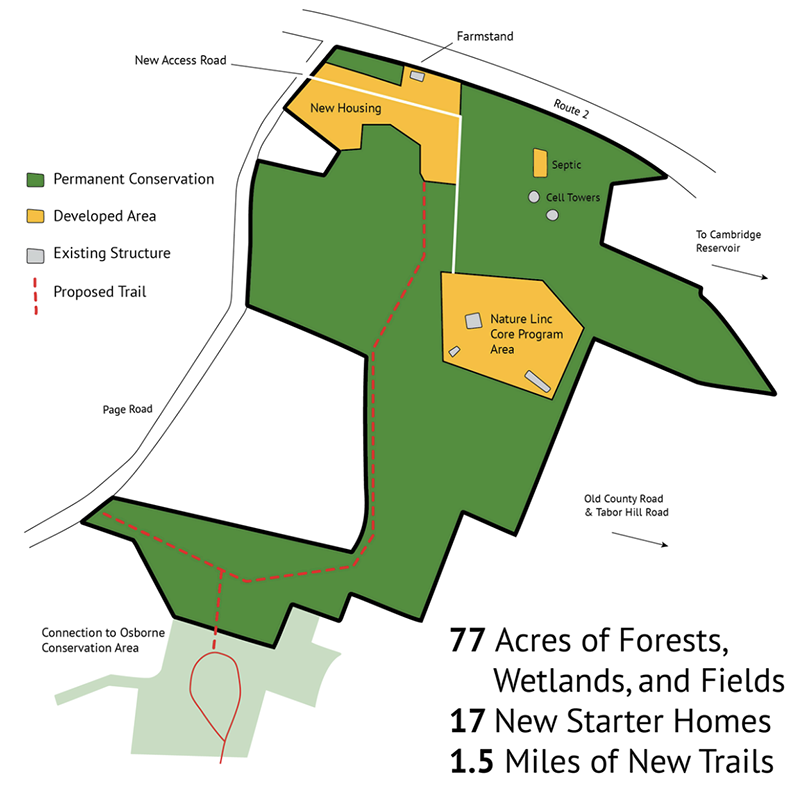
The first of two Nature Link articles, which also required a two-thirds majority, passed easily, 80% to 20% (644-165). That measure put the Panetta/Farrington land abutting Route 2, part the North Lincoln Overlay District, into a new Planned Development District to allow a cluster of 20 new homes to be built, pending Planning Board site plan review.
The second Nature Link article, which asked voters to approve a transfer of funds from Community Preservation Fund to the general fund balance so the town could help gain a permanent conservation restriction on 77 acres of the Farrington land, passed 608-124 (83% to 17%). The original plan was to ask for $950,000, but it was changed to $850,000 because private fundraising exceeded expectations.
The conservation restriction, which will prevent future development on the land (including by a religious or educational organization), is costing a total of $3.1 million. Of that, the City of Cambridge is paying $800,000 due to the property’s proximity to the Cambridge Reservoir, and fundraising that included 100 private pledges plus $500,000 from the Rural Land Foundation/Lincoln Land Conservation Trust.
In a separate deal, Civivo, which built Oriole Landing, is buying three lots from the Panetta family for $3.3 million. The company plans to build 17 starter homes (three of which will be income-restricted) and three larger homes. That housing and Farrington Nature Linc will share a new access road from Page Road (Farrington currently is accessible only from Route 2 eastbound).
At the meeting, most speakers were in favor of the deal, but some advocated for splitting up the housing and land conservation aspects. David Cuetos also argued that the RLF had an unfair advantage and implied that the proposal was brought to voters too quickly and without sufficient input from some Page Road residents who said they were not notified by the town about the proposal.
“It’s opaque, it’s undemocratic,” Cuetos said. “We should not reward secrecy and favoritism.”
Klaus Dobler, a Page Road abutter, said the deal meant that taxpayers were “indirectly supporting developer profits” by allowing the new neighborhood’s septic system to be on the Farrington land. He also objected to the argument that without the conservation restriction, the Farrington land was at risk of being sold and developed. “To me, that’s a pressure tactic and a red flag,” he said. As for the time pressure to have the vote, “It’s Email 101 — if someone is telling you right away to act quickly, watch out.”
Dobler also touted a proposal from Jeff and Arline Sutherland to purchase and “rewild” the Farrington property, which would achieve the same conservation and educational goals. But Page Road resident Joey Kolchinsky pushed back. “This alternate plan is a false promise. It comes with no guarantees and none of the key players are on board,” he said. There would also be no guarantee that the Panetta land would be safe from future development, he added.
FinCom appointments
Article 5 asked residents to have Finance Committee members appointed by the Select Board rather than the Town Moderator as they are now. The request was motivated by “recent concerns about town finances as well as the alleged loss of payments to the town for Hanscom School teacher pensions from the Department of Defense.
“These were catalysts, but we’re focusing on improving town governance going forward, not any specific financial issue,” said Bob Domnitz, who represented those who signed a citizens’ petition to bring the matter to Town Meeting.
The bigger issue, Domnitz said, is that the FinCom openings are not advertised and candidates are not interviewed in open forums. The committee is supposed to be a natural body with diverse viewpoints, “but that’s not what seems to be happening in Lincoln,” he said. The petitioners aren’t advocating for direct election of FinCom members, however; “FinCom is one of the most difficult jobs in town and asking someone to campaign for the job seems like cruel and unusual punishment.”
The Select Board voted not to recommend the change, saying the move “would have the appearance of giving us undue influence over the budget process” by naming the people who would deliberate over a town budget that the Selects themselves had submitted, board member Jim Hutchinson said. That said, “we agree that it is important to continue to review practices with an eye to transparency and improvement.”
In discussions with Holden, “we confirmed her willingness to broadly advertise, publicly interview, and consider input from the current Finance Committee about their needs and preferences, and we encourage future moderators to do the same,” he added.
Holden recused herself but spoke from the floor, agreeing that she welcomed the suggestions and “I look forward to including [them] in the Lincoln moderator handbook that I’m writing.”
“The FinCom sits between boards and the [voters] who make those decisions who are sitting in this room,” said former FinCom Chair Andy Payne. Two other residents urged defeat of the proposal, both saying, “If it ain’t broke, don’t fix it.” The final vote was 80 in favor and 345 against.
Article 2 was actually voted on first at the meeting because it was the least controversial and attendees were still filing into the gym and auditorium. Residents unanimously approved a transfer of $25,000 from free cash to the reserve fund in the budget for the current fiscal year that ends on June 30, 2025.
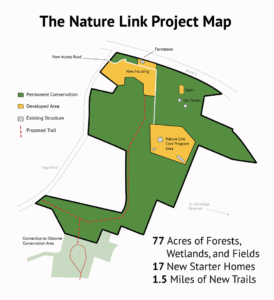 The Select Board voted on June 2 to formally endorse the Nature Link project on the Panetta/Farrington land with the following statement: