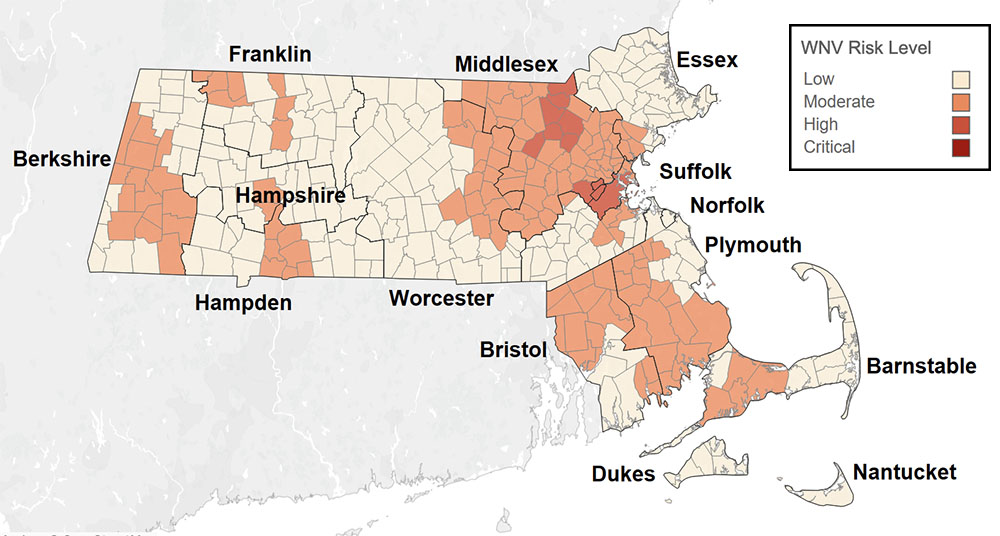
A map showing towns with low, moderate, and high risk of West Nile virus (click to enlarge). Source: Mass.gov.
The Massachusetts Department of Public Health announced that West Nile virus (WNV) has been detected in Culex pipiens/restuans mosquitoes collected in Lincoln on August 5, 2025. This raises the risk level in Lincoln to moderate.
Due to ongoing evidence of mosquito samples carrying the virus, the risk level for WNV is classified as high in Acton, Bedford, Billerica, Boston, Brookline, Carlisle, Chelmsford, Dracut, Lowell, and Newton.
“WNV findings in mosquitoes have accelerated rapidly over the last several weeks,” said State Epidemiologist Catherine M. Brown. “We are now in the peak time for transmission of mosquito-borne disease to people, and it is important for people to know that so they can take steps to protect themselves.”
The state Public Health Laboratory confirmed this year’s first WNV-positive mosquitoes in Massachusetts on June 17. Since then, there have been 168 WNV-positive mosquito samples detected from 12 counties including Middlesex. No human cases of WNV have been confirmed in Massachusetts so far this year.
Although serious illness caused by WNV is uncommon, there have been 142 cases of WNV in Massachusetts between 2015 and 2024. There were nineteen human cases of WNV in 2024, six human cases in 2023, and eight human cases of WNV in 2022. In addition, there have been seven mosquito samples that have tested positive for EEE (eastern equine encephalitis) this year, but no confirmed human or animal cases so far.
“Both West Nile virus and EEE pose risk to the people in Massachusetts,” Public Health Commissioner Robbie Goldstein said in an August 12 press release. “The weather remains warm and somewhat humid, which increases mosquito activity. I encourage everyone to take measures to protect themselves: use mosquito repellent when outdoors, wear long sleeves and pants, and be aware of peak mosquito hours.”
More information on both viruses as well as protection and control measures can be found on this Mass. Department of Health web page.
According to Lincoln public health nurse Tricia McGean, East Middlesex Mosquito Control collects mosquitoes by setting out mosquito traps. Once back at the lab, mosquitoes from each individual trap are sorted by species, and certain species are submitted to the Department of Public Health to be tested for both WNV and EEE. Each sample submitted consists of 5-50 mosquitoes, all of the same species. Each sample is tested as one unit, so if one “pool” of 25 mosquitoes is submitted and tests positive, that would count as one WNV+ sample.
The specific locations that yielded positive samples are not disclosed, she said.
Leave a Reply